 RELIGION
RELIGION
RELIGION
 One of Those
 Wonderfully AMBITIOUS!
 18th-Century “Sketches”
 Kames,
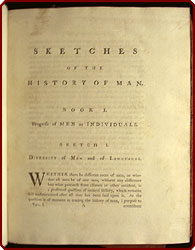
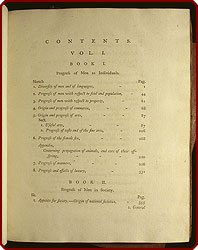
Henry Home, Lord. Sketches
of the history of man. Edinburgh: W. Creech, W. Strahan, & T. Cadell,
1774. 4to (27.5 cm, 10.9"). 2 vols. I: xii, 519, [1 (blank)] pp. II: [4], 507,
[1 (blank)] pp.
Kames,
Henry Home, Lord. Sketches
of the history of man. Edinburgh: W. Creech, W. Strahan, & T. Cadell,
1774. 4to (27.5 cm, 10.9"). 2 vols. I: xii, 519, [1 (blank)] pp. II: [4], 507,
[1 (blank)] pp. 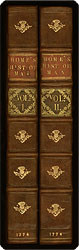
 Click the images for enlargements.
 Provenance: Front pastedown with bookplate “De la bibliotheque de F. Freudenreich.”
• ESTC T48434; Alston, III, 308; Goldsmiths’-Kress 11089; Sabin 32702. Contemporary speckled calf, neatly rebacked preserving original gilt-stamped leather title and volume labels, spines with gilt-stamped thistle decorations; edges and corners rubbed, sides showing small scrapes and discolorations. Residue on pastedowns from sometime removal of bookplates. Pages age-toned, with occasional small spots, and offsetting from binding to in margins of first and last few leaves. All edges speckled.
 For more SETS, click here.

 Special
Type for
Special
Type for the
Micmac
Kauder, Christian. Sapeoig oigatigen tan tetli
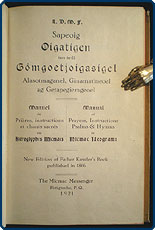
gômgoetjoigasigel...manual of prayers, instructions, psalms & hymns in Micmac ideograms.
Ristigouche, Quebec: The Micmac Messenger, 1921. 16mo (18 cm, 7.125"). 456 pp. (pp.i–xii never
bound in).
the
Micmac
Kauder, Christian. Sapeoig oigatigen tan tetli
gômgoetjoigasigel...manual of prayers, instructions, psalms & hymns in Micmac ideograms.
Ristigouche, Quebec: The Micmac Messenger, 1921. 16mo (18 cm, 7.125"). 456 pp. (pp.i–xii never
bound in).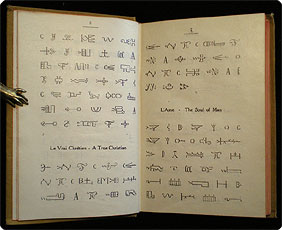
 Click the images for enlargements.
 The characters used to print this work were the invention of Father Christian
Leclercq, a 17th-century missionary, and later revised and improved by Abbé
Pierre Maillard. More than 5700 types were cut and cast for the book, and
the characters each represent words rather than sounds.  This may well be the sole work printed in these
characters.
This may well be the sole work printed in these
characters.
This issue without English language front matter (i.e., pp. i–xii).
• Pilling, Algonquian, p. 275 (ref). Publisher's yellow-brown cloth with simply gilt-lettered spine, to which one stain and general light soiling; each cover creased vertically from an old bump. All edges red. Internally clean. (25312)

Keach
on Tropes
of the Bible
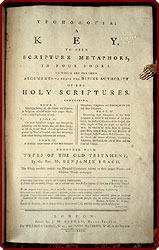
Keach, Benjamin. Tropologia: A key, to open Scripture metaphors, in four books ... together with Types of the Old Testament, by the Rev. Mr. Benjamin Keach. London: Pr. by J.W. Pasham for William Otridge, 1779. Folio (32.7 cm, 12.9"). [8], xxiv, 224, 225*–40*, 225–980, [12 (index)] pp.
Tropes
of the Bible
Keach, Benjamin. Tropologia: A key, to open Scripture metaphors, in four books ... together with Types of the Old Testament, by the Rev. Mr. Benjamin Keach. London: Pr. by J.W. Pasham for William Otridge, 1779. Folio (32.7 cm, 12.9"). [8], xxiv, 224, 225*–40*, 225–980, [12 (index)] pp.
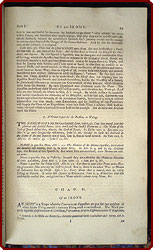
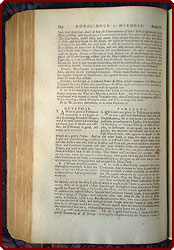 Click the interior images for enlargements.
 The Tropologia was first printed in 1681, and went through several editions; Lowndes and Allibone both identify this present one as the best of the old issues. Allibone notes how rare it had become by mid-19th-century, and also cites De Coetlogn, who called the work “A most valuable treasure of human composition: a book without which no Christian Minister's Library can be complete.”
• ESTC T194778; Lowndes 1254; Allibone 1008. Contemporary treed sheep, spine with gilt-stamped leather title-label and old paper shelving label; covers scuffed and abraded, minor cracks to spine leather, front joints starting from the weight of the substantial volume. Front free endpaper with early inked presentation inscription: “Presented to the N.Y. Bap. Ed. Socty. by Lewis Leonard, Poughkeepsie.” One leaf with closed tear to center, no loss of text. Pages gently age-toned, with occasional light foxing. (24895)
One
Year's Worth ofWell-Spent Half Hours
Knight, Charles. Half-hours with the best authors.
[London: Charles Knight, 1847–48]. 8vo (22.8 cm, 9"). 4 vols. in 2. I: Frontis., engr. t.-p., [2],
312 pp., frontis., engr. t.-p., [2], 312 pp. II: Frontis., engr. t.-p., [iii]–iv, 312 pp., frontis., engr. t.-p., [iii]–iv, 316 pp.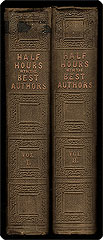
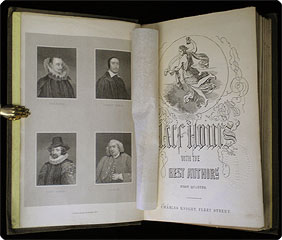 Click the images for enlargements.
52 weekly issues meant to be consumed in half-hour portions, with each weekly number containing seven half-hours. (Indices and quarterly title-pages are bound in here.)
Click the images for enlargements.
52 weekly issues meant to be consumed in half-hour portions, with each weekly number containing seven half-hours. (Indices and quarterly title-pages are bound in here.)
Knight, who was devoted to books and to literature from the time he was a small child, was a much-admired printer and publisher, as well as an author, reformer, and would-be educator: Many of his publishing endeavors were aimed at improving and enlightening the working class.
• NSTC 2K7731. On Knight, see: Oxford Dictionary of National Biography online. On binding cloth, see: Krupp, Bookcloth, style Wav3. Publisher's textured brown cloth, covers blind-stamped with muse motif and title, spines with gilt-stamped title and blind-stamped decorations; lightly worn overall with some fading, vol. II spine head with traces of a strip of cloth tape. Ex–social club library: 19th-century bookplate, call number on endpaper, pressure-stamp on title-page, no other markings. Paper slightly embrittled (more so in second volume), with a few short edge tears. Externally ordinary; internally worthwhile. (26860)

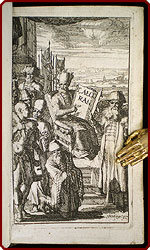
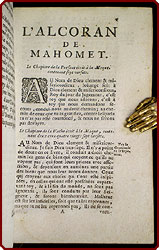
First French Koran — Pirated Edition Koran. L'Alcoran de Mahomet. Traduit d'Arabe en François, par le Sieur du Ryer, Sieur de la Garde Malezair. A la Haye: Adrian Moetjens, 1683. 12mo (13.7 cm, 5.4"). Frontis., [10], 486, [4] pp.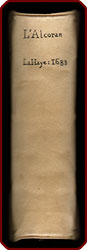
 Click the images for enlargements.
 This edition opens with a copper-engraved added title-page signed by J. Padebrugge; the main title-page bears the Elzevir sphere mark. Willems notes that it is “une copie exacte et ligne pour ligne de celle [the Elzevir edition] de 1672, dont en effect Moetjens s'était rendu adjudicataire, mais c'est positivement une réimpression.” It is, in effect, a line-for-line piracy, and a handsome one faithful to its original's good qualities.
Uncommon: OCLC and NUC Pre-1956 locate only eight U.S. holdings.
Provenance: Front pastedown with bookplate of collector Robert J. Hayhurst.
• Brunet, III, 1309; Willems 1472. Contemporary vellum, spine with early inked title; vellum remarkably clean. Original blue silk place marker present and intact. Front free endpaper with upper outer corner excised, mostly removing an early inked ownership inscription; title-page with early inked inscriptions lined through; back free endpaper with recent pencilled purchase record. One leaf with short tear from outer margin, just touching text without loss. Pages clean. A nice book. (25561)
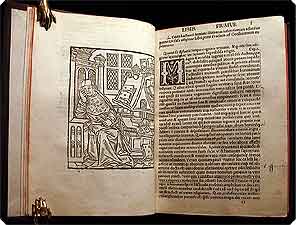
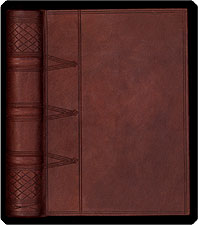
 His Works & More — A Cut of aScholar ReadingLactantius. Lepida Lactantii Firmiani opera accurate graeco adiuncto castigata: Eiusde[m] Nephytomon: Carmina de Phoenice. & Christi resurrectione. Io. Chry. De eucharistia sermo. Lau. Vall. sermo. Phil. ad Theo. adhortatio. [colophon: Parisiis: Pro Ioha{n}ne Petit fidelissimo bibliopola in Bellouisu, Impressi anno Domini. M.cccccix {1509}]. 4to (19.5 cm; 7.5"). A6 B4 a–z8,4 2A4 2B8 C–N4,8 O6 P4; [10], ccxxxv, [1] ff.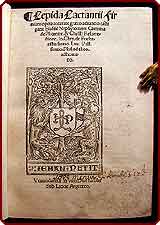
 Click
either interior image for enlargement.
Click
either interior image for enlargement.
The volume is printed in a clear roman face with numerous ornamental woodcut initials and with side- and shoulder-notes. The Jean Petit publisher’s device is on the title-page and that of Guy Marchand on the verso of the last. Additionally, there is a full-page woodcut of a scholar in his study opposite the first numbered leaf. A 16th-century reader has added a significant amount of marginal commentary on the text.
• Moreau 1509:127; Panzer, VIII, 537, no. 324; Adams L13. Not in Schweiger. Recent calf old style, tooled in blind on spine and covers. Faint traces of water and resultant mild arrested mildew in lower outer corners of earliest few pages. Marginalia in some parts affected by a binder’s trimming; in other cases, not. All edges carmine.  A very good copy.

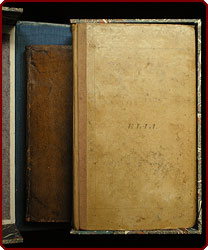
The ESSAYS that Made Lamb's Reputation — 1st U.S. Edition Lamb, Charles. Elia. Essays which have appeared under that signature in the London Magazine. Philadelphia: Carey, Lea, & Carey (pr. by Mifflin & Parry, and J.R.A. Skerrett), 1828. 12mo (I: 18.4 cm, 7.25", II: 16.8cm, 6.6"). 2 vols. I: 292 pp. II: 230 pp. (both vols. without ads.).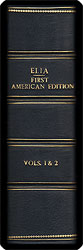
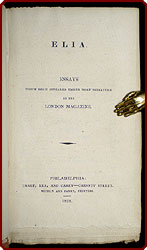
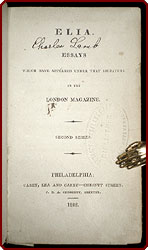 Click the images for enlargements. true
first edition of the unofficial second series, of Lamb's pseudonymously
published essays for the London Magazine. These eloquently written pieces
mingle humor and pathos as they describe the experiences of the author and his
acquaintances while attending boarding school, playing whist, listening to music,
visiting Quaker meetings, etc. Food is a recurring topic (“A Dissertation
upon Roast Pig”); there are two essays on Valentine's Day (one in each
volume), and several on plays and actors.
Click the images for enlargements. true
first edition of the unofficial second series, of Lamb's pseudonymously
published essays for the London Magazine. These eloquently written pieces
mingle humor and pathos as they describe the experiences of the author and his
acquaintances while attending boarding school, playing whist, listening to music,
visiting Quaker meetings, etc. Food is a recurring topic (“A Dissertation
upon Roast Pig”); there are two essays on Valentine's Day (one in each
volume), and several on plays and actors.
The first series made its first appearance in book form in London, 1823. The authorized second series was not published until 1833, under the title The Last Essays of Elia; the pieces selected for the unauthorized American second series offered here are different from those contained in that volume, and mistakenly include three essays written by other hands.
• Shoemaker 33813 & 33814; NCBEL, III, 1225; NSTC 2L2346. Vol. I: Uncut copy. Publisher's quarter once-red cloth and paper sides, covers printed with “Elia” within a simple frame, spine with printed paper label; binding rubbed and lightly soiled, spine sunned to yellow. Repaired tear to one leaf, touching text without loss; remarkably clean and sound. Vol. II: Contemporary speckled sheep, spine with gilt-stamped leather title-label; rubbed, and head of spine chipped with old refurbishing. Ex–social club library: 19th-century bookplate and call number ticket on front pastedown, front free endpaper with inked numerals, title-page pressure-stamped. Author's name inked on title-page; front free endpaper and title-page reinforced at fore-edge (the latter from the back). Both volumes age-toned, with intermittent spots of staining; advertisements absent. The set now housed in a quarter blue morocco and blue cloth–covered clamshell case with marbled paper–covered sides and gilt-stamped spine. (26434)
Cutting-Edge Biblical Scholarship — Three Maps Lamy, Bernard. Commentarius in harmoniam sive concordiam quatuor evangelistarum.... Parisiis: Excudebat Joannis Anisson, 1699. 4to (12.6 cm, 10.25"). 2 vols. in 1. I: 2 a[n]4 e[n]4 A–Z4 Aa–Zz4 AAa–ZZz4 AAaa – OOoo4; [2] ff., xvi, 661, [1] pp., [25] ff.; 3 plts. II: 2 a–h4 A–Z4 Aa–Xx4 Yy2; [2] ff., lxiv, 326 pp., [15] ff.; 3 plts.
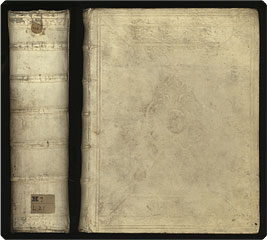
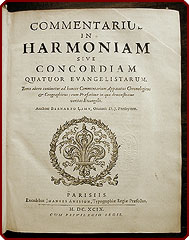
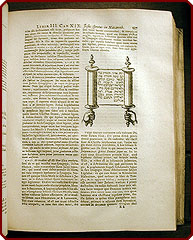 Click the interior images for enlargements.
 Provenance: Charles Spencer, Third Earl of Sunderland, lot 7230 in the Sunderland Library sale (1882).
• On Lamy, see: New Catholic Encyclopedia, VIII, 354–55. 18th-century vellum over boards with raised bands, lightly soiled; on the covers an ornate mandorla inside a composite frame. Crack in the vellum along front joint, joint itself sound. Ex-library with paper labels on spine; old pressure-stamps, including one on title-page of vol. I. Upper outer corner of title-leaf lost taking part of one letter of title; small tear into printed border of first map in vol. II. All edges speckled blue and red. A stout, substantial volume.
He
Had a Dream
Langland,
William. The vision and creed of Piers Ploughman. London:
Reeves & Turner, 1883. 12mo. 2 vols. I: Frontis., xl, [2], 272 pp. II: [4],
[273]–621 pp.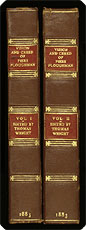
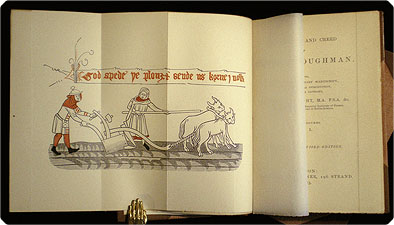 Click the interior images for enlargements.
 • Later 19th-century half toffee-brown calf over salmon cloth boards; gilt-lettered red leather spine-labels (title, volume, editor); gilt-accented raised bands, date in gilt at base. Slight rubbing to joints and extremities, one label with a streak of discoloration, vol. II with small chip at head of spine and lower corners rubbed. Pages toned. One leaf with edge nicks. Lower outer portion of pp. 211/212 chipped, with loss of outermost letters of bottom four lines and detached piece laid in; aforesaid pages also creased down the middle, brittle, and all but separated in two (still, present). Top edge gilt, others deckle. A pleasing and attractive binding; a volume internally clean. (21256)
For more SETS, click here.

An
EASTER Sermon
Larrain Gandarillas, Joaquín. Sermon que predicó el presbítero...el viérnes 18 de abril de 1851, en presencia del... arzobispo de Santiago, del cabildo y clero de la iglesia metropolitana. Santiago, [Chile]: Imp. de la Sociedad, 1851. 12mo. 17, [1 (blank)] pp. 
• Not in Palau. Modern light wrappers, lacking original wrappers. Very good condition.

Quaker
Meditations —
A Neat CompendiumTwo
Women in the Contents —
Womanly Provenance, Too
[Law, William].
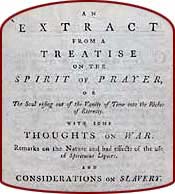
An extract from a treatise on the spirit of prayer, or the soul rising out of
the vanity of time into the riches of eternity. With some thoughts on war. Remarks
on the nature and bad effects of the use of spirituous liquors. And considerations
on slavery. Philadelphia: Joseph Crukshank, 1780. 12mo (16.3 cm, 6.45"). 84
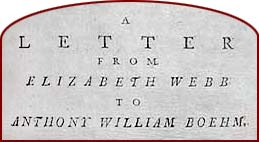
pp. [bound with] Webb,
Elizabeth. A letter...to Anthony William Boehm, with his answer.
Philadelphia: Joseph Crukshank, 1783. 44 pp. [with]
[Benezet, Anthony]. In the life
of the lady Elizabeth Hastings... [Philadelphia: Joseph Crukshank, 1784]. 8
pp. 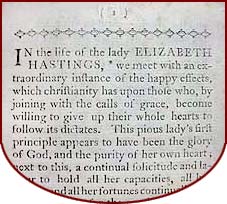
 Elizabeth Webb, "an acknowledged minister among the people called Quakers," first encountered Prince George of Denmark's chaplain Boehm while on a visit to Great Britain; the missive with which she opened her subsequent correspondence with him, here, greatly inspired him and a number of his friends.
Provenance: With inscription reading "Miss Hannah Amelia Moore / Book a Present from her worthy / Friend Ruth Patton / 1789."
• Law: ESTC W32233; Evans 16817; Hildeburn 3987. Webb: ESTC W13440; Evans 18295; Hildeburn 4409. Benezet: ESTC W6416; Evans 18355. Contemporary quarter sheep over paper-covered sides, the whole worn and abraded but the little volume quite sound. Light age-toning, occasional darker spots. Small chip in bottom margin of title-page; one leaf with paper flaw in lower corner, resulting in the loss of a very few letters.

The
Spirit of Prayer
Law, William. An extract from a treatise...called, the spirit of prayer; or, the soul rising out of the vanity of time, into the riches of eternity. With some thoughts on the nature of war, and its repugnancy to the Christian life, &c. &c. Philadelphia: Henry Miller, 1766. 8vo [signed in 4s] (17.3 cm, 6.8"). 48 pp.

The present copy does not include the thirty pages, mentioned in the subtitle, on the nature of war; the Extract and Some Thoughts were issued as the first and second titles in a collection of religious tracts printed by Henry Miller, and also issued separately (Evans 10352 and 10505). Sabin calls for 48 pages, as found in this copy.
• Evans 10352; Sabin 39325. On Law, see: Dictionary of National Biography, XXXII, 236–40. Later neat plain cloth binding, spine with gilt-stamped morocco title label; clean. Half-title lacking. Some foxing, mostly marginal. Pencilled notes to top of title-page and final page; early inked ownership inscription to title-page verso, including Philadelphia street address.
Leaves from a Large 18th-Century CHOIRBOOK Leaves from a Graduale romanum. Venice:
Balleoniana, 1729. Folio extra (19.25" x 13.625"). 1 f. 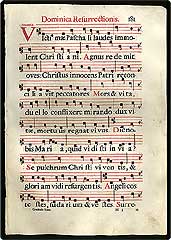
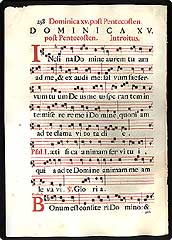 Click either image for an enlargement.
 This particular choirbook was printed with 10 lines of text and music per page. Each leaf contains music and words, and is printed in black and red; text is in black, with an occasional small letter in red, and the music is provided for all the antiphons in black square notation on a four-line red staff. Antiphons begin with a tall decorative initial printed in red, as high as the text and music together. The initials vary from leaf to leaf.
• Crisp, wide margined leaf with slightest bleed-through from one side to another. Printed on handmade paper of 100% rag. A marvelous display, accent, or gift item.
Notebook of theFirst Lawyer in Boston — The 19th-Century Reissue Lechford, Thomas. Plain dealing or news from New England. Boston: J.K. Wiggin and Wm. Parsons Lunt, 1867. 4to (cm). xl, 160, [2], 203–11, [1 (blank)] pp. (text complete despite pagination).
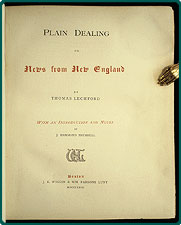
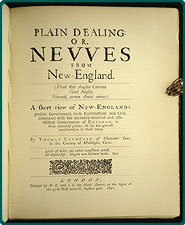
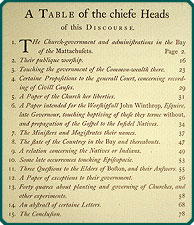 Click the interior images for enlargements.
 285 copies were printed; this is no. 180. The publication was dedicated to collector (“and careful reader”) George Brinley, Esq.
• Sabin 39642. Recent black moiré cloth, spine with gilt-stamped leather title-label. Several pages (including title-page) with faint shadows of institutional rubber-stamps, mostly effaced. Many signatures unopened; two index leaves with tears in upper margins from clumsy opening. Pagination shifts between text and index. (23906)
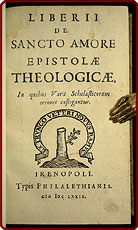
False Imprint — Radical Theology Leclerc, Jean. Liberii de Sancto Amore Epistolae theologicae,in quibus varii scholasticorum errores castigantur. Irenopoli [i.e., really, Saumur]: typis Philalethianis, 1679. 12mo (16 cm; 6.375"). [10] f.,, 320 p.
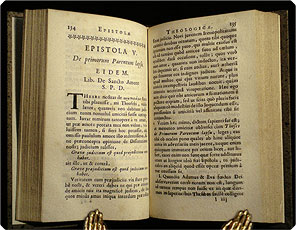 Click the interior images for enlargements.
 The woodcut “printer's device” on the title-page is telling: “Ex trunco veteri novus ramus,” which pretty much epitomizes Leclerc's writings.
Uncommon. We locate fewer than 10 copies in the U.S.
• Weller, I, p.278. Recent quarter leather with gilt spine; sides with German-style brown paper speckled with black. Shadow of old pencilled shelf number and another four-digit number on verso of title-page. A very good copy. (24769)
Bohemian
HistoryLe Mire, Aubert Miraeus. De bello Bohemico Ferdinandi II. caesaris auspiciis feliciter gesto commentarius ex quo seditiosissimum Caluinianae sectae genium, & praesentem Europae statum licet agnoscere .... Bruxellis: Ioannem Pepermannum, [colophon: 1621]. 4to (18.5 cm, 7.25"). (∴)6A–G4; [12], 44, [12] pp.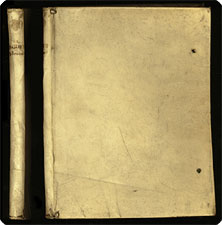
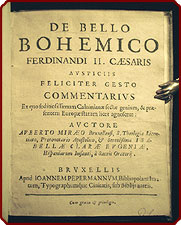
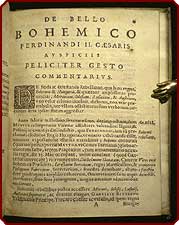 Click the interior images for enlargements.
 The printing privilege and the colophon of this edition both give the date 1621; a revised edition was printed in Cologne in 1622.
Very uncommon. Searches of OCLC, RLIN, and NUC Pre-1956 find no U.S. institutional holdings, and only one overseas location.
• Not in Brunet; not in STCV. Contemporary vellum, spine with hand-inked title; ties now lacking, back cover showing minor abrasions. Title-page with early inked inscription mostly shaved away from lower margin. Pages of different signatures variously browned or age-toned; clean.
Arguing Baptism with the QUAKERS Leslie, Charles. A discourse; shewing, who they are that are now qualify'd to administer baptism and the Lord's-Supper. Wherein the cause of Episcopacy is briefly treated. London: C. Brome, W. Keblewhite, & H. Hindmarsh, 1698. 4to (22 cm, 8.7"). [8], 62, [2 (adv.)] pp.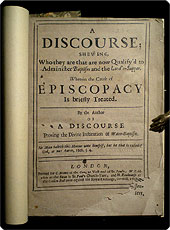
Click the image for an enlargement. • ESTC R25145; Wing (rev. ed.) L1130; McAlpin, IV, 589. Recent marbled paper wrappers. Title-page darkened and institutionally pressure-stamped, with lower outer portion torn away, just touching final number in date with no loss of sense. First few pages with edge nicks. Final (adv.) leaf with short internal tear with loss of a few letters, not affecting sense. (25009)

“A Short & Easy Method with theDeists”
Leslie, Charles. A short and easy method with the deists:
wherein the certainty of the Christian religion is demonstrated, by infallible proof from four rules, which are incompatible to any imposture that ever yet has been, or that can possibly be. In a letter to a friend. Windsor, VT: Pr. by T.M. Pomroy, 1812. 12mo. 168 pp.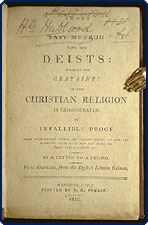
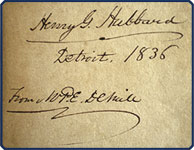 Click the title page image for an enlargement.
 Provenance: Property, in 1836, of Henry G. Hubbard of Detroit.
• Shaw & Shoemaker 25848. Contemporary sheep. Spine with compartments divided by gilt rules. Leather much rubbed with a little chipping. Browning from turn-ins onto endpapers and title-page. Top margins closely trimmed with loss of page numbers in some places. Inked ownership inscriptions on recto of front free endpaper and title-page. (5442)
Roman Law, Emperor
Theodosius, Desecration of Temples, & More Libanius, Antiochenus. Libanii antiocheni Pro templis gentilium non exscindendis, ad Theodosium m. imp. Oratio: ante M. CCC. fermè annos conscripta: nunc primùm edita à Iacobo Gothofredo ic. notisq[ue] illustrata. [with another, as below]. Genevae: [Petri Chouët?], 1634. 4to (22.5 cm; 8.75"). [12], 63, [9] p. [also bound in] Godefroy, Jacques. De cenotaphio: deq[ue]z, diversis, super eius religione, Ulpiani & Marciani sententiis, diatriba. Genevae: [s.n.], 1634. 4to. 15, [1] pp.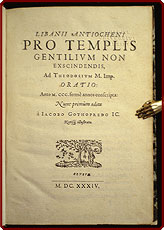
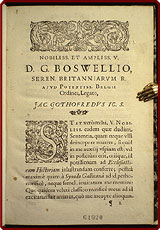
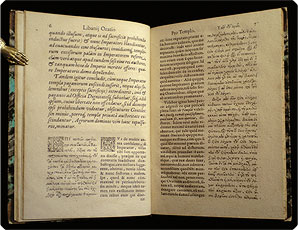
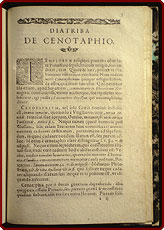
The present work is his famous “lamentation” on the desecration of pagan temples. Addressed to the Emperor Theodosius, the oration concerns the legality of the Emperor's order for the desecration; the text is in Greek and Latin in parallel columns.  The Greek font is notably light and elegant.
At the rear of this volume is Godefroy's opuscule on funeral rites and ceremonies. Several libraries report both works being bound together, as here, but not all.
• 19th-century quarter brown leather, spine sunned much lighter. Library-bound with call number inked on cover, bookplates on front pastedown, rubber-stamps on pastedowns. Title-page with old pressure-stamp; text itself without other markings save a six-digit number neatly stamped at base of next leaf. Actually, a clean, good copy. (22733)
Historical Context of theNew Testament Lightfoot, John. A commentary upon the Acts of the Apostles: Chronicall and criticall. The difficulties of the text explained, and the times of the story cast into annals. London: Pr. by R.C. for Andrew Crooke, 1645. 4to (18.2 cm, 7.2"). [20], 331, [1] pp. (pp. 145–48 bound out of sequence).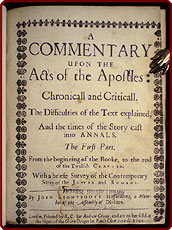
 Click the interior image for an enlargement.
 Lightfoot (1602–75) was a noted Hebraist and Biblical scholar; Lowndes says of his works that “the writings of Dr. Lightfoot are an invaluable treasure to the biblical student.”
• ESTC R21614; Wing (2nd ed.) L2052; Lowndes 1359. Recent marbled paper–covered boards, spine with gilt-stamped title and publication labels. Title-page institutionally rubber-stamped. Pp. 145–48 (the end of the “Christian History...XXXIIII” section) bound in between pp. 152 and 153, with annotations in an early inked hand noting the error. Pages trimmed closely, taking part of title-page border and in a few instances affecting the catchwords or final lines of text. Waterstaining, mostly to lower outer portions. (24853)
This Author Covers a Lot HereLindanus, Guilelmus Damasus. In hoc libello contenta: Tabulae grassantium passim haeresen anasceuasticae ... Quibus Subtexitur sectae Lutheranae trimembris epitome. Antuerpiae: Apud Joannem Withagium, 1562. Small 8vo. [46], 26 ff.
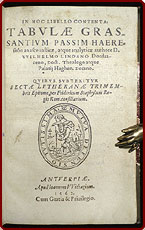
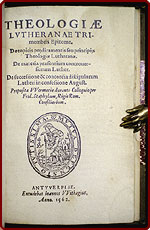
Rare in the U.S., withWorldCat locating only one copy in America (this at Notre Dame).
• Adams 728. 19th-century half-calf with marbled paper sides; leather (only) cracked at hinges, with volume holding quite sound. Library bookplate but no other markings. (19937)
A
Young Philadelphian’s
Christian EpicCharles
Brockden BrownLinn,
John Blair. Valerian, a narrative poem: Intended, in part, to describe
the early persecutions of Christians, and rapidly to illustrate the influence
of Christianity on the manners of nations...with a sketch of the life and character
of the author. Philadelphia: Thomas & George Palmer, 1805. 4to (24.5 cm, 9.6").
xxvi, [2], 97, [1 (blank)] pp.
Philadelphian’s
Christian EpicCharles
Brockden BrownLinn,
John Blair. Valerian, a narrative poem: Intended, in part, to describe
the early persecutions of Christians, and rapidly to illustrate the influence
of Christianity on the manners of nations...with a sketch of the life and character
of the author. Philadelphia: Thomas & George Palmer, 1805. 4to (24.5 cm, 9.6").
xxvi, [2], 97, [1 (blank)] pp.
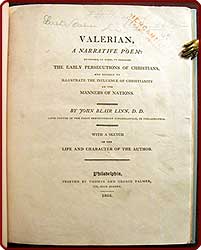
• Shaw & Shoemaker 8790; Wegelin 1038; BAL 1509 (for Brown’s “Sketch”). On Linn, see: Dictionary of American Biography, XI, 281–82. Period-style quarter tan cloth and light blue paper-covered sides, spine with printed paper label. Lacking portrait of author. Title-page and a few others stamped by a now-defunct institution; title-page also with pencilled inscription dated 1830. Pages age-toned and slightly cockled; some staining, with some spots accounted for by laid-in floral matter; occasional stray pencil marks and short edge tears or chips, with repairs to margins and longer tears of first few leaves.
(LISTS). . . .
|
We've
created a new series of book lists for you! Most of the
usually budget-priced books in these simple, unillustrated, EXTENSIVE
catalogues are not offered via any of the databases (e.g., ABE, Biblio,
ILAB); they are mostly not described here at our independent website
either. It's
“find 'em in these lists or come find 'em on our shelves”!
|
 |
Click: The LIST of LISTS
Separation of Church & State — RELIGIOUS LIBERTYFirst Collected Edition Locke, John. Letters concerning toleration. London: A. Millar, H. Woodfall, I. Whiston & B. White, I. Rivington, et al., 1765. 4to (29.5 cm, 11.6"). Frontis., [8], 399, [1 (blank)] pp.
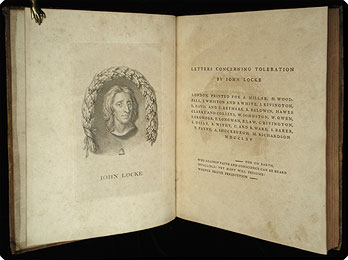 Click the images for enlargements.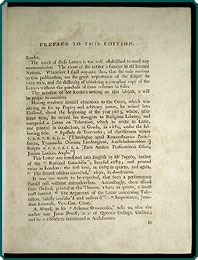
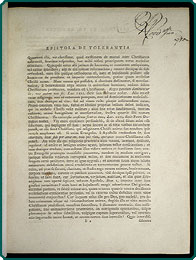
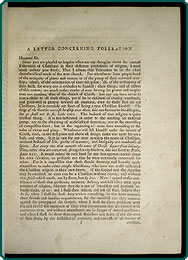 This is a lovely, “gentleman's library” edition, well printed with generous margins.
Provenance: Two text pages and back pastedown with flourished ownership inscriptions of Richard Wood, Jr., dated 1780.
• ESTC T114245; Graesse, IV, 243; Lowndes 1380; Allibone 1113–14. Contemporary speckled calf, spine with gilt-ruled raised bands and gilt-stamped leather title-label; binding lightly rubbed/scuffed overall, joints starting from top and front hinge (inside) starting; spine with a chip and a small paper label. Front pastedown with three bookplates most tantalizingly layered over one another, the most recent being from a 19th-century social club library; front free endpaper with pencilled and inked numerals in an early hand. Pages age-toned and faintly to moderately spotted; minor offsetting from frontispiece to title-page. (26302)
United
Brethren inNorth
AmericaFirst
EditionLoskiel,
Georg Henrich. Geschichte der Mission der evangelischen Brüder unter
den Indianern in Nordamerika. Barby: Zu finden in den Brüdergemein, &
Leipzig: Paul Gotthelf Kummer, 1789. 8vo (19.3 cm, 7.6"). [8] ff., 783, [1] pp.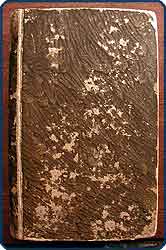
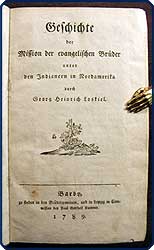
This first edition does not include the map found in the later English translation; the six lines of errata (rather than a full page) at the back mark the present copy as an example of the first issue.
• Howes, U.S.iana, L474; Pilling, Algonquian, 317; Sabin 42109; Vail 795. Early 19th-century German paper-covered boards, much worn and abraded, slightly cocked, spine with remnants of paper shelving label. Some corners dog-eared; scattered small spots of foxing, otherwise internally clean.
Polygamy
isENJOINED
upon Christians?
Lyserus, Johann Peter Theodore. Polygamia triumphatrix, id est discursus politicus de polygamia. Londini Scanorum: Sumtibus authoris, 1682. 4to (21 cm, 8.25"). [10], 565, [33] pp.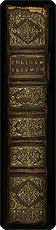
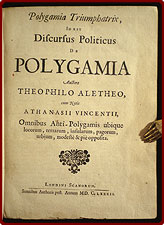
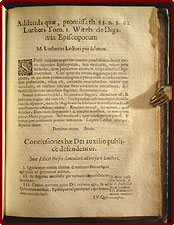
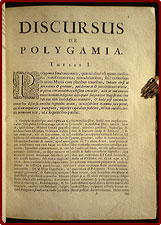 Click the images for enlargements.
 According to the online cataloguing of this book at Brigham Young University, “Early editions [were] burnt by [the] hangman in Denmark (1676); in Sweden (1679) . . . the possession of a copy meant a 1000 ducat fine. This edition was added to the Index of forbidden books in 1687.” It is often held today in medical libraries.
• Graesse, I, 68. 17th-century speckled calf, spine gilt extra with gilt-stamped leather title-label; leather chipped at top of spine with front joint open (though holding), abraded/pitted, and rubbed through to paste boards at corners. Front pastedown with Parisian bookseller's ticket; front free endpaper with pencilled annotation; back pastedown with rubber-stamped date in 1908. Slip of old printed cataloguing laid in. (23549)
 TO
Part IX TO
Part IX |