 SEVERAL
SUMPTUOUS
SEVERAL
SUMPTUOUS SERVICE
BOOKS
SEVERAL
SUMPTUOUSSERVICE
BOOKS
SERVICE
BOOKS
SEVERAL
SUMPTUOUSSERVICE
BOOKS
 Charming
Old Missal from
Charming
Old Missal from PLASY
— Cistercian
Propers
PLASY
— Cistercian
Propers Catholic
Church. Liturgy & ritual. Missal.
Missale romanum ex decreto Sacro-Sancti Concilii Tridentini Restitutum. Pii V.
Pont. Max. jussu editum, Clementis VIII. primum, nunc denuo Urbani Papæ
Octavi auctoritate recognitvm. In quo missæ propriæ de sanctis recentioribus
suo quæque loco & ordine ad longum sunt positæ ad majorem celebrantium
commoditatem. Tulli Leucorum: Sumptibus Joannis Eliae Höffling, 1672. Folio
(34 cm, 13.5"). A–D6 E8 2A–2E6
F–Z6 Aa–Zz6 Aaa–Ddd6 Eee4
a–i6 k4 3A2; [32] ff., 608,
cxii, 4 pp. [bound with] Catholic Church.
Liturgy & ritual. Proper masses. [Cistercian].
Proprivm missarvm de sanctis ad usum Sacri Ordinis Cisterciensis.... Tulli Leucorum:
Sumptibus Joannis Eliae Höffling, 1672. Folio (34 cm, 13.5"). A–B4
C2; 20 pp.
Catholic
Church. Liturgy & ritual. Missal.
Missale romanum ex decreto Sacro-Sancti Concilii Tridentini Restitutum. Pii V.
Pont. Max. jussu editum, Clementis VIII. primum, nunc denuo Urbani Papæ
Octavi auctoritate recognitvm. In quo missæ propriæ de sanctis recentioribus
suo quæque loco & ordine ad longum sunt positæ ad majorem celebrantium
commoditatem. Tulli Leucorum: Sumptibus Joannis Eliae Höffling, 1672. Folio
(34 cm, 13.5"). A–D6 E8 2A–2E6
F–Z6 Aa–Zz6 Aaa–Ddd6 Eee4
a–i6 k4 3A2; [32] ff., 608,
cxii, 4 pp. [bound with] Catholic Church.
Liturgy & ritual. Proper masses. [Cistercian].
Proprivm missarvm de sanctis ad usum Sacri Ordinis Cisterciensis.... Tulli Leucorum:
Sumptibus Joannis Eliae Höffling, 1672. Folio (34 cm, 13.5"). A–B4
C2; 20 pp. 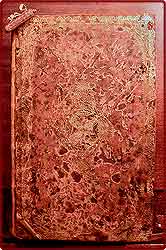
 The
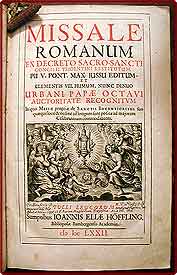
title-page has an engraving of angels before a monstrance, two with censers.
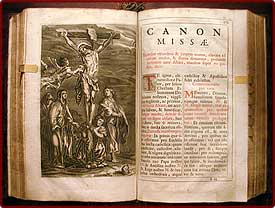
The masses begin with a small charming woodcut initial, and the major feasts
and the Canon are each preceded by a full-page engraving, some of which are
signed by Iottain: these are the Annunciation (First Sunday of Advent), Nativity
of our Lord, Adoration of the Magi (Epiphany), Crucifixion (Canon), Risen
Christ (Easter Day), Ascension, Pentecost, Last Supper (Corpus Christi), Assumption,
and All Saints. There are more than 50
pp. of music, including the Exsultet and the prefaces, printed
with black square notes on a red four line staff, as usual.
The
title-page has an engraving of angels before a monstrance, two with censers.
The masses begin with a small charming woodcut initial, and the major feasts
and the Canon are each preceded by a full-page engraving, some of which are
signed by Iottain: these are the Annunciation (First Sunday of Advent), Nativity
of our Lord, Adoration of the Magi (Epiphany), Crucifixion (Canon), Risen
Christ (Easter Day), Ascension, Pentecost, Last Supper (Corpus Christi), Assumption,
and All Saints. There are more than 50
pp. of music, including the Exsultet and the prefaces, printed
with black square notes on a red four line staff, as usual.
Provenance: On the title-page below the engraved vignette is the following inscription: “Pro Monasterio B.M.V. in Plass S.O.Cist comparavit R[everendissimus] D[ominus] Benedict Engelken loci abbas . . . Anno D[omin]i 1673.” Plass or Plasy is a Cistercian abbey (now redundant) in western Bohemia, founded ca. 1144. On the verso of second front flyleaf is inscribed in ink “Sacristiæ S. Thomæ a 1 Julii 1804.”
• Mottled calf with remnants of sumptuous gilt; rebacked, leather with holes for hardware not present; stained and peeling in places. Leaves in good condition for a missal; some paper repairs in margins with loss of rules, a few small holes in bottom margins, expected soiling on most used pages and some in margins elsewhere, no obscured or lost text. Marbled endpapers. Vellum tabs for leaves of canon. Six silk placemarkers attached to a red and green silk headband (not part of binding). All edges gauffered and gilt.


 HOW
to Bless anAbbot
. . . Catholic
Church. Liturgy & ritual. Pontifical.
Pontificale romanvm Clementis VIII Pont. Max. ivssv restitvtvm, atque editum.
Parisiis: Apud Rolinum Thierry & Eustachium Foucault, 1615. Folio (31.2 cm,
12.25"). a[m]4 A–Z4 Aa–Zz4 Aaa–Ddd4;
[4] ff., 400 pp.
HOW
to Bless anAbbot
. . . Catholic
Church. Liturgy & ritual. Pontifical.
Pontificale romanvm Clementis VIII Pont. Max. ivssv restitvtvm, atque editum.
Parisiis: Apud Rolinum Thierry & Eustachium Foucault, 1615. Folio (31.2 cm,
12.25"). a[m]4 A–Z4 Aa–Zz4 Aaa–Ddd4;
[4] ff., 400 pp. 
 •
Pontificale (Eng. “Pontifical”) comes from the Latin word
Pontifex, “high priest” or “bishop,” and refers
to the book containing those services appropriately conducted by a bishop. The
Pontifical contains some of the most historically interesting rites of the Church
and, according to the Roman Rite, is divided into three parts. The first, de
personis, contains Confirmation, Ordination, Consecration of bishops and
virgins (nuns) blessing of abbots and abbesses, anointing of kings and queens.
The second, de rebus, prescribes the rites for blessing and consecrating
churches, altars, and objects, such as chalices and bells. The third part includes
rites for special functions, such as consecration of oils, reception of a bishop
into his diocese, councils, synods, and diocesan visitations. (NCE)
•
Pontificale (Eng. “Pontifical”) comes from the Latin word
Pontifex, “high priest” or “bishop,” and refers
to the book containing those services appropriately conducted by a bishop. The
Pontifical contains some of the most historically interesting rites of the Church
and, according to the Roman Rite, is divided into three parts. The first, de
personis, contains Confirmation, Ordination, Consecration of bishops and
virgins (nuns) blessing of abbots and abbesses, anointing of kings and queens.
The second, de rebus, prescribes the rites for blessing and consecrating
churches, altars, and objects, such as chalices and bells. The third part includes
rites for special functions, such as consecration of oils, reception of a bishop
into his diocese, councils, synods, and diocesan visitations. (NCE)
The present version of the Pontifical was promulgated by Clement VIII (who also promulgated the Tridentine Missal), and was first published at Rome in 1596. It was based on the 1482 Roman pontifical, which was derived from the 1294 Pontifical of William Duranti the elder, bishop of Mende, France. Clement’s version remained unchanged until 1961, but editions are much less common than those of the Breviary and Missal; and of this (apparently) third edition of “Tridentine” Pontifical, we were able to trace
 only
three copies via OCLC, RLIN, and NUC Pre-1956. The
title-page has an engraved vignette showing SS. Peter and Paul on either side
of the arms of Pope Paul V (reigned 1605–21). The text is in red and
black with woodcut foliated, inhabited and grotesque initials, and there are
altogether more than
only
three copies via OCLC, RLIN, and NUC Pre-1956. The
title-page has an engraved vignette showing SS. Peter and Paul on either side
of the arms of Pope Paul V (reigned 1605–21). The text is in red and
black with woodcut foliated, inhabited and grotesque initials, and there are
altogether more than  110
pages of music employing black square notes on a red four-lin
staff, as usual.
110
pages of music employing black square notes on a red four-lin
staff, as usual.
• On the Pontifical, see: New Catholic Encyclopedia, XI,
549–50. Later speckled sheep, spine sumptuously gilt with white leather
title label, gilt lettered. All edges speckled red and blue. Leather with
fine pitting, with peelings and scratches; spine leather dry and rubbed with
some loss of gilt. Browning on pastedowns, front pastedown with wormhole.
Paper generally clean with occasional spots of of soiling or staining on first
and last few leaves. Pages closely trimmed by binder, shaving some headers.
This copy was obviously used, as there is a goodly amount of marginalia (some
cut off by the binder’s trimming), including supplemental directions
for the rite and forms for the Latin singular when this is not provided by
the text. Despite its use, it is in very good condition for a liturgical book
and indeed  most
impressive and engaging.
most
impressive and engaging.

The
FIRST Complete
Church of
England Liturgy
inGREEK
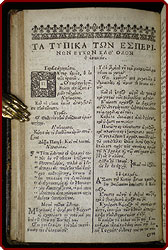
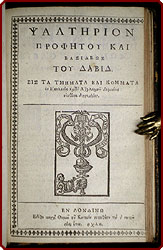
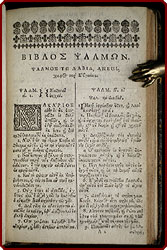
Church of England. Book of Common Prayer. Greek. [in Greek, romanized as ] Leitourgia Brettanikē ēgoun Biblos dēmosiōn euchōn kai diakonēseōs mystēriōn kai tōn allōn thesmōn kai teletōn en tē Ekklēsia hēmōn Anglikanē eis t[ēn] tōn philhellēnōn neōn charin hellēnisti ekdotheisa. Liber precum publicarum ac celebrationis sacramentorum reliquorumq[ue]; rituum & caeremoniarum in Ecclesiâ nostrâ Anglicanâ, in studiosae juventutis gratiam nunc primùm graecè editus. Operâ & studio Eliae PetilI presbyteri. Londini: Typis Tho. Cotes pro Richardo Whitakero, 1638. 8vo (16.1 cm, 6.5"). [262] pp. (lacking prelim. blank f.). [π1A4α4(-α1) β4γ4 ¶4¶¶4¶¶¶1 B–N4 A–04 P2].
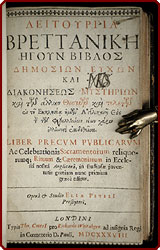
 Click the images for enlargements.
 The main title-page is printed in red and black; the separate title-page for the Psalter has a neat woodcut printer's vignette and blazons (in Greek type) Psalterion prophetou kai basileos tou Dabid. The elegant Greek type is set in double columns, with some nicely laid in typographic ornaments and decorated capitals. The signing is erratic, but the collation of this example matches most recorded descriptions: Leaf α1, apparently a cancel in a few copies but lacking in most reported examples and not present here, was a supplemental title-page giving Biblos dēmosiōn euchōn, kai leitourgēseōs mystēriōn; Griffiths calls for only one preliminary leaf, as is found here, with the other leaf in the gathering being a blank. Leaf 1C2 is a cancel.
Provenance: Front pastedown with armorial bookplate of Twistleton Fiennes, with that family's motto: “Fortem posce animum”; front free endpaper rubber-stamped “Birch” and front fly-leaf inked “Tho.s Birch e Coll. Herts. Oxon.” (apparently neither the historian nor the marine painter); title-page with inked monogram (obscure).
• ESTC S108726; STC (rev. ed.) 16432 & 2353; Griffiths, Bibliography of the Book of Common Prayer, (Other Languages) 45/2. Psalter: Darlow & Moule 4683. See: Oxford Guide to the Book of Common Prayer 57. Contemporary speckled calf, covers framed in gilt double fillets, rebacked with speckled calf quite plainly (without labels but with gilt-dotted raised bands); corners rubbed, original leather showing expectable acid-pitting. One preliminary blank (only) lacking; title-pages trimmed closely at outer edge, affecting typographical border and (on main page) one letter of publication information. Ownership marks as above. Pages lightly age-toned, otherwise clean; tiny spot of worming in lower inner margin, not affecting text.  A handsome and evocative little book. (26373)

 A Double Fore-Edge Painting on
 Treasured & TreasurableChurch
of England. Liturgies.
Book of common prayer. Book of common prayer, and administration of the sacraments,
and other rites and ceremonies of the Church, according to the use of the Church
of England: Together with the Psalter or Psalms of David, pointed as they are
to be sung or said in churches. Oxford: Clarendon Press, 1791. 8vo (25.5 cm, 10").
[196] ff. [bound with] Bible. O.T. Psalms. English. Sternhold and Hopkins.
The whole book of psalms, collected into English metre. Oxford: Clarendon Press,
1793. 8vo (25.5 cm, 10"). [60] ff.
Treasured & TreasurableChurch
of England. Liturgies.
Book of common prayer. Book of common prayer, and administration of the sacraments,
and other rites and ceremonies of the Church, according to the use of the Church
of England: Together with the Psalter or Psalms of David, pointed as they are
to be sung or said in churches. Oxford: Clarendon Press, 1791. 8vo (25.5 cm, 10").
[196] ff. [bound with] Bible. O.T. Psalms. English. Sternhold and Hopkins.
The whole book of psalms, collected into English metre. Oxford: Clarendon Press,
1793. 8vo (25.5 cm, 10"). [60] ff.

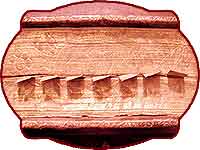
striking double fore-edge painting depicting (in one direction) the medieval Abbey Church of St. Albans in Hertfordshire, with a horse-drawn carriage in the foreground, and in the other direction the western facade of Westminster Abbey, with passing pedestrians.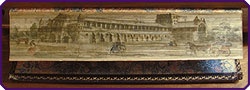
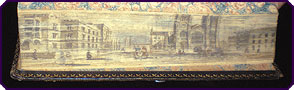 Single-click any image where the hand appears on
Provenance: The front fly-leaf bears an inked inscription reading “From this Book our 4 Dear Children were Babtized [sic] by the Rev. S. Good, Rector of St. Anns Blk. Friars, And afterwards Christened by their Dear Uncle the Rev. Charles Brown, Rector of Whitestone, near Exeter, Devon.” The children's baptismal dates range from 1806 through 1814.
• ESTC T93069; Griffiths, Bibliography of the Book of Common Prayer, 1791/7. Binding as above, leather slightly worn over joints and extremities. Front fly-leaf with collector's small bookplate, reverse with inscription as above, title-page with owner's name and date (1806) inked in upper margin. Pages clean.
For
BOOKS OF COMMON PRAYER, click here. For
a short “shelf” devoted to
All about the Mass — Best Edition & Beautiful Binding Bona, Giovanni, & Robertus Sala. Rerum liturgicarum libri duo. Augustae Taurinorum [i.e., Turin]: Ex Typographia Regia, 1747–53. Folio (40 cm, 15.75). 3 vols. I: xcvi, 522 pp. II: xi, [29], 391, [1], clxiii pp. III: xv, [25], 444, xcv pp.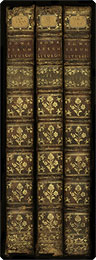
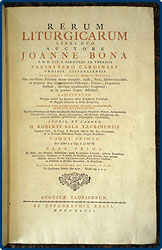
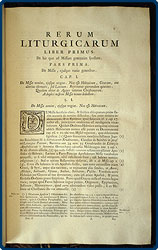 Click the interior images for enlargements.
 The typography is by the Royal Press and is handsome, employing roman and italic faces in a variety of point sizes. The text is presented in single and double-column format with finely engraved initials, and head- and tailpieces. The title-pages are printed in red and black with an engraved vignette.
Binding: Contemporary treed sheep, covers framed in double gilt fillets, spines with gilt-stamped red leather label, gilt-ruled raised bands, and elaborately gilt-tooled floral decorations in compartments.  A most pleasing production!
• Bound as above, covers with some cuts/abrasions, rubbing at corners and joints, surface cracks on spines; spines of vols. I and II with head and foot chipped. Front pastedowns with institutional bookplates; front free endpapers with early inked ownership inscriptions. Ex-library with old shelf labels to spines, and pressure-stamps (not rubber-stamps) including some on title-pages. All edges marbled, and marbled endpapers. Imposing. (21444)
 For more SETS, click here.
German-AmericanHymnalEvangelical Lutheran Ministerium of Pennsylvania and the Adjacent States. Erbauliche Lieder-Sammlung zum Gottesdienstlichen Gebrauch in den vereinigten Evangelisch-Lutherischen Gemeinen in Pennsylvanien und den benachbarten Staaten. Philadelphia: gedruckt bey G. und D. Billmeyer, 1814. 12mo (17.2 cm, 7"). Frontis., [11] ff., 626 pp., [5] ff. [bound with] Helmuth, Justus Henry Christian. Kurze Andachten einer Gottsuchenden Seele, auf alle Tage der Woche und andere Umstände eingerichtet. Philadelphia: G. & D. Billmeyer, 1814. 12mo (17.2 cm, 7"). 26 pp.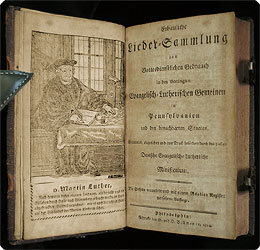
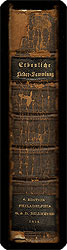
 which differs from that below (look at the windows), is printed in two columns in fraktur type; it contains the texts of the hymns only, no music. The work was first published in 1786, with a number of subsequent editions. Helmuth's Kurze Andachten, a short collection of morning, evening, and other occasional prayers, was issued with this edition of the hymnal and is usually, as here, bound in at the end.
Click the images for enlargements.
which differs from that below (look at the windows), is printed in two columns in fraktur type; it contains the texts of the hymns only, no music. The work was first published in 1786, with a number of subsequent editions. Helmuth's Kurze Andachten, a short collection of morning, evening, and other occasional prayers, was issued with this edition of the hymnal and is usually, as here, bound in at the end.
Click the images for enlargements. • Hymnal: Shaw & Shoemaker 31426; Arndt, The First Century of German Language Printing in the United States of America, 2032. Kurze Andachten: Shaw & Shoemaker 31686; Arndt, The First Century of German Language Printing in the United States of America, 2034. Contemporary sheep over wooden boards withworking brass clasps, abraded; spine with raised bands and later spine labels. Leather of top spine compartment damaged with loss of leather; front joint abraded and starting. Spots of browning throughout as usual in German imprints of this period, not worse and indeed better than is often the case. (26967)


AND we've a Gathering of :
Leaves
from a Large
18th-Century CHOIRBOOK Leaves from a Graduale romanum.
Venice: Balleoniana, 1729. Folio extra (19.25" x 13.625"). 1 f.
Large
18th-Century CHOIRBOOK Leaves from a Graduale romanum.
Venice: Balleoniana, 1729. Folio extra (19.25" x 13.625"). 1 f. 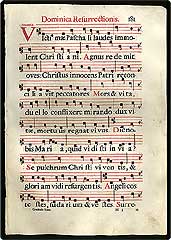
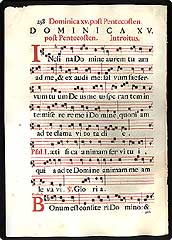 Click either image for an enlargement.
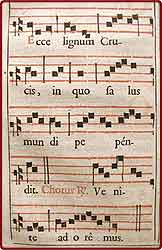
 This particular choirbook was printed with 10 lines of text and music per page. Each leaf contains music and words, and is printed in black and red; text is in black, with an occasional small letter in red, and the music is provided in black square notation on a four-line red staff. Antiphons begin with a tall decorative initial printed in red, as high as the text and music together. The initials vary from leaf to leaf.
• Crisp, wide margined leaf with slightest bleed-through from one side to another. Printed on handmade paper of 100% rag. A marvelous display, accent, or gift item.
For
more RARE CATHOLICA, click here. For
more MUSIC (& DANCE), click here. For
BOOKS OF COMMON PRAYER, click here. For
more RELIGION IN GENERAL, click here. Or
for more LEAVES, click here.


PLACE AN ORDER | E-MAIL US | GO (BACK) TO TOPIC/INTEREST TABLE | PRB&M HOME
All material © 2010
The Philadelphia Rare Books & Manuscripts
Company
