 RELIGION
RELIGION
RELIGION
 ANTIQUARIAN
CATHOLICA ANTIQUARIAN
CATHOLICAHAS ITS OWN, ADDITIONAL “AISLE” IN THE PRB&M WEBSHOP — WHICH SEE.  If
you are interested in THE REFORMATION,
you will usually find things herein, below; If
you are interested in THE REFORMATION,
you will usually find things herein, below;but your best bet is to click to our 16TH-CENTURY shelves.
|

 Separation of Church & State — RELIGIOUS LIBERTY
 First Collected Edition
  (A
LANDMARK). Locke, John.
Letters concerning toleration. London: A. Millar, H. Woodfall, I. Whiston &
B. White, I. Rivington, et al., 1765. 4to (29.5 cm, 11.6"). Frontis., [8], 399,
[1 (blank)] pp.
(A
LANDMARK). Locke, John.
Letters concerning toleration. London: A. Millar, H. Woodfall, I. Whiston &
B. White, I. Rivington, et al., 1765. 4to (29.5 cm, 11.6"). Frontis., [8], 399,
[1 (blank)] pp.
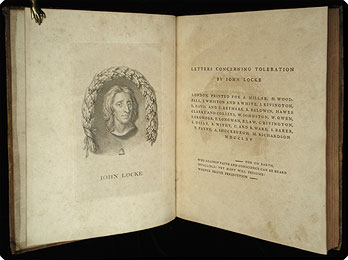
 Click the images for enlargements.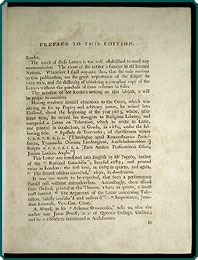
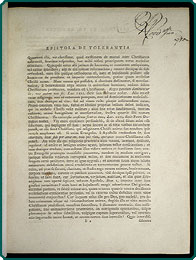
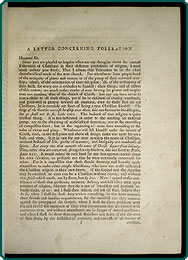
 This is a lovely, “gentleman's library” edition, well printed with generous margins.
Provenance: Two text pages and back pastedown with flourished ownership inscriptions of Richard Wood, Jr., dated 1780.
• ESTC T114245; Graesse, IV, 243; Lowndes 1380; Allibone 1113–14. Contemporary speckled calf, spine with gilt-ruled raised bands and gilt-stamped leather title-label; binding lightly rubbed/scuffed overall, joints starting from top and front hinge (inside) starting; spine with a chip and a small paper label. Front pastedown with three bookplates most tantalizingly layered over one another, the most recent being from a 19th-century social club library; front free endpaper with pencilled and inked numerals in an early hand. Pages age-toned and faintly to moderately spotted; minor offsetting from frontispiece to title-page. (26302)
 This entry is repeated in the

A
Restoration
Binding —
A Painted
Fore-Edge
(A
Long-Treasured Heirloom). Church
of England. Book of Common Prayer.
The book of common prayer and administration of the sacraments, and other rites
and ceremonies of the church, according to the use of the Church of England.
Together with the Psalter or Psalms of David, pointed as they are to be sung
or said in churches. London: John Bill, Thomas Newcomb, & Henry Hills, 1680.
12mo (14.7 cm, 5.75"). [432] pp. (lacking A1, blank or licence). [with]
Bible.
English. Authorized (i.e., “King James Version”). 1679. The
Holy Bible, containing the Old Testament and the New ... appointed to be read
in churches. London: John Bill, Thomas Newcomb, & Henry Hills, 1679. 12mo.
[870] pp. [and with] Bible.
O.T. Psalms. English. Sternhold & Hopkins. 1679. The whole
book of Psalms, collected into English metre, by Thomas Sternbold, John Hopkins,
and others. London: Pr. for the Company of Stationers, 1679. 12mo. [72] pp.
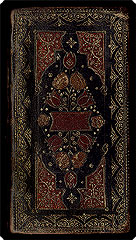
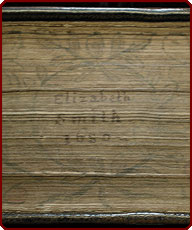
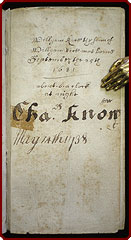
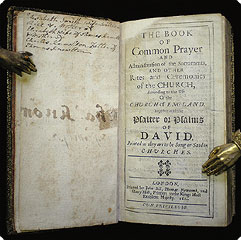 Click the images for enlargements.
 Provenance: Fore-edge painted with “Elizabeth Smith, 1680"; front fly-leaf with inscription recording the birth of William Rice in 1681 and with inscription of Charles Knowlton, dated 1738; fly-leaf verso with early inked genealogy describing the Smith-Rice-Knowlton descent.
Binding: Elaborate Restoration binding: black morocco framed in gilt semi-circle and strawberry rolls surrounding a broken panel design of red-inlaid scalloped corners decorated with floral-dotted volutes, containing a bouquet of tulips and other flowers with red and citron morocco inlays; the upper- and lowermost tulips each with a smaller gilt-stamped flower and leaf tool inside, spaces filled with small flowers and dots. Spine gilt extra using cover rolls and additional floral decorations, with two decorated compartments of red morocco; board edges and turn-ins with gilt rolls. The tools used do not appear to be an exact match to any binder represented in Bennett, Nixon, or Maggs: Bookbinding in the British Isles, although the tulip with superimposed small flower is reminiscent of the binder Nixon identifies as the Small Carnation Binder. All edges gilt. Fore-edge painted with name as above, surrounded by hand-painted floral decorations.
• BCP: Wing (rev. ed.) B3659B. Not in ESTC; not in Griffiths
(see 1680/5 for a very close example). Bible: ESTC R215858; Wing (rev.
ed.) B2308A; Herbert 758. Psalms: Not in ESTC, not in Wing.
Binding as above, front joint cracked (sewing holding) with corners/edges
rubbed; spine leather with small cracks and head chipped, small area darkened.
BCP lacking A1, either a blank or a licence and much more likely an
initial blank; title-page repaired at one corner. Elsewhere, one leaf with
tear from outer margin, extending across one column without loss; page edges
with occasional small smudges from fore-edge decorations; some faint spotting
and foxing. Now housed in a café au lait morocco slipcase mistakenly
giving 1630 as year of publication, based on misleading print impression on
title-page.  A good and interesting book apart from its extraordinary
binding, charming fore-edge treatment, and multi-generational provenance.
(25925)
A good and interesting book apart from its extraordinary
binding, charming fore-edge treatment, and multi-generational provenance.
(25925)
This entry is repeated in the


 Famous for Its
 Maps of the Holy LandAdrichem (a.k.a. Adrichom), Christiaan van. Theatrum Terrae Sanctae et biblicarum historiarum cum tabulis geographicis aere expressis. [colophon: Coloniae Agrippinae: Officina Birckmannica, sumptibus Hermanni Mylij, 1628]. Folio (37 cm; 14.5"). [6] ff., 256 pp., [15] ff.; 12 fold. or double-page engr. maps.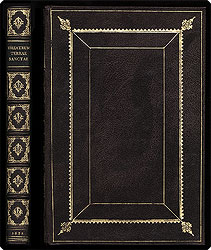
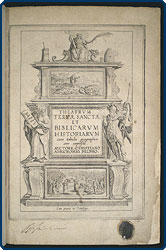
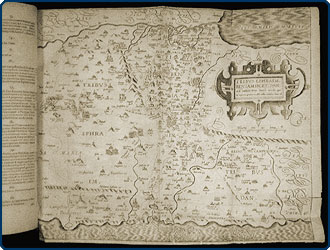
Theatrum Terrae Sanctae is famous for its engraved maps, but the work is justly sought for its descriptions of Palestine and the antiquities of Jerusalem. Additionally the work contains a chronology from Adam to 1585, the year of the author's death.
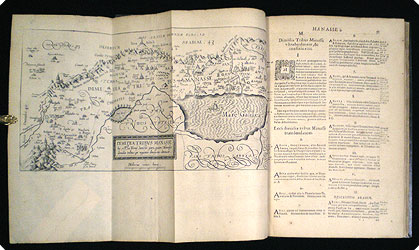
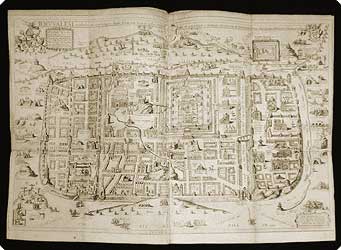
The work begins with an engraved allegorical title-page, has woodcut initials and tailpieces, and bears 12 folding or double-page engraved maps. The text is printed in roman type in double-column format.
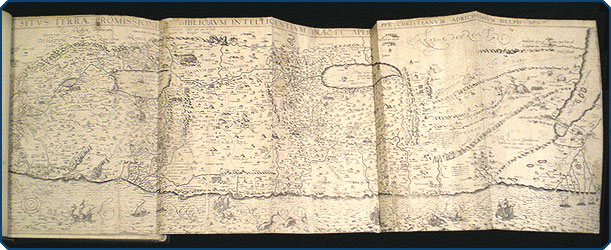
 In all, a good+ copy and a very handsome volume. (24104)
UPBRAIDING a Lutheran Theologian forHis Statements on Transubstantiation Ad frivolas calumnias, et cavillationes sophisticas Danielis Hoffmanni doctoris theologiae responsio ministrorum Ecclesiae Bremensis, qua monetur Hoffmannus, ut suo se pede metiens, & secum habitans, ad sobrietatem sapere discat, neque supra quam sapere opertet, sapiat. Bremae: ex officina typographica Theodori Glückstein, 1584. Small 8vo (16.2 cm; 6.25"). [32] ff.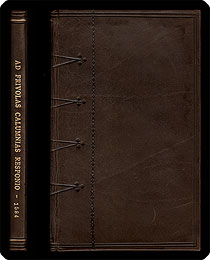
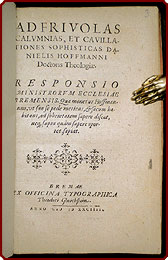
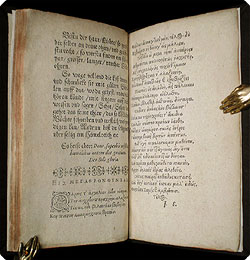 Click the images for enlargements.
 The text is in Latin printed in italic, but with some passages in Greek and others in German (the latter printed in fraktur). One final section is entirely in Greek.
There were only two editions of this printed, one year apart. This is the second (1584) and is apparently much scarcer than the first (1583): It is not listed in VD16 and WorldCat finds only two copies worldwide, one of which has been deaccessioned.
• VD16 A184 (for 1583 ed.). Recent ebony-brown calf old style: Round spine, fillets extending onto covers terminating in trefoils, and covers framed in blind double fillets. Very good condition. (26755)

Reformation Concern aboutMonasticism Ain Schoner Dialogus wie ain Bawr mit aim Frawe[n] brüder Münch redt[,] das er die Kutten von jm würfft, vnd dem Münch arbayt zügeben, lustbarlich vnd lieblich zu lesen. [Augsburg: Philipp Ulhart d.Ä.], 1525. Small 4to (19 cm; 7.5"). 6 pp.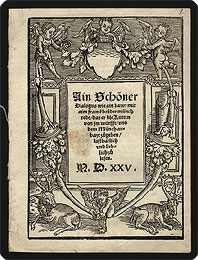 Click the image for an enlargement.
 This edition has a handsome, single-unit woodcut title-border incorporating pillars, stags, vines, and cherubs. The text is in fraktur, of course.
Rare: WorldCat locates only one copy of any edition in the U.S. (at Emory — this edition), while VD16 locates three German copies each for the Augsburg and Würzburg editions and only a microform of the Strassburg printing.
• Kuczynsk 579; VD16 S3433. Removed from a nonce volume. One small area of discoloration on title-page. Very good condition. (25922)

A
Learned HUGUENOT
Discusses the Thrice-Holy
HymnAllix, Pierre. Dissertatio de Trisagii origine. Rothomagi: Apud Joannem Lucas, 1674. 8vo (18.2 cm, 7.125"). A–I4; 70 pp., [1 (blank)] f.
Thrice-Holy
HymnAllix, Pierre. Dissertatio de Trisagii origine. Rothomagi: Apud Joannem Lucas, 1674. 8vo (18.2 cm, 7.125"). A–I4; 70 pp., [1 (blank)] f. 
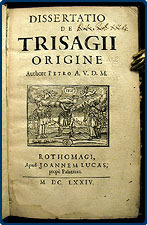
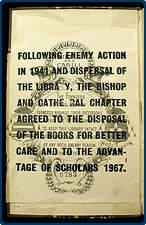 Click the interior images for enlargements.
 Thissole
edition is ornamented with a woodcut printer’s device
and a woodcut headpiece and initial; the text is referenced with sidenotes.
Rare: Only two copies traced in the U.S. via OCLC, RLIN, and NUC Pre-1956.
Provenance: Bookplate of Virtue & Cahill Library (the library of Portsmouth’s Catholic Cathedral) no. 8783, with a large overlaid rubber-stamp thereon starkly, blackly noting the dispersal and eventual sale of the library “following enemy action”—the cathedral having been bombed by the Germans in 1941.
• On Allix, see: The Dictionary of National Biography, I, 334–35. 19th- or early 20th-century half calf over marbled paper, spine with gilt title; edges of leather with a dog’s tooth roll in blind. Leather rubbed, especially on joints and edges. Some soiling and waterstaining, mostly light and most notable on early leaves, with some small wormholes in the margins; a little fine chipping and some shallow dog-ears. Old inked ownership inscription on title-page, crossed out but still legible.
 Anti-Anabaptist Althamer, Andreas, attrib. author. Ein kurtze Vntterricht, den Pfarherrn und Predigern: Inn meiner gnedigen Herrn der Marggraffen zu Branndenburg. [et]c. Fürstenthumben un[d] Landen, hieniden in Francken, und auff dem Gebirg verordent, wes sie das Volck wider etliche verfürische Lere, der Widertauffer, an den Feyertägen auff der Canntzel, zum getreülichsten und besten, auss götlicher Schrifft vermanen, und unterrichten sollen. [Nuremberg: Jobst Gutknecht, 1528]. Small 4to (20 cm; 8.75"). [14] ff.
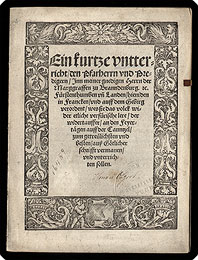 Click the image for an enlargement.
 During the Bern Disputation (1528) Althamer stood and defended the Lutheran doctrine of the Lord's Supper.
This is printed in gothic type and offers a title-page graced by a four-element woodcut border composed of floral, avian, and animal motifs, with putti not forgotten.
Provenance: Ownership signature on title-page of Howard Osgood, noted late 19th- and early 20th-century collector and scholar; old circular pressure-stamp on same page of a seminary (properly released).
WorldCat finds two copies in North America, one of which has been deaccessioned, and COPAC finds two copies in Great Britain, both at the British Library.
• Hillerbrand, Anabaptism,3577; VD16 ZV2334 or ZV2333 or B6972 (all listed without attrib. author). Removed from a nonce volume, provenance indications as above. Light dust-soiling to exterior paper; minor library pencillings and one old inked numeral; limited brown stain in blank area of last leaf, offsetting to previous page opposite. A few instances of marginal notation or textual correction in old ink and an old hand. (25960)
Creepy Crawlies & Winged Wish-they-weren'ts American Tract Society. Lessons from insect life. With numerous illustrations. Boston: American Tract Society, [1863]. 12mo. Frontis., 185, [1 (blank) pp.
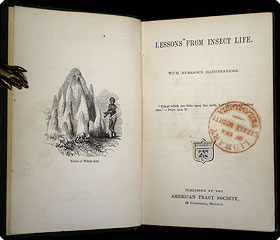
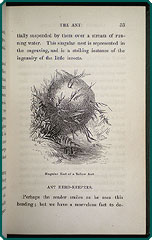 Click the images for enlargements.
 • Publisher's green textured cloth modestly blind-stamped at board edges and with the ATS logo blind-embossed in the center of each cover, spine stamped and lettered in gold, now dull. Ex–social club library: call number on pastedown, rubber-stamp on title-page, no other markings. Lacks the front free endpaper and with a very few stains; overall a very nice copy. (26267)
“The
Foule Mist ofAnabaptisme”
Anonymous. A short history of the Anabaptists of High and Low Germany. London: Robert Austin, 1647. 4to (19.3 cm, 7.6"). [2], 56 pp.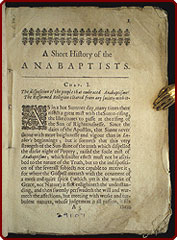
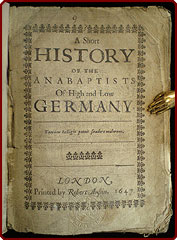 Click the images for enlargements.
 • ESTC R30642; Wing (rev. ed.) S3598. Later plain paper wrappers with edge wear and chipping at spine. Title-page with very old institutional pressure-stamp and early inked numeral in upper margin. Outer corners stained, edges ragged; one leaf with upper outer corner torn away, with loss of a few words; title-page darkened and last page stained; still a good, usable copy. (25531)

Defending the Immortality of the SoulAnonymous. Free thoughts upon the discourse of free-thinking. London: John Pemberton, 1713. 8vo (19.8 cm, 7.8"). [4], 68 pp.
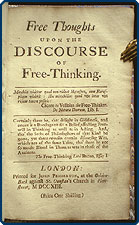
• ESTC T96164. Recent marbled paper–covered boards, front cover with gilt-stamped leather title-label. Pages slightly age-toned, else clean. (20770)
Duty Revisited with a New Spin: Faith Added Anonymous. The new Whole duty of man, containing the faith as well as practice of a Christian; made easy for the practice of the present age ... fourteenth edition. London: Edward Wicksteed, [1756]. 12mo (18.1 cm, 7.15"). Frontis., add. engr. t.-p., [2], xiv, 556 (i.e., 565), [18], 584–85, [3] pp.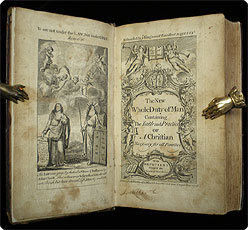
 Click the images for enlargements.
 The original Whole Duty is now generally ascribed to Allestree although, as the DNB says, “it has by some been supposed that Allestree joined [his good friend and biographer] Bishop [John] Fell” in writing it.” Allestree (1619–81) was a royalist Church of England clergyman; Bishop Fell reports that “few of his time had either a greater compass or a deeper insight into all parts of learning” (DNB). The hand responsible for the present alterations of his most famous work has not yet been identified.
The volume begins with a copper-engraved frontispiece depicting Moses giving the law and Jesus giving grace and truth, and an additional engraved title-page. The frontispiece to the original edition, done byHollar, is reproduced here as a full-page illustration. The section of “Private Devotions: Containing directions and prayers for morning and evening . . .” has a separate title-page.
Provenance: Large ownership note of Nathan Levering on imprimitur page; the start, perhaps, of his second signature (much smaller) to the bottom of the title-page.
This edition is uncommon, as are most of the other printings from this time period. OCLC and ESTC locate only three U.S. institutional holdings, two of which have since been deaccessioned.
• ESTC T80506. On Allestree, see: Oxford Dictionary of National Biography online. Contemporary speckled calf framed in gilt double fillets, recently rebacked, spine with gilt-stamped leather title-label and gilt-dotted raised bands; corners and edges rubbed. Lower edges (closed) institutionally rubber-stamped; frontispiece and several pages pressure-stamped; dedication with inked annotation and numeral. Front fly-leaf with early inked annotation consisting mostly of numerals; title-page verso with inked ownership inscription as above. Foxing and the occasional stain; one leaf with short tear from outer margin touching text without loss; one index leaf with tear affecting a few words. In fact, a decent copy of this interesting book. (25857)
 His
Fellow Novice Was Fra Angelico
. . . INCUNABLE
from the Press
of Grüninger
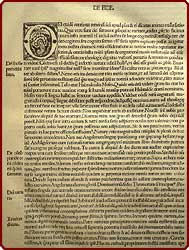
Antoninus, Saint, Abp. of Florence. Tertia pars totius
su[m]me maioris beati Antonini [i.e., Summa theologica, pars tertia]. [Argentinae: Johann Grüninger,
1496]. Folio ( 31 cm; 12/25"). [311 of 312] ff., lacks final blank.
His
Fellow Novice Was Fra Angelico
. . . INCUNABLE
from the Press
of Grüninger
Antoninus, Saint, Abp. of Florence. Tertia pars totius
su[m]me maioris beati Antonini [i.e., Summa theologica, pars tertia]. [Argentinae: Johann Grüninger,
1496]. Folio ( 31 cm; 12/25"). [311 of 312] ff., lacks final blank.
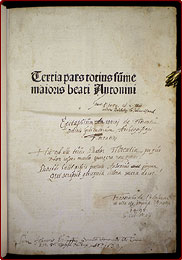
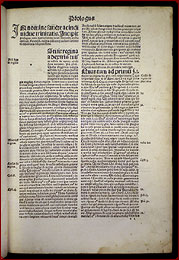
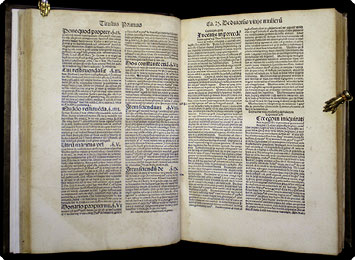 Click the interior images for enlargements.
 Summa Theologica Moralis is the saint's principal work and was written shortly before his death. Scholars say it marks a new and considerable development in moral theology, as well as containing a fund of matter for the student of the history of the 15th century.
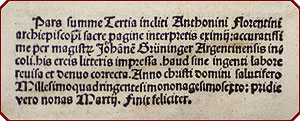
Provenance: 1630 ownership inscription; later in the library of a divinity school, deaccessioned.
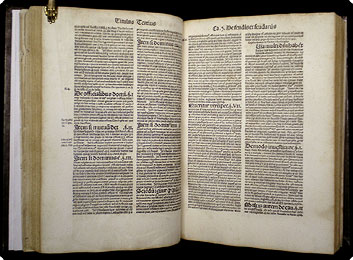
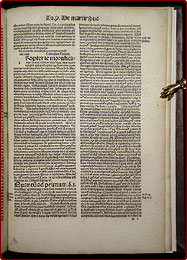
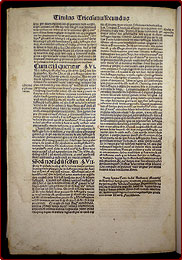
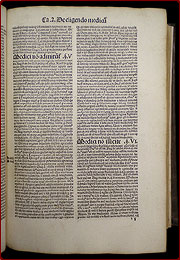

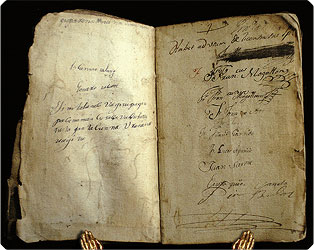
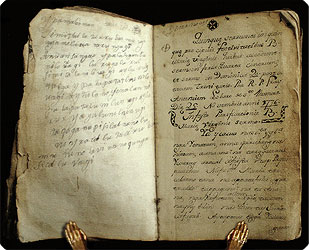
Extended MANUSCRIPT in an UNCOMMON PHILIPPINE LANGUAGE Antonio Lobato de Santo Tomás. Manuscript in Ibanag on paper: “Quinque sermones in quinque precipuis festivitatibus B. Maria Virginis. Quibus accedunt sermo in feria quarta cinerumz et sermo in dominica 2o post octavam trinitatis. Per R. P. fray Antoniium Lobatao de Sto. Thomas. Tuguegarao, The Philippines: 1776–80. Small 4to. 196 pp.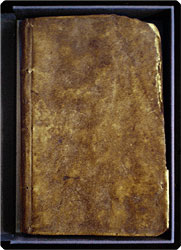
 Click the interior images for enlargements.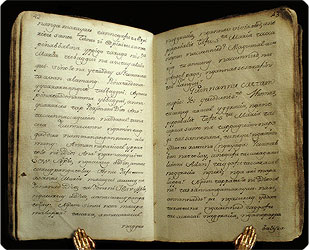
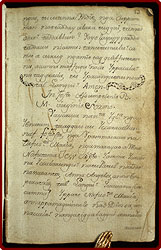
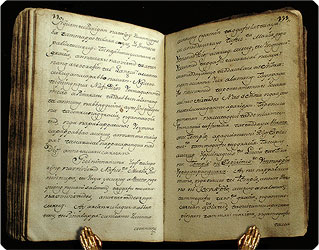 a large body of work set down in the Ibanag language, from the 18th century and as written/spoken by one of the seminal scholars of the language, should be obvious for anyone researching the language as understood by missionaries, as used by missionaries, as influenced by Spanish, and as held out by Spaniards of authority as the model of Ibanag speech to be emulated. Beyond this, of course, is the interest of the sermons themselves, letting us see what the Ibanaq speakers were hearing from their missionaries — or, at least, this missionary — in this place, in this period.
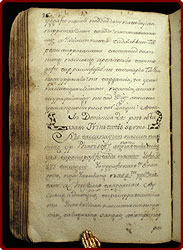
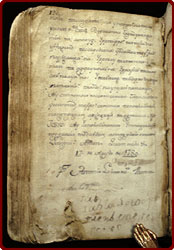
Provenance: A signature “Fr. Antonio Lobato de Sto. Thomas” appears at the bottom of the last page and is almost certainly that of the the friar himself, which would mean that this is his autograph manuscript of the sermons.
• Contemporary very stiff vellum. Binding gnawed by a rodent with loss. Written on a good quality European paper, with some soiling and an occasional stain. No faults are serious and overall this is a remarkably good survival for an 18th-century Philippines manuscript. Now housed in a blue cloth clamshell box. (23668)
For
more CATHOLICA, click here.
Looking
atTithes
from Both Sides[Arnall,
William]. The second part of the case of tythes; containing animadversions
on a reverend prelate’s remarks upon the bill now depending in Parliament...to
which are prefix’d the reverend prelate’s remarks. The third edition,
with additions. London: J. Peele, 1731. 8vo (19 cm, 7.5"). 32 pp.
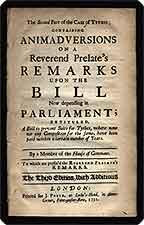
Conveniently, both Sherlock’s argument and Arnall’s
response are printed here.
• ESTC T108041. On Arnall, see: The Dictionary of National Biography, II, 103). Removed from a nonce volume and now in a Mylar folder. Final page stamped by a now-defunct institution. Small area of worming in lower outer corner throughout, not touching text.

For a Broader ChurchArnold, Thomas. Principles of Church reform. London: Pr. [by R. Clay] for B. Fellowes, 1833. 8vo (20 cm, 7.875"). v, [1 (blank)], 88 pp.
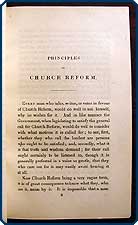 • Principles of Church Reform by Thomas Arnold (1795–1842), the famous reforming headmaster of Rugby, was an important and controversial argument for comprehension of Protestant dissenters within the Church of England, including proposals for revising Church government and liturgy to encourage that. This is the first of four 19th-century editions, all published in 1833 (it was also reprinted by SPCK in 1962).
Single-click
the image,
• Principles of Church Reform by Thomas Arnold (1795–1842), the famous reforming headmaster of Rugby, was an important and controversial argument for comprehension of Protestant dissenters within the Church of England, including proposals for revising Church government and liturgy to encourage that. This is the first of four 19th-century editions, all published in 1833 (it was also reprinted by SPCK in 1962).
Single-click
the image,• NSTC 2A16362. On Arnold, see: DNB, II, 113–17. Removed from a nonce volume. A few dog ears, some shallow chipping, and traces of soiling. A little underlining and sidelining in old ink.
“Translated
Asgill” Strikes
Back[Asgill,
John]. Mr. Asgill’s defence upon his expulsion from the House of
Commons of Great Britain in 1707. With an introduction, and a postscript. London:
A. Baldwin, 1712. 8vo (19.2 cm, 7.55"). 87, [1] pp.
Strikes
Back[Asgill,
John]. Mr. Asgill’s defence upon his expulsion from the House of
Commons of Great Britain in 1707. With an introduction, and a postscript. London:
A. Baldwin, 1712. 8vo (19.2 cm, 7.55"). 87, [1] pp.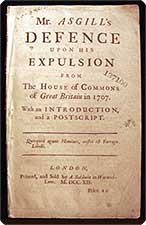 his rapturous religious
tenets while affirming his belief in the Scriptures and denying
any wrongdoing—especially in the pesky land speculation matter. One might,
upon perusing Asgill’s arguments, agree with the assessment made by the
printer of the original treatise, who “fancy’d [Asgill] was a little
craz’d” (p. 40).
his rapturous religious
tenets while affirming his belief in the Scriptures and denying
any wrongdoing—especially in the pesky land speculation matter. One might,
upon perusing Asgill’s arguments, agree with the assessment made by the
printer of the original treatise, who “fancy’d [Asgill] was a little
craz’d” (p. 40).
This example is apparently a variant state of the first edition of 1712 (ESTC does not distinguish between variants, grouping all entries under one listing), with p. 61, line 8 ending “of the Romish Persuasion.’
• ESTC T41498. On Asgill, see: The Dictionary of National Biography, II, 159–61. Removed from a nonce volume, now in a Mylar folder. Title-page with small numeric stamp, spots of discoloration. A few pages more notably browned than their neighbors; otherwise generally clean.
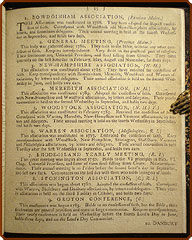
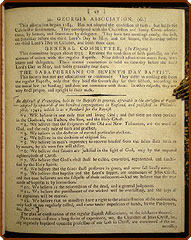
The Very Rare Richmond PrintingFirst Edition of the First Register — Anti-Slavery Content Asplund, John. The annual register of the Baptist denomination, in North-America; to the first of November, 1790. Containing an account of the churches and their constitutions, ministers, members, associations, their plan and sentiments, rule and order, proceedings and correspondence. Also remarks upon practical religion. [Richmond: Printed by Dixon, Nicolson, and Davis, April, 1792]. 4to (18.5 cm; 7.5"). iv, 5-60 pp.
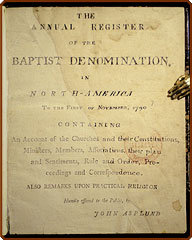
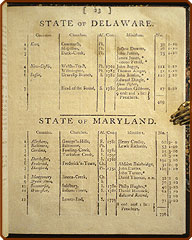 Click the interior images for enlargements.
 The wonderful cataloguers at the American Antiquarian Society write of this edition: “Apparently printed in sections, presumably by John Dixon, Thomas Nicolson and Augustine Davis, rival Richmond printers. The first 16 p. were probably printed in 1791; p. 17-60 in or before April, 1792. Evans, however, postulates that the first 16 p. were printed by Thomas Dobson of Philadelphia in September, 1792, and that Asplund replaced the original gatherings A and B of this edition with Dobson’s corrected sheets. Cf. the prefaces to the 1794 and 1796 editions, with title: The universal register of the Baptist denomination . . .”
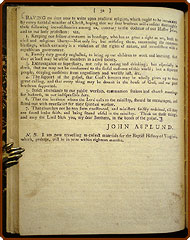 This
was a standard Baptist stance, if not one universally held; it is striking here
as appearing on p. 52, in the part of the pamphlet that Evans and the AAS agree
was Richmond-printed. At the end of that section,
Asplund notes thathe
is writing from the American “field” —
“N.B. I am now travelling to collect materials for the Baptist History
of Virginia, which, perhaps, will be in print within eighteen months.”
This
was a standard Baptist stance, if not one universally held; it is striking here
as appearing on p. 52, in the part of the pamphlet that Evans and the AAS agree
was Richmond-printed. At the end of that section,
Asplund notes thathe
is writing from the American “field” —
“N.B. I am now travelling to collect materials for the Baptist History
of Virginia, which, perhaps, will be in print within eighteen months.”
Rare. We trace fewer than half a dozen copies in U.S. libraries.
• Evans 26580; Sabin 2222; ESTC W37301. 19th-century half morocco with marbled paper covered boards; binding with label of “John C. Moore, Rochester, NY.” Ex-library with area of discoloration on front board where call number label was removed; bookplate on front pastedown; rubber-stamp on title-page, and small stamp and pencilling on rear of same. Approximately 60% of title-leaf replaced in pen and ink facsimile. Some foxing and age-toning. Not an ideal copy, but given the rarity, a darned good one. (24456)
Dobson Printing ofAsplund's Annual Register Asplund, John. The annual register of the Baptist denomination, in North-America; to the first of November, 1790. Containing an account of the churches and their constitutions, ministers, members, associations, their plan and sentiments, rule and order, proceedings and correspondence. Also remarks upon practical religion. [Philadelphia: Pr. by Thomas Dobson, 1792]. Small 4to. iv, 5-57, [1], 69-70 pp.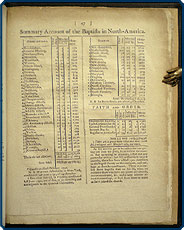
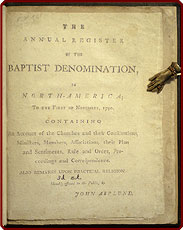 Click the images for enlargements.
 As is the case with the 70 p. issue, the first 16 p. are the same sheets as appear in the original [Richmond, April 1792] edition (Evans 26580), and were probably printed in 1791. Evans, however, postulates that the first 16 p. were printed by Dobson in September 1792. He accounts for their presence in copies of the [Richmond] edition of 60 p. by suggesting that Asplund substituted the corrected Philadelphia sheets for the unsatisfactory sheets of the earlier edition. Cf. the prefaces to the 1794 and 1796 editions, with title: The universal register of the Baptist denomination.”
In addition to its exhaustive account of who's who and what's where, this lists both principles of belief and “Rules of Decorum”; the latter, e.g., forbid laughing and whispering when another member of the association is speaking in assembly. Between the “Rules of Decorum” and the Index, Asplund remarks on the un-Christian “inconsistency” of “Keeping our fellow-creatures in bondage, who have as good a right was we, both to civil and religions liberty — Not only so; but misusing them, concerning common blessings, which certainly is a violation of the rights of nature and inconsistent with a republican government.”
• Evans 26582; ESTC W37302. Uncut copy. In 20th-century black buckram binding. Ex-library with bookplate but no other markings. (24467)
Seceders
& CovenantersAssociate
Reformed Church in North America. The Constitution and Standards....
New York: Pr. by T.J. Swords, 1799. 8vo (21.5 cm, 8.5"). 612 pp., [2] ff. 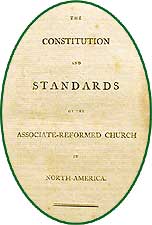
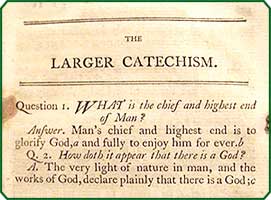
• ESTC W35823; Evans 35119. Contemporary sheep, spine with red leather title label; abraded with a few wormholes (including one track across spine) and front joint opening. Some pages quite stained, not impairing reading; a couple instances of chipping in margins with loss of letters. Front free endpaper excised. Pp. 433–44 pinned together in the inside margin. Pencil doodlings on half-title and p. [5].
Two
Church Fathers —
Two
Scholar PrintersAn
Apparatus by Erasmus
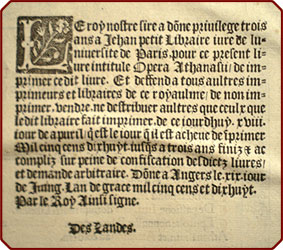
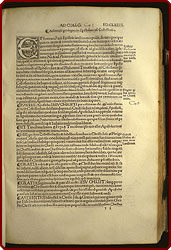
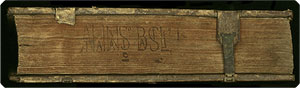
Athanasius, Saint, Patriarch of Alexandria. Athanasii Episcopi Alexandrini sanctissima, eloquentissma que opera ... que omnia olimia[m] latina facta Christophoro Porsena, Ambrosio Monacho, Angelo Politiano, interpretibus, una cum doctissima Erasmi Roterodani ad pium lectorem paraclesi. [bound with another work as below]. Parisiis: Joanne Paruo [i.e., Jean Petit] , [1519]. Folio extra. [6], 255, [66] ff. [bound with] Basil, Saint, Bishop of Caesarea.
Basilii Magni Caesariensium in Cappadocia Antistitis sanctissimi opera plane diuina, variis e locis sedulo collecta: & accuratio[n]e ac impe[n]sis Iodici Badii Asce´sii recognita & coimpressa, quorum index proxima pandetur charta. [Paris: Venundantur eidem Ascensio [i.e., Badius Ascensius, 1520]. Folio extra. [10], 178 ff. 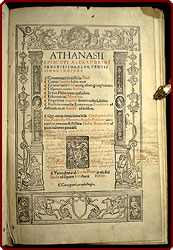
 Click any image where the hand appears on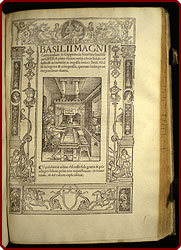
A
PRB&M “FEATURED BOOK” —
St.
Augustine It
isNOT
— Anselm,
Bernard,Augustinus Aurelius, S. (pseudo). Pious breathings. Being the Meditations of St. Augustine, his Treatise of the love of God, Soliloquies, and Manual. To which are added, select contemplations from St. Anselm, & St. Bernard. London: S. Sprint, T. Bennet, R. Parker, J. Bullord, & M. Gilliflower, 1701. 8vo (20.7 cm, 8.1"). [10], 414 pp. (pagination 177/78 skipped, 209/10 repeated, text complete); 4 plts.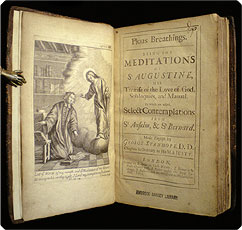
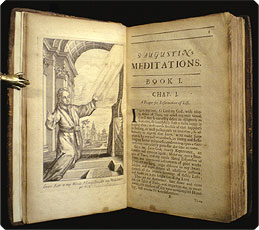 Click the images for enlargements.
 The volume is illustrated with a frontispiece and three other copper-engraved plates done by “I. Simons.”
• ESTC T97614. Contemporary speckled calf framed and panelled in blind with contrasting plain calf panel and blind-tooled corner fleurons, rebacked with lighter speckled calf, spine with gilt-stamped leather title-label; sides abraded. Contemporary inked ownership inscription to back of frontispiece and similarly old small inked notation (monogram?) to title-page; ; title-page institutionally rubber-stamped at base (no other markings). Pages age-toned; intermittent light spotting and staining. (24438)
Dutch Opinions on theSpanish Inquisition Avontroot, Johannes Bartholomeus. Den grouwel der verwoestinghe, oft grondich bericht ende ontdeckinghe, van de gronden der Spaensche inquisitie. In s'Graven-haghe: Aert Meuris, 1621. 4to (19.7 cm, 7.75"). [28], 212 pp.
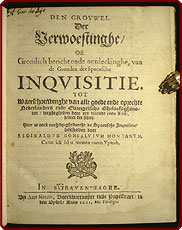
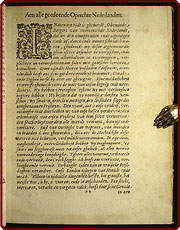
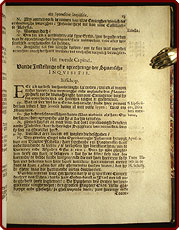 Avontroot was executed by the Inquisition at Toledo in 1632.
This copy lacks the work by González de Montes, a.k.a. Reginaldus Gonsalvius Montanus, which should follow p. 212. It is largely printed in black letter.
Uncommon. OCLC finds only two holdings in the U.S., one being this copy, now properly deaccessioned, and the other at the John Carter Brown Library. NUC Pre-1956 does not identify any additional copies.
• Vekené, Bib. der Inquisition, 139-140; Boehmer, Bibliotheca Wiffeniana, 290 (identifying the volume as the second Dutch translation of the Montanus work not present here). 19th-century half calf with marbled paper-covered sides; joints and corners rubbed. Front pastedown with institutional bookplate, title-page with early inked ownership inscription in upper margin. Pages age-toned with some mild waterstaining; one leaf with lower outer corner torn away, not affecting text. (19569)
 TO
Part II TO
Part II |