 RELIGION
RELIGION
RELIGION
 Saving the Souls of the Rich via
 CHARITY
  Nelson, Robert. An address to persons of quality and estate ... To which is added, an appendix of some original and valuable papers. [with another related title, as below]. London: A. & G. Way, prs., 1715. 8vo (21.9 cm, 8.6"). Frontis., xxxi, [1], 267, [1], 55, [7] pp. [with] A poem in memory of Robert Nelson Esquire. London: Pr. by Geo. James for Richard Smith, at Bishop Beveridge’s-Head, 1715. 8vo. 21, [3] pp.

 Click the images for enlargements.
 The frontispiece portrait of Nelson was engraved by George Vertue after a painting by Sir Godfrey Kneller. The volume also includes all publisher's advertisements as well as the rather uncommon Poem in Memory of Robert Nelson Esquire.
 This was produced to be a handsome work, printed in large type on good paper with wide margins — the better to appeal to a “quality” audience?
• ESTC T85360; Goldsmiths’-Kress 5249. Poem: ESTC T25431; Foxon P538. Contemporary speckled calf, framed and panelled in blind with blind-tooled corner fleurons; rebacked with speckled calf, spine with gilt-stamped leather title-label, raised bands, and blind-tooled foliate compartment decorations. Original leather abraded, front cover with small chip to outer edge and area of faint discoloration from a now-absent label; title-page institutionally rubber-stamped (no other markings). Some signatures browned and foxed, most pages clean. (25999)

 The Scientist as
 Bible ScholarNewton, Isaac. Observations upon the prophecies of Daniel, and the Apocalypse of St. John. In two parts. London: Printed by J. Darby and T. Browne...and sold by J. Roberts...[et al.], 1733. 4to (26 cm). vi, [2], 323 pp
 Click the image above right
• Wallis, Newton, 328.1; ESTC T41883, T18642, N64145. Recent quarter calf over marbled paper, spine with raised bands; gilt-lettered and -ruled label from a previous binding retained, chipped about the edges. Bookplate on front pastedown. Some light waterstaining and some cockling, and a few leaves with shallow chipping or tattering; these, with good repairs. Ample margins. In sum a handsome book.

Sir
Isaac &
His (actually, not so) Mystical
Side
Newton, Isaac. Observations upon the prophecies of Daniel. London: James Nisbet, &T. Stevenson, Cambridge, 1831. 8vo (23.5 cm; 9"). [1] f., xii, 250 pp.

 Click the interior images for enlargements.
 “A new edition, with the citations translated, and notes by P. Borthwick . . . of Downing College, Cambridge.”
• Publisher's quarter green cloth with paper-covered boards. Rebacked in sympathetic cloth and new paper label (antique style) applied. Boards show age-stains and wear but are solid. Old library pressure-stamp on title-page. In an open back slipcase of green library cloth; spine of box with author, title, and call number in gilt. A nice copy, sound for reading. (21773)
 Keeping the
 Would-Be Ministers DECENT New York Baptist Union for Ministerial Education. Manuscript on paper, in English. “Donation record of bedding wearing apparel etc. for beneficiaries. Nov. 1850.” [New York: 1850–61]. 8vo (19 cm, 7.5"). [140 pp. (approx. 35 used)].
 Click the images for enlargements.
 The New York Baptist Union for Ministerial Education held the charter for Rochester Seminary, which opened in 1850 and eventually became part of the Colgate Rochester Divinity School.
Provenance: Title-page with pencilled inscription reading “This book was found after the great Sibley fire [in Rochester, 1904] on one of the streets leading to Main Street. It was given to me some time after. -A.J. Rau[saker?].”
• Contemporary roan in imitation of morocco, covers framed in simple gilt roll; worn and rubbed, front cover warped and spine cracked with both fire-darkened. First leaf excised; a number of leaves separated; a few leaves cut across, sometimes repaired with tape. (26236)

 An
Edition that Has
An
Edition that Has Escaped
the Bibliographers?
Nicolaus, de Plove (a.k.a. Nicolaus de Blony). TRactatus [sic] sacerdotalis d[e] sacrame[n]tis: de[que] diuinis officiis et eoru[m] administrato[n]ibus. [Strassburg: Johann Knobloch, 1502–8?]. Small 4to (19 cm; 7.5"). A8C–D4D8F–K4L–M8N–R4S8T6 (-T5); [97 (of 98)] ff. (without the “tabula”).
Escaped
the Bibliographers?
Nicolaus, de Plove (a.k.a. Nicolaus de Blony). TRactatus [sic] sacerdotalis d[e] sacrame[n]tis: de[que] diuinis officiis et eoru[m] administrato[n]ibus. [Strassburg: Johann Knobloch, 1502–8?]. Small 4to (19 cm; 7.5"). A8C–D4D8F–K4L–M8N–R4S8T6 (-T5); [97 (of 98)] ff. (without the “tabula”).


 Click the images for enlargements.
 The text is complete but it is clear that the next to the last leaf is missing: It would contain the “Tabula” and possibly the colophon. The final blank is present.
Nicolaus's text is printed in double-column format in gothic, black-letter type, with guide letters but the initials unaccomplished.
Evidence of readership: Marginalia throughout; a small area at the beginning of four lines on A6v with early reader's inking over of the lightly printed letters (in a near perfect approximation of the gothic type).
Provenance: Ownership signature of “G. Lunndro, Woodmansey, 1852”; bookplate of Madison University; later bookplate of Colgate University (i.e., Madison changed names in 1890); later transferred to Colgate Rochester Divinity School. Deaccessioned.
• Not in VD16; not in Adams. 19th-century plain boards. Ex-library with bookplates of two different institutions; pressure-stamp on title- and other leaves; five-digit acquisition number stamped in lower margin of first leaf of the prologue; residue of a charge pocket on rear pastedown and ink transfer to rear free endpaper. (26026)
Christian Philosophy from the “English Malebranche”
Norris, John. A treatise concerning Christian prudence: Or
the principles of practical wisdom, fitted to the use of human life, and design'd for the better regulation of it. London: Samuel Manship, 1710. 8vo (20 cm, 7.9"). [12], 399, [5] pp.
“English Malebranche”
Norris, John. A treatise concerning Christian prudence: Or
the principles of practical wisdom, fitted to the use of human life, and design'd for the better regulation of it. London: Samuel Manship, 1710. 8vo (20 cm, 7.9"). [12], 399, [5] pp.

 Click
the interior image for an enlargement.
Click
the interior image for an enlargement.
Provenance: 18th-century inscription, “Master Griffith Boynton”; 20th-century bookplate of the John Donne scholar Charles Monroe Coffin.
• ESTC T76120. On Norris, see: Dictionary of National Biography. Contemporary speckled calf, framed and panelled (with plain calf) in blind with blind-tooled corner fleurons, rebacked, spine with recent gilt-stamped leather title-label; edges and corners showing minor rubbing, front cover with small faint area of staining from a now-absent paper label. Front pastedown with private collector's bookplate (institutionally rubber-stamped), as above; front free endpaper with inked inscription, as above; title-page institutionally rubber-stamped in lower margin. Two pencilled marginal annotations; scattered pencilled bracketing. Pages age-toned, with occasional light spotting. (20902)
A
Rather EXTENDED
Chapbook!Ghost,
Here, Too]Ogilvie, William. The Laird of Cool's ghost: being several conferences and meetings betwixt the Reverend Mr. Ogilvie, late minister of the gospel at Innerwick; and the ghost of Mr. Maxwell, late Laird of Cool; as it was found in Mr. Ogilvie's closet after his death — written with his own hand. Glasgow: Pr. for the booksellers, [ca. 1840?]. 12mo. 24 pp. 
• This ed. not in NSTC. Removed from a nonce volume. Title-page with upper margin trimmed a bit closely, just touching “The” of title. Pages slightly age-toned, otherwise clean. (16780)
 Die Religion desZoroasterOlshausen, Justus, ed.; Johann August Vullers. Fragmente ueber die religion des Zoroaster, aus dem persischen uebersetzt und mit einem ausfuehrlichen commentar versehen nebst dem leben des Ferdusi aus Dauletscha’hs biographieen der dichter, von Johann August Vullers, mit einem vorworte von Windischmann. Bonn: verlag von T. Habicht, 1831. 8vo. xxxii, 130, 14 p.

 with the life of the great poet Ferdusi (i.e., f Abu-'l Kasim Mansur).
Click either image for an enlargement.
with the life of the great poet Ferdusi (i.e., f Abu-'l Kasim Mansur).
Click either image for an enlargement.
• 19th-century German boards covered with black mottled paper; abraded. Paper author/title label on spine, call number label on front cover. Ex-library with bookplate on front pastedown and call number in pencil on verso of title-page. No other markings. (19137)
Lenten Liturgy fromthe Phoenix Press Orthodox Eastern Church. Liturgy & ritual. [In Greek: Triodion katanyktikon, periechon apasan ten anekousan auto akolouthian tes Hagias kai Megales Tessarakostes ... ]. Benetia: Ek tou Hellenikou Typographeiou o Phoinix, 1876. 4to (32 cm, 12.5"). [4], 455, [1 (blank)] pp.

 Click the interior images for enlargements.


• Contemporary blind-stamped black cloth, covers with central gilt-stamped cross and Virgin-with-Infant vignettes, spine with gilt-stamped title; edges, extremities, and back cover rubbed; cloth wrinkled at spine and split at front joint with small bubbles on covers. Front covers lacking clasp hardware (straps present on back cover), spine with inked shelving number; hinges (inside) tender. Front pastedown with New York bookseller's small ticket. Half-title, title-page, and several others institutionally pressure-stamped. Some mild foxing, most pages clean. All edges speckled red. (25894)
SurprisinglyUnbiased for Its Time Otte, Johann Heinrich [a.k.a. Johannes Ottius]. Annales anabaptistici hoc est, historia universalis de anabaptistarum origine, progressu, factionibus & schismatis ... Basileae: Johannis Regis (impressa per Jacobum Werenfelsium), 1672. 4to (20.3 cm, 8"). [40], 360, [24] pp. (pagination skips 226–29, repeats 241–44).


 Click the images for enlargements.
 The title-page is printed in red and black; the text is printed in roman, italic, and black-letter fonts with one large foliate initial, two typographical headpieces, and two woodcut tailpieces.
Provenance: Title-page with 19th-century inked ownership inscription of Howard Osgood (1831–1911), an eminent Baptist minister, scholar, and member of the American Committee on Revision of the Old Testament, as well as a famed collector of Reformation materials.
• VD17 12:119791F; Hillerbrand, Anabaptism, 2456; Rosenthal, Bibliotheca magica et pneumatica, 4650. Period-style full dark calf, covers framed in blind fillets and blind roll, spine with gilt-stamped leather title-label, gilt beading on raised bands with blind-tooling extending onto boards, and blind-tooled decorations in compartments; all edges stained black. Title-page with small inked numeral in upper inner corner, ownership inscription as above, and institutional pressure-stamp. First few leaves darkened; first and last leaf each with small paper adhesions along inner margin; instances of minor to moderate offsetting throughout. One leaf with tear from outer margin, just touching text without loss. A clean, wide-margined, rather pretty. little quarto. (26090)
Famous
Religious
& Social DebateOwen,
Robert, & Alexander Campbell. Debate on the evidences of Christianity; containing an examination of the “social system,” ... reported by Charles H. Sims, Stenographer. Bethany, Va.: Pr. & pub. by Alexander Campbell, 1829. 8vo. 2 vols. in 1. 251, [1 (blank)] pp.; 301, [1 (blank)] pp.  Click the image at right for an enlargement.
 • Shoemaker 39945; Goldsmiths', Robert Owen, 1771-1858: Catalogue of an exhibition of printed books held in the Library of the University of London, 79a. Uncut copy, in original quarter cloth, with paper spine label. Binding worn, covers detached (such bindings are notoriously delicate), and with the usual amount of foxing to pages. Housed in a cloth clamshell box. A good copy.
A
Renaissance/Reformation Man
— WhoDIED
at the HandsPaleario,
Aonio. ...Opera. Ad illam editionem quam ipse auctor recensuerat
& auxerat excusa, nunc novis accessionibus locupletata ... Amstelaedami: Apud
Henricum Wetstenium, 1696. 8vo (16.5 cm; 6.5"). *8 **4 A-Z8
Aa–Ss8 Tt4 (Tt4 blank); [12] ff., 650, [7] ff.

Paleario was at once a creation of the Renaissance and of the Reformation: He carried on a wide correspondence with the intellectuals of his time, he studied the writings of Luther and Erasmus, and he sought to reconcile the old with the new. This edition of his works is chiefly composed of his letters, but also includes “De Immortalitate Animorum libri III,” and “Poematia.”
• On Paleario, see: Contemporaries of Erasmus, III, 45–46. Contemporary vellum over boards; bit of abrasion and black speckling in lower area of spine. 18th-century armorial bookplate on front pastedown. Occasional light spotting in text. Notes in pencil on rear endpapers. Rear free endpaper torn with loss of paper in the lower outer area.


A Bright Young Minister's Theological Efforts Parkin, Joseph. Manuscript on paper, in English. “A course of theological lectures, on the most important subjects.” [U.K.]: [ca. 1805–1809]. 8vo (20.8 cm, 8.25"). [1], 29, [2 (blank)], [79], [3 (blank)], [11], [13 (11 blank)], 6, [7 (blank)], [5]–12 ff.
 Click the interior images for enlargements.


Once in an institutional collection but with no markings, and now deaccessioned.
• Recent quarter calf and marbled paper–covered sides, spine with gilt-stamped title. Most outer margins deliberately creased to make section markers. Clean, readable, and attractive. (25665)
The Plan forTaking Back England Parsons, Robert. The Jesuit's memorial, for the intended reformation of England, under their first popish prince. Published from the copy that was presented to the late King James II. London: British & Foreign Bible Society, 1690. 8vo (19.6 cm, 7.75"). [8], lvi, [16], 262, [2 (adv.)] pp.

 Click the interior images for enlargements.
 • ESTC R1686; Wing (rev. ed.) P569; Allibone 1518; DeBacker-Sommervogel, VI, 304–305. Not in Clancy, English Catholic Books 1641–1700. On Parsons, see: Oxford Dictionary of National Biography online. Period-style calf, framed and panelled in gilt with gilt-stamped corner fleurons, spine gilt extra with gilt-stamped leather title-label; signed binding by Starr Bookworks. Half-title verso with small inked numeral. Pages age-toned, otherwise generally clean; one leaf with an irregular fore-edge (paper flaw?), one with a closed tear to lower margin (not reaching text), a few with signs of old dog-ears, last sections especially suggesting that the text-block, in an unbound era, spent some time lying partly bent across an edge or short bar of some sort — there are no cuts or soiling from this, but the paper shows the old diagonal impressions. (25333)
“Sicut Serpentes” Pascal, Blaise. The mystery of Jesuitism, discovered in certain letters, written upon occasion of the present differences at Sorbonne between the Jansenists and the Molinists, displaying the pernicious maximes of the late casuists. London: Richard Royston, 1679. 8vo (18.7 cm, 7.4"). [14], 152, 161–342 pp.; 1 fold. plt. (text complete; lacking frontis. and prelim. ff.). [with, as issued] Additionals to the Mystery of Jesuitism. Englished by the same hand. London: Richard Royston, 1679. [2] ff., 126 pp. (lacking final 8 adv. pp.).
 Click the interior image for an enlargement.
 The work was first printed in English in 1657, as Les provinciales: Or the Mysterie of Jesvitisme. The present edition is illustrated with an oversized, folding plate depicting prominent Jesuits. The second section (the “Additionals”) has a separate title-page.
Our caption is the first title's epigraph.
• ESTC R5437; Wing (rev. ed.) P641 & 642; Lowndes 1208; PMM 140 (on the first edition). Period-style mottled calf, covers framed and panelled in gilt rules with gilt-stamped corner fleurons, spine gilt extra with gilt-stamped leather title-label. Frontispiece (Moses delivering the law), a few preliminary leaves, and final advertising leaves lacking; text complete despite skip in pagination and fold-out plate present. Title-page with early inked numerals and institutional rubber-stamp. Light waterstaining to outer and lower page portions; otherwise, the odd spot only. (24874)
The
Famous Wager
inEnglish
Pascal,
Blaise. Thoughts on religion, and other subjects ... translated from the French. London: Pr. by W.B. for A. & J Churchil, R. Sare, & J. Tonson, 1704. 8vo (19.4 cm, 7.6"). [2], lviii, [12], 352, 361–76, 369–92 pp. (text complete despite pagination).

 Click the interior images for enlargements.
 Kennett, an antiquary and translator of a number of French works, served as the first chaplain to the British merchants at Leghorn — where his ministry incurred the wrath of the Inquisition. An interesting international addition to this book's trouble with religious authority, for the Pensees were placed on the Index shortly after their original publication.
Binding: Contemporary speckled calf and mottled calf framed and panelled in gilt rules with gilt-stamped corner fleurons; recently rebacked with speckled calf, spine with gilt-stamped leather title-label and gilt-stamped decorations within gilt-dotted raised bands.
• ESTC T144329; Lowndes 1795. On Kennett, see: Oxford Dictionary of National Biography online. Binding as above, corners and edges with minor rubbing; lower (closed) edges institutionally rubber-stamped. Front fly-leaf with early inked ownership inscription. Pages age-toned and in some instances browned; old, usually (but not quite always) faint waterstaining to a number of leaves; corner creases from old dog-earring and one old inkblot, one leaf with closed tear from outer margin touching a few letters without loss. Pagination erratic, but catchwords correct and text continuous. A solid, usable copy in an attractively refreshed binding. (25099)
Banned!
in Mexico(Pascal, Blaise). Carta de un leonés a uno de los suscritores a la reimpresion de las Cartas provinciales de Pascal. México: Impr. de Luis Abadiano y Valdes, 1842. Small 4to. 16 pp.
• Sutro 756 ("19p." being a typographical error for collation given here); not in Steele, Independent Mexico: A Collection of Mexican Pamphlets in the Bodleian Library. Folded and never sewn or bound; as issued.
By a LiteralistPearce, Zachary. The miracles of Jesus vindicated...the second edition. London: J. Roberts, 1729. 8vo (19.7 cm, 7.75"). 31, [1 (blank)], 31, [1 (blank)], 32, 39, [1 (blank)] pp.

• ESTC N34872; Part IV: ESTC T93310. Recent marbled paper–covered boards, spine with printed paper label. Title-page with traces of now-absent early ownership inscription and with an early inked annotation identifying Pearce, then the Bishop of Bangor, as the author; one page with inked and pencilled annotations. Pages mildly age-toned.

Methodism's Start in America Peck, George. Early Methodism within the bounds of the old Genesee Conference from 1788 to 1828; or, The first forty years of Wesleyan evangelism in northern Pennsylvania, central and western New York, and Canada. Containing sketches of interesting localities, exciting scenes, and prominent actors. New York: Carlton & Porter, 1860. 8vo (19.3 cm, 7.6"). Frontis., 512 pp.; 1 plt. Click the image for an enlargement.
 The work is illustrated with a frontispiece portrait of the author done by A.H. Ritchie, one plate of Capt. Parish's residence at Ross Hill, Wyoming, and one in-text steel engraving.
• Sabin 59471. Publisher's brown textured cloth, spine with gilt-stamped title and sunned with adhesive shelving label at foot; binding rubbed overall with spots of light discoloration, cloth lost at spine extremities, and starting to split at back joint. Front pastedown with institutional bookplate, front free endpaper with inked ownership inscription. Foxing and staining intermittently throughout, notable but never of the worst kinds. (25820)
A
Reforming
13th-CenturyENGLISH
BishopPegge, Samuel. Memoirs of the life of Roger de Weseham, Dean of Lincoln, Bishop of Coventry and Lichfield.... London: J. Whiston and B. White, 1761. 4to (29 cm, 11.5"). viii, 60 pp. 
Single-click
the image for an enlargement.• ESTC T98695. On Roger de Weseham, see: The Dictionary of National Biography,LX, 297–98. On Samuel Pegge, see: The Dictionary of National Biography, XLIV, 233–35. In recent marbled wrappers. Uncut copy with nice wide margins; deckle edges with some soiling and a few chipped or dog-eared corners with no loss of impression. Paper lightly age-toned.

Rauschenbusch Family Provenance Peirce, James. An essay in favour of the ancient practice of giving the Eucharist to children. London: J. Noon & J. Gray, 1728. 8vo. viii, 183, [1] pp.
 Click the interior image for an enlargement.
 Provenance: Ownership signature on the front fly-leaf of August Rauschenbusch, father of Walter Rauschenbusch, a key figure in the Social Gospel movement in the U.S. Before it was given to the Rochester Theological Seminary (whence it was deaccessioned), this would have been one of the books in the Rauschenbusch home library for Walter's perusal.
• ESTC T110135. Contemporary calf, framed and panelled in blind with blind-tooled corner fleurons in the Cambridge style; spine with a bit of leather lost at bottom and old paper author/title labels. Ex-library, with title-page pressure-stamped (but not rubber-stamped); shadow of old pencilled call number on back of title-page and five-digit inked number to first leaf of preface. Joints (outside) expertly repaired. Some light foxing and an old blot to one leaf; otherwise, a nice clean old book. (24168)
Celebrating theBaptism of a PrincessPellicer de Touar [Tovar], José. Piramide baptismal, o inscripcion cronologica, historica, genealogica, i panegirica ... Dedicada a las felicissimas memorias del sacro, soberano, i real baptismo, de la serenissima Infante de Ambas Españas Doña Maria Teresa Bibiana de Austria. Madrid: Por la viuda de Alonso Martin, 1638. Folio (28.2 cm, 11.1"). [4], 6 ff. 
Click the image for an enlargement. • Palau 216717. Removed from a nonce volume. Light waterstaining, mostly to inner corners. Trimmed closely, with shouldernotes and first or last few letters shaved in some instances. One leaf with tear from upper margin extending into text, repaired some time ago, obscuring a few words.
Manuscript
Notes: The State
of Theology in Upland,
1871
Pepper,
George Dana Boardman. Manuscript on paper,
in English. “Outlines of Theology.” [Upland, PA]: 1871. 4to (20.7
cm, 8.1"). [10] pp., 276, [23 (blank)] ff. (pagination skips 38).

 Click the images for enlargements.


Neoplatonic
CreationismPhiloponus, Joannes Grammaticus. ... In Procli Diadochi duo de viginti argumenta De mundi aeternitate. Opus varia multiplicique philosophiae cognitione refertum. Lugduni: [colophon: Nicolaus Edoardus Campanus], 1557. Folio (33.5 cm, 13.15"). a–b4a–z6A–B6 (-B6); 295, [3 (blank)] pp. (lacking final blank f.)

 Click the images above for enlargements.


 Virtuous EMBLEMS — Engraved Title-Pageafter RUBENS Pietrasanta, Silvestro. Symbola heroica. Amstelaedami: Janssonio Waesbergios & Henr. Wetstenium, 1682. 4to (21.3 cm, 8.4"). lxxx, 480, [32] pp.; illus. (lacking 1 portrait).


 Click the images for enlargements. 264 in-text copper engravings. One emblem features a telescope aimed at the sun, with the heading “Non ideo maculor”; Pietrasanta's anti-Galilean explanation is that any flaws to be perceived in the character of a virtuous prince are as imaginary as the illusory sunspots created by optical vibrations.


BENEDICTINES Come
to the New WorldA
FINE Engraved Title-Page & 18 Splendid Plates[Plautius, Caspar]. Nova typis transacta navigatio novi orbis Indiae occidentalis.... [Linz], 1621. Folio (32.6 cm, 12.875"). )(4 (-)(4, blank) A–M4 N4 (-N4, blank); Engr. t.-p., [2] ff., 101, [1] pp.; 18 plts. 


 This
book bears an ornate, emblematic engraved title-page, with portraits of St.
Brendan and Boyl and more, and no fewer than 18 leaf-filling plates by Wolfgang
Kilian. These plates, which mixfancy and realism in entirely engaging ways, include
a portrait of Columbus, a scene of St. Brendan celebrating mass on the back of a whale, botanical images of the marvelous Peruvian potato, and numerous views of the missionaries’interaction with the natives, some friendly, and some not—the unfriendliest being notably violent and gory. Also, on p. 35–36 is given an example of purportednative
American music, with both words and notation. This copy is one (probably the first) of two states of this sole edition (with only three leaves in the preliminaries), without the additional foldout plate found in some copies.
This
book bears an ornate, emblematic engraved title-page, with portraits of St.
Brendan and Boyl and more, and no fewer than 18 leaf-filling plates by Wolfgang
Kilian. These plates, which mixfancy and realism in entirely engaging ways, include
a portrait of Columbus, a scene of St. Brendan celebrating mass on the back of a whale, botanical images of the marvelous Peruvian potato, and numerous views of the missionaries’interaction with the natives, some friendly, and some not—the unfriendliest being notably violent and gory. Also, on p. 35–36 is given an example of purportednative
American music, with both words and notation. This copy is one (probably the first) of two states of this sole edition (with only three leaves in the preliminaries), without the additional foldout plate found in some copies.


• Alden & Landis, European Americana, 621/100; Sabin 63367; Palau 224762. Binding as above and shown at left (distortion noted), chipped on corners and at head and foot of spine. Small wormholes visible on inside of covers, running into margins of pages and plates, and a few closed tears, neither affecting print or plates. Engraved title remounted. Small stains, light spots of waterstaining, and light soiling.
 A
very covetable illustrated Americanum of the early 17th century, in an enjoyable copy.
A
very covetable illustrated Americanum of the early 17th century, in an enjoyable copy.


The Pope Appointsa New Grand Inquisitor for Spain Pope Paul V (1552–1621; pontificate 1605–21). Letter to King Philip III of Spain, in Latin, on vellum. Rome: 4 January 1619. Narrow strip (10 x 40.5 cm; 4" x 16"). [1] leaf. Click the image for enlargement.
 This contemporary file copy was retained in Rome and signed “S. Card. S. Susannae” (i.e., Cardinal Scipione Cobelluzzi, who was also at this time the Librarian of the Vatican Library).
• Written in a very handsome italic on very good quality vellum. Light discoloration along lower edge, below the writing. (26978)
Gorgeous
St. James Hymnal
— Chapel
Binding &
Fore-Edge
Painting
Pordage, Edward, ed. A collection of anthems, as the
same are now performed in his Majesty's Chapels Royal, &c. London: Pr. by J. Bettenham for B.
Barker, 1749. 8vo (18.7 cm, 7.4"). [2], 214, [6 (index)] pp.

 Click the images for enlargements.
 Binding: Contemporary red goat, framed in gilt floral tooling with crowned fleurons, covers stamped with center medallions of crowned monograms surmounted by herald angels. Supra-Libros —“Chapel Royal St James's.” Board edges gilt-tooled. All edges gilt, with fore-edge painting as below.

• ESTC T123146. Binding as above, strongly rebacked with
red morocco, spine with gilt-stamped leather title-label and compartments
with gilt-stamped floral decorations; older portions with rubbing and a few
small scuffs. Minor rubbing to page edge gilt and to fore-edge; pages gently
age-toned with the odd faint spot.  An altogether lavish little production.
(26522)
An altogether lavish little production.
(26522)
The “Recueil d'Utrecht” Port-Royal. Recueil de plusieurs pieces pour servir a l'histoire de Port-Royal; ou suplément aux Memoires de Messieurs Fontaine, Lancelot & du Fossé. Utrecht: Aux dépens de la Compagnie, 1740. 12mo (17.2 cm, 6.75"). [8], 600 pp.
 Click the images for enlargements.
 This volume, occasionally but not definitively attributed to Jean-Louis Barbeau de La Bruyère, is commonly known as the “Recueil d'Utrecht”; it appears here with a title-page printed in red and black.
• Period-style deep brown calf, covers framed and panelled in gilt rolls with gilt-stamped corner fleurons, spine with gilt-stamped burgundy leather title-labels, gilt-ruled raised bands, and gilt-stamped compartment decorations. Light offsetting to first and last few leaves and scattered spotting, pages otherwise clean. (27084)
WORLD MYTHOLOGY — 8 Vols. & Thousands of Entries Pozzoli, Giovanni; Felice Romani; Antonio Peracchi, et al. Dizionario storico-mitologico di tutti i popoli del mondo. Livorno: Stamperia Vignozzi, 1824–28. 8 vols. 8vo (21 cm, 8.25"). I: 580 pp. II: 581–1163, [1] pp. (pp. 1057–64 repeated in place of pp. 1065–72). III: [1165]–1708 pp. (pagination 1551–52 repeated, 1687–88 skipped). IV: [1709]–2342 pp. V: 2351–3086 pp. (pagination skips 2519–26). VI: 3087–3855 pp. (pagination skips 3407–08). VII: 576 pp. VIII: 577–1074 pp.

 Click the middle and right hand-images for enlargements.
 This set includes two volumes of supplemental text, adding a number of entries. The first edition was followed by two volumes of supplemental plates, not present here and not called for: Graesse describes this edition as “sans grav.”
The pagination is erratic in a number of places; there is a numbering gap from 2342 to 2351 between vols. IV and V, but the text and signatures are uninterrupted.
Uncommon: OCLC locates only two U.S. institutional holdings of this second edition.
Provenance: Most volumes with small inked ownership inscription in an outer margin: “G.R.W.” the mark of William Rollinson Whittingham (1805–79), fourth Episcopal Bishop of Maryland and an enthusiastic book collector.
• Brunet, IV, 851; Graesse, V, 429. Not in Sabin. Contemporary half binding, recently rebacked with tan paper, spines with printed paper labels; boards rubbed and faded with small chips, one vol. with front cover waterstained. Foxing almost throughout, generally no worse than moderate; light waterstaining in upper margins of vol. I; one leaf in vol. VII with lower outer portion torn away, with loss of words from about 18 lines on each side. Vol. II with printer's error replacing pp. 1065–72 with duplicates of pp. 1057–64; pagination erratic in other places. Most vols. with ownership mark as above; vol. VI with one pencilled and one inked marginal annotation. (25862)
Chapbook Prayer Book — GRACES A prayer book for families and private persons, upon various subjects and occasions; in which all the prayers are so arranged, that when any one is too long to be used without inconvenience, it may be shortened by leaving out some of the paragraphs: and this may be done without injury to the connection. To which are added, graces for young persons. Glasgow: Pr. for the booksellers, [1850?]. 12mo. 24 pp. 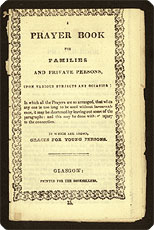
• NSTC 2P24752. Removed from a nonce volume. Title-page cropped close to the border along the top edge and the spine; second leaf with outer edge chipped. (16771)
PRICE'sHistory of Islam
Price, David. Chronological retrospect, or memoirs of the principal events of Mahommedan history, from the death of the Arabian legislator, to the accession of the Emperor Akbar, and the establishment of the Moghul Empire in Hindustaun. London: J. Booth; Longman, Hurst, Rees, Orme, & Brown; and Black, Parry, & Kingsbury, 1811–20. Large 4to (29.8 cm). 3 vols. in 4. I: xvi, 606, [8] pp. II: xvi, 716 pp.; 1 oversized, fold. col. map. III: xv, [1], 483, [1] pp. IV: [2], [485]–998 pp.

 Click the images for enlargements.
 The work was printed by several different hands, all in Wales, and one was a woman printer: Vol. I was done by George North of Brecknock, vol. II by Henry Hughes of Brecon, and vols. III and IV by Priscilla Hughes, also of Brecon and presumably heir to Henry. Vol. II opens with a hand-colored oversized, folding map.

Anti-Muslim & Anti-Deist Prideaux, Humphrey. The true nature of imposture fully display'd in the life of Mahomet. With a discourse annex'd for the vindication of Christianity from this charge ... eighth edition, corrected. London: E. Curll, J. Hooke, W. Mears & F. Clay, 1723. 8vo (20.2 cm, 7.9"). xvi (i.e., xvii), [3], 260 pp.


 Click the images for enlargements.
 The “Discourse for the Vindicating of Christianity from the Charge of Imposture” has a separate title-page dated 1722, but its pagination is continuous with the first work.
• ESTC T138493. Contemporary speckled calf, framed and panelled in blind with panel of contrasting calf decorated with blind roll and blind-tooled corner fleurons, rebacked with sympathetic calf, spine with gilt-dotted raised bands, gilt-stamped leather title-label, and blind-tooled compartment decorations; original leather showing minor acid-pitting with edges worn and rubbed. Ex–social club library: 19th-century bookplate, call number on endpapers, no other markings. Front free endpaper with upper outer corner repaired; browned, with offsetting to margins of first and last few leaves from turn-ins, yet not brittle. (27101)
A
Curious Text &
12 Remarkable Woodcuts
Priest, Josiah. The anti-universalist, or history of the
fallen angels of the Scriptures. Albany: J. Munsell, 1839. 8vo. 420 pp.; 12 plts. (incl. in
pagination).


 Click the images for enlargements.
 The twelve unsigned woodcut plates are full of energy both emblematic and artistic.
• Publisher's quarter tan cloth with blue paper-covered sides; boards stained and chipped with paper peeling, all extremities rubbed, and paper spine label mostly lost. Front hinge cracked, back hinge starting. Front pastedown with institutional bookplate; title-page with private owner's stamp in upper margin and old cataloguing excerpt affixed to lower margin. Lower outer corners waterstained in first half; pages cockled, with occasional faint spotting; first text page with newsprint blurb about Priest affixed in upper margin. A compromised copy, but an extraordinary production; interesting from a variety of perspectives. (15630)
His “Christian History” (the Early Era) — Corrected & ExpandedPriestley, Joseph. A general history of the Christian church, to the fall of the Western Empire ...the second edition improved. Northumberland [PA]: Pr. for the author by Andrew Kennedy, 1803–04. 8vo (21.7 cm, 8.5"). 2 vols. I: xix, [1], 488 pp. II: 552 (i.e., 554), [2] pp.

The work was printed in Northumberland, Pennsylvania, where Priestley settled in 1782, when his liberal political opinions and defense of the French Revolution (in addition to his status as a nonconforming minister of questionable orthodoxy) obliged him to emigrate from England to the United States.
Provenance: Both title-pages inscribed by N. Irwin.
• Shaw & Shoemaker 4912 & 7121. Recent quarter calf over marbled paper–covered sides, spines with gilt-stamped leather title and volume labels. Title-pages with faint impression of a once-pencilled shelf number; some leaves lightly foxed.
 For more SETS, click here.
His “Christian History” (the Later Era) — First EditionPriestley, Joseph. A general history of the Christian church, from the fall of the Western Empire to the present time.... Northumberland [PA]: Pr. for the author by Andrew Kennedy, 1802–03. 8vo (21.6 cm, 8.5"). 4 vols. I: xxxvi, 475, [1 (blank)] pp. II: vii, [1], 539, [1 (blank)] pp. III: [6], 488 pp. IV: x, [3], xii–xiii, [1], 480 pp.
 Click
the image to the left for an enlargement.
Click
the image to the left for an enlargement.
This work was printed in Northumberland, Pennsylvania, where Priestley settled in 1782, his liberal political opinions and defense of the French Revolution (in addition to his status as a nonconforming minister of questionable orthodoxy) having obliged him to emigrate from England to the United States.
Provenance: Each title-page inscribed by N. Irwin.
• Shaw & Shoemaker 2933 & 4913. Recent quarter calf over marbled paper–covered sides, paper darkened at edges and/or turn-ins on some volumes, most notably vol. IV; spines with gilt-stamped leather title and volume labels. Title-pages with faint impression of a once-pencilled shelf number; a few page edges slightly ragged; some instances of small spots of foxing, mostly in margins, and varying degrees of offsetting. Please note these are octavo values — they're substantial, but we think the photo may make them look a bit taller than they actually are.
For more SETS, click here.
TWO Responses toAnthony Collins
Pycroft, Samuel. A brief enquiry into free-thinking in matters of religion; and some pretended obstructions to it ... Cambridge: Pr. at the University Press for Edmund Jeffery & Jonah Bowyer, 1713. 8vo (19.8 cm, 7.75"). [2], 150, [2 (errata)] pp. (lacking half-title). [bound with] Addenbrooke, John. A short essay upon free-thinking. London: Jonah Bowyer, 1714. 8vo. [8], 16 pp. 

 Click the interior images for enlargements.
 Provenance: The first work's title-page has “Ex dono Autoris” inscribed in the upper margin in an early hand.
• Pycroft: ESTC T144698; Allibone 1712. Addenbrooke: ESTC T88427. Recent marbled paper–covered boards, front cover with gilt-stamped leather title-label. Pycroft half-title lacking; title-page with annotation as above. Pages slightly age-toned, with light spotting to final leaves of Enquiry and throughout Essay. (20760)
 TO
Part XI TO
Part XI |