 FREEDOM OF THE PRESS
FREE SPEECH
FREEDOM OF THE PRESS FIRST
PAINE COLLECTION
FIRST
PAINE COLLECTION
 Paine, Thomas. The works of Thomas Paine. London: D. Jordan, 1792. 8vo (21.6 cm, 8.5"). Frontis., [4], 67, [1], viii, 110, [2], 142, [2], 69, [3], 29, [3], 16, 9, [1] pp.


 Click the images for enlargements.
 Individual titles in this collection are often separated and sold as if complete in themselves, but the present volume reflects their original state and the publisher's intent.
• ESTC T5785; Goldsmiths'-Kress 15080; Sabin 58244; Stephans, Paine Collection of Richard Gimbel, 1. Recent quarter calf and marbled paper–covered sides, spine with gilt-stamped leather label and gilt-stamped compartment decorations between gilt-ruled raised bands. Title-page and a few others with oval,19th-century institutional rubber-stamp; lower (closed) page edges rubber-stamped sometime later. Variable, mild to moderate foxing and other spotting, especially “in from edges”; occasional pencilled bracketing or underlining. One leaf with short tear in outer margin, not touching text. (25027)

 Paine
Was a
Paine
Was a DIRTY
Man!Cheetham, James. The life of Thomas Paine, author of Common sense, The crisis, Rights of man, &c. &c. &c. New York: Southwick & Pelsue, 1809. 8vo (22.2 cm, 8.75"). 347, [1] pp.
DIRTY
Man!Cheetham, James. The life of Thomas Paine, author of Common sense, The crisis, Rights of man, &c. &c. &c. New York: Southwick & Pelsue, 1809. 8vo (22.2 cm, 8.75"). 347, [1] pp.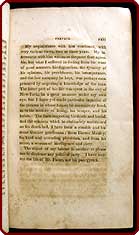
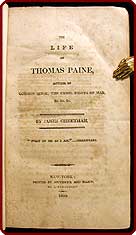 Click either image for an enlargement.
 Provenance: Pencilled note on endpaper, “From Ralph E. McCoy’s Library”; McCoy, emeritus Dean of Libraries at Southern Illinois University, Carbondale, published widely on the First Amendment freedoms.
• Howes C336; Sabin 12379; Shaw & Shoemaker 17193. Later quarter plain brown paper over contemporary tan paper–covered sides; edges and corners rubbed. Front free endpaper (modern) with pencilled note of McCoy’s ownership; front fly-leaf with pencilled gift inscription dated 1849. Offsetting and foxing throughout. A very sound copy.
 For a short, dedicated PAINE list, click here.

 “Official Edition” — A
 Human Rights MilestoneColombia. Constitution. 1853. Constitucion política de la Nueva Granada. Año de 1853. [Bogotá]: no publisher/printer, 1853. Small 8vo (20 cm, 7.9"). 12 pp.
 freedom
of the press, and creation of separation of church and
state.
Click
the images for enlargements.
freedom
of the press, and creation of separation of church and
state.
Click
the images for enlargements.
There were two editions in 1853, the other being 24 pages in length.
• Palau 59737. Original printed yellow wrappers, creased and a little dusty. Very good condition.


Letters
of OBSCURE MEN —
Their Authors &
EVERYBODY ElseCrotus Rubeanus, Johannes, & Ulrich von Hutten. Duo volumina epistolarum obscurorum virorum, ad Dominum M. Ortuinum Gratium, Attico lepôre referta, denuò excusa, & à mendis repurgata. Francoforti ad Moenum: [Apud Ioannem Spies, impensis Sigismundi Feyerabenij], 1581. 8vo (16 cm, 6.25"). [179] ff. (lacking appendix: 16 ff.).

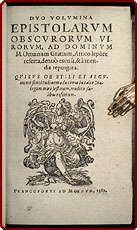
Click the images for enlargements. This example is lacking the appendix (entitled Conciliabvlvm theologistarvm adversvs Germaniae, & bonarum literarum studiosos), and thus is without the colophon providing printer and bookseller information. The title-page bears the printer's device of Feyerabend: Fame and her trumpets.
Uncommon: OCLC and NUC Pre-1956 locate only seven copies of this edition in U.S. libraries, one having been deaccessioned.
• VD16 E1729. This ed. not in Adams or Brunet. Period-style calf, covers framed in blind rolls, spine with gilt-stamped title/date and gilt- and blind-accented raised bands (blind tooling extended onto boards, terminating in decorative fleurons); spine compartments decorated in gilt and blind. Appendix (16 ff.) lacking; letters complete and the handsomely printed text all clean. (25643)
Gómez Farías as SlandererDocumentos relativos al promovido por el Sr. D. Eustaquio Barron contra Benito Gómez Farías. Mexico : Impr. de José Mariano Fernandez de Lara, 1856. Small 8vo. 56 pp.
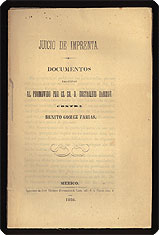
Presented here is Gómez Farías’ side of things, in a very uneditorialized manner.
At the top of the title-page: “Juicio de imprenta.”
• Sewn as issued, lacking front wrapper but rear one present. A good+ copy.
 What
You Saw Depended
on
What
You Saw Depended
on Where You Stood
Giddings, [Joshua R.]. [drop-title] Privilege of the representative -- Privilege of the people. Speech of Mr. Giddings, of Ohio, on the trial of Preston S. Brooks, for an assault on Senator Sumner. Before the House of Representatives, July 11, 1856. [Washington, D.C.: Buell & Blanchard, 1856]. 8vo. 8 pp.
Where You Stood
Giddings, [Joshua R.]. [drop-title] Privilege of the representative -- Privilege of the people. Speech of Mr. Giddings, of Ohio, on the trial of Preston S. Brooks, for an assault on Senator Sumner. Before the House of Representatives, July 11, 1856. [Washington, D.C.: Buell & Blanchard, 1856]. 8vo. 8 pp.

• Removed from a nonce volume; respined with archival tissue. (576)
 The
Famous Wager
in
The
Famous Wager
in English
Pascal,
Blaise. Thoughts on religion, and other
subjects ... translated from the French. London: Pr. by W.B. for A. & J
Churchil, R. Sare, & J. Tonson, 1704. 8vo (19.4 cm, 7.6"). [2], lviii, [12],
352, 361–76, 369–92 pp. (text complete despite pagination).
English
Pascal,
Blaise. Thoughts on religion, and other
subjects ... translated from the French. London: Pr. by W.B. for A. & J
Churchil, R. Sare, & J. Tonson, 1704. 8vo (19.4 cm, 7.6"). [2], lviii, [12],
352, 361–76, 369–92 pp. (text complete despite pagination).

 Click the interior images for enlargements.
 Kennett, an antiquary and translator of a number of French works, served as the first chaplain to the British merchants at Leghorn — where his ministry incurred the wrath of the Inquisition. An interesting international addition to this book's trouble with religious authority, for the Pensees were placed on the Index shortly after their original publication.
Binding: Contemporary speckled calf and mottled calf framed and panelled in gilt rules with gilt-stamped corner fleurons; recently rebacked with speckled calf, spine with gilt-stamped leather title-label and gilt-stamped decorations within gilt-dotted raised bands.
• ESTC T144329; Lowndes 1795. On Kennett, see: Oxford Dictionary of National Biography online. Binding as above, corners and edges with minor rubbing; lower (closed) edges institutionally rubber-stamped. Front fly-leaf with early inked ownership inscription. Pages age-toned and in some instances browned; old, usually (but not quite always) faint waterstaining to a number of leaves; corner creases from old dog-earring and one old inkblot, one leaf with closed tear from outer margin touching a few letters without loss. Pagination erratic, but catchwords correct and text continuous. A solid, usable copy in an attractively refreshed binding. (25099)
Banned!
in Mexico(Pascal,
Blaise). Carta de un leonés a uno de los suscritores
a la reimpresion de las Cartas provinciales de Pascal. México: Impr. de
Luis Abadiano y Valdes, 1842. Small 4to. 16 pp.
• Sutro 756 ("19p." being a typographical error for collation given here); not in Steele, Independent Mexico: A Collection of Mexican Pamphlets in the Bodleian Library. Folded and never sewn or bound; as issued.

The Pope Appointsa New Grand Inquisitor for Spain Pope Paul V (1552–1621; pontificate 1605–21). Letter to King Philip III of Spain, in Latin, on vellum. Rome: 4 January 1619. Narrow strip (10 x 40.5 cm; 4" x 16"). [1] leaf. Click the image for enlargement.
 This contemporary file copy was retained in Rome and signed “S. Card. S. Susannae” (i.e., Cardinal Scipione Cobelluzzi, who was also at this time the Librarian of the Vatican Library).
• Written in a very handsome italic on very good quality vellum. Light discoloration along lower edge, below the writing. (26978)
From
aSuccessful
& Insightful
Indian Civil ServantPrinsep, Henry Thoby. The India question in 1853. London: William H. Allen & Co., 1853. 8vo (19.6 cm, 7.75"). [2], 111, [1 (blank)] pp.
 • Parliament reviewed the management of the East India Company
every 20 years beginning in 1773. At the time of the 1853 review the number
of directors of the East India company was reduced, one of those retained being
Henry Prinsep (1793–1878), an able and successful Indian civil servant
and member of the Council of India. He here gives his insights on a wide range
of issues, from education and
• Parliament reviewed the management of the East India Company
every 20 years beginning in 1773. At the time of the 1853 review the number
of directors of the East India company was reduced, one of those retained being
Henry Prinsep (1793–1878), an able and successful Indian civil servant
and member of the Council of India. He here gives his insights on a wide range
of issues, from education and the press to
finance, the administration of justice, and how best to govern the country.
the press to
finance, the administration of justice, and how best to govern the country.
• NSTC 2P27024. On Prinsep, see: DNB. Removed from a nonce volume. Lightly age-toned. Traces of soiling and small inked numeral on title-page. A few instances of pencilled sidelining.
 TheGlorious Revolution's Centennial Revolution Society (London). An abstract of the history and proceedings of the Revolution Society, in London. To which is annexed a copy of the Bill of Rights. [London]: Pr. by Order of the Committee, 1789. 8vo. 40, 7, [1 (blank)] pp., [1] f., pp. 41–78, [1 (blank)] f., pp. 79–87, 90–92, pp. 79–86, 93–96 (page numbers 88, 89 not used).

 Click the interior images for enlargements.
 Uncommon: No U.S. copy of this issue located via OCLC and ESTC locates only the Harvard copy. There were other, less complete editions of 40 pp., 58 pp., and 78 pp.
• ESTC N15187. Recent full calf, period style; spine with raised bands accented in gilt, oxblood leather gilt-lettered title, publication date and place in gilt at base; covers framed and paneled in gilt rules with gilt-stamped corner fleurons. Shallow chip to top outer corners of final two leaves. One word on p. 32 is blotted out in ink by an early owner with the correction supplied above it. Penned signature (partly cropped) at top edge of p. 79. Pp. 79–92 duplicated, nothing missing. (23766)
Let's NOT Bring Back the Inquisition S., Y. O. Anecdota importante relativa a la Inquisicion de España, y varias reflexiones sobre el mismo asunto. Mejico: Impr. de D.M. Ontiveros, 1820. Small 4to. 35, [1 (blank)] pp.

Uncommon: OCLC locates only the copies at the Bancroft and Chilean National libraries; although, clearly, there is or was one in the Sutro Library.
• Sutro 175. Removed from a nonce volume. A good clean copy. (21742)

 Censoring
Mexican
CLERGY
Spain. Consejo de Regencia. Broadside, begins: “... Los reyes de España, encargados de concordar el decoro de la Santa Iglesia con la seguridad y tranquilidad del Reyno....” Mexico: no publisher/printer, 12 January 1814. Folio (41 cm; 16"). 1 p.
Censoring
Mexican
CLERGY
Spain. Consejo de Regencia. Broadside, begins: “... Los reyes de España, encargados de concordar el decoro de la Santa Iglesia con la seguridad y tranquilidad del Reyno....” Mexico: no publisher/printer, 12 January 1814. Folio (41 cm; 16"). 1 p.
OCLC locates only the copies at the John Carter Brown and the Bancroft Libraries. NUC Pre-1956 adds no others.
• Garritz 1917. Not in Medina, Mexico; not in Sutro. Folded once, otherwise as issued. With Viceroy Calleja's paraph next to his printed name at the base of the document. (24595)
Freedom of the Press in the Spanish EmpireSpain.
Sovereigns, etc., 1808–33 (Ferdinand VII). Broadside.
Begins: “Don Francisco Xavier Venegas...`Exmô. Sr. = ...sabed: que
en las Córtes generales y extraordinarias, congregadas en la Real Isla
de Leon, se resolvió y decretó lo siguiente...Articulo I. Todos
los cuerpos y personas particulares, de qualquiera condicion y estado que sean,
tienen libertad de escribir, imprimir y publicar sus ideas politicas sin necesidad
de licencia, revision ó aprobacion alguna anteriores a la publicacion....”
Mexico, 5 October 1812. Folio extra (48 cm; 17.25"). [1] p.
• Garritz, Impresos novohispanos, 1612. Not in Medina, Mexico; not in Sutro. One horizontal fold; right margin a little crumpled. Revenue stamps on the verso. Viceroy Venegas’s paraph (“rúbrica”) below his printed name. A very good copy.
Freedom
of the Press — Philadelphia, 1800United States. Senate. Committee of Privileges. Report of the Committee of Privileges, on the measures it will be proper to adopt, relative to a publication in the General Advertizer, or Aurora, of the 19th of February last. [Philadelphia: Pr. by John Ward Fenno?, 1800]. 8vo. 7, [1] pp. 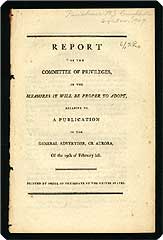
At the heart of the controversy was Duane’s support of Jefferson for president and his exposure of the notorious Ross election bill by which the Federalists sought to thwart Jefferson’s bid for that office.
• Evans 38856; ESTC W021879. Removed from a nonce volume. Clean and in nice condition.

PLACE AN ORDER | E-MAIL US | GO (BACK) TO TOPIC/INTEREST TABLE | PRB&M HOME
All material © 2010
The Philadelphia Rare Books & Manuscripts
Company