 WORLDWIDE CATHOLICA
WORLDWIDE CATHOLICA
WORLDWIDE CATHOLICA
 The
Year in
The
Year in Four
Vols. &
Beautiful Bindings
Four
Vols. &
Beautiful Bindings
 (A
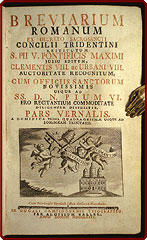
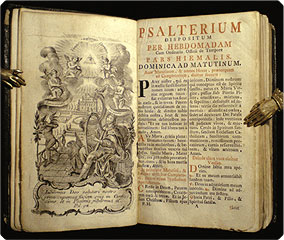
HANDSOME QUARTET). Catholic Church.
Liturgy & ritual. Breviaries. Breviarium romanum
ex decreto sacrosancti Concilii tridentini restitutum S. Pii V. pontificis maximi
iussu editum, Clementis VIII. ac Urbani VIII. auctoritate recognitum, cum officiis
sanctorum novissimis usque ad SS. D.N. Pium VI, pro recitantium commoditate diligenter
dispositis. [Romae]: A. Galler , 1781. 8vo (18 cm, 7.1"). 4 vols. I: [20], 632,
cclxxxviii, 19, [1] pp.; illus. II: [18], 646, ccliv, 21, [1] pp.; 1 plt. III:
[54], 566, cclxxvi, 26 pp.; 1 plt. IV: [20], 608, cclxx, 15, [1] pp.; illus.
(A
HANDSOME QUARTET). Catholic Church.
Liturgy & ritual. Breviaries. Breviarium romanum
ex decreto sacrosancti Concilii tridentini restitutum S. Pii V. pontificis maximi
iussu editum, Clementis VIII. ac Urbani VIII. auctoritate recognitum, cum officiis
sanctorum novissimis usque ad SS. D.N. Pium VI, pro recitantium commoditate diligenter
dispositis. [Romae]: A. Galler , 1781. 8vo (18 cm, 7.1"). 4 vols. I: [20], 632,
cclxxxviii, 19, [1] pp.; illus. II: [18], 646, ccliv, 21, [1] pp.; 1 plt. III:
[54], 566, cclxxvi, 26 pp.; 1 plt. IV: [20], 608, cclxx, 15, [1] pp.; illus.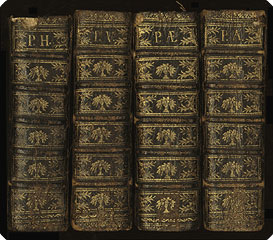
 Click
the images for enlargements.
Click
the images for enlargements.
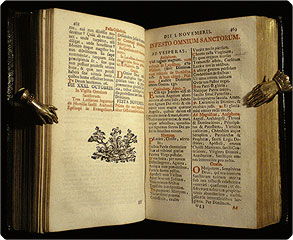
• Not in Weale & Bohatta. Bindings as above, edges
and extremities rubbed, spine leather with tiny cracks, one spine head chipped,
one joint starting. Ex-library with bookplates, rubber-stamp on lower edges
of pages of the closed volumes. One volume with text block separating from
spine and sewing loosening; this with the most leather rubbed away and the
darkest instances of the usually-light waterstaining and spots of foxing seen
occasionally throughout. Endpapers bear early inked ownership inscriptions
and annotations.  An elegant quartet. (12406)
 This entry is repeated in the

 A
Catholic School
Prize Copy:
“High Sanctity
Attained in an Indian Wigwam”
(A
SWEET SINGLETON). Smet, Pierre-Jean de. New Indian sketches.
New York: D. & J. Sadlier & Co., [ca. 1870]. 12mo (16.4 cm, 6.45").
Frontis., [2], [2]–3, [7]–175, [1] pp.
A
Catholic School
Prize Copy:
“High Sanctity
Attained in an Indian Wigwam”
(A
SWEET SINGLETON). Smet, Pierre-Jean de. New Indian sketches.
New York: D. & J. Sadlier & Co., [ca. 1870]. 12mo (16.4 cm, 6.45").
Frontis., [2], [2]–3, [7]–175, [1] pp.

 Click the images for enlargements.
 Provenance: Front pastedown with presentation bookplate of a Catholic Sunday School in Virginia, dated 1880; front free endpaper with recipient's ownership inscription.
• Sabin 82267; Pilling, Proof-sheets, 3631; Wagner-Camp 395; Howes D285. Publisher's green cloth blind-stamped in diapered pattern containing crosses (not in Krupp), spine with elaborate gilt-stamped title and decorations; binding cocked and rubbed, sides with spots of discoloration. Front pastedown and free endpaper as above. Back hinge (inside) reinforced with cloth tape. Pages age-toned, with scattered spotting. (26581)
This entry is repeated in the


Christian History’s ChronicleAdrichem, Christiaan van. Chronicon de Christiano Adricomio Delfo; traducido de latin en español por Don Lorenco Martinez de Marcilla. Madrid: En La Imprenta Imperial, 1679. Small 4to. π4 A–Z4 Aa–Pp4 Qq2; [4] ff., 284 (i.e., 286) pp., [11] ff.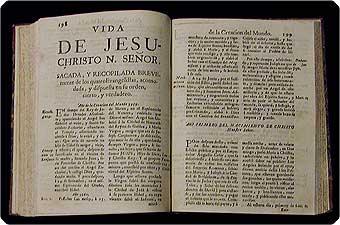
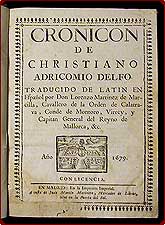 translation into Spanish of Adrichem’s history of Biblical events to the year 109 a.d. An additional “Chronicon Breve” at the end of the volume gives a chronology from Adam and Eve to the year 1585.
Click either imageThe title is within a typographic border; text is printed in double-column format, in roman type.
• Palau 2864. 19th-century half sheep with marbled paper sides; binding shows wear. Lower margin of title-leaf and leaves of the preliminaries with minor worming; repaired with pasted-over paper. Some side- and shouldernotes shaved with loss. Sporadic soiling, not severe.

An
EXTENDED MANUSCRIPT
in an UNCOMMON
PHILIPPINE LANGUAGE
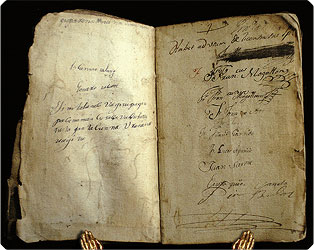
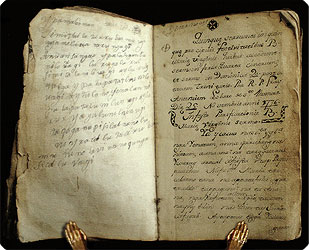
Antonio Lobato de Santo Tomás. Manuscript in Ibanag
on paper: “Quinque sermones in quinque precipuis festivitatibus B. Maria
Virginis. Quibus accedunt sermo in feria quarta cinerumz et sermo in dominica
2o post octavam trinitatis. Per R. P. fray Antoniium Lobatao de Sto. Thomas.
Tuguegarao, The Philippines: 1776–80. Small 4to. 196 pp.
UNCOMMON
PHILIPPINE LANGUAGE
Antonio Lobato de Santo Tomás. Manuscript in Ibanag
on paper: “Quinque sermones in quinque precipuis festivitatibus B. Maria
Virginis. Quibus accedunt sermo in feria quarta cinerumz et sermo in dominica
2o post octavam trinitatis. Per R. P. fray Antoniium Lobatao de Sto. Thomas.
Tuguegarao, The Philippines: 1776–80. Small 4to. 196 pp.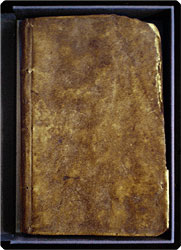
 Click the interior images for enlargements.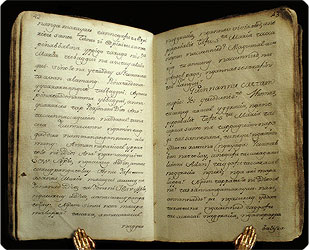
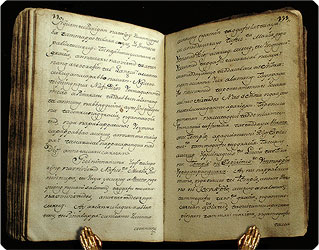
 a large body of work set down in the Ibanag language, from the 18th century and as written/spoken by one of the seminal scholars of the language, should be obvious for anyone researching the language as understood by missionaries, as used by missionaries, as influenced by Spanish, and as held out by Spaniards of authority as the model of Ibanag speech to be emulated. Beyond this, of course, is the interest of the sermons themselves, letting us see what the Ibanaq speakers were hearing from their missionaries — or, at least, this missionary — in this place, in this period.
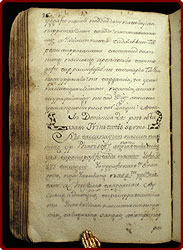
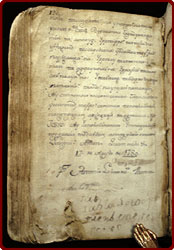
Provenance: A signature “Fr. Antonio Lobato de Sto. Thomas” appears at the bottom of the last page and is almost certainly that of the the friar himself, which would mean that this is his autograph manuscript of the sermons.
• Contemporary very stiff vellum. Binding gnawed by a rodent with loss. Written on a good quality European paper, with some soiling and an occasional stain. No faults are serious and overall this is a remarkably good survival for an 18th-century Philippines manuscript. Now housed in a blue cloth clamshell box. (23668)

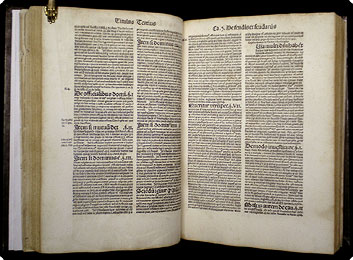
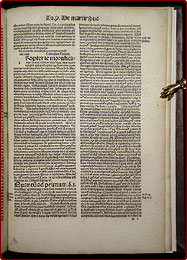
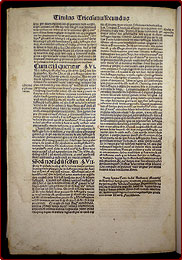
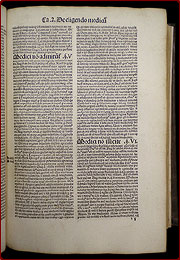
His Fellow Novice Was Fra Angelico . . .  Incunable from the Press of Grüninger Antoninus, Saint, Abp. of Florence. Tertia pars totius su[m]me maioris beati Antonini [i.e., Summa theologica, pars tertia]. [Argentinae: Johann Grüninger, 1496]. Folio ( 31 cm; 12/25"). [311 of 312] ff., lacks final blank.
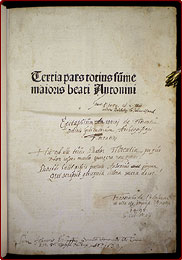
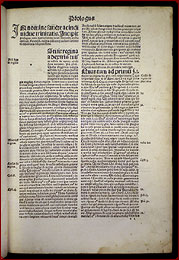
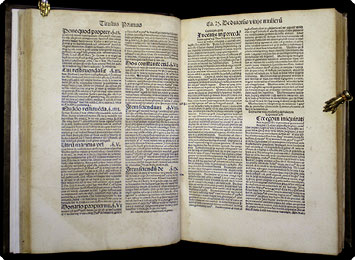 Click the interior images for enlargements.
 Summa Theologica Moralis is the saint's principal work and was written shortly before his death. Scholars say it marks a new and considerable development in moral theology, as well as containing a fund of matter for the student of the history of the 15th century.
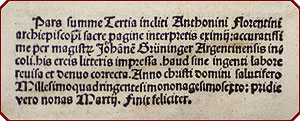
Provenance: 1630 ownership inscription; later in the library of a divinity school, deaccessioned.
Printed
by Hogal —
Illustrated
with Four
Woodcuts
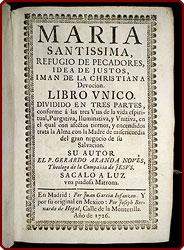
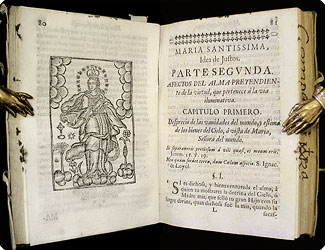
Aranda Novés, Gerardo. Maria Santissima, refugio de
pecadores, idea de justos, iman del la christiana devocion. Libro unico. Dividido en tres partes,
conforme a las tres vias de la vida espiritual, purgativa, iluminativa, y unitiva, en el qual con
afectos tiernos, y encendidos trata la alma con la madre de misericordia del gran negocio de su
salvacion. Mexico: por Joseph Bernardo de Hogal, 1726. 8vo (15 cm; 6"). [4] ff., 341 pp. (blank
verso of p. 265 omitted in numbering), [2] ff., 1 plt.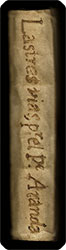
 Click the images for enlargements.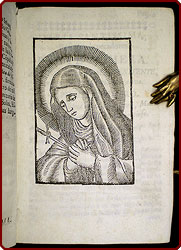
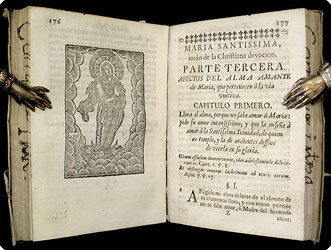 An
uncommon work of mariology; in the U.S. only the New York Public Library reports
owning a copy.
An
uncommon work of mariology; in the U.S. only the New York Public Library reports
owning a copy.
• Medina, Mexico, 2844. Contemporary vellum over light boards, with the ties. Top and bottom edges of the closed volume with inked ownership of an unidentified conventual library. Clean copy. (26872)

Two
Church Fathers —
Two
Scholar PrintersAn
Apparatus by Erasmus
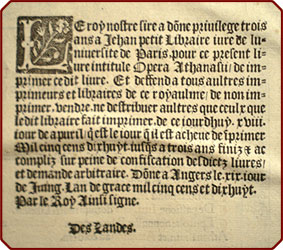
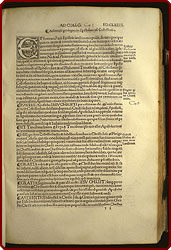
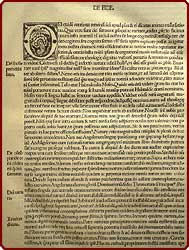
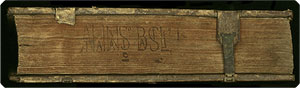
Athanasius, Saint, Patriarch of Alexandria. Athanasii Episcopi Alexandrini sanctissima, eloquentissma que opera ... que omnia olimia[m] latina facta Christophoro Porsena, Ambrosio Monacho, Angelo Politiano, interpretibus, una cum doctissima Erasmi Roterodani ad pium lectorem paraclesi. [bound with another work as below]. Parisiis: Joanne Paruo [i.e., Jean Petit] , [1519]. Folio extra. [6], 255, [66] ff. [bound with] Basil, Saint, Bishop of Caesarea.
Basilii Magni Caesariensium in Cappadocia Antistitis sanctissimi opera plane diuina, variis e locis sedulo collecta: & accuratio[n]e ac impe[n]sis Iodici Badii Asce´sii recognita & coimpressa, quorum index proxima pandetur charta. [Paris: Venundantur eidem Ascensio [i.e., Badius Ascensius, 1520]. Folio extra. [10], 178 ff. 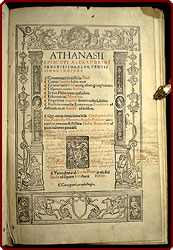
 Click any image where the hand appears on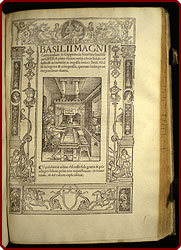
St.
Augustine It
isNOT
— Anselm,
Bernard,Augustinus Aurelius, S. (pseudo). Pious breathings. Being the Meditations of St. Augustine, his Treatise of the love of God, Soliloquies, and Manual. To which are added, select contemplations from St. Anselm, & St. Bernard. London: S. Sprint, T. Bennet, R. Parker, J. Bullord, & M. Gilliflower, 1701. 8vo (20.7 cm, 8.1"). [10], 414 pp. (pagination 177/78 skipped, 209/10 repeated, text complete); 4 plts.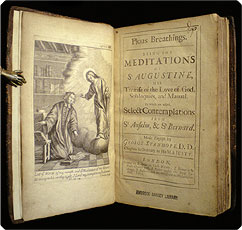
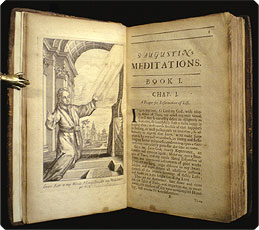 Click the images for enlargements.
 The volume is illustrated with a frontispiece and three other copper-engraved plates done by “I. Simons.”
• ESTC T97614. Contemporary speckled calf framed and panelled in blind with contrasting plain calf panel and blind-tooled corner fleurons, rebacked with lighter speckled calf, spine with gilt-stamped leather title-label; sides abraded. Contemporary inked ownership inscription to back of frontispiece and similarly old small inked notation (monogram?) to title-page; ; title-page institutionally rubber-stamped at base (no other markings). Pages age-toned; intermittent light spotting and staining. (24438)

Dutch Opinions on the Spanish Inquisition Avontroot, Johannes Bartholomeus. Den grouwel der verwoestinghe, oft grondich bericht ende ontdeckinghe, van de gronden der Spaensche inquisitie. In s'Graven-haghe: Aert Meuris, 1621. 4to (19.7 cm, 7.75"). [28], 212 pp.
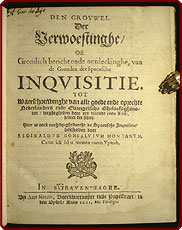
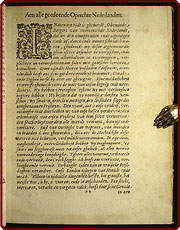
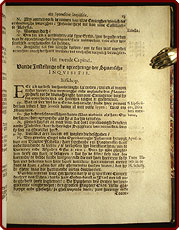 Avontroot was executed by the Inquisition at Toledo in 1632.
This copy lacks the work by González de Montes, a.k.a. Reginaldus Gonsalvius Montanus, which should follow p. 212. It is largely printed in black letter.
Uncommon. OCLC finds only two holdings in the U.S., one being this copy, now properly deaccessioned, and the other at the John Carter Brown Library. NUC Pre-1956 does not identify any additional copies.
• Vekené, Bib. der Inquisition, 139-140; Boehmer, Bibliotheca Wiffeniana, 290 (identifying the volume as the second Dutch translation of the Montanus work not present here). 19th-century half calf with marbled paper-covered sides; joints and corners rubbed. Front pastedown with institutional bookplate, title-page with early inked ownership inscription in upper margin. Pages age-toned with some mild waterstaining; one leaf with lower outer corner torn away, not affecting text. (19569)
 TO Part
II . . . TO Part
II . . . |