
 WORLDWIDE CATHOLICA
WORLDWIDE CATHOLICA
WORLDWIDE CATHOLICA
 Getting
It Right . . . Rubricæ
Missalis Romani
Getting
It Right . . . Rubricæ
Missalis Romani Quarti,
Paolo Maria. Rubricæ Missalis Romani commentariis illustratæ....
Accessere in hac novissima editione tractatus duo ejusdem auctoris, I. De processionibus
ecclesiasticis & de Litaniis Sanctorum: II. De sacris benedictionibus, deque
rebus benedictione sacratis. Venetiis: Ex typographia Balleoniana, 1727. Folio
(34.8 cm, 13.75"). [12] ff., 464 pp., [14] ff., 192 pp., [6] ff.
Quarti,
Paolo Maria. Rubricæ Missalis Romani commentariis illustratæ....
Accessere in hac novissima editione tractatus duo ejusdem auctoris, I. De processionibus
ecclesiasticis & de Litaniis Sanctorum: II. De sacris benedictionibus, deque
rebus benedictione sacratis. Venetiis: Ex typographia Balleoniana, 1727. Folio
(34.8 cm, 13.75"). [12] ff., 464 pp., [14] ff., 192 pp., [6] ff. 

 This
is the second edition of this commentary on the rubrics of the Mass by Paulo
Maria Quarti (fl. ca. 1663), a clerk regular; it was first published in 1674,
but here carries added commentaries on processions, including the Litany of
the Saints, and on blessings. The title-page is handsomely printed in red
and black with a woodcut vignette, and the text is simply ornamented with
a few remarkable woodcut initials and headpieces.
This
is the second edition of this commentary on the rubrics of the Mass by Paulo
Maria Quarti (fl. ca. 1663), a clerk regular; it was first published in 1674,
but here carries added commentaries on processions, including the Litany of
the Saints, and on blessings. The title-page is handsomely printed in red
and black with a woodcut vignette, and the text is simply ornamented with
a few remarkable woodcut initials and headpieces.  Scarce.
• Quarter treed paper over vellum; quaint paper title label in red and black. Some abrasion to spine and edges; endpapers wormed; hinges (inside) open, with sewing holding to visible flat “cords.” Foxing, variously. Vellum page tab at the beginning of De Processionibus.


 Dominican Missions in
 California Quiñones, Baltasar de. Autograph Letter Signed in Spanish to Fray Ignacio Gentil. Rome: 7 April 1789. Tall 8vo (26.5 cm; 10.5"). [2] pp., with integral address leaf.

 Click the images for enlargements.
 The main question at hand is the appointing of a new attorney/solicitor (i.e., procurador) for the California missions. He says, “quiero que ahora y siempre que ocurra [la necesidad de un nuevo procurador], se haga el nombramiento por la Provincia misma despues de haber oido al Presidente de las Misiones, el cual es mi voluntad que en cuanto sea posible camine con acuerdo de la mayor parte a lo menos de los demas misioneros, antes de hacer su propuesta a la Prov[inci]a.”
He also makes appointments to the positions of “Depositarios del Deposito” and the names of the four appointees are given.
• Written in a clear large hand and with the paper and wax closure in evidence. (25329)
Lima Mourns Charles III Rico, Juan. Reales exequias, que por el fallecimiento del señor don Carlos III, rey de España y de las Indias, mando celebrar en la ciudad de Lima. Lima: En la Imprenta Real de los Niños Expósitos, 1789. Folio. [2] ff., 169, [1 (blank)] pp., [1] f., 50 pp., fold. plt.

 Click the interior images for enlargements.
 Rare: WorldCat locates only two copies in the U.S.
An important source on the social and artistic life of Lima in the decade following the Tupac Amaru rebellion.
• John Carter Brown Library, Catalogue, 1493-1800, III,324; Medina, Lima, 1697; Sabin 73902; Vargas Ugarte, Impresos peruanos, 2546. Contemporary limp vellum with late, neatly inked title on spine. Some foxing. Plate lacking lower half and small portion of upper one; a handsome skeleton (memento mori) archer is the focus of what remains. Bookplate sometime removed; rubber-stamps on several pages, including title, reading (yes, in English), “Bought of F. Perez Velasco October 1912.” (25771)

 Catholic Catechism in Aztec — First Edition — Excellent Provenance Ripalda, Gerónimo. Catecismo mexicano. Mexico: Impr. de la Bibliotheca Mexicana, 1758. 16mo. [17] ff., 170 pp., [1] f.


 Click the images for enlargements.
 Beristain describes Paredes as being “outstanding in the Mexican language.” His volume was intended for use by missionaries, by parish priests, and by Indians: Indeed, there is a prologue intended to persuade Indians in particular to read and learn this catechism.


Provenance: Henry Ward Poole ownership signature in minute pencil on rear free endpaper, dated Mexico 1879; old paper auction label at top of spine with lot number; private ownership stamp and bookplate of John Carter Brown; later in the John Carter Brown Library, Providence; deaccessioned.
• Garcia Icazbalceta, Lenguas, 56; Viñaza 341; H. de León-Portilla, Tepuztlahcuilolli, 2286; Palau 269110; Medina, Mexico, 4500; DeBacker-Sommervogel, VI, 210–211; Sabin 71488; Leclerc 2334; Pilling, Proof-sheets, 2891. 19th-century Mexican acid-stained calf, gilt roll of a rope design on boards; gilt spine extra; spine label defective and missing much leather. Title-pages closely cropped at foremargin not costing any letters; small piece torn from the frontispiece. Light to moderate waterstaining and light wear. A rather decent copy of a decidedly important work. (26388)
 French Translation of the NT with
 Exegesis of TextRohault de Fleury, Charles. L'évangile études iconographiques et archéologiques. Tours: Alfred Mame et Fils, 1874. Folio (33 cm, 13"). 2 vols. I: Frontis., [8], vii, [1], 287 pp.; 53 plts. II: Frontis., [4], 320 pp.; 46 plts.

 Click the interior images for enlargements.
 The book is illustrated with 100 engraved plates and numerous in-text engravings, as well as a frontispiece map of the Holy Land in each volume. The plates are mostly figural illustrations taken from paintings in catacombs and on sarcophagi, illuminated manuscripts, mosaics, ivory figurines, murals, etc. The title-pages are printed in black and red ink, and decorated with an engraved vignette.
• Publisher's red cloth, stamped in gilt on the spines and front covers. Spines sunned and front cover of vol. II slightly sunned along fore-edge also; cloth of spines frayed at extremities and chipped in other places. Hinges (inside) of vol. I a little weak, stitching exposed; corners bumped with cloth damage; pages very shallowly bumped. Ex-library, with shelf labels on spines, institutional bookplates on front pastedowns, pressure-stamp to title-pages and one other page in each volume. Paper very good; pages clean and bright. (24688)
 For more SETS, click here.
 Death Dead Priests & Salvation Rojas y Andrade, Francisco. Sermon funebre predicado en la santa iglesia gatedral [sic] de Méjico e dia 26 de enero de 1821 en el aniversario de los venerables sacerdotes. Méjico [i.e., Mexico]: En la oficina de D. Alejandro Valdés, 1821. 4to (20 cm; 8"). [4] ff., 19, [1 (blank)] pp.
 Click the image for enlargement.
 • Medina, Mexico, 12092; Garritz, Impresos novohispanos, 5236. Sewn, in plain wrappers, lacking the front one. A clean copy. (24850)

Oaxaca, 1656 Roque de la Serna, Fray. Autograph Manuscript Signed, in Spanish, on paper. Oaxaca, Mexico, September, 1656. Small 4to, 9 pp.

Single-click the image, Seventeenth-century manuscripts from Oaxaca are rare in the marketplace.
• Written in a clear clerical hand. Leaves separated from each other, but in very good condition.
 For
more MANUSCRIPTS, click here.For
our MSS in SPANISH,
For
more MANUSCRIPTS, click here.For
our MSS in SPANISH,
For theCatholic Mohawk 1865Roman Catholic Church. Liturgy and Ritual. Mohawk. Tsiatak Nihono8entsiake onk8e on8e Akoiatonsera... le Livre des Sept Nations ou Paroissien Iroquois, auquel on a ajouté, pour l'usage de la mission du Lac des Deux-Montagnes, quelques cantiques en langue Algonquine. Tiohtiake [Montréal]: John Lovell, 1865. 12mo (18.5 cm, 7.25"). [6], [6 (blank leaves with decorative borders)] ff., 460 pp.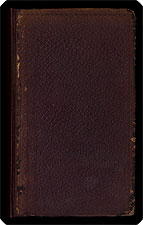
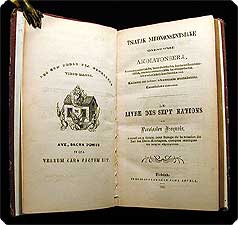 Click the image to the left
 Provenance: Inscribed in 1891 to W.D. Lighthall, prominent citizen of and author of Hochelagans and Mohawks: A Link in Iroquois History, by George S. Wilson.
• TPL 9325; Banks, 109; Pilling, Iroquian, 50; Calderisi, 16. Contemporary roan, rebacked; abrasions along edges. Half-title with short tear at binding and with pencilled inscription as above. Tear at foremargin of one blank leaf; pp. 274–75 with small area of adhesion.
An INNOCENT
Man Executed — His
Speech, His “Paper”Russell, William. The speech of the late Lord Russel, to the sheriffs: Together with the paper deliver’d by him to them, at the place of execution, on July 21. 1683. [colophon: London: John Darby (by direction of the Lady Russel), 1683]. Folio (30.2 cm, 11.9"). 4 pp.
INNOCENT
Man Executed — His
Speech, His “Paper”Russell, William. The speech of the late Lord Russel, to the sheriffs: Together with the paper deliver’d by him to them, at the place of execution, on July 21. 1683. [colophon: London: John Darby (by direction of the Lady Russel), 1683]. Folio (30.2 cm, 11.9"). 4 pp.
 • Nicknamed “the Patriot,” Lord William Russell should have been called “the Unlucky”; he was executed for his alleged role in the Rye House Plot of 1683,although “no reason exists for supposing [him] to have been cognisant of the desperate scheme for the assassination of the king and the Duke of York,” according to the DNB. Here the condemned man sets down on paper “all that I think fit to leave behind me,” which is an assertion of his innocence and his anti-Catholic beliefs.
Click the image to the left
• Nicknamed “the Patriot,” Lord William Russell should have been called “the Unlucky”; he was executed for his alleged role in the Rye House Plot of 1683,although “no reason exists for supposing [him] to have been cognisant of the desperate scheme for the assassination of the king and the Duke of York,” according to the DNB. Here the condemned man sets down on paper “all that I think fit to leave behind me,” which is an assertion of his innocence and his anti-Catholic beliefs.
Click the image to the left • ESTC R36940; Wing (rev.) R2356A. On Russell, see: The Dictionary of National Biography. Unbound, spine delicately reinforced. Pages age-toned and creased, with a few tiny pinpoint holes. Tissue repair to tear from inner margin extending across both leaves, touching but not obscuring a few letters. P. 2 with numerals in an early inked hand in the outer margin.
A Trio of Books onMARRIAGESánchez, Tomás. Disputationum de sancto matrimonii sacramento...editio haec postrema superiorum auctoritate correcta. Antverpiae: Apud Martinum Nutium, 1626 [colophon: Ex typographia Henrici Aertsi]. Folio (36 cm, 14.2"). †6††4A–Z6Aa–Ss 6Tt4AA–ZZ6AAa–KKk6LLl 4AAA–ZZZ6AAAa–LLLl6a–e

• Brunet, V, 115; De Backer-Sommervogel, VII, 532; Englisch, Der erotischen literatur, 145; Palau 294482. Contemporary alum-tawed pigskin, tooled in blind, spine with inked title; binding darkened and scuffed, with clasps now lacking and with leather torn over head and foot of spine (lacking at foot, with underlying vellum showing). Title-page with inked ownership inscriptions dated 1715, later institutional stamp in lower margin, and faint shadows of pencilled notations; front pastedown and one text page also with institutional stamps. Small spots of worming to lower margins of a number of leaves. Pages age-toned, with some instances of marginalia and underlining in early inked hands and occasionally in pencil (a handful of leaves in part III extensively annotated within text); a few spots of foxing, and one leaf with paper flaws partially obscuring a few letters. A big, solid volume.
Charming
Chalma — Miraculous
’Way
BackSardó, Joaquín. Relación histórica y moral de la portentosa imagen de N. Sr. Jesucristo crucificado aparecido en una de las cuevas de S. Miguel de Chalma, hoy real convento y santuario de este nombre, de religiosos ermitaños de N.G.P. y doctor S. Agustin, en esta Nueva España, y en esta provincia del santísimo nombre de Jesús de México. Con los compendios de las vidas de los dos venerables religiosos legos y primeros anacoretas de este santo desierto, F. Bartolomé de Jesús María, y F. Juan de San Josef. [Mexico]: Casa de Arizpe, 1810. Small 4to. [7] ff., 386 pp., plt.
 Click either image for an enlargement.
 In addition to the wealth of information here about the origins of the cave as a site of miracles, its history throughout the colonial period, and accounts of miracles occurring there, this work also has important biographies of Augustinians of the 17th century who played important roles in the care and perpetuation of the site.
 The engraving shows the cave, the Christ figure, pilgrims, and Augustinian friars.
• Palau 302085; Medina, Mexico, 10516. 19th-century mottled sheep, abraded, missing spine label; spine is cracking down center, and volume may sometime split into two halves. Some brown stains, most notable in inner and upper or lower margins; lower outside corner of title–page neatly excised. Old ink notes and scribblings.
 TO Part
XVIII . . . TO Part
XVIII . . . |