
 WORLDWIDE CATHOLICA
WORLDWIDE CATHOLICA
WORLDWIDE CATHOLICA
 English Incunable Leaf — Crucifixion Woodcut
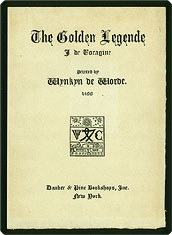
 Jacobus de Voragine. Golden legend [single leaf]. [Westmynster: Wynkyn de Worde, 1498]. Small folio (27.5 cm; 10.5"). [1] f. .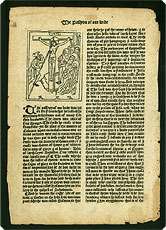
 Click the images for enlargements.
 The text is printed in double-column format in English gothic type. The printer, Wynkyn de Worde (a.k.a., Jan van Wynkyn) was England's first typographer and worked with William Caxton, England's first printer. In 1495, he took over Caxton's print shop, but only after a difficult three-year litigation following Caxton's death in 1491.
Provenance: Sold by Dauber & Pine (NY), the firm having dismembered an incomplete copy of the work and offered the individual leaves each with a letter-press leaf serving as ad hoc title-page.
English incunable leaves with woodcuts are increasingly difficult to obtain. That this Golden Legend leaf bears the image at the heart of its matter makes it a particularly desirable one.
• STC (rev. ed.) 24876; ESTC S103597; Duff 411; Copinger 6475; Goff J-151. Irregular in the margins and the recto of the leaf with old ink crossing out. The page with the woodcut in very good condition. (24601)

 Incunable “Golden Legend” — From the Printer of the
 1483 Jordanus de QuedlinburgJacobus, de Voragine. Lombardica historia que a plerisq[ue] Aurea legenda sa[n]ctorum appellatur. [Arge[n]tine: {Printer of the 1483 Jordanus de Quedlinburg (Georg Husner)}, 1489]. Small folio (27 cm). [260 of 264] ff.

 Click any image where the hand appears on
 page
for page reprints. The imprint information is from the colophon
on H5r.
page
for page reprints. The imprint information is from the colophon
on H5r.
This is an uncommon edition in the U.S. though heavily held in Europe; Goff and ESTC locate only two U.S. copies — this being one of them, deaccessioned.


The text is printed in double-column format in gothic type. In
this copy, virtually all of the initials are nicely accomplished in red or
blue.
• Copinger, II, 6452; ISTC ij00122000; Proctor 618; BMC, I, 138; Goff J122. 19th-century quarter German calf with black mottled paper sides. Various waterstaining throughout, with other stray stains; copy missing first two and final two leaves of text, and the leaves at front and back remargined (with some others repaired). Priced according to faults, not pleasures!
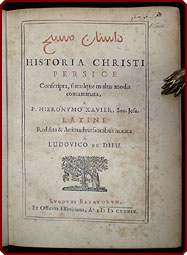
TWO Notable Orientalists — Elzevir Edition Javier, Jerónimo. [two words in Persian, then] Historia Christi Persice conscripta, simulque multis modis contaminata. Lugduni Batavorum: Ex Officina Elseviriana, 1639. 4to (20.6 cm, 8.1"). [24], 636, [4 (index)] pp. [with, as issued, the same author's] [three words in Persian, then] Historia S. Petri Persice conscripta, simulque multis modis contaminata. Latine reddita, & brevibus animadversionibus notata ... Lugduni Batavorum: Ex Officina Elseviriana, 1639. [8], 144 pp. 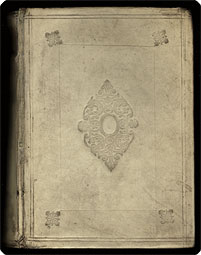
 Click the images for enlargements.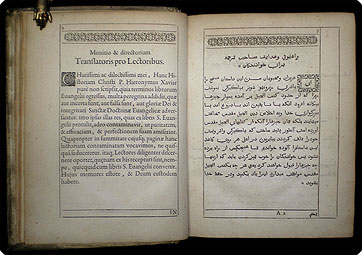
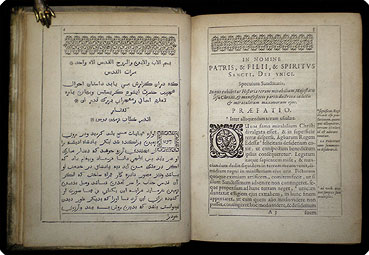
• Willems 490; Copinger 5255; Palau 376807–8; DeBacker-Sommervogel, VIII, 1339. Contemporary vellum, covers framed in blind with blind-tooled central medallion, spine with early hand-inked title; vellum lightly soiled overall, upper outer front corner bumped, splits in spine vellum repaired with Japanese paper and minor (expert) repair to joints. Upper outer corner of title-page with early inked ownership inscription in both Persian and English, possibly by orientalist Henry Pitts Forster (1766–1815); title-page with shadows of other annotations. Pages age-toned, with upper portions darkened; scattered light spotting towards back of volume. Eleven leaves with small spots of worming, affecting a few letters without loss of sense; light to moderate waterstaining to portions of leaves towards back of volume. Last leaf with small tear without loss. One page with pencilled annotations. (25957)

 For the INGALIKJetté, Jules. Canotlé Rannaga Kelékak. Délochét Roka. Winnipeg: Free Press no-rodeneletekteyar, 1904. 8vo (14.4 cm, 5.6"). 54 pp.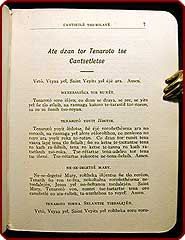
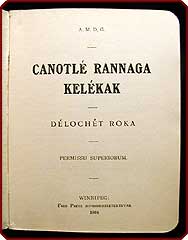
 The Ingalik inhabited the middle part of the Yukon River Valley, Alaska.
Click the image to the right
The Ingalik inhabited the middle part of the Yukon River Valley, Alaska.
Click the image to the right• Cf. Wickersham, 1050, for another title by Jetté with the same imprint. Not in Evans; not in Banks. Original stiff cloth wrappers. Pages very slightly age-toned, otherwise fine.
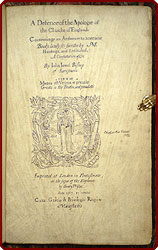
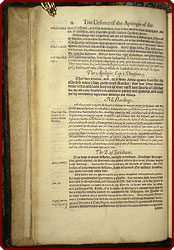
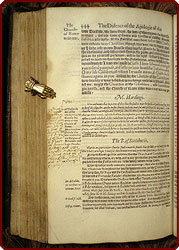
Contentious Counterpoint — Contemporary Binding Jewel, John. A defence of the apologie of the Churche of Englande conteininge an answeare to a certaine booke lately set foorthe by M. Hardinge, and entituled, A confutation of &c. London: Henry Wykes, 1567. Folio (30.9 cm, 12.1"). [24], 742, [6] pp. (title-page in facsim., pp. 675/76 lacking; pagination erratic).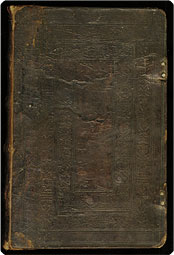
 Click the interior images for enlargements.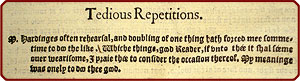
Binding: Contemporary calf over heavy boards, panelled and framed in blind with floral, geometric, and armorial blind-tooling within panels; a pencilled note on the front free endpaper says, “Richardson binding.” There once were clasps, now lost.
Provenance: Title-page with small inked inscription, dated 1836, of Charles Nice Davies (1794–1842), a Welsh linguist, librarian at the Congregational Library, and divinity tutor at Brecon College.
• STC (2nd ed.) 14600.5; ESTC S112182. Bound as above, rebacked preserving original spine; leather cracked, edges and extremities rubbed, clasps now lost, hinges (inside) reinforced some time ago. Institutionally rubber-stamped on lower closed page edges, front pastedown, and first contents page. Title-page provided in early pen and ink facsimile, with inscription as above; last text page with commentary on the book's age, dated 1724 and 1913. Early inked underlining and marks of emphasis throughout; occasional marginalia, two pages dealing with women and the Church having extensive annotations. Pp. 675/76 lacking. One leaf with tear from upper margin extending into three lines of text, without loss; one leaf with large chip from lower margin, not affecting text. Scattered spots of staining only — a clean, strong volume. (24511)
 Transcribed
from Glagolitic
Script into
Cyrillic
John
Chrysostom, Saint.
Glagolita Clozianus[,] id est, codicis Glagolitici inter suos facile antiquissimi
... leipsanon ... servatum in bibliotheca Illmi. Comitis Paridis Cloz.... Vindobonae:
Prostat apud Carolum Gerold, 1836. Folio (31.5 cm; 12.25"). [1] f., lxxx, [1]
f., 86 pp., 2 engr. plates, facsim.
Transcribed
from Glagolitic
Script into
Cyrillic
John
Chrysostom, Saint.
Glagolita Clozianus[,] id est, codicis Glagolitici inter suos facile antiquissimi
... leipsanon ... servatum in bibliotheca Illmi. Comitis Paridis Cloz.... Vindobonae:
Prostat apud Carolum Gerold, 1836. Folio (31.5 cm; 12.25"). [1] f., lxxx, [1]
f., 86 pp., 2 engr. plates, facsim.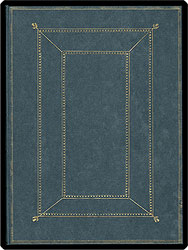
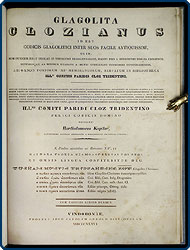
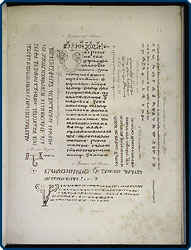 Click the images for enlargements.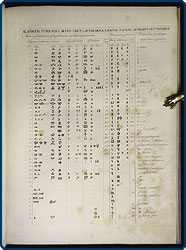
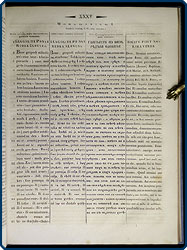
• Recently bound in blue-grey paper over boards, gilt tooling in the 18th-century style on the boards. Scattered foxing. A very good copy of a handsome book. (26002)

His
Surviving Oratory
&
The FIRST
BIBLIOGRAPHY
Printed
in the New World
Juan Bautista, fray. A Jesu Christo S.N. ofrece este sermonario en lengua mexicana ... Primera parte. Mexico: En casa de Diego Lopez Davalos, 1606. 4to (21.5 cm; 8.5"). [26] ff., pp. 1–559, ff. 560–99, pp. 600–39, ff. 640–47, pp. 648–55, 664–709, [1] p., [20 of 24] ff., lacks final 4 leaves.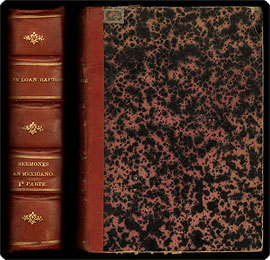
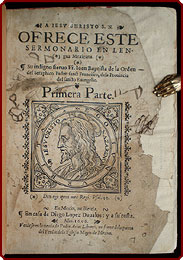
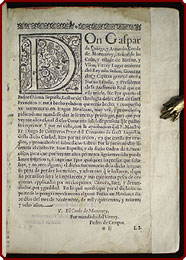
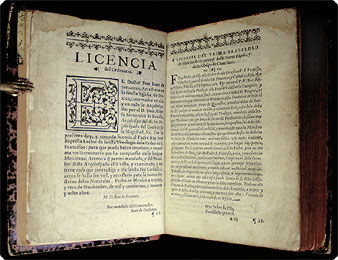 Click the images for enlargements.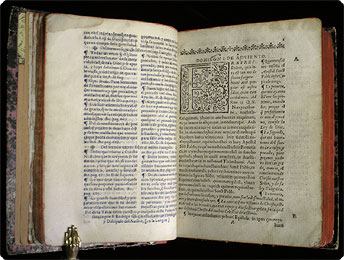
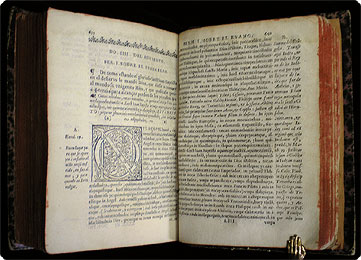
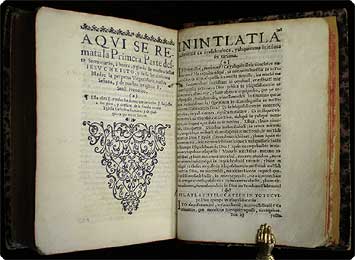
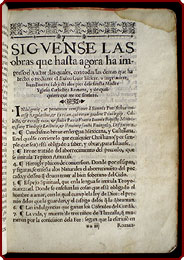
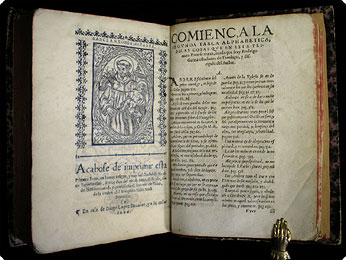
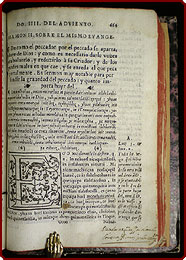
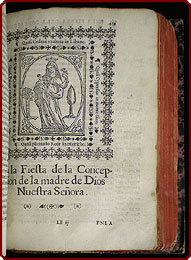
A long unnoticed feature of this book is that it contains the first bibliography published in the New World. On signature **iiii recto and verso is a list of “las obras que hasta agora ha impesso el Auctor” (“the works that until now the author has had published”). The list is not in chronological order nor is it alphabetical by title; nonetheless it is a bibliography and supplies us with information now known only because of its inclusion here. Of the 17 items listed, several have failed to survive in any known copy, including the second part of this sermonario — though at the time of publication of this part one, “de la segunda parte esta ya impresso gran pedaço” (“of the second part a large portion is already printed”).
The volume is enhanced by  half-page woodcuts: here, Christ's portrait profile on the title-page, St. Andrew with his Cross, St. Anne with the Virgin as infant (appearing twice), and St. Anthony of Padua. The text is in roman with side- and shouldernotes in italic type. Printer López Dávalos employs an interesting set of very large (5 x 5 cm; 2" x 2") foliated woodcut initials throughout the volume.
Provenance: 18th-century signature in a few margins of Carlos Perez; late 19th- or early 20th-century bookplate of Nicolás León; in the collection of the John Carter Brown Library (deaccessioned).
• Medina, Mexico, 227; García Icazbalceta, Lenguas, 13; H. de León-Portilla, Tepuztlahcuilolli, 342; Viñaza 114; Newberry Library, Ayer Indians, Nahuatl-21; Pilling, Proof-sheets, 235; Palau 23467; Putick & Simpson 154; Schwaller 11. For biographical information on Bautista, see: Archivo biográfico de España, Portugal, e Iberoamérica, fiche 104, frames 339–73. Late 19th-century quarter red Mexican sheep with purple and black mottled paper sides. Title- and following leaf with irregular foremargins, loss of blank areas of old repaired; waterstaining in margins of early leaves. Some worming in text costing letters here and there but not impeding sense for the reader. Last four leaves, one bearing an illustration of the Crucifixion, absent (i.e., from the section of Bible citations used in the sermons); last leaves present a bit chipped/gnawed at lower corners and one fore-edge. Old marca de fuego eradicated from top edge; all edges red and corners elegantly rounded. Some 18th-century marginalia in Spanish explicating words and phrases in the Nahuatl text. (26393)
Spanish Statecraft — First English Appearance Juan de Santa María, fray. Christian policie: Or, the Christian common-wealth. London: Pr. by Thomas Harper for Richard Collins, 1632. 4to (22 cm, 8.6"). [18 of 19 (lacks blank {only})], 481, [1] pp.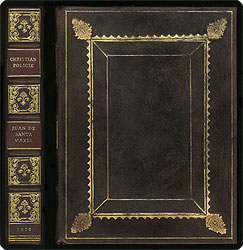
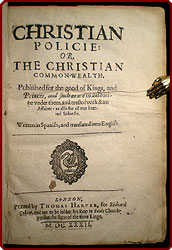
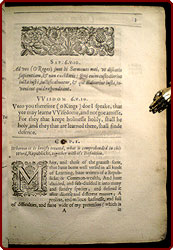 Click the images for enlargements.
  scholar and poet James Mabbe, known for his translations of Cervantes and other works of Spanish literature and theology.
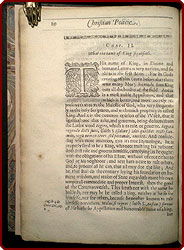
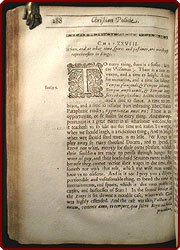
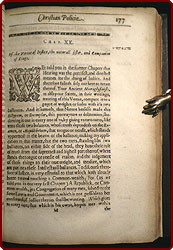
Uncommon: ESTC, OCLC, and NUC Pre-1956 find only 9 U.S. holdings.
• ESTC S107911; STC (2nd ed.) 14831. Period-style calf framed and panelled in gilt fillets with gilt-stamped corner fleurons; spine gilt extra with gilt-stamped leather title and author labels. Lacks initial blank leaf, as is the case with virtually all copies. Two leaves with tattered outer edges, one leaf with small hole affecting a few letters; pages with some moderate offsetting, a few browned. (25084)
Special
Type for the
Micmac
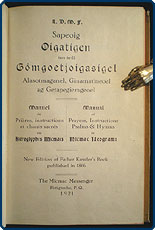
Kauder, Christian. Sapeoig oigatigen tan tetli
gômgoetjoigasigel...manual of prayers, instructions, psalms & hymns in Micmac ideograms.
Ristigouche, Quebec: The Micmac Messenger, 1921. 16mo (18 cm, 7.125"). 456 pp. (pp.i–xii never
bound in).
the
Micmac
Kauder, Christian. Sapeoig oigatigen tan tetli
gômgoetjoigasigel...manual of prayers, instructions, psalms & hymns in Micmac ideograms.
Ristigouche, Quebec: The Micmac Messenger, 1921. 16mo (18 cm, 7.125"). 456 pp. (pp.i–xii never
bound in).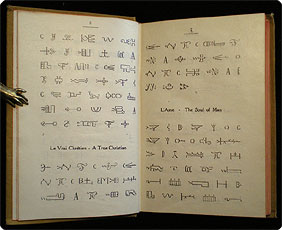
 Click the images for enlargements.
 The characters used to print this work were the invention of Father Christian
Leclercq, a 17th-century missionary, and later revised and improved by Abbé
Pierre Maillard. More than 5700 types were cut and cast for the book, and
the characters each represent words rather than sounds. This may well be the sole work printed in these
characters.
This issue without English language front matter (i.e., pp. i–xii).
• Pilling, Algonquian, p. 275 (ref). Publisher's yellow-brown cloth with simply gilt-lettered spine, to which one stain and general light soiling; each cover creased vertically from an old bump. All edges red. Internally clean. (25312)

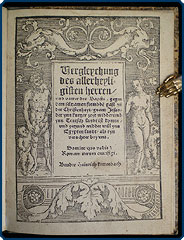
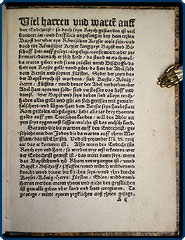
“A Bitingly SARCASTIC Portrayal of thePAPACY” Kettenbach, Heinrich von. Vergleychung des allerheyligisten herren, und vatter des Bapsts, gegen dem seltzamen frembden gast, in der Christenheyt, gnant Jesus, der in kurtzer zeyt widerumb in Teutschlandt ist komen, und yetzund wider will in Egiptenlandt als eyn verachter bey unns. [Wittenberg?: Nickel Schirlentz?, 1523]. Small 4to (19 cm; 7.5"). [12] ff.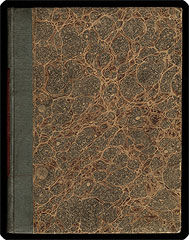
 Click the images for enlargements.
 Title-page with a woodcut single-element border featuring a bearded near-naked man with a child and a naked woman opposite with a child; Adam and Eve, with Cain and Abel?
This is the issue without the colophon.
WorldCat locates only two copies of any edition in North America and COPAC finds one copy of this edition in Great Britain.
• VD16 K835(?) or K836(?); Schrodt & Vogelstein 149–50; Köhler 2039. 20th-century quarter green cloth with marbled paper sides; crescent of light waterstaining to foremargin of nearly all leaves. Blank leaf at end with later 16th-century writing in German; same leaf with damage from a liquid spill causing a hole piercing earlier leaves also, affecting perhaps four letters; these leaves show the stain from the spill in graded degrees from “notable” to “faint.” (25962)
Cutting-Edge
Biblical Scholarship
— Three
Maps
Lamy, Bernard. Commentarius in harmoniam sive concordiam quatuor evangelistarum.... Parisiis: Excudebat Joannis Anisson, 1699. 4to (12.6 cm, 10.25"). 2 vols. in 1. I: 2 a[n]4 e[n]4 A–Z4 Aa–Zz4 AAa–ZZz4 AAaa – OOoo4; [2] ff., xvi, 661, [1] pp., [25] ff.; 3 plts. II: 2 a–h4 A–Z4 Aa–Xx4 Yy2; [2] ff., lxiv, 326 pp., [15] ff.; 3 plts.
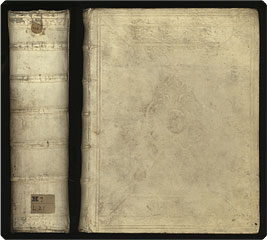
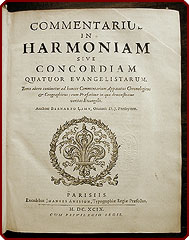
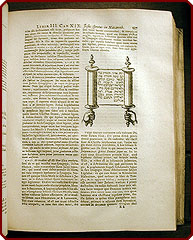 Click the interior images for enlargements.
 Provenance: Charles Spencer, Third Earl of Sunderland, lot 7230 in the Sunderland Library sale (1882).
• On Lamy, see: New Catholic Encyclopedia, VIII, 354–55. 18th-century vellum over boards with raised bands, lightly soiled; on the covers an ornate mandorla inside a composite frame. Crack in the vellum along front joint, joint itself sound. Ex-library with paper labels on spine; old pressure-stamps, including one on title-page of vol. I. Upper outer corner of title-leaf lost taking part of one letter of title; small tear into printed border of first map in vol. II. All edges speckled blue and red. A stout, substantial volume.
The Man Had One of
Those Breathtakingly
Simple Insights
. . .
Lancellotti, Giovanni Paolo. Institvtiones ivris canonici, qvibvs ivs pontificivm singulari methodo libris quattuor comprehenditur.... Lugduni: Apud haeredes Gulielmi Rouillii, 1614. 16mo (12.1 cm, 4.75"). A–Z8Aa–Nn8; 500 pp., [38] ff. [bound with] Naogeorg, Thomas. Rvbricæ, sive svmmæ capitvlorvm ivris canonici Thomæ Noageorgi [sic] Straubingensis opera in lucem editæ.... Lugduni: Apud haeredes Gulielmi Rouillii, 1614. 16mo. A–S8; 286 pp., [1 (blank)] f.
Breathtakingly
Simple Insights
. . .
Lancellotti, Giovanni Paolo. Institvtiones ivris canonici, qvibvs ivs pontificivm singulari methodo libris quattuor comprehenditur.... Lugduni: Apud haeredes Gulielmi Rouillii, 1614. 16mo (12.1 cm, 4.75"). A–Z8Aa–Nn8; 500 pp., [38] ff. [bound with] Naogeorg, Thomas. Rvbricæ, sive svmmæ capitvlorvm ivris canonici Thomæ Noageorgi [sic] Straubingensis opera in lucem editæ.... Lugduni: Apud haeredes Gulielmi Rouillii, 1614. 16mo. A–S8; 286 pp., [1 (blank)] f. 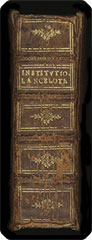
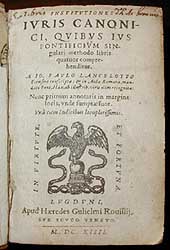
Bound with Lancellotti's work is a summary of titles of chapters of canon law compiled by Thomas Naogeorg (1508–63). Naogeorg's wanderings took him from being a Dominican to being a Lutheran to being a Calvinist. Along the way, during his Lutheran phase, he studied canon law for a year (1551) at Basel, during which time he compiled and published this work, likely as a student's guide. He is better known for his plays, in which he sharply attacks the Papacy.
The two works here were first published by the firm of Guillaume Rouillé, in 1587 and 1588 respectively, and may have been intended to be bound together, as witnessed by the Library of Congress copy. The title-page transcriptions of the earlier editions (except for the date and "hæredes"), and their signatures, pagination, and arrangement, match those of these present 1614 editions. There are italic shouldernotes, and woodcut headpieces and initials.
• On Lancellotti, see: New Catholic Encyclopedia, VIII, 356. 17th-century calf; covers gilt-ruled; gilt spine. Abraded, corners bumped with leather lost, joints opening—yet this is a perfectly sound volume. All edges speckled brown. Bouquiniste's paper label on front pastedown and front free endpaper lacking. Two words inked long ago in two margins, and one page with old pencilled underlining.
He Had a Dream Langland, William. The vision and creed of Piers Ploughman. London: Reeves & Turner, 1883. 12mo. 2 vols. I: Frontis., xl, [2], 272 pp. II: [4], [273]–621 pp.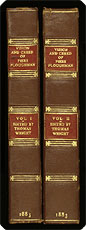
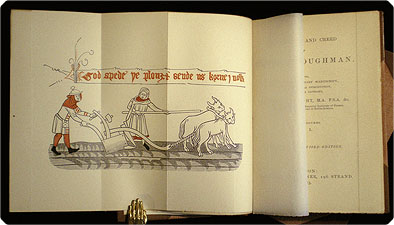 Click the interior images for enlargements.
 • Later 19th-century half toffee-brown calf over salmon cloth boards; gilt-lettered red leather spine-labels (title, volume, editor); gilt-accented raised bands, date in gilt at base. Slight rubbing to joints and extremities, one label with a streak of discoloration, vol. II with small chip at head of spine and lower corners rubbed. Pages toned. One leaf with edge nicks. Lower outer portion of pp. 211/212 chipped, with loss of outermost letters of bottom four lines and detached piece laid in; aforesaid pages also creased down the middle, brittle, and all but separated in two (still, present). Top edge gilt, others deckle. A pleasing and attractive binding; a volume internally clean. (21256)
 For more SETS, click here.
The
Road
to Heaven inNahuatl
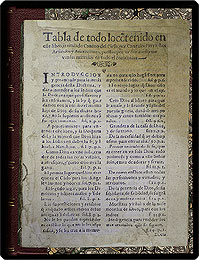
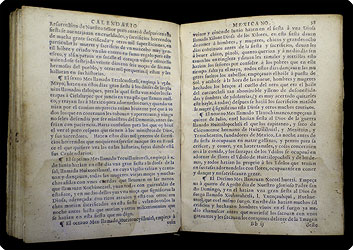
León, Martín de. Camino del cielo en lengua mexicana, con todos los requisitos necessarios para conseguir este fin, co[n] todo lo que un Xp[r]iano deue creer, saber, y obrar, desde el punto que tiene uso de razon, hasta que muere. En Mexico: En la Emprenta de Diego Lopez Davalos, 1611. Small 4to (18.5 cm; 7.25"). Fols. 10–11, 13–69, 69[!]–73, [nothing missing] 76, 75, 77–108, 110–23.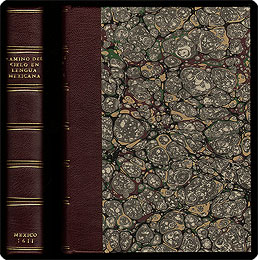
 Click the images for enlargements.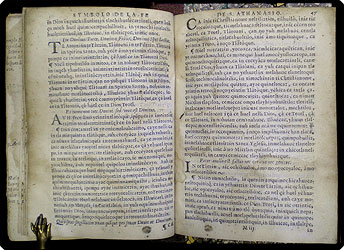
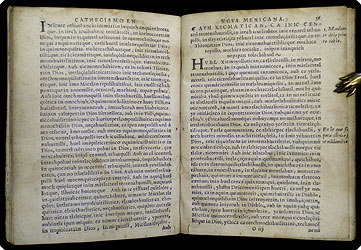
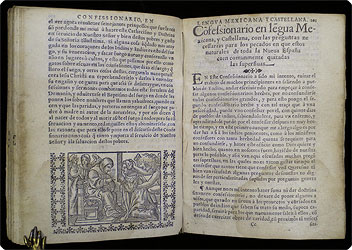
 Priced much, much less than a good, complete copy; and a relic with much more than its lowered price to recommend it. (25860)
For Books for the BUSTED
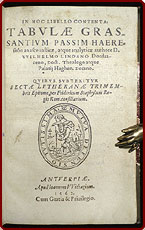
This Author Covers a Lot HereLindanus, Guilelmus Damasus. In hoc libello contenta: Tabulae grassantium passim haeresen anasceuasticae ... Quibus Subtexitur sectae Lutheranae trimembris epitome. Antuerpiae: Apud Joannem Withagium, 1562. Small 8vo. [46], 26 ff.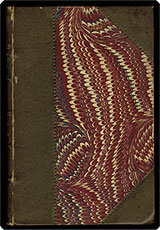
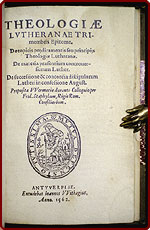
Rare in the U.S., withWorldCat locating only one copy in America (this at Notre Dame).
• Adams 728. 19th-century half-calf with marbled paper sides; leather (only) cracked at hinges, with volume holding quite sound. Library bookplate but no other markings. (19937)

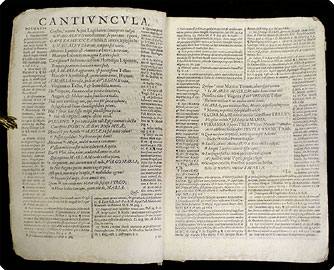
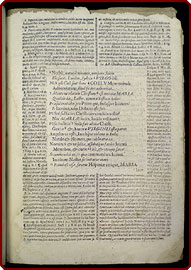
In PRAISE of theVirgin of Guadalupe Lopez de Abiles, Joseph [a.k.a., José López de Aviles]. Veridicum ad modum anagramma, epigramma obsequiosum, unaque cum acrostichide virgilio centunculus rigorosus in laudem purissimae immaculataeque conceptionis sanctissimae virginis dei-genitricis Mariae.... Mexici: ex typographia vidue Bernardi Calderon, 1669. Folio (30 cm; 11.75"). [17of 19] ff., lacking half-title and plate.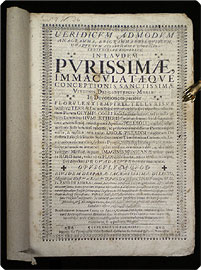
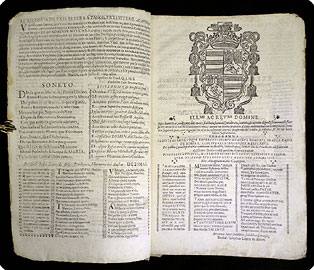 Click the images for enlargements.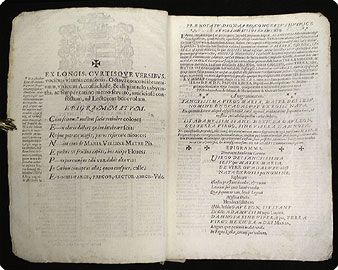
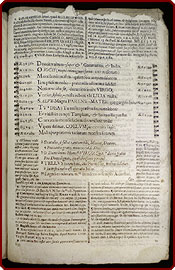
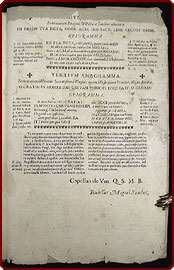
 This
ambitiously designed production is from the press of one of Mexico's famous
17th-century woman printers, the Widow Calderón.
This
ambitiously designed production is from the press of one of Mexico's famous
17th-century woman printers, the Widow Calderón.
The work ends with a short essay addressed to López de Abiles by Lic. Miguel Sánchez and with anagrams by him as well. Sánchez was the author of Imagen de la Virgen Maria madre de dios de Guadalupe, milagrosamente aparecida en la ciudad de Mexico that had appeared in 1648. As a researcher with considerable knowledge of the Virgin of Guadalupe, he praises López de Abiles in no uncertain terms.
For some unfathomable reason Medina lists this under the extensive half-title — Poeticum viridarium in honorem, laudationem, et obsequium purae admodum ... Mariae: eiusdem dominae miraculosae Mexiceae imaginis de Guadalupe.... — and the cataloguer at the University of Arizona has blindly followed Medina down that road so that the WorldCat record is not findable via the real title.
Rarity: WorldCat locates only one copy worldwide but we know of two others. No additional copies were located via COPAC, Catálogo Colectivo del Patrimonio Bibliográfico, Metabase, or the OPACs of the Spanish National Library, the Mexican National Library, and the British Library.
• Medina, Mexico, 1016; Andrade 582; Grajales & Burrus, Bibliografia guadalupana, 82. In later wrappers, a little tattered at the spine. Lacks the half-title and the plate. Top margins of last 10 leaves rodent-gnawed with loss of paper but not of text, although a few letters are touched and the headline words “Segundum Anagramma” lost to that animal. Some light staining, front and rear. In all, a good if damaged copy of an important rarity. (26413)
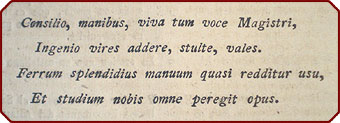
 Dictionary & Catechism in OTOMÍ López Yepes, Joaquín. Catecismo y declaracion de la doctrina cristiana en lengua otomí, con un vocabulario del mismo idioma. Megico [i.e., Mexico]: Impreso en la oficina del ciudadano Alejandro Valdes, 1826. 8vo. 254 pp., [1] f.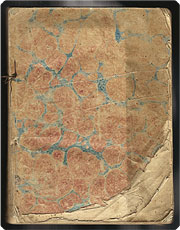
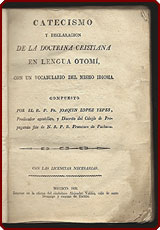
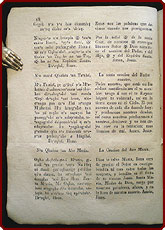
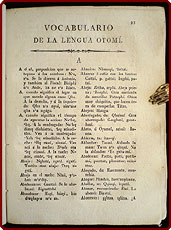 Click the interior images above for enlargements. More than 150 pages of this work comprise an Otomí/Spanish vocabulary. Included at the end are instructions for teaching the catechism to Indians.
• Viñaza 420; García Icazbalceta, Apuntes, 40; Sabin 106013; Palau 142256; Pilling, Proof-sheets, 2316. Not in Newberry Library, Ayer Collection. Stitched in original wrapper; wrappers tattered, torn with some loss, and partly darkened; same for the front free endpaper and fly-leaf. Some dog-earing, and some leaves (including title) with some marginal soiling, but really, a worthwhile copy. (25558)
A Massachusetts Convent Looted
& BurnedLoring, Charles G. Report of the committee, relating to the destruction of the Ursuline Convent, August 11, 1834. Boston: J.H. Eastburn, 1834. 8vo (25 cm, 9.9"). 16 pp.
Looted
& BurnedLoring, Charles G. Report of the committee, relating to the destruction of the Ursuline Convent, August 11, 1834. Boston: J.H. Eastburn, 1834. 8vo (25 cm, 9.9"). 16 pp. 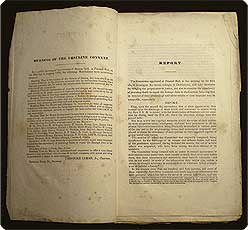
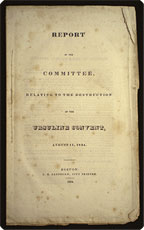
• Sabin 12115. Sewn, now in a Mylar folder. Light spots of foxing, more pronounced to first and last few leaves; edges untrimmed and a bit ragged. (19753)
Rhetoric
for the Preacher:
Barcelona Edition
Luis, de Granada. Los seis libros de la rhetorica eclesiastica, o de la manera de predicar.... Quinta impresion. Barcelona: En la Imprenta de Juan Jolis y Bernardo Pla, 1778. 4to (20.8 cm, 8.25"). [1] f., xxxvi pp., [6] ff., 562 pp. 
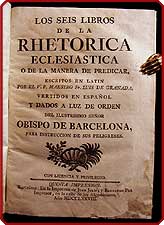
• Palau 108151. Recent neat vellum over light boards, spine lettered in black. Paper cockled with light to moderate waterstaining and small spots of soiling, not impeding legibility. Some marginal chipping with tissue paper repair on front fly- and title-leaf, a few shallow marginal tears elsewhere, and a wormhole in lower inner margin of final 22 leaves and rear fly-leaf; rear fly-leaf with some holing. Overall actually in very good condition.
The Papal Court — As Seen by a CriticLunadoro, Girolamo. Relazione della corte di Roma e de’riti, che si osservano in esta, suoi officij, dignità, e magistrati ...nuovamente corretta, & accresciuta, con l’aggiunta del Moderno maestro di camera. Roma: Presso Michel’Angelo, e Pier Vincenzo Rossi, 1697–98. 12mo (14.3 cm, 5.6"). π8A–O12*3 2A–2G12 2H4 (-π1); [7] ff., 336, [6], 176 pp. (lacks initial blank)
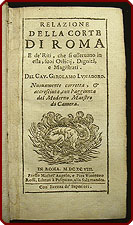
Click the interior image for an enlargement.
Francesco Sestini’s Il Moderno Maestro di Camera has a separate title-page, dated 1698; the first title-page bears the printer’s crowned salamander device and the second a vignette of Minerva. The collation here matches descriptions of other copies.
Uncommon: Searches of OCLC and RLIN locate only three copies in U.S. libraries.
Provenance: Late 18th-century private collector’s booklabel — “Ex Biblioth. Hamburg. Wolfiana”; also with a 19th-century bookplate.
• Contemporary vellum, spine with early hand-inked title; binding with small spots of light discoloration, spine title a bit scuffed. All edges speckled blue. Front pastedown with bookplates as above; front free endpaper with early inked shelving number. First gathering, including title, a cancel. Title-page reinforced at inner margin. Pages clean.
Mariology for the New World Luzuriaga, Juan de. Paranympho celeste[.] Historia de la mystica zarza, milagrosa imagen, y prodigioso santuario de Aranzazu de religiosos observantes de n. seraphico padre San Francisco en la provincia de Guypuzcoa. Mexico: Por los herederos de la viuda de Bernardo Calderon, 1686. Folio (27 cm; 10.75"). 3 pts. in 1 vol. [17 of 18] ff., 114, 96, 112 pp., [8] ff., lacking the plate (as usual), and a leaf in the preliminaries.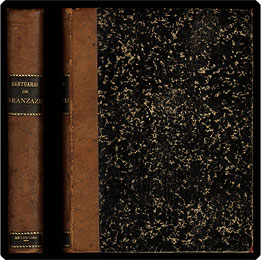
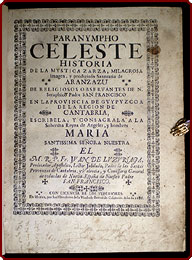 Click the images for enlargements.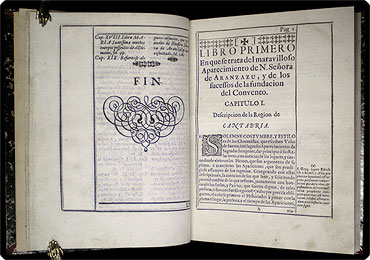
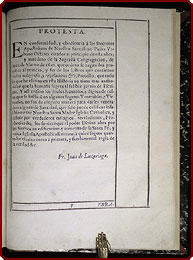 It is extremely noteworthy that this thick and significant history of this Cantabrian apparition was written and published in Mexico and not in Spain. After years of service in Cantabria, his native region, in 1680 the author was transferred to New Spain to serve as the Comisario General of the Franciscan Order in New Spain and the Philippines, and it was in Mexico City that he composed his massive and important work. He then also had it printed there, in spite of the fact that he retained contacts in Spain where it presumably would have had a greater natural audience, and in spite of the fact that it was, for its day, a very large project for a Mexican press to be offered. Or for one to take on! Additionally, it is printed on exceptionally thick paper.
Provenance: Bookplates of Luis and Clotilde Montt (Chilean collectors) and of the John Carter Brown Library (deaccessioned).
• Medina, Mexico, 1376; Palau 144367; Beristain, II, 198; Leclerc 1190. On Luzuriaga, see: Archivo biográfico de España, Portugal, e Iberoamérica, fiche 534, frames 77–81. 19th-century quarter brown sheep with black leather spine labels lettered in gilt; black and white marbled paper sides. Without the plate and one leaf in the preliminaries; last three leaves of the index damaged with loss in the foremargins, costing a few words and letters; title-page soiled and with several old tears very well-repaired of old; stains occasionally, never bad ones. Withal a rather good copy of a  very uncommon work of New World Mariology. (26392)

 TO Part
XIII . . . TO Part
XIII . . . |