 INCUNABLES INCUNABLES
  " Incunabula" is the
special name given to European books printed from movable type before
1 January 1501 — that is, before the end of Gutenberg's own century. The
name comes from the ancient Latin word for "baby clothes" or the medieval
Latin one for "things of the cradle" and is often Englished as "incunables."
The printing centers of the New World had their own similarly revered
infancy periods, of course, starting for example in 1539 for Mexico, 1639
for what is now the U.S., 1660 for Guatemala, and 1766 for Argentina.
" Incunabula" is the
special name given to European books printed from movable type before
1 January 1501 — that is, before the end of Gutenberg's own century. The
name comes from the ancient Latin word for "baby clothes" or the medieval
Latin one for "things of the cradle" and is often Englished as "incunables."
The printing centers of the New World had their own similarly revered
infancy periods, of course, starting for example in 1539 for Mexico, 1639
for what is now the U.S., 1660 for Guatemala, and 1766 for Argentina.
 By
extension, American imprints of these periods are sometimes called " New
World Incunables" and they occasionally appear below among their elder,
European brothers and sisters. By
extension, American imprints of these periods are sometimes called " New
World Incunables" and they occasionally appear below among their elder,
European brothers and sisters. |

 His
Fellow Novice Was Fra Angelico
. . .
His
Fellow Novice Was Fra Angelico
. . .  INCUNABLE
from the Press
of Grüninger
INCUNABLE
from the Press
of Grüninger
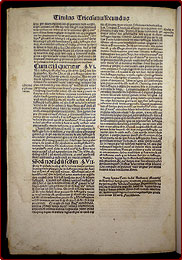
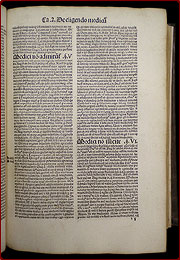
 Antoninus, Saint, Abp. of Florence. Tertia pars totius
su[m]me maioris beati Antonini [i.e., Summa theologica, pars tertia]. [Argentinae: Johann Grüninger,
1496]. Folio ( 31 cm; 12/25"). [311 of 312] ff., lacks final blank.
Antoninus, Saint, Abp. of Florence. Tertia pars totius
su[m]me maioris beati Antonini [i.e., Summa theologica, pars tertia]. [Argentinae: Johann Grüninger,
1496]. Folio ( 31 cm; 12/25"). [311 of 312] ff., lacks final blank.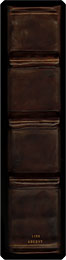
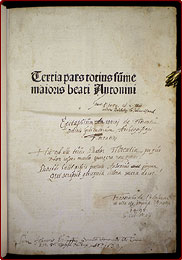
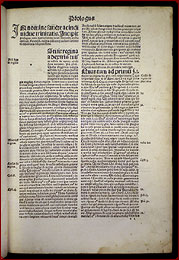
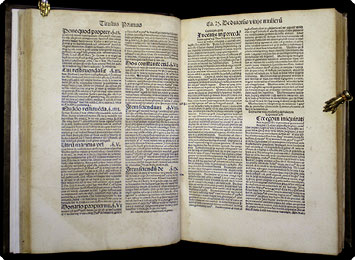
 Click the interior images for enlargements.
 Summa Theologica Moralis is the saint's principal work and was written shortly before his death. Scholars say it marks a new and considerable development in moral theology, as well as containing a fund of matter for the student of the history of the 15th century.
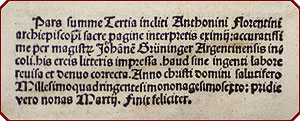
Provenance: 1630 ownership inscription; later in the library of a divinity school, deaccessioned.
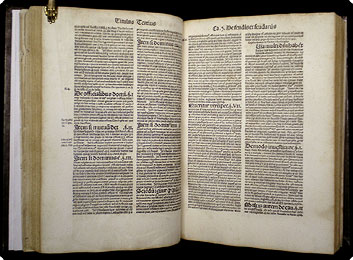
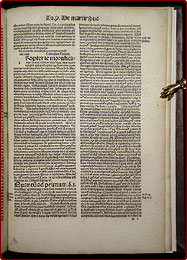
 Incunable
Cicero with!Extensive
Evidence of Readership
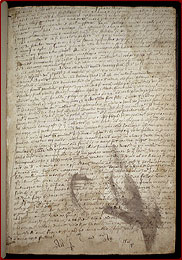
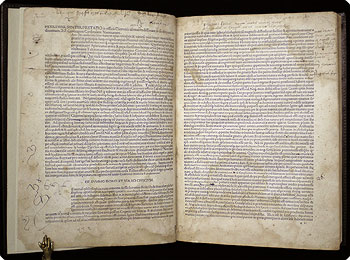
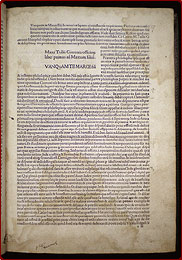
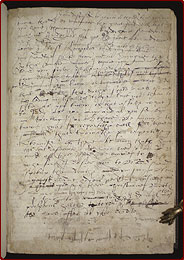
Cicero, Marcus Tullius. De officiis [and other works].
Venetiis [Venice]: Bernardinus Rizus, Novariensis & Bernardinus Celerius, 12 Oct. 1484. Folio. [180
of 182] ff., lacking b4–5.
Incunable
Cicero with!Extensive
Evidence of Readership
Cicero, Marcus Tullius. De officiis [and other works].
Venetiis [Venice]: Bernardinus Rizus, Novariensis & Bernardinus Celerius, 12 Oct. 1484. Folio. [180
of 182] ff., lacking b4–5.
 Click the interior images for enlargements.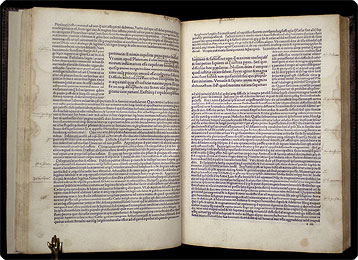
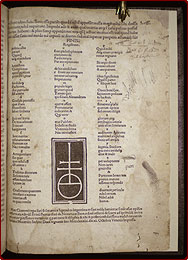
The recto of leaf a1 is blank, the text of the prefatory matter beginning on the verso.
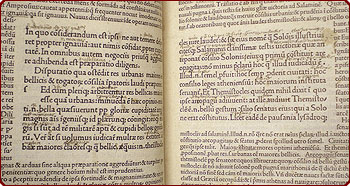
Provenance: Signature of “John Webb” in a 17th-century hand twice in margin of k3r.
Uncommon beyond the Continent: ISTC and Goff locate only two copies in the U.S. and ISTC locates only two copies in the U.K. (one incomplete), but there is a third copy at the British Library.
• ISTC ic00601000; Goff C601; HC 5274*; IGI 2910; Pr 4942; BMC,
V 400; GKW 6954. Full modern walnut calf old style: Spine with
raised bands, accented with gilt and blind rules, the latter extending onto
covers to terminate in trefoils with blind double fillets beyond. Gilt center
devices in the spine compartments. Red leather spine label lettered in gilt,
and date in gilt at base of spine. Lacking two leaves (b4–5). Upper
corners of leaves in gatherings & and [con] damaged with loss of paper.
Lower corner of i1 torn with loss of text of both sides of leaf. Waterstaining
and old dampstaining variously, this often faint and never really worse than
moderate (worst at beginning/end); some age-toning and dustsoiling.  Though
an imperfect copy, a rarity; indeed, with its manuscript enhancements, a “uniquum.”
(25766)
Though
an imperfect copy, a rarity; indeed, with its manuscript enhancements, a “uniquum.”
(25766)
Incunable “Golden Legend” — From the Printer of the 1483 Jordanus de QuedlinburgJacobus, de Voragine. Lombardica historia que a plerisq[ue] Aurea legenda sa[n]ctorum appellatur. [Arge[n]tine: {Printer of the 1483 Jordanus de Quedlinburg (Georg Husner)}, 1489]. Small folio (27 cm). [260 of 264] ff.

 Click any image where the hand appears onpage
for page reprints. The imprint information is from the colophon
on H5r.
Click any image where the hand appears onpage
for page reprints. The imprint information is from the colophon
on H5r.
This is an uncommon edition in the U.S. though heavily held in Europe; Goff and ESTC locate only two U.S. copies — this being one of them, deaccessioned.


The text is printed in double-column format in gothic type.  In
this copy, virtually all of the initials are nicely accomplished in red or
blue.
In
this copy, virtually all of the initials are nicely accomplished in red or
blue.
• Copinger, II, 6452; ISTC ij00122000; Proctor 618; BMC, I, 138; Goff J122. 19th-century quarter German calf with black mottled paper sides. Various waterstaining throughout, with other stray stains; copy missing first two and final two leaves of text, and the leaves at front and back remargined (with some others repaired). Priced according to faults, not pleasures!


English
Incunable Leaf —
Crucifixion Woodcut
(A
Leaf). Jacobus
de Voragine. Golden legend [single leaf]. [Westmynster: Wynkyn
de Worde, 1498]. Small folio (27.5 cm; 10.5"). [1] f. .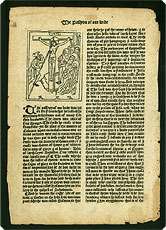
 Click the images for enlargements.
 The text is printed in double-column format in English gothic type. The printer, Wynkyn de Worde (a.k.a., Jan van Wynkyn) was England's first typographer and worked with William Caxton, England's first printer. In 1495, he took over Caxton's print shop, but only after a difficult three-year litigation following Caxton's death in 1491.
Provenance: Sold by Dauber & Pine (NY), the firm having dismembered an incomplete copy of the work and offered the individual leaves each with a letter-press leaf serving as ad hoc title-page.
English incunable leaves with woodcuts are increasingly difficult to obtain. That this Golden Legend leaf bears the image at the heart of its matter makes it a particularly desirable one.
• STC (rev. ed.) 24876; ESTC S103597; Duff 411; Copinger 6475; Goff J-151. Irregular in the margins and the recto of the leaf with old ink crossing out. The page with the woodcut in very good condition. (24601)

 NO!
Copies of
the BOOK in the U.S.
(A
Leaf). Justinianus.
A leaf from the Digestum vetus. Venice: Andreas Torresanus, de Asula,
26 March 1491. Folio (42.5 cm; 16.625"). [1] f.
NO!
Copies of
the BOOK in the U.S.
(A
Leaf). Justinianus.
A leaf from the Digestum vetus. Venice: Andreas Torresanus, de Asula,
26 March 1491. Folio (42.5 cm; 16.625"). [1] f.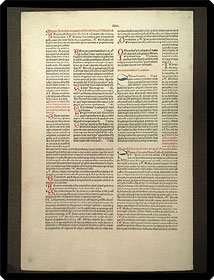 Click
the image for an enlargement.
In 1479 Torresano acquired the fonts of Nicholas Jenson and in 1505 he acquired Aldus Manutius as a son-in-law!
Click
the image for an enlargement.
In 1479 Torresano acquired the fonts of Nicholas Jenson and in 1505 he acquired Aldus Manutius as a son-in-law!
In the U.S., both Goff and the ISTC only locate only stray leaves of this text: two at Stanford and one at Illinois.
Provenance: Clearly once part of a offering of The Foliophiles Incorporated, and probably from its ad hoc album Pages from the past : a collection of original leaves from rare books and manuscripts [New York: T.F.I., c1926–27].
• ISTC ij00554000; Goff J554; H 9556*; GKW 7675; Pr 4725; BMC, V, 309. Mounted on a brown cardboard backing, with a description (but no bibliographical information) on the verso of the board. Leaf in very good, bright condition. (27100)

 A
Prüss Incunable Leaf
(A
Leaf). Melber, Johannes. Vocabularius praedicantium,
sive Variloquus. Strassburg: [Johann Prüss], 1 June 1486. 4to (20.5 x 14.
5 cm; 8" x 5.5"). 1 leaf.
A
Prüss Incunable Leaf
(A
Leaf). Melber, Johannes. Vocabularius praedicantium,
sive Variloquus. Strassburg: [Johann Prüss], 1 June 1486. 4to (20.5 x 14.
5 cm; 8" x 5.5"). 1 leaf. 
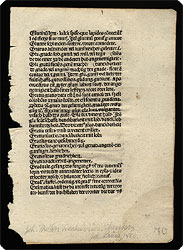
• ISTC im00464000; Goff M464; H 11040*; Pr 516; BMC, I, 119. Inner margin irregular and light semi-circular waterstain in lower outside corner away from text. Leaf identified in pencil in lower margin of the recto side. (26686)


From
the Nuremberg
Chronicle — 8
Portraits
(A
Leaf). Schedel, Hartmann.
Liber chronicarum. Nürnberg: Anton Koberger, for Sebald Schreyer and Sebastian
Kammermeister, 1493. Folio (42 x 29.5 cm; 16.5" x 11.5"; h x w). 1 leaf.
Nuremberg
Chronicle — 8
Portraits
(A
Leaf). Schedel, Hartmann.
Liber chronicarum. Nürnberg: Anton Koberger, for Sebald Schreyer and Sebastian
Kammermeister, 1493. Folio (42 x 29.5 cm; 16.5" x 11.5"; h x w). 1 leaf. Click
the image for an enlargement.
Click
the image for an enlargement.
• ISTC is00307000; Goff S307; HC 14508*; Klebs 889.1; Polain(B)
3469; IGI 8828; Oates 1026, 1027, 1028, 1029; Pr 2084; BMC, II, 437.
Old stitching holes in inner margin; one short tear in lower margin;
spotting or old staining (generally light) in margins; no wormholes. Very nice. (26692)
Colophon
Leaf from Padua,
1473
(A
Leaf). Thomas, Aquinas, Saint.
Summa theologicae. Pars prima. Padua: Albertus de Stendal, 1473. Folio (28 x
19.5 cm; 11" x 7.75"). 1 leaf.
Padua,
1473
(A
Leaf). Thomas, Aquinas, Saint.
Summa theologicae. Pars prima. Padua: Albertus de Stendal, 1473. Folio (28 x
19.5 cm; 11" x 7.75"). 1 leaf.

 Click the images for enlargements.
 The text is St. Thomas' highly influential theological treatise: It is printed in a small gothic with roman influence, in double-column format, 48 lines per column, with hand rubrication and one initial (“A”) accomplished by hand in blue. The type bears all the appearance of a trial font and clearly was one that did not gain favor, thereby making it yet more interesting.
• ISTC it00197000; Goff; T-197; Hain; 1440*; BMC, VII, 911
(IB. 29893); Pr *6781; Oates 2550. Overall dust-soiling; old creasing,
one tear into text without loss, and some small, pin type worming. One margin
reinforced and two other small areas with modern paper reinforcement. A very nice early incunable leaf, and a handsome
representative of an early Italian incunable. (26688)

PLACE AN ORDER | E-MAIL US | GO (BACK) TO TOPIC/INTEREST TABLE | PRB&M HOME
All material © 2010
The Philadelphia Rare Books & Manuscripts
Company