 THE BUSTED BIBLIOPHILE THE BUSTED BIBLIOPHILE
 ometimes, a lesser copy at a lower price is JUST what's
wanted. ometimes, a lesser copy at a lower price is JUST what's
wanted.Each book below costs only a fraction of what its perfect counterpart would — & each, for the right owner and purpose, is  ABSOLUTELY
WORTH HAVING ! ABSOLUTELY
WORTH HAVING !
This catalogue brings together an array of “bargain”
entries from our general catalogues — |
 A
Copy for
A
Copy for the
“Busted Bibliophile”
the
“Busted Bibliophile” (A
BINDER'S BAD DAY)? Hale,
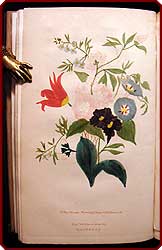
Sarah Josepha. Flora’s
interpreter: Or, the American book of flowers and sentiments...fourteenth edition,
improved. Boston: Thomas H. Webb & Co., (1833). 12mo (19 cm, 7.5"). 262, [2
(index)] pp. (157–68 repeated, 169–80 skipped); 2 col. plts.
(A
BINDER'S BAD DAY)? Hale,
Sarah Josepha. Flora’s
interpreter: Or, the American book of flowers and sentiments...fourteenth edition,
improved. Boston: Thomas H. Webb & Co., (1833). 12mo (19 cm, 7.5"). 262, [2
(index)] pp. (157–68 repeated, 169–80 skipped); 2 col. plts.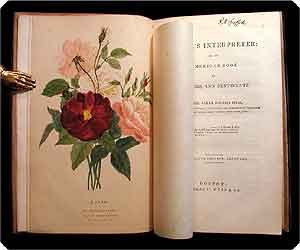
Provenance: Early inked ownership inscriptions reading “P.N. Spofford” on the front fly-leaf and the title-page.
• Original printed paper–covered boards, front cover detached,
with paper cracked over the spine and back joint, and some light staining
to the covers. A few verses with pencilled notes; pages with occasional small,
light spots.  The
pages from 157–68 are bound in twice in this copy, with the pagination
skipped from 169–80; the text headers go from “rose,
bridal” to “rose-bud,
red.”
The
pages from 157–68 are bound in twice in this copy, with the pagination
skipped from 169–80; the text headers go from “rose,
bridal” to “rose-bud,
red.”

Trial by Jury Adam, William. Observations respecting the further extension of trial by jury to Scotland in civil causes. Edinburgh: J. Hay & Co., 1819. 8vo. [2], 51, [1], xi, [1] pp.
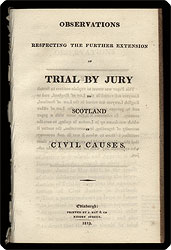
 Click the image for an enlargement.
 • NSTC 2A2513. Removed from a nonce volume. Closely trimmed with shouldernotes and signature marks variously shaved; one page's last line in the Appendix taken (but no others). (11155)


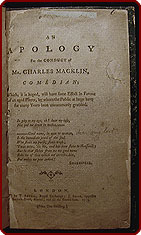
NOT Your Best Copy — Interesting Reading, However!(Aged Player). An apology for the conduct of Mr. Charles Macklin, comedian; which, it is hoped, will have some effect in favour of an aged player, by whom the public at large have for many years been uncommonly gratified. London: Sold by T. Axtell; J. Swan, 1773. 8vo. [4], 38 pp. (lacks frontis.). 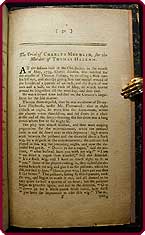
 Click
either image for an enlargement.
Click
either image for an enlargement.
• ESTC T22230. Rebound in quarter library cloth, front and back covers pressure-stamped by a now-defunct library, front cover with paper shelving label. Hinges (inside) starting. Title-page and p. 37 with perforation stamp, pp. 23 and 35 with rubber-stamp, title-page with paper remnants adhered at top margin, rear free endpaper with library charge pocket. Title-leaf separated and chipped, with loss of three letters from the title and several letters from the imprint. Pages 1–6 with tear in lower inner margin and slightly separating. Front free endpaper loose and chipped. Title-leaf browned, p. 1 soiled at top margin, light stain on p. 36, soiling on p. 38. Pages 29-30 soiled, missing some paper in fore-margin, and creased from folding of one corner. Final two leaves with very small dog-ears. Lacks the frontispiece. Toned. (10352)
A
word to the Wise? — if THIS one is of interest,(LISTS).
in this list!


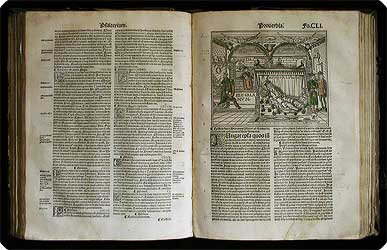
Not THAT AgricolaAgricola, Johann. Siebenhundert und funfftzig deutscher sprüchwörter ernewert und begessert durch Johan. Agricola. Mit vielen schönen lustigen und nützlichen historien und exempeln erkleret und ausgelegt. Wittenberg: Gedruckt bey J. Krafft, 1592. Small 8vo. )(8 *8 A–Z8 Aa–Xx8 (-Xx8, a blank) [14], 350 ff.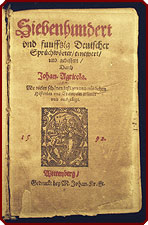
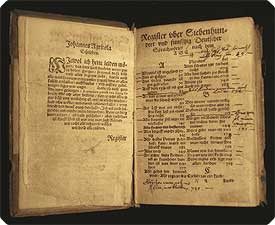
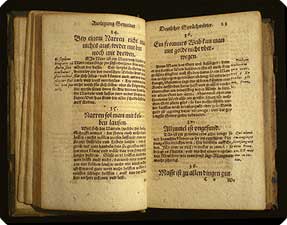 Click the interior images for enlargements.
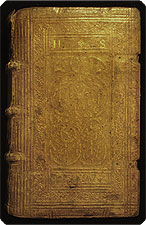 All 16th-century editions are scarce. Via NUC, OCLC and RLIN we locate only this copy of this edition (now deaccessioned) and that at Princeton.
Binding: Contemporary alum-tawed sheep over wooden boards with partially bevelled edges. Elaborately blind-embossed with a roll and a center panel ornament. Front cover with initials “H. S.” and date “1597” in gilt. Rear cover with gilt putti in the areas where initials and the date appear on the front.
Evidence of readership: Marginalia in the prefatory index; very scattered early underscoring.
• VD16 A969; Goedeke, II, 8. Binding as above, lacking clasps and with old paper spine label; ex-library with bookplate and call number in old, faded, white numbering on spine. Title-page browned and tipped in; loss of paper to fore- and bottom margins of same. Some age-toning to paper and several leaves with natural paper flaws, repaired with archival tissue; three other leaves also with natural paper flaws repaired at time of binding or shortly after printing. Approximately 12 leaves with inkstains, sometimes obscuring text. One leaf (178) with a hole costing a significant loss of text. A marginally acceptable copy as regards text, in a good binding.

 A Classic in
 Classic Renaissance Form Ariosto, Lodovico. Orlando furioso ... ornato di nuove figure, & allegorie in ciascun canto. Venetia: Gio. Andrea Valuassori detto Guadagnino, 1556. 4to (21.6 cm, 8.5"). [1], 274 (168 & 169 lacking), [19] ff.; illus.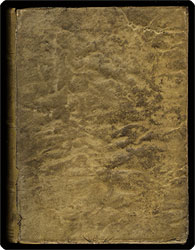
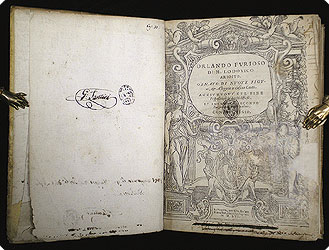
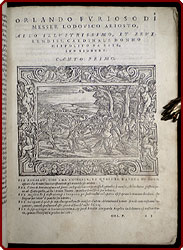 Click the images for enlargements.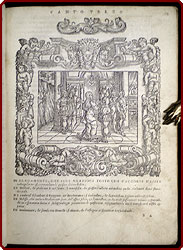
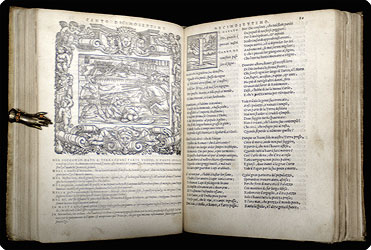
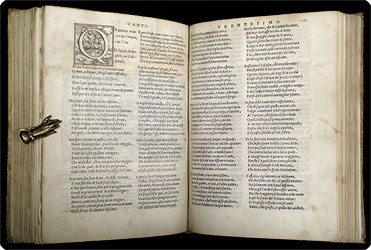
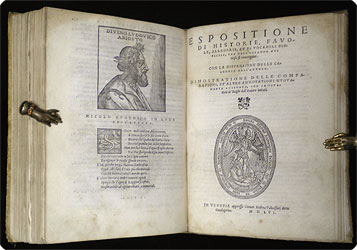
Provenance: Front free endpaper with early inked ownership inscriptions including that of G. Santini; title-page with early inked inscription (lined through) in lower margin and with Santini's small oval rubber-stamp monogram at center; one other page similarly rubber-stamped.
• Brunet, I, 435; Essling, Les livres à figures vénitiens, 115; Graesse, I, 198; Index aurel. 107.474. This ed. not in Adams, not in Mortimer. Sophisticated copy. Contemporary vellum, neatly and unobtrusively rebacked; sides dust-soiled, corners rubbed. Hinges (inside) reinforced; ownership marks as above. Title-page repaired, with small portion of image lacking, inner margin reinforced, and some reinforcements affecting sharpness of image; two leaves supplied from another edition and ff. 168 and 169 lacking; one leaf with upper border portion of image supplied and another with capital and several lines of text hand-inked as described above. Staining and spotting variously, generally light; a few early inked marks of emphasis, and scattered marginalia in Italian.  An appealing “book for the busted bibliophile” as a solid volume offering both charm and signifcance and a lowered price. (26560)
A HandsomeDated Binding — Initials, “A.W.” — 1539 Arrianus. [three lines in Greek, romanized as] Arrianou Peri Alexandrou anabaseōs historiōn biblia oktō. [then in Latin] Arriani De expeditione sive Rebus gestis Alexandri Macedonum regis libri octo, nuper & reperti, & quàm diligentissimè in lucem editi. Historiam quoque eandem, olim quidem a Bartholomaeo Facio latinitate donatam, nunc vero ... mendis repurgatam, hic adiungi curavimus ... Basileae: [Robertus Winter, 1539]. Vol. 1 of 2. 13, [1] pp., [321] ff. (lacks last 8 leaves).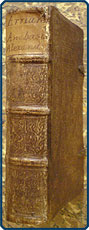
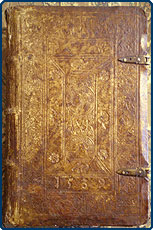
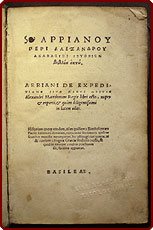 Click the middle and righthand images for enlargement.
 Present here is vol. I containing the original Greek text, the Latin translation
having been printed in a separate volume. Incomplete at the end, it lacks
the final eight leaves or the last part of the Indica (37.3–43.14),
only, with Arrian's Anabasis Alexandrou (Campaigns of Alexander)
appearing complete
as Books 1–7.
complete
as Books 1–7.
Binding: Contemporary alum-tawed pigskin over bevelled boards, remnants of the metal closures. Covers elaborately blind-embossed with several rolls and devices. Front cover has in its center panel the initials “A. W.,” the date 1539, and medallions of Manfred of Saxony and Luther, while the rear cover's center panel has medallions of Melanchthon and Erasmus.
• Graesse, I, 227; Legrand, Bibliographie hellénique, III, 388; Adams A2009. Binding toned to a pleasing dark tan. Old bookplate on front pastedown. Front free endpaper torn with loss. Vol. I only, and lacking those final eight leaves; the Anabasis complete. (20418)
Dutch Opinions on the Spanish Inquisition Avontroot, Johannes Bartholomeus. Den grouwel der verwoestinghe, oft grondich bericht ende ontdeckinghe, van de gronden der Spaensche inquisitie. In s'Graven-haghe: Aert Meuris, 1621. 4to (19.7 cm, 7.75"). [28], 212 pp.
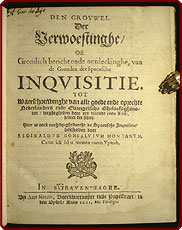
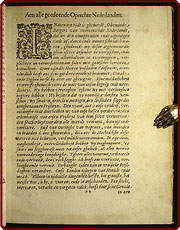
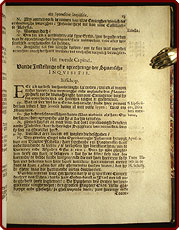
 Avontroot was executed by the Inquisition at Toledo in 1632.
This copy lacks the work by González de Montes, a.k.a. Reginaldus Gonsalvius Montanus, which should follow p. 212. It is largely printed in black letter.
Uncommon. OCLC finds only two holdings in the U.S., one being this copy, now properly deaccessioned, and the other at the John Carter Brown Library. NUC Pre-1956 does not identify any additional copies.
• Vekené, Bib. der Inquisition, 139-140; Boehmer, Bibliotheca Wiffeniana, 290 (identifying the volume as the second Dutch translation of the Montanus work not present here). 19th-century half calf with marbled paper-covered sides; joints and corners rubbed. Front pastedown with institutional bookplate, title-page with early inked ownership inscription in upper margin. Pages age-toned with some mild waterstaining; one leaf with lower outer corner torn away, not affecting text. (19569)
FrenchWoodcut-Illustrated
— Contemporary
BindingBible.
Latin. Vulgate. 1513. Biblia cum concordantiis veteris et novi testamenti
necnon et iuris canonici. Lugduni: M. Jacobum Sacon, 1513. Folio (34.5 cm, 13.5").
aa8 bb6 a–z8 A–Q8 R6
AA–BB8 CC10 (-aa1, CC9,10); [13], CCCXVII, [25] ff.
(lacking title-page & last 2 ff. of the Interpretationes).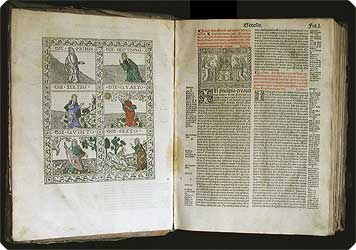
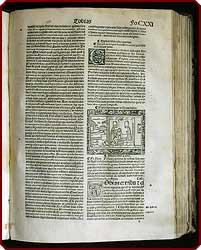
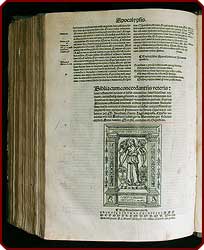 Click any image where the hand appears on
This Bible is illustrated with two full-page and 130 in-text woodcuts (including some repeated images), a few of which have early hand-coloring, mostly but not entirely in green or
yellow. One full-page cut shows the six days of Creation — partially hand-colored in green, brown, red, blue, and yellow — while another depicts the manger scene. The text is followed by the Interpretationes nominum hebraicorum, a dictionary of Hebrew names often appended to manuscript and early printed Bibles.
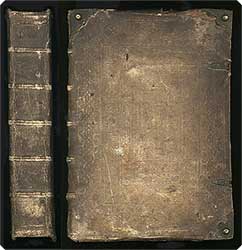
Binding: Contemporary blind-tooled, alum-tawed pigskin over beech boards, elaborately worked using embossing rolls with religious vignettes and busts. Covers with etched metal corner bosses and remnants of leather and metal clasps.
• Adams B988; c.f. Darlow & Moule 6101 & 6091. Binding as above, spine with hand-inked title; overall dust-soiled and darkened with several short tears to leather; leather no longer tight to the boards. Straps, clasp locking-mechanisms, and lower front metal corner now lost. Title-page and final two ff. of Interpretationes lacking; front pastedown separated from board and back pastedown lacking. First and last few leaves with insect damage to outer edges. First text page (contents) with old institutional rubber-stamp and shadow of pencilled numeral. A few leaves separated; a number of leaves with short tears from lower margins, a few extending into text, in many cases with traces of old repairs. Two leaves with lower outer corners torn away, one repaired some time ago. Pages age-toned, some waterstained. Scattered contemporary inked marginalia; some light underlining and a few instances of early inked doodling. Despite its faults, this is rare and imposing.
Important
Text — Important
BindingAll
Initials HighlightedBible.
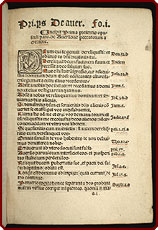
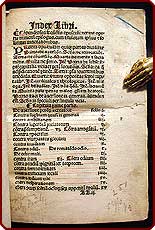
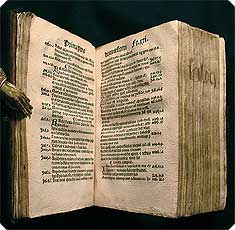
Latin. Selections. Peckham. 1514. Diuinarum sententiarum libro[rum] Biblie ad certos titulos redacte collectariu[m], ingenio siquide[m] eruditissimi sacris literis assuetissimi viri ... Joha[n]nis de Pechano ... compilatu[m] ... Parisius: Venales reperiu[n]tur in vico diui Jacobi ad intersignium diui Claudii [Francois Regnault], 1514. Small 8vo (14.5 cm; 5.875"). AA8 BB4 a–z8 [et]8 A–H8 I4 (-AA1); [11 (of 12)], cclxi [i.e., 260] ff. (without the title-leaf).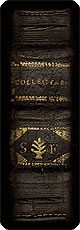
 All
initials are highlighted in red.
All
initials are highlighted in red.
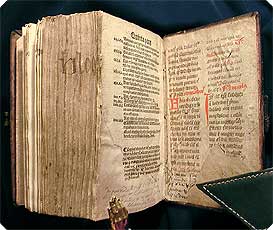
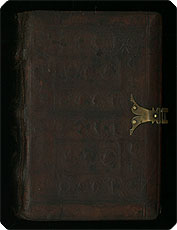
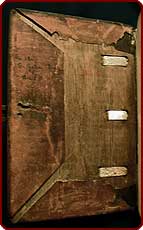 Click the images for enlargements. older
manuscript leaf.
Click the images for enlargements. older
manuscript leaf.
Provenance: 17th-century spine label with initials “S.F.” and a tree design between them. Ownership signature of Gordon Duff; Yale University (bookplate) — deaccessioned.
• Edition: Moreau, II, 930; Shaaber, British Authors Printed
Abroad, P57; not in Darlow & Moule. Binding: Fogelmark, Flemish
and Related Panel-Stamped Bindings, plate XXXII R.46 & pp. 48–49.
Volume rebacked and much of old spine reapplied; lacks title-leaf and
last leaf torn across corner with loss replaced of old, colophon partly supplied
in manuscript. Highlights to initials as above; occasional early underlining
or another mark and a later pencilled note on last leaf. Missing leaf and
torn second one notwithstanding (though they do lower the price), this isa
very nice copy in a notable early binding.
A
PRB&M “FEATURED BOOK” —
“Breeches”
Bible with
Concordances
& Psalter
Bible.
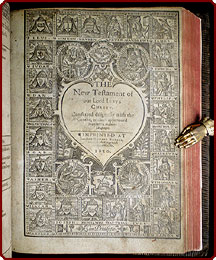
English. Geneva. 1609. The Bible. Translated according to the
Ebrew and Greeke, and conferred with the best translations in diuers languages.
[with two others, as below]. London: Robert Barker, 1609. 4to (22.1 cm,
8.75"). [2], 554 ff. (lacking ff. 79 & 80, 436). [with]
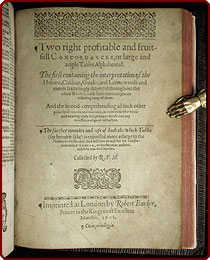
Herrey, Robert F. Two right profitable and fruitfull concordances, or large
and ample tables alphabeticall. The first containing the interpretation of the
Hebrew, Caldean, Greeke, and Latin words and names.... London: Robert Barker,
1608. 4to. [82] ff. (lacking C8). [and] Bible.
O.T. Psalms. The whole booke of Psalmes. Collected into English meeter,
by Thomas Sternehold, Iohn Hopkins, and others ... with apt notes to sing them
withall. London: Pr. for the Company of Stationers, 1610. 4to. [10], 68 (of
102) pp.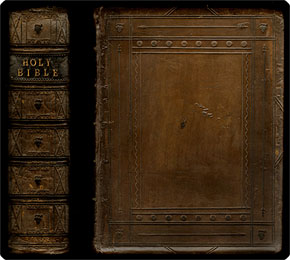
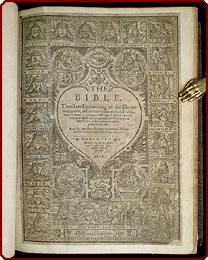
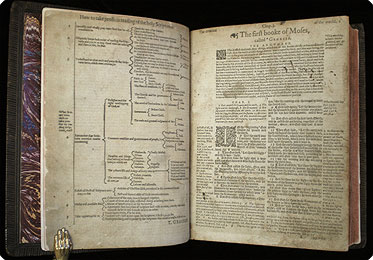 Click the images for enlargements.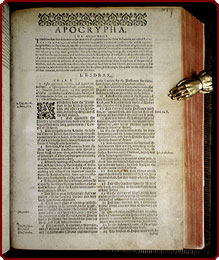
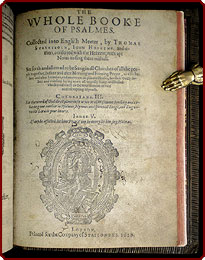 with music, the text again printed
in double columns of black-letter.
with music, the text again printed
in double columns of black-letter.
• Herbert 298; Darlow & Moule 230; STC (rev. ed.) 2206. Concordances: ESTC S122240; STC (rev. ed.) 13232. Psalmes: ESTC S124337; STC (rev. ed.) 2533.5. Period-inspired later (late 19th-/early 20th-century) calf, covers framed and panelled in blind with blind-tooled corner fleurons, spine with gilt-stamped leather title-label and blind-tooled decorations; joints and corners refurbished, spine leather and label with minor cracking. All edges stained red. Title-page mounted, with old repaired tear; a few outer corners replaced, with loss of a few words from notes (only); one leaf with tear from lower margin, extending into text without loss; one leaf with burn hole towards upper outer corner, with loss of a few letters from several lines. Bible (Deuteronomy) with ff. 79 and 80 torn out, f. 436 lacking after Apocrypha and before “The Summe of the whole Scripture”; Concordances lacking f. C8; Psalmes lacking final 34 pp. Paper good, though darkened and spotted; a number of scattered early inked marks and marginalia. (26610)
Full-Size  FULL
Facsimile of the King
James FIRST Edition
Bible. English.
1611/1961. Authorized (i.e., King James Version). The Holy Bible, conteining
the Old Testament, and the New: Newly translated out of the originall tongues:
and with the former translations diligently compared and revised by his Majesties
speciall Commandement. Appointed to be Read in Churches. [colophon: Cleveland:
World Publishers, 1961]. Folio. [737] ff.
FULL
Facsimile of the King
James FIRST Edition
Bible. English.
1611/1961. Authorized (i.e., King James Version). The Holy Bible, conteining
the Old Testament, and the New: Newly translated out of the originall tongues:
and with the former translations diligently compared and revised by his Majesties
speciall Commandement. Appointed to be Read in Churches. [colophon: Cleveland:
World Publishers, 1961]. Folio. [737] ff.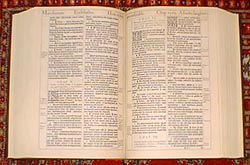
 The
edition was limited to 1500 copies, of which this is number 878.
It was printed by offset lithography and bound in full leather by Amilcare Pizzi
of Milan in a replica of the type of binding found on some copies of this edition.
The
edition was limited to 1500 copies, of which this is number 878.
It was printed by offset lithography and bound in full leather by Amilcare Pizzi
of Milan in a replica of the type of binding found on some copies of this edition.
• Binding as above with leather abraded at edges and joints open
and fragile; slipcase lacking. A
compromised copy, but a handsome and interesting production not necessarily
easy to find on the market.
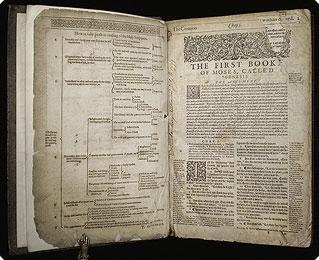
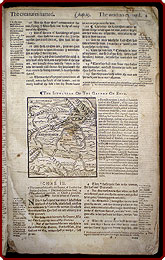
TheLAST English “Breeches” Edition Bible. English. Geneva–Tomson–Junius. 1616. The Bible: that is, the Holy Scriptures contained in the Old and New Testament.... London: Robert Barker, 1616. Folio (31.1 cm, 12.25"). [1], 362 (i.e., 365), [7] ff. (t.-p., Apocrypha, & New Testament not present here; foliation extremely erratic); illus.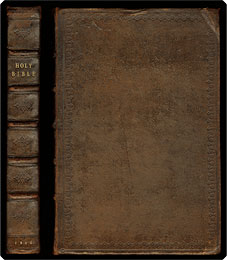
 Click the images for enlargements.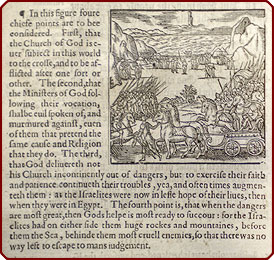
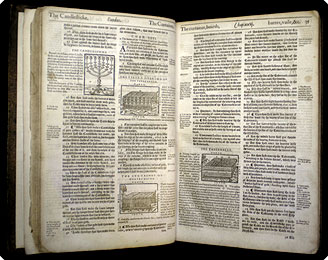
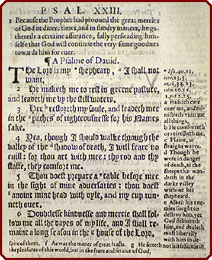 black-letter folio edition, illustrated with a handful of in-text woodcuts (including the Ark and its paraphernalia, and charts of consanguinity). The copy consists essentially of the Old Testament and some additional matter; it lacks two of the four preliminary leaves (including the title-page, publication information being provided by the colophon) and it also lacks the Apocrypha and New Testament. It begins with “Of the incomparable treasure of the holy Scriptures”; the “Briefe Table of the interpretation of the proper names which are chiefly found in the Olde Testament” and the “Table of the principall things that are conteined in the Bible, after the order of the Alphabet” are both present.
• Darlow & Moule 270; ESTC S1792; Rumball-Petre, Rare Bibles, 130; STC (2nd ed.) 2244. Full later mottled calf, covers framed in double blind fillets and fleuron roll; spine with raised bands, blind-tooled compartment decorations, and gilt-stamped title and date; incomplete, with title-page, Apocrypha, and N.T. lacking. Binding rubbed/bumped at stress points, one compartment scuffed. Front free endpaper, first text page, and several others institutionally pressure-stamped; first page with rubber-stamped numeral in lower margin and early inked annotation regarding date of printing. Front free endpaper with affixed slips documenting gift donation in 1955, and with inked annotation regarding date; back pastedown showing traces of now-absent pocket. Tattering to first leaves not reaching text, and first one with recent repairs, second one with area of loss to upper outer portion affecting a border and ten lines of text, third one with central tear (touching woodcut map) repaired some time ago with tape, four leaves each with short tear from lower margin without loss, one leaf with lower outer corner torn away with partial loss of shouldernotes and image caption, final index leaf with hole affecting six lines. Expectable sorts of age-toning, dust-soiling, and light spotting/staining, only; lower outer corners of first quarter waterstained (often faintly). In sum a survivor; “breeches” in Genesis underlined in ink! (26072)
First Complete
Bible Printed
in the NEW
WORLDin
a European
LanguageBible.
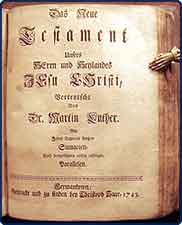
German. 1743. Luther.
[Biblia, das ist: Die Heilige Schrift Altes und Neues Testaments, nach der Deutschen
Uebersetzung D. Martin Luthers, mit jedes Capitels kurzen Summarien, auch beygefügten
vielen und richtigen Parllelen {sic}. Germantown: Gedruckt bey Christoph
Saur, 1743]. 4to (26.3 cm, 10.375"). [2] ff. (supplied in facsimile), 995, [1
(blank)], 277, [1] pp., [1] f. 

 Arndt
lists three states for this edition, of which this appears to be C, based on
the absence of a two-leaf addendum giving a short history of Bible translation—that
a buyer could choose to have bound in or not.
Arndt
lists three states for this edition, of which this appears to be C, based on
the absence of a two-leaf addendum giving a short history of Bible translation—that
a buyer could choose to have bound in or not.
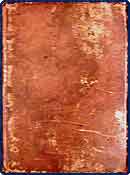
• Rumball-Petre, Rare Bibles, 159; Darlow & Moule 4240; O’Callaghan 22; Wright, Early Bibles of America, 24–44; Evans 5127–28; Sabin 5191; Arndt, The First Century of German Language Printing in the United States of America, 47C; Hildeburn, The Issues of the Press in Pennsylvania, 1685-1784, 804. Contemporary calf over bevelled boards. Binding scratched and abraded with tears to spine leather. Hinges (inside only) open. A printed poem has been affixed to the front pastedown, over a strip of cloth. Ownership inscriptions in German (in gothic cursive) and English on endpapers. Pp. 1–2 with loss of part of margins, some text, and part of headpiece, repaired with paper. Lightly age-toned with darker brown-spotting, some waterstaining, occasional dog ears, and some holing or chipping in the margins—some of the latter repaired with paper. First two leaves, i.e., main title-page and preface supplied in facsimile; the New Testament title-page is present.

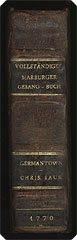
 Saur's Lutheran Hymnal Bible. O.T. Psalms. Paraphrases, German. Vollständiges Marburger Gesang-Buch zur Uebung der Gottseligkeit, in 649 christlichen und trostreichen Psalmen und Gesängen Hrn. D. Martin Luthers. Germantown [PA]: Christoph Saur, 1770. (16.8 cm, 6.7"). Frontis., [12], 490, [15], 13, 83 (i.e., 84; 85/86 lacking) pp.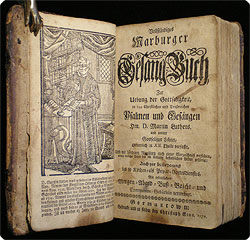
 Click the interior image for an enlargement.
 The volume opens with a woodcut portrait of Martin Luther which according to Hamilton (cited in Reilly [see below]) “might have been made by Justu Fox who was working in Philadelphia at this time.”
• Evans 11714; Hildeburn, Pennsylvania, 2561; ESTC W21005; Warrington, History and Practice of Psalmody in the United States, p. 39; Reilly, Dictionary of American Printers' Ornaments & Illustrations, 1577. Contemporary sheep, rebacked some time ago, spine with gilt-stamped leather title-, place, “Chris. Saur,” and date labels; rubbed in the ordinary degree and with remnants of clasps. Back free endpaper lacking; pastedowns and blanks with old inked and pencilled signatures and writing practice(?) — which we do not make out much of, beyond “Johann(es).” Three leaves each with closed tear from outer margin extending into text; three index leaves with tattered outer edges, one with loss of lower outer portion; small section of pages with odd little dent to outer edge; last leaf present (and that leaf only) with a couple of pin-type wormholes; final leaf lacking. Pages age-toned, with moderate spotting and staining. Priced according to its described “issues,” not according to its considerable charm on shelf and in hand. (25105)
States-General
N.T., with Psalms
Bible.
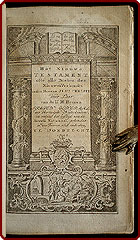
N.T. Dutch. States-General. 1792. Het Nieuwe Testament
ofte alle boeken des nieuwen verbondts onses heeren Iesu Christi. [Amsterdam:
J. Bouwer en de wed. J. Ratelband], 1792. 12mo (17.7 cm, 7"). [2], 274 ff. [with]
Bible. O.T. Psalms. Dutch. Het boek der psalmen, nevens de gezangen
bij de Hervormde Kerk van Nederland in gebruik; door last van de ... Staaten
Generaal der Verëenigde Nederlanden, uit drie berijmingen, in den jaare
1773, gekooren. Amsterdam: J. Bouwer en de wed. J. Ratelband, 1794. 12mo. [245]
ff., 85, [1] pp.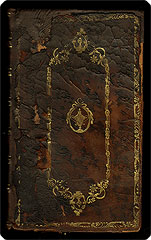
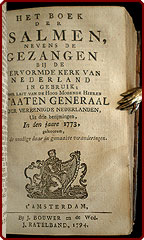
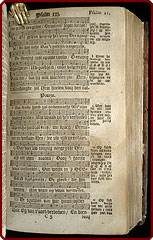 Click the images for enlargements. with music.
Binding: Contemporary mottled calf, covers framed and panelled in gilt rolls surrounding a gilt-stamped urn medallion, board edges gilt-tooled also; rebacked with mottled calf, spine with gilt-dotted raised bands and gilt-stamped compartment decorations. All edges gilt and modestly gauffered of old.
• This ed. not in Darlow & Moule. Binding as above, original leather of covers badly chipped, cracked, and darkened, with portions of gilt darkened, rubbed, or lost especially toward spine and at edges; elegance and interest yet remain. Front fly-leaf with early inked inscription. Neatly placed library rubber-stamp on the title-page verso; title-page verso and
first text page with small inked numerals in lower margins. First two leaves with edges slightly tattered; pages with usually very light to sometimes moderate waterstaining. A conundrum of a book: The sad damage to the boards makes this an obvious candidate for rebinding — but, the tooling present is SO pretty! (25503)
For the“United States of Columbia” Bible. English. 1800. Authorized (i.e., “King James Version”). The Holy Bible, containing the Old and New Testaments: Translated out of the original tongues, and with the former translations diligently compared and revised, by the special command of King James I, of England. Worcester, MA: Isaiah Thomas, 1800. 12mo (17.6 cm, 6.9"). [788 (of 792)] pp. (X1 and X12 lacking).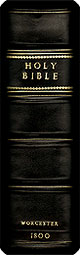
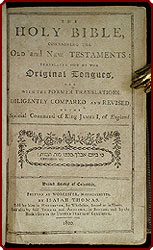
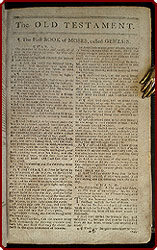 Click the images for enlargements.
 In an attempt to promote the idea of changing the country's name from the United States of America to the United States of Columbia, Thomas used the latter nomenclature on all issues of his proudly local, non-imported production.
ESTC and OCLC locate only eight institutional holdings, all in the U.S.
• ESTC W4503; Evans 36955; Hills 72; O'Callaghan 55 (for 1799 ed.). Period-style calf, framed and panelled in blind rolls, spine with gilt-stamped title and publication information and gilt-ruled raised bands, turn-ins blind-tooled. Two pages of Jeremiah (not consecutive) lacking. Pages age-toned with moderate staining; first and last few leaves with edge nicks, chips, and short tears; a few leaves creased; one leaf with lower margin chipped, resulting in loss of about four words. Some corners bumped or dog-eared. (26121)
Early American Mennonite Hymnal Bible. O.T. Psalms. German. 1820. Die kleine geistliche Harfe der kinder Zions, oder auserlesene geistreiche Gesänge. Germantaun: Gedruckt bey Michael Billmeyer, 1820. 12mo (17.3 cm, 6.8"). Frontis., [4], 39, [1], 412, [20], 20 pp. (21/22 lacking).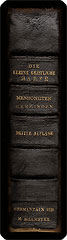
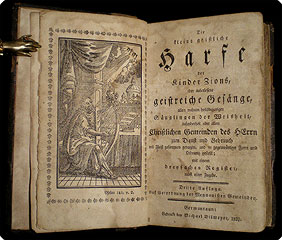 Click the images for enlargements.
  It's an engaging fact that psalms are given in multiple versions; there are four of the 23d.
Arndt and Eck cite Bender, who says “This first American Mennonite Hymnbook isnot to be confused with one of similar title printed by Saur at Germantown in 1753, called erroneously by Seidensticker and Flory a Mennonite hymnbook.” Each portion of this item has a separate title-page, with the second section's title-page reading Sammlung altre und neuer Geistreichen Gesänge. The woodcut frontispiece depicts David playing his harp.
• Arndt & Eck 2419; Shoemaker 2239. Contemporary calf rebacked some time ago, spine with gilt-stamped leather title and publication labels; rubbed, original clasps now lacking. Front fly-leaves with early inked and pencilled inscriptions. Final leaf (pp. 21/22 of the 22-page appendix of brief hymn texts, not of the main portion of the work) lacking. Edge nicks, chips, and tears, some extending into text; three leaves torn in half from outer margin, without loss of text; two leaves (one index) with lower outer corner torn away, with loss of a few words; last two leaves with outer edges ragged. Some upper corners bumped. Pages browned, with waterstaining to lower inner portions of about a third of the volume. (25569)
A
Carlisle New Testament —
Luther with
12 Woodcut
PlatesBible. N.T. German. 1825. Luther. Das Neue Testament unsers Herrn und Heilandes Jesu Christi, nach der deutschen Uebersetzung von Dr. Martin Luther.... Carlisle (Pa.): Gedruckt und zu haben bey Moser & Peters, 1825. 8vo. (17 cm, 6.75"). 511, [1] pp., [2] ff. (lacking pp. 101–104); 12 plts. 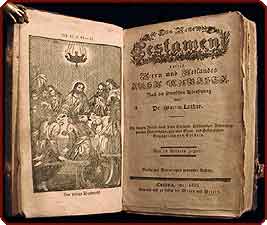
Provenance: 20th-century booklabel of Michael Zinman on front pastedown, along with pencilled ownership inscription of Margaret Lache.
• Not in O’Callaghan; not in Darlow & Moule; Arndt, The First Century of German Language Printing in the United States of America, 2724; Shoemaker 19698. Contemporary calf with raised bands; remnants of clasps. Calf scratched with some rubbing; spine a little warped. Some dog-earing and shallow tattering; lightly to moderately age-spotted throughout; pp. 17–18, 257-60 detached. No loss or obscuring of text due to the above, but two pages in Mark, pp. 101–104, lacking.
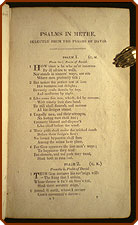
Very Pretty! & With a Proper Provenance!Fragile/Broken & IncompleteBible. O.T. Psalms. English. Selections. 1835. Psalms, in metre, selected from the Psalms of David. [New York: Swords, Stanford & Co., 1835?]. 12mo (19 cm, 7.5"). 130, [2 (blank)] pp. (lacking pp. 1/2). [with]
Hymns of the Protestant Episcopal Church, in the United States of America. New York: Swords, Stanford & Co., 1837. 12mo. 132 pp.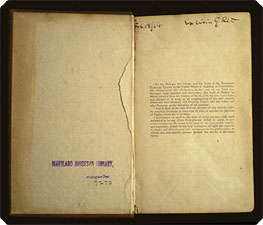
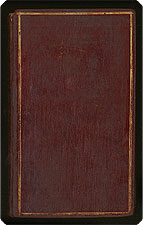
Binding: Contemporary red straight-grain morocco, covers framed in gilt roll, spine with gilt-stamped title and compartment decorations.
Provenance: Ownership initials of William R. Whittingham (G.R.W., the "William" being rendered as "Guillelmus" for his love of Latin), fourth Episcopal Bishop of Baltimore; stamp of an Episcopal Diocesan lending library.
• Front joint almost entirely broken, back joint starting from top, head of spine chipped, with binding showing minor darkening and scuffing overall. Free endpapers excised. Front pastedown with rubber-stamp as above (no other institutional markings); first text page with inked ownership inscription as above dated [18]64. Title-page of first work lacking. Pages slightly age-toned, some creased; one leaf with lower outer corner torn away. Small emphasis marks to index of Hymns, with an additional manuscript entry in the table of first lines.
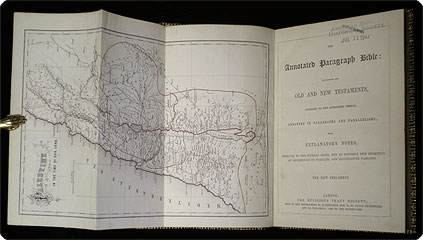
Useful Edition — Crozer's Deluxe Copy Bible. English. 1866. Authorized (i.e., “King James Version”). The annotated paragraph Bible: Containing the Old and New Testaments, according to the authorized version, arranged in paragraphs and parallelisms; with explanatory notes, prefaces to the several books, and an entirely new selection of references to parallel and illustrative passages. London: The Religious Tract Society (pr. by Knight), 1866. 8vo (24.2 cm, 9.5"). 2 vols. (lacking vol. 1 of O.T.). I: [2], 521–1050 pp. II: [4], 1051–1471, [1] pp.; 2 maps.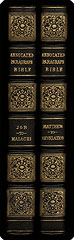
 Click the images for enlargements.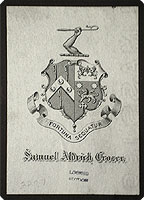
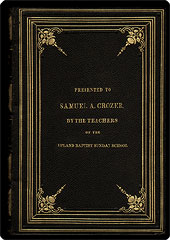
Provenance: Presentation copy, front covers gilt-stamped “Presented to Samuel A. Crozer, by the teachers of the Upland Baptist Sunday School”; front pastedowns with armorial bookplate of Samuel Aldrich Crozer. Crozer was the son of John P. and Abigail Crozer, who endowed the Crozer Theological Seminary (now part of Colgate Rochester Crozer Divinity School); he served as president of the seminary's Board of Trustees and erected the chapel of the Upland Baptist church.
Binding: Signed binding by Lewis & Sons of London: Black morocco, covers framed and panelled in gilt fillets with gilt-tooled corner fleurons, spines gilt extra, front covers with gilt-stamped presentation as above; board edges gilt-dotted, turn-ins with gilt roll. All edges gilt.
• This ed. not in Darlow & Moule (see 1193 for 1855 ed.). Binding as above, very minor wear to corners and spine, overall bright and beautiful. Two vols. only, lacking first vol. of O.T. Front pastedowns each with private bookplates as above; then ex-library with stamps/annotations variously placed and of various generations, back pastedowns and free endpapers with paper adhesions; properly deaccessioned. One frontis. map with tear along one fold, neatly repaired from rear. A very few scattered small spots of light foxing in one volume, pages otherwise clean. (26128)
Ivy-Leaf Bible — Two-Color Frontispieces Bible. English. 1866. Authorized (i.e., “King James Version”). The Holy Bible, containing the Old and New Testaments, translated out of the original tongues, and with the former translations diligently compared and revised. Philadelphia: John E. Potter & Co., 1866. 4to (29.7 cm, 11.7"). 576, [4], 767, [1] pp.(lacking appended Psalms and concordance); 2 plts. (of 6).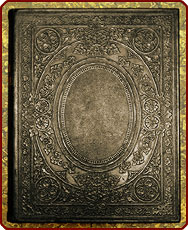
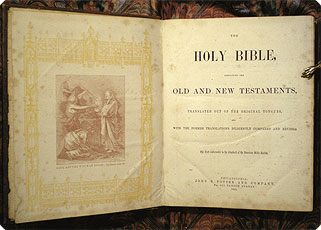
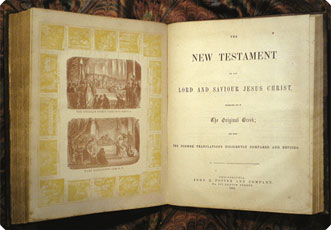 Click the interior images for enlargements.
 Provenance: The family register leaves record that one Peter Paul Shank, presumably the Bible's original owner, outlived three wives (born in 1833, he married in 1857, 1896, and 1903, and died in 1913 in Mineral Springs, NY). The birthdates of Shank and his wives are all listed, but no offspring are recorded.
Binding: Publisher's deluxe embossed brown roan in imitation of morocco, covers with central medallions surrounded by ivy motifs, spine with gilt-stamped title and blind-tooled knotwork and floral decorations.
• Hills 1796. Not in Wolf, From Gothic Windows to Peacocks. Binding as above, minor rubbing to joints, edges, and extremities. 64 pp. of appended material (index, concordance, metrical Psalms) lacking, with Biblical text and index complete; four plates (of six) lacking, with no indication of their ever having been present. Sewing loosening; first few leaves partially separated. Pages age-toned with some foxing. Front free endpaper torn from outer edge; one leaf with tear from outer margin, extending into text without loss. (24453)
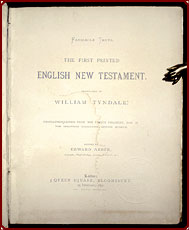
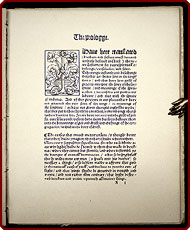
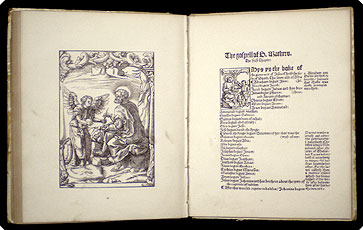
Facsimile Tyndale Bible. N.T. Matthew. English. Tyndale. 1871. The first printed English New Testament. London: no publisher/printer, 1871. Small 4to. 70, 62 pp.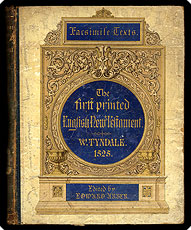
One from theChurch of Scotland Mission Bible. N.T. Lala. 1947. Ichalayano Ichabwangu icha ku Sikulu wesu no Mupanusi wesu Yesu Kristu. Edinburgh & Glasgow: National Bible Society of Scotland, 1947. 12mo (19 cm; 7.5"). [2] ff., 519, [1] pp.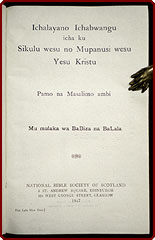
 Click the images for enlargements.
 This is the first printing of the New Testament and Psalms in this language. The translation is the work of Cecilia M. Irvine and J.S. Howie of the Church of Scotland Mission.
We locate only three U.S. libraries reporting ownership.
• North & Nida, Book of a Thousand Tongues (1972), 1352. Publisher's red cloth, slight discoloration at top of spine and abrasion/discoloration to back cover. Upper outer edges of pp. 17–92 bumped and crumpled, front free endpaper with spots of soil. NOT a dreadful copy but not a fresh one! (25341)
For a NEW, unillustrated, PDF-format list of 100 Bibles, Testaments,
 For our full catalogue of
BIBLES, TESTAMENTS,
For our full catalogue of
BIBLES, TESTAMENTS,


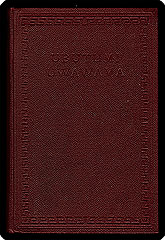
The PLATES areInteresting & um, Explicit Boitard, Pierre. Nouveau manuel complet du naturaliste préparateur, ou l’art d’empailler les animaux, de conserver les végétaux et les minéraux, de préparer les pièces d’anatomie normale et pathologique ... nouvelle édition. Paris: Librairie encyclopédique de Roret, 1852. 12mo (14.7 cm, 5.8"). [4], 510 pp.; 4 fold. plts. (of 5).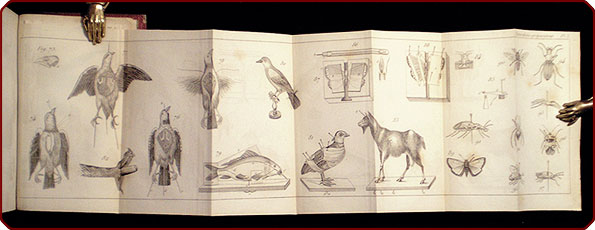 Click the interior images for enlargement.
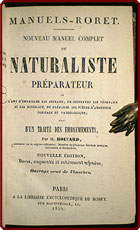
• Contemporary quarter morocco with pebbled cloth–covered sides, spine with gilt-stamped title; corners and spine extremities rubbed. Front pastedown with private collector’s bookplate, this and the front free endpaper then institutionally rubber-stamped. One plate lacking (no. 5). Pages slightly age-toned; plates with small spots of light foxing. (20363)

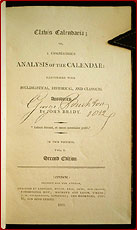
A Not-So-Brief History ofTime Brady, John. Clavis calendaria; or, a compendious analysis of the calendar: Illustrated with ecclesiastical, historical, and classical anecdotes ... second edition. London: Pr. for the author & sold by Longman, Hurst, Rees, Orme, & Brown, et al., 1812–13. 8vo (21.6 cm, 8.5"). 2 vols. I: xxxvi, 387, [1] pp.; 1 plt. II: [2], 395, [1] pp. 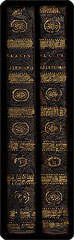
Click the images for enlargements.
Vol. I is illustrated with one wood-engraved plate depicting a Saxon almanac, and seven in-text engravings depicting Odin, Frigga, Thor, and the other deities with days named in their honor.
Provenance: Signature on title-pages of George Buckton, vol. I dated 1812 and vol. II dated 1813.
• Allibone 237 (listing 1813 & 1814 eds. only); NSTC B4120. Contemporary treed calf, rebacked preserving original spines with gilt-stamped titles, gilt-ruled and -dotted compartment bands, and gilt-stamped compartment decorations; original spine leather chipped, cracked, and darkened as by fire. Covers with corners and edges unobtrusively rubbed; portions nearest spines showing evidence of heat exposure; hinges (inside) reinforced. Front pastedowns each with institutional bookplate, vol. I front pastedown with bookseller's ticket and affixed early cataloguing slip, vol. I back pastedown and vol. II front pastedown with inked library inscription. Title-pages with inked ownership inscriptions as above. Offsetting from plate and to endpapers from binding, pages otherwise clean though with all edges (i.e., of closed book) darkened. A particularly handsome exemplar of popular scholarship of the day. (25436)
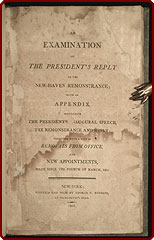
Public Office as Political Football Brutus, Lucius Junius. An examination of the President's reply to the New-Haven remonstrance with an appendix containing the President's inaugural speech, the remonstrance and reply, together with a list of removals from office and new appointments made since the fourth of March, 1801. New York: George F. Hopkins, 1801. 8vo (21.7 cm, 8.5"). 69, [3 (1 adv.)] pp.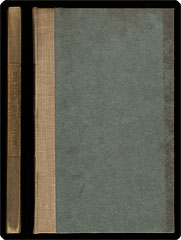
 Click the images for enlargements.
 • Sabin 14312; Shaw & Shoemaker 326; Howes C573. Period-style quarter tan cloth and light blue paper–covered sides, spine with printed paper label; spine cloth and edges of covers much darkened by smoke, endpapers and pastedowns discolored also. Title-page and last leaf waterstained from an earlier accident and the former tattered, with paper repairs not touching text and small early inked numeral partially cut off at outer edge; marginal smoke invasions and other light spotting at points throughout. One small early inked correction. Sad faults noted, a copy sound for reading and working with, soundly priced. (26239)
NOT the Progress — The Pharisee & Publican & the Dying Sayings Bunyan, John. A discourse upon the Pharisee and Publican. Wherein several weighty things are handled ... the twelfth edition, corrected. To which is added his last sermon; as also his dying sayins [sic]. London: John Marshall, 1725. 12mo (14.7 cm, 5.75"). 166 pp. (lacking final blank f.).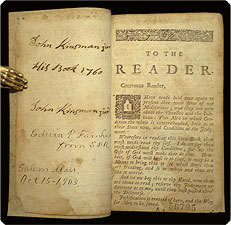
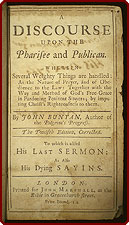 Click the images for enlargements.
 John Marshall also issued this work in the same year as the present example with a slightly different title-page, reading “Wherein several great and weighty things . . . ,” this being a copy of the issue with a cancel title-page.The text is illustrated with one woodcut scene. A few copies are described as having a frontispiece, which would not be integral to the collation; presumably it was added later and so not original.
Provenance: John Kinsman, jun., 1760; Edwin P. Farnham, 1903.
• ESTC T58485. Recent speckled paper wrappers. Free endpapers and first and last leaves with worm damage to edges; final blank leaf lacking. Front free endpaper and dedication page with rubber-stamped numerals (no other markings). Lower outer corners waterstained in first portion of volume; some darker stains from laid-in plant matter, with several leaves having words obscured or lost due to botanical adhesions — in the worst case, one leaf with hole affecting about 30 words from having adhered to plant matter, subsequent leaf with about 15 words obscured. Some headers just shaved but no catchwords touched. Title-page verso and back free endpaper with inked ownership inscriptions as above. (20618)
FIRST toTimbuktu & Back Caillié, René Auguste. Journal d'un voyage a Temboctou et
a Jenné, dans l'Afrique Centrale, précédé d'observations faites chez les Maures Braknas, les Nalous et d'autres peuples; pendant les années 1824, 1825, 1826, 1827, 1828. Paris: L'Imprimerie Royale, 1830. 8vo (21.1 cm, 8.25"). 3 vols. I: Frontis., [4], xii, 472, [4] pp. II: [4], 426 pp. III: [4], 404, [2] pp. (lacking 5 plates and map).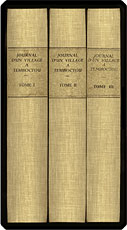
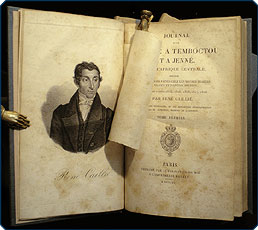 Click the interior image for an enlargement.
 Vol. I opens with a steel-engraved portrait of the author.
• Howgego, II, C2. Period-style quarter tan cloth and light blue paper–covered sides, spines with printed paper labels. Five plates and one map lacking (frontispiece present); two leaves each with tear along inner margin, not touching text; foxed throughout but without embrittlement. (24387)
For more SETS, click here.
Love & MUCH More Casseday, Davis B. The Hortons. Or American life at home. Philadelphia: James S. Claxton, 1866. 12mo. viii, 5-362 pp.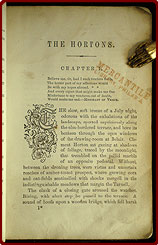 Any early buyer may have to wait for this until its cataloguer (CDB) has finished actually reading it!
• Wright, II, 474. Contemporary quarter morocco and marbled paper sides, worn and abraded, spine chipped and cracking, front and back covers pressure-stamped by a now-defunct library. Text block separated from spine, front cover partially detached. Title-page and several others stamped; pages with light waterstaining and scattered small spots. (4362)
Lafayette — With Chromos Cecil, E. Life of Lafayette. Written for children. Boston: Crosby, Nichols, & Co., 1860. 12mo. Frontis., illus. added title-page, [6], 218 pp.; 4 color plts.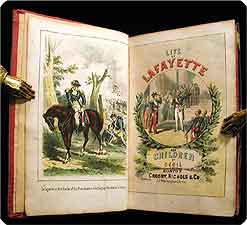
• Publisher's quarter red cloth, stamped in blind on sides and in gold on spine. Cloth starting at joints, and splitting over edges and corners; spine tips off. Waterstains on first five leaves, intermittent light foxing in margins, pencilling to front endpapers. Minor bubbling to front and rear pastedowns, front endpaper chipped. (756)
“Innocent Entertainment, Mingled with Correct Information & Sound Instruction” Chambers, Robert; & William Chambers, eds. Chambers' repository of instructive and amusing papers. Boston: Gould & Lincoln, 1853. 16mo (18.6 cm, 7.3"). 4 vols. I: [12 (8 adv.)], 31, [1], 32, 31, [1], 31, [1], 31, [1], 31, [1] 31, [1], 31, [1] pp.; illus. II: [10 (6 adv.)], 31, [1], 31 (lacking pp. 3–30), [1], 31 (lacking pp. 3–30), 31, [1], 31, [1], 31, [1], 32, 31, [1] pp.; illus. III: [4], 31, [1], 31, [1], 31, [1], 31, [1], 31, [1], 31, [1], 31, [1], 31, [1] pp.; illus. IV: [4], 31, [1], 31, [1], 31, [1], 31, [1], 31, [1], 31, [1], 31, [1], 31, [1] pp.; illus. .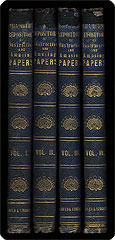
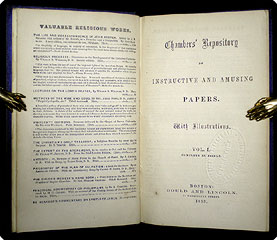
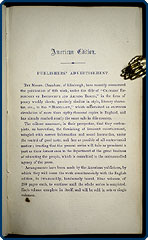
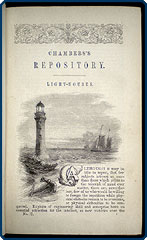 Click the images for enlargements.
 • Publisher's blue textured cloth, covers blind-stamped, spines with gilt-stamped title and compartment decorations; worn and scuffed with spines sunned and heads each with strip of dark cloth tape extending onto boards. Ex–social club library: Each volume with 19th-century bookplate on front pastedown, call number on endpaper, title-page pressure-stamped. Vol. IV lacking front free endpaper. Vol. II with one leaf with inner margin reinforced, several leaves with outer edges chipped, pp. 3–30 lacking from two articles. Paper slightly brittle, with occasional short edge tears; pages age-toned. (26396)
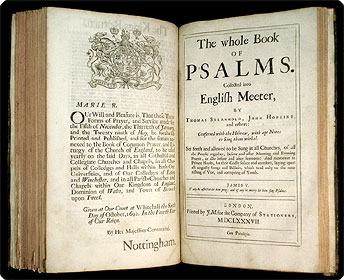
A Black-Letter
17th-Century Folio
BCP
Church
of England. Book
of Common Prayer.
The book of common prayer, and administration of the sacraments, and other rites
and ceremonies of the church, according to the use of the Church of England,
together with the psalter or psalms of David, pointed as they are to be sung
or said in churches [as below].... London: Charles Bill, Henry Hills,
& Thomas Newcomb, 1687. Folio (31.7 cm, 12.5"). Add. engr. t.-p., [231]
ff. (S1 bound in out of order, T6 lacking, Tt2-4 (blank) lacking, H2 of Psalms
signed H3). [with] Bible.
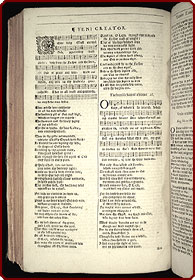
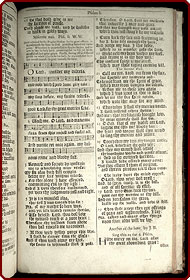
O.T. Psalms. English. Sternhold & Hopkins. The whole book of psalms.
Collected into English meeter ... conferred with the Hebrew, with apt notes
to sing them withal. London: Pr. by J.M. for the Company of Stationers, 1687.
Folio. [64] ff.
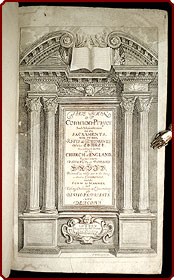
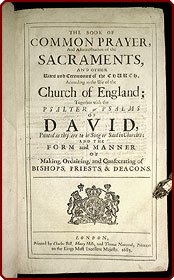 Click the images for enlargements.
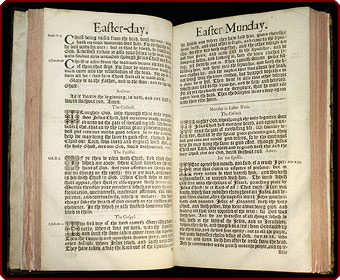
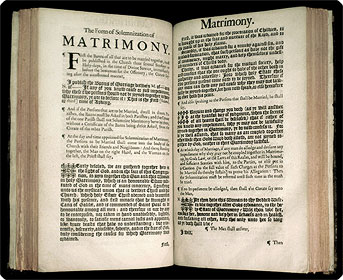 black-letter
Anglican prayer book, with an additional engraved architectural title-page
done by P. Williamson (giving a date of 1686), and a Kalendar printed in red
and black. The Psalter has a separate title-page (dated 1686) but continuous
registration with the BCP; the accompanying Psalms has separate title-page and
registration, and features music. The type is handsome throughout, and generally
is notably LARGE.
black-letter
Anglican prayer book, with an additional engraved architectural title-page
done by P. Williamson (giving a date of 1686), and a Kalendar printed in red
and black. The Psalter has a separate title-page (dated 1686) but continuous
registration with the BCP; the accompanying Psalms has separate title-page and
registration, and features music. The type is handsome throughout, and generally
is notably LARGE.
Incunable Cicero with!Extensive Evidence of Readership Cicero, Marcus Tullius. De officiis [and other works]. Venetiis [Venice]: Bernardinus Rizus, Novariensis & Bernardinus Celerius, 12 Oct. 1484. Folio. [180 of 182] ff., lacking b4–5.
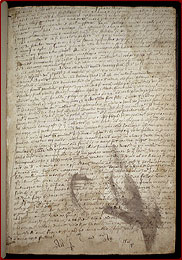
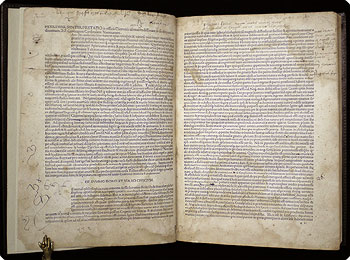
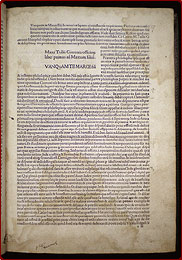 Click the interior images for enlargements.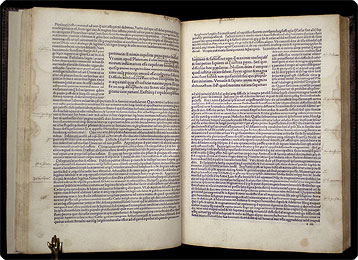
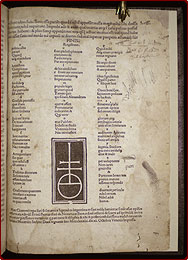
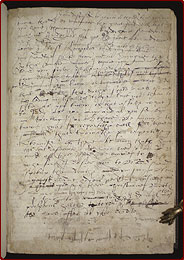
The recto of leaf a1 is blank, the text of the prefatory matter beginning on the verso.
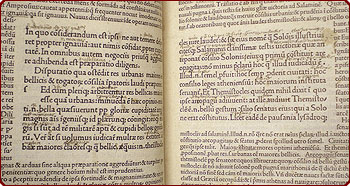
Provenance: Signature of “John Webb” in a 17th-century hand twice in margin of k3r.
Uncommon beyond the Continent: ISTC and Goff locate only two copies in the U.S. and ISTC locates only two copies in the U.K. (one incomplete), but there is a third copy at the British Library.
• ISTC ic00601000; Goff C601; HC 5274*; IGI 2910; Pr 4942; BMC, V 400; GKW 6954. Full modern walnut calf old style: Spine with raised bands, accented with gilt and blind rules, the latter extending onto covers to terminate in trefoils with blind double fillets beyond. Gilt center devices in the spine compartments. Red leather spine label lettered in gilt, and date in gilt at base of spine. Lacking two leaves (b4–5). Upper corners of leaves in gatherings & and [con] damaged with loss of paper. Lower corner of i1 torn with loss of text of both sides of leaf. Waterstaining and old dampstaining variously, this often faint and never really worse than moderate (worst at beginning/end); some age-toning and dustsoiling. Though an imperfect copy, a rarity; indeed, with its manuscript enhancements, a “uniquum.” (25766)
Huguenot
Horrors —Translated
forEnglish
Readers,
1686[Claude,
Jean]. [Account of the persecutions and oppressions of the Protestants
in France. London: J. Norris, 1686]. 4to (19.5 cm, 7.6"). A–G4
(-A1); 56 pp. (lacking title-page).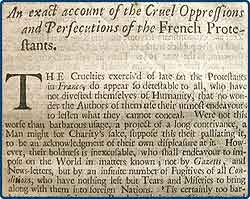
• Wing (rev.) C4589. Removed sometime from a nonce volume and now contained in a cloth-covered clamshell case with gilt-stamped leather spine label. Lacks the title-page; otherwise complete, with small loss of paper (not nearing text) at inner lower corners and one leaf with “chip” (only) of lower outer corner torn away (this perhaps in fact a paper flaw, and, again, far from type). One page with early monogram inked in upper outer corner; last page with neat stamp marking institutional deaccession (ex-Folger Shakespeare Library).
For more RELIGION, click
here.

Life on theAmerican Frontier Clavers, Mary [pseud. of Caroline M. Kirkland]. A new home — who'll follow? Or, glimpses of western life. New York: C.S. Francis; Boston: J.H. Francis, 1839. 12mo (17.5 cm, 6.9"). 317, [1 (blank)] pp. (lacking 2 final adv. pp.).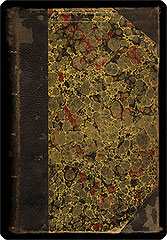
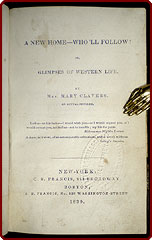
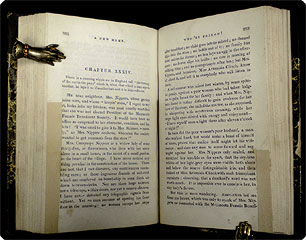 Click the images for enlargements.
 This copy includes the half-title, but has been well read and shows the signs thereof!
• BAL 11139; Howes K184; Sabin 37991; Wright, I, 1583. Contemporary half sheep and marbled paper–covered sides, spine with gilt-stamped title and author; leather worn/rubbed, especially at head of spine, but text firm in its binding. Front pastedown with Philadelphia bookbinder's ticket of B. Kohler (printed on blue paper). Ex–social club library: 19th-century inked call numerals on endpaper and half-title overlaid with paper labels, title-page pressure-stamped, no other markings. Pages age-toned, with intermittent stains and short edge tears; many leaves with edge repairs done some time ago, often with loss of a few letters, generally not affecting sense. Two final pages of advertisements lacking; one leaf with upper outer portion torn away, costing parts of 12 lines; two leaves with lower portions torn away, with loss of about 14 lines to each. Last leaves with waterstaining to outer portions. Clearly, as noted above, the club library that owned this had avid clientele for it; and that they were as determined to “keep it going” as the repairs show, even after it had been damaged, is interesting! (26386)
Folio — First Edition Covel, John. Some account of the present Greek Church, with reflections on their present doctrine and discipline; particularly in the Eucharist, and the rest of their seven pretended sacraments, compared with Jac. Goar's notes upon the Greek ritual. Cambridge: Cornelius Crownfield, 1722. Folio (37 cm, 14.5"). [5] ff., lx, [4], 400 pp., [5] ff.; 4 plts.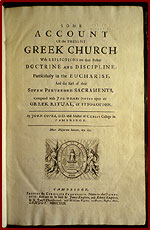
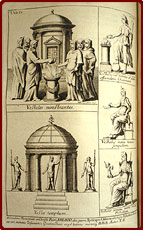
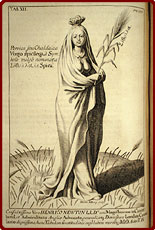
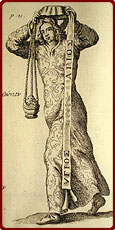
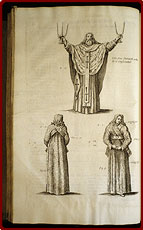 Click the images for enlargements.
 • ESTC T112737. Cambridge-style contemporary sheep, rebacked
in a very obvious but not unattractive way; red leather spine label and gilt
compartment devices.  Front
joint (exterior) cracked and board definitely loosening.
Ex-library with bookplates on front pastedown, pressure-stamp on title-page,
and pencil notation on verso of same. A clean, crisp copy in a binding needing
a bit of attention. (22635)
Front
joint (exterior) cracked and board definitely loosening.
Ex-library with bookplates on front pastedown, pressure-stamp on title-page,
and pencil notation on verso of same. A clean, crisp copy in a binding needing
a bit of attention. (22635)
Letters
of OBSCURE
MEN — Their
Authors &
EVERYBODY ElseCrotus Rubeanus, Johannes, & Ulrich von Hutten. Duo volumina epistolarum obscurorum virorum, ad Dominum M. Ortuinum Gratium, Attico lepôre referta, denuò excusa, & à mendis repurgata. Francoforti ad Moenum: [Apud Ioannem Spies, impensis Sigismundi Feyerabenij], 1581. 8vo (16 cm, 6.25"). [179] ff. (lacking appendix: 16 ff.).

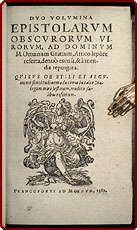
Click the images for enlargements. This example is lacking the appendix (entitled Conciliabvlvm theologistarvm adversvs Germaniae, & bonarum literarum studiosos), and thus is without the colophon providing printer and bookseller information. The title-page bears the printer's device of Feyerabend: Fame and her trumpets.
Uncommon: OCLC and NUC Pre-1956 locate only seven copies of this edition in U.S. libraries, one having been deaccessioned.
• VD16 E1729. This ed. not in Adams or Brunet. Period-style calf, covers framed in blind rolls, spine with gilt-stamped title/date and gilt- and blind-accented raised bands (blind tooling extended onto boards, terminating in decorative fleurons); spine compartments decorated in gilt and blind. Appendix (16 ff.) lacking; letters complete and the handsomely printed text all clean. (25643)
Syriac & English — Greek & LatinCureton, William. Spicilegium syriacum: Containing remains of Bardesan, Meliton, Ambrose and Mara bar Serapion. London: Rivingtons, 1855. 8vo (26.2 cm,
10.3"). [4], iii, [1], xv, [1], 102, [54] pp.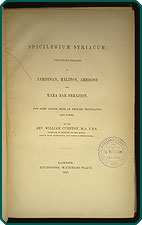
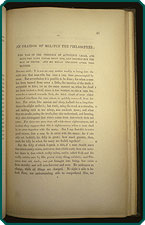
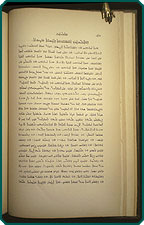 Single-click any image for an enlargement.
• NSTC 2C47117. Publisher’s cloth, covers blind-stamped, spine embossed and with gilt-stamped title; front cover detached, cloth chipped at spine extremities and rubbed at edges. Front pastedown with institutional bookplate, front free endpaper and title-page rubber-stamped, front free endpaper with inked ownership inscription dated 1870. Early inked marginalia to one page.
 TO Part II . . . TO Part II . . . |