 ANTIQUARIAN BIBLES
I: ENGLISH-LANGUAGE BIBLES, TESTAMENTS, & “PARTS” (Part A) (Part B)
II: POLYGLOTS & ANCIENT LANGUAGES (Part A) (Part B) | III: NATIVE AMERICAN LANGUAGES
 IV: MODERN LANGUAGES NOT ENGLISH OR AMERIND (Part A) (Part B)
V: BIBLE STUDY AIDS, COMMENTARY, & “RELATED” (Part A) (Part B)
 |
ENGLISH-LANGUAGE
BIBLES, TESTAMENTS, & “PARTS”
AMERICAN IMPRINTS INCLUDED HERE —
CATALOGUE ORDERED BY DATE
 We
can now offer a simple, unillustrated, 100-item list of “exotic”-language
Bibles. We
can now offer a simple, unillustrated, 100-item list of “exotic”-language
Bibles.
To browse this directly, click here!
|
AT LEAST THREE “FIRSTS” — First English Septuagint
First American-Translated English N.T. — First Bible Printed by an American
Woman
 (A
#1 EXCEPTION to the “DATE ORDER” RULE).
Bible. English.
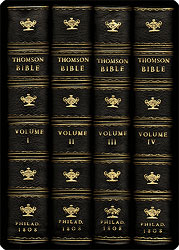
1808. Thomson.
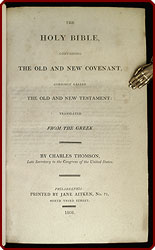
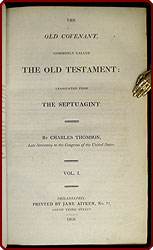
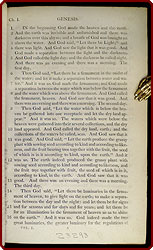
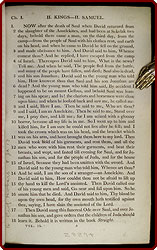
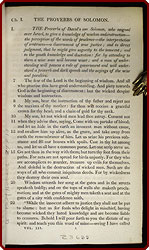
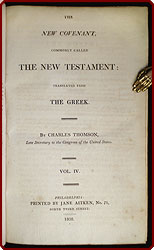
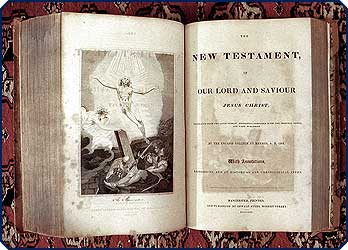
The Holy Bible, containing the Old and New Covenant, commonly called the Old and
New Testament: Translated from the Greek. By Charles Thomson.... Philadelphia:
Pr. by Jane Aitken, 1808. 8vo. 4 vols. I: [252] ff. II: [245] ff. III: [222] ff.
IV: [240] ff.
(A
#1 EXCEPTION to the “DATE ORDER” RULE).
Bible. English.
1808. Thomson.
The Holy Bible, containing the Old and New Covenant, commonly called the Old and
New Testament: Translated from the Greek. By Charles Thomson.... Philadelphia:
Pr. by Jane Aitken, 1808. 8vo. 4 vols. I: [252] ff. II: [245] ff. III: [222] ff.
IV: [240] ff.
$6500.00
 Click the images for enlargements.
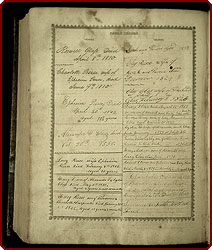
• The first-ever translation into English of the Septuagint, the first English translation of the New Testament by an American, and the first Bible printed by an American woman — Jane Aitken.  It was also the first translation of the Greek New Testament into English by a native of Ireland, and of course it is the work of a key figure of the American Revolution.
Charles Thomson was born in County Derry, Ireland, 29 November 1729 and arrived with his brothers in the American colonies as an orphan in 1740, his mother having died before embarkation and his father having died at sea during the crossing. He studied ancient languages and theology; through the influence of Benjamin Franklin received the mastership of the Latin school in Philadelphia (now the William Penn Charter School); kept records of proceedings at the Treaty of Easton (1757) on behalf of of the the Indian tribes, and was adopted into the Delaware Indian nation; served as the secretary of every congress from 1774 until 1789; and designed the Great Seal of the United States. An abolitionist and ardent supporter of the Revolutionary cause, he was characterized by a fellow Revolutionary (John Adams) as “the Sam Adams of Philadelphia, the life of the cause of liberty,” and by a conservative (Joseph Galloway) as “one of the most violent of the Sons of Liberty in America.” It was he who informed George Washington of his election to the presidency.
On 4 July 1776 only two signatures were affixed to the unanimously adopted Declaration of Independence — those of John Hancock, president of the Congress, and Charles Thomson, secretary, in order to authenticate the document that had been voted on and approved. Yet by a curious twist of fate (read rather, surely, of a political enemy's knife), when the calligraphic copy that is so well known to every school child was ready shortly after 19 July, authenticator Thomson was not invited to sign it!
When he had retired from public life in 1789, Thomson was to turn his interest in the Bible and Greek to the 20-year task of producing this monumentally important work.
Its printer was the daughter of Robert Aitken, who had printed the first Bible in English in America. A major edition of the English Bible, this is essential for any Bible collection, not just for collections of American Bibles — though as an American Bible and simple Americanum it has a revered place.
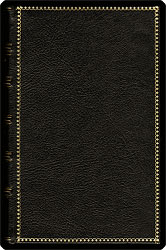
• Rumball-Petre, Rare Bibles, 184; Hills 153; Herbert 1514; O'Callaghan 91–92; Shaw & Shoemaker 14486. On Thomson, see: Dictionary of American Biography, XVIII, 481–82. Modern full black morocco, signed “GB” (Grace Bindings). Gilt spines. Black endpapers. The effect, richly elegant. Faintly visible pressure-stamps of a library (properly deaccessioned), each volume with neatly pencilled collection note and small old inked 5-digit number to first text leaf; in fact a remarkably clean, ever–well cared for, and handsome set. (26019)


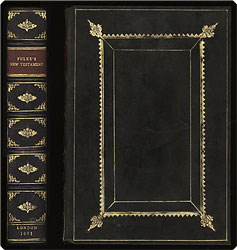
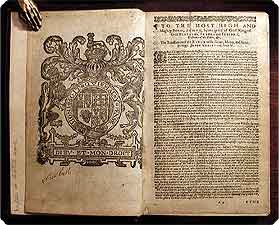
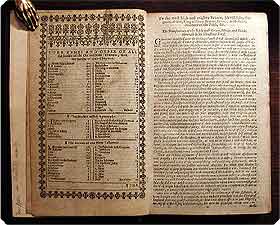
Bible. N.T. English. Rheims–Bishops’ version. 1601. The text of the New Testament of Jesus Christ, translated out of the vulgar Latine by the Papists ... at Rhemes ... Whereunto is added the translation out of the original Greeke, commonly used in the Church of England, with a confutation of all such arguments, glosses, and annotations, as conteine manifest impietie, of heresie ... against the Catholike Church of God ... [ed.] by W. Fulke. London: Robert Barker, 1601. Folio (31.5 cm, 12.25"). [21] ff., 914 [i.e., 912] pp., [5] ff.
$5000.00
Click the interior images for enlargements.
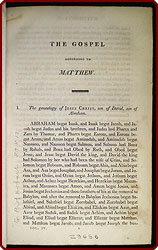
• When the Jesuit scholars at Rheims succeeded in printing their Catholic translation of the New Testament into English (first edition, 1582), the event affected various English Protestant scholars in different ways: Some were offended or outraged, others intrigued, and yet others spurred to action. William Fulke, of Pembroke College, Cambridge, was among those offended, outraged, and spurred: In 1589 he produced the first edition of his work attempting to refute the Rheims New Testament. His approach, however — which was to print the Rheims NT in parallel columns with the Bishops' NT (the then accepted version of the Church of England), supplying accompanying notes and
explanations — had unforeseen consequences.
As Darlow and Moule comment, “by printing the Rheims Testament in full, side by side with the Bishops' version, [Fulke] secured for the former a publicity which it would not otherwise have obtained, and was indirectly responsible for the marked influence which Rheims exerted on the Bible of 1611.” Alan Thomas elaborates by observing that “many a dignified or felicitous phrase was silently lifted by the editors of King James's Version, and thus passed into the language” (Great Books and Book Collectors, p. 108).
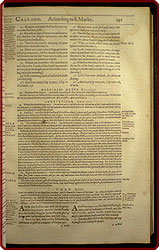
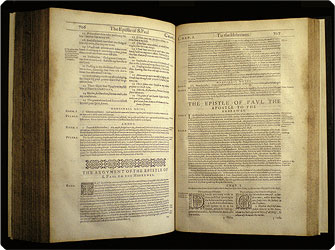
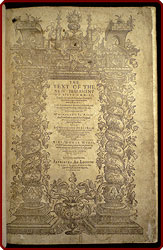
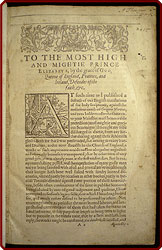
This is the second edition of the Rheims–Bishops' version of the New Testament, and thus the second printing of the Rheims in England.  All early editions of the Rheims NT are important and most are scarce. The present one has a handsome architectural woodcut border on the title-page; it is signed by the woodcut artist, “N.H.” The text is printed in double-column format, with side- and shouldernotes and with the apparatus at the bottom of the page.
Provenance: Signature of a contemporary owner “A. Thorpe, York,” undated, on A2.
• STC 2900; Darlow & Moule 265; Herbert 265; ESTC S115769. Modern black calf, covers framed with single gilt rule and paneled in gilt rolls with corner fleurons. Title-page mounted, with outer edge and small hole in lower margin reinforced; dust-soiled. A2 with early inked ownership signature (see above) and notation; reinforced at hinge (inside). Other markings: two pages with marginal notations and four pages with corrections, both inked by an early hand. Bug-spotting on several preliminary leaves. Light waterstaining on some early and later leaves, with occasional odd stains and spots elsewhere, not impairing sense of text. Dust-soiling on index pages. Two preliminary leaves missing small pieces of paper in blank margins; small hole at top outer corner of Kkkk4; and small chip at top edge of Hhhh2. Fold-mark at top outer corner of Vvv2.  In fact, a very nice copy of an important book. (24477)

“Breeches”
Bible with
Concordances
& Psalter
Bible.
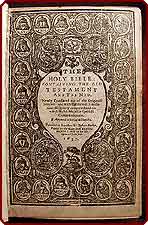
English. Geneva. 1609. The Bible. Translated according to the
Ebrew and Greeke, and conferred with the best translations in diuers languages.
[with two others, as below]. London: Robert Barker, 1609. 4to (22.1 cm,
8.75"). [2], 554 ff. (lacking ff. 79 & 80, 436). [with]
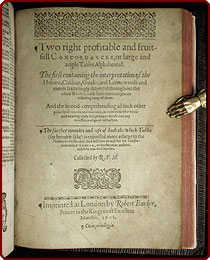
Herrey, Robert F. Two right profitable and fruitfull concordances, or large
and ample tables alphabeticall. The first containing the interpretation of the
Hebrew, Caldean, Greeke, and Latin words and names.... London: Robert Barker,
1608. 4to. [82] ff. (lacking C8). [and] Bible.
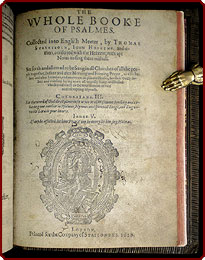
O.T. Psalms. The whole booke of Psalmes. Collected into English meeter,
by Thomas Sternehold, Iohn Hopkins, and others ... with apt notes to sing them
withall. London: Pr. for the Company of Stationers, 1610. 4to. [10], 68 (of
102) pp.
$2250.00
Click the images for enlargements.
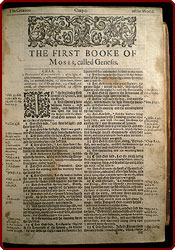
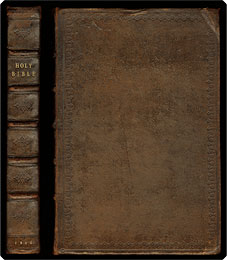
• This is a Barker printing of the Geneva version or “Breeches Bible,” known for its
translation of Genesis 3:7, “they sewed figge tree leaves together, and made themselves
breeches”; here with Tomson's revised New Testament and Junius's Revelation in a close reprint
of the 1606 quarto edition. Printed not long before the first appearance of the King James
version, this Bible hails from the close of the era of Geneva printings (and their Puritan
commentary) in England.
The present edition is printed in double-column format, predominantly in black-letter
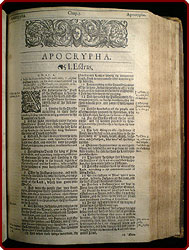
with shouldernotes in roman, and includes the Apocrypha. The main title-page
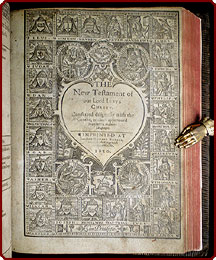
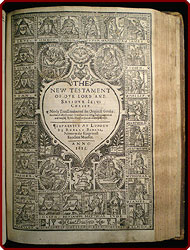
is framed in an elaborate woodcut border showing the 12 tribes of Israel and
the 12 Apostles; the separate New Testament title-page (dated 1610) has a matching
border. In addition to the Concordances, the Bible is also followed by
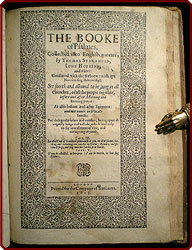
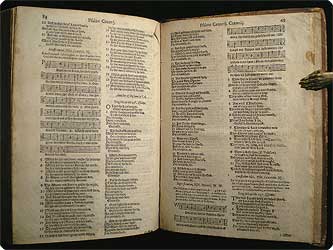
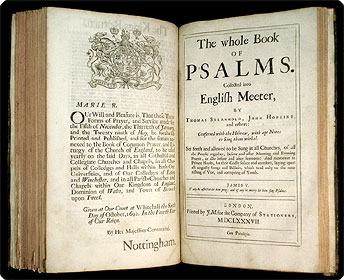
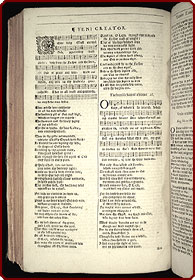
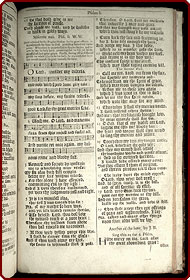
a classic Sternhold and Hopkins psalter, here with music, the text again printed
in double columns of black-letter.
with music, the text again printed
in double columns of black-letter.
• Herbert 298; Darlow & Moule 230; STC (rev. ed.) 2206.
Concordances: ESTC S122240; STC (rev. ed.) 13232. Psalmes:
ESTC S124337; STC (rev. ed.) 2533.5. Period-inspired later (late
19th-/early 20th-century) calf, covers framed and panelled in blind with blind-tooled
corner fleurons, spine with gilt-stamped leather title-label and blind-tooled
decorations; joints and corners refurbished, spine leather and label with
minor cracking. All edges stained red. Title-page mounted, with old repaired
tear; a few outer corners replaced, with loss of a few words from notes (only);
one leaf with tear from lower margin, extending into text without loss; one
leaf with burn hole towards upper outer corner, with loss of a few letters
from several lines. Bible (Deuteronomy) with ff. 79 and 80 torn out, f. 436
lacking after Apocrypha and before “The Summe of the whole Scripture”;
Concordances lacking f. C8; Psalmes lacking final 34 pp. Paper
good, though darkened and spotted; a number of scattered early inked marks
and marginalia. (26610)

KJV
Leaf, 1611:
 The
Stages of Israel's
Journey
& the Borders of
Canaan
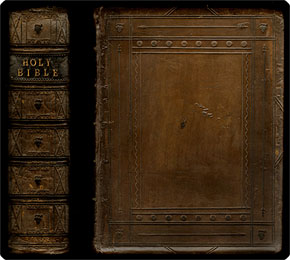
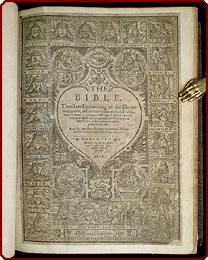
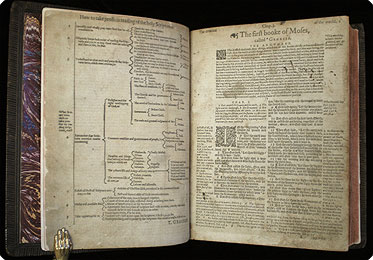
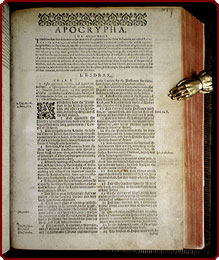
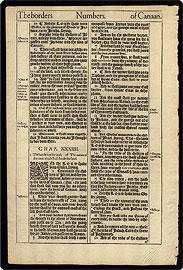
Bible. English. 1611. Authorized (i.e., “King James Version”). Leaf extracted from the Old Testament of the first edition of the King James Version of the Bible. [London: 1611]. Folio (40.1, 15.75"cm). [1] f.
The
Stages of Israel's
Journey
& the Borders of
Canaan
Bible. English. 1611. Authorized (i.e., “King James Version”). Leaf extracted from the Old Testament of the first edition of the King James Version of the Bible. [London: 1611]. Folio (40.1, 15.75"cm). [1] f.
$250.00
 Click the image for an enlargement.
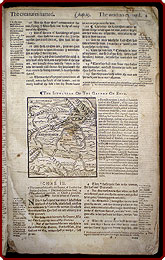
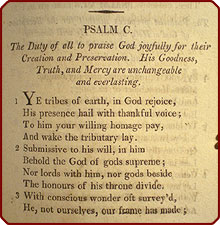
• Numbers 33:6–34:20, from the first edition of the English translation best known to the vast majority of the English-speaking world. The text is printed in large English black-letter (i.e., gothic type) with the occasional use of roman, composed in double-column format with 59 lines per column; present on this leaf is one large woodcut initial “A” on a field of foliage.
• Disbound. Inner edge with small nicks; very unobtrusive creasing to lower corners (from the original press run?); otherwise in beautiful condition. (25835)
 For
LEAVES,
For
LEAVES,
click here.
 BARKER's 1613 KJV QUARTO
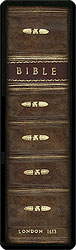
Bible. English. 1613. Authorized (i.e., King James Version). The Holy Bible, containing the Old Testament, and the New. London: Robert Barker, 1613. 4to (21.3 cm, 8.4"). [2], 34 pp., [520] ff. [with] Bible. OT. Psalms. English. Paraphrases. 1599. Sternhold & Hopkins. The booke of Psalmes, collected into English meeter ... London: Pr. for the Companie of Stationers, 1613. 4to. [10], 90 (final 12 pp. lacking) pp.
BARKER's 1613 KJV QUARTO
Bible. English. 1613. Authorized (i.e., King James Version). The Holy Bible, containing the Old Testament, and the New. London: Robert Barker, 1613. 4to (21.3 cm, 8.4"). [2], 34 pp., [520] ff. [with] Bible. OT. Psalms. English. Paraphrases. 1599. Sternhold & Hopkins. The booke of Psalmes, collected into English meeter ... London: Pr. for the Companie of Stationers, 1613. 4to. [10], 90 (final 12 pp. lacking) pp.
[SOLD]
Click the images for enlargements.
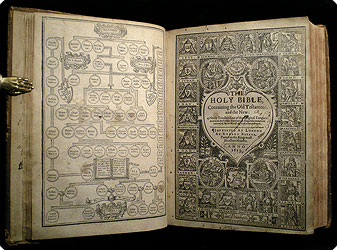
• The first black-letter quarto edition of the King James version, giving “bring foorth” for Genesis i, 11 and “he went” for Ruth iii, 15. Herbert notes that “This and many subsequent issues were produced in close imitation of those black-letter quarto editions of the Geneva Bible which had proved so popular.”
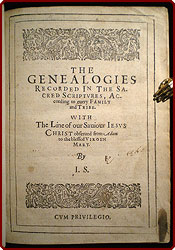
The separate title-page for the New Testament is present here, as are the Genealogies (though not the map) often found in copies of this edition; the volume closes with a 1613 printing of Sternhold and Hopkins's psalter, with music. The marvelous woodcut title-page border depicts the Twelve Tribes of Israel in panels on the left, balanced by panels depicting the Twelve Apostles on the right, with rondelles of the Four Evangelists.
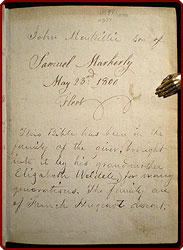
Provenance: Front free endpaper with inked ownership inscription dated 1800, noting this Bible's possession “for many generations” by a family “of French Huguenot descent”: the Markerly or, as it was later known, Markillie family, settlers in Ohio. Front pastedown with inked inscription describing artist John Markillie's presentation of the Bible to an Ohio institution in 1868, the year of his death. One text page with inked inscription of Samuel Markerly, dated 1799.
• ESTC S121317; Herbert 323; STC (2nd ed.) 2227; Rumball-Petre 128. Psalmes: ESTC S108634; STC (2nd ed.) 2544.5. Contemporary treed calf, rebacked, spine with gilt-stamped leather title-label and gilt-stamped decorations between gilt-dotted raised bands; edges and corners rubbed. Inscriptions as above; back free endpaper with early inked musical annotations; a few pages (mostly blank, but also including the O.T. title-page) with early inked annotations and doodles. Pages age-toned and trimmed closely, in some cases touching shouldernotes and headers; occasional light staining. Psalms lacking final 12 pp., with edges of three leaves tattered (in one case with loss of several words); Psalms otherwise complete and Bible entirely so. An appealing copy with interesting provenance. (25100)

TheLAST English “Breeches” Edition
Bible. English. Geneva–Tomson–Junius. 1616. The Bible: that is, the Holy Scriptures contained in the Old and New Testament.... London: Robert Barker, 1616. Folio (31.1 cm, 12.25"). [1], 362 (i.e., 365), [7] ff. (t.-p., Apocrypha, & New Testament not present here; foliation extremely erratic); illus.
$1000.00
Click the images for enlargements.
• Barker printing of the Geneva version, or “Breeches Bible,” the earliest English Bible printed with verse divisions — known for its translation of Genesis 3:7, “they sewed figge tree leaves together, and made themselves breeches.” This is the last Geneva Bible printed in England; produced five years after the first edition of the King James version, it brings to an end the printing of Puritan Bibles in that country and marks the close of the Geneva version's era of supremacy.
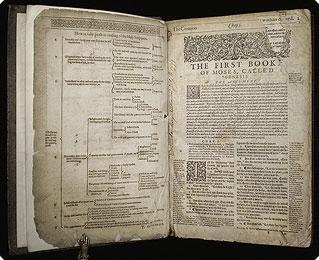
This is a black-letter folio edition, illustrated with a handful of in-text woodcuts (including the Ark and its paraphernalia, and charts of consanguinity). The copy consists essentially of the Old Testament and some additional matter; it lacks two of the four preliminary leaves (including the title-page, publication information being provided by the colophon) and it also lacks the Apocrypha and New Testament. It begins with “Of the incomparable treasure of the holy Scriptures”; the “Briefe Table of the interpretation of the proper names which are chiefly found in the Olde Testament” and the “Table of the principall things that are conteined in the Bible, after the order of the Alphabet” are both present.
• Darlow & Moule 270; ESTC S1792; Rumball-Petre, Rare Bibles, 130; STC (2nd ed.) 2244. Full later mottled calf, covers framed in double blind fillets and fleuron roll; spine with raised bands, blind-tooled compartment decorations, and gilt-stamped title and date; incomplete, with title-page, Apocrypha, and N.T. lacking. Binding rubbed/bumped at stress points, one compartment scuffed. Front free endpaper, first text page, and several others institutionally pressure-stamped; first page with rubber-stamped numeral in lower margin and early inked annotation regarding date of printing. Front free endpaper with affixed slips documenting gift donation in 1955, and with inked annotation regarding date; back pastedown showing traces of now-absent pocket. Tattering to first leaves not reaching text, and first one with recent repairs, second one with area of loss to upper outer portion affecting a border and ten lines of text, third one with central tear (touching woodcut map) repaired some time ago with tape, four leaves each with short tear from lower margin without loss, one leaf with lower outer corner torn away with partial loss of shouldernotes and image caption, final index leaf with hole affecting six lines. Expectable sorts of age-toning, dust-soiling, and light spotting/staining, only; lower outer corners of first quarter waterstained (often faintly).  In sum a survivor; “breeches” in Genesis underlined in ink! (26072)
 Handsome KJV with Genealogies & Psalms
Bible. English. Authorized (i.e., “King James Version”). 1632. The Holy Bible conteyning the Old Testament and the New. London: Robert Barker...by the assignes of John Bill, 1632. Folio (34 cm, 13.4"). [15], 507, [1] ff. (lacking 7 prelim. ff.).
Handsome KJV with Genealogies & Psalms
Bible. English. Authorized (i.e., “King James Version”). 1632. The Holy Bible conteyning the Old Testament and the New. London: Robert Barker...by the assignes of John Bill, 1632. Folio (34 cm, 13.4"). [15], 507, [1] ff. (lacking 7 prelim. ff.).
$5750.00
Click the images for enlargements.
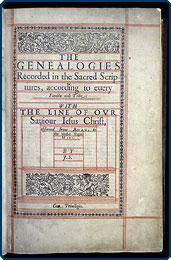
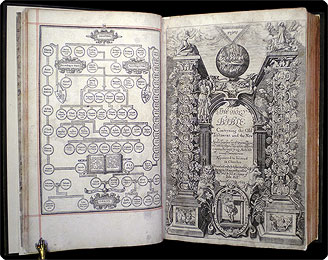
• [preceded by] Speed, John. The genealogies recorded in the Sacred Scriptures, according to euery familie and tribe. [London: F. Kingston, 1632?]. Folio. [2], 34 pp. [with] Bible. O.T. Psalms. English. Sternhold & Hopkins. 1632. The whole booke of Psalmes. Collected into English meeter.... London: Pr. by R. Badger for the Co. of Stationers, 1632. Folio. [2], 114 pp. (lacking 8 index pp.).
Attractive folio King James Bible, set in roman in double columns ruled in red throughout, with woodcut headpieces and decorative capitals. Darlow and Moule suggest that this edition was actually printed in early 1633, as a number of copies are recorded as having their title-page dates altered by hand to read 1633, as is the case here.
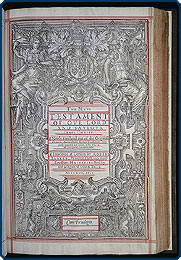
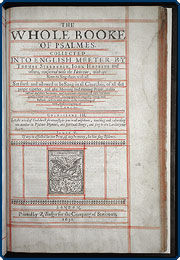
The Apocrypha are present, with the blank space on the last page of Malachi filled with an early inked “account of the several books in the Apocrypha.”  The Psalter following the Bible includes music. The O.T. title-page is engraved and signed (very faintly in this example) by William (here “Guilielmus”) Hole, and is framed by an elaborate architectural border displaying the coats of arms of the 12 tribes of Israel and portraits of the 12 Apostles. The recto of the list of books is a full-page engraving of Adam and Eve in the Garden of Eden, surrounded by animals. The New Testament has a separate title-page, dated 1632, with an ornate wood-engraved border featuring Justice and Truth along with the British lion and unicorn and various architectural motifs.
The volume opens with two fly-leaves bearing genealogical records in several different early inked hands, with dates ranging from 1743 through 1847. A copy of Speed's Genealogies precedes the Old Testament, while the “Description of Canaan” with map that should close the Genealogies has been bound in after the O.T. title-page.
• ESTC S122379; Darlow & Moule 359; STC (2nd ed.) 2298.5. Speed: ESTC S126191; STC (2nd ed.) 23039a.4. Psalms: ESTC S122383; STC (2nd ed.) 2633. Recent mottled calf, covers fillet-framed and panelled in blind with decorative inner blind roll and blind-tooled corner fleurons; spine with gilt-stamped title and gilt-ruled raised bands. Front cover with two slender scrapes; title-page with date altered in ink to 1633, as above. Front fly-leaves with margins repaired; “Description of Canaan” with inner margin reinforced. Bible, seven preliminary leaves lacking (calendar, dedication, preface, and list of books all present); Psalms, four final index leaves (only) lacking; foliation slightly erratic. Varying degrees of age-toning, occasional light waterstaining, some margins with faint smudging; in fact and in suma nice volume to hold and work with. (26102)
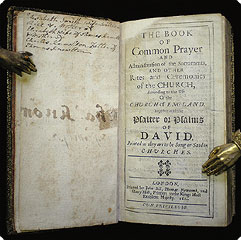
Restoration Binding — Painted Fore-Edge
(Bible).
Church of England. Book of
Common Prayer. The book of common prayer and administration of the
sacraments, and other rites and ceremonies of the church, according to the use
of the Church of England. Together with the Psalter or Psalms of David, pointed
as they are to be sung or said in churches. London: John Bill, Thomas Newcomb,
& Henry Hills, 1680. 12mo (14.7 cm, 5.75"). [432] pp. (lacking A1, blank
or licence). [with] Bible.
English. Authorized (i.e., “King James Version”). 1679. The
Holy Bible, containing the Old Testament and the New ... appointed to be read
in churches. London: John Bill, Thomas Newcomb, & Henry Hills, 1679. 12mo.
[870] pp. [and with] Bible.
O.T. Psalms. English. Sternhold & Hopkins. 1679. The whole
book of Psalms, collected into English metre, by Thomas Sternbold, John Hopkins,
and others. London: Pr. for the Company of Stationers, 1679. 12mo. [72] pp.
$6875.00
Click the images for enlargements.
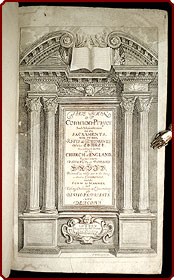
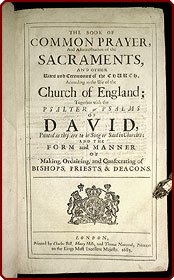
• Beautiful family heirloom prayerbook containing a later, but still 17th-century, printing of the King James Bible alongside the BCP and Psalter. The Bible is printed in two columns of roman type, without the Apocrypha; the New Testament has a separate title-page dated 1679. The Book of Common Prayer does not exactly match any of the 1680 printings described by ESTC or Griffiths: the collation ends with S12, while the title-page does not include “and the form & manner of making, ordaining, & consecrating of bishops, priests, and deacons,” nor does it give “Printed by the assigns of . . . “ before the publishers' names. The Psalter is likewise an unusual variant, not exactly matching any variant in ESTC.
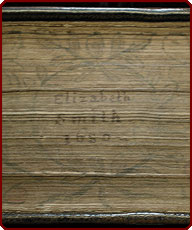
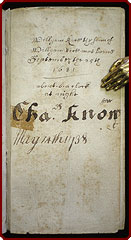
Provenance: Fore-edge painted with “Elizabeth Smith, 1680"; front fly-leaf with inscription recording the birth of William Rice in 1681 and with inscription of Charles Knowlton, dated 1738; fly-leaf verso with early inked genealogy describing the Smith-Rice-Knowlton descent.
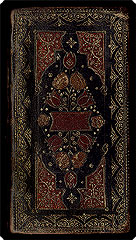
Binding: Elaborate Restoration binding: black morocco framed in gilt semi-circle and strawberry rolls surrounding a broken panel design of red-inlaid scalloped corners decorated with floral-dotted volutes, containing a bouquet of tulips and other flowers with red and citron morocco inlays; the upper- and lowermost tulips each with a smaller gilt-stamped flower and leaf tool inside, spaces filled with small flowers and dots. Spine gilt extra using cover rolls and additional floral decorations, with two decorated compartments of red morocco; board edges and turn-ins with gilt rolls. The tools used do not appear to be an exact match to any binder represented in Bennett, Nixon, or Maggs: Bookbinding in the British Isles, although the tulip with superimposed small flower is reminiscent of the binder Nixon identifies as the Small Carnation Binder. All edges gilt. Fore-edge painted with name as above, surrounded by hand-painted floral decorations.
• BCP: Wing (rev. ed.) B3659B. Not in ESTC; not in Griffiths (see 1680/5 for a very close example). Bible: ESTC R215858; Wing (rev. ed.) B2308A; Herbert 758. Psalms: Not in ESTC, not in Wing. Binding as above, front joint cracked (sewing holding) with corners/edges rubbed; spine leather with small cracks and head chipped, small area darkened. BCP lacking A1, either a blank or a licence and much more likely an initial blank; title-page repaired at one corner. Elsewhere, one leaf with tear from outer margin, extending across one column without loss; page edges with occasional small smudges from fore-edge decorations; some faint spotting and foxing. Now housed in a café au lait morocco slipcase mistakenly giving 1630 as year of publication, based on misleading print impression on title-page. A good and interesting book apart from its extraordinary binding, charming fore-edge treatment, and multi-generational provenance. (25925)

CALVINIST
“King James”
Folio
Extra —
1679
Bible.
English. 1679. Authorized (i.e., King James Version). The Holy Bible...with
the most profitable annotations. [Amsterdam: For Stephen Swart], 1679. Folio
extra (44 cm, 17.5"). π1*6**6A–Z6Aa–Zz6Aaa–Mmm6Nnn–Ooo4a–u6x4;
Engr. t.-p., [13] ff., 710 (i.e., 712), 248 pp.; illus. (6 double-spread plts.).
$6000.00
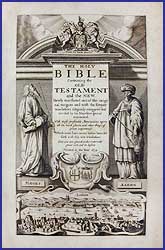
• A "pulpit Bible." This Authorized, "King James" Version Bible was printed for those more of Calvinist than Anglican bent and contains the notes from the Geneva Bible, including those of Theodore Beza. Like many others of its edition, this copy was not bound with the Apocrypha. Printed in Amsterdam, to avoid the censors, the edition exists in two states, one with the place and printer’s name on the printed title-page, and one (as here) without.
The engraved title-page is very fine, with Moses and Aaron flanking the title, the British royal arms above, and a scene of London below. The rest of the plates are all maps, as would not be the case in an Anglican Bible: These are all double-page, full of detail, and very attractive. The first, a map of the world, is labelled in Latin and Italian, and the rest in Dutch.
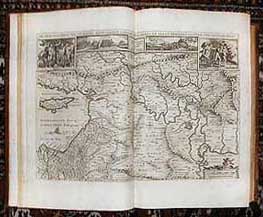 • Herbert 743; Wing (rev.) B2310. Contemporary diced calf, rebacked;
one joint again open and the other open, but cords holding. Covers ruled with
single gilt fillets, edges with single gilt rolls. Spine compartments ornately
gilt. Covers stained and with abrasions and some loss of leather, especially
over corners; spine dry and rubbed, with loss of leather and gilt. All edges
speckled red. Scattered spots of light soiling and staining, especially in
the margins. Entirely untattered.
• Herbert 743; Wing (rev.) B2310. Contemporary diced calf, rebacked;
one joint again open and the other open, but cords holding. Covers ruled with
single gilt fillets, edges with single gilt rolls. Spine compartments ornately
gilt. Covers stained and with abrasions and some loss of leather, especially
over corners; spine dry and rubbed, with loss of leather and gilt. All edges
speckled red. Scattered spots of light soiling and staining, especially in
the margins. Entirely untattered.

Bible. English. Authorized (i.e., King James Version). 1680. [The Holy Bible containing the Old Testament and the New. Oxford: At the Theater for Moses Pitt, Peter Parker, Thomas Guy, and William Leak, all in London, 1680]. 8vo (17 cm, 6.75"). A–Z8 Aa–Zz8 Aaa–Ggg8 Hhh2 Iii–Zzz8 Aaaa8 Bbbb4; [558] ff.; lacking engraved title (replaced with title and prelim. leaf from another edition).
$2500.00
Click
any image where the hand appears on
mouse-over, for an enlargement.
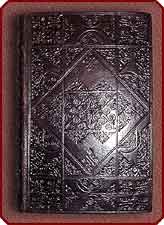
• An uncommon type of book sophistication: Considerable trouble has been taken to make this 1680 Oxford octavo Bible (the first complete English octavo Bible printed in that city) look like an earlier 1637 London Bible. The title-leaf and subsequent leaf from that Bible have been bound in at the beginning (the latter replicating the content found on f. [1] of this Bible) and the date on the New Testament sectional title has been all but completely erased. The charming binding supports the hoax, bearing a gilt “1637” on its spine.
This edition is printed in two unruled columns with shouldernotes, sidenotes (including dates), and italic headers. Acts 6:3 wrongly reads “ye may” for “we may.” Tables of kindred and affinity, weights and measures, money, and time are found on the last two pages. The New Testament sectional title has a woodcut vignette showing the arms of the University.
Binding: 19th-century black calf, elaborately tooled in blind in imaginative evocation of an “over the top” 17th-century binding, being horizontally, vertically, and diagonally ruled, foliate and floral devices within. Spine compartments tooled within, with gilt title in second one and gilt “Barker 1637” gilt at base. Red marbled endpapers. All edges gilt.
Provenance: 20th-century bookplate of C. ( or J.?) F. Weidmann, D.D. on front pastedown.
• Herbert 757; Darlow & Moule 595; Wing (rev.) 2315; Loftie, A
Century of Bibles,
354; ESTC R213033. (The title-page is from ESTC S90540 or S90541.) Binding
as above, a little rubbed, and refurbished. Occasional light browning, soiling,
and shallow bumping or chipping (not touching text).
Lacking engraved title (replaced with title and preliminary leaf from another
edition). A
bibliophile’s delight, and warning.
 A Black-Letter
17th-Century Folio
BCP
(Bible). Church of England.
Book of Common Prayer.
The book of common prayer, and administration of the sacraments, and other rites
and ceremonies of the church, according to the use of the Church of England,
together with the psalter or psalms of David, pointed as they are to be sung
or said in churches [as below].... London: Charles Bill, Henry Hills,
& Thomas Newcomb, 1687. Folio (31.7 cm, 12.5"). Add. engr. t.-p., [231]
ff. (S1 bound in out of order, T6 lacking, Tt2-4 (blank) lacking, H2 of Psalms
signed H3). [with] Bible.
O.T. Psalms. English. Sternhold & Hopkins. The whole book of psalms.
Collected into English meeter ... conferred with the Hebrew, with apt notes
to sing them withal. London: Pr. by J.M. for the Company of Stationers, 1687.
Folio. [64] ff.
A Black-Letter
17th-Century Folio
BCP
(Bible). Church of England.
Book of Common Prayer.
The book of common prayer, and administration of the sacraments, and other rites
and ceremonies of the church, according to the use of the Church of England,
together with the psalter or psalms of David, pointed as they are to be sung
or said in churches [as below].... London: Charles Bill, Henry Hills,
& Thomas Newcomb, 1687. Folio (31.7 cm, 12.5"). Add. engr. t.-p., [231]
ff. (S1 bound in out of order, T6 lacking, Tt2-4 (blank) lacking, H2 of Psalms
signed H3). [with] Bible.
O.T. Psalms. English. Sternhold & Hopkins. The whole book of psalms.
Collected into English meeter ... conferred with the Hebrew, with apt notes
to sing them withal. London: Pr. by J.M. for the Company of Stationers, 1687.
Folio. [64] ff.
$800.00
Click the images for enlargements.
• Nicely boundblack-letter
Anglican prayer book, with an additional engraved architectural title-page
done by P. Williamson (giving a date of 1686), and a Kalendar printed in red
and black. The Psalter has a separate title-page (dated 1686) but continuous
registration with the BCP; the accompanying Psalms has separate title-page and
registration, and features music. The type is handsome throughout, and generally
is notably LARGE.
• ESTC R36536; Griffiths, Bibliography of the Book of Common Prayer, 1687/1; Wing (rev. ed.) B3679. Psalms: ESTC R40777; Wing (rev. ed.) B2561. Contemporary mottled calf panelled with plain calf, decorated with blind-tooled scalloping and corner fleurons, recently rebacked with mottled calf, spine with gilt-stamped leather title-label, gilt-ruled and blind-tooled raised bands, and gilt-stamped acorn decorations in compartments; original leather with expectable acid-pitting, back cover with slightly deeper abrasions, hinges (inside) reinforced. Front pastedown with early inked ownership inscription. Added engraved t.-p. with short tear from lower margin, just touching lower edge of frame; upper outer corners of same and main t.-p. chewed. S1 bound in out of order; T6 lacking; Tt2-4 (blank) lacking; H2 of Psalms signed H3. Most pages clean and whole, but a number of early BCP leaves with lower and outer portions tattered, in some cases with significant loss and in others with only a few letters affected. First and last few leaves darkened. A damaged but still very attractive 17th-century exemplar. (26945)
Bible.
English. 1774. Authorized (i.e., “King James Version”).
The Holy Bible, containing the Old Testament and the New: Translated out of the
original tongues, and with the former translations diligently compared and revised,
by his Majesty’s special command. Oxford: T. Wright & W. Gill, 1774.
12mo (17.5 cm, 6.9"). [840] pp.
$700.00 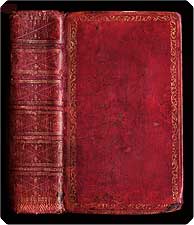
• Nicely bound copy of this Wright and Gill publication, which joined
an octavo edition by the same publishers in the same year. This Bible is without
the Apocrypha, as issued; some copies are described as ending with leaf Qq12,
although the present example closes on Mm12 with the words “The End.”
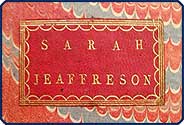 Provenance:
Front pastedown with red leather bookplate gilt-stamped “Sarah Jeaffreson.”
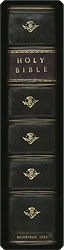
Also with tipped-in bookplate of the Zion Research Library’s A. Marguerite
Smith Collection and with laid-in bookplate of the Endowment for Biblical
Research, Boston.
Provenance:
Front pastedown with red leather bookplate gilt-stamped “Sarah Jeaffreson.”
Also with tipped-in bookplate of the Zion Research Library’s A. Marguerite
Smith Collection and with laid-in bookplate of the Endowment for Biblical
Research, Boston.
Binding: Red goat, covers
framed in floral gilt rolls and spine compartments with gilt-stamped geometric
and floral decorations; very delicate and pretty. Board edges gilt, gilt inner
dentelles, all edges gilt.
• ESTC T91635; Darlow & Moule 1238. Binding moderately rubbed
and abraded with spine slightly darkened; corners bumped and lower one of
front cover discolored at leather-edge; gilt on edges faded almost away. Inside
some age-toning, with a handful of small, light spots; one leaf torn along
inner margin. Back fly-leaf with pencilled notation; scattered stray pencil
marks to other leaves. A pleasing little Oxford Bible.
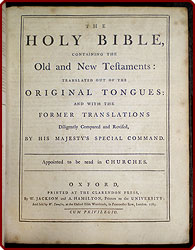
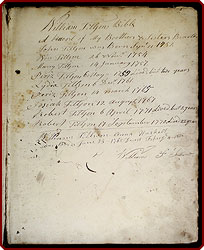
“William Tillsons Bible”
& BCP
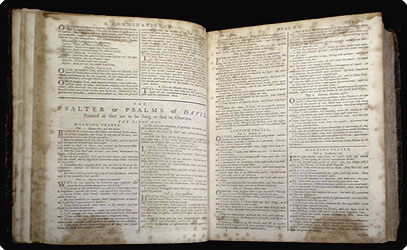
(Bible). Church of England. Book of Common Prayer. [The book of common prayer, and administration of the sacraments, and other rites and ceremonies of the church, according to the use of the Church of England; together with the Psalter, or Psalms of David, pointed as they are to be sung or said in churches]. [Oxford: W. Jackson & A. Hamilton, 1783?]. 4to (28 cm, 11"). [52] ff. (lacking ff. [1]–[3]). [bound with] Bible. English. 1783. Authorized (i.e., King James Version). The Holy Bible, containing the Old and New Testaments: translated out of the original tongues: and with the former translations diligently compared and revised.... Oxford: W. Jackson & A. Hamilton, 1783. 4to (28 cm, 11"). [144] ff. (lacking final blank?). [bound with] Bible. O.T. Psalms. English.Paraphrases. 1770. Sternhold and Hopkins. The whole book of psalms, collected into English metre.... Oxford: Pr. by T. Wright & W. Gill, 1770. 4to (28 cm, 11"). [28] ff.
$800.00
Click the images for enlargements.
• Large, heavy, quarto family bible — smaller and more manageable
and less expensive than the large folios intended to be used at the lectern
in church, but still quite substantial. These family Bibles also could contain,
as in this case, the Book of Common Prayer and the "old" version metrical psalter
— the expectation that they would serve the master of the house in leading
family worship.
Provenance:
"William Tillsons Bible" in manuscript above manuscript family records on the
front free endpaper.
• Prayer Book, Psalter: not in ESTC.
Bible: not in Darlow & Moule or ESTC; Herbert 1286. Contemporary
calf, covers panelled in blind with remnants of clasps. Front joint open with
cords strongly holding; covers abraded with incisions and leather loss to
edges; spine leather dry and cracking; front fly-leaf detached. Lacking title-page
and two preliminary leaves of Prayer Book; another early leaf detached with
a closed tear across, no loss of text; four or half a dozen leaves with a
crescent of waterstaining along upper margin and some lines into text. Bible:
scattered foxing and brown spotting, with a few closed tears and occasional
chipping in the margins, resulting in loss of words from a few shouldernotes.
The copy described by Herbert had engravings and maps not present here; this
copy is complete textually.
(Bible).
Church of England. Liturgies. Book of common prayer.
Book of common prayer, and administration of the sacraments, and other rites and
ceremonies of the Church, according to the use of the Church of England: Together
with the Psalter or Psalms of David, pointed as they are to be sung or said in
churches. Oxford: Clarendon Press, 1791. 8vo (25.5 cm, 10"). [196] ff. [bound
with] Bible. O.T. Psalms. English. Sternhold and Hopkins. The whole book of
psalms, collected into English metre. Oxford: Clarendon Press, 1793. 8vo (25.5
cm, 10"). [60] ff.
$2550.00

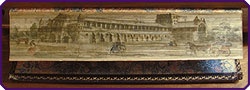
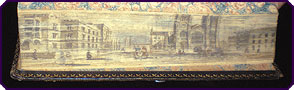
• Highly decorative and sweetly sentimental copy of the Book of Common Prayer and its accompanying psalter. The volume is embellished with astriking double fore-edge painting depicting (in one direction) the medieval Abbey Church of St. Albans in Hertfordshire, with a horse-drawn carriage in the foreground, and in the other direction the western facade of Westminster Abbey, with passing pedestrians.
Single-click any image where the hand appears on
mouse-over, for an enlargement.
Binding: Contemporary black straight-grain morocco, covers framed with a gilt double fillet and a gilt roll of a vine design, spine gilt extra, gilt-tooled board edges, gilt inner dentelles. All edges gilt, front edge with double fore-edge painting as above.
Provenance: The front fly-leaf bears an inked inscription reading “From this Book our 4 Dear Children were Babtized [sic] by the Rev. S. Good, Rector of St. Anns Blk. Friars, And afterwards Christened by their Dear Uncle the Rev. Charles Brown, Rector of Whitestone, near Exeter, Devon.” The children's baptismal dates range from 1806 through 1814.
• ESTC T93069; Griffiths, Bibliography of the Book of Common Prayer, 1791/7. Binding as above, leather slightly worn over joints and extremities. Front fly-leaf with collector's small bookplate, reverse with inscription as above, title-page with owner's name and date (1806) inked in upper margin. Pages clean.
Uncommon ScottishBible & Psalter
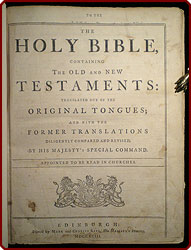
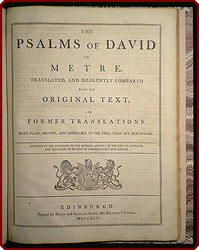
Bible. English. 1793. Authorized (i.e., King James Version). The Holy Bible, containing the Old and New Testaments: Translated out of the original tongues; and with the former translations diligently compared and revised, by His Majesty's special command. Edinburgh: Mark & Charles Kerr, 1793. 4to (30.4 cm, 12"). [508] ff. [with] Bible. O.T. Psalms. English.1795. Paraphrases. The Psalms of David in metre. Translated, and diligently compared with the original text, and former translations. More plain, smooth, and agreeable to the text, than any heretofore. Allowed by the authority of the General Assembly of the Kirk of Scotland, and appointed to be sung in congregations and families. Edinburgh: Mark & Charles Kerr, 1795. 4to. [24] ff.
$850.00
Click the interior images for enlargements.
•
The Kerrs, printers to His Majesty, published a number of Bibles in the late 18th century, with minor to significant variations among the editions — including several different formats in 1793. In the present (uncommon) large quarto edition, the Apocrypha are not present although listed in table of contents, but the signatures of the Old and New Testaments are continuous and uninterrupted; the New Testament has a separate title-page.
This edition ends with leaf 6M4 and does not match Darlow and Moule 957 (Edinburgh: M. & C. Kerr, 1793), described as a folio with text ending on 9R2, although that entry's statement that “The insertion of the Apocrypha interrupts the signatures” would seem to explain the absence of the non-integral Apocrypha; the accompanying Scotch Metrical Psalms of 1795 are also present in Darlow and Moule's listing. Herbert finds additional Kerr printings of 1793, but none that match the format and
collation of this copy.
Scarce: ESTC, OCLC, and NUC Pre-1956 find only two U.S. holdings.
Provenance: The beautifully written ownership note, “Rebecca Jane Emack,” at top of first text leaf.
• ESTC T91818; this ed. not in Darlow & Moule or Herbert. Recent quarter calf and marbled paper–covered sides, spine with gilt-stamped leather title-label and gilt-stamped thistle decorations, leather edges tooled in blind. Upper portion of title-page neatly excised and probably something off the bottom also; early inked ownership inscription as above. Light staining and foxing; several instances of laid-in dried plant matter. (25336)
It's the Notes that Are the Real Treat Here
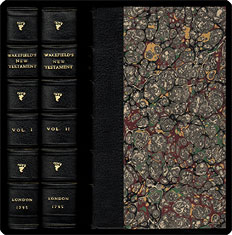
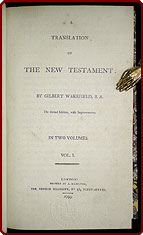
Bible. N.T. English. Wakefield. 1795. A translation of the New Testament ... the second edition, with improvements. London: Pr. by A. Hamilton for George Kearsley, 1795. 2 vols. 8vo (21.3 cm, 8.4"). I: [4], viii, 410, [2] pp. II: [4], 472 pp.
$600.00
Click the interior images for enlargements.
• Wakefield first published a volume of “those parts only of the New Testament which are wrongly translated in our common version” before having this complete Testament printed in 1791; this is the second edition, revised and corrected, of the entire translation. A theological and political controversialist, Wakefield adopted Unitarian principles, although the Cambridge History of the Bible says his New Testament is “in no sense sectarian.”
Each volume closes with extensive Notes; the last leaf of vol. I offers a list of other works by this author for sale from the same publisher; and the last page of the second volume has an affixed errata slip. The notes are quite direct and personal, with Wakefield remarking, e.g., on what effect or variety of accuracy he is trying to achieve; what the knot of difficulty at a particular point actually is, for the translator; and whose “excellent” reading he is following (and how the chosen version from the Coptic differs from the Syriac or AEthiopic). He expresses surprise that an “obvious construction” has “escaped the critics” so “remarkabl[y]” long as it has, and in another case confesses that he is “quite at a loss” as to how one clause is supposed to connect with another — definitely, he's a scholar who yetlives in his pages.
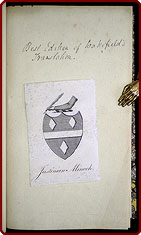
Provenance: Armorial bookplates of Justinian Minoch laid in.
• ESTC T93093; Darlow & Moule 933 (see note); Herbert 1362. On Wakefield, see: Oxford Dictionary of National Biography online. Recent quarter black morocco and stone pattern marbled paper–covered sides, leather edges tooled in blind; spines with gilt-stamped title, volume number, place/date, and compartment decorations. Bookplates laid in as above. Half-titles and title-pages with handsome old institutional pressure-stamp; each first text page with inked numeral. Intermittent light foxing, pages otherwise clean. An engaging pair of books in all respects. (25784)
Bible. N.T. Gospels. English. 1796. Campbell. The four Gospels, translated from the Greek. With preliminary dissertations, and notes critical and explanatory. By George Campbell. Philadelphia: Thomas Dobson, 1796. 4to (27.7 cm, 10.9"). vii, xvi, 488, 196 pp., [8] ff.
$3000.00
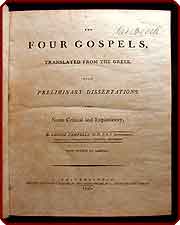
• Three American “firsts” here, counting that of our caption! For while being additionally the uncommonfirst
printing in America of the Gospels in English in any translation other than the King James or the Douai-Rheims version, this is also the first privately accomplished translation of the Gospels printed in America.
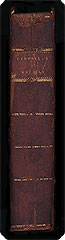 George Campbell (1719–96) was a minister of the Church of Scotland, theologian, and principal of Marischal College. He wrote a number of theological works, including a defense of miracles in response to David Hume, and was noted for originality of argument as well as charity towards his opponents. This
translation of the Gospels was first published in England in 1789; the work consists of a preface and preliminary dissertations, the actual translation, and the notes, with the whole being very scholarly, resorting frequently to the Greek in the dissertations and notes.
George Campbell (1719–96) was a minister of the Church of Scotland, theologian, and principal of Marischal College. He wrote a number of theological works, including a defense of miracles in response to David Hume, and was noted for originality of argument as well as charity towards his opponents. This
translation of the Gospels was first published in England in 1789; the work consists of a preface and preliminary dissertations, the actual translation, and the notes, with the whole being very scholarly, resorting frequently to the Greek in the dissertations and notes.
Provenance: Title-page and contents leaf with early inked inscriptions reading “Jas. Booth.”
• ESTC W4383; Evans 30086; Hills, English Bible in America, 56. On Campbell, see: The Dictionary of National Biography. Contemporary treed sheep, rubbed and abraded with leather lost at corners/spine and cracking over joints and spine. Title-page and contents inscribed as described above; endpapers waterstained, and pages with light spots of foxing. Paper in many sections faintly blue.

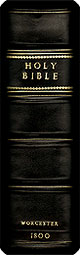
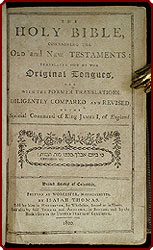
For the “United States of Columbia”
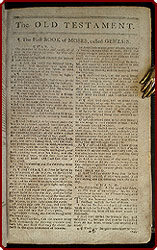
Bible. English. 1800. Authorized (i.e., “King James Version”). The Holy Bible, containing the Old and New Testaments: Translated out of the original tongues, and with the former translations diligently compared and revised, by the special command of King James I, of England. Worcester, MA: Isaiah Thomas, 1800. 12mo (17.6 cm, 6.9"). [788 (of 792)] pp. (X1 and X12 lacking).
“United States of Columbia”
Bible. English. 1800. Authorized (i.e., “King James Version”). The Holy Bible, containing the Old and New Testaments: Translated out of the original tongues, and with the former translations diligently compared and revised, by the special command of King James I, of England. Worcester, MA: Isaiah Thomas, 1800. 12mo (17.6 cm, 6.9"). [788 (of 792)] pp. (X1 and X12 lacking).
$1375.00
Click the images for enlargements.
• Early issue of Thomas's famous duodecimo “Standing Edition,” following the first printing of 1797. Having invested in sufficient type to leave the pages of this Bible intact and ready to print at all times, Thomas reaped a substantial commercial reward from the long-term success of this edition, originally conceived of as a “Common School Bible.”
In an attempt to promote the idea of changing the country's name from the United States of America to the United States of Columbia, Thomas used the latter nomenclature on all issues of his proudly local, non-imported production.
ESTC and OCLC locate only eight institutional holdings, all in the U.S.
• ESTC W4503; Evans 36955; Hills 72; O'Callaghan 55 (for 1799 ed.). Period-style calf, framed and panelled in blind rolls, spine with gilt-stamped title and publication information and gilt-ruled raised bands, turn-ins blind-tooled. Two pages of Jeremiah (not consecutive) lacking. Pages age-toned with moderate staining; first and last few leaves with edge nicks, chips, and short tears; a few leaves creased; one leaf with lower margin chipped, resulting in loss of about four words. Some corners bumped or dog-eared. (26121)
Bible. English. 1804. Authorized (i.e., “King James Version”). The Holy Bible: Containing the Old and New Testaments; translated out of the original tongues, and with the former translations, diligently compared and revised. Philadelphia: Benjamin Johnson (pr. by Robert Carr), 1804. 8vo in 4s (22.2 cm, 8.75"). 4 vols. I: [234] ff. II: [280] ff. III: [230] ff. (lacking 1 contents f.). IV: [231] ff. (lacking 1 prelim. blank).
$475.00
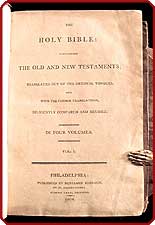
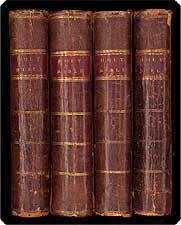
• Early Philadelphia double-column Bible, in a uniformly bound four-volume set.Provenance: Front free endpaperswith inscription reading “Mary Miller — Greenwich No. 2 10mo [?] 1st 1837.”
• Hills 114; Shaw & Shoemaker 5850. Contemporary sheep, abraded, with leather cracking over spines and joints cracked or cracking; spines with gilt-stamped leather title labels. Vol. III lacking first contents leaf; vol. IV lacking front free endpaper and preliminary blank. Occasional spots of foxing and varying degrees of age-toning; some leaves with edge chips.
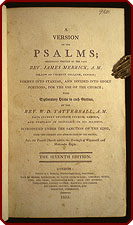
Bible. O.T. Psalms. English. 1805. Merrick. A version of the Psalms ... formed into stanzas, and divided into short portions, for the use of the Church ... the seventh edition. London: Pr. by C. Rickaby for Messrs. Rivingtons; Longman, Hurst, Rees, & Orme; Leigh & Sotheby; et al., 1805. 12mo (18.3 cm, 7.2"). [4], 389, [1 (blank)] pp.
$275.00
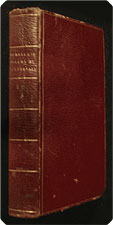
• Seventh edition of the William Dechair Tattersall’s revision. Originally printed in 1765, James Merrick’s rhymed English translations were described by one contemporary review (quoted by Allibone) as “too poetical for ordinary public worship, but . . . highly gratifying for private use to persons of cultivated taste.” The popular work went through a number of editions and issues; in the present rendition, the paraphrases appear “formed into stanzas, and divided into short portions” by the Rev. Tattersall.
Binding: Contemporary red straight-grain morocco, covers framed in gilt single fillet, spine with gilt-stamped title. All edges gilt.
• NSTC B2162; Lowndes, Bibliographer’s Manual, 2002 (for 1798 Tattersall ed.); Allibone, Critical Dictionary of English Literature, 1269 (likewise). Binding as above, spine and outer edge of front cover darkened, joints and edges with moderate shelf wear. Front pastedown with institutional bookplate and donor bookplate; front free endpaper reverse with inked ownership inscription and pencilled inscription dated 1814; title-page with small inked initials in upper outer corner. Light foxing. In fact quite nice.
Bible. English. Douai–Rheims. 1811–13. The Holy Bible, translated from the Latin Vulgate... the Old Testament, first published by the English College at Doway, A.D. 1609, and the New Testament, first published by the English College at Rhemes, A.D. 1582; with annotations, references, and an historical and chronological index. Manchester: Oswald Syers, 1811–13. Folio (cm). [approx. 702] ff., lacking title–page, but having both cancel and cancelland of N.T. L2 present; (several signatures incorrectly signed); 19 plts. (1 excised & laid in).
$1250.00
Click either image for an enlargement.
• Scarce sole edition. Sold without direct episcopal sanction, this folio edition of the Douai– Rheims version was issued in rivalry with the better-known Haydock rendition and is the artefact of a sad story: The Catholic priests of Manchester, who mistakenly believed that Haydock’s effort to print a Douai–Rheims Bible had been abandoned after his move from that city to Dublin, therefore encouraged local printer Syers to produce his own edition — only to restore their patronage to Haydock following the discovery of their error, leaving poor Syers in the lurch.
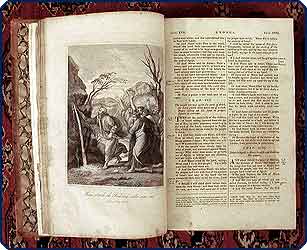
The text generally follows the Challoner–Rheims revision, although the notes are collected from various sources. The volume is illustrated with two frontispieces and17 plates engraved by J. Bottomley, Symns and Mitchell, and others after paintings by Westall, Raphael, Reynolds, et al. Issued in parts in a small print run, this Bible is now uncommon.
• Darlow & Moule 1034. Contemporary treed calf, rebacked some time ago in plain calf with gilt-ruled bands and gilt-stamped title-label; sides rubbed and scraped, with spine scuffed, leather worn over extremities, front joint cracked from weight of oversized volume. Hinges (inside) reinforced with cloth tape. Lacking title-page. Plate from Genesis I:4 removed, and laid back in with margins cut away. First few leaves with edges ragged. Pages with offsetting around plates; occasional light spots of staining, mostly confined to outer margins.
Bible.
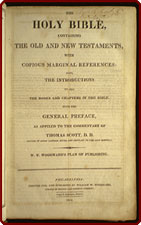
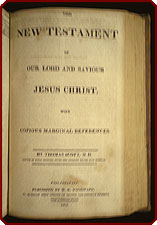
English. Authorized (i.e., King James version). 1814. The Holy Bible, containing the Old and New Testaments, with copious marginal references; also, the introductions to all the books and chapters in the Bible, with the general preface, as affixed to the commentary of Thomas Scott, D.D. Philadelphia: William W. Woodward, 1814. 2 vols. in 1. 4to (24.1 cm, 9.5").
[441], [160] ff.
$300.00
• Early American printing of this popular commentary, originally published in several years’ worth of weekly portions. The text is that of the King James Bible and is supplemented by extensive notes from Thomas Scott, one of the founding members of the Church Missionary Society.
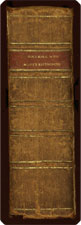
• Hills 259; Shaw & Shoemaker 30867. Contemporary treed sheep, spine with gilt-ruled raised bands and gilt-stamped leather title-label; binding rubbed, front joint cracked, back joint starting from top, spine extremities chipped. Front pastedown with private collector’s small bookplate, title-page with early inked ownership inscription in upper margin. Pages age-toned.
First
U.S. Stereotype
Quarto
Bible —
MANYPlates
& Maps
Bible.
English. 1816. Authorized (i.e., “King James Version”).
The Holy Bible: containing the Old and New Testaments: together with the
Apocrypha: translated out of the original tongues and with the former translations
diligently compared and revised; with Canne's marginal notes and references.
To which are added, an index; an alphabetical table of all the names in the
Old and New Testaments, with their significations; tables of scripture weights,
measures, and coins; John Brown's concordance, &c. Embellished with maps
and elegant historical engravings. New York: Collins & Co., 1816. 4to (28.5
cm, 11.25"). 683, [5], 160, [2], 687–932, 56 pp.; 20 plts., 4 maps, 1
fold. map.
$850.00
Click the images for enlargements.
• The first quarto Bible stereotyped in America (and the fifth Collins quarto Bible
overall, including his Trenton edition). The volume is set in small pica type and illustrated with
20 copperplate and wood-engraved plates and five maps, one oversized and folding. John Watts
of London, one of the pioneers of stereotyping in America, supervised the effort.
The Bible was issued with various accompaniments; this example includes the
Apocrypha and Brown's Concordance (the latter with a separate title-page, dated 1815), but not
“Ostervald's Notes.”
Provenance:
Ownership note of “Ephraim Pierce” on front free endpaper,
with the “Family Records” pages offering four pages (eight columns)
on the Pierce family and its connections.
• Books Contained in the Library of the American Bible Society 15;
Hills 296; O'Callaghan 128–29; Shaw & Shoemaker 36952; Wright, Early Bibles of America,
195–96. Contemporary mottled sheep, spine with gilt-stamped leather title-label, gilt-stamped Greek key bands, and gilt-stamped decorations consisting of a sickle, wheat,
and an hourglass overlaid by an open book; binding rubbed overall, front cover with lower outer
portion darkened, spine leather with minor cracking, spine with old inked shelving number in
bottom compartment. Front pastedown with traces of now-absent bookplate, front free endpaper
with early inked ownership inscription, title-page and two others institutionally pressure-stamped, preliminary advertisement with inked annotation along inner margin and rubber-stamped numeral in lower margin. Back fly-leaf with affixed contemporary religious clippings.
Two plates torn, each with old hand-sewn repair in dark thread. Folding map torn along folds,
one tear with small area of loss, edges tattered. Pages and plates predictably foxed, some
browned; a few corners dog-eared. (26016)
Bible. English. 1819. Authorized (i.e., “King James Version”). The Holy Bible, containing the Old and New Testaments...stereotype [7th] edition. New York: American Bible Society (stereotyped by E. & J. White; pr. by D. Fanshaw), 1819. 8vo (24.2 cm, 9.5"). 705, [1], 215 (lacking 1/2), [1 (blank)] pp.
$600.00 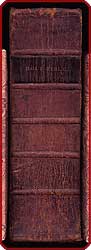
• Early American Bible Society Bible, following its first, which appeared in 1816. This stereotyped New York Bible was done from the same plates as Fanshaw’s 1818 Long Primer Octavo, and this 1819 example is seen institutionally far more often in microform copies than in genuine holdings.
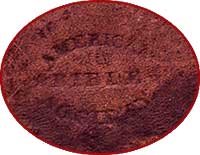
Provenance: Front cover with blind-stamped logo of the American Bible Society; title-page with inked inscription reading “Mary Ann Lanings [word obscured] August 24 1823.”
• Shaw & Shoemaker 47213; Hills 375. Contemporary sheep double-panelled in blind, spine with gilt-ruled raised bands and gilt-stamped leather title label; binding rubbed and unevenly faded, leather cracking over spine. Foxing ranging from mild to severe; last few leaves waterstained; some dog-earing. One worm track to upper outer margin of a few leaves. New Testament lacking title. Well used but not abused; an evocative copy.
Bible. English. Authorized. 1823. The Holy Bible: Containing the Old and New Testaments: Translated out of the original tongues.... Brattleborough, VT: Holbrook & Fessenden, 1823. 4to (27.5 cm, 10.9"). [6], 9–683, [5], 160, [2], 687–930, [2] pp.; 10 plts., 1 fold. map.
$400.00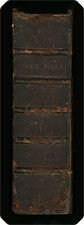
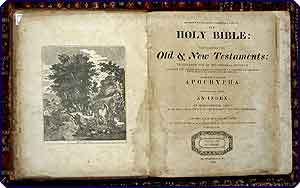
• Uncommon second issue, following the first of 1820–22, of
Holbrook and Fessenden’s stereotype edition including the Apocrypha and
the Account of the Lives and Martyrdom of the Apostles and Evangelists.
The Bible is illustrated with 10 engraved plates, some signed by Anderson, and
one oversized, folding map.
The family record leaves here were partially filled in with occasions in
the lives of James M. Welling (b. 1807, d. 1882), his wife Susan Vail Welling
(b. 1805, d. 1886), and their children; the final entry notes the death of
Mark Hermon [sic] Wheeler in 1908.
Provenance:
Front pastedown with small bookplate of prominent collector Michael Zinman.
• Hills 465 (describing 684 pp. and only
three plates); Shoemaker 11809 (for an edition of this year,
but with only 684 pp.); O’Callaghan gives 1818 Holbrook stereotype edition
only. Contemporary mottled sheep, spine with gilt-stamped title-label; binding
rubbed and abraded, with leather cracking over spine and cracked over joints.
Pages browned, with waterstaining to inner margins. One plate with hole to
corner of image; oversized, folding map with small hole near edge.
only
three plates); Shoemaker 11809 (for an edition of this year,
but with only 684 pp.); O’Callaghan gives 1818 Holbrook stereotype edition
only. Contemporary mottled sheep, spine with gilt-stamped title-label; binding
rubbed and abraded, with leather cracking over spine and cracked over joints.
Pages browned, with waterstaining to inner margins. One plate with hole to
corner of image; oversized, folding map with small hole near edge.
“The Uninterrupted Harmony” of the New Testament
Bible. N.T. English & Greek. 1825. Scientia biblica: Containing the New Testament, in the original tongue, with the English Vulgate, and a copious and original collection of parallel passages, printed in words at length. London: W. Booth, 1825. 8vo (23.2 cm, 9.2"). 3 vols. I: xvii, [3], 592 pp.; 1 plt. II: [4], 669, [3 (2 adv.)] pp. III: [4], 546, [2], [547]–551, [1] pp.
New Testament
Bible. N.T. English & Greek. 1825. Scientia biblica: Containing the New Testament, in the original tongue, with the English Vulgate, and a copious and original collection of parallel passages, printed in words at length. London: W. Booth, 1825. 8vo (23.2 cm, 9.2"). 3 vols. I: xvii, [3], 592 pp.; 1 plt. II: [4], 669, [3 (2 adv.)] pp. III: [4], 546, [2], [547]–551, [1] pp.
$975.00
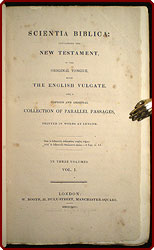
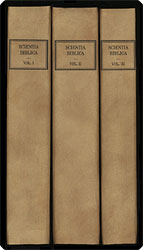
• First edition of this English and Greek compilation of New Testament
passages, intended to facilitate Scriptural comparison and analysis for both
biblical scholars and general readers. The editor was William Carpenter, a reformer,
journalist, and prominent member of the Chartist movement — as well as
an active Freemason who was a “constant contributor to the London Freemason,”
according to his obituary in the 1874 New England Freemason.
Click
the interior image for an enlargement.
Vol. I opens with a copper-engraved dedication to the king; vol. III closes
with a list of subscribers.
Complete sets in good condition are not commonly found on the market.
• Herbert 369; NSTC 2B26321. Original boards (signed binding:
each front pastedown with small ticket of G. Peck, bookbinder), newly rebacked
in the style of the era with tan paper spines in mottled tones bearing new
printed paper labels; corners and edges rubbed, sides showing moderate wear.
Each front pastedown with early inked numeral. Page edges untrimmed; pages
lightly age-toned, with intermittent spotting. A
very good set. (25087)
For
BIBLE SCHOLARSHIP,
click here.
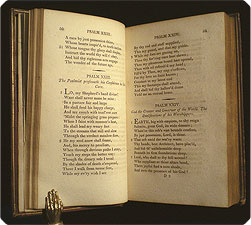
Bible. O.T. Psalms. English. Paraphrases. 1827. Watts. The Psalms, hymns, & spiritual songs ... to which are added, select hymns from other authors; and directions for musical expression. Boston: Samuel T. Armstrong and Crocker & Brewster,
[1827]. 12mo (15.6 cm, 6.2"). 496, [5]–156 pp.
$225.00
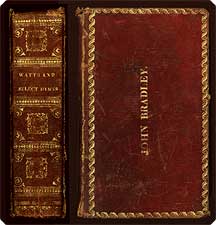
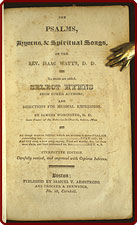
• “Stereotype edition, carefully revised, and improved with Copious Indexes.” The editor was Samuel Worcester, who also selected the added hymns at the back of this volume.
Binding: Contemporary red straight-grain morocco, covers framed in gilt rolls, spine gilt extra, front cover gilt-stamped “John Bradley.” All edges marbled.
• Shoemaker 31685. Binding as above, sides darkened, corners and spine rubbed, joints cracked with sewing holding but quite fragile. Fly-leaves with early pencilled ownership inscriptions and annotations. Light to moderate foxing. Separate title-page for second section (only) lacking.
PLACE
AN ORDER | E-MAIL
US | PRB&M HOME