 ANTIQUARIAN BIBLES
I:
ENGLISH-LANGUAGE BIBLES, TESTAMENTS, & “PARTS” (Part
A) (Part B)
II: POLYGLOTS &
ANCIENT LANGUAGES (Part A)
(Part B)
| III: NATIVE
AMERICAN LANGUAGES
 IV:
MODERN LANGUAGES NOT ENGLISH OR AMERIND
(Part A) (Part
B)
IV:
MODERN LANGUAGES NOT ENGLISH OR AMERIND
(Part A) (Part
B)
V: BIBLE STUDY AIDS, COMMENTARY, &
“RELATED”
(Part A) (Part B)
 |
MODERN LANGUAGES NOT ENGLISH OR “AMERIND”
AMERICAN IMPRINTS INCLUDED — A CATALOGUE
ORDERED BY DATE
|
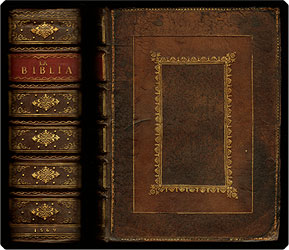
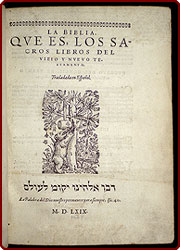
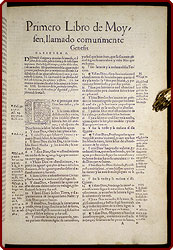
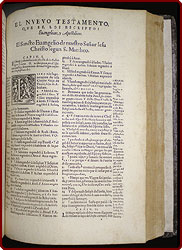
 The Bear Bible — The FIRST Complete Bible in Spanish
 Bible.
Spanish. Reina. 1569. La Biblia, que es, los sacros libros
del vieio y nueuo testamento. [Basel: Thomas Guarinus for or with Samuel Apiarius],
1569. 4to. [15 of 16] ff., 1438 columns, [1] p., 544, 508 columns, [1] p., [1]
f. (without the 3 leaves of “Annotationes” and the final blank);
illus.
Bible.
Spanish. Reina. 1569. La Biblia, que es, los sacros libros
del vieio y nueuo testamento. [Basel: Thomas Guarinus for or with Samuel Apiarius],
1569. 4to. [15 of 16] ff., 1438 columns, [1] p., 544, 508 columns, [1] p., [1]
f. (without the 3 leaves of “Annotationes” and the final blank);
illus.
$28,750.00
 Click the images for enlargements.
• The earliest edition of the complete Bible in Spanish. Following the success of producing the world's first polyglot Bible, Spain retreated from printing Bibles in an almost absolute way after the onset of the Reformation. Given the emphasis that Reformation leaders placed on accessible Bibles in the vernacular tongues, Spain, as a staunchly non-Reformation country heeding the Church's stricture against translation into the vernacular, produced no Bible in Spanish actually in Spain until the late 18th century.
Rather, the production of a Bible in Spanish fell to a peripatetic exiled Spaniard named Casiodoro de Reina (ca. 1520–94), a man who began his adult life as a monk, came under suspicion of being a “Reformist,” and fled Spain for Geneva — later fleeing that city for a series of others and declaring it “a new Rome” for its intolerance of new ideas. Whether the translation is solely from his pen or is the work of a committee in which he was primus inter pares is not known.
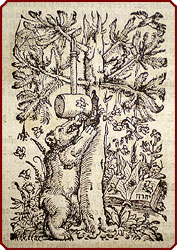
This Bible is known as the “Bible of the Bear” or the “Bear Bible” because of the printer's device on the title-page, a bear at a honey comb, which was the device of Samuel Apiarius. The relationship between Apiarius and the actual printer, Thomas Guarinus, is unresolved. The Old Testament in this translation is based on the Hebrew and derived heavily from the Latin of St. Pagninus and from the Ferrara version. The New Testament is based on the Greek of Erasmus with comparisons to the Vetus Latina and Syriac manuscripts.
There are two states of the title-page, this being state A with the line of type ornaments described in Darlow and Moule.
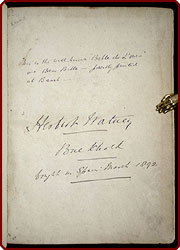
Provenance: Ownership signature of Herbert Watney and note “bought in Spain March 1892" on the front fly-leaf. Mr. Watney (1843–1932), the youngest son of the brewer James Watney, was educated at Rugby and Cambridge, and became Senior Assistant Physician at St. George's Hospital, London. In 1915 he served as Master of the Mercers' Company as his father had in 1846. He was a dedicated book collector of Bibles and English history: The first edition of the first complete Bible in Welsh in the library of St. John's College library, Cambridge, was his gift to the school.
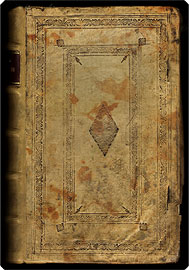
• VD16 B2869; Rumball-Petre262; Darlow & Moule 8472; Graesse, I, 386; Palau 2894; Adams B12061. 17th-century English calf, rebacked with new spine gilt extra very suitable in style; leather of covers a bit crackled and variously darkened; small areas of the covers at board edges replaced with new leather sympathetically gilt-tooled. Lacks the blank preliminary leaf and the four leaves at the end of “Annotationes breves sobre los lugares . . . “, both of which are very often lacking, the latter leaves having perhaps (even probably) been printed separately and later. Small piece of front fly-leaf cut away (probably removing an ownership inscription). The occasional instance of light soil or light waterstaining to fore- or bottom margins, sometimes reaching text; a generally clean and good copy. All edges mottled red and blue-green. (25772)

The
First Translation of the
Bible into Italian
from Hebrew
& Greek Sources
Bible.
Italian. Diodati.
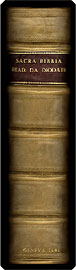
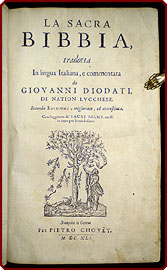
1641. La sacra bibbia tradotta in lingua Italiana, e commentata da
Giovanni Diodati. Stampata in Geneua: Per Pietro Chovët, 1641. Folio (30.5
cm; 12.125"). [3] ff., 837, [3], 331, [1], 148, 68 pp.
Hebrew
& Greek Sources
Bible.
Italian. Diodati.
1641. La sacra bibbia tradotta in lingua Italiana, e commentata da
Giovanni Diodati. Stampata in Geneua: Per Pietro Chovët, 1641. Folio (30.5
cm; 12.125"). [3] ff., 837, [3], 331, [1], 148, 68 pp.
$2200.00
Click the images for enlargements.
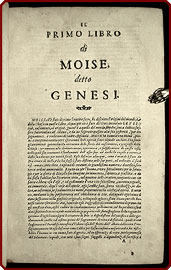
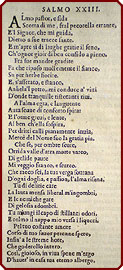
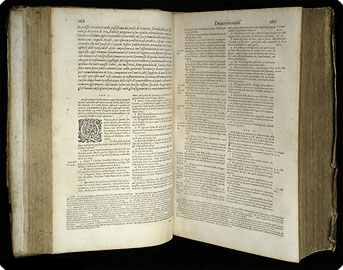
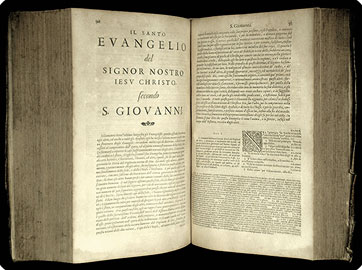
• Second edition of Giovanni Diodati's translation, “migliorata, ed accresciuta. Con
l'aggiunta de' Sacri Salmi, missi in rime per lo medesimo.” The first edition appeared in 1607.Diodati (1576–1649), a Protestant theologian, in 1609 succeeded Theodore Beza as
professor of theology at Geneva, and in fact was Beza's choice for his successor. He is best
remembered today as the first to translate the Bible into Italian from Hebrew and Greek sources.
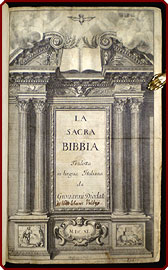
The added engraved title-page of this edition is dated 1640 and signed “A. Bosse jn. et
fecit”; it bears two old ownership notes, not deciphered. The biblical text is printed in roman
and italic in double-column format and has woodcut initials; Diodati's commentary is in smaller
roman type at the bottom of pages in very wide single-column format. The New Testament,
Apocrypha,and Psalter have sectional titles.
• Darlow & Moule 5600.
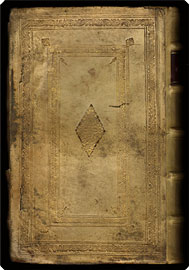
Contemporary vellum over paste boards, elaborately tooled in gilt, rebacked
and the gilt of the front board mostly perished leaving the tooling attractively highlighted in
black; gilt of the bottom board still bright. Vellum with old stains and slightly yapp edges
defective in part, showing signs that silk ties were once present. The half-title leaf for the N.T. is
not printed, but blank. Light waterstaining in upper margin of early leaves; otherwise occasional
spotting only. All edges gilt. In sum, a rather nice copy. (26298)
 A
A Lectern
Bible USED
in a Lutheran Church?
Bible. German. 1710. Luther. Biblia, das ist: Die gantze heilige Schrift des Alten und
Neuen Testaments. Wie solche von Herrn Doctor Martin Luther Seel. im Jahr Christi
1522. in unsere Teutsche Mutter-Sprach zu übersetzen angefangen.... Nürnberg:
In Verlegung Johann Andreä Endters Seel, Sohn, und Erben, 1710. Folio (39
cm, 15.38"). Frontis., [32] ff., 1181, [1] pp., [11 (-1)] ff.; 1 plt., illus.
Lectern
Bible USED
in a Lutheran Church?
Bible. German. 1710. Luther. Biblia, das ist: Die gantze heilige Schrift des Alten und
Neuen Testaments. Wie solche von Herrn Doctor Martin Luther Seel. im Jahr Christi
1522. in unsere Teutsche Mutter-Sprach zu übersetzen angefangen.... Nürnberg:
In Verlegung Johann Andreä Endters Seel, Sohn, und Erben, 1710. Folio (39
cm, 15.38"). Frontis., [32] ff., 1181, [1] pp., [11 (-1)] ff.; 1 plt., illus.
$1500.00
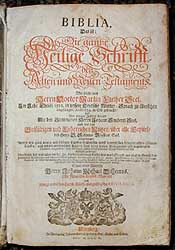
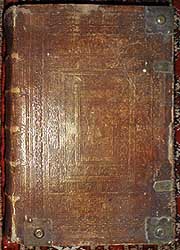
• Aside from its importance in the religious tradition, Luther's translation of the Bible is probably the most important single text for the formation of Modern German. Like other Luther Bibles, this one contains his prefaces to the books of the Bible, including his theologically significant Preface to the Epistle to the Romans. It is also supplemented by the Augsburg Confession, of which, sadly, the last leaf is absent here.
In this printing, a fine engraved title-page shows an angel delivering Luther's translation of the Old Testament to a Church still in bondage to the requirements of the old Law. A similar sectional title-page, depicting God the Father, Jesus Christ, and allegorical figures of the sacraments of Baptism and Communion, comes before the New Testament. Six special pairs of leaves, bound in at various places, each offer a first page containing an engraving of biblical figures and three following pages containing their biographies. A woodcut vignette of the unusual triple arms of the city of Nürnberg appears on the title-page; a number of chapters are adorned, at head, with one-third page woodcut illustrations set in neat borders; and the books typically open with typographically appealing two-column "headers." The text is in a handsome and relatively legible fraktur. The size, decoration, and overall composition of the volume, along with its faults (especially the manner in which which pages are worn), suggest a history as a lectern Bible in a Lutheran Church.
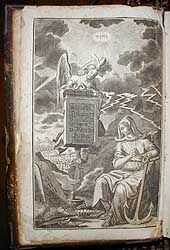
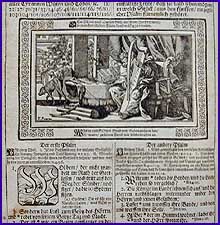
Binding: This copy is bound in ornately
blind-tooled and -stamped alum-tawed sheep over wooden boards, the front cover
with three of its original etched corner bosses and with its two etched clasp-catches.
(Bosses of back cover no longer present, remnants of clasps.) A martial portrait
is centered on each cover; unfortunately these are now so worn that they are
no longer identifiable. Perhaps they belong to the electors of Saxony who safeguarded
the Lutheran faith in its infancy.
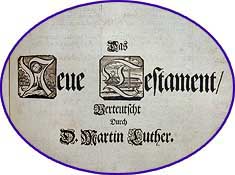
• Binding as above. Covers abraded and worn, some scraping to back upper board, leather peeling back from fore-edge of front cover and opening at ends of joints, most notably at bottom of front one. Front free endpaper with inked inscription, in German, dated Philadelphia, 1852. Frontispiece with a fore-edge chip (not into image) and tears in from bottom margin and at gutter, with small loss to plate area at bottom inner corner. A number of pages with tears extending into text, a few places with chips to bottom outer corners with loss of words but not of sense. Scattered foxing, with occasional darker small stains. Last leaf (of Confession, NOT Bible) lacking. Despite faults, a grand volume both usable and inspiring.

Bible.
German. 1743. Luther.
[Biblia, das ist: Die Heilige Schrift Altes und Neues Testaments, nach der Deutschen
Uebersetzung D. Martin Luthers, mit jedes Capitels kurzen Summarien, auch beygefügten
vielen und richtigen Parllelen {sic}. Germantown: Gedruckt bey Christoph
Saur, 1743]. 4to (26.3 cm, 10.375"). [2] ff. (supplied in facsimile), 995, [1
(blank)], 277, [1] pp., [1] f.
$6000.00
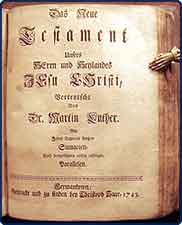
• 1743 saw the first complete Bible in a European language printed
in the New World, in—of all places—Germantown, Pa., and in—of
all languages—German. The colonial powers had granted monopolies for Bible
printing to “home” publishers and their products were priced sufficiently
low to discourage illegal printing by colonial printers, which left it to German-Americans—a
people here as independent settlers, not “colonists”—to first
print a Bible of their own. Christopher Saur (or Sower, as he Englished it)
was something of a renaissance man, university educated and a physician, and
he used his connections in Germany to obtain the gift of the fraktur
type used in this Bible. It was printed in an edition of 1200 copies, and cost
18 shillings. Another complete American Bible did not follow until Saur’s
son, also Christopher, published a further edition in 1763. 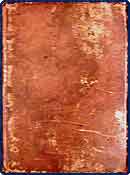 Arndt
lists three states for this edition, of which this appears to be C, based on
the absence of a two-leaf addendum giving a short history of Bible translation—that
a buyer could choose to have bound in or not.
Arndt
lists three states for this edition, of which this appears to be C, based on
the absence of a two-leaf addendum giving a short history of Bible translation—that
a buyer could choose to have bound in or not.
• Rumball-Petre, Rare Bibles, 159; Darlow & Moule 4240;
O’Callaghan 22; Wright, Early Bibles of America, 24–44;
Evans 5127–28; Sabin 5191; Arndt, The First Century of German Language
Printing in the United States of America, 47C; Hildeburn, The Issues
of the Press in Pennsylvania, 1685-1784, 804. Contemporary calf over bevelled
boards. Binding scratched and abraded with tears to spine leather. Hinges
(inside only) open. A printed poem has been affixed to the front pastedown,
over a strip of cloth. Ownership inscriptions in German (in gothic cursive)
and English on endpapers. Pp. 1–2 with loss of part of margins, some
text, and part of headpiece, repaired with paper. Lightly age-toned with darker
brown-spotting, some waterstaining, occasional dog ears, and some holing or
chipping in the margins—some of the latter repaired with paper. First
two leaves, i.e., main title-page and preface supplied in facsimile; the New
Testament title-page is present.
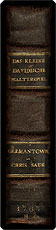
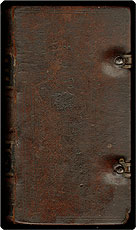
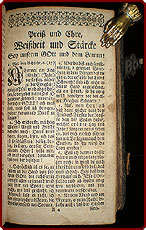
Saur Psalms, 1764
Bible. O.T. Psalms. German. Luther. 1764. Das kleine Davidische Psalterspiel der Kinder Zions. Germantown: Gedruckt bey Christoph Saur, 1764. 12mo. [3] ff., 570 pp., [12] ff.
$950.00
Click the images for enlargements.
• Third printing in America of the German metrical psalms; from the press of the man to print the first German Bible in America, which was also the first Bible printed in the New
World in a European language. Printed in double-column format, without the music.
Provenance: Old inked inscription of John Ebersole, dated 1793, on front free endpaper; later pencilled signatures of Anna Ebersole and another person to pastedown.
• Evans 9602; Hildeburn, Pennsylvania, 2045; Arndt & Eck, First Century of German Language Printing in the U.S., 296; ESTC W20981. Contemporary calf with one clasp working and a remnant of the other; moderate rubbing to covers, leather on spine showing flex marks from the tight-back binding. Later spine labels. Faint library pressure-stamp on title-page;
signatures as above. Age-toning and some staining; in fact the paper in cleaner condition than is often seen. (25959)
Bible. N.T. French. 1811. Le Maistre. Le Nouveau Testament de notre seigneur Jésus-Christ. Imprimé sur l'édition de Paris, de l'année, 1805. Revue et corrigée avec soin d'après le texte Grec. Boston<: Les Libraires Associés,
1811. 12mo (18 cm, 7"). 379, [1] pp., [2 (advertisements)] ff.
$275.00
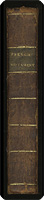
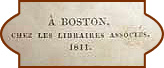
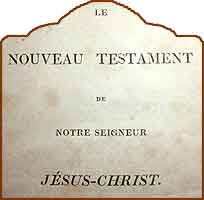
• 1810 was the year that saw the first printing of a complete Testament in French in the U.S.— one was then issued in Boston for use among French Canadians and French émigrés. This edition came out the following year, and is the second to have been printed in the U.S.
Provenance: Late-20th-century book label of Michael Zinman on front pastedown.
• Not in O'Callaghan; not in Darlow & Moule; Shaw & Shoemaker 22372. Treed sheep; flat spine with gilt rules and a black leather title label, gilt-lettered. Lightly rubbed, dry with some cracking. Inside, scattered spots of light browning and some chipping in the margins, the latter not affecting text. In fact, a nice copy. (4710)
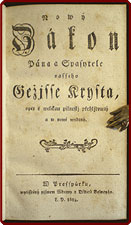
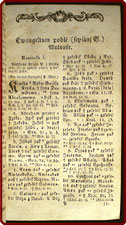
Bible. N.T. Czech. Kralitz. 1814. Nowý Zákon pána a spasytele nasseho Gežisse Krysta: opět s welokau pilnostj prehljdnutý a w nowě wydaný. W Presspurku : Wdowy a Dědicu Belnayho, 1814. 12mo (17 cm, 6.75"). [8], 624, 158 pp.
[SOLD]
• Uncommon Czech New Testament and Psalter. This is similar to another edition published in Pressburg by the Bible Institute in the same year (Darlow & Moule 2200); the present printing has a reset title page omitting mention of the Psalter and Ecclesiasticus, the latter not being included here. The text is printed in double columns, in a variety of black-letter type.
• Darlow & Moule 2201. Contemporary diced morocco, spine with gilt-stamped leather title-label and blind-tooled decorations in compartments; abraded, leather pulled at spine and headband mostly detached, front hinge (inside) cracked. All edges marbled. Light foxing throughout. A few lower corners crumpled; page edges very occasionally ragged, in one case touching a few letters.
 For the
 FIRST Time, in America . . .
Le Nouveau Testament ET le Vieux
Bible. French. 1815. La sainte Bible, contenant le Vieux et le Nouveau Testament: Imprimée sur l'édition stéréotype de Londres, et selon l'édition de Paris, de l'année 1805... New York: New-York Bible Society (pr. by J. Seymour), 1815. 12mo (18.2 cm, 7.2"). 798, 246 pp.
$900.00
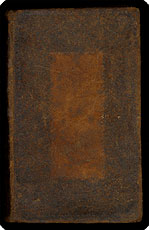
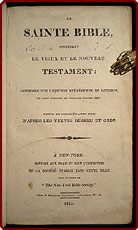
• First complete French Bible printed in America, with the text copied from the Paris edition of 1805, which was reprinted in London in 1807; only the N.T. alone had appeared previously. The New Testament here has a separate title-page and pagination.
Provenance: Front free endpaper with contemporary inscription, “Susan Prescott's / from a friend — “ Front pastedown with small booklabel of prominent collector Michael Zinman.
• Shaw & Shoemaker 34103; O'Callaghan, 126–27; Rumball-Petrie 193; not in Darlow & Moule. Contemporary mottled sheep, framed and panelled in blind with contrasting leather colors, spine plain without label; binding rubbed overall, but sturdy and solid. Front pastedown with label as above, front free endpaper with inked numeral and inscription above, title-page with almost entirely effaced inked inscription. Front fly-leaf with irregular, nickel-sized hole; a few leaves with their corners crimped; one leaf with a section of margin gone at fore-edgenot touching text (natural paper flaw?). Otherwise, pages mildly age-toned, some lightly to moderately spotted. A good copy. (25187)
Early Russian
Bible Society
Edition
Bible.
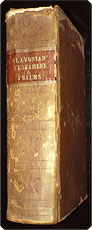
Church Slavonic. 1816. Biblia ili Knigi sveshtennago
pisanie vetkhago i novago zaveta. [St. Petersburg: Russian Bible Society, 1816].
8vo (23.5 cm, 9.25"). [4], 1012, [2], 252 pp.
Russian
Bible Society
Edition
Bible.
Church Slavonic. 1816. Biblia ili Knigi sveshtennago
pisanie vetkhago i novago zaveta. [St. Petersburg: Russian Bible Society, 1816].
8vo (23.5 cm, 9.25"). [4], 1012, [2], 252 pp.
[SOLD]
Click the interior images for enlargements.
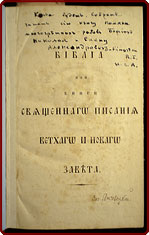
• One of the first combined editions of the Old and New Testaments in Slavonic printed by the Russian Bible Society under the direction of the Holy Synod of the Russian Orthodox Church. The Russian (or St. Petersburg) Bible Society was founded in 1813 by order of Tsar Alexander I — and then suppressed by Tsar Nicholas I in 1826, but not before publishing “at Moscow and St. Petersburg editions of the Bible and New Testament in Slavonic and Russian amounting to over 500,000 copies” (Darlow & Moule). The complete Scriptures did not appear in modern Russian vernacular until 1876.
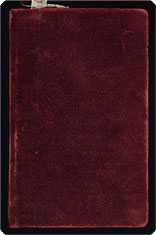
• Darlow & Moule 8382. Modern oxblood velvet–covered boards, unadorned; showing virtually no wear and housed in a plain box. Title-page with fountain pen inscription in upper portion (in Cyrillic except for “Kingston R.I. U.S.A.”) and inked owner's name in lower portion. Several contemporary silk bookmarks laid in. First three leaves with inner margins reinforced, one leaf with outer margin and one with lower margin reinforced. Light foxing; a number of pages with pencilled numerals in margins. (24138)
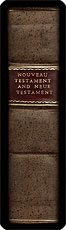
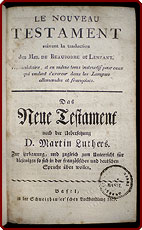
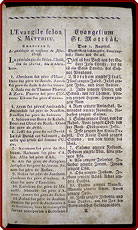
Protestant French–German
DIGLOT
Bible. N.T. French & German. 1819. Beausobre–Lenfant & Luther. Le Nouveau Testament suivant la traduction des Mrs. [sic] de Beausobre et Lenfant ... das Neue Testament nach der Uebersetzung D. Martin Luthers. Basel: In der Schweighauser'schen Buchhandlung, 1819. 8vo (18.5 cm, 7.3"). [8], 1101 (i.e., 961), [1 (blank)] pp. (536–37 used twice in pagination, 959–1098 skipped).
French–German
DIGLOT
Bible. N.T. French & German. 1819. Beausobre–Lenfant & Luther. Le Nouveau Testament suivant la traduction des Mrs. [sic] de Beausobre et Lenfant ... das Neue Testament nach der Uebersetzung D. Martin Luthers. Basel: In der Schweighauser'schen Buchhandlung, 1819. 8vo (18.5 cm, 7.3"). [8], 1101 (i.e., 961), [1 (blank)] pp. (536–37 used twice in pagination, 959–1098 skipped).
$275.00
• Uncommon diglot New Testament printed in parallel columns of French and German, intended for students of both languages. The French translation is a much-acclaimed version done by two Huguenot divines, Isaac de Beausobre (known for his groundbreaking Manichaean studies) and Jacques L'Enfant (chaplain to the Electress Dowager Palatine at Heidelberg, and a prolific historian); the German translation, printed in black-letter, is Luther's. This is the second edition to pair the two, following the first of 1746.
OCLC locates only one U.S. institutional holding of this edition, which has since been deaccessioned.
• Darlow & Moule 4318. Recent speckled paper–covered boards, spine with gilt-stamped leather title-label, all edges stained blue. Front fly-leaf with early inked inscriptions, one dated 1851. Title-page with early institutional rubber-stamp, last page with pressure-stamp, second page of contents with inked annotation along inner margin and rubber-stamped numeral in lower margin. Pp. 959–1098 skipped in pagination; text complete. Foxed, but not badly; clean. (25856)

 A
Very Typical-Looking
A
Very Typical-Looking German
American TESTAMENT
German
American TESTAMENT
Billmeyer
1822
Bible.
N.T. German. 1822. Luther.
Das Neue Testament.... Germantaun: Michael Billmeyer, 1822. 8vo. 537, [1] pp.,
[1] f.
$115.00

• The ninth Billmeyer printing of the German New Testament and the only German NT or Bible printed this year.
• O'Callaghan 161; Shoemaker 8025; German Language Printing in the United States 2535. Contemporary calf, raised bands, covers blind-framed; a few chips and old abrasions, but pleasant. Lower clasp intact, top one missing. Front hinge open, joint starting; front free endpaper torn across with loss. German fly-leaf inscription. Usual foxing/staining only, and complete.

 Tamil New Testament
Bible. N.T. Tamil. 1824. The Tamul New Testament of our Lord and Saviour Jesus Christ. [Madras: Madras Auxiliary Bible Society, 1824]. 8vo (19.7 cm, 7.75"). [1106] pp.
Tamil New Testament
Bible. N.T. Tamil. 1824. The Tamul New Testament of our Lord and Saviour Jesus Christ. [Madras: Madras Auxiliary Bible Society, 1824]. 8vo (19.7 cm, 7.75"). [1106] pp.
$500.00
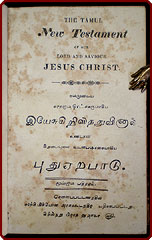
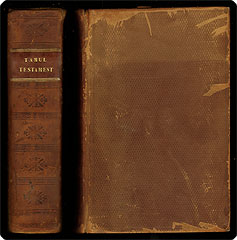
• Third edition of Johann Philipp Fabricius's translation of the New Testament, printed entirely in Tamil characters except for five lines on the title-page. This example appears to include some portions from another printing: Some signatures are lettered and some numbered, while the total page count exceeds that given by Darlow and Moule.
• Darlow & Moule 9120. Contemporary diced calf, spine with gilt-stamped leather title-label and blind-tooled compartment decorations; binding worn and abraded,
especially at edges and joints, with upper portion of front cover and inner portion of back cover sunned. All edges marbled; front hinge (inside) tender. Front pastedown with traces of now-absent bookplate. Pages with varying degrees of age-toning; Matthew, Mark, Luke, John, and Acts with English titles added in pencil. (26177)
Bible.
N.T. French. 1824.
Ostervald. Le nouveau testament de
notre seigneur Jésus-Christ... seconde édition Américaine.
Boston: J.H.A. Frost, 1824. 12mo (18.2 cm, 7.1"). 379, [5 (1 blank)] pp.
$600.00
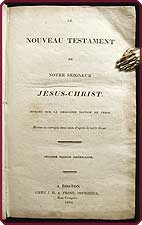
• Early American edition of the translation by eminent Swiss Protestant
Jean Frédéric Ostervald, based on a Paris edition and following
1811 and 1814 U.S. printings. Likely intended for use among French Canadians
and French émigrés in the United States, this is a good
example of an early American printing of a complete Testament, either Old or
New, in French.
• Shoemaker 15382. Contemporary speckled sheep, worn and abraded,
spine with gilt-stamped leather title label. Front pastedown with early numerical
inscription. Outer margins of last few leaves waterstained; some pages with
mild cockling or light spotting, others with varying degrees of age-toning.
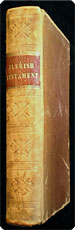
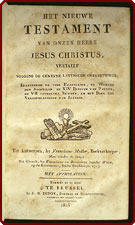
Bible.
N.T. Dutch.
Verhulst. 1825. Het Nieuwe Testament van onzen heere Jesus Christus, vertaelt
volgens de gemeyne Latynsche overzettinge ... Brussel: J.-B. Dupon, 1825. 12mo
(17.2 cm, 6.75"). [6], 568 pp.
$400.00
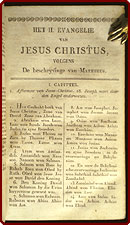
• Reprinting of Verhulst’s Old Catholic edition of 1717, circulated by the British and Foreign Bible Society. The work is printed in double columns with typographic head- and tailpieces.
• Darlow and Moule 3369. Contemporary diced calf, spine tooled in blind, with gilt-stamped leather title-label; edges and joints rubbed, sides with minor abrasions, spine sunned. Front pastedown with traces of a now-absent bookplate. Some light foxing, mostly confined to first few leaves. Pp. 5/6 and 7/8 bound in out of order. One leaf with short tear from upper margin, touching a few letters; one leaf with upper outer corner torn away, with loss of two letters. All edges marbled.
Bible. N.T. German. 1825. Luther. Das Neue Testament unsers Herrn und Heilandes Jesu Christi, nach der deutschen Uebersetzung von Dr. Martin Luther.... Carlisle (Pa.): Gedruckt und zu haben bey Moser & Peters, 1825. 8vo. (17 cm, 6.75"). 511, [1] pp., [2] ff. (lacking pp. 101–104); 12 plts.
$200.00
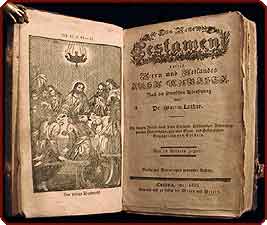
• Stereotyped edition with 12 woodcut plates, and the fifth printing (but second edition) of the German New Testament by Johann B. Moser and Gustav Sigmund Peters of Carlisle, Pa.
Provenance: 20th-century booklabel of Michael Zinman on front pastedown, along with pencilled ownership inscription of Margaret Lache.
• Not in O’Callaghan; not in Darlow & Moule; Arndt, The First Century of German Language Printing in the United States of America, 2724; Shoemaker 19698. Contemporary calf with raised bands; remnants of clasps. Calf scratched with some rubbing; spine a little warped. Some dog-earing and shallow tattering; lightly to moderately age-spotted throughout; pp. 17–18, 257-60 detached. No loss or obscuring of text due to the above, but two pages in Mark, pp. 101–104, lacking.

PLACE
AN ORDER | E-MAIL
US | PRB&M HOME
 in
a European
Language
in
a European
Language