 ANTIQUARIAN BIBLES
I:
ENGLISH-LANGUAGE BIBLES, TESTAMENTS, & “PARTS” (Part
A) (Part B)
II: POLYGLOTS &
ANCIENT LANGUAGES (Part A)
(Part B)
| III: NATIVE
AMERICAN LANGUAGES
 IV:
MODERN LANGUAGES NOT ENGLISH OR AMERIND
(Part A) (Part
B)
IV:
MODERN LANGUAGES NOT ENGLISH OR AMERIND
(Part A) (Part
B)
V:
BIBLE STUDY AIDS, COMMENTARY, & “RELATED”
(Part A) (Part
B)
 |
BIBLE STUDY AIDS, COMMENTARY, & “RELATED”
A CATALOGUE
ORDERED BY DATE
|
 Petrus Riga. Aurora. Manuscript on vellum, in Latin. England (Oxford?), ca. 1210? 8vo (23.7 × 12 cm, 9.25" × 4.625"). [1] f.
$2700.00 
• Peter Riga’s Aurora, a verse paraphrase of the Bible including commentary composed near the end of the 12th century, served as a useful memory aid for students of the Scriptures. This leaf is from an English university text of the Aurora, an early form of it most probably written early in the 13th century. The text on this leaf is Ruth, Aurora 1.62–I
Kings, Aurora 1.84, including the narrative of the birth of Samuel.

It is written in brown ink in the small compact Gothic textura used in the 13th century to economize space, which script predates the development of cursive book hands later used for the same purpose. It is written in the long narrow format commonly used for English university texts, and was most likely produced at Oxford, where there grew up a thriving center of manuscript production. The recto has 1 five-line red initial with pen tracery in blue and a five-line blue and red “puzzle”initial with pen tracery
also in blue and red. (“Puzzle” initials are inked to appear as if made up of colored “pieces”—like a jigsaw puzzle—and they are distinctively, if not uniquely, a feature of English and French 13th-century manuscripts.) The verso has 3 two-line red initials, 1 three-line, and 1 two-line blue initials—each of these initials has pen flourishes in the contrasting
color (i.e., blue or red).
five-line blue and red “puzzle”initial with pen tracery
also in blue and red. (“Puzzle” initials are inked to appear as if made up of colored “pieces”—like a jigsaw puzzle—and they are distinctively, if not uniquely, a feature of English and French 13th-century manuscripts.) The verso has 3 two-line red initials, 1 three-line, and 1 two-line blue initials—each of these initials has pen flourishes in the contrasting
color (i.e., blue or red).
The text is written in one column of 50 lines on the recto and 51 lines on the verso. The leaf is faintly ruled in lead on the verso only, the impression of the ruling showing on the recto, the top line of text being above the top line of ruling; on the right edge of the page are double rules enclosing the first letter of each line. On the outer edge are prickings for the ruling. The left edge of the recto has directions to the rubricator, the explicits of each section being done in darker ink in a different hand. One line on the verso has been crossed out with a single thin line of ink. At the bottom of the verso is the quire number VIII and remnants of a catchword can just be seen at right on the bottom edge.  English manuscripts from this period are rare.
Provenance: Ex–Zion Research Foundation (later known as the Endowment for Biblical Research); very likely to Zion from Ege.
• Judith, Manuscripts Sacred and Secular, 18, f. 9. A small hole in the lower margin. Parchment a little soiled, especially on the hair side, as is not unusual with English vellum. Traces of adhesive from mounting on the corners of the verso.


 BEDE on
 OLD Testament Books
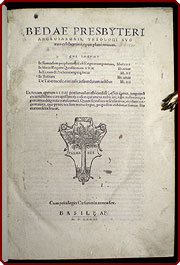
Bede, the Venerable, Saint. Bedae presbyteri Anglosaxonis, theologi suo aevo celeberrimi, Opus planè nouum. Cui insunt In Samuelem prophetam, id es Regnorum primum, libri IIII ... En nouam operum Bedae portiunculam tibi candide lector damus, iamprimu[m] ex vetustissimo corruptissimoq[ue] codice, qui unicus nobis fuit, typis nostris ea qua potuimus diligentia transformata[m], quam si probare te senserimus, eiusdem longe maiora, quae penes nos sunt manu scripta, propediem exhibituri sumus, illis interim felix fruere. Basileae: [colophon: Per Andr. Cratandrum et Ioan. Bebelium], 1533. Folio (29.5 cm; 11.75"). [4], 195, [1] ff.
OLD Testament Books
Bede, the Venerable, Saint. Bedae presbyteri Anglosaxonis, theologi suo aevo celeberrimi, Opus planè nouum. Cui insunt In Samuelem prophetam, id es Regnorum primum, libri IIII ... En nouam operum Bedae portiunculam tibi candide lector damus, iamprimu[m] ex vetustissimo corruptissimoq[ue] codice, qui unicus nobis fuit, typis nostris ea qua potuimus diligentia transformata[m], quam si probare te senserimus, eiusdem longe maiora, quae penes nos sunt manu scripta, propediem exhibituri sumus, illis interim felix fruere. Basileae: [colophon: Per Andr. Cratandrum et Ioan. Bebelium], 1533. Folio (29.5 cm; 11.75"). [4], 195, [1] ff.
$1500.00
 Click the images for enlargements.
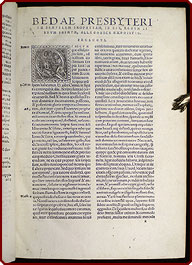
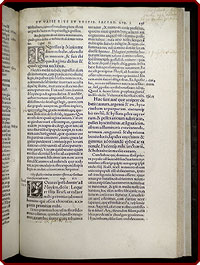
• First edition of commentary on the Old Testament books of Samuel, Kings, Ezra, Nehemiah, and Tobit from the pen of the Venerable Bede (673–735). Also included here is his De tabernaculo, eius uasis, ac sacerdotum vestibus, lib. III. The texts are printed in roman in double-column format with side- and shouldernotes. Chapter headings are in italics and they
begin with historiated woodcut initials.
Johannes Bebelius’ printer’s device appears on the title-page and on the verso of the final leaf, while the errata are printed on the verso of leaf 195, just above the colophon.
Evidence of readership: Faded sepia marginalia and/or underlining on folios 154, 155, 156.
WorldCat locates only six copies in U.S. libraries, one of which has been deaccessioned.
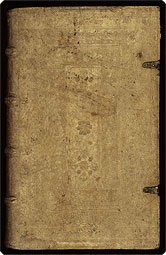
• VD16 B3048. Full dark modern calf old style, green leather spine label; spine with raised bands accented with blind rules extending onto covers to terminate in trefoils, and simple blind double fillets to covers; title-page reinforced at inner margin, lightly soiled. Pinhole worming, on most pages in lower margin; occasionally in text touching a letter but not costing text. “Elenchus” leaves with light waterstain to upper outer quadrant; same in inner upper and upper margins of commentary most notable from folios 100 to end, where at times it is brown and into the text of the inner columns. (26539)
 ALLYou Ever Wanted to Know about
 the PSALMS
Musculus, Wolfgang. In sacrosanctum Dauidis Psalterium commentarii, in quibus et reliqua Catholicae religionis nostre capita passim, non praetermissis orthodoxorum etiam Patrum sententiis, ita tractantur, ut Christianus lector nihil desiderare amplius possit. Basileae: [colophon: Per Ioannem Heruagium, 1551]. Folio (33 cm; 13"). [6] ff., 1702 (i.e., 1694 ) pp., [1 (blank)], [45] ff. (lacks final blank).
the PSALMS
Musculus, Wolfgang. In sacrosanctum Dauidis Psalterium commentarii, in quibus et reliqua Catholicae religionis nostre capita passim, non praetermissis orthodoxorum etiam Patrum sententiis, ita tractantur, ut Christianus lector nihil desiderare amplius possit. Basileae: [colophon: Per Ioannem Heruagium, 1551]. Folio (33 cm; 13"). [6] ff., 1702 (i.e., 1694 ) pp., [1 (blank)], [45] ff. (lacks final blank).
$1600.00
Click the images for enlargements.
• Musculus (1497–1563), a Protestant theologian, humanist, and leading Reformer, compiled the famous, influential, and oft-reprinted Loci communes sacrae theologiae, but his pen also produced a large body of commentary such as this work on the Psalms. In later editions it often carried the title, In Davidis Psalterium sacrosanctum commentarii.
The texts of the psalms are given in Latin, as is the commentary and explication. As one will surmise from the size of this work, the commentary and explications are much, much more extensive than the psalms themselves!
The text is printed in roman, single-column format, with phrases and passages in Greek and Hebrew in those typefaces. Each psalm begins with a four-line woodcut historiated initial; and the typographer's lay-out and execution are both workmanlike and handsome.
Provenance: 19th-century booklabel of collector W. Jackson.
• VD 16 ZV 1677. 19th-century vellum, later recased in that binding and hinges (inside) strengthened with cloth; soiled. Pin-hole type worming at front and rear of volume, in-text and touching but only rarely costing a letter, never impairing ability to read and understand; light waterstaining in some lower margins or across corners. A very few old marginal notes or corrections. (25943)
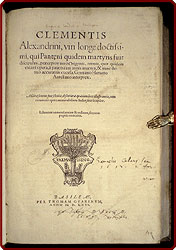
Peter Martyr Meets St. Clement of Alexandria
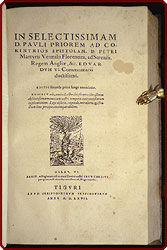
Clement, of Alexandria, Saint. Clementis Alexandrini, viri longe doctissimi, qui Panteni quidem martyris fuit discipulus, praeceptor verò Origenis, omnia, quae quidem extant opera, à paucis iam annis inventa, [et] nunc denuò accuratiùs excusa Gentiano Herueto Aureliano interprete ... [with another, as below]. Basileae: Per Thomam Guarinum, 1566. Folio (33.5 cm; 13.125"). 364 pp., [8] ff. [also bound in] Vermigli, Pietro Martire. In selectissimam D. Pauli priorem ad Corinthios Epistolam. Tiguri: apud C. Froschouerum, 1567. Folio (33.5 cm; 13.125"). [6], 242, [17] ff. (lacks final blank).
St. Clement of Alexandria
Clement, of Alexandria, Saint. Clementis Alexandrini, viri longe doctissimi, qui Panteni quidem martyris fuit discipulus, praeceptor verò Origenis, omnia, quae quidem extant opera, à paucis iam annis inventa, [et] nunc denuò accuratiùs excusa Gentiano Herueto Aureliano interprete ... [with another, as below]. Basileae: Per Thomam Guarinum, 1566. Folio (33.5 cm; 13.125"). 364 pp., [8] ff. [also bound in] Vermigli, Pietro Martire. In selectissimam D. Pauli priorem ad Corinthios Epistolam. Tiguri: apud C. Froschouerum, 1567. Folio (33.5 cm; 13.125"). [6], 242, [17] ff. (lacks final blank).
$2800.00
Click the images for enlargements.
• Wonderful large folio volume containing the Works (in Latin translation) of St. Clement of Alexandria (ca. 150 – ca. 215), here in the second edition as edited by Gentian Hervet (1499–1584); the first was in 1556 from Isengrin's press. In this edition, Isengrin's device appears on the title-page and the verso of the final leaf. As with the first edition, this has scholia at the end, notes (including sidenotes), and an index. The contents are Liber adhortatorius adversus gentes, qui Protrepticus inscribitur; Paeagogi libri tres; and Stromaton sive Commentariorum, de varia multipliciq[ue] literatura, ad instituendum Christianum philosophum, libri octo.
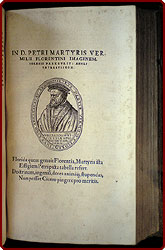
The second work is Peter Martyr's commentaries on Corinthians, here in the second edition. It has a full-page woodcut  portrait of him on the recto of leaf aa6. The printer's woodcut device is on the title-page and there are numerous woodcut initials. The sidenotes are printed in italic while the text proper is in roman.
Peter Martyr (8 September 1499 – 12 November 1562), was an Italian theologian who began his religious life as an Augustinian friar, converted to the Protestant cause, was closely associated on the continent with Ochino, Bucer, and some prominent Lutherans, and, while in England where he held the Regius Chair of Divinity at Oxford, was an intimate of Thomas Cranmer and Bishop Jewel.
Both works are uncommon in these editions in the U.S.: We locate four copies of the first title and two of the Vermigli, but one copy of each title has been deaccessioned, meaning current holdings are three and one only.
Binding: Contemporary alum-tawed pig over wooden boards with bevelled edges and metal and leather clasps; one clasp perished. Leather tooled elaborately in blind using a variety of rolls and fillets, including one roll incorporating the date 1546, a medallion of David and his harp, and another medallion depicting John the Baptist with the words below the image, “Ecce Agnus Dei.”
• Clement: VD16 C4070; Index Aurel. 104.903; Adams C2106. Vermigli: VD16 B5054; Adams M788. Bound as above. Ex-library with bookplate on front pastedown, small blind pressure- (not perf-.) stamp on title-page and remnant of charge pocket at rear; six-digit number stamped in lower margin of one leaf. Early inked ownership indicia on title-page and old private ownership stamp on front free endpaper; a little old marginalia and underlining. A very little foxing and the odd spot only. Excellent copies of both works in a handsome contemporary binding. (24827)

Early Cöthen Imprint, in Syriac
Trostius, Martin. Lexicon Syriacum ex inductione omnium exemplorum Novi Testamenti Syriaci adornatum; adjecta singulorum vocabulorum significatione latina & germanica, cum indice triplici. Cothenis Anhaltinorum: Officina Cotheniana, 1623. 4to (19.8 cm, 7.75"). [4] ff., 722 pp.
$1200.00
Click the images for enlargements.
• Syriac in the classical Edessene literary form is still the sacred language of several Eastern Churches and is the language of this lexicon. The dialect in ancient times was spoken in the north of Syria and in Upper Mesopotamia around Edessa.
Trost (1588–1636), a professor of theology at Wittenberg, compiled this dictionary and issued it two years after publishing his much-praised edition of the Syriac New Testament with an accompanying Latin translation; the Lexicon was likewise lauded, primarily for its completeness.
This and Trost's Syriac New Testament are among the earliest books printed in Cöthen, Upper Saxony. This is the sole edition of the dictionary and it is uncommon in commerce.
• Graesse, VII, 103; VD17 12:128565E. Period-style calf, framed in blind; spine with gilt-stamped leather title-label, blind-tooled decorations in compartments, blind- and gilt-ruled raised bands with blind-tooling continued onto boards, ending in trefoils; signed in blind on lower rear turn-in by Grace Bindings. Title-page institutionally pressure-stamped, dedication with numeral rubber-stamped in lower margin. Pages age-toned; title-page and last two index leaves with moderate staining and spotting (in part from old binding).  A strong, handsome book. (25212)

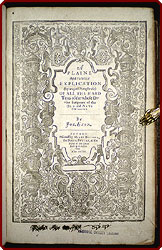
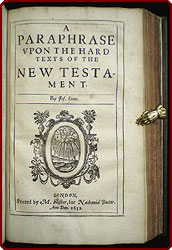
A Protestant Controversialist'sVersion of the Bible
Hall, Joseph. A plaine and familiar explication (by way of paraphrase) of all the hard texts of the whole Divine Scripture of the Old and New Testament. London: Pr. by Miles Flesher for Nath. Butter, 1633. Folio (30 cm, 11.75"). [10], 621, [3], 427, [3] pp. (lacking one prelim. f.; pagination skips 441–50 & 525–42, 287–89).
$825.00
Click the images for enlargements.
• First edition: Challenging Bible passages reworded, with a Protestant perspective. The title-page attributes this to “Jos. Exon.,” which is also the name appended to the dedicatory epistle, but the author was actually Joseph Hall (1574–1656), bishop of Norwich. Hall was a notable preacher, known for his engagement in various doctrinal disputes; his Common Apology against the Brownists and The Olde Religion were particularly controversial works.
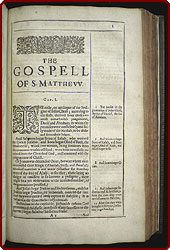
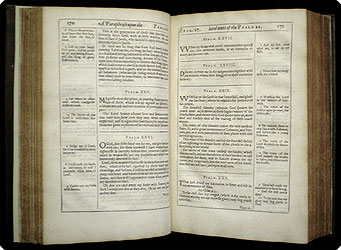
The title-page is within a single-element architectural woodcut border; the text is printed in single wide columns with the original texts in shouldernotes, with woodcut decorative capitals, some historiated, at the beginnings of books and tailpieces at the ends. The New Testament portion has a separate title-page, dated 1632.
• ESTC S120055; STC (2nd ed.)12702. Period-style calf framed and panelled in gilt with decorative blind rolls and gilt-stamped corner fleurons, spine with gilt-stamped leather title-label, gilt-dotted raised bands, and gilt-stamped floral decorations in compartments. Front fly-leaf with inked presentation inscription dated 1830. Title-page with early inked inscription in lower margin, crossed out, and with institutional rubber-stamp; short tear from lower outer edge just touching border. Pages age-toned; final 50 ff. waterstained, mostly in margins, but extending into text in final 30 ff. Text complete despite erratic pagination and signing (signatures begin with B as per ESTC's description). All edges speckled red. Very interesting reading. (25845)

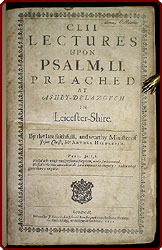
 Line by LinePURITAN Meditations on the Miserere
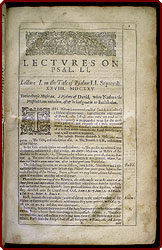
Hildersam [or Hildersham], Arthur. CLII lectures upon Psalm LI. Preached at Ashby-Delazouch in Leicester-Shire. London: Pr. by J. Raworth for Edward Brewster, 1642. Folio (28.3 cm, 11.25"). [36], 815, [1] pp. (pagination skips 176–77).
Line by LinePURITAN Meditations on the Miserere
Hildersam [or Hildersham], Arthur. CLII lectures upon Psalm LI. Preached at Ashby-Delazouch in Leicester-Shire. London: Pr. by J. Raworth for Edward Brewster, 1642. Folio (28.3 cm, 11.25"). [36], 815, [1] pp. (pagination skips 176–77).
$750.00
Click the images for enlargements.
• Extensive Puritan exegesis on the most famous of the seven Penitential Psalms. Originally published posthumously in 1635 and here in its second edition, the text is decorated with woodcut head- and tailpieces and decorated capitals. Hildersam was a prominent and sometimes persecuted non-conformist divine known for his preaching; the DNB calls him a church reformer rather than a separatist.
Provenance: Signature of Henry G. Weston on title-page; another inscription reads, “Betsy Colling Her Book.” An early owner practiced handwriting in this volume: Several pages bear sample letters, and the final (blank) page offers additional notations (largely, a list of Colling family names) and a doodle.
• ESTC R20661; Wing (rev. ed.) H1978. On Hildersam, see: Dictionary of National Biography, IX, 833–35. Recent quarter calf and marbled paper–covered sides, spine with gilt-stamped leather title-label, gilt-ruled raised bands, and blind-tooled compartment decorations. Title-page institutionally pressure-stamped, with inked ownership inscription in upper portion; dedication with inked annotation in inner margin and inked numeral in lower margin; first contents page with small paper adhesion in upper portion. Pages age-toned with occasional staining; light to moderate waterstaining towards back of volume. First two leaves with margins chipped. One leaf with lower outer corner torn away, not touching text. Several pages with early inked notes and doodles as above. All edges red; fore-edge with an old “H” recording onetime shelving fore-edge out. (26126)
Historical Context of theNew Testament
Lightfoot, John. A commentary upon the Acts of the Apostles: Chronicall and criticall. The difficulties of the text explained, and the times of the story cast into annals. London: Pr. by R.C. for Andrew Crooke, 1645. 4to (18.2 cm, 7.2"). [20], 331, [1] pp. (pp. 145–48 bound out of sequence).
$750.00
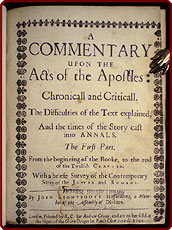

• First edition of this important “Tripartite History” (as described by the dedication), a chronological arrangement of the events described in the New Testament along with accompanying historical happenings. The sections of “The Christian History, the Jewish and the Roman” for the years 34–44 each have separate title-pages.
Click the interior image for an enlargement.
Lightfoot (1602–75) was a noted Hebraist and Biblical scholar; Lowndes says of his works that “the writings of Dr. Lightfoot are an invaluable treasure to the biblical student.”
• ESTC R21614; Wing (2nd ed.) L2052; Lowndes 1359. Recent marbled paper–covered boards, spine with gilt-stamped title and publication labels. Title-page institutionally rubber-stamped. Pp. 145–48 (the end of the “Christian History...XXXIIII” section) bound in between pp. 152 and 153, with annotations in an early inked hand noting the error. Pages trimmed closely, taking part of title-page border and in a few instances affecting the catchwords or final lines of text. Waterstaining, mostly to lower outer portions. (24853)
One of Buxtorf'sTWO Great Lexicons
Buxtorf, Johann, the elder. Lexicon hebraicum et chaldaicum: Complectens omnes voces, tam primas quàm derivatas, quae in sacris Bibliis, Hebraeâ, & ex parte Chaldaeâ linguâ scriptis, extant ... Accessit lexicon breve rabbinico-philosophicum, communiora vocabula continens, quae in commentariis passim occurrunt ... editio sexta, de novo recognita, & innumeris in locis aucta & emendata. Basilae: Johannis König, 1655. 8vo (17.4 cm, 6.9"). [24], 976, [76 (index)] pp.
$500.00
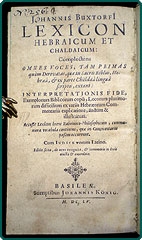
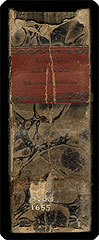
• Buxtorf's famous and standard Biblical Hebrew-to-Latin lexicon was first published in 1607; this is its sixth edition, revised. A leading Hebrew scholar of the late 16th and early 17th centuries, the author was a friend and correspondent of Bezè and Grynaeus, and the compiler of two important Hebrew–Latin dictionaries: The one at hand should not be confused with the Lexicon chaldaicum, talmudicum et rabbinicum which he left incomplete at his death and which his son completed and published in 1639.
Click the interior image for an enlargement.
• VD17 12:131988L. 19th-century marbled paper–covered boards, spine with gilt-stamped leather title-label; paper rubbed with spine paper chipped, cracked, and shelving number inked at bottom. Pastedowns with institutional bookplates, free endpapers and lower (closed) edges institutionally rubber-stamped, title-page with early inked numeral in upper portion. First third of work with early inked annotations and underlining (some marginalia shaved), this tapering off in frequency with close of volume untouched. Two leaves with small portions of outer margins excised. Occasional small stains, pages mostly clean. (25818)
 A FAMED but UNLUCRATIVEPolyglot Dictionary
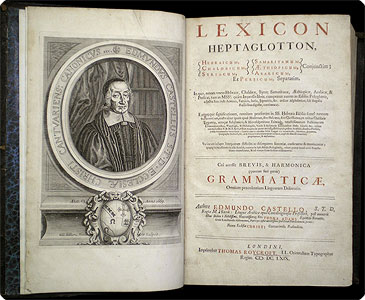
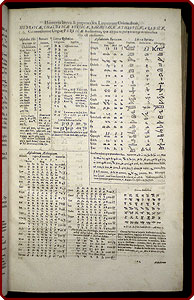
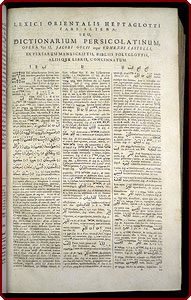
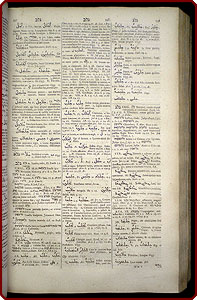
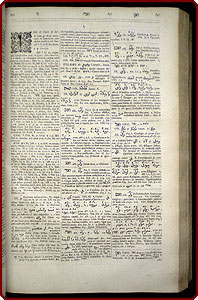
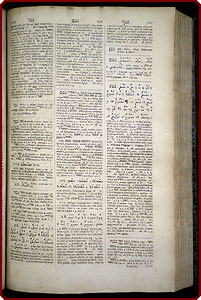
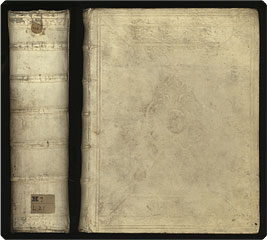
Castell, Edmund. Lexicon heptaglotton, Hebraicum, Chaldaicum, Syriacum, Samaritanum, Æthiopicum, Arabicum, conjunctim; et Persicum, separatim. London: Thomas Roycroft, 1669. Folio (44.9 cm, 17.6). 2 vols. in I. Frontis., [8] pp., 44 columns (43 & 44 repeated in numbering), [2] pp., 573 columns (402, 403, 421 & 422 repeated in numbering; 340, 341, 399, & 400 skipped), [1] p., 4008 columns (376–78 & 391–93 incorrectly numbered; 484–86, 538, 1936–38, 3220–25, 3773–78, & 3950–51 repeated in numbering; 487–89, 535, & 3226–3231 skipped).
A FAMED but UNLUCRATIVEPolyglot Dictionary
Castell, Edmund. Lexicon heptaglotton, Hebraicum, Chaldaicum, Syriacum, Samaritanum, Æthiopicum, Arabicum, conjunctim; et Persicum, separatim. London: Thomas Roycroft, 1669. Folio (44.9 cm, 17.6). 2 vols. in I. Frontis., [8] pp., 44 columns (43 & 44 repeated in numbering), [2] pp., 573 columns (402, 403, 421 & 422 repeated in numbering; 340, 341, 399, & 400 skipped), [1] p., 4008 columns (376–78 & 391–93 incorrectly numbered; 484–86, 538, 1936–38, 3220–25, 3773–78, & 3950–51 repeated in numbering; 487–89, 535, & 3226–3231 skipped).
$1500.00
Click the images for enlargements.
• First edition. Intended as a companion to Bishop Walton's Biblia Sacra Polyglotta, in which endeavor the author assisted, this seven-language dictionary is “probably the greatest and most perfect work of the kind ever performed by human industry and learning” according to Dr. Clarke; Dibdin says of the erudite and somewhat erratically organized Lexicon that it “has long challenged the admiration, and defied the competition, of foreigners; and . . . has raised an eternal monument of literary fame.” Castell was an orientalist who spent 18 years and (according to Dibdin) the whole of his patrimony laboring over the Lexicon, only to find the undertaking woefully unsuccessful on the market despite its much-lauded scholarship.
The frontispiece portrait was done by William Faithorne, and the title-page is printed in red and black. The text is printed first in two columns and then in three per page, and is ornamented throughout with decorative capitals. The columns are erratically numbered, but the text is complete.
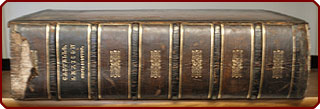
Provenance: Signature on fly-leaf of Hampus Kristoffer Tullberg (Lund), 19th-century Swedish scholar of Hebrew and other languages.
• ESTC R16460; Wing (rev. ed.) C1225; Vancil 46; Lowndes 386; Dibdin, I, 31–35. On Castell, see: Oxford Dictionary of National Biography online. 18th-century speckled calf, covers bordered with a darker calf band blind-rolled and then framed with single gilt fillet; spine with gilt-stamped leather title-label, darker-leather raised bands gilt-stamped/blind-tooled, and compartments gilt- and blind-tooled enclosing gilt-stamped floral decorations. Binding rubbed, with leather significantly lost in top compartment and and lost also at foot. All edges marbled. Front fly-leaf with inked ownership inscription as above dated 1837; title-page with old institutional pressure-stamp. Frontispiece with outer margin reinforced some time ago. One leaf slightly oversized and creased, intermittent soiling in many upper margins, one leaf with text affected but not obscured, small sections with light waterstaining to outer or upper margins; over all, a book both impressive and pleasant. Columns erratically numbered, text complete. (25792)
Reineccius, Christian, praeses; & Johann Heinrich Stolle, respondent. (three lines in Hebrew, then) Seu traditio Eliana de sex mundi millenariis, quam, annuentibus benevolè superioribus .... Lipsiae: Literis Goezianis, 1696. 4to (21 cm, 8.25"). A–C4D2; [28] pp.
$200.00


• Uncommon sole edition of this dissertation on Elijah and millennial prophecy, incorporating extensive quotations in Arabic and in Hebrew, with some of the Hebrew being printed with vowels. Reineccius, a Lutheran scholar, edited a well-regarded polyglot Bible in addition to a Hebrew-Chaldaic lexicon; Stolle was the secondary respondent for another disputation led by Reineccius, De SS. nomine Jehovah.
Click the images for enlargements.
Scarce.
Searches of OCLC and RLIN locate only two U.S. holdings.
• VD17 39:118489Q. Recent speckled paper–covered boards, spine with printed paper label. Pages faintly age-toned, clean.
Cutting-Edge Biblical Scholarship — Three Maps
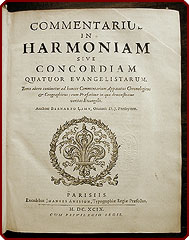
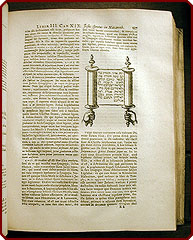
Lamy, Bernard. Commentarius in harmoniam sive concordiam quatuor evangelistarum.... Parisiis: Excudebat Joannis Anisson, 1699. 4to (12.6 cm, 10.25"). 2 vols. in 1. I: 2 a[n]4 e[n]4 A–Z4 Aa–Zz4 AAa–ZZz4 AAaa – OOoo4; [2] ff., xvi, 661, [1] pp., [25] ff.; 3 plts. II: 2 a–h4 A–Z4 Aa–Xx4 Yy2; [2] ff., lxiv, 326 pp., [15] ff.; 3 plts.
$800.00
Click the interior images for enlargements.
• Bernard Lamy (1640–1715) was an Oratorian priest, philosopher, and biblical scholar. After getting himself exiled to Grenoble for excessive Cartesianism, he went on to do significant work in biblical studies, and this present work is especially notable: Lamy here contends that Jesus died on the cross on the eve of the Passover (thus at the same time as the Passover lamb was being killed), not during the first day of the Passover. This view, while considered radical at the time, is now generally held by biblical scholars.
This work was first published under the title Harmonia, sive concordia quatuor evangelistarum in 1689. This second edition is printed in small roman types with some italic, Greek, and Hebrew. Ornaments include an ornate woodcut fleur-de-lis on the title-pages, plus initials and headpieces. Vol. II (bound in) consists of the Apparatus chronologicus et geographicus, chronologies and geographical descriptions with three fine fold-out plates: a map of Judea, a plan of Jerusalem, and a plan of the temple.
Provenance: Charles Spencer, Third Earl of Sunderland, lot 7230 in the Sunderland Library sale (1882).
• On Lamy, see: New Catholic Encyclopedia, VIII, 354–55. 18th-century vellum over boards with raised bands, lightly soiled; on the covers an ornate mandorla inside a composite frame. Crack in the vellum along front joint, joint itself sound. Ex-library with paper labels on spine; old pressure-stamps, including one on title-page of vol. I. Upper outer corner of title-leaf lost taking part of one letter of title; small tear into printed border of first map in vol. II. All edges speckled blue and red. A stout, substantial volume.
How GREAT This Scholar Must Have Felt When He Found This!
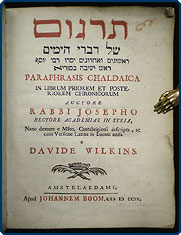
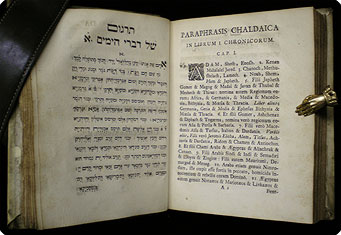
Bible. O.T. Chronicles. Aramaic. Targum. 1715. [four lines in Hebrew characters, transliterated as] Targum shel Divre ha-yamim rishonim ve-aharonim, yisdo Rabi Yosef, rosh yeshivah be-Surya. [then in Latin] Paraphrasis Chaldaica in Librum priorem et posteriorem chronicorum, autore Rabbi Josepho, rectore academiae in Syria. Amstelaedami: apud Johannem Boom, 1715. 4to. [27] ff., 415, [1(blank)] pp.
$450.00
Click the interior images for enlargements.
• Prussian-born Coptic scholar David Wilkins (1685–1745) found the manuscript that is the basis of this, his first publication, in the Cambridge University library; he here offers his editing and translation of a fourth century Aramaic paraphrasis of the books of Chronicles from the pen of Rabbi Yosef ben Hiyya.
Printed in Hebrew (with the points) and Latin on opposite pages, this has a title-page printed in black and red; the Latin text is in roman with occasional italic.
An uncommon work in commerce now and in Brunet's time: “Livre recherché et peu commun.” Not heavily held in U.S. libraries, if WorldCat is to be believed, for it locates only eight copies.
• Vinograd, II, 55; Amsterdam 1072; Steinschneider 1157; Zedner 148; Darlow & Moule 2416. Contemporary vellum over paste boards, boards warped and front pastedown abraded and torn by this. Spine lettered in black in 20th-century and with an old library call number at base; library pressure-stamp in lower margin of title-page. A few leaves with slightly tattered foremargins. (25775)

Raphel,
Georg. Annotationes philologicae in Novum Testamentum ex Polybio &
Arriano collectae. Hamburgi: Apud Christianum Liebezeit, bibliopolam, 1715. 8vo
(16.8 cm, 6.625"). [28] ff., 722 (i.e., 702) pp., [21] ff. [bound with]
Raphel, Georg. Annotationes philologicae
in Novum Testamentum ex Xenophonte collectae. Hamburgi: Apud Christianum Liebezeit,
bibliopolam (Leoburgi: Typis Christ. Alb. Pfeifferi), 1709. 8vo. [24] ff., 374
pp., [13] ff.
$525.00

•
Georg Raphel (1673–1740, co-rector of the Luneburg Athenaeum in 1709
but by 1715 pastor of St. Nicholas’Church) was a philologist and New
Testament scholar. He produced a goodly amount of work comparing the Bible
with classical literature, an especially profitable area of study in the case
of the New Testament, showing the influence of classical language and historical
writing on its language and style. In the first of the works here he gives
correspondences between Polybius and Arrianus and the sacred writers, and in
the second work he does the same with Xenophon. These are apparently the first
editions of these works, the second of which was once reprinted (in 1720).
• Contemporary vellum over paste boards; spine with inked author
and paper shelf labels: soiled with a few spots. Front hinge (inside) partially
open, but sewing holding. Pages generally clean, with a few small dog ears.
Inked ownership inscriptions on front endpapers and title-page; a few instances
of underlining.
"For
the clearer understanding of the
Words of thePROPHET"
Bible.
O.T. Isaiah. English. Paraphrases. 1726. Bedingfeld. A paraphrase on
the book of Isaiah. Wherein, for the clearer understanding of the words of the
prophet, the whole text, and paraphrase, are printed in separate columns, over-against
each other; and arguments placed before each chapter. By Philip Bedingfeld.
London: Tho. Wotton, James Lacy, & J. Shuckburgh (colophon: Pr. by Sam.
Aris.), 1726. 8vo (20 cm, 7.9"). [16], 403, [13] pp.
$500.00
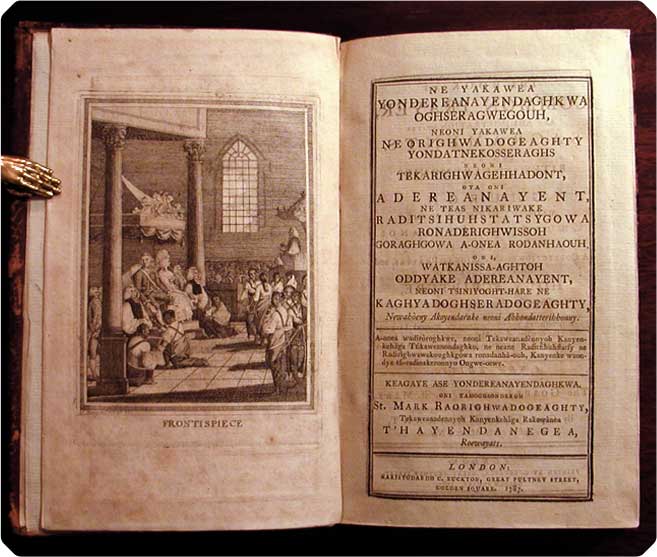
• Sole edition of this rather uncommon reworking of Isaiah's prophecies
from the King James version; this is the only recorded publication by Bedingfeld,
a gentleman author who introduces the piece as "my Endeavours to drive away
the Mist of Error, and to rescue the Prophet Isaiah from false Glosses." In
some instances the original text is expanded on, while in others it is abbreviated,
depending apparently on how much Bedingfeld liked the metaphor in play. The
text was printed with some care in roman and italic double columns, with decorative
head- and tailpieces.
• ESTC T117664. Contemporary speckled calf, covers separated;
front cover sometime (home?)-stitched to spine and holding, back one once
(later) held on by paper laid over spine and a portion of both covers, paper
now considerably chipped away. Lacking endpapers; front pastedown with library
bookplate, back pastedown with doodles. Pages age-toned, with some minor foxing.
Newton, Isaac. Observations upon the prophecies of Daniel, and the Apocalypse of St. John. In two parts. London: Printed by J. Darby and T. Browne...and sold by J. Roberts...[et al.], 1733. 4to (26 cm). vi, [2], 323 pp
$3000.00
 Click the image above right
for an enlargement.
• First edition. In addition to being a physicist, mathematician, and natural philosopher, Sir Isaac Newton was something of a Biblical scholar as well, as shown by the present exegesis on apocalyptic texts. His analysis generally reads as being practical in nature—as the New Catholic Encyclopedia (X, 428) says, “Newton's writings on apocalyptical prophecies were not mystical or millenarian in any sense, but more exercises in deciphering cryptograms.” They comport with our sense of him as someone who believed in the scientific method!
• Wallis, Newton, 328.1; ESTC T41883, T18642, N64145. Recent quarter calf over marbled paper, spine with raised bands; gilt-lettered and -ruled label from a previous binding retained, chipped about the edges. Bookplate on front pastedown. Some light waterstaining and some cockling, and a few leaves with shallow chipping or tattering; these, with good repairs. Ample margins. In sum a handsome book.
Stock, Christian. Clavis lingvae sanctae Veteris Testamenti...cvi accedit breve dictionarium Chaldeo-Rabbinicum. Editio quinta.... Ienae: Apud Ioh. Felicem Bielckium, 1744. 8vo (22 cm, 8.625"). Frontis., [3] ff., 1198 pp., [25] ff., 133, [1 (blank)] pp., [1 (blank)] f.
$300.00

• Christian Stock (1672–1733) was a Professor at Jena who edited his own edition of the New Testament and was the author of a popular Greek–Latin lexicon of the New Testament, a homiletical lexicon, and this Hebrew lexicon of the Old Testament. It is printed in Hebrew, Arabic, Greek, roman, and italic types, with an engraved portrait of the author as frontispiece. The 25 unnumbered leaves following p. 1198 are an index of the Latin definitions used, and a short “Chaldean” (i.e., Aramaic) dictionary, for those parts of the Old Testament written in that language, is appended at the end.
• Contemporary calf, spine gilt and with red leather label. Leather dry and flaking, with loss over corners, joints open but sewing holding, chipping at head and foot of spine, and crack down center of spine: This volume could split. Ownership inscriptions in ink on front pastedown and reverse of frontispiece. Browning from turn-ins onto endpapers and fly-leaves; light to moderate foxing throughout. All edges speckled red.
Defining“Child” for Baptismal Purposes — RARE
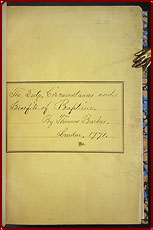
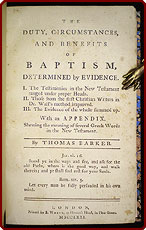
Barker, Thomas. The duty, circumstances, and benefits of baptism, determined by evidence ... with an appendix, shewing the meaning of several Greek words in the New Testament. London: B. White, 1771. 8vo (20.5 cm, 8"). x, 208, [6 (index & errata)] pp.
$650.00
Click the interior images for enlargements.
• Sole edition of this examination of the writings of the Apostolic Fathers as pertaining to the great infant baptism controversy. Closing the work is a collection of New Testament usages of various Greek words for “child” or “children,” with analysis of their contexts and connotations.
The author was a dedicated observer of meteors and comets and published several well-received works on those subjects in addition to his religious and philosophical treatises.
Rare: OCLC and ESTC locate only one U.S. holding, since deaccessioned; there are only two holdings found in the U.K.
• ESTC T68482. Recent marbled paper–covered boards, spine with gilt-stamped leather title-label; yellow wrapper with early hand-inked title bound in. Title-page institutionally pressure-stamped and a five-digit number inked twice to the first page of the preface; no other markings. First and last few leaves with minor foxing; other scattered spots mostly confined to margins. Occasional pencillled annotations. (25768)
Sacred Hebrew Poetry
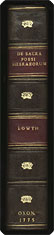
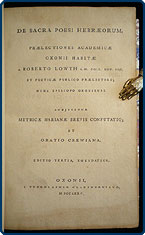
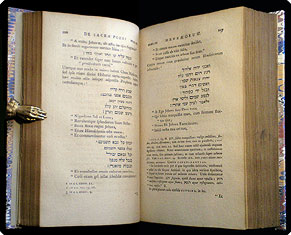
Lowth, Robert. De sacra poesi hebraeorum. Oxonii: E typographeo Clarendoniano, 1775. 8vo (22.5 cm; 8.875"). [4] ff., 515, [1 (blank)] pp., [6] ff.
$360.00
Click the interior images for enlargements.
• “Editio tertia, emendatior,” the first having appeared
in 1753 and the second in 1763; collected lectures by the Bishop of London on
Hebrew poetry, delivered at Oxford. The volume is printed in Latin, Greek, and
Hebrew; it was later translated into English and published as Lectures on
the Sacred Poetry of the Hebrews. Hannah More praised the work highly in
a letter to Frances Boscawen, and said that it “taught me to consider
the Divine Book it illustrates under many new and striking points of view.”
• ESTC T113648. Recent quarter calf, old style; raised
bands, gilt ruling above and below the bands as accents, gilt center devices
in spine compartments. Deep red spine labels lettered in gilt; marbled paper
sides, with dark wedge of soil crossing bottom 3/4-inch of front cover’s
paper and line of same soil also to turn-ins of back cover. Faint off-setting
to top and bottom margins of early leaves from old binding; medium-light waterstains
in margins of index (i.e., last 6 leaves), and the odd spot or bit of soil
elsewhere. Generally, a very nice clean book. (25318)
Bodoni Printing: Texts of the Hebrew Old Testament
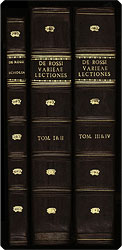
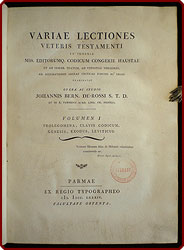
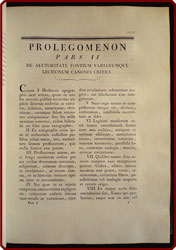
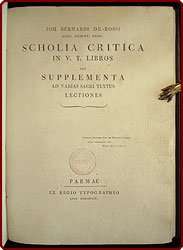
De Rossi, Giovanni Bernardo. Variae lectiones Veteris Testamenti, ex immensa mss. editorumq. codicum congerie haustae et ad Samar. textum, ad vetustiss. versiones, ad accuratiores sacrae criticae fontes ac leges examinatae [and] Scholia critica in v.t. libros seu supplementa ad varias sacri textus lectiones. Parmae: Ex Regio typographeo, 1784–88. Folio (I & II: 29.8 cm, 11.75"; III: 28.8 cm, 11.25"). 5 vols. in 3. I: [8], clx, 116, xiv, [2], 264 pp. II: viii, [2], 268, xxxii, [2], 242 (pp. 241/42 misbound), [16] pp. III: xvi, 144 pp.
$1500.00
Click the interior images for enlargements.
• First edition of an important collection of variant readings of the Old Testament, assembled by an Italian Christian Hebraist who taught Oriental languages at the University of Parma. This gathering of Massoretic manuscripts was printed by Bodoni in Latin and Hebrew, in double columns. The first four books close with Specimen ineditae et hexaplaris Bibliorum versionis Syro-Estranghelae cum Simplici atque utriusque fontibus Graeco et Hebraeo collatae cum duplici lat. vers. ac notis, and the final volume adds the Scholia critica in V.T. libros seu supplementa ad varias sacri textus lectiones.
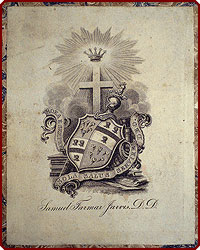
Provenance: Front pastedown with bookplate of the Rev. Dr. Samuel Farmar Jarvis, historian and author of A Discourse on the Religion of the Indian Tribes of North America, The Colonies of Heaven, and A Chronological Introduction to the History of the Church.
• Brooks, Compendiosa Bibliografia di Edizioni Bodoniane, 279; Steinschneider, Catalogus hebraeorum in Bibliotheca Bodleiana, 2152. Binding on vols. I–IV: Contemporary calf, covers framed and panelled in blind rolls with original leather cracked, chipping, and darkened (III–IV especially severely); rebacked, spines with gilt-stamped title, gilt-dotted raised bands, and gilt-stamped compartment decorations. Hinges (inside) reinforced. Binding on the Scholia: Recent, full period-style calf framed and panelled in blind rolls; spine with gilt-stamped title, gilt-dotted raised bands, and gilt-stamped compartment decorations. All title-pages with very old institutional rubber-stamps; early portions of vol. I with lightly pencilled annotations and bracketing, and vol. II with small pencilled marks of emphasis. Old soft corner creases or mild cockling variously throughout to vols. I–IV and, where these things (or a natural paper flaw) are most notable, a grey soil has entered at the loose or open places to mark the margins at their edges. Otherwise, scattered light foxing, golden, not brown; and the occasional old spill (e.g., I Samuel) or smudge only. Not “fresh” — but substantial, impressive, and with its lovely typography still lovely. (25513)
Sheriff's Sales, Foreign Intelligence, a Wet Nurse & Other Ads
The Federal Gazette and Philadelphia Evening Post, Wednesday, 18th February, 1789. Philadelphia: Andrew Brown, 1789. 4to (28.4 cm, 11.2"). [4] pp.
$300.00
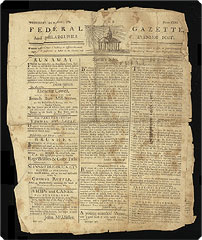 Click the image for an enlargement.
• No. CXXI of this daily newspaper, of interest not only for its
general content but for the numerous advertisements, which include a proposal
forthe
first American printing of a Catholic Bible (Carey's
“Doway Translation”), a notice of a runaway apprentice boy (18 years
old), and the hopeful posting of “A young married Woman, with a good breast of
milk” who would like to take a child to nurse.
Also reported/canvassed are hot religious disputes at the University of
Pennsylvania and “Carlisle” (Dickinson), with reference to (literal)
iconoclasm at Cambridge colleges under the Protectorate ; a double execution
in New-York; and minutes of the General Assembly (including a petition from
residents of Germantown protesting “enormous” taxes, “an
act to prevent the importation of convicts within this common wealth,”
and several items having to do with insolvent debtors.
• Unbound, as issued; edges tattered, pages creased, age-toned
and foxed, with tears along one fold and scattered small holes, with loss
of a few letters or words not affecting general sense. Two pages with large,
early inked notations over text. (24658)
Dutch Bible Commentary by aControversial Scholar/Politician
Hamelsveld, Ysbrand van. Korte aanmerkingen over het Oude & Nieuwe Testament voor ongeleerden. [with] De Apokryfe boeken. Amsteldam: Martinus de Bruijn, 1791–98. 8vo (22.7 cm, 8.9"). 9 vols. O.T.: I: [4], 388 pp. II: [4], 396 pp. III: [8], [429]–1011, [1] pp. IV: [4], 624 pp. V: [2], 582 pp. VI: [4], 442, [2], [443]–656, iv pp. Apocr.: [4], 456, [4], 342 pp. N.T.: I: [4], 134, [2], 135–187, [3], 189–282, [2], [283]–514 pp. II: viii, 489, [1] pp.
$2200.00
Click the images for enlargements.
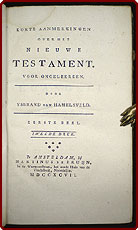
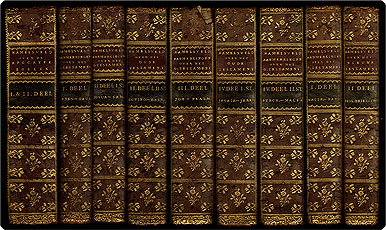
• Nine-volume set of Biblical commentary intended for laypeople rather than theologians, incorporating extensive quotations from both Testaments in Dutch. Van Hamelsveld, a Christian Hebraist, preacher, and professor of theology at Utrecht, suffered a period of unpopularity due to his political activism and association with the Patriot party, but following his death his reputation was rehabilitated. His translations of the Old and New Testaments from the original languages are well regarded, with Houtman taking particular note of the fluency and free nature of van Hamelsveld's Old Testament with respect to word choice and sentence structure.
This is the first edition of the Old Testament commentary and the second of the New (which was first published in 1789–90). An entire volume is dedicated to the Apocrypha; in the other volumes, each section has a separate title-page.
Scarce: OCLC locates only three U.S. holdings, one of which has since been deaccessioned.
• Not in Darlow & Moule, but see under 3357. On van Hamelsveld, see: Houtman, Nederlandse Vertalingen van het Oude Testament, 25–26. Contemporary half mottled calf with speckled paper–covered sides, spines gilt extra with gilt-stamped leather title and volume labels; rubbed, paper starting to peel at a few edges, some spines with unobtrusive chips or a gilt-stamped decoration rubbed away, one spine with portion of leather (rather bigger than a “chip”) lost at head. Lower (closed) edges institutionally rubber-stamped, front pastedowns each with institutional bookplate. Page edges untrimmed. Waterstaining to upper inner portions throughout (a bit difficult to visualize the accident); otherwise, occasional minor spotting only. Vol. I of N.T. with back fly-leaf excised. Vol. I of O.T. with pencilled ownership inscription on front free endpaper, one leaf with short tear from outer margin not touching text, one blank intermediary leaf excised. Apocrypha with hole to one sectional title affecting one letter. A sturdy set with a great deal of shelf appeal. (25843)

 AidingAMERICAN
Autodidacts, 1803
Smith, John. A Hebrew grammar, without points: designed to facilitate the study of the scriptures of the Old Testament, in the original.... Boston: Pr. by David Carlisle, for John
West, 1803. 8vo. 56 pp.
AidingAMERICAN
Autodidacts, 1803
Smith, John. A Hebrew grammar, without points: designed to facilitate the study of the scriptures of the Old Testament, in the original.... Boston: Pr. by David Carlisle, for John
West, 1803. 8vo. 56 pp.
$295.00

• First edition of Smith's grammar, which was "particularly adapted to the use of those who may not have instructors."  Uncommon. The author taught at Dartmouth.
• Rosenbach, Jewish, 131; Shaw & Shoemaker 5067. Not in Singerman Judaica Americana. Contemporary quarter sheep with paper-covered paste boards; heavily worn; joints open and covers almost detached. Early ownership signatures on front and rear pastedowns. Signature torn from upper outer corner of title-page, taking upper parts of three letters. Small Library of Congress duplicate release stamp on verso of title-page.
 For
a few more AMERICAN HEBREW
For
a few more AMERICAN HEBREW
GRAMMARS &
other JUDAICA/HEBRAICA, click here.
Cruden,
Alexander. A complete concordance to the Holy Scriptures of the
Old and New Testaments: Or, a dictionary and alphabetical index to the Bible....
Philadelphia: Kimber, Conrad, & Co., 1806. 4to (30.3 cm, 11.9"). Frontis.,
[8], 1012 pp.
$150.00
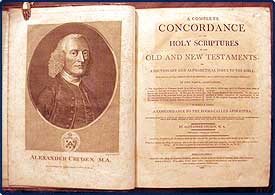
• First American edition of this cornerstone of biblical scholarship. The editors announce in their preface that they hope “it will be found
as much superior to the best London copies in correctness, as it evidently is
in paper and print,” noting that they have corrected numerous errors that
had crept into various editions. Cruden’s own preface gives a short historical
survey of concordances.
Cruden, bookseller to Queen Caroline, dedicated his initial publication of
his concordance to her. Unfortunately, she died two weeks later, and profits
from the sale of the volume did not meet the author’s expectations;
Cruden’s disappointment (and bouts of eccentric behavior) regardless,
the DNB stresses that “his biblical labours have justly made
his name a household word among the English-speaking peoples.”
The
frontispiece portrait of the author was engraved by William Kneass.
• Shaw & Shoemaker 10233. On Cruden, see: The Dictionary
of National Biography, V, 249–51. Contemporary sheep, spine with
gilt-stamped leather title label; worn and abraded, leather cracking over
spine. Front pastedown and free endpaper (partially separated) with stray
pencil marks. Varying degrees of offsetting and spotting. One piece of dried
plant material laid in. (5706)
[Gillet, Eliphalet]. History of the Bible and Jews, with remarks upon the rise and progress of Mahometanism and Popery. Adapted to the use of schools. Hallowell [ME]: Ezekiel Goodale (pr. by Benjamin Edes), 1806. 12mo (17.7 cm, 7"). 312 pp.
$400.00
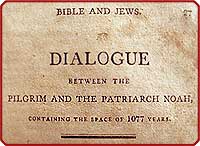
• First edition as such, and relatively uncommon. This is an English
rendition of Jan Philipsz Schabaelje’s 1635 Lusthof des gemoets,
being a retelling
of Old and New Testament history as a series of conversations between an
inquisitive pilgrim and various Biblical figures, here
edited and “accomodated to the use of schools in America” by
the Rev. Gillet. Gillet, who also published a number of sermons and discourses,
was a founding member of the First Congregational Church in Pittston, Maine,
as well as a member of the Maine Missionary Society. At back is a list of
Goodale’s other publications, to be had at the “Sign of the Bible.”
retelling
of Old and New Testament history as a series of conversations between an
inquisitive pilgrim and various Biblical figures, here
edited and “accomodated to the use of schools in America” by
the Rev. Gillet. Gillet, who also published a number of sermons and discourses,
was a founding member of the First Congregational Church in Pittston, Maine,
as well as a member of the Maine Missionary Society. At back is a list of
Goodale’s other publications, to be had at the “Sign of the Bible.”
• Shaw & Shoemaker 10485. Contemporary speckled sheep, worn and abraded; back cover with slices to leather, title label on spine almost entirely rubbed away. One leaf torn; pages age-toned throughout, with staining/spotting. Back pastedown with calligraphy practice inked in an early hand.
Wood, James. A dictionary of the Holy Bible.... New-York: D. Hitt & T. Ware, 1813. 8vo (22 cm, 8.625"). 2 vols. I: 600 pp. II: 616 pp.
$200.00


• James Wood (1751–1840), a Methodist minister, largely based this encyclopedic dictionary of the Bible on that of Augustin Calmet.
 This is the sole American edition. First printed in England in 1804.
• Shaw & Shoemaker 30564; NSTC W2651. Contemporary speckled sheep. Spines divided into compartments by double gilt rules with large red leather title labels and small round black volume labels, both edged with gilt fillets and gilt-lettered. Fine cracking to spines with shallow chipping from head and foot; edges rubbed, corners bumped. Pages with light browning around impression and on edges, with darker browning from turn-ins towards beginning and end of each volume. Large bite from rear free endpaper of vol. II; generally, text problem-free, with but a few shallow tears and chippings and a few light waterstains.
By
the“English
Athanasius”
Milner, John. A brief summary of the history
and doctrine of theHoly
Scriptures...In two parts. New York: Pr. for William H. Creagh,
1820. 8vo. 230 pp.
$265.00
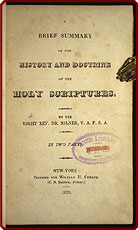

• First American edition. The author was a bishop in England and
leader of the Catholic Emancipation movement.
Click
the interior image for an enlargement.
• Parsons 655; Shoemaker 2272. Treed sheep, red spine label,
gilt ruling on spine. Edges rubbed and abraded, refurbished; front joint and
hinge expertly reinforced; now nice. Ex-Georgetown University with stamps
on title-page; some old dog-ears and spots.
Milner, John. A brief summary of the history and doctrine of the Holy Scriptures. Philadelphia: Eugene Cummiskey, 1821. 8vo. [1] f., 278 pp.
$155.00
• Second American edition.
• Parsons 680; Shoemaker 6058. Treed sheep, red spine label; gilt ruling on spine. Joints starting, edges rubbed and abraded. Foxed. Georgetown marks in pencil on front free endpaper.
PLACE
AN ORDER | E-MAIL
US | PRB&M HOME