 18TH-CENTURY BOOKS
Aa-Al • Am-Az • Ba-Beq • Ber-Bo • Bibles • Bp-Bz
Ca-Cb • Cc-Coq • Cor-Cz • Da-Di • Dj-Dz
Ea-England • English-Ez • F • Ga-Gp • Gr-Gz • Ha-Hb
Hc-Hz • I-K • La-Lel • Lem-Log • Loh-Lz • Maa-Mar
Mas-Mz • N-O • Pa-Pi • Pj-Pz • Q-R • Sa-Sch
Sci-Se • Sf-Sol • Som-Sz • Ta-Th • Ti-U • Va-Wil • Wim-Z
 [Garth, Samuel]. The dispensary. A poem. In six canto’s [sic]...the fifth edition. London: John Nutt, 1703. 8vo (20 cm, 7.9"). Frontis., [11] ff., 96 pp.
$300.00
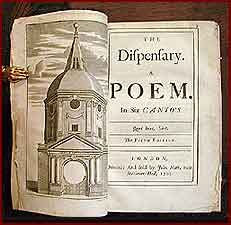
• Satiric verse mocking the greed and lack of compassion of apothecaries, and of a few physicians as well. In 1687 the Royal College of Physicians voted to establish a charity enabling the poor to obtain medical care; however, the apothecaries and some doctors resisted mightily, and close to ten years later the endeavor had been almost entirely frustrated, primarily by the refusal of the majority of the apothecaries to provide medications at lower costs. The present poetic response to the fiasco was written by Sir Samuel Garth, physician in ordinary to George I and physician-general to the British army, and first published in 1699. The Cambridge History of English and American Literature praises Garth’s technique, noting that this composition “represents, as a sort of practical Ars Poetica or object lesson, the stage between Dryden and Pope, and, without exaggeration, may be said to be the first draft—and not a very rough first draft—of the couplet versification and the poetic diction which were to dominate the whole eighteenth century” (IX, vi, 25). Aside from its literary merits and its record of the contemporary practice of medicine, the highly successful piece served the useful purpose of encouraging popular support for the charity and humbling naysayers; the dispensary survived until 1724.
The frontispiece portrays a small but elegantly composed octagonal structure, labelled “Theatrum Cutlerianum.”
• ESTC T34564; Foxon G21; Wing (rev.) G273 (first ed.). Recent marbled paper wrappers, front cover with printed paper label. Two pages (not including title-page) stamped; one page with two pencilled corrections. Margins untrimmed and occasionally showing a few spots or light staining, pages otherwise quite clean.

 Country
Matters?
Gay, John. The shepherd’s week. In six pastorals. London: Pr. by R. Burleigh, 1714. 8vo. [7] ff., 60 pp., [2] ff., 7 plts.
Country
Matters?
Gay, John. The shepherd’s week. In six pastorals. London: Pr. by R. Burleigh, 1714. 8vo. [7] ff., 60 pp., [2] ff., 7 plts.
$300.00
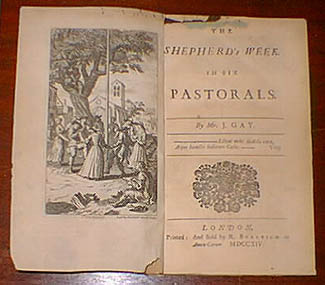
• According to Foxon, the date may be a misprint for 1716. With a
charming frontispiece of dancers ’round a maypole.
• Foxon G73. Recent marbled paper wrappers; paper tape from an
old library hinge reinforcement left in place. Frontispiece with small chip
from bottom margin; title-page chipped along narrow old ink splotch at top
and with slim adherence from old binder’s slip (as seen in our picture). Pencilled
bracketing on several pages.


 Prize Copy of
 the Attic Nights
Gellius, Aulus. Auli Gellii Noctium atticarum libri XX prout supersunt quos ad libros msstos novo & multo labore exegerunt.... Lugduni Batavorum: Apud Cornelium Boutesteyn & Johannem du Vivié, 1706. 4to (26, 10.25" cm). Add. engr. t.-p., [34], 903, [65 (index; 1 final f. blank)] pp.
the Attic Nights
Gellius, Aulus. Auli Gellii Noctium atticarum libri XX prout supersunt quos ad libros msstos novo & multo labore exegerunt.... Lugduni Batavorum: Apud Cornelium Boutesteyn & Johannem du Vivié, 1706. 4to (26, 10.25" cm). Add. engr. t.-p., [34], 903, [65 (index; 1 final f. blank)] pp.
$650.00
 Click the images for enlargements.
• Gellius's Attic Nights, supposed to have been written for the entertainment and education of his children, offers a rich tapestry of the life and times of the Roman Empire under the five good emperors. In an informal style Gellius ranges from law, grammar, history, and literary criticism to evening chats with fellow students and visits to the awe-inspiring villas of Herodes Atticus, the most famous philanthropist of Athens. Brunet calls the present example the “Édition la meilleure qui ait paru jusqu'ici” of the Attic Nights. Originally edited by Joannes Fredericus Gronovius and then polished by his son Jacobus Gronovius, this version also includes notes and commentary by Kaspar Schoppe, Peter Lambeck, Louis Carrion, Antoine Thysius, and Jacobus Oiselius.
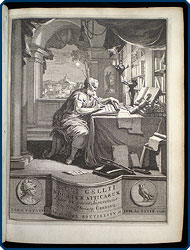
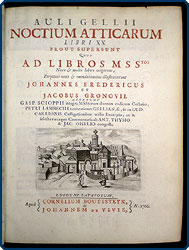
The additional engraved title-page, done by P. Sluyter after a design by J. Groere, depicts the author at work on a moonlit night, and is decorated with medallions of Athena and her owl; the title-page is printed in red and black, with an engraved vignette of an Attic city.
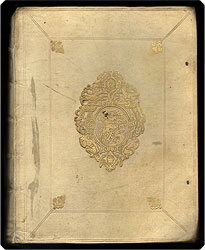
Binding: Prize binding (without certificate) of contemporary vellum, covers framed and panelled in double blind fillets with gilt-stamped corner fleurons, gilt-stamped medallion on each cover showing a scimitar-wielding knight bearing two crossed keys on his shield, supported by monkeys and surmounted by lounging figures grasping snakes. Spine with gilt-ruled raised bands, gilt-stamped compartment decorations, and early inked title.
• Brunet, II, 1524; Graesse, II, 46; Schweiger, II, 379. Binding as above, small areas of discoloration, ties now lacking; front hinge (inside) very unobtrusively reinforced. Front pastedown with affixed slip of old cataloguing, partially obscuring an early inked annotation. Title-page with shadows of pencilled numeral and publication annotation. Some margins darkened or with mild spotting, pages otherwise clean, and all edges red. (25963)
 For more GREEK & LATIN CLASSICS, click here.
For FINE, ATTRACTIVE, & INTERESTING
BINDINGS, click here .
Contradicting Collins . . .
Gentleman of Cambridge. An answer to the discourse on free-thinking: Wherein the absurdity and infidelity of the sect of free-thinkers is undeniably demonstrated. London: John Morphew & A. Dodd, 1713. 8vo (19.7 cm, 7.75"). [8], 28 pp.
$300.00
• First edition of this response to Anthony Collins's Discourse on Free-thinking, one of many published replies to Collins's landmark treatise on the role of independent critical thought in religion and philosophy. The present rebuttal is often assigned to Richard Bentley, although ESTC considers that an erroneous attribution.
• ESTC T22052. Recent marbled paper–covered boards, front cover with gilt-stamped leather title-label. Pages clean. (20790)
 For more RELIGION, click here.
Or for FREE THINKING, click here.
 Early History of Persia in English & with the Farsi — View & Map Both Present
Ghaffari, Ahmad ibn Muhammad, & William Ouseley. Epitome of the ancient history of Persia. London: Pr. by Cooper & Wilson for Cadell & Davies, 1799. 12mo (17.9 cm, 7"). Fold. frontis., [4], xxxvi, 92 pp.; 1 fold. map.
Early History of Persia in English & with the Farsi — View & Map Both Present
Ghaffari, Ahmad ibn Muhammad, & William Ouseley. Epitome of the ancient history of Persia. London: Pr. by Cooper & Wilson for Cadell & Davies, 1799. 12mo (17.9 cm, 7"). Fold. frontis., [4], xxxvi, 92 pp.; 1 fold. map.
$1000.00
Click the images for enlargements.
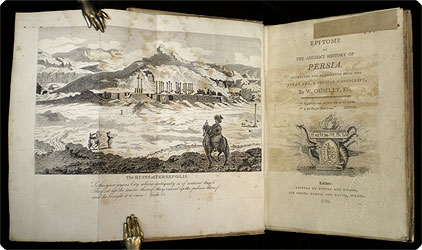
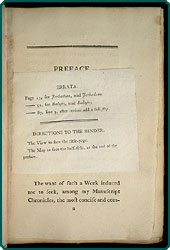
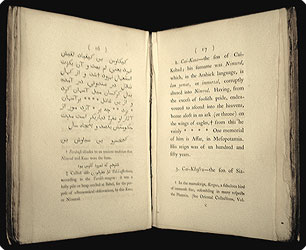
• First edition: Annals of Persian history as extracted from the “Jehan Ara” manuscript (i.e., the Nusakh-i Jahan-ara, a general history of Asia) and translated into English by Sir William Ouseley. Ouseley was an orientalist who served as secretary to his brother, the English ambassador to the court of Persia from 1810 through 1812; he published numerous critically acclaimed studies of Persian literature, history, and antiquities. The Classical Journal, which said that Ouseley's Travels in Various Countries in the East “must rank high among the most important books of reference of which we are possessed,” also praised Ouseley as having “done more to elucidate ancient geography and antiquarian studies, than any who have preceded him in the same tract” (vol. XXX, p. 161).The present work opens with an oversized, folding view of the ruins of Persepolis, and includes a folding map of “Persia or iran” done by prominent engraver Samuel John Neele, as well as two small copper-engraved vignettes. The main text is given in Farsi and English on opposing pages; in addition to the portions of text taken from the Jahan-ara, Ouseley also provides “collateral illustrations from other manuscripts” (p. ii) and historical works. An errata slip is tipped in — this also, interestingly, containing instructions to the binder!
• ESTC T97308; Lowndes 1741; Brunet, IV, 261; Allibone 1469. Uncut copy. Publisher's paper shelf-back and plain boards, respined with similar paper; binding rubbed and soiled, spine head chipped, spine reinforcement with crack. Ex–social club: 19th-century bookplate, call number on endpaper, annotation on title-page covered over with slip of paper (pleasure and challenge of removal reserved for next owner), pressure-stamp on title-page. Frontispiece and map moderately waterstained, title-page with offsetting. Pages lightly age-toned, a few mildly foxed. Early inked corrections to a handful of words. (26276)
For more PERSIANA, click here.
For more TRANSLATIONS, click here.
This appears in the GENERAL
MISCELLANY — click here.
Giacinto di Santa Maria. Memorie dell’ umile servo di Dio P. Carlo Giacinto di Santa Maria.... Roma: Nella Stamperia del Bernabò, 1728. 4to (22.5 cm, 8.875"). [12] ff., 323, [1] pp.
$800.00
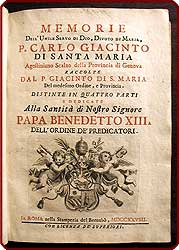
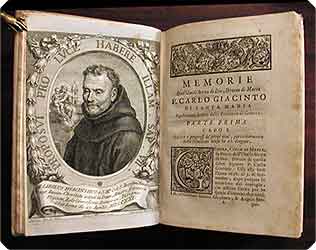
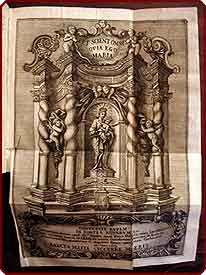
• Fr. Hyacinth of Saint Mary (P. Giacinto di Santa Maria), an Austin friar, here gives the life of a fellow Augustinian, the Genoese Servant of God Charles Hyacinth of St. Mary (Carlo Giacinto di Santa Maria, 1658–1721), for the edification of the faithful and to promote his cause for canonization. That cause enjoyed some limited success, as Charles was elevated from a simple Servant of God and is now considered the Venerable Charles Hyacinth.
The most striking feature of this piece is the first of the two plates, a lifelike portrait of the book’s subject engraved by Heinrich Wehymer after Antonio Davide. The other plate, an unsigned etching, depicts the statue of Our Lady of Consolation in the Augustinian church at Genoa. Also present is an engraved title-page vignette depicting the arms of Pope Benedict XIII, the work’s dedicatee, and there are a few initials and woodcut head- and tailpieces, the tailpiece on the last page being especially large and handsome.
 This
is apparently the sole edition of this biography, and it is rare: A search of OCLC, RLIN, and NUC Pre-1956 revealed no copies, and the Italian Library Service union catalogue lists only one holding, at the Central Library in Turin.
This
is apparently the sole edition of this biography, and it is rare: A search of OCLC, RLIN, and NUC Pre-1956 revealed no copies, and the Italian Library Service union catalogue lists only one holding, at the Central Library in Turin.
• Vellum over paste boards with staining on front cover; pastedowns torn along turn-ins and puter edge of front free endpaper somewhat tattered. Lightly foxed throughout, a few pages more heavily so, with a light waterstain on the bottom edge and/or lower outer corner of most leaves (barely visible, on some). Small hole in outer margin of half-title and hole with tear (from a paper defect) in the margin of pp. 51–52. The second plate with two closed tears into the engraving, without loss. All edges mottled red and blue.
For more BOOKS IN ITALIAN, click here.
For more BIOGRAPHIES, mostly modern
& much less expensive, click here.
MuchMore than the Decline & Fall
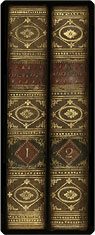
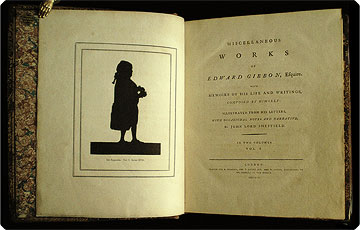
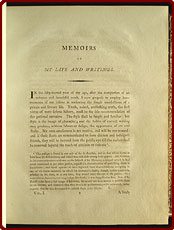
Gibbon, Edward. Miscellaneous works ... With memoirs of his life and writings, composed by himself: illustrated from his letters, with occasional notes and narrative, by John Lord Sheffield. London: A. Strahan and T. Cadell, Jr. & W. Davies, 1796. 4to (28.7 cm, 11.25"). 2 vols. I: Frontis., xxv, [1], 703, [1 (blank)] pp. II: viii, 726, [2 (errata & adv.)] pp.
$1500.00
• First edition: Gibbon's memoirs, assembled and annotated by John Baker Holroyd, Earl of Sheffield, along with various observations, essays, and remarks by the great historian. Among the contents are “Examination of Longinus's Treatise upon the Sublime,” “A Dissertation on the Subject of Metals,” “Essai sur l'Etude de la Littérature,” and outlines of the history of the world from the 9th through 15th centuries. The collected correspondences include letters to Dr. Priestley following Gibbon's receipt of his History of the Corruptions of Christianity, dialogues on literature conducted in both French and Latin (accompanied by English translations) with Gesner and others, and extensive discussion with Holroyd about American, French, and English politics.
The work was additionally printed in Dublin and Basil in the same year. OCLC notes that a third volume was printed almost ten years later, by J. Murray; that supplementary volume is not present here.
Signed binding: Contemporary treed calf, covers framed in gilt rolls, beautifully rebacked with gilt-stamped spines preserving handsome original gilt-stamped, two-color leather title and volume labels, turn-ins with gilt rolls. Front pastedown of vol. I with binder's ticket: “Pigge Binders, Lynn.”
A charming silhouette of Gibbon serves as frontispiece to volume I.
• ESTC T79696; Allibone 663; Brunet, II, 1586; Norton, Gibbon, 131. Bindings as above with original leather showing some scuffs and abrasions; gilt on original spine labels a little (but a little only) dimmed. Hinges (inside) reinforced. Final page of each volume, back pastedown of vol. I, and title-page of vol. II institutionally rubber-stamped; no other such marks. Intermittent spots of light
foxing. A lovely, wide-margined, archetypically “18th-century” quarto production for this quintessentially 18th-century writer. (23770)
For more SETS, click here.
For LITERATURE, click here.
For FINE, ATTRACTIVE, & INTERESTING
BINDINGS, click here .
Or for ENGLISH POLITICS, click here.
History
of Convocation. Gibson
on Ecclesiastical Law.
Gibson, Edmund. Synodus Anglicana: Or, the constitution
and proceedings of an English convocation, shown from the acts and registers thereof, to be agreeable
to the principles of an Episcopal church. London: A. & J. Churchill, 1702. 8vo (19.4 cm, 7.6"). [2],
xii, [24], 221, [1], 130, [2], 137–76, 169–75, 222–308, [10] pp. (pagination erratic, text complete).
$450.00
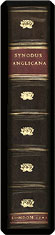
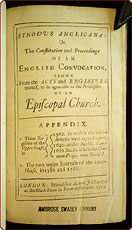
• First edition (despite a misleading variant issue with an incorrect publication date of
1672) of this important source of ecclesiastical history and canon law. Not a lawyer himself, Gibson,
Bishop of London, nonetheless made a significant contribution to English canon law with his
landmark Codex juris ecclesiastici Anglicani; the present work marks his first legal effort, predating
the 1713 publication of the Codex, and reflects his dedication to research and scholarship pertaining
to the Church of England. The DNB notes that the Synodus Anglicana “came to be regarded as
definitive.”
Click
the interior image for an enlargement.
• ESTC R24103; Lowndes 888; Wing (rev. ed.) S6383 (noting the true
publication date). On Gibson, see: Oxford Dictionary of National Biography online.
Recent quarter calf and marbled paper–covered sides, spine with gilt-stamped
leather title and publication labels and gilt-stamped compartment decorations, leather edges tooled in
blind. Lower (closed) edges and title-page recto and verso institutionally rubber-stamped; last page
with affixed printed errata slip. Back fly-leaf with early inked annotation; text with a very few
instances of inked bracketing in an early hand, pages otherwise clean. All edges speckled in red and
brown. (25422)
For
RELIGION, click here.
For ANGLO-AMERICAN LAW, click
here.
This
appears in the GENERAL
MISCELLANY — click here.
Ginther, Antonius. Speculum amoris et doloris in sacratissimo ac divinissimo corde Jesu incarnati, eucharistici, et crucifixi, orbi christiano propositum....editio IV. Augustæ Vindelicorum: Joannis Jacobi Lotteri, 1743. 4to (21.1 cm, 8.4"). [38], 408, [16 (index)] pp. (lacking engraved title, pp. 49/50); illus.
$875.00
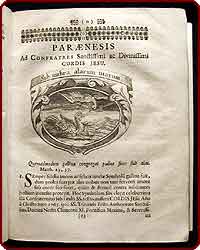
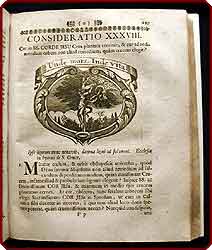
• Very uncommon fourth edition of this emblem book, following the first of 1706. Ginther also published a book of sermons, Currus Israel, et auriga ejus, along with a Marian emblem book, Mater amoris et doloris; the present item was printed in Augsburg, Germany, with the text in Latin and illustrated with 50 engraved emblems. The emblems are unattributed, but the frontispiece (not present in this copy) was done by Johann Caspar Gütwein.
Rare in the U.S.: We trace only the Getty copy of this edition, and earlier editions are no less rare.
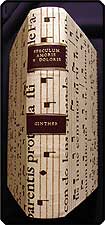
• Landwehr, German Emblem Books, 317. Boards covered in music-printed paper from an 18th-century antiphonal, spine with gilt-stamped leather title and author labels. Engraved title and pp. 49/50 (emblem VII) lacking. Title-page and next leaf with long-ago repaired holes, one on the latter affecting an initial on the verso; title-page with old inked device(?) and 19th-century institutional stamp on verso, showing through in part to recto; a small hole in a third leaf, taking perhaps a letter or two. Final blank leaf and two other leaves also stamped. One leaf torn from margins into text, repaired with Japanese tissue. Pages slightly age-toned, some with mild foxing or the odd spot. Faults noted, this is yet a worthwhile and studyable/enjoyable volume.
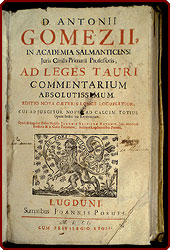
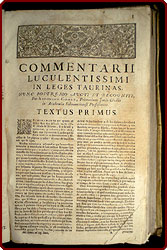
Gómez, Antonio. Ad leges tauri commenatrium absolutissimum. Editio nova cæteris longe locupletior.... Lugduni: Joannis Posuel, 1701. Folio (34 cm, 13.5"). ã2A–C4 D–Z6 Aa–Zz6 Aaa–Ccc6 Ddd4; [2] ff., 504 pp., [40 (index)] ff.
$875.00
Click the images for enlargements.
• Uncommon, early 18th-century edition of commentary on the Leyes de Toro, a Castilian law book compiled in 1505. Antonio Gómez was a professor of civil (i.e., Roman) law at Salamanca; the first edition of his commentary on the laws of Toro appeared in 1555, and the work was continuously reprinted internationally through the 18th century. Toro, a town in the province of Zamora, Spain, played an important role in the development of the kingdoms of Leon and Castile and the Reconquest but is best known for its laws, which went through several codifications and were thereafter used elsewhere as a model and precedent. This work is arranged with the text of each law in Spanish and Latin, then a summary of Gómez's commentary on it, then the full text of his commentary.
The text is mostly in Latin, with portions in Spanish; the printer has made use of nicely cut head- and tailpieces as well as a striking woodcut printer’s vignette (“De forti dulcedo”) on the red and black title-page.
 RLIN and OCLC show only two U.S. holdings of this edition.
Provenance: Front free endpaper with bookplate of Michael J. O’Farrell, the first Bishop of the Diocese of Trenton; also with bookplate noting O’Farrell’s gift of the book to an institution.
• Palau 103253. Contemporary limp vellum, cockled and lightly soiled, with ties now lacking; spine with faded inked title. Title-page dusty, thin, and holed, with lower outside corner torn away, touching one letter and a red rule; date altered to 1601 by erasure of the first “C” in the roman-numeralled date! Leaves browned, foxed; instances of early inked marginalia and blots. Uncommon, as well as interesting for its contemporary use and its later provenance. (12184)
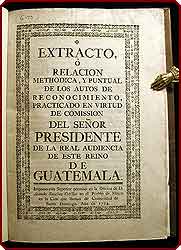
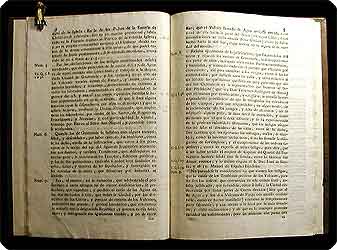
González Bustillo, Juan. Extracto, ô Relacion methodica, y puntual de los autos de reconocimiento, practicado en virtud de commission del señor presidente de la Real Audiencia de este reino de Guatemala. Pueblo de Mixco [Guatemala]: Impreso en la oficina de A. Sanchez Cubillas, 1774. Folio (29.5 cm; 11.675"). [2], 86 pp. (without final leaf with one erratum)
$10,750.00
Single-click any image where the hand appears on
mouse-over, for an enlargement.
• Following the ruin of Santiago de los Caballeros by the big earthquake of 1773, the capital of Guatemala was moved first to the little town of Mixco and then later to the location of the present site of Guatemala City. Offered here is the highly important report of the commission headed by Juan González Bustillo on that devastating July, 1773 earthquake: It occupies pp. 1–55 and is followed by "Prosigue la relacion, ô Extracto de todo lo que resulta èvacuado en la Junta general, y demas que se ha tenido presente hasta la conclusion del assunto de translacion, e informe, que debe hacerse à Su Magestad” on pp. 57–86.
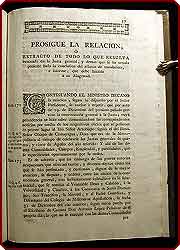
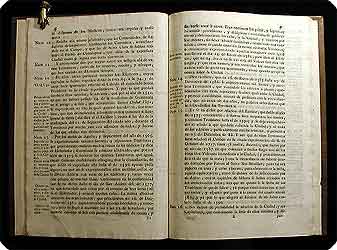
The careful, lengthy, and contemporary reports present here detail the day’s events, give the sequence of the destruction of various buildings and areas of the city, recount salvage and evacuation efforts, etc. The writers (and the citizens) erroneously blamed the nearby volcanos for causing the tremors and quaking, but that was logical at the time. Seeking historical perspective, the commissioners make significant and informed comparisons with earlier earthquakes.
This document is one of the very few printed in the temporary capital of Mixco, a press having been salvaged from the ruins in the former capital. Thus, Mixco was the second city/town to have a press in Central America, and then, for only a short time—appoximately two years.
In addition to being important for its contents and in the realm of printing history, the González Bustillo report is uncommon: We trace only half a dozen copies in U.S. libraries.
• Medina, Guatemala, 384; Palau 105113; Sabin 27811. Modern full calf, very plain style. Without the final leaf with one erratum on it.
FIRST EDITION
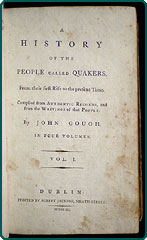
Gough, John. A history of the people called Quakers. From their first rise to the present time. Dublin: Robert Jackson, 1789. 8vo (21 cm, 8.25"). 3 (of 4) vols. I: x, [2], 546, [10 (index)] pp. (pagination skipping 294 to 297, text complete and uninterrupted). II: [2], 557, [11] pp. III: 526, [10] pp.
$375.00
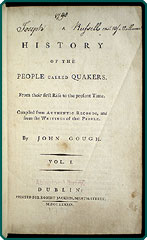
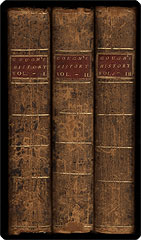
• First edition of Gough's account of the origins of the Society of Friends, including biographies of a number of Irish Quakers. This three-volume set in matching contemporary
bindings is composed of the original three books projected; a fourth volume, published in 1790, is not present here. Each book has an index at the back.
Provenance: Vol. I title-page with inscription dated 1790, reading “Joseph Russells cost 10s a Vollume [sic]”.
• ESTC T102429. Contemporary treed calf, spines with gilt-stamped leather title labels; worn but sound. Bookplates of a now-defunct institution on front pastedowns. Some instances of offsetting and foxing, generally no more than moderate, with pages otherwise clean. (8655)
 Second Edition (?) — “New” Fourth Volume Present
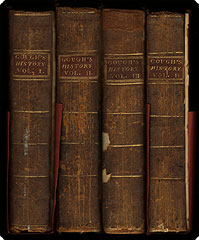
Gough, John. A history of the people called Quakers. From their first rise to the present time. Dublin: Robert Jackson, 1790. 8vo (21 cm, 8.25"). 4 vols. I: x, [2], 542, [10 (index)] pp. II: [2], 557, [11] pp. III: 526, [10] pp. IV: 573, [7] pp.
Second Edition (?) — “New” Fourth Volume Present
Gough, John. A history of the people called Quakers. From their first rise to the present time. Dublin: Robert Jackson, 1790. 8vo (21 cm, 8.25"). 4 vols. I: x, [2], 542, [10 (index)] pp. II: [2], 557, [11] pp. III: 526, [10] pp. IV: 573, [7] pp.
$350.00
Click the images for enlargements.
• Second edition (?) of Gough's account of the origins of the Society of Friends, including biographies of a number of Irish Quakers. This is a four-volume, 1790 set in matching contemporary bindings, composed of the originally projected three books first printed in 1789 along with a fourth, printed for the first time here, which brought the history up to date; each volume has an index at the back.
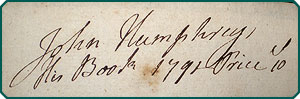
Provenance: Each volume's front fly-leaf (facing title-page) with inscription dated 1791, reading “John Humphrey, his book 1791 Price 10s”; each volume's pastedown with small bookplate of Richard McIlvain.
• ESTC N2800. Contemporary treed calf, spines with gilt-stamped leather title labels; worn, with all front covers and free endpaper of vol. IV detached. Some instances of light offsetting and foxing, with pages generally clean; some leaves chipped or with marginal tears, one tear causing loss of a few letters from a heading. (14671)
For more RELIGION, click here.
For a “shelf” dedicated to the
FRIENDS/QUAKERS, click here.
For Books for the BUSTED
BIBLIOPHILE, click here.
PLACE
AN ORDER |
E-MAIL US |
PRB&M HOME


 Most Lifelike Portrait