IRELAND
 IRISH
IRISH[IMPRINTS INCLUDED]
IRISH Irish Insurgency — American Imprint & Provenance
  (An
IRISH AMERICANUM).
Jones, John, of Dublin. An impartial narrative
of the most important engagements which took place between His Majesty's forces
and the insurgents, during the Irish Rebellion, in 1798; including very interesting
information not before published. Carefully collected from authentic letters.
Second edition, with additions and corrections. South Newberlin, NY: Levi Harris,
1834. 12mo (18.3 cm, 7.2"). Frontis., 227, [1] pp.
(An
IRISH AMERICANUM).
Jones, John, of Dublin. An impartial narrative
of the most important engagements which took place between His Majesty's forces
and the insurgents, during the Irish Rebellion, in 1798; including very interesting
information not before published. Carefully collected from authentic letters.
Second edition, with additions and corrections. South Newberlin, NY: Levi Harris,
1834. 12mo (18.3 cm, 7.2"). Frontis., 227, [1] pp.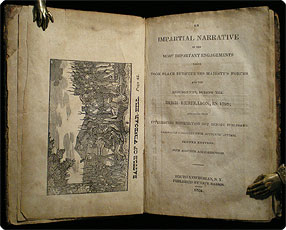
 Click
the interior image for an enlargement.
Click
the interior image for an enlargement.
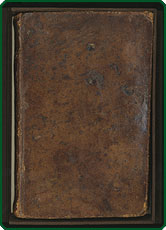
Provenance: Inked inscriptions of James Mack of Windham, VT (1784–1860) on front free endpaper and rear fly-leaf. Although both inscriptions are dated 1840, one gives “Col. James Mack” and the other “Major James Mack.”
• American Imprints 25154. Contemporary treed sheep, spine with gilt-stamped leather title-label; joints, edges, and extremities rubbed, spine leather darkened and cracked, boards very slightly sprung. Inscriptions as above. Light to moderate age-toning and foxing, more pronounced to frontispiece and title-page. Now housed in a cloth clamshell case with gilt-stamped leather spine label. (25116)
 This entry is repeated in the
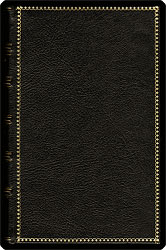
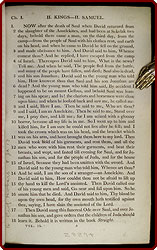
 AT LEAST THREE “FIRSTS” — First English SeptuagintBible. English. 1808. Thomson. The Holy Bible, containing the Old and New Covenant, commonly called the Old and New Testament: Translated from the Greek. By Charles Thomson.... Philadelphia: Pr. by Jane Aitken, 1808. 8vo. 4 vols. I: [252] ff. II: [245] ff. III: [222] ff. IV: [240] ff.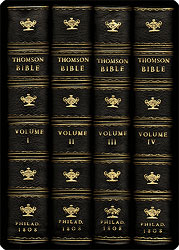
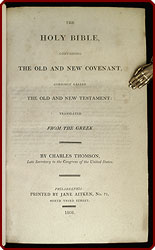 Click the images for enlargements.
  It was also the first translation of the Greek New Testament into English by a native of Ireland, and of course it is the work of a key figure of the American Revolution.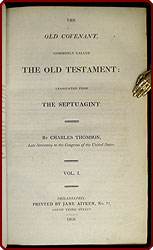
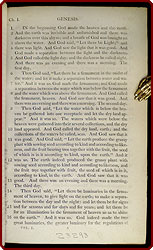
On 4 July 1776 only two signatures were affixed to the unanimously adopted Declaration of Independence — those of John Hancock, president of the Congress, and Charles Thomson, secretary, in order to authenticate the document that had been voted on and approved. Yet by a curious twist of fate (read rather, surely, of a political enemy's knife), when the calligraphic copy that is so well known to every school child was ready shortly after 19 July, authenticator Thomson was not invited to sign it!
When he had retired from public life in 1789, Thomson was to turn his interest in the Bible and Greek to the 20-year task of producing this monumentally important work.
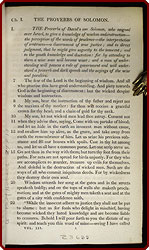
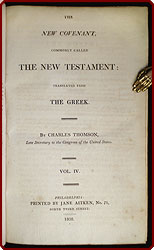
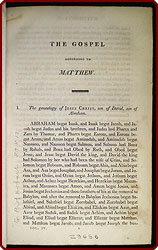
Its printer was the daughter of Robert Aitken, who had printed the first Bible in English in America. A major edition of the English Bible, this is essential for any Bible collection, not just for collections of American Bibles — though as an American Bible and simple Americanum it has a revered place.• Rumball-Petre, Rare Bibles, 184; Hills 153; Herbert 1514; O'Callaghan 91–92; Shaw & Shoemaker 14486. On Thomson, see: Dictionary of American Biography, XVIII, 481–82. Modern full black morocco, signed “GB” (Grace Bindings). Gilt spines. Black endpapers. The effect, richly elegant. Faintly visible pressure-stamps of a library (properly deaccessioned), each volume with neatly pencilled collection note and small old inked 5-digit number to first text leaf; in fact a remarkably clean, ever–well cared for, and handsome set. (26019)
 Really Printed in
 Kilkenny, not Cologne Burke, Thomas. Hibernia Dominicana. Sive Historia Provinciae Hiberniae Ordinis Praedicatorum. Coloniae Agrippinae [i.e., Kilkenny]: ex typographia Metternichiana sub Signo Gryphi, 1762. 4to (23 cm; 9.125"). xv,, 949, [1] pp.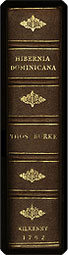
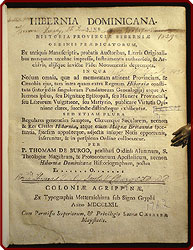
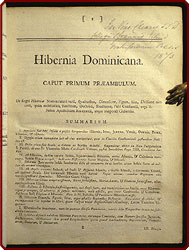 Click the interior images for enlargements.
 Those copies with the Kilkenny impirnt (Killkenniae: ex typographi Jacobi Stokes) are far fewer than those with the Cologne imprint, but it is clear that all copies were printed at Kilkenny by Stokes.
Not a common work: NUC Pre-1956 and OCLC combine to locate only eight copies in U.S. libraries.
Provenance: On title-page, ownership inscriptions of the Revs. Thomas Qualy (1829) and Jacob Cleary. Additional Cleary ownership inscriptions on p. 1 (1873) and iii (1891), the latter a gift inscription on the occasion of that owner's giving the volume to a Rev. Thomas Kelly.
• Bradshaw Irish Coll., nos. 5222-5223; ESTC t036179. Recent full brown calf with covers panelled in the Cambridge style, author/title/etc. lettering in gilt directly to spine; spine with gilt rules above and below bands and gilt devices in the compartments. Title-page soiled and small portion of lower inside blank margin torn away and repaired; same page has old library call number in ink and the date of publication in ballpoint! Ownership notes as above. Very light waterstain in lower blank margins of preliminary leaves. Generally a very nice, clean copy. (24805)

What’s Going on Here?Burnside, Thomas. Document Signed. Clearfield, PA, 1811. Double folio (39.5
cm, 15.5"). [1] f.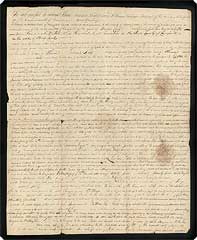 Click the image for an enlargement.
The Irish-born
Burnside, then treasurer of Clearfield, Pennsylvania,
was later a justice of the Pennsylvania state supreme court.
Irish-born
Burnside, then treasurer of Clearfield, Pennsylvania,
was later a justice of the Pennsylvania state supreme court.
A notary’s seal is affixed to the document, which was signed by both Burnside and Patton.
• Creased and slightly age-toned, with the folios separated and some offsetting from seal; a few small holes, touching text without notable loss.

He Liked
ItCarr, John. The stranger in Ireland: Or, a tour in the southern and western parts of that country, in the year 1805. Philadelphia: Samuel F. Bradford et al. (pr. by T. & G. Palmer), 1806. 8vo (21.5 cm, 8.5"). xi, [1], 168, *167/68, 169–339, [1 (blank)], 8 (adv.) pp.; 1 plt\.
Liked
ItCarr, John. The stranger in Ireland: Or, a tour in the southern and western parts of that country, in the year 1805. Philadelphia: Samuel F. Bradford et al. (pr. by T. & G. Palmer), 1806. 8vo (21.5 cm, 8.5"). xi, [1], 168, *167/68, 169–339, [1 (blank)], 8 (adv.) pp.; 1 plt\.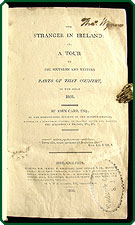
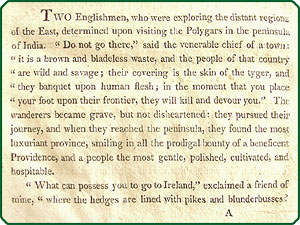
An Englishman through and through, Carr seems sincerely to have liked Ireland and the Irish he met. His book is full of extended and very readable detail — some original, much quoted — on (e.g.) language matters and Irish poetry, Irish agriculture and industry, Irish management of charities, Irish “sights” and ruins, Irish marriage cust marriage customs — and the implications of a potato-based diet.
Provenance: Contemporary inked inscription reading “Tho.s Wynne.”
• Shaw & Shoemaker 10096. On Carr, see: The Dictionary of National Biography. Contemporary mottled sheep, spine with gilt-stamped title-label; leather moderately rubbed, joints cracking and spine label dimmed. Title-page with owner's name as described above; title-page and one other stamped. Pages, except for central leaves, with waterstaining in lower margins; two pages with smeared spots of ink. (11960)
For more PRE-1820 AMERICANA, click here. For more VOYAGES, TRAVELS, & books on“EXOTIC” PLACES, click here.

 Damnation
sansGender
Limitation[Combe,
William]. The diaboliad...also, the diabo-lady: Or, a match in Hell. London
pr., Dublin repr., 1777. 8vo (18.7 cm, 7.4"). 97, [1 (blank)] pp.
Damnation
sansGender
Limitation[Combe,
William]. The diaboliad...also, the diabo-lady: Or, a match in Hell. London
pr., Dublin repr., 1777. 8vo (18.7 cm, 7.4"). 97, [1 (blank)] pp.
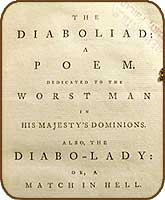
• ESTC T77101; NCBEL, II, 647. Marbled paper–covered boards, front cover with printed paper label. Half-title spotted, title-page and two others stamped by a now-defunct institution, title-page also with traces of paper affixed to upper margin; pages otherwise clean. One ESTC listing calls for plates; most holdings, however, do not report any and OCLC listings do not note any.

 TO Part
II TO Part
II |