 ENGLISH
POLITICS
ENGLISH
POLITICS
I-L • M-O • P • Q-S • T • U-Z
ENGLISH
POLITICS
 Famed
Famed Anti-Hobbesian
UTOPIA
Anti-Hobbesian
UTOPIA
 (A
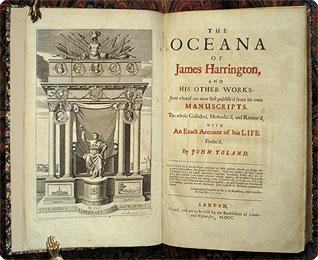
Thinker, Thinking)! Harrington, James.
The Oceana of James Harrington, and his other works som[e] wherof are now first
publish'd from his own manuscripts. The whole collected, methodiz'd, and review'd,
with an exact account of his life prefix'd, by John Toland. London: The booksellers
of London & Westminster, 1700. Folio (32.2 cm, 12.7"). Frontis., [2], xliv,
546, [2]pp.; 1 fold. plt, 1 plt. (incl. in pagination).
(A
Thinker, Thinking)! Harrington, James.
The Oceana of James Harrington, and his other works som[e] wherof are now first
publish'd from his own manuscripts. The whole collected, methodiz'd, and review'd,
with an exact account of his life prefix'd, by John Toland. London: The booksellers
of London & Westminster, 1700. Folio (32.2 cm, 12.7"). Frontis., [2], xliv,
546, [2]pp.; 1 fold. plt, 1 plt. (incl. in pagination).
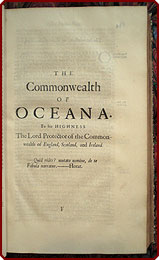
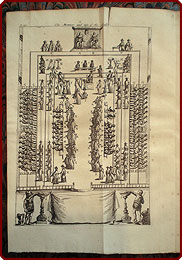
 Click the interior images for enlargements.
 Also present here are The Grounds and Reasons of Monarchy Consider'd, The Art of Lawgiving, and six political tracts, along with several other pieces. The volume is illustrated with three engraved plates by Michael van der Gucht: an allegorical frontispiece, a portrait of the author after P. Lely, and an oversized folding plate depicting “The Manner and Use of the Ballot.” The title-page is printed in red and black.  This was edited by John Toland.
• ESTC R009111; Goldsmiths'-Kress 3735; Wing (rev. ed.) H816. On Harrington, see: Oxford Dictionary of National Biography online. Recent quarter calf and marbled paper–covered boards, spine with gilt-stamped leather title-label and gilt-ruled raised bands, leather edges tooled in blind. Minor offsetting to title-page and elsewhere; intermittent light to moderate foxing; good paper. Oversized folding plate with short tear from upper margin, just touching caption but not extending into text. A handsome book. (25237)

An
Address to the
“Livery”(Abolition).
To the livery of London. [London, 1791?]. 8vo (18.5 cm, 7.25").
24 pp. (lacking pp. 9–16).
the
“Livery”(Abolition).
To the livery of London. [London, 1791?]. 8vo (18.5 cm, 7.25").
24 pp. (lacking pp. 9–16).
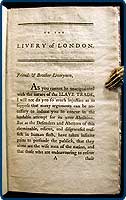
• Not in ESTC. Marbled paper–covered boards, old style, front cover with printed paper label. Lacking pp. 9–16. Pages cockled and slightly browned; edges untrimmed.

REGICIDE
Pilloried — Sort
Of?
Anonymous. Invisible John made visible: or, A grand pimp of tyranny portrayed, in Barkstead’s arraignment at the barre, vvhere he stands impeached of high treason, and other gross misdemeanours, as the late tyrant’s bum-bayliff in his most arbitrary, oppressive and tyrannical invasions of the rights and liberties of Engli sh-men, within the late cantonized county of Middlesex, the City of London Tower, &c. Whereunto are added, five queries, to the Parliament, Council of State, and Army.... London: no publisher/printer, 1659. Small 4to. [1] ff., 6 pp. 
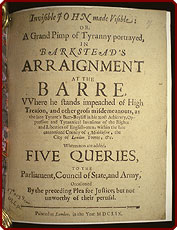 Click the image for an enlargement.
 There exist at least four different editions of this work. In this edition, line 9 of the title begins “VVhere” and line 19 has “Parliament, Council of State, and Army.”
• Wing (rev. ed.) I289aA; ESTC R234704. Removed from a nonce volume and now in later wrappers. (21001)


Military ScienceAnonymous.
Suggestions with regard to the education of officers in the British Army. London:
William Clowes & Sons, 1857. 8vo (19.8 cm, 7.75"). 21, [1 (blank)] pp., [1
(blank)] f. 
Rare: We were able to trace only one U.S. copy of this work via NUC Pre-1956, OCLC, or RLIN.
• NSTC 2ENG3884. Removed from a nonce volume. Light soiling and staining on title-page. Closely trimmed by binder, cutting off some sidenotes. Inked numeral in margin of title-page.
 For a Broader ChurchArnold, Thomas. Principles of Church reform. London: Pr. [by R. Clay] for B. Fellowes, 1833. 8vo (20 cm, 7.875"). v, [1 (blank)], 88 pp.
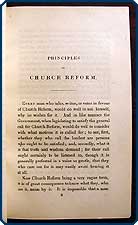 • Principles of Church Reform by Thomas Arnold (1795–1842), the famous reforming headmaster of Rugby, was an important and controversial argument for comprehension of Protestant dissenters within the Church of England, including proposals for revising Church government and liturgy to encourage that. This is the first of four 19th-century editions, all published in 1833 (it was also reprinted by SPCK in 1962).
Single-click
the image,
• Principles of Church Reform by Thomas Arnold (1795–1842), the famous reforming headmaster of Rugby, was an important and controversial argument for comprehension of Protestant dissenters within the Church of England, including proposals for revising Church government and liturgy to encourage that. This is the first of four 19th-century editions, all published in 1833 (it was also reprinted by SPCK in 1962).
Single-click
the image,• NSTC 2A16362. On Arnold, see: DNB, II, 113–17. Removed from a nonce volume. A few dog ears, some shallow chipping, and traces of soiling. A little underlining and sidelining in old ink.
“Translated
Asgill” Strikes
Back[Asgill,
John]. Mr. Asgill’s defence upon his expulsion from the House of
Commons of Great Britain in 1707. With an introduction, and a postscript. London:
A. Baldwin, 1712. 8vo (19.2 cm, 7.55"). 87, [1] pp.
Strikes
Back[Asgill,
John]. Mr. Asgill’s defence upon his expulsion from the House of
Commons of Great Britain in 1707. With an introduction, and a postscript. London:
A. Baldwin, 1712. 8vo (19.2 cm, 7.55"). 87, [1] pp.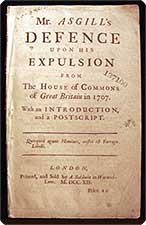 his rapturous religious
tenets while affirming his belief in the Scriptures and denying
any wrongdoing—especially in the pesky land speculation matter. One might,
upon perusing Asgill’s arguments, agree with the assessment made by the
printer of the original treatise, who “fancy’d [Asgill] was a little
craz’d” (p. 40).
his rapturous religious
tenets while affirming his belief in the Scriptures and denying
any wrongdoing—especially in the pesky land speculation matter. One might,
upon perusing Asgill’s arguments, agree with the assessment made by the
printer of the original treatise, who “fancy’d [Asgill] was a little
craz’d” (p. 40).
This example is apparently a variant state of the first edition of 1712 (ESTC does not distinguish between variants, grouping all entries under one listing), with p. 61, line 8 ending “of the Romish Persuasion.’
• ESTC T41498. On Asgill, see: The Dictionary of National Biography, II, 159–61. Removed from a nonce volume, now in a Mylar folder. Title-page with small numeric stamp, spots of discoloration. A few pages more notably browned than their neighbors; otherwise generally clean.

 TO Part II
. . . TO Part II
. . . |