
 17TH-CENTURY BOOKS
17TH-CENTURY BOOKS
17TH-CENTURY BOOKS
 False Imprint — Radical Theology
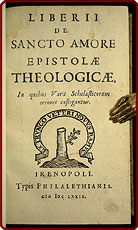
  Leclerc, Jean. Liberii de Sancto Amore Epistolae theologicae,in quibus varii scholasticorum errores castigantur. Irenopoli [i.e., really, Saumur]: typis Philalethianis, 1679. 12mo (16 cm; 6.375"). [10] f.,, 320 p.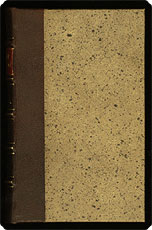
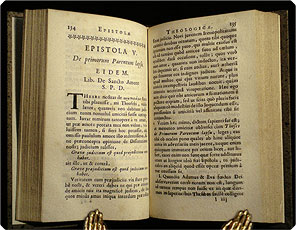
 Click the interior images for enlargements.
 The woodcut “printer's device” on the title-page is telling: “Ex trunco veteri novus ramus,” which pretty much epitomizes Leclerc's writings.
Uncommon. We locate fewer than 10 copies in the U.S.
• Weller, I, p.278. Recent quarter leather with gilt spine; sides with German-style brown paper speckled with black. Shadow of old pencilled shelf number and another four-digit number on verso of title-page. A very good copy. (24769)
 For
FALSE IMPRINTS,
For
FALSE IMPRINTS,
 The
Road
to Heaven in
The
Road
to Heaven in Nahuatl
León, Martín de. Camino del cielo en lengua mexicana, con todos los requisitos necessarios para conseguir este fin, co[n] todo lo que un Xp[r]iano deue creer, saber, y obrar, desde el punto que tiene uso de razon, hasta que muere. En Mexico: En la Emprenta de Diego Lopez Davalos, 1611. Small 4to (18.5 cm; 7.25"). Fols. 10–11, 13–69, 69[!]–73, [nothing missing] 76, 75, 77–108, 110–23.
Nahuatl
León, Martín de. Camino del cielo en lengua mexicana, con todos los requisitos necessarios para conseguir este fin, co[n] todo lo que un Xp[r]iano deue creer, saber, y obrar, desde el punto que tiene uso de razon, hasta que muere. En Mexico: En la Emprenta de Diego Lopez Davalos, 1611. Small 4to (18.5 cm; 7.25"). Fols. 10–11, 13–69, 69[!]–73, [nothing missing] 76, 75, 77–108, 110–23.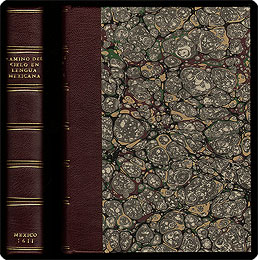
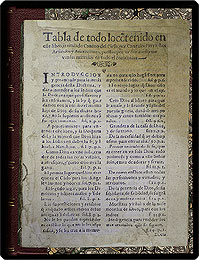
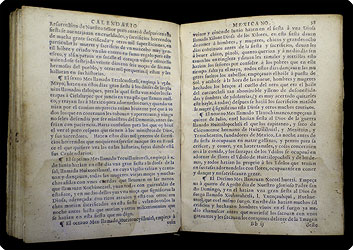 Click the images for enlargements.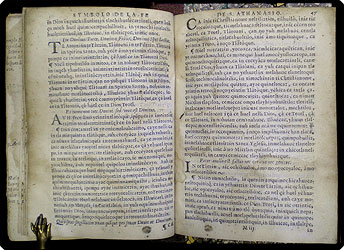
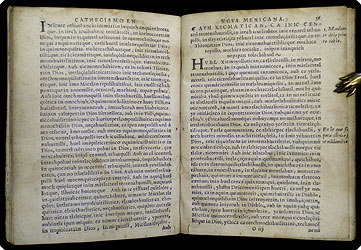
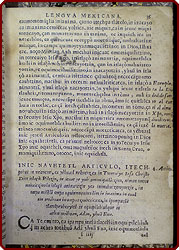
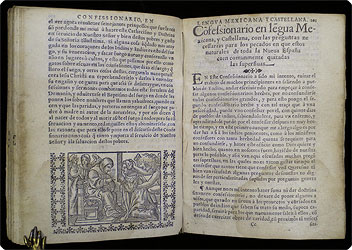
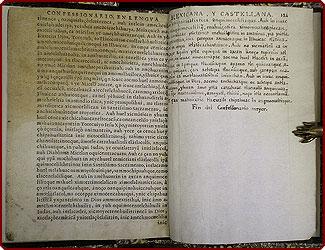
 Priced much, much less than a good, complete copy; and a relic with much more than its lowered price to recommend it. (25860)
 For Books for the BUSTED
 Arguing
 Baptism
with the
QUAKERS
Leslie, Charles. A discourse; shewing, who they are that are
now qualify'd to administer baptism and the Lord's-Supper. Wherein the cause of Episcopacy is briefly
treated. London: C. Brome, W. Keblewhite, & H. Hindmarsh, 1698. 4to (22 cm, 8.7"). [8], 62, [2
(adv.)] pp.
Baptism
with the
QUAKERS
Leslie, Charles. A discourse; shewing, who they are that are
now qualify'd to administer baptism and the Lord's-Supper. Wherein the cause of Episcopacy is briefly
treated. London: C. Brome, W. Keblewhite, & H. Hindmarsh, 1698. 4to (22 cm, 8.7"). [8], 62, [2
(adv.)] pp.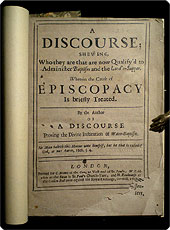
• ESTC R25145; Wing (rev. ed.) L1130; McAlpin, IV, 589. Recent marbled paper wrappers. Title-page darkened and institutionally pressure-stamped, with lower outer portion torn away, just touching final number in date with no loss of sense. First few pages with edge nicks. Final (adv.) leaf with short internal tear with loss of a few letters, not affecting sense. (25009)


Bohemian
HistoryLe Mire, Aubert Miraeus. De bello Bohemico Ferdinandi II. caesaris auspiciis feliciter gesto commentarius ex quo seditiosissimum Caluinianae sectae genium, & praesentem Europae statum licet agnoscere .... Bruxellis: Ioannem Pepermannum, [colophon: 1621]. 4to (18.5 cm, 7.25"). (∴)6A–G4; [12], 44, [12] pp.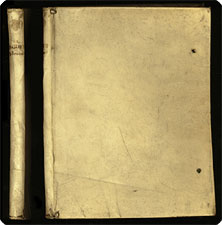
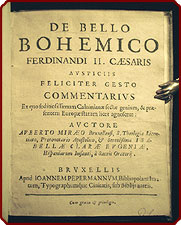
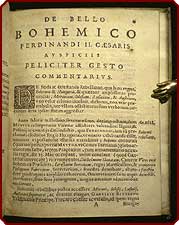 Click the interior images for enlargements.
 The printing privilege and the colophon of this edition both give the date 1621; a revised edition was printed in Cologne in 1622.
Very uncommon. Searches of OCLC, RLIN, and NUC Pre-1956 find no U.S. institutional holdings, and only one overseas location.
• Not in Brunet; not in STCV. Contemporary vellum, spine with hand-inked title; ties now lacking, back cover showing minor abrasions. Title-page with early inked inscription mostly shaved away from lower margin. Pages of different signatures variously browned or age-toned; clean.

Roman
Law, Emperor
Theodosius, Desecration
of Temples, &
More
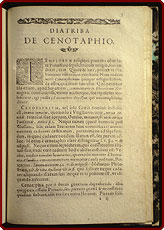
Libanius, Antiochenus. Libanii antiocheni Pro templis gentilium non exscindendis, ad Theodosium m. imp. Oratio: ante M. CCC. fermè annos conscripta: nunc primùm edita à Iacobo Gothofredo ic. notisq[ue] illustrata. [with another, as below]. Genevae: [Petri Chouët?], 1634. 4to (22.5 cm; 8.75"). [12], 63, [9] p. [also bound in] Godefroy, Jacques. De cenotaphio: deq[ue]z, diversis, super eius religione, Ulpiani & Marciani sententiis, diatriba. Genevae: [s.n.], 1634. 4to. 15, [1] pp.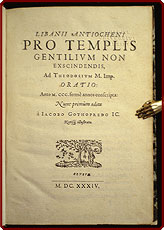
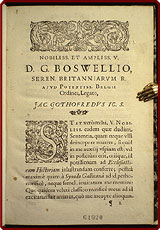
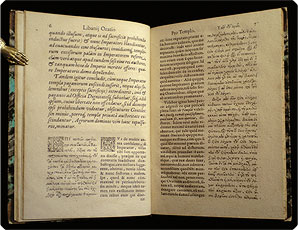
The present work is his famous “lamentation” on the desecration of pagan temples. Addressed to the Emperor Theodosius, the oration concerns the legality of the Emperor's order for the desecration; the text is in Greek and Latin in parallel columns.  The Greek font is notably light and elegant.
At the rear of this volume is Godefroy's opuscule on funeral rites and ceremonies. Several libraries report both works being bound together, as here, but not all.
• 19th-century quarter brown leather, spine sunned much lighter. Library-bound with call number inked on cover, bookplates on front pastedown, rubber-stamps on pastedowns. Title-page with old pressure-stamp; text itself without other markings save a six-digit number neatly stamped at base of next leaf. Actually, a clean, good copy. (22733)
Historical Context of the New Testament Lightfoot, John. A commentary upon the Acts of the Apostles: Chronicall and criticall. The difficulties of the text explained, and the times of the story cast into annals. London: Pr. by R.C. for Andrew Crooke, 1645. 4to (18.2 cm, 7.2"). [20], 331, [1] pp. (pp. 145–48 bound out of sequence).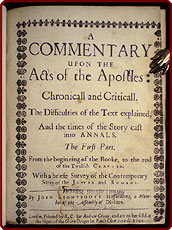
 Click the interior image for an enlargement.
 Lightfoot (1602–75) was a noted Hebraist and Biblical scholar; Lowndes says of his works that “the writings of Dr. Lightfoot are an invaluable treasure to the biblical student.”
• ESTC R21614; Wing (2nd ed.) L2052; Lowndes 1359. Recent marbled paper–covered boards, spine with gilt-stamped title and publication labels. Title-page institutionally rubber-stamped. Pp. 145–48 (the end of the “Christian History...XXXIIII” section) bound in between pp. 152 and 153, with annotations in an early inked hand noting the error. Pages trimmed closely, taking part of title-page border and in a few instances affecting the catchwords or final lines of text. Waterstaining, mostly to lower outer portions. (24853)
The
Future INTERPRETED
by  “the
English Merlin”
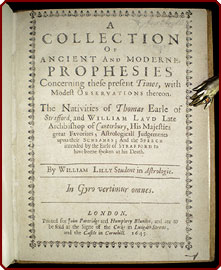
Lilly,
William. A collection of ancient and moderne prophesies concerning
these present times, with modest observations thereon. London: John Partridge
& Humphrey Blunden, 1645. 4to (18.1 cm, 7.1"). [8], 54, [2] pp.; illus.
“the
English Merlin”
Lilly,
William. A collection of ancient and moderne prophesies concerning
these present times, with modest observations thereon. London: John Partridge
& Humphrey Blunden, 1645. 4to (18.1 cm, 7.1"). [8], 54, [2] pp.; illus.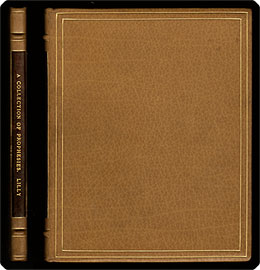
 Click the images for enlargements.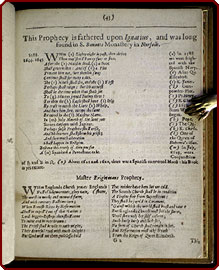
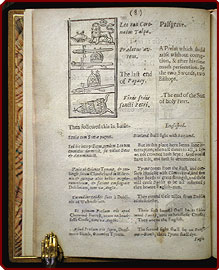
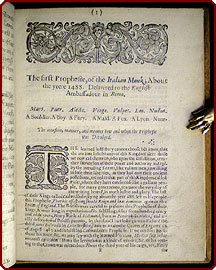
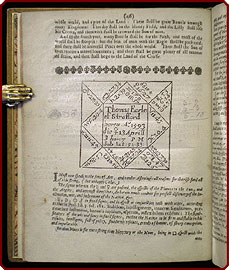 woodcuts depicting the central images of that set of predictions. Astrological charts are provided for Thomas, Earl of Strafford, and William Laud, Archbishop of Canterbury.
• ESTC R200424; Wing (rev. ed.) L2217; Huth, Catalogue, 849. Not in Coumont, Demonology and Witchcraft. On Lilly, see: Oxford Dictionary of National Biography online. Recent calf in a classic “collectors' style”; covers framed in gilt double fillets, spine with gilt-ruled raised bands and gilt-stamped leather title-label. Title-page darkened, with small closed tear and early inked ownership inscription; pages with small pencilled annotations and marks of emphasis. The shouldernotes, of a sort often trimmed-into, are here intact; and the volume is now in a tan cloth–covered slipcase, this with light dust-soiling. A solid and interesting copy of an intriguing work, one of Lilly's rarest. (26921)
A
17th-Century English
Superhero
& ADVENTURERAMERICA
& Patagonia
Lloyd, David,
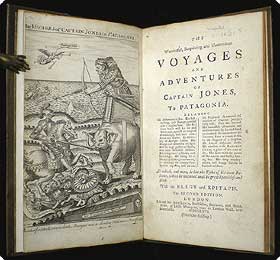
attrib. author. The wonderful, surprizing and uncommon
voyages and adventures of Captain Jones, to Patagonia. London: Pr. for John
Lever, 1766. Narrow 4to (21.1 cm; 8.5"). Engr. title-page, 74 pp., [1] f. (ads).
 Click the images for enlargements.
 Outrageous
in extremis, this has as its proximate target Captain John Smith, who is satirized
while references to Florida and America fly left and right, including, for example
on p. 5, a poem “engraven on a Pillar of Gold, in the famous City of Chiapa”
that purports to be in Maya! — this with, “by the assistance of
Mr. Gage,” a translation helpfully given below it.
Outrageous
in extremis, this has as its proximate target Captain John Smith, who is satirized
while references to Florida and America fly left and right, including, for example
on p. 5, a poem “engraven on a Pillar of Gold, in the famous City of Chiapa”
that purports to be in Maya! — this with, “by the assistance of
Mr. Gage,” a translation helpfully given below it. The title-page better than a cataloguer summarizes this work: “Relating his adventures to sea. His first landing, and strange combat with a mighty bear. His furious battle with his six and thirty men, against an army of eleven kings, with their overthrow and deaths. His relieving of Kemper Castle. His strange and admirable sea fight with six huge galleys of Spain, and nine thousand soldiers. His being taken prisoner, and hard usage. His being set at liberty by the king's command, in exchange for twenty-four Spanish captains, and return for England. A comical description of Captain Jones's ruby nose. Part the second. His incredible adventures and atchievements [sic] by sea and land, particularly his miraculous deliverance from a wreck at sea, by the support of a dolphin. His several desperate duels. His combat with Bahader Cham, a giant of the race of Og. His loves with the queen of No-Land, and basely leaving her. His deep employments, and happy success in business of state. All which, and more, is but the tythe of his own relation, which he continued until he grew speechless and died. With his elegy and epitaph.”
Provenance: 20th-century bookplate of Frank L. Hadley
Searches of WorldCat and ESTC locate only four copies in U.S. institutions.
• Sabin 41685; ESTC T116640. 20th-century half tan calf with tan linen sides. Booksellers' catalogue entry pasted to the front free endpaper. Engraved title-page closely trimmed at left edge, costing a sliver of the image. (25940)

In PRAISE of theVirgin of Guadalupe Lopez de Abiles, Joseph [a.k.a., José López de Aviles]. Veridicum ad modum anagramma, epigramma obsequiosum, unaque cum acrostichide virgilio centunculus rigorosus in laudem purissimae immaculataeque conceptionis sanctissimae virginis dei-genitricis Mariae.... Mexici: ex typographia vidue Bernardi Calderon, 1669. Folio (30 cm; 11.75"). [17of 19] ff., lacking half-title and plate.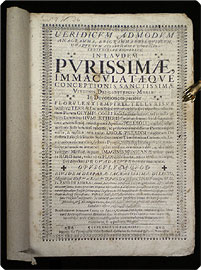
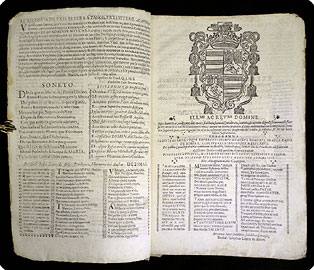 Click the images for enlargements.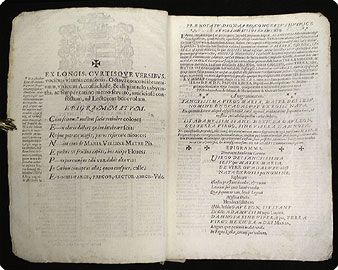
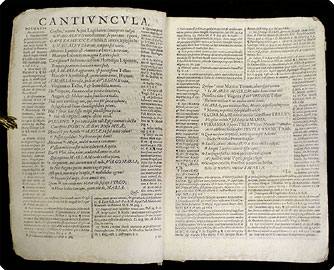
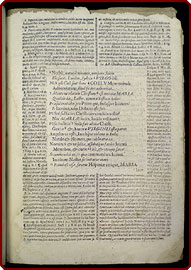
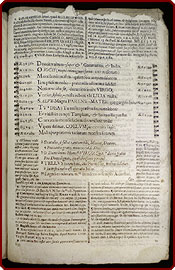
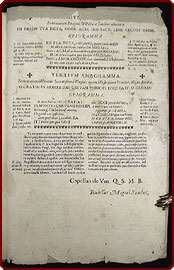
 This
ambitiously designed production is from the press of one of Mexico's famous
17th-century woman printers, the Widow Calderón.
This
ambitiously designed production is from the press of one of Mexico's famous
17th-century woman printers, the Widow Calderón.
The work ends with a short essay addressed to López de Abiles by Lic. Miguel Sánchez and with anagrams by him as well. Sánchez was the author of Imagen de la Virgen Maria madre de dios de Guadalupe, milagrosamente aparecida en la ciudad de Mexico that had appeared in 1648. As a researcher with considerable knowledge of the Virgin of Guadalupe, he praises López de Abiles in no uncertain terms.
For some unfathomable reason Medina lists this under the extensive half-title — Poeticum viridarium in honorem, laudationem, et obsequium purae admodum ... Mariae: eiusdem dominae miraculosae Mexiceae imaginis de Guadalupe.... — and the cataloguer at the University of Arizona has blindly followed Medina down that road so that the WorldCat record is not findable via the real title.
Rarity: WorldCat locates only one copy worldwide but we know of two others. No additional copies were located via COPAC, Catálogo Colectivo del Patrimonio Bibliográfico, Metabase, or the OPACs of the Spanish National Library, the Mexican National Library, and the British Library.
• Medina, Mexico, 1016; Andrade 582; Grajales & Burrus, Bibliografia guadalupana, 82. In later wrappers, a little tattered at the spine. Lacks the half-title and the plate. Top margins of last 10 leaves rodent-gnawed with loss of paper but not of text, although a few letters are touched and the headline words “Segundum Anagramma” lost to that animal. Some light staining, front and rear. In all, a good if damaged copy of an important rarity. (26413)

 French
Foreign Policy — As Considered
“Abroad”
(Louis XIV).
Espiritv de Francia, y maximas de Luis XIV. Descvbiertas a la Evropa.
Colonia: Christian Wan-Sager, 1689. 8vo. 58 pp.
French
Foreign Policy — As Considered
“Abroad”
(Louis XIV).
Espiritv de Francia, y maximas de Luis XIV. Descvbiertas a la Evropa.
Colonia: Christian Wan-Sager, 1689. 8vo. 58 pp.
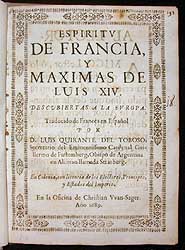
• Palau 82871. Modern cloth.

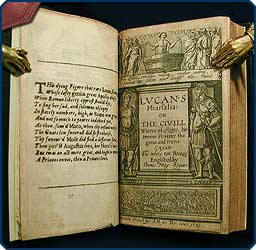
An
EarlyENGLISH
TranslationLucanus,
Marcus Annaeus [Lucan]. Lvcans Pharsalia: Or the civill warres of Rome,
betweene Pompey the great, and Ivlivs Cæsar. The whole tenne bookes, Englished
by Thomas May...the second edition, corrected, and the annotations inlarged by
the author. London: Thomas Iones (pr. by Aug. Mathews), 1631. 8vo (14.5 cm,
5.75"). π1a8A–S8T2; engr.
frontis., [146] ff. [with] May,
Thomas. A continvation of the subiect of Lucan’s historicall poem
till the death of Ivlivs Cæser the 2d edition corrected and amended. London:
James Boler, 1633. 8vo. A–K8(-K8); [79 of 80] ff.
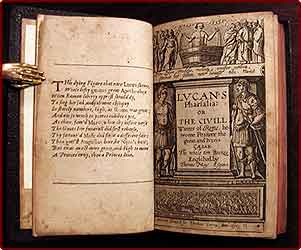
The editio princeps of the Pharsalia was printed in Rome by Sweynheym and Pannartz in 1469; Christopher Marlowe published the first English translation of any part of the Pharsalia, his rendition of the first book, in 1600, with a 1614 effort by Sir Arthur Gorges being the only other such to precede May’s standard-setting 1626 English version of books one through three.
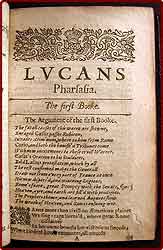 In the present volume, this great epic poem in May’s translation is
accompanied by its translator’s English rendition of his own sequel,
originally written in Latin verse. This Continuation advances the
action through Cleopatra’s seduction of Caesar (May depicts the Egyptian
queen with “snowie necke” and “golden tresses”), the
death of Cato, and various additional battles before arriving at Caesar’s
death. At the time, May’s work was thought highly enough of that Charles
I allowed the Continuation’s dedication to bear his name.
In the present volume, this great epic poem in May’s translation is
accompanied by its translator’s English rendition of his own sequel,
originally written in Latin verse. This Continuation advances the
action through Cleopatra’s seduction of Caesar (May depicts the Egyptian
queen with “snowie necke” and “golden tresses”), the
death of Cato, and various additional battles before arriving at Caesar’s
death. At the time, May’s work was thought highly enough of that Charles
I allowed the Continuation’s dedication to bear his name.
• Pharsalia: STC 16888; Schweiger, II, 567; ESTC
S108868. Continuation: STC 17712; ESTC S108892. 20th-century
black morocco in imitation of early, severe style, with raised bands from
which blind-tooling extends onto covers; spine with gilt-stamped title and
date, and turn-ins elaborately tooled in blind. Moderately worn, spine faded
not unattractively, and leather rubbed over joints. Front pastedown with bookplate,
inked date of 1986; front free endpaper with inked gift inscription dated
1944. T1-2 trimmed differently and possibly surviving from another copy;
A3 of the continuation also possibly supplied. Occasional instances of very
minor staining; mostly clean. Pleasant
on shelf and in hand.
AGAIN Lucan English’dLucanus, Marcus. Lucan’s Pharsalia: Or the civill warres of Rome, betweene Pompey the great, and Iulius Caesar. London: Pr. by A.M. for Will. Sheares, 1635. 8vo (14.7 cm, 5.8"). π1a8A–S8T2; [310] pp. [with] May, Thomas. A continuation of the subiect of Lucan’s historicall poem till the death of Iulius Caeser. London: James Boler, 1633. 8vo. 2A–2K8; [160] pp.
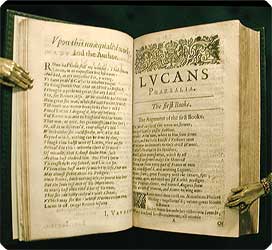 Click the interior images for enlargements.
 • ESTC S108867; STC (2nd ed.) 16889. Continuation: ESTC S108892; STC (2nd ed.) 17712. Both: Lowndes, III, 1408. Period-style calf by Grace (signed “GB” on lower back turn-in), framed and panelled in gilt rolls, spine with gilt-stamped leather title and author labels and gilt-stamped decorations in compartments. Outer and lower edges of the engraved title-page of second work shaved, touching design. Light waterstaining to upper portions of approx. 25 ff. of Continuation; small area of worming to lower inner margins of a few leaves, touching the occasional catchword but not main text.
NeatIllustrated
VolumeLucanus,
Marcus Annaeus [Lucan]. La Pharsale de Lvcain, ou les gverres civiles
de Cesar et de Pompée. Paris: Jean Ribou, 1670. 12mo (15 cm, 5.9"). π1ã12A–Q12R4(-R4); frontis., [12]
ff., 390 pp. (lacking final blank); illus.
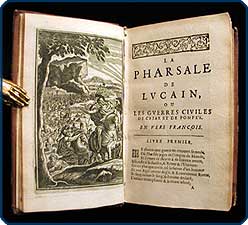 10
full-page engravings present in this nicely printed volume
include a frontispiece displaying a bust of Lucan (a native of Cordoba, Spain)
surrounded
by Roman
motifs, an additional engraved title-page bearing a martial scene, and—among
other war images done by various hands—a striking rendition of Cato and
the snakes.
10
full-page engravings present in this nicely printed volume
include a frontispiece displaying a bust of Lucan (a native of Cordoba, Spain)
surrounded
by Roman
motifs, an additional engraved title-page bearing a martial scene, and—among
other war images done by various hands—a striking rendition of Cato and
the snakes.
• Schweiger, II, 568 (citing the 1666 Pierre Ribou and the Loyson eds.). Contemporary mottled calf, board edges gilt-stamped, spine gilt extra, with raised bands and a gilt-stamped leather title label; moderately worn, leather cracking over joints, edges rubbed with corners bumped, spine with small chip to head exposing headband and with small paper label at foot. All page edges speckled in red and brown. Lacking final blank (only). Front pastedown with bookplate dated 1969. Pages clean; slight offsetting from a few illustrations.
For
more LUCAN, click here.
The Papal Court — As Seen by a CriticLunadoro, Girolamo. Relazione della corte di Roma e de’riti, che si osservano in esta, suoi officij, dignità, e magistrati ...nuovamente corretta, & accresciuta, con l’aggiunta del Moderno maestro di camera. Roma: Presso Michel’Angelo, e Pier Vincenzo Rossi, 1697–98. 12mo (14.3 cm, 5.6"). π8A–O12*3 2A–2G12 2H4 (-π1); [7] ff., 336, [6], 176 pp. (lacks initial blank)
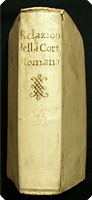
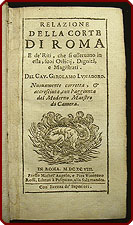
Click the interior image for an enlargement.
Francesco Sestini’s Il Moderno Maestro di Camera has a separate title-page, dated 1698; the first title-page bears the printer’s crowned salamander device and the second a vignette of Minerva. The collation here matches descriptions of other copies.
Uncommon: Searches of OCLC and RLIN locate only three copies in U.S. libraries.
Provenance: Late 18th-century private collector’s booklabel — “Ex Biblioth. Hamburg. Wolfiana”; also with a 19th-century bookplate.
• Contemporary vellum, spine with early hand-inked title; binding with small spots of light discoloration, spine title a bit scuffed. All edges speckled blue. Front pastedown with bookplates as above; front free endpaper with early inked shelving number. First gathering, including title, a cancel. Title-page reinforced at inner margin. Pages clean.

Mariology for the New World Luzuriaga, Juan de. Paranympho celeste[.] Historia de la mystica zarza, milagrosa imagen, y prodigioso santuario de Aranzazu de religiosos observantes de n. seraphico padre San Francisco en la provincia de Guypuzcoa. Mexico: Por los herederos de la viuda de Bernardo Calderon, 1686. Folio (27 cm; 10.75"). 3 pts. in 1 vol. [17 of 18] ff., 114, 96, 112 pp., [8] ff., lacking the plate (as usual), and a leaf in the preliminaries.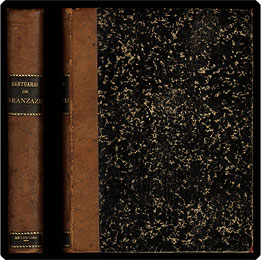
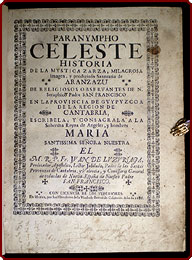 Click the images for enlargements.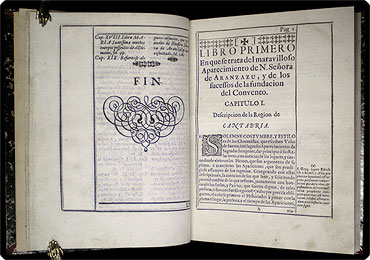
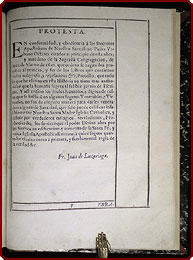 It is extremely noteworthy that this thick and significant history of this Cantabrian apparition was written and published in Mexico and not in Spain. After years of service in Cantabria, his native region, in 1680 the author was transferred to New Spain to serve as the Comisario General of the Franciscan Order in New Spain and the Philippines, and it was in Mexico City that he composed his massive and important work. He then also had it printed there, in spite of the fact that he retained contacts in Spain where it presumably would have had a greater natural audience, and in spite of the fact that it was, for its day, a very large project for a Mexican press to be offered. Or for one to take on! Additionally, it is
  printed on exceptionally thick paper.
Provenance: Bookplates of Luis and Clotilde Montt (Chilean collectors) and of the John Carter Brown Library (deaccessioned).
• Medina, Mexico, 1376; Palau 144367; Beristain, II, 198; Leclerc 1190. On Luzuriaga, see: Archivo biográfico de España, Portugal, e Iberoamérica, fiche 534, frames 77–81. 19th-century quarter brown sheep with black leather spine labels lettered in gilt; black and white marbled paper sides. Without the plate and one leaf in the preliminaries; last three leaves of the index damaged with loss in the foremargins, costing a few words and letters; title-page soiled and with several old tears very well-repaired of old; stains occasionally, never bad ones. Withal a rather good copy of a very uncommon work of New World Mariology. (26392)
Polygamy
isENJOINED
upon Christians?
Lyserus, Johann Peter Theodore. Polygamia triumphatrix, id est discursus politicus de polygamia. Londini Scanorum: Sumtibus authoris, 1682. 4to (21 cm, 8.25"). [10], 565, [33] pp.
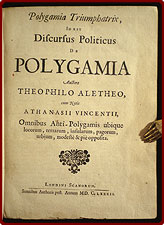
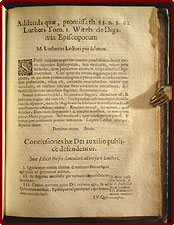
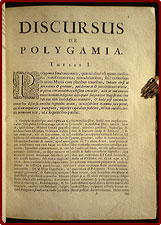 Click the images for enlargements.
 According to the online cataloguing of this book at Brigham Young University, “Early editions [were] burnt by [the] hangman in Denmark (1676); in Sweden (1679) . . . the possession of a copy meant a 1000 ducat fine. This edition was added to the Index of forbidden books in 1687.” It is often held today in medical libraries.
• Graesse, I, 68. 17th-century speckled calf, spine gilt extra with gilt-stamped leather title-label; leather chipped at top of spine with front joint open (though holding), abraded/pitted, and rubbed through to paste boards at corners. Front pastedown with Parisian bookseller's ticket; front free endpaper with pencilled annotation; back pastedown with rubber-stamped date in 1908. Slip of old printed cataloguing laid in. (23549)
 TO Part
IX .
. . TO Part
IX .
. . |