
 17TH-CENTURY BOOKS
17TH-CENTURY BOOKS
17TH-CENTURY BOOKS
 INTRIGUES EXPOSED
 Pageau, abbé. Memoires des intrigues de la cour de Rome, depuis l’année 1669 jusques en 1676. Paris: Estienne Michallet, 1677. 12mo (14.5 cm, 5.7"). [8], 265, [1] pp.

 Both this and the first edition are scarce. Searches of OCLC, RLIN, and NUC Pre-1956 find only seven U.S. institutional holdings of the 1677 printing.
• Barbier, Dictionnaire des ouvrages anonymes, IV, 213; BM STC French, 1601–1700, R1083. Contemporary speckled calf, spine gilt extra; leather slightly acid-pitted, with edges and joints rubbed and unobtrusive number inked on back cover, spine with gilt a bit rubbed and paper shelving label in uppermost compartment. Front pastedown with inked ownership inscription dated 1737.

 This
Renaissance/Reformation
Man
This
Renaissance/Reformation
Man DIED
at the HandsPaleario, Aonio. ... Opera. Ad illam editionem quam ipse auctor recensuerat & auxerat excusa, nunc novis accessionibus locupletata ... Amstelaedami: Apud Henricum Wetstenium, 1696. 8vo (16.5 cm; 6.5"). *8 **4 A-Z8 Aa–Ss8 Tt4 (Tt4 blank); [12] ff., 650, [7] ff.
DIED
at the HandsPaleario, Aonio. ... Opera. Ad illam editionem quam ipse auctor recensuerat & auxerat excusa, nunc novis accessionibus locupletata ... Amstelaedami: Apud Henricum Wetstenium, 1696. 8vo (16.5 cm; 6.5"). *8 **4 A-Z8 Aa–Ss8 Tt4 (Tt4 blank); [12] ff., 650, [7] ff.

Paleario was at once a creation of the Renaissance and of the Reformation: He carried on a wide correspondence with the intellectuals of his time, he studied the writings of Luther and Erasmus, and he sought to reconcile the old with the new. This edition of his works is chiefly composed of his letters, but also includes “De Immortalitate Animorum libri III,” and “Poematia.”
• On Paleario, see: Contemporaries of Erasmus, III, 45–46. Contemporary vellum over boards; bit of abrasion and black speckling in lower area of spine. 18th-century armorial bookplate on front pastedown. Occasional light spotting in text. Notes in pencil on rear endpapers. Rear free endpaper torn with loss of paper in the lower outer area.

 Sarpi is a Liar! Here is theTRUE HistoryPallavicino, Sforza. Vera concilii tridentini historia. contra falsam Petri Suavis Polani narrationem, scripta & asserta à P. Sfortia Pallavicino ... Primum italico idiomate in lucem edita; deinde ab ipso auctore aucta & revisa; ac latinè reddita à P. Johanne Baptista Giattino. Antuerpiae: no printer/publisher, 1673. Folio. 3 parts in 1 vol. I: [a]–b6 A–Z6 Aa–Bb6 Cc–Dd4; [5] ff., 14, 296 pp., [11] ff. II: π2 A–Z6 Aa–Dd6; [2] ff., 297, [1] pp., [15] ff. III: π2 A–Z6 Aa–Ff6; [2] ff., 326 pp., [11] ff.


 Click the interior images for enlargements.
 The volume begins with a half-title, followed by an added engraved title-page that is printed from one very large plate (signed by Kilian). The main and each of the divisional title-pages has a large printer’s device of a lion with bees and the motto “De forti dulcedo” (Joannis Posuel, the Lyonnaise printer?). There are woodcut head- and tailpieces. The text is printed in double-column format.
• DeBacker-Sommervogel, III, 1398; also VI, 130. Contemporary vellum over paste boards, round spine, raised bands; covers ruled in blind with a double-fillet to form concentric compartments; center of each cover with a large blind-stamped medallion of interwoven design. Front joint open along the bottom two spine compartments; some soiling and stains. Title-page of pars I torn and crumpled along inner area of upper margin, tear repaired from verso; area of tear with slight crumpling. Foxing. scattered throughout, sometimes very noticeable; some ink blots; also browning from interaction of printer’s ink with impurities in paper at time of manufacture.
 The Plan for
 Taking Back England Parsons, Robert. The Jesuit's memorial, for the intended reformation of England, under their first popish prince. Published from the copy that was presented to the late King James II. London: British & Foreign Bible Society, 1690. 8vo (19.6 cm, 7.75"). [8], lvi, [16], 262, [2 (adv.)] pp.

 Click the interior images for enlargements.
 • ESTC R1686; Wing (rev. ed.) P569; Allibone 1518; DeBacker-Sommervogel, VI, 304–305. Not in Clancy, English Catholic Books 1641–1700. On Parsons, see: Oxford Dictionary of National Biography online. Period-style calf, framed and panelled in gilt with gilt-stamped corner fleurons, spine gilt extra with gilt-stamped leather title-label; signed binding by Starr Bookworks. Half-title verso with small inked numeral. Pages age-toned, otherwise generally clean; one leaf with an irregular fore-edge (paper flaw?), one with a closed tear to lower margin (not reaching text), a few with signs of old dog-ears, last sections especially suggesting that the text-block, in an unbound era, spent some time lying partly bent across an edge or short bar of some sort — there are no cuts or soiling from this, but the paper shows the old diagonal impressions. (25333)
 “Sicut Serpentes” Pascal, Blaise. The mystery of Jesuitism, discovered in certain letters, written upon occasion of the present differences at Sorbonne between the Jansenists and the Molinists, displaying the pernicious maximes of the late casuists. London: Richard Royston, 1679. 8vo (18.7 cm, 7.4"). [14], 152, 161–342 pp.; 1 fold. plt. (text complete; lacking frontis. and prelim. ff.). [with, as issued] Additionals to the Mystery of Jesuitism. Englished by the same hand. London: Richard Royston, 1679. [2] ff., 126 pp. (lacking final 8 adv. pp.).
 Click the interior image for an enlargement.
 The work was first printed in English in 1657, as Les provinciales: Or the Mysterie of Jesvitisme. The present edition is illustrated with an oversized, folding plate depicting prominent Jesuits. The second section (the “Additionals”) has a separate title-page.
Our caption is the first title's epigraph.
• ESTC R5437; Wing (rev. ed.) P641 & 642; Lowndes 1208; PMM 140 (on the first edition). Period-style mottled calf, covers framed and panelled in gilt rules with gilt-stamped corner fleurons, spine gilt extra with gilt-stamped leather title-label. Frontispiece (Moses delivering the law), a few preliminary leaves, and final advertising leaves lacking; text complete despite skip in pagination and fold-out plate present. Title-page with early inked numerals and institutional rubber-stamp. Light waterstaining to outer and lower page portions; otherwise, the odd spot only. (24874)
Celebrating theBaptism of a PrincessPellicer de Touar [Tovar], José. Piramide baptismal, o inscripcion cronologica, historica, genealogica, i panegirica ... Dedicada a las felicissimas memorias del sacro, soberano, i real baptismo, de la serenissima Infante de Ambas Españas Doña Maria Teresa Bibiana de Austria. Madrid: Por la viuda de Alonso Martin, 1638. Folio (28.2 cm, 11.1"). [4], 6 ff. 
Click the image for an enlargement. • Palau 216717. Removed from a nonce volume. Light waterstaining, mostly to inner corners. Trimmed closely, with shouldernotes and first or last few letters shaved in some instances. One leaf with tear from upper margin extending into text, repaired some time ago, obscuring a few words.

Hoping
for “a Great
Charter for Liberty
of Conscience”Penn, William. The great and popular objection against the repeal of the penal laws & tests briefly stated and consider’d, and which may serve for answer to several late pamphlets upon that subject. London: Andrew Sowle, 1688. 4to (19.8 cm, 7.75"). 23, [1 (blank)] pp.

 Click the interior images for enlargements.
 Despite this strongly worded treatise against persecution (which argues that all men should be able to make a free and open choice of faith and worship), the statutes remained in place for many years to come.
• Wing (rev.) P1298A; ESTC R12742. Recent marbled paper–covered boards. Title-page with tiny, unobtrusive numeral inked in upper outer corner, first text page with numeral stamped in lower margin (no other markings). Title-page and first text page with moderate foxing, others clean.
 Defending Bishops — Defending a Local CalendarPercin de Montgaillard, Pierre Jean François de. Du droit et du pouvoir des evesques de regler les offices divins dans leurs diocéses .... [n.p., 1686?]. 8vo (20 cm, 7.9"). 229, [1 (blank)] pp. [with, as issued, the same author’s] Recueil des factums et autres pieces, qui ont servies à la deffence du calendrier du Diocése de Saint Pons. [n.p.], 1686. 8vo. [10], 269, [1 (blank)] pp.

 Extremely uncommon. Searches of OCLC, RLIN, and NUC Pre-1956 locate just three institutional holdings, only one in the U.S.
• 18th-century quarter sheep with speckled paper–covered sides, rubbed and abraded; front joint open and back joint starting, leather cracking and gilt lettering to spine all but lost. Front pastedown with pencilled notations and institutional bookplate, front fly-leaf and title-page rubber-stamped, front fly-leaf with inked ownership inscription dated [18]45. Pages untrimmed. Moderate foxing; some leaves with red staining along inner margin, not approaching text. Two leaves with small portion of lower margin excised; separate title-page for second work with small portion of outer margin excised and replaced some time ago with a scrap of paper bearing an early inked annotation.
Waldensians
& Albigensians
— Heretical
Sects of the Alps
Perrin, Jean Paul;
Jacques Cappel. Histoire des Vaudois divisee en trois parties. Geneve:
Pierre & Iaques Chouët and Matthieu Berjon, 1619. 8vo (17.5 cm, 6.9").
[32], 248, [8], 333, [3], 16, 111, [1] pp.

 Click the interior images for enlargements.
 Caillet includes this “ouvrage remarquable” in his bibliography of theoccult, since “On trouve dans cette étude des fragments précieux des anciens traités vaudois.”
Uncommon: OCLC and NUC Pre-1956 locate only eight U.S. institutional holdings of this work, one since deaccessioned.
Provenance: This can be “walked back” not so much through collectors and institutions as through the shops of booksellers: Front pastedown with small New York bookseller’s ticket affixed over partially visible Paris bookseller’s ticket; title-page rubber-stamped in late-19th or early-20th century by a Spanish bookseller of Cadiz, and title-page verso bearing the attractive affixed printed advertisement of an earlier Cadiz bookseller.
• Brunet, IV, 209-10; Caillet, Manuel bibliographique des sciences psychiques ou occultes, 8539; Graesse 208; Morgand and Fatout, Bulletin de la Librairie Morgand et Fatout, 5802 (for 1619 Chouët edition, first two parts only); Picot, Catalogue des livres composant la bibliothèque de feu M. le baron Rothschild, 2030 (for Berjon edition). Contemporary vellum with yapp edges, covers framed in blind triple fillets, spine with title in an early inked hand, covers a little sprung; covers a bit darkened with light staining, spine with partially effaced inked shelving number; front free endpaper (only) lacking. Ownership indications as above; later in an American institutional library, with its pressure- stamp on title-page, first dedication page with neat inked numeral in lower margin, and lower (closed) edges rubber-stamped. First few leaves with spot of pinhole worming in inner margins, affecting three letters only; final portion of volume with worming in lower margins, affecting a few more letters and continuing through back cover. Pages age-toned and with instances of faint staining.  An interesting copy of an interesting book. (25534)
The Father of Renaissance Humanism Petrarca, Francesco. Franc. Petrarchae ... Epistolarum: Familiarium libri XIV, Variarum lib. I, Sine titulo lib. I, Ad quosdam ex veteribus ilustriores li.I. Lugduni: Apud Samuelem Crispinum, 1601. 8vo (16.8 cm; 6.625"). [16] ff., 96, 93–396, 381–683 (i.e., 703), [1 (blank)] p.

 Click the interior images for enlargements.
 The reference to “multis epistolis auctum ex vetusto codice bibliotecae I. Chalasii I. C.” refers to the 65 letters found in the library of Johannes Chalasius, of Nîmes, andpublished here for the first time.
The volume is in roman type and has the Crispinus printer's device on the title-page, woodcut initials, and headpieces. This is one of several issues of an edition differing only in the imprint and in slight variations of paging.
• Horti 364–5; Catalogue of the Petrarch Collection in the Cornell University Library 34; Graesse, V, 236 (“C'est l'édition la plus complète des Epitres de Petrarca.; il y a 65 lettres de plus que dans la prem. édition”). 18th-century half “white” calf, gilt spine, raised bands; boards covered with red and white combed paper. Edges rubbed; two spine compartments lighter than others. Old institutional bookplate (no other markings); 19th-century pencilling and pen notes on front free endpaper. A clean and nice copy. (24431)
 Virtuous EMBLEMS — Engraved Title-Page
 after RUBENS Pietrasanta, Silvestro. Symbola heroica. Amstelaedami: Janssonio Waesbergios & Henr. Wetstenium, 1682. 4to (21.3 cm, 8.4"). lxxx, 480, [32] pp.; illus. (lacking 1 portrait).


 Click the images for enlargements. 264 in-text copper engravings. One emblem features a telescope aimed at the sun, with the heading “Non ideo maculor”; Pietrasanta's anti-Galilean explanation is that any flaws to be perceived in the character of a virtuous prince are as imaginary as the illusory sunspots created by optical vibrations.


Bilingual
& AMERICAN
Interest
 Pindarus. [two lines in Greek, romanized as] Pindaroy Periodos [then, in Latin]: hoc est, Pindari lyricorum principis, plus quam sexcentis in locis emaculati, ut jam legi & intellegi possit ... illustrati versione nova fideli .Rationis metricae indicatione certa. Dispositione textus genuina. Commentario sufficiente. Cum fragmentis aliquot
diligenter collectis. Indice locuplete, victorum, tutorum, rerum & verborum. Discursu duplici; uno de dithyrambis; altero de insula Atlantica ultra Columnas Herculis quae America hodiè dicitur. Opera Erasmi Schmidii Delitiani. [Witebergae]: sumptibus Z. Schureri, 1616. 4to. 4 parts in 1 vol. [6], 23, [1], 331, [9], 395, [9], 267, [9], 264 pp., 1 fold. table.
Pindarus. [two lines in Greek, romanized as] Pindaroy Periodos [then, in Latin]: hoc est, Pindari lyricorum principis, plus quam sexcentis in locis emaculati, ut jam legi & intellegi possit ... illustrati versione nova fideli .Rationis metricae indicatione certa. Dispositione textus genuina. Commentario sufficiente. Cum fragmentis aliquot
diligenter collectis. Indice locuplete, victorum, tutorum, rerum & verborum. Discursu duplici; uno de dithyrambis; altero de insula Atlantica ultra Columnas Herculis quae America hodiè dicitur. Opera Erasmi Schmidii Delitiani. [Witebergae]: sumptibus Z. Schureri, 1616. 4to. 4 parts in 1 vol. [6], 23, [1], 331, [9], 395, [9], 267, [9], 264 pp., 1 fold. table.


 Click the images for enlargements.
 The main text is composed of “In Pindaricam exegesin prolegomena” (pt. 1: fol. 1–5 recto); “Prolegomina de Olympiis” (pt. 1: fol. 5 verso – 12, p. 13–45); “De eidei, strophe, antisrophei [sic], epodoi, kolois, pedibus, & carminibus lyricis” (pt. 1: p. 46–51); “Pindarou Olympionikai” (pt. 1: p. 53–331; caption title p. 53); “Pindari Pythionicae” (pt. 2: p. [1–8], 1–395; half title p. [1]); “Pindari Nemeonicae” (pt. 3: p. [1-8], 1–267; half title p. [1]); “Pindari Isthmionicae” (pt. 4: p. [1–8], 1-–53; half title p. [1]); “ Catalogus victorum, qvibus eide haec scripta sunt” (pt. 4: p. 155–56); “Leipsana seu residua fragmenta scriptorum Pindari, incuria superiorum seculorum amissorum, ex diversis autoribus collecta ab E[rasmo S[chmidtio]” (pt. 4: p. 157–68); “De dithyrambis. Qvaestio in promotione XXXII. Philosophiae candidatorum d. 23. Martii Anno 1607. à M. Joachimo Jaschio proposita” (pt. 4: p. 247–55); and two indices.
• Alden & Landis 616/94; Sabin 62917; Jantz, German Baroque, 193; Schweiger, I, 235; Dibdin, Greek & Latin Classics, II, 288. Contemporary vellum. Browned copy; ex-library with bookplate and attractive rubber -stamp in margin of one preliminary leaf; old notes in an elegant hand on front and rear free endpapers. In fact a very good copy. (21201)
BENEDICTINES Come
to the New WorldA
FINE Engraved Title-Page & 18 Splendid Plates[Plautius, Caspar]. Nova typis transacta navigatio novi orbis Indiae occidentalis.... [Linz], 1621. Folio (32.6 cm, 12.875"). )(4 (-)(4, blank) A–M4 N4 (-N4, blank); Engr. t.-p., [2] ff., 101, [1] pp.; 18 plts. 


 This
book bears an ornate, emblematic engraved title-page, with portraits of St.
Brendan and Boyl and more, and no fewer than 18 leaf-filling plates by Wolfgang
Kilian. These plates, which mixfancy and realism in entirely engaging ways, include
a portrait of Columbus, a scene of St. Brendan celebrating mass on the back of a whale, botanical images of the marvelous Peruvian potato, and numerous views of the missionaries’interaction with the natives, some friendly, and some not—the unfriendliest being notably violent and gory. Also, on p. 35–36 is given an example of purportednative
American music, with both words and notation. This copy is one (probably the first) of two states of this sole edition (with only three leaves in the preliminaries), without the additional foldout plate found in some copies.
This
book bears an ornate, emblematic engraved title-page, with portraits of St.
Brendan and Boyl and more, and no fewer than 18 leaf-filling plates by Wolfgang
Kilian. These plates, which mixfancy and realism in entirely engaging ways, include
a portrait of Columbus, a scene of St. Brendan celebrating mass on the back of a whale, botanical images of the marvelous Peruvian potato, and numerous views of the missionaries’interaction with the natives, some friendly, and some not—the unfriendliest being notably violent and gory. Also, on p. 35–36 is given an example of purportednative
American music, with both words and notation. This copy is one (probably the first) of two states of this sole edition (with only three leaves in the preliminaries), without the additional foldout plate found in some copies.


• Alden & Landis, European Americana, 621/100; Sabin 63367; Palau 224762. Binding as above and shown at left (distortion noted), chipped on corners and at head and foot of spine. Small wormholes visible on inside of covers, running into margins of pages and plates, and a few closed tears, neither affecting print or plates. Engraved title remounted. Small stains, light spots of waterstaining, and light soiling.
A
very covetable illustrated Americanum of the early 17th century, in an enjoyable copy.


 Single-click
any image above, for an enlargement.
Single-click
any image above, for an enlargement.
 The Pope Appointsa New Grand Inquisitor for Spain Pope Paul V (1552–1621; pontificate 1605–21). Letter to King Philip III of Spain, in Latin, on vellum. Rome: 4 January 1619. Narrow strip (10 x 40.5 cm; 4" x 16"). [1] leaf.
 Click the image for enlargement.
 This contemporary file copy was retained in Rome and signed “S. Card. S. Susannae” (i.e., Cardinal Scipione Cobelluzzi, who was also at this time the Librarian of the Vatican Library).
• Written in a very handsome italic on very good quality vellum. Light discoloration along lower edge, below the writing. (26978)
 If
YouLook
Like a Swine
. . . Porta, Giambattista della. Della fisionomia dell'huomo.... Venetia: Presso Christoforo Tomasino, 1644. 4to (23 cm, 9"). a6 A–Z8 Aa–Nn8; [6] ff., 570 (i.e., 572) pp., [2] ff.; illus.
If
YouLook
Like a Swine
. . . Porta, Giambattista della. Della fisionomia dell'huomo.... Venetia: Presso Christoforo Tomasino, 1644. 4to (23 cm, 9"). a6 A–Z8 Aa–Nn8; [6] ff., 570 (i.e., 572) pp., [2] ff.; illus. 


"Porta's system . . . leads him constantly to conclusions of analogies between plants, animals and men. Similar humours are found in various apparently unrelated organisms. Plants and animals that correspond in shape are interrelated. A leaf formed like a stag horn shares the character of the deer. The horse is a noble animal, therefore it is a sign of nobility to walk erect with the head held high. Men who resemble a donkey are like that animal: timid, stupid, nervous. He who looks like an ostrich is akin to it in character: he is timid, elegant, vicious, stolid. A man who reminds us of a swine is a swine, eating greedily and having all the other characteristics, such as rudeness, irascibility, lack of discipline, sordidness, lack of intelligence [and] modesty. In a similar way, men who look like ravens are impudent; those who resemble oxen are stubborn, lazy, irascible; men who have lips shaped like those of a lion are hearty, magnanimous, courageous; others who make us think of a ram are timid, malicious and humble. When practising medicine, Porta had many occasions to observe his patients, and to study their character and complexion; the results of this studious inquiry are laid down in his book." (Seligmann)
 This
work was written in Latin and first published in 1586 under the title De
humana physiognomia. It saw 19 editions before 1701, and has been translated
into Italian (1598; translation by Salvatore Scarano), German (1651), French
(1655), and English (1817). This
tenth Italian edition is replete with a large number of intriguing (and humorous)
woodcuts. The first is a portrait of Porta, and, while some
of the rest show anatomical figures, the vast majority contrast the shapes
of faces and bodies of animals and men. The title-page vignette is of Aesculapius,
the Greco-Roman god of healing.
This
work was written in Latin and first published in 1586 under the title De
humana physiognomia. It saw 19 editions before 1701, and has been translated
into Italian (1598; translation by Salvatore Scarano), German (1651), French
(1655), and English (1817). This
tenth Italian edition is replete with a large number of intriguing (and humorous)
woodcuts. The first is a portrait of Porta, and, while some
of the rest show anatomical figures, the vast majority contrast the shapes
of faces and bodies of animals and men. The title-page vignette is of Aesculapius,
the Greco-Roman god of healing.
Appended to Della fisionomia humana are the Fisionomia naturale of Giovanni Ingegneri († 1600), the Physionomia of Polemon (ca. a.d. 88 – a.d. 145) in an Italian translation, Porta’s Della celeste fisionomia (a repudiation of astrology), and two short related treatises by Livius Agrippa and Luigi Settala (1552–1633). Della celeste fisionomia has a number of interesting woodcuts showing pagan gods and constellations.
• Seligmann, The History of Magic, 319. On physiognomy,
see: Thorndike, History of Magic and Experimental Science, VII, 448
& following. On Porta, see: Webster’s New Biographical Dictionary
811. Vellum over paste boards, soiled and cockled with a little chipping and
front joint opening. Ex-library: paper labels on spine and rubber-stamps,
including one on title-page. Pages cockled with traces of soiling on top edges;
a few edges bumped.  Plates
in very clear, strong impressions.
Plates
in very clear, strong impressions.
“Consider,
O Turk . . .”(Prophecies). Breve compendio de notables baticinios, qve famosos avtores matematicos de Europa han hecho contra el sobervio imperio y casa otomana. [Madrid, ca. 1683]. 4to (19.6 cm, 7.75"). A6; [6] ff. 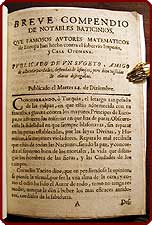
Among the “mathematic authors” cited are Merlin, “the great astrologer Juan Francisco Spina,”and Saint Isidore of Seville.Rare: No copies traced via NUC Pre-1956, OCLC or RLIN.
Single-click the image where the hand appears on• Not in Palau. In recent wrappers. Light foxing, a few light waterstains, and a few shallow tears, the latter not touching text.

 TO Part
XI .
. . TO Part
XI .
. . |