 17TH-CENTURY BOOKS
17TH-CENTURY BOOKS
17TH-CENTURY BOOKS
 |
 Only
the Second
Printing of the
Only
the Second
Printing of the Catholic
New Testament
in England
Catholic
New Testament
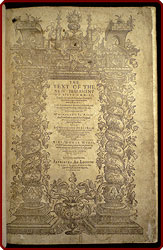
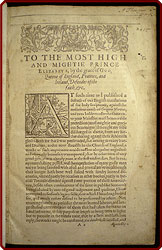
in England Bible. N.T. English. Rheims–Bishops’ version. 1601. The text of the New Testament of Jesus Christ, translated out of the vulgar Latine by the Papists ... at Rhemes ... Whereunto is added the translation out of the original Greeke, commonly used in the Church of England, with a confutation of all such arguments, glosses, and annotations, as conteine manifest impietie, of heresie ... against the Catholike Church of God ... [ed.] by W. Fulke. London: Robert Barker, 1601. Folio (31.5 cm, 12.25"). [21] ff., 914 [i.e., 912] pp., [5] ff.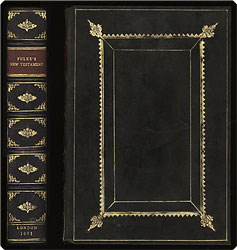
 Click the interior images for enlargements.
 As Darlow and Moule comment, “by printing the Rheims Testament in full, side by side with the Bishops' version, [Fulke] secured for the former a publicity which it would not otherwise have obtained, and was indirectly responsible for the marked influence which Rheims exerted on the Bible of 1611.” Alan Thomas elaborates by observing that “many a dignified or felicitous phrase was silently lifted by the editors of King James's Version, and thus passed into the language” (Great Books and Book Collectors, p. 108).
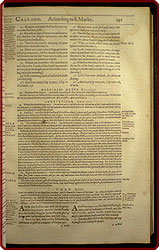
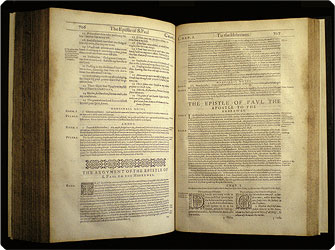
 All early editions of the Rheims NT are important and most are scarce. The present one has a handsome architectural woodcut border on the title-page; it is signed by the woodcut artist, “N.H.” The text is printed in double-column format, with side- and shouldernotes and with the apparatus at the bottom of the page.
Provenance: Signature of a contemporary owner “A. Thorpe, York,” undated, on A2.
• STC 2900; Darlow & Moule 265; Herbert 265; ESTC S115769. Modern black calf, covers framed with single gilt rule and paneled in gilt rolls with corner fleurons. Title-page mounted, with outer edge and small hole in lower margin reinforced; dust-soiled. A2 with early inked ownership signature (see above) and notation; reinforced at hinge (inside). Other markings: two pages with marginal notations and four pages with corrections, both inked by an early hand. Bug-spotting on several preliminary leaves. Light waterstaining on some early and later leaves, with occasional odd stains and spots elsewhere, not impairing sense of text. Dust-soiling on index pages. Two preliminary leaves missing small pieces of paper in blank margins; small hole at top outer corner of Kkkk4; and small chip at top edge of Hhhh2. Fold-mark at top outer corner of Vvv2. In fact, a very nice copy of an important book. (24477)

 A
POLYGLOT
Mass Lectionary
— Latin,
Greek, Hebrew,
German
A
POLYGLOT
Mass Lectionary
— Latin,
Greek, Hebrew,
German EPISTLES & GOSPELSBible.
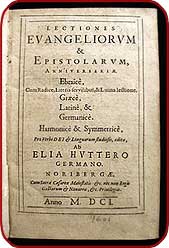
N.T. Polyglot. Hutter. Selections. 1601. Lectiones evangeliorum & epistolarum, anniversariae. Ebraicé, cum radice, literis servilibus, & Latina lectione. Græcé, Latiné,
& Germanicé. Harmonicé & symmetricé...editæ ab Elia Huttero.... Noribergae: 1601. 8vo. (19 cm, 7.5"). A–Z8
Aa–Zz8 Aaa–Ccc8; 781, [1 (blank)] pp., [1 (blank)] f.; plts.
EPISTLES & GOSPELSBible.
N.T. Polyglot. Hutter. Selections. 1601. Lectiones evangeliorum & epistolarum, anniversariae. Ebraicé, cum radice, literis servilibus, & Latina lectione. Græcé, Latiné,
& Germanicé. Harmonicé & symmetricé...editæ ab Elia Huttero.... Noribergae: 1601. 8vo. (19 cm, 7.5"). A–Z8
Aa–Zz8 Aaa–Ccc8; 781, [1 (blank)] pp., [1 (blank)] f.; plts. 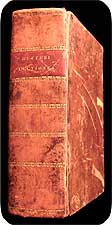
 Click
the interior image above for an enlargement.
Click
the interior image above for an enlargement.
 a
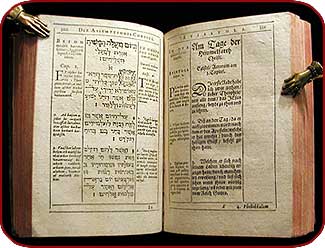
Hebrew translation of the liturgical epistles and gospels for use at Mass, accompanied by a transcription of the Hebrew into Latin letters, as well as the Greek, Latin, and German versions. The Hebrew text incorporates some small handsome woodcut initials, and the printer has also employed some interesting woodcut headpieces.
a
Hebrew translation of the liturgical epistles and gospels for use at Mass, accompanied by a transcription of the Hebrew into Latin letters, as well as the Greek, Latin, and German versions. The Hebrew text incorporates some small handsome woodcut initials, and the printer has also employed some interesting woodcut headpieces.
Elias Hutter (1553–1609) was an orientalist and professor of Hebrew at Leipzig. The text here is drawn from his famous and sought after polyglot New Testament in 12 languages (Nuremberg, 1599), and so shares in the censure Hutter received for there translating and inserting "in some versions missing passages which he found in others" (Darlow and Moule)—but, he was open about that. The present work was apparently for devout students of Hebrew, both to further their knowledge of that language and to give them comparative
texts for study and meditation on the week’s lessons.  Polyglot lectionaries are not common, and this is the only polyglot lectionary of the epistles and gospels listed by NUC Pre-1956 before the 19th century.
• Not in Darlow & Moule, but see 1430, 1431, 1432, 1433, and 1434 for Hutter’s polyglot New Testament in 12 languages, and his St. Matthew’s Gospel, St. Mark’s Gospel, polyglot Psalter, and polyglot New Testament in four languages. Sheep, spine simply gilt with a red leather title label; leather rubbed and abraded, front joint opening. Pages with some instances of light waterstaining or browning. All edges red.


 “Breeches”
Bible with
Concordances
& Psalter
Bible.
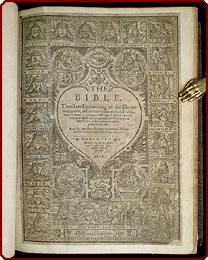
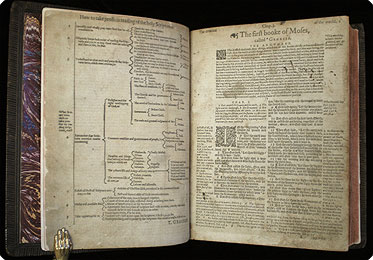
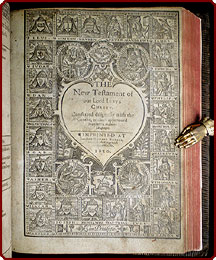
English. Geneva. 1609. The Bible. Translated according to the
Ebrew and Greeke, and conferred with the best translations in diuers languages.
[with two others, as below]. London: Robert Barker, 1609. 4to (22.1 cm,
8.75"). [2], 554 ff. (lacking ff. 79 & 80, 436). [with]
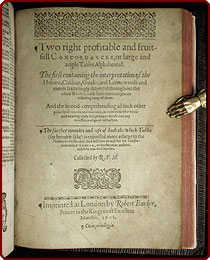
Herrey, Robert F. Two right profitable and fruitfull concordances, or large
and ample tables alphabeticall. The first containing the interpretation of the
Hebrew, Caldean, Greeke, and Latin words and names.... London: Robert Barker,
1608. 4to. [82] ff. (lacking C8). [and] Bible.
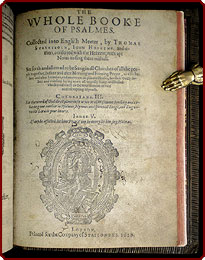
O.T. Psalms. The whole booke of Psalmes. Collected into English meeter,
by Thomas Sternehold, Iohn Hopkins, and others ... with apt notes to sing them
withall. London: Pr. for the Company of Stationers, 1610. 4to. [10], 68 (of
102) pp.
“Breeches”
Bible with
Concordances
& Psalter
Bible.
English. Geneva. 1609. The Bible. Translated according to the
Ebrew and Greeke, and conferred with the best translations in diuers languages.
[with two others, as below]. London: Robert Barker, 1609. 4to (22.1 cm,
8.75"). [2], 554 ff. (lacking ff. 79 & 80, 436). [with]
Herrey, Robert F. Two right profitable and fruitfull concordances, or large
and ample tables alphabeticall. The first containing the interpretation of the
Hebrew, Caldean, Greeke, and Latin words and names.... London: Robert Barker,
1608. 4to. [82] ff. (lacking C8). [and] Bible.
O.T. Psalms. The whole booke of Psalmes. Collected into English meeter,
by Thomas Sternehold, Iohn Hopkins, and others ... with apt notes to sing them
withall. London: Pr. for the Company of Stationers, 1610. 4to. [10], 68 (of
102) pp.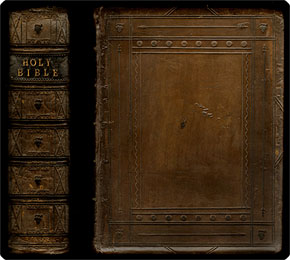
 Click the images for enlargements.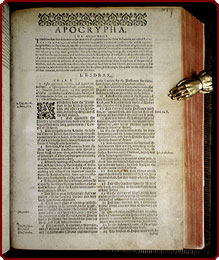
 with music, the text again printed
in double columns of black-letter.
with music, the text again printed
in double columns of black-letter.
• Herbert 298; Darlow & Moule 230; STC (rev. ed.) 2206. Concordances: ESTC S122240; STC (rev. ed.) 13232. Psalmes: ESTC S124337; STC (rev. ed.) 2533.5. Period-inspired later (late 19th-/early 20th-century) calf, covers framed and panelled in blind with blind-tooled corner fleurons, spine with gilt-stamped leather title-label and blind-tooled decorations; joints and corners refurbished, spine leather and label with minor cracking. All edges stained red. Title-page mounted, with old repaired tear; a few outer corners replaced, with loss of a few words from notes (only); one leaf with tear from lower margin, extending into text without loss; one leaf with burn hole towards upper outer corner, with loss of a few letters from several lines. Bible (Deuteronomy) with ff. 79 and 80 torn out, f. 436 lacking after Apocrypha and before “The Summe of the whole Scripture”; Concordances lacking f. C8; Psalmes lacking final 34 pp. Paper good, though darkened and spotted; a number of scattered early inked marks and marginalia. (26610)

KJV
Leaf, 1611: The
Stages of Israel's
Journey
& the Borders of
Canaan
Bible. English. 1611. Authorized (i.e., “King James Version”). Leaf extracted from the Old Testament of the first edition of the King James Version of the Bible. [London: 1611]. Folio (40.1, 15.75"cm). [1] f.
The
Stages of Israel's
Journey
& the Borders of
Canaan
Bible. English. 1611. Authorized (i.e., “King James Version”). Leaf extracted from the Old Testament of the first edition of the King James Version of the Bible. [London: 1611]. Folio (40.1, 15.75"cm). [1] f.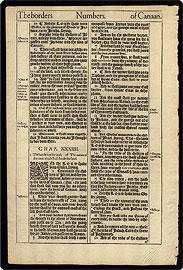 Click the image for an enlargement.
 • Disbound. Inner edge with small nicks; very unobtrusive creasing to lower corners (from the original press run?); otherwise in beautiful condition. (25835)
BARKER's
1613 KJV
QUARTO
Bible.
English. 1613. Authorized (i.e., King James Version).
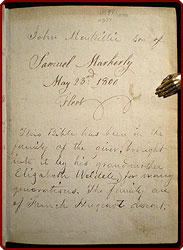
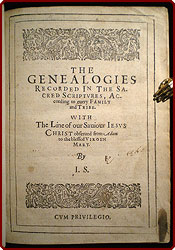
The Holy Bible, containing the Old Testament, and the New. London: Robert Barker,
1613. 4to (21.3 cm, 8.4"). [2], 34 pp., [520] ff. [with] Bible.
OT. Psalms. English. Paraphrases. 1599. Sternhold & Hopkins.
The booke of Psalmes, collected into English meeter ... London: Pr. for the
Companie of Stationers, 1613. 4to. [10], 90 (final 12 pp. lacking) pp.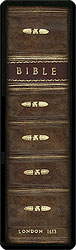
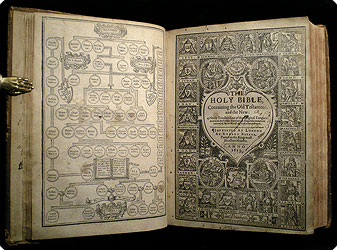 Click the images for enlargements.
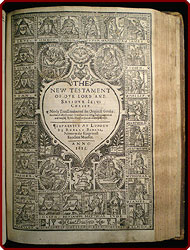
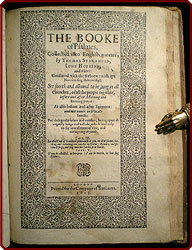
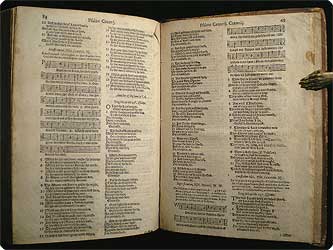
• ESTC S121317; Herbert 323; STC (2nd ed.) 2227; Rumball-Petre 128. Psalmes: ESTC S108634; STC (2nd ed.) 2544.5. Contemporary treed calf, rebacked, spine with gilt-stamped leather title-label and gilt-stamped decorations between gilt-dotted raised bands; edges and corners rubbed. Inscriptions as above; back free endpaper with early inked musical annotations; a few pages (mostly blank, but also including the O.T. title-page) with early inked annotations and doodles. Pages age-toned and trimmed closely, in some cases touching shouldernotes and headers; occasional light staining. Psalms lacking final 12 pp., with edges of three leaves tattered (in one case with loss of several words); Psalms otherwise complete and Bible entirely so. An appealing copy with interesting provenance. (25100)

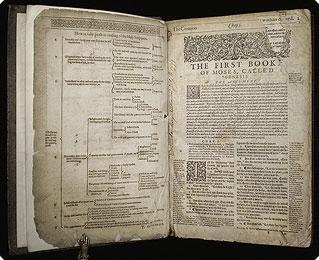
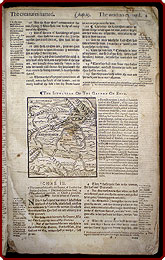
TheLAST English “Breeches” Edition Bible. English. Geneva–Tomson–Junius. 1616. The Bible: that is, the Holy Scriptures contained in the Old and New Testament.... London: Robert Barker, 1616. Folio (31.1 cm, 12.25"). [1], 362 (i.e., 365), [7] ff. (t.-p., Apocrypha, & New Testament not present here; foliation extremely erratic); illus.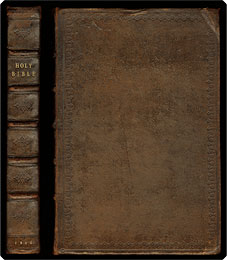
 Click the images for enlargements.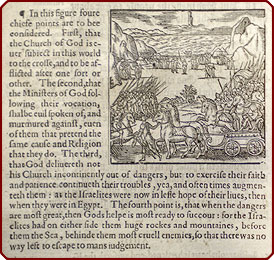
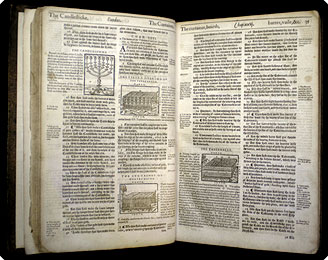
 black-letter folio edition, illustrated with a handful of in-text woodcuts (including the Ark and its paraphernalia, and charts of consanguinity). The copy consists essentially of the Old Testament and some additional matter; it lacks two of the four preliminary leaves (including the title-page, publication information being provided by the colophon) and it also lacks the Apocrypha and New Testament. It begins with “Of the incomparable treasure of the holy Scriptures”; the “Briefe Table of the interpretation of the proper names which are chiefly found in the Olde Testament” and the “Table of the principall things that are conteined in the Bible, after the order of the Alphabet” are both present.
• Darlow & Moule 270; ESTC S1792; Rumball-Petre, Rare Bibles, 130; STC (2nd ed.) 2244. Full later mottled calf, covers framed in double blind fillets and fleuron roll; spine with raised bands, blind-tooled compartment decorations, and gilt-stamped title and date; incomplete, with title-page, Apocrypha, and N.T. lacking. Binding rubbed/bumped at stress points, one compartment scuffed. Front free endpaper, first text page, and several others institutionally pressure-stamped; first page with rubber-stamped numeral in lower margin and early inked annotation regarding date of printing. Front free endpaper with affixed slips documenting gift donation in 1955, and with inked annotation regarding date; back pastedown showing traces of now-absent pocket. Tattering to first leaves not reaching text, and first one with recent repairs, second one with area of loss to upper outer portion affecting a border and ten lines of text, third one with central tear (touching woodcut map) repaired some time ago with tape, four leaves each with short tear from lower margin without loss, one leaf with lower outer corner torn away with partial loss of shouldernotes and image caption, final index leaf with hole affecting six lines. Expectable sorts of age-toning, dust-soiling, and light spotting/staining, only; lower outer corners of first quarter waterstained (often faintly).  In sum a survivor; “breeches” in Genesis underlined in ink! (26072)
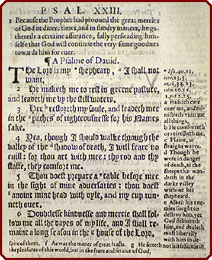
 Handsome KJV with Genealogies & Psalms Bible. English. Authorized (i.e., “King James Version”). 1632. The Holy Bible conteyning the Old Testament and the New. London: Robert Barker...by the assignes of John Bill, 1632. Folio (34 cm, 13.4"). [15], 507, [1] ff. (lacking 7 prelim. ff.).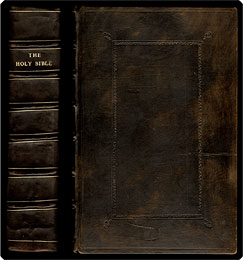
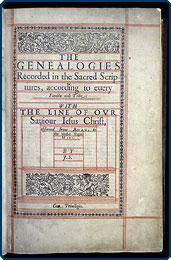
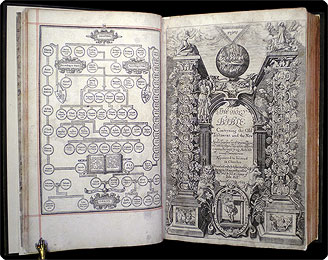 Click the images for enlargements.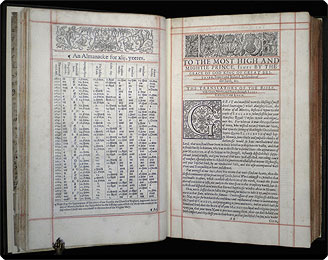
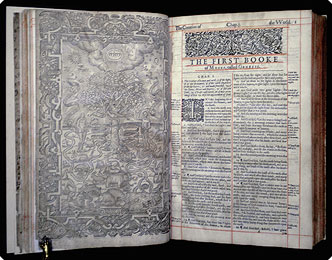
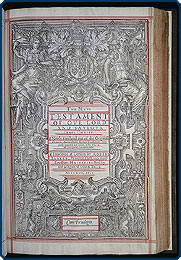
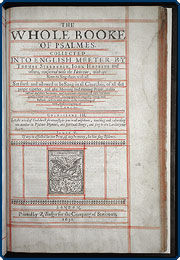
 The Psalter following the Bible includes music. The O.T. title-page is engraved and signed (very faintly in this example) by William (here “Guilielmus”) Hole, and is framed by an elaborate architectural border displaying the coats of arms of the 12 tribes of Israel and portraits of the 12 Apostles. The recto of the list of books is a full-page engraving of Adam and Eve in the Garden of Eden, surrounded by animals. The New Testament has a separate title-page, dated 1632, with an ornate wood-engraved border featuring Justice and Truth along with the British lion and unicorn and various architectural motifs.
The volume opens with two fly-leaves bearing genealogical records in several different early inked hands, with dates ranging from 1743 through 1847. A copy of Speed's Genealogies precedes the Old Testament, while the “Description of Canaan” with map that should close the Genealogies has been bound in after the O.T. title-page.
• ESTC S122379; Darlow & Moule 359; STC (2nd ed.) 2298.5. Speed: ESTC S126191; STC (2nd ed.) 23039a.4. Psalms: ESTC S122383; STC (2nd ed.) 2633. Recent mottled calf, covers fillet-framed and panelled in blind with decorative inner blind roll and blind-tooled corner fleurons; spine with gilt-stamped title and gilt-ruled raised bands. Front cover with two slender scrapes; title-page with date altered in ink to 1633, as above. Front fly-leaves with margins repaired; “Description of Canaan” with inner margin reinforced. Bible, seven preliminary leaves lacking (calendar, dedication, preface, and list of books all present); Psalms, four final index leaves (only) lacking; foliation slightly erratic. Varying degrees of age-toning, occasional light waterstaining, some margins with faint smudging; in fact and in suma nice volume to hold and work with. (26102)
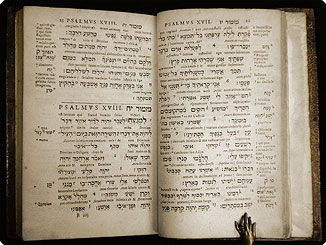
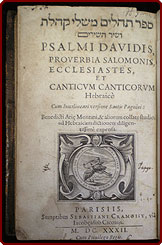
Not from the Pepys's Library Bible. O.T. Selections. Latin & Hebrew. 1632. [two lines in Hebrew, romanized as] Sefer Tehilim Mishle Kohelet ve-Shir ha-Shirim] Psalmi Davidis, Proverbia Salomonis, Ecclesiastes, et Canticum Canticorum Hebraicè cum interlineari versione Santis Pagnini.... Parisiis: Sebastiani Cramoisy, 1632. 8vo (18.4 cm, 7.25"). [16], 416 pp.

 Click the images for enlargements.
 The title-page bears Cramoisy's printer's device, inherited from his grandfather Sébastien Nivelle: two storks with the motto “Honora patrem tuum et matrem tuam ut sis longaevus super terram.” The work is also decorated with four very large, foliated Hebrew initials
Provenance: First dedication page with inked inscription of Dr. Henry Power (ca. 1626–68), a physician and natural philosopher who became one of the first elected fellows of the Royal Society. The title-page bears an inked inscription reading “S. Pepys” (lined through), but a tipped-in manuscript letter signed by Derek Pepys Whiteley, curator of the Pepys Library at Magdalene College, notes that the handwriting is “quite unlike examples of [the diarist's] signature.”
• Steinschneider, Catalogus hebraeorum in Bibliotheca Bodleiana, 459b. Not in Darlow & Moule. On Power, see: Oxford Dictionary of National Biography online. Later calf, spine with gilt-stamped leather label and gilt-ruled raised bands, board edges with gilt roll, rebacked preserving original spine; corners and joints refurbished, edges rubbed. Hinges (inside) unobtrusively reinforced. Back pastedown with institutional bookplate almost entirely obscuring early inked inscription. Title-page with early inscriptions at head and foot mostly trimmed away, also with inscription as above; dedication page with inscription as above. Pages age-toned; first few leaves with staining and minor chipping in lower portions. A very few early pencilled and inked marginalia in both Latin and Hebrew; one instance of inked underlining. (25937)
The
First Translation of the
Bible into Italian
fromHebrew
& Greek Sources
Bible.
Italian. Diodati.
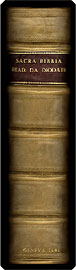
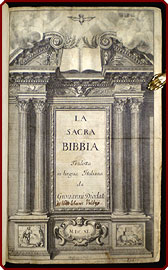
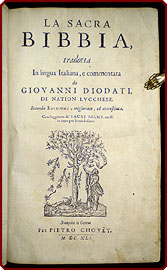
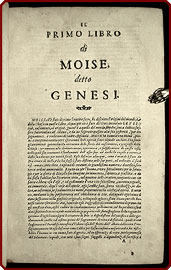
1641. La sacra bibbia tradotta in lingua Italiana, e commentata da
Giovanni Diodati. Stampata in Geneua: Per Pietro Chovët, 1641. Folio (30.5
cm; 12.125"). [3] ff., 837, [3], 331, [1], 148, 68 pp.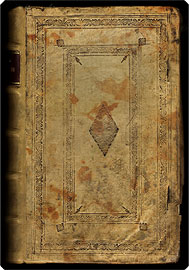
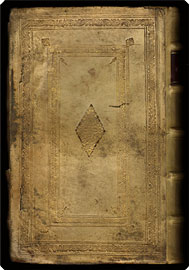 Click the images for enlargements.
 Diodati (1576–1649), a Protestant theologian, in 1609 succeeded Theodore Beza as professor of theology at Geneva, and in fact was Beza's choice for his successor. He is best remembered today as the first to translate the Bible into Italian from Hebrew and Greek sources.
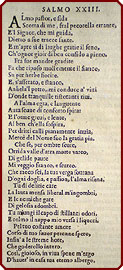
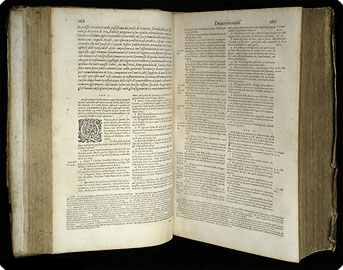
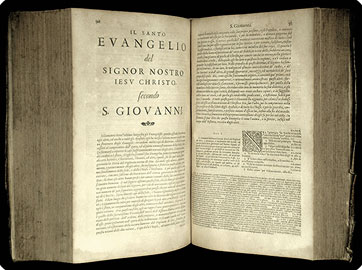
First Printing of theHebrew Psalms in England Bible. O.T. Psalms. Hebrew. Robertson. [in Hebrew: Sepher Tehillim u-sepher echah] The Hebrew text, of the Psalmes and Lamentations but published, without the points or vowels; yet to be made use of, by any who can read with the points, if they will but practice it a little.... London: Pr. for the author, 1656. 12mo (15 cm, 5.9"). [12], 156, 149-191, 15, [2 (errata)] pp.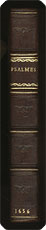
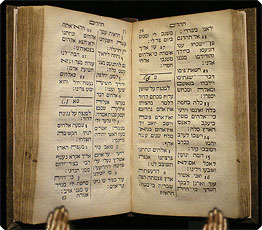
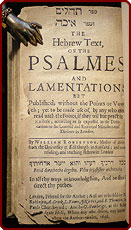 Click the interior images for enlargements.
This is the first stand-alone printing of the Psalms in Hebrew in England, published around the same time as the London (i.e., “Walton”) Polyglot.
• ESTC R210526; Wing (rev.) B2742C; Cowley, Hebrew Printed Books in the Bodleian Library, 92. Not in Darlow & Moule, not in Herbert, not in Rumball-Petre. On Robertson, see: Oxford Dictionary of National Biography online. Recent quarter calf and mottled paper–covered sides; spine with gilt-stamped and gilt-ruled title, gilt-dotted raised bands, and blind-tooled compartment decorations; leather edges tooled in blind. Title-page with edges chipped, touching lower outer portion of publication information; first and last few leaves also with edges chipped, and slight darkening. (25358)
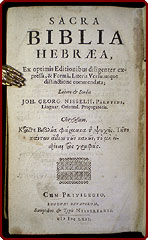
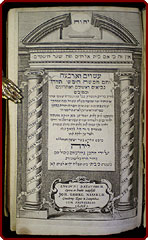
Edited & Printed by aWould-Be Academic Bible. O.T. Hebrew. 1662. Sacra Biblia Hebraea, ex optimis editionibus diligenter expressa, & formâ, literis versuumque distinctione commendata. Lugduni Batavorum: Nisselianis, 1662. 8vo (19.1 cm, 7.5"). [431] ff. (lacking 1 internal f. [blank]). 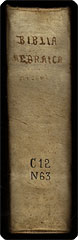
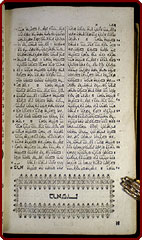
 Click the images for enlargements.
 Darlow and Moule note that the text here is based on Stephanus's Bible, with reference to the editions of Bomberg and Mannasseh ben Israel; after Nisselius's death, the work was completed by Allart Uchtmann, who wrote the preface. The Hebrew text is vocalized and, for the most part, set fairly plainly in double columns, but it is occasionally decorated with typographical ornaments. This copy includes the additional engraved title-page, which is handsome.
• Darlow & Moule 5133; Fuks & Fuks-Mansfeld, Hebrew Typography in the Northern Netherlands, 1585-1815, 48 (on Nisselius and this work, see also pp. 45–46). Contemporary vellum, soiled; spine with early inked title and old shelving number. Front free endpaper with early inked annotations; first three leaves institutionally pressure-stamped; title-pages reinforced along inner margin; one internal blank leaf lacking. Pages with light age-toning and offsetting; roughly half of volume with light staining in upper margins. All edges red. (26193)
The Eliot Indian Bible — A Leaf from Daniel/Hosea Bible. Algonquian. Eliot. 1663. Mamusse wunneetupanatamwe Up-Biblum God naneeswe Nukkone Testament kah wonk Wusku Testament. Ne quoshkinnumuk nashpe Wuttinneumoh Christ noh asoowesit John Eliot. Nahohtãoeu ontchetãoe printeuoomuk. Cambridge [Mass.]: Printeuoop nashpe Samuel Green kah Marmaduke Johnson, 1663. 4to (19 cm; 7.5"). [1] f.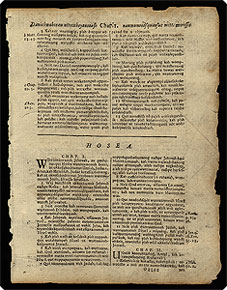 Click the image for an enlargement.
 The text is Daniel 12:3 (being the end of Daniel's apocalyptic vision of the end days) though Hosea 1–3:5 (with its promises/foretelling of Israel's destruction). It is printed in roman brevier type, in double-column format, with generally 62 lines per column. It took 139 and a half weeks to set the type and print the Bible.
The Bible was a monumental undertaking and achievement in its day and it remains an American monument today.
• Evans 73; Wing (rev. ed.) B2755; ESTC W38287; Darlow & Moule 6737; Pilling, Algonquian, 139–152; Pilling, Proof-sheets, 1175–77; Winship, Cambridge Press, pp. 208–44. Removed, inner margin slightly irregular; edges chipped (never approaching text) and light soiling. Definitely, a treasure. (26071)

Respected
Scholar's OwnPrivate
PressA
Labor
of LOVE
Bible.
N.T. Syriac. 1664. Novum domini nostri Jesu Christi testamentum
Syriacè, cum punctis vocalibus & versione Latina Matthaei, ita adornatâ,
ut, unicô hôc Evangelistâ intellectô, reliqui totius
Operis libri, fine interprete, facilè inteligi poffint: Ingratiam Studiosae
Juventutis & Studii Linguar, Orient. propagandi causâ plenè
& emendatè editum. Hamburgi: Cum privilegiis, typic & imprensis
Autoris, 1664. 8vo (16.5 cm; 6.75"). [32], 604 p. [also bound in, as issued]
Gutbier, Aegidius. Lexicon Syriacum. Hamburgi, 1667. And his Notae criticae
in Novum Testamentum Syriacum. Hamburgi: Typis & Sumptibus Gutbirianis,
1667. 8vo. [4] ff., 146 pp., [31] ff. [also bound in, as issued, the same
author's] Notae criticae in Novum Testamentum Syriacum. Hamburgi: Typis
& Sumptibus Gutbirianis,1667. 8vo. [3] ff., 55, [1 (blank)] pp.
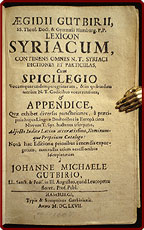
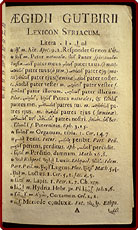
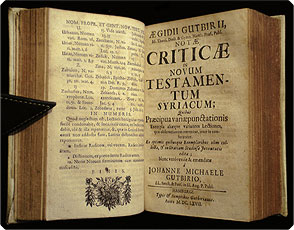 Click the interior images for enlargements. Incontestably, the culmination of his studies was this volume, still a standard in the field. Having his own printing press, and cutting the Syriac types himself, certainly ensured his total control over the production.
• Darlow & Moule 8966. Contemporary plain vellum over paste boards. Ex-libarary with call number on spine, one small numerical stamp in a lower margin, acquisition information in a gutter margin, and a (touching!) typed note about the purchase of the volume tipped-in among the preliminary leaves. Without the added engraved title-page. Old private bookplates and ownership inscriptions of the 18th and 19th centuries; rubber-stamp on the lower edge of the closed volume. A very good copy. (23163)
 CALVINIST
“King James”Folio
Extra —
1679
Bible.
English. 1679. Authorized (i.e., King James Version). The Holy Bible...with
the most profitable annotations. [Amsterdam: For Stephen Swart], 1679. Folio
extra (44 cm, 17.5"). π1*6**6A–Z6Aa–Zz6Aaa–Mmm6Nnn–Ooo4a–u6x4;
Engr. t.-p., [13] ff., 710 (i.e., 712), 248 pp.; illus. (6 double-spread plts.).
CALVINIST
“King James”Folio
Extra —
1679
Bible.
English. 1679. Authorized (i.e., King James Version). The Holy Bible...with
the most profitable annotations. [Amsterdam: For Stephen Swart], 1679. Folio
extra (44 cm, 17.5"). π1*6**6A–Z6Aa–Zz6Aaa–Mmm6Nnn–Ooo4a–u6x4;
Engr. t.-p., [13] ff., 710 (i.e., 712), 248 pp.; illus. (6 double-spread plts.).
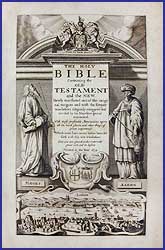
The engraved title-page is very fine, with Moses and Aaron flanking the title, the British royal arms above, and a scene of London below. The rest of the plates are all maps, as would not be the case in an Anglican Bible: These are all double-page, full of detail, and very attractive. The first, a map of the world, is labelled in Latin and Italian, and the rest in Dutch.
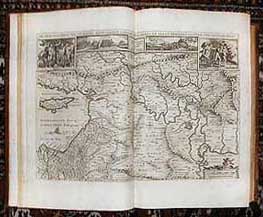 • Herbert 743; Wing (rev.) B2310. Contemporary diced calf, rebacked;
one joint again open and the other open, but cords holding. Covers ruled with
single gilt fillets, edges with single gilt rolls. Spine compartments ornately
gilt. Covers stained and with abrasions and some loss of leather, especially
over corners; spine dry and rubbed, with loss of leather and gilt. All edges
speckled red. Scattered spots of light soiling and staining, especially in
the margins. Entirely untattered.
• Herbert 743; Wing (rev.) B2310. Contemporary diced calf, rebacked;
one joint again open and the other open, but cords holding. Covers ruled with
single gilt fillets, edges with single gilt rolls. Spine compartments ornately
gilt. Covers stained and with abrasions and some loss of leather, especially
over corners; spine dry and rubbed, with loss of leather and gilt. All edges
speckled red. Scattered spots of light soiling and staining, especially in
the margins. Entirely untattered.

NOT
the London, 1637 — English
Octavo Bible Printed
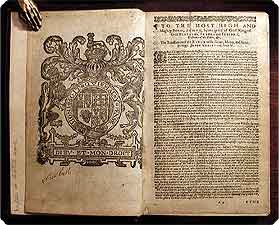
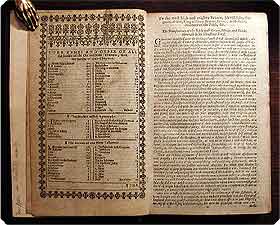
at OxfordBible. English. Authorized (i.e., King James Version). 1680. [The Holy Bible containing the Old Testament and the New. Oxford: At the Theater for Moses Pitt, Peter Parker, Thomas Guy, and William Leak, all in London, 1680]. 8vo (17 cm, 6.75"). A–Z8 Aa–Zz8 Aaa–Ggg8 Hhh2 Iii–Zzz8 Aaaa8 Bbbb4; [558] ff.; lacking engraved title (replaced with title and prelim. leaf from another edition).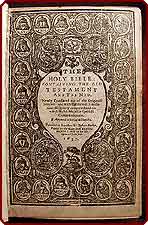
 Click
any image where the hand appears on
Click
any image where the hand appears on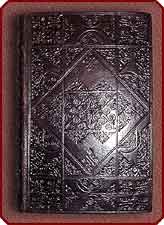
This edition is printed in two unruled columns with shouldernotes, sidenotes (including dates), and italic headers. Acts 6:3 wrongly reads “ye may” for “we may.” Tables of kindred and affinity, weights and measures, money, and time are found on the last two pages. The New Testament sectional title has a woodcut vignette showing the arms of the University.
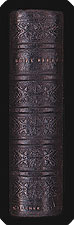
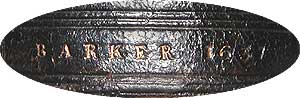
Binding: 19th-century black calf, elaborately tooled in blind in imaginative evocation of an “over the top” 17th-century binding, being horizontally, vertically, and diagonally ruled, foliate and floral devices within. Spine compartments tooled within, with gilt title in second one and gilt “Barker 1637” gilt at base. Red marbled endpapers. All edges gilt.
Provenance: 20th-century bookplate of C. ( or J.?) F. Weidmann, D.D. on front pastedown.
• Herbert 757; Darlow & Moule 595; Wing (rev.) 2315; Loftie, A
Century of Bibles, 354; ESTC R213033. (The title-page is from ESTC S90540
or S90541.) Binding as above, a little rubbed, and refurbished.
Occasional light browning, soiling, and shallow bumping or chipping (not
touching text).
Lacking
engraved title (replaced with title and preliminary leaf from another edition). A
bibliophile’s delight, and warning.
With a Fold-Out“Holy Land” Map Bible. N.T. Latin. Vulgate. 1688. Novum testamentum Domini Iesu Christi, vulgatae editionis, juxta exemplar Vaticanum anni 1592. Cum indicibus epistolarum et evangeliorum necnon rerum et verborum. Parisiis: Apud Danielem Horthemels, 1688. 16mo (11.3 cm, 4.4"). Engr. t.-p. (incl. in pagination), 488, [24 (index)] pp.; 1 fold. map.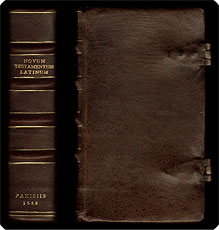
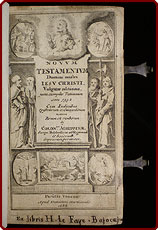
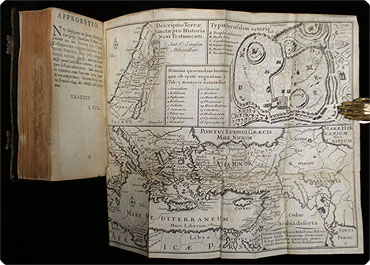 Click the images for enlargements.
 • Not in Darlow & Moule. Recent mottled calf with brass clasps, spine with gilt-ruled raised bands and gilt-stamped title. Title-page with early inked ownership inscription in lower margin. Pages age-toned. All edges red. (26308)
 To
browse the complete BIBLES “aisle,”
—
To
browse the complete BIBLES “aisle,”
—

 TO Part
III .
. . TO Part
III .
. . |