 MANUSCRIPTS
A-B • C • D-F • G-J • K-M • N-R • S-Z
MANUSCRIPTS
A-B • C • D-F • G-J • K-M • N-R • S-Z

 For
our MSS in SPANISH: Click here.
For
our MSS in SPANISH: Click here.
 Sixty Full-Page Full-Color Illustrations
 Narkiss, Bezalel, & Cecil Roth. Illuminated Hebrew manuscripts. New York & London: Alpine Fine Arts Collection, Ltd., 1983. Folio. 175, [1] pp.
$40.00

• Lengthy introduction followed by descriptions of 60 manuscripts, each description with a full-page, full-color illustration. Work ends with a bibliography.
• Publisher's tan cloth and blue d/j printed in white and “gold” with illustration. Corners bumped.
(22344)
For
a list of inexpensive, MODERN books
on JEWISH HISTORY & CULTURE,
click here.

Mostly Desserts — Manuscript Cookery
(“Oringe Pudding,” Plus). Manuscript in English, on paper: Cookery recipes. [England: ca. 1730 through 1875]. 4to (20.3 cm, 8"). [43] ff. (15 used).
$1500.00
 Click the interior images for enlargements.
• Early 18th- through 19th-century cookery manuscript focusing primarily on desserts. At least four hands contributed, with three clearly distinct writers being responsible for the opening section of sweet and savory puddings. The first writer starts out with “oringe pudding” before giving several variants each of calves-foot, oatmeal, and boiled or baked puddings, along with one “shakin” and one “quaking” pudding. The second adds the ever-popular Portugal cakes along with orange and carob puddings, while the third digresses into pound cake, “a nice plum cake,” and cheese straws before closing with fig pudding — all taken from Mrs. Beeton's famed cookbook.

After the dessert section, the original writer returns to add a few more miscellaneous recipes and, after an intermission of blank leaves, some marmalades and jellies. Four additional items are present towards the back of the volume, the contributors having turned the volume upside-down to inscribe them: pastilles for burning, Madeira wine, cider attributed to “Mr. Phillips” (possibly Henry Phillips, author of a historical account of fruits known in Great Britain), and instructions for fining stale beer.
Although a number of leaves here are blank, the content is substantial, legible, and interesting. No dates are present in the text itself, but the paper bears a Dutch watermark related to Churchill 109–119, and was produced in the Seven Provinces ca. 1675–1700 and the recipes attributed to Beeton must date after 1861. Some of the handwriting and spelling is consistent with a date of 1730.
• Contemporary vellum, rebacked, corners rubbed/bumped, front cover with now-illegible traces of inked ownership inscription, covers with spots of discoloration; hinges (inside) reinforced. First leaf excised (first recipe present numbered 2). Soiling (mostly at or in from edges) and moderate foxing/spotting, throughout. (25630)

A Bright Young Minister's Theological Efforts
Parkin, Joseph. Manuscript on paper, in English. “A course of theological lectures, on the most important subjects.” [U.K.]: [ca. 1805–1809]. 8vo (20.8 cm, 8.25"). [1], 29, [2 (blank)], [79], [3 (blank)], [11], [13 (11 blank)], 6, [7 (blank)], [5]–12 ff.
Bright Young Minister's Theological Efforts
Parkin, Joseph. Manuscript on paper, in English. “A course of theological lectures, on the most important subjects.” [U.K.]: [ca. 1805–1809]. 8vo (20.8 cm, 8.25"). [1], 29, [2 (blank)], [79], [3 (blank)], [11], [13 (11 blank)], 6, [7 (blank)], [5]–12 ff.
$675.00
Click the interior images for enlargements.
• Manuscript volume of highly detailed notes on a series of religious lectures by the Rev. Joseph Parkin, with a spine title reading “Parkin's Syllabus.” Having served as pastor at the Church of Christ (“Independent denomination”) in Wigan, Lancashire, the prematurely deceased Parkin was memorialized by the Evangelical Magazine in June 1809 as an “excellent young man” known for sermons that “displayed deep thought, as well as much seriousness and fervour.” A different hand from the first has added, at the back of the volume, a funeral sermon for Parkin — or, as that unknown author says, “more correctly named, a sketch of one.”
The primary text is carefully and very legibly inscribed, in impressively organized fashion. Written on the rectos of leaves only and with an occasional note on the versos, this devotes its first 29 leaves to such topics as the existence and being of God, the “proper standard” of religion, and the “character and authenticity of the Scriptures,” with the concluding, greater part of the volume being devoted to the attributes of God: His names, omnipresence, infinity, immutability, omniscience, will, wisdom, power, justice, goodness, etc.
A second, separate section in six leaves shows less finished work/thinking, in the same hand less carefully managed, on the subject of the Christian Church.
Once in an institutional collection but with no markings, and now deaccessioned.
• Recent quarter calf and marbled paper–covered sides, spine with gilt-stamped title. Most outer margins deliberately creased to make section markers. Clean, readable, and attractive. (25665)
A Boy's Delights — A Delightful Manuscript
Payne, Frederick George. Manuscript on paper, in English. “Vol. IV. No. I.” Unionville, CT: 1871. 4to (19 cm, 7.5"). [72] ff.; illus.
[SOLD]
Click the interior images for enlargements.
• Illustrated manuscript notebook by a talented musician and printer-publisher, fifteen years old at the time of the journal's composition. The young Payne used this volume for handwriting practice (inscribing some very fancy characters indeed), recording mathematical rules, and copying tables of weights, measurements, and exchange rates. He also used it for sketching curiosities of interest such as optics (a telescope, spyglass, draughtman's camera, opera glass, etc.), games and puzzles (“The perplexed Carpenter,” “The board & Ball”), tools, machines, and inventions (including a pyrometer, galvanic cup, telegraph machine, printing press, etc.), guns, and “Designs of Iron Clads Ships Steamers & etc.” In terms of “pure” art, there are numerous sketches of buildings, animals, Native American objects such as canoes and tepees, etc. Also present is a page of “Hocus Pocus” (conjuring tricks and sleights of hand), as well as one carefully reproducing a collection of “Coins Possessed by Fred G. Payne.” Some of the designs and information were copied from the Happy Hours periodical, while others were original.


Payne (1856–1919) grew up on a Connecticut farm and went on to become a prominent band leader, composer, and arranger; he founded both the Lewiston Brigade Band and Payne's Second Maine Regiment Band, and Edwards says that he “did as much for band music in Maine as any man of his time.” He was also the proprietor of a printing business in Lewiston, ME, and an active Mason who held such positions as Master of Rabboni Lodge, High Priest of King Hiram Chapter, Illustrious Potentate of Kora Temple, etc. His son, of the same name, served as Governor of Maine from 1949 to 1952 and U.S. Senator from Maine from 1953 to 1959.
Overall, an engaging reflection of a creative young mind — and of the scientific and mechanical developments which might intrigue a bright, late-19th-century American teenager.
• On Payne, see: Edwards, Music & Musicians of Maine, 334. Publisher's quarter sheep with marbled paper–covered sides, worn and abraded. Hinges (inside) tender. Sewing a bit shaky, with some leaves loosening. Pages age-toned but generally clean otherwise. (25895)

Manuscript Notes: The State of Theology in Upland, 1871
Pepper, George Dana Boardman. Manuscript on paper, in English. “Outlines of Theology.” [Upland, PA]: 1871. 4to (20.7 cm, 8.1"). [10] pp., 276, [23 (blank)] ff. (pagination skips 38).
$350.00
Click the images for enlargements.
• Lecture notes from a course taught by Dr. George Dana Boardman Pepper at Crozer Theological Seminary, transcribed and “published” by Isaac Denison (or Dennison)
Newell, Jr., class of 1871. Pepper (1833–1913) was one of the first faculty members at Crozer and later president of Colby University. Newell (1837–1914) went on to serve as a member of
the American Baptist Home Missionary Society and as the first pastor of the First Baptist Church in Hastings, Nebraska.
The notes are thorough, recorded in a generally quite legible hand with occasional instances of lined-through words or short sections; the pages are used on one side only except for sectional headers given on some versos.
• Contemporary half roan and marbled paper–covered sides, spine with gilt-stamped title; binding rubbed overall, foot of spine with portion of leather lost and inked shelving number. Front pastedown with institutional presentation bookplate and institutional rubber-stamp, other stamps/annotations variously placed; back pastedown with pocket (“Locked Section”). Front pastedown and free endpaper with Newell's near-calligraphic inked ownership inscriptions. Pages clean. (26146)
Petrus Riga. Aurora. Manuscript on vellum, in Latin. England (Oxford?), ca. 1210? 8vo (23.7 × 12 cm, 9.25" × 4.625"). [1] f.
$2700.00 
• Peter Riga’s Aurora, a verse paraphrase of the
Bible including commentary composed near the end of the 12th century, served
as a useful memory aid for students of the Scriptures. This leaf is from an
English university text of the Aurora, an early form of it most probably
written early in the 13th century. The text on this leaf is Ruth, Aurora 1.62–I
Kings, Aurora 1.84, including the narrative of the birth of Samuel.

It is written in brown ink in the small compact Gothic textura used
in the 13th century to economize space, which script predates the development
of cursive book hands later used for the same purpose. It is written in the
long narrow format commonly used for English university texts, and was most
likely produced at Oxford, where there grew up a thriving center of manuscript
production. The recto has 1 five-line red initial with pen tracery in blue
and a five-line
blue and red “puzzle”initial with pen tracery
also in blue and red. (“Puzzle” initials are inked to appear as
if made up of colored “pieces”—like a jigsaw puzzle—and
they are distinctively, if not uniquely, a feature of English and French 13th-century
manuscripts.) The verso has 3 two-line red initials, 1 three-line, and 1 two-line
blue initials—each of these initials has pen flourishes in the contrasting
color (i.e., blue or red).
five-line
blue and red “puzzle”initial with pen tracery
also in blue and red. (“Puzzle” initials are inked to appear as
if made up of colored “pieces”—like a jigsaw puzzle—and
they are distinctively, if not uniquely, a feature of English and French 13th-century
manuscripts.) The verso has 3 two-line red initials, 1 three-line, and 1 two-line
blue initials—each of these initials has pen flourishes in the contrasting
color (i.e., blue or red).
The text is written in one column of 50
lines on the recto and 51 lines on the verso. The leaf is faintly ruled in
lead on the verso only, the impression of the ruling showing on the recto,
the top line of text being above the top line of ruling; on the right edge
of the page are double rules enclosing the first letter of each line. On
the outer edge are prickings for the ruling. The left edge of the recto has
directions to the rubricator, the explicits of each section being done in
darker ink in a different hand. One line on the verso has been crossed out
with a single thin line of ink. At the bottom of the verso is the quire number
VIII and remnants of a catchword can just be seen at right on the bottom
edge.  English
manuscripts from this period are rare.
English
manuscripts from this period are rare.
Provenance: Ex–Zion Research Foundation (later known as the Endowment for Biblical
Research); very likely to Zion from Ege.
• Judith, Manuscripts
Sacred and Secular, 18, f. 9. A small hole in the lower margin.
Parchment a little soiled, especially on the hair side, as is not unusual
with English vellum. Traces of adhesive from mounting on the corners
of the verso.


 The Pope Appointsa New Grand Inquisitor for Spain
Pope Paul V (1552–1621; pontificate 1605–21). Letter to King Philip III of Spain, in Latin, on vellum. Rome: 4 January 1619. Narrow strip (10 x 40.5 cm; 4" x 16"). [1] leaf.
The Pope Appointsa New Grand Inquisitor for Spain
Pope Paul V (1552–1621; pontificate 1605–21). Letter to King Philip III of Spain, in Latin, on vellum. Rome: 4 January 1619. Narrow strip (10 x 40.5 cm; 4" x 16"). [1] leaf.
$1250.00
Click the image for enlargement.
• The pope has learned of the death of Bernardo de Sandoval y Rojas, the archbishop of Toledo and the Grand Inquisitor of Spain. In this letter the pope appoints Luis de Aliaga Martínez the new Grand Inquisitor.
This contemporary file copy was retained in Rome and signed “S. Card. S. Susannae” (i.e., Cardinal Scipione Cobelluzzi, who was also at this time the Librarian of the Vatican Library).
• Written in a very handsome italic on very good quality vellum. Light discoloration along lower edge, below the writing. (26978)
Prentis, Joseph. Autograph Letter Signed to Robert Saunders. Unnamed place in Virginia, 2 February 1820. Folio (32.8 cm, 13"). [2] ff.
$125.00

• Sent to Robert Saunders in Williamsburg, Va., this letter discusses a debt owed to the writer (not by Saunders, but rather by a gentleman with whom Saunders was apparently in communication); a court case in which the writer’s family was involved; the health of “Aunt Susan,” who has been “so much indisposed of late”; and the stagnation of business that followed the War of 1812. The letter bears its integral address leaf with a notations, “mail single, post paid” and “Paid 12½.”
Click the image for an enlargement.
The writer seems to have been Joseph Prentis (1785–1851), son of a Williamsburg merchant of the same name; it is difficult to identify him with absolute certainty, but Saunders is elsewhere recorded as having assisted in the administration of the estate of Joseph Prentis the elder.
• Creased, with small spots of discoloration. Portion of upper and upper inner margins lost to hungry rodent, with loss of a number of words; one tear to the final leaf repaired some time ago with tape.
 Dominican Missions in
 California
Quiñones, Baltasar de. Autograph Letter Signed in Spanish to Fray Ignacio Gentil. Rome: 7 April 1789. Tall 8vo (26.5 cm; 10.5"). [2] pp., with integral address leaf.
California
Quiñones, Baltasar de. Autograph Letter Signed in Spanish to Fray Ignacio Gentil. Rome: 7 April 1789. Tall 8vo (26.5 cm; 10.5"). [2] pp., with integral address leaf.
$775.00
Click the images for enlargements.
• As Master of the Order of Preachers (i.e., the Dominicans) from 1777 to 1798, Baltasar de Quiñones helped formulate policy concerning the missions that the Dominicans took over following the expulsion of the Jesuits in 1767. In this letter he addresses some matters relating to the Dominican missions in California.
The main question at hand is the appointing of a new attorney/solicitor (i.e., procurador) for the California missions. He says, “quiero que ahora y siempre que ocurra [la necesidad de un nuevo procurador], se haga el nombramiento por la Provincia misma despues de haber oido al Presidente de las Misiones, el cual es mi voluntad que en cuanto sea posible camine con acuerdo de la mayor parte
a lo menos de los demas misioneros, antes de hacer su propuesta a la Prov[inci]a.”
He also makes appointments to the positions of “Depositarios del Deposito” and the names of the four appointees are given.
• Written in a clear large hand and with the paper and wax closure in evidence. (25329)
 ManuscriptCookery-Book
Fragments
ManuscriptCookery-Book
Fragments
[THREE
LEAVES]
“To Make
La Feyetts a nice cake for Tea”
(Receipt Book Leaves). Manuscript on paper, in English.
[U.S.?, late 18th- / early 19th-century?]. 8vo, [3] ff.
$200.00
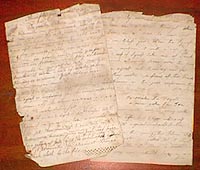
• Two cookbooks or one? The leaves at hand, one a single page and
the other a conjugate two-leaf spread, pose an interesting question of identification.
Both offer recipes for sweets. The former is done throughout in a formal script,
whereas the latter is partly in a similar if not identical hand, partly in a
more casual style—perhaps they represent contributions of two generations to
the same book. Then again, the chipped edges make exact determination of size
difficult; these leaves might have come from the treasured documents of different
families entirely. Whichever interpretation one might prefer, these leaves provide
a thought-provoking glimpse of turn-of-the-century kitchen life—going on two
centuries ago!
• In a Mylar folder. Pages darkened, with small discolorations
and edges somewhat tattered. A
pleasing gift for anyone exploring culinary, or almost certainly women’s,
history.
For Books for the BUSTED
BIBLIOPHILE, click
here.
 Inspiration,
“Biblology,”
Attributes,
Angels
Robinson, Ezekiel
Gilman. Manuscript on paper, in English. “Christian theology
by E.G. Robinson, D.D. Vol. I & Vol. II.” Rochester, NY: 1868–69.
8vo (20.3 cm, 8"). 2 vols. I: [4], 316 pp. II: [4], 315, [1] pp.
Inspiration,
“Biblology,”
Attributes,
Angels
Robinson, Ezekiel
Gilman. Manuscript on paper, in English. “Christian theology
by E.G. Robinson, D.D. Vol. I & Vol. II.” Rochester, NY: 1868–69.
8vo (20.3 cm, 8"). 2 vols. I: [4], 316 pp. II: [4], 315, [1] pp.
$450.00
Click the images for enlargements.
• Highly detailed lecture notes from a course on Baptist theology
taught at Rochester Theological Seminary, neatly transcribed in 1868 and 1869
by A. Coil. Dr. Robinson (1815–94) was president and professor of theology
at Rochester, and later president of Brown University. Originally intended for
the use of his students, the present work was privately printed in partial form
in 1872 but not officially and fully published until the year of Robinson's
death — doubtless, with a number of interesting differences from what
was recorded by Mr. Coil.
The final section of the first volume and first section of the second volume
here are on angels; the second has also an interesting section on the "Salvation
of Infants." The preface to the printed text notes that “however
[readers] may value this book, the printed page can only imperfectly indicate
the power of the living teacher,” and it is fair to feel closer to that
teacher via these volumes.
• Original half sheep and textured paper–covered sides,
spines with gilt-ruled compartments; bindings rubbed overall, front cover
of vol. I detached, spines sunned and with remnants of paper shelving labels.
All edges marbled. Front free endpapers with early inked ownership inscription.
Pages clean. (26318)
PLACE
AN ORDER | E-MAIL
US | PRB&M HOME


 TO Part
VII . . .
TO Part
VII . . .  For
an OXFORD “shelf,”
For
an OXFORD “shelf,”