
 ILLUSTRATED
BOOKS \ CUTS & ENGRAVINGS
ILLUSTRATED
BOOKS \ CUTS & ENGRAVINGS
American Primer — American Woodcuts
ILLUSTRATED
BOOKS \ CUTS & ENGRAVINGS
ILLUSTRATED
BOOKS \ CUTS & ENGRAVINGS
American Primer — American Woodcuts  M'Carty's American primer. Being a selection of words the most easy of pronunciation. Philadelphia: M'Carty & Davis (stereotyped by J. Howe), (copyright 1828). 12mo (14.3 cm, 5.6"). 36 pp.; illus.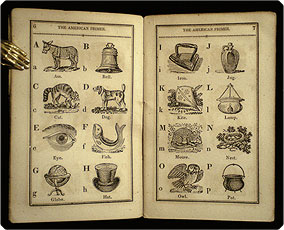
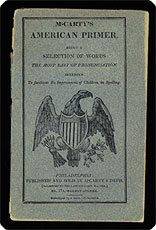
 12 half-page wood engravings of animals and birds done by Gilbert.
• Shoemaker 33941; Rosenbach, Early American Children's Books, 714. Publisher's printed light blue paper wrappers, split and chipped along spine, otherwise crisp and clean. Pages with light age-toning and offsetting. (24569)


 Plays Elegantly Produced for Their
 First
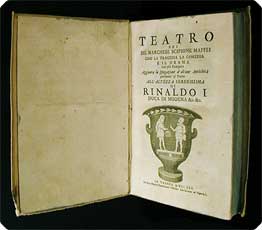
Print AppearanceMaffei, Francesco Scipione. Teatro del Sig. Marchese Scipione Maffei cioè la tragedia la comedia e il drama non più stampato.... Verona: Gio. Alberto Tumermani, 1730. 8vo (19.7 cm, 7.75"). xli, [3], 281, [1] pp.; 1 fold. plt., illus.
First
Print AppearanceMaffei, Francesco Scipione. Teatro del Sig. Marchese Scipione Maffei cioè la tragedia la comedia e il drama non più stampato.... Verona: Gio. Alberto Tumermani, 1730. 8vo (19.7 cm, 7.75"). xli, [3], 281, [1] pp.; 1 fold. plt., illus.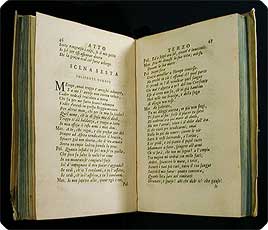
 Click the images for enlargements.
 • Gamba 2323; not in Brunet. Contemporary vellum over paste boards, outer edges yapp, spine with hand-inked title; vellum torn and partially lost over lower edge of front cover, with signs of wear and small spots of staining elsewhere. Ex-library, front pastedown with Italian institutional bookplate; yet volume otherwise free of markings. Title-page verso with affixed scrap of paper. Intermittently occurring light dampstaining in upper margins; otherwise clean.
 Micmac
Catechism With
Micmac
Catechism With Illustrations
Maillard, Antoine Simon. Le catechisme Micmac.
Ristigouche, P.Q. [Quebec]: Freres mineurs capucins, [1921]. 12mo. 128, 32 pp.; illus.
Illustrations
Maillard, Antoine Simon. Le catechisme Micmac.
Ristigouche, P.Q. [Quebec]: Freres mineurs capucins, [1921]. 12mo. 128, 32 pp.; illus.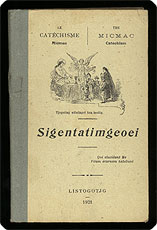
 Click
the images for enlargement.
Click
the images for enlargement.
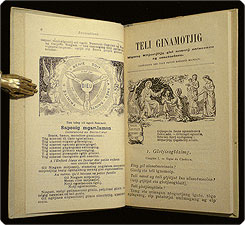
Up to p. 112, this issue is a reprint of the second edition (with the title-page labeled Deuxième edition, giving a date of 1913), after which comes a section entitled “Alasotmaganel” (rather than the “Gis Oen Melgitimg” of the actual 1913 printing). The closing section, “Gtapegiemgeoel,” is the same in both printings. The publisher's binding gives the date of 1921 on the front cover!
• Publisher's quarter cloth with printed paper-covered sides; cloth and paper showing light wear. Some offsetting and paper punctured around binding staples, otherwise a nice, even fresh copy. (12614)

 Marilyn Monroe'sLAST Posed Photo Session Maloney, Tom, ed. U.S. camera annual 1964. New York: Duell, Sloan & Pearce, (copyright 1963). 8vo (29 cm, 11.4"). 231, [1] pp.; illus.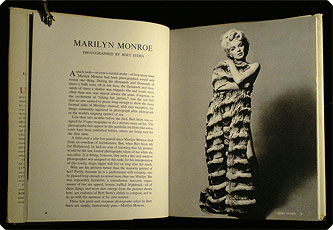
• Publisher's red cloth in dust wrapper, jacket not price-clipped; dust jacket rubbed and chipped at extremities and along upper back edge, light dustsoiling to portion of back cover. (24682)
Marmontel's Political-Philosophical Novel with Gravelot's Illustrations Marmontel, Jean François. Bélisaire. Paris: Chez Merlin, 1767. 8vo (19.9 cm, 7.8"). [4], x, 340, [6] pp.; 4 plts.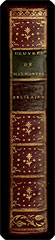
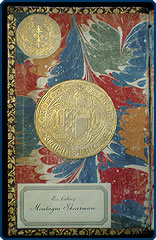
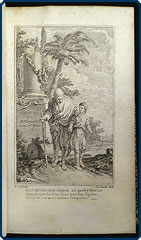
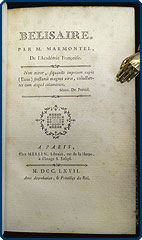
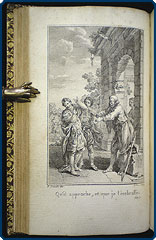 Click the images for enlargements.
 Merlin also printed a duodecimo edition in 1767; in the present edition, “Fragmens de philosophie morale” is found on pp. 273–340, followed by the Addition and Approbation.
Provenance: Front pastedown with gilt-stamped armorial bookplate of notable 19th-century book collector Edward Hailstone, gilt-stamped “I.T.” bookplate with motto “Inter folia fructus,” and bookplate of Sir Montague Shearman.
Binding: Contemporary crimson morocco, covers framed in gilt triple fillets; spine gilt extra with gilt-stamped leather labels, board edges and turn-ins with gilt rolls. This volume (complete in itself) seems at one time to have been part of a set of Marmontel's works, and bears an (unnumbered) spine label reading “Oeuvres de Marmontel.”
• Brunet, III, 1440; Cohen de Ricci, Guide de l’amateur de livres à gravures du XVIIIe siècle, 688; Graesse 406; Tchermezine 455. Binding as above, with edges, extremities, and joints showing minor rubbing. Front pastedown with bookplates as above; front free endpaper with affixed slip of early cataloguing; rear pastedown with small chip out of paper. Light spots of foxing, slightly heavier around plates. All edges gilt. (25776)
Wonderful “Peasant”(!)
Binding
Martin, von Cochem. Der grosse Baumgarten.
Sulzbach: Im verlage der J. E. Seidelschen Kunst- und Buchhandlung, 1807. 8vo (18.5 cm;
7.375"). Frontis., [9] ff., 688 pp., [6] ff., 16 plts.
“Peasant”(!)
Binding
Martin, von Cochem. Der grosse Baumgarten.
Sulzbach: Im verlage der J. E. Seidelschen Kunst- und Buchhandlung, 1807. 8vo (18.5 cm;
7.375"). Frontis., [9] ff., 688 pp., [6] ff., 16 plts.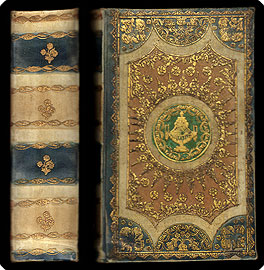
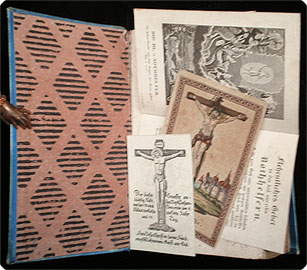 Click the images for enlargements. 16
woodcut plates.
Click the images for enlargements. 16
woodcut plates. 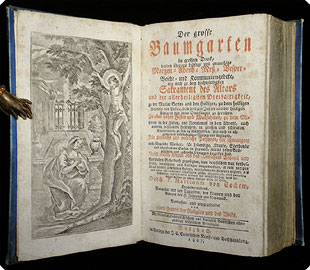
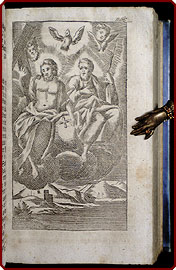
The vellum binding is elaborately tooled in gilt and in-painted in blue, green, and salmon. All edges are gilt and gauffered.
• Binding as above with light rubbing. A very handsome, interestingly late example of this uncommon binding style. (26690)
A First
Edition of the First
“Volume”Martin,
William, ed. Peter
Parley’s annual: a Christmas and New Year's present for
young people. London: Simpkin, Marshall, & Co., 1840 [i.e., 1839].
12mo (15 cm, 5.9"). Engr. t.-p., vi, 378 pp.; 4 plts., illus.
First
“Volume”Martin,
William, ed. Peter
Parley’s annual: a Christmas and New Year's present for
young people. London: Simpkin, Marshall, & Co., 1840 [i.e., 1839].
12mo (15 cm, 5.9"). Engr. t.-p., vi, 378 pp.; 4 plts., illus.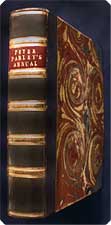
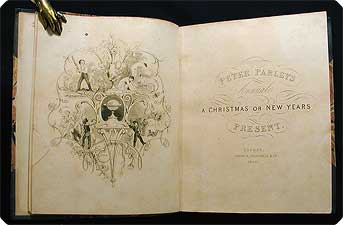
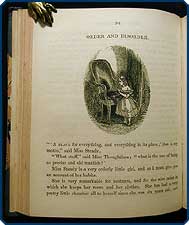
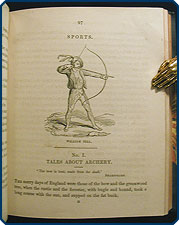 Click
the interior images for enlargements.
the history and rules of
chess, are illustrated with a number of in-text steel engravings
and four engraved plates, one of which depicts a ship at sea in stormy weather.
Click
the interior images for enlargements.
the history and rules of
chess, are illustrated with a number of in-text steel engravings
and four engraved plates, one of which depicts a ship at sea in stormy weather.
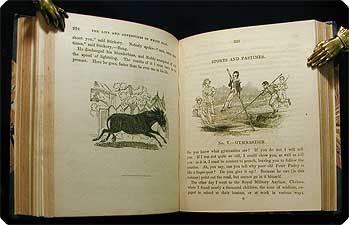
• Faxon 108. Binding as above, paper scuffed and joints a touch
rubbed. Front free endpaper with owner’s name; front pastedown and fly-leaf
with pencilled notations. Frontispiece with small chip to outer margin, repaired.
Some instances of offsetting surrounding plates and illustrations, pages otherwise
clean. An attractive, engaging
little book.

 Gardener's
Guidebook 1844
— 12 Plates
Maund, B[enjamin]. Our hardy flowers [/] how to cultivate and rear them from seeds, cuttings, and layers...with numerous accurately coloured illustrations. London: Charles Griffin & Co., [1864]. 4to (20.5 cm, 8.1"). 100, [5]–20 (adv.) pp.; 12 plts.
Gardener's
Guidebook 1844
— 12 Plates
Maund, B[enjamin]. Our hardy flowers [/] how to cultivate and rear them from seeds, cuttings, and layers...with numerous accurately coloured illustrations. London: Charles Griffin & Co., [1864]. 4to (20.5 cm, 8.1"). 100, [5]–20 (adv.) pp.; 12 plts.
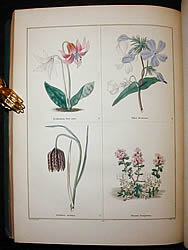
A considerable and interesting array of ads for other Griffin publications is appended.
• Publisher's green textured cloth, extremely neatly rebacked, back cover blind-stamped, front cover gilt-stamped with abstract plant-recalling border and central title amidst flowers; each cover pressure-stamped by now-defunct library, with slight discolorations to upper edges. All edges gilt. Title-page and four others lightly stamped (plates untouched); library pocket on back free endpaper. Small bookseller's ticket on back pastedown; endpaper edges chipped.  Plates clean and very pleasing; in fact, it's a pleasing little volume overall.


A
UniversalistWomen's
Literary
Annual:
1843
Mayo, Sarah Carter Edgarton, ed. The rose of Sharon:
A religious souvenir, for MDCCCXLIII. Boston: A. Tompkins & B.B. Mussey, 1843 [i.e., 1842].
8vo (17.8 cm, 7"). add. engr. t.-p., 312 pp.; 3 plts. (lacking frontis.).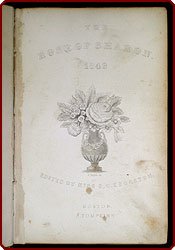
 Click the images for enlargements.
 The volume is illustrated with an added engraved title-page and three steel-engraved plates, done by O. Pelton after designs by T.B. Read and Beaume, and by Charles Phillips after Sir Joshua Reynolds.
Signed binding: Hunter green embossed morocco, covers with cherub vignette in foliate frame; the embossed panel was designed by Francis N. Mitchell and engraved by Alex C. Morin, and the binding was done by Benjamin Bradley, with all three names stamped in panel. All edges gilt.
• Faxon 713. On binding, see: Wolf, From Gothic Windows to
Peacocks, 178; Spawn & Kinsella, American Signed Bindings,
53. Binding as above, extremities with very minor rubbing; frontispiece
lacking. Offsetting from plates, two pages with offsetting from now-absent
laid-in item, scattered light spotting elsewhere. A gorgeous example of the binding, with interesting
reading inside. (26737)

A Universalist Women's Literary Annual: 1844 Mayo, Sarah Carter Edgarton, ed. The rose of Sharon: A religious souvenir, for MDCCCXLIV. Boston: A. Tompkins & B.B. Mussey, 1844 [i.e., 1843]. 8vo (17.8 cm, 7"). Add. engr. t.-p., 304 pp.; 4 plts.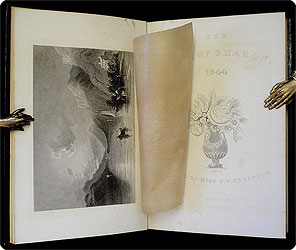
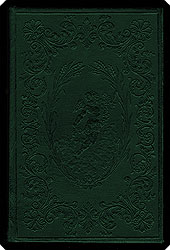 Click the images for enlargements.
 The volume is illustrated with four steel-engraved plates and an additional engraved title-page by various hands.
Signed binding: Hunter green embossed morocco, covers with cherub vignette in foliate frame; the embossed panel was designed by Francis N. Mitchell and engraved by Alex C. Morin, and the binding was done by Benjamin Bradley, with all three names stamped in panel. All edges gilt.
• Faxon 714. On binding, see: Wolf, From Gothic Windows to Peacocks, 178; Spawn & Kinsella, American Signed Bindings, 53. Binding as above, showing virtually no wear. A few light spots, pages mostly clean. Dried flower laid in. It is hard to imagine a better copy of this lovely annual. (26743)
“What Is Dis, A Chin-Chin to a Show Down?” McHugh, Hugh. Out for the coin. New York: G.W. Dillingham Co., 1903. 8vo. 107, [1], xx (adv.) pp.; 6 plts.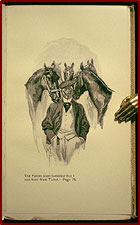
 Click the interior image for an enlargement.
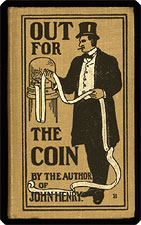
 Binding: Publisher's tan cloth, front cover pictorially stamped in black and white; designed by Thomas Watson Ball and with his “B” cipher. The cover depicts a richly dressed man at a tickertape machine. Top edge gilt.
• Bound as above; black stamping showing light wear: a solid, clean copy. (22208)
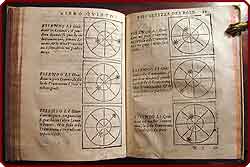
Standard & Ground (or Wave?)-BreakingMedina, Pedro de. Arte del navigare. Venetia: Appresso Tomaso Baglioni, 1609. 4to (20.5 cm, 8"). A4 b4 2A8 B–Q8 R10; [7], [1 (blank)], 137, [1 (blank)] ff.; illus. 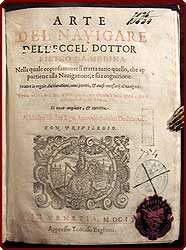
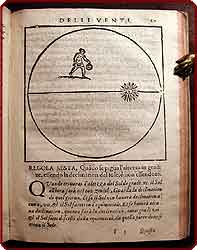
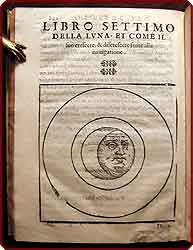
Also included is a woodcut map showing Europe, the Atlantic, and the New World.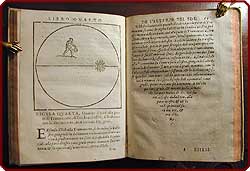
• Palau 159680; Alden & Landis, European Americana, 609/77; Medina, BHA, 123. Old vellum; red leather, gilt-lettered spine label; some staining, and chipping to edges and label. Old, careful repairs to interior worming occasionally cost individual letters (but never sense) or a little loss to an illustration. Old rubber-stamps and red and black ownership label on title-page; inked notations on title-page and front pastedown. All edges speckled red.

Victorian ArabicaNicely Presented Meredith, George. The shaving of Shagpat. New York: Pr. by the George Grady Press for the Limited Editions Club, 1955. 4to.
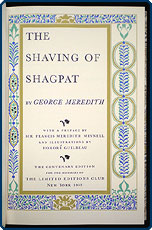
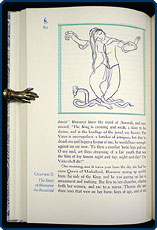
• Bibliography of the Fine Books Published by the Limited Editions Club 260. Publisher's quarter leather over printed paper-covered sides; spine extremities slightly rubbed, in slipcase showing a bit of scraping and refurbished at top fore-edge. Very nice. (13276)

 Cortlandt
Bishop Copy
Mérimée, Prosper. Colomba.
Paris: L. Conquet, 1904. Small folio.
Cortlandt
Bishop Copy
Mérimée, Prosper. Colomba.
Paris: L. Conquet, 1904. Small folio.
 with
a suite of proofs of the illustrations, which are by Daniel Vierge. Ex-libris Cortlandt F. Bishop.
with
a suite of proofs of the illustrations, which are by Daniel Vierge. Ex-libris Cortlandt F. Bishop.
• Bound by M. Lortic in red morocco, gilt extra with accents of black; original wrappers bound in; rubbing to joints at top and bottom. Wide turn-ins with gilt dentelles; marbled endpapers. All edges gilt.

WONDERFUL
Culs-de-Lampe by
Villavicencio
& NavarroMexico
(ecclesiastical province). 1st & 2nd Concilia (1555, 1565).
Concilios provinciales primero, y segundo, celebrados en la muy noble,
y muy leal Ciudad de México, presidiendo el Illmo. y Rmo. Señor
D. Fr. Alonso de Montúfar, en los años de 1555, y 1565. En México:
En la Imprenta de el Superior Gobierno, de el Br. D. Joseph Antonio de Hogal,
1769. Folio (27 cm; 10.5"). [10], 34, [2], 35–38, 41–184, [2], 185–396,
[12] pp.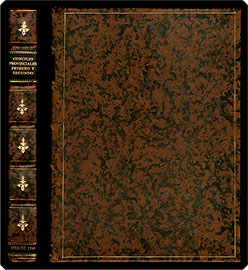
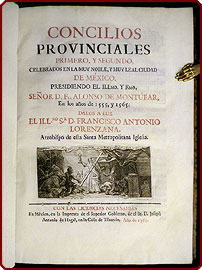
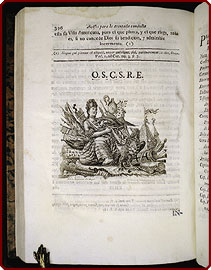
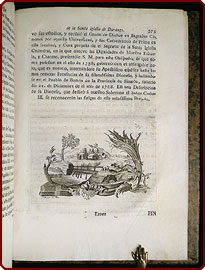 Click the images for enlargements. This text is from the press of José Hogal,
who is often called the Baskerville of Mexico.
Click the images for enlargements. This text is from the press of José Hogal,
who is often called the Baskerville of Mexico.
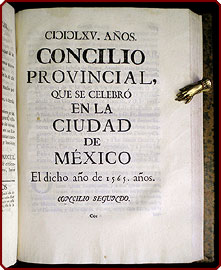
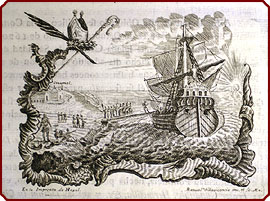
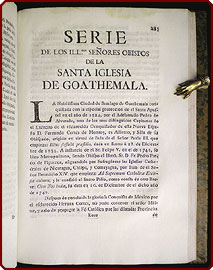
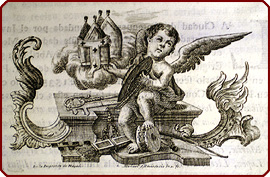
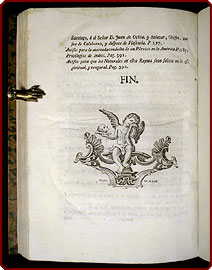
The force behind this edition was archbishop Francisco Antonio Lorenzana (1722–1804), a patron of Hogal's press and of the arts, who soon after assuming the archbishopric of Mexico in 1766 saw the need for a concilium. In preparation for it he paid Hogal to publish or republish, as was the case, the acts of the first three provincial councils of Mexico, held respectively in 1555, 1565, and 1585; these appeared in 1769 and 1770. In 1771 he himself held the fourth Mexican provincial synod; ironically, those acts were not published until 1898.
• Medina, Mexico, 5299; Palau 142387; Sabin 42063.
Recent Spanish sheep mottled in the Valenciana style. Occasional light waterstain
in some upper margins, never in text. Paper crisp and printing very sharp.
 A
very good copy. (26797)
A
very good copy. (26797)
Michener on Japanese Woodblocks Michener, James A. Japanese prints from the early masters to the modern. Rutland, VT & Tokyo, Japan: Charles E. Tuttle Co., (copyright 1959). Folio (31.7 cm, 12.5"). 287, [1] pp.; plts., 6 fold.
• Publisher's textured taupe silk binding, front cover with patterned coral silk insert; spine with gilt-stamped title. Dust wrapper and original slipcase present, lower back corner of jacket slightly crumpled; otherwise a gorgeous, clean copy in an undamaged slipcase. (24683)
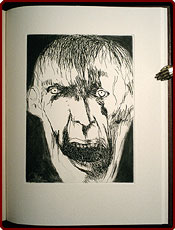
Signed by Arthur Miller & Leonard Baskin Miller, Arthur. Death of a salesman: certain private conversations in two acts and a requiem ... With five etchings by Leonard Baskin. New York City: The Limited Editions Club, 1984. 4to. [12], 5–164, [3 (1 blank)] pp.; 5 plts.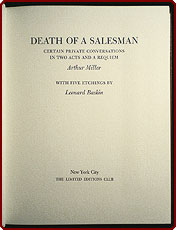
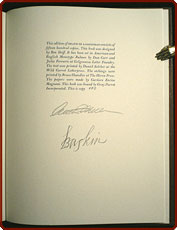 Click the images for enlargements. signed by both the playwright and the illustrator at the colophon.
The binding is full rusty-brown Nigerian goat, stamped in gold on the spine. The etchings are by Leonard Baskin, a series of five portraits tracing the downward spiral of Willy Loman — a powerful complement to Miller's portrait of a salesman at the end of his career and at the end of his rope! The plates, printed by Bruce Chandler, are each protected by a brown paper tissue guard. The book is designed by Benjamin Schiff, who chose a Bulmer font for the text.
This offering includes the monthly newsletter but not the mailing notice.
• Limited Editions Club, Bibliography of the Fine Books Published by The Limited Editions Club, 1929–1985, 540. Binding as above. One of the tissue guards is loose but otherwise undamaged. Fine, in the original slipcase. A handsome production of one of the most performed plays in the world! (21754)
A Friendship Book Milne, Walter J. Manuscript on paper, in English. [U.K.], 1914. Long 8vo (10.5 cm, 4.1"). [140 (32 used)] pp.; illus.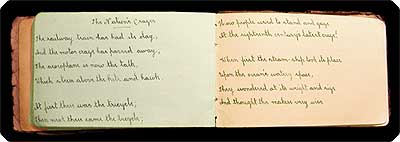
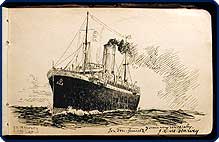 TWO
nicely accomplished pen-and-ink drawings of ships (one
of a great steamship, signed “J.A.M. Harvey,” 1914, one of a three-masted
sailing ship accompanied by a small “modern” warship, signed Jack
Neill, 1915). Friends have also noted favorite authors, “authoresses,”
and heroines, and two pages are devoted to a series of cut-out autographs (possibly
not original) affixed beneath photographs of Ellen Terry, Estelle Stead, and
others. Place names are London and Hunstanton (Norfolk).
TWO
nicely accomplished pen-and-ink drawings of ships (one
of a great steamship, signed “J.A.M. Harvey,” 1914, one of a three-masted
sailing ship accompanied by a small “modern” warship, signed Jack
Neill, 1915). Friends have also noted favorite authors, “authoresses,”
and heroines, and two pages are devoted to a series of cut-out autographs (possibly
not original) affixed beneath photographs of Ellen Terry, Estelle Stead, and
others. Place names are London and Hunstanton (Norfolk).
One leaf bears a number of small photographs of young men, labelled “1915” — possibly classmates from St. Paul’s?
• Publisher’s cloth wrappers, front cover gilt-stamped “Autographs”; edges and extremities chipped. Text block partially separated from spine. Some fading to colored pages, with occasional very slight offsetting or ink smearing.
For more MANUSCRIPTS, click
here.
“Milton
. . . KnowsNo Limits But ThoseImpassable by the Human Intellect”Milton, John. The poetical works... from the text of the Rev. Henry John Todd, M.A. with a critical essay, by J. Aikin, M.D. London: Pr. for J. Johnson,
W.J. & J. Richardson, R. Baldwin, et al., 1808. (16.5 cm, 6.45"). 4 vols. I: Frontis., [4], 39, [1], 256 pp.; 6 plts. II: [4], 245, [1] pp.; 6 plts. III: [4], 259, [1] pp.; 6 plts. IV: iv, 265, [1] pp.; 2 plts. 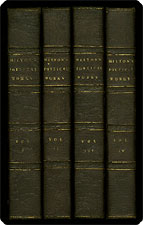
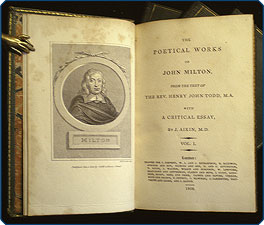
 a frontispiece and 19 engraved plates done by I. Neagle, W. Cooke, P. Thomas and others after designs by Stephen Francis Rigaud.
Binding: Contemporary olive morocco, covers framed in gilt single fillet, spines with gilt-stamped title. All edges gilt.
• NSTC T1207 (for 1801 and 1809 eds., not citing this ed.). Bound as above; spines darkened (not unattractively), some corners bumped. Front pastedowns each with armorial bookplate, one volume with additional private collector’s bookplate affixed and others with that bookplate laid in. Occasional small spots of faint foxing; one page with two drops of spilled wax.
 For more SETS, click here.

With Printed Music —
Edmund Dulac's Last
Project
Milton, John, & Henry
Lawes. The
masque of Comus. Cambridge: Printed for the members of The Limited Editions
Club at the University Press, 1954. 4to. [1 (blank)] p., [1 (blank)] f., [3
(2 blank)], frontis., [6 (2 blanks)], 3–59 pp., [1 (blank)] p., 12 pp. of printed
music, [2 (1 blank)] pp., [1 (blank)] f., [1 (blank)] p.; 5 plts.
 The illustrations are full-page watercolors, six in all, by Edmund Dulac. The LEC Bibliography says they were "printed in process offset," but this is in error: The mailing notice asserts they were "reproduced in six printings by the Sun Engraving Company," and a member of the family that owned that enterprise observes to us that it did not in fact have offset presses—while it was noted for its color letterpress productions, including the original (1940) Szyk Haggadah.
The design is by John Dreyfus, who chose a monotype Bembo font printed by the University of Cambridge Press; the engraving of the music was done by G.T. Friend. The binding is quarter gold-stamped vellum with marbled paper sides; top edges are gilt. Since Hubert Foss and Edmund Dulac both died during the production of this book, a one-page photo-print from The Times of London's obituary section summarizing the achievements of these two men has been included with this offering. The monthly letter and mailing notice are also present.
• Limited Editions Club, Bibliography of the Fine Books Published by The Limited Editions Club, 1929–1985, 250. Two tiny stains on the fore-edge, a penstroke marking p. 54, and two other pen-point spots. With the original slipcase.
For more LIMITED EDITIONS CLUB books,
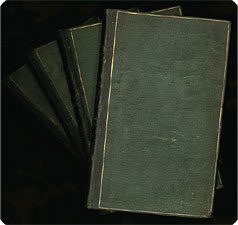
ILLUSTRATED! — Swedish AntiquitiesMontelius, Oscar. Antiquités suédoises, arrangées et décrites .... Stockholm: P.A. Norstedt & Söner, 1873–75. 2 vols. in 1. 8vo (25.1 cm, 9.9"). [6], 80, [12], 182, [16] pp.; illus.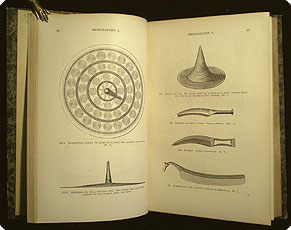
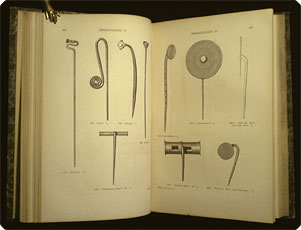
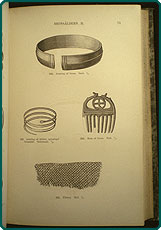
• Lipperheide, Katalog der Freiherrlich von Lipperheide’schen Kostumbibliothek, 285m. Contemporary quarter morocco with marbled paper–covered sides, spine with gilt-stamped title; joints and edges rubbed, joints cracked
and leather chipped at spine extremities. Front free endpaper separated but present; front pastedown and free endpaper institutionally rubber-stamped. Pages clean. Absorbing.
The FIRST ENTIRELY ENGRAVED Bookthe AMERICAS Montes de Oca, José. Vida de San Felipe de Jesus protomartir de Japon y patron de su patria Mexico. Mexico: Montes de Oca ... Calle del. Baustisterio de S. Catalina m.e n.o 3, 1801. 4to (23 cm; 9"). [1] f., 28 [of 30] plts.
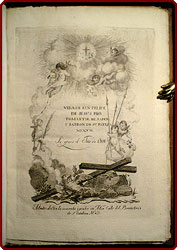
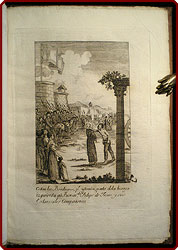 Click the interior images for enlargements. self-published this, the first entirely engraved book printed in the Americas. In a series of 30 plates with captions he told the biography of St. Philip of Jesus (1572–97), the protomartyr of Japan.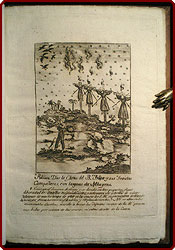
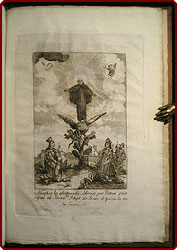
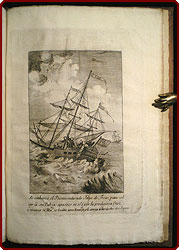
Montes de Oca's plates are particularly detailed and moving when they show the saint in Japan being abused and tortured, but all are strong and striking.
Uncut.
• Palau 363045. Late 19th-century plain sheep binding. Uncut; lacking two plates and two with minor worming as noted above; all plates well impressed, as would be expected of a work that the artist himself saw through the press! A very good copy of a scarce and important work. (25095)
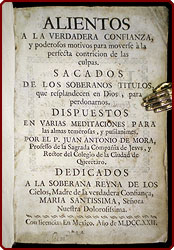
Interesting Mariology — A Fine Image of Her Mora, Juan Antonio de. Alientos a la verdadera confianza, y poderosos motivos para moverse â la perfecta contricion de las culpas. Sacados de los soberanos titulos, que resplandecen en dios para perdonarnos. Dispuestos en varias meditaciones para las almas temerosas y pusilanimes. Mexico: No publisher/printer, 1722. Small 8vo (14.5 cm; 5.75"). [12] ff., 238 pp., plt.
 Click the images for enlargements.
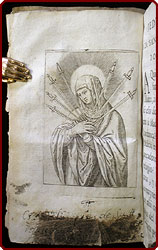
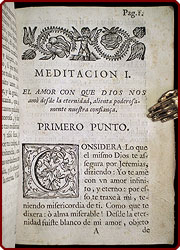
 An excellent, unsigned, copper engraving of Our Lady of Sorrows opposite the first page of the dedication represents each of the Seven Sorrows as a long sword piercing Her heart; “Meditacion I” with an absolutely charming headpiece.
No U.S. library reports ownership of this edition.
• Medina, Mexico, 2685; DeBacker-Somervogel, V, 1275. Contemporary vellum over paste boards, lacking the ties; vellum stained and worn through at board edges; text block loose in binding. Finger soiling in foremargins, old ink stains and some areas of light waterstaining here and there, some light foxing, instances of light dust-soiling. Ownership inscriptions in lower margins of two leaves inked over. Minor worming at inner margins at rear of book, touching some letters. (26870)
20 CHROMOSMurray, Hannah Lindley & Mary. The
toilet. Washington, DC: William Ballantine [Ballantyne], 1867. 8vo (21 cm, 8.25"). [4] pp.; 20 col. plts.


 Click the interior images for enlargements.
 Provenance: Inscription to Ellie Bond Robinson (from her cousin Elizabeth); elegant small booklabel, “Gardner.”
• Publisher’s textured cloth, framed in blind, front cover with gilt-stamped title; covers and corners showing very slight traces of wear. Front free endpaper with small booklabel and with inked gift inscription dated 1887. One flap (“Circumspection”) lacking, with all other flaps present and working. An attractive copy of an uncommon item.
Illustrated
English Translation:
HERETICS
in the MOUNTAINS
Muston, Alexis. The Israel of the Alps: A history of the
persecutions of the Waldenses. London: Ingram, Cooke, & Co., 1852. 8vo (19.5 cm, 7.75"). vii,
[1], 312 pp.; 7 plts.
 Click the images for enlargements.
 Binding: Publisher's embossed brown cloth in pattern incorporating foliage, heraldic shields, and the words “National Illustrated Library”; spine with gilt-stamped title and floral decorations.
• Binding as above, cloth gently faded and partially split over joints, corners and spine tips rubbed. Ex–social club library: 19th-century bookplate, inked call number on front free endpaper, no other markings. Back pastedown with London bookseller's ticket. Sewing going, two signatures separated and other leaves starting. One leaf with tear from lower margin, extending into text with loss of one or two letters; one section with small edge chips. Pages age-toned. (26411)
“Marble is Never Commonplace”
National Association of Marble Dealers. The everyday uses of marble. Cleveland: The National Association of Marble Dealers, © 1927. 8vo. 76 pp.; illus.
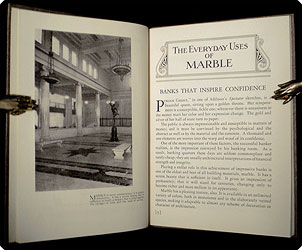 Click the images for enlargements. photographs of a wide variety of interiors and exteriors.
• Publisher's brown marbled, textured paper–covered boards, front cover with gilt-stamped title. Clean and unworn. Not a commonplace copy! (26833)
First U.S. Edition: Icelandic Travel Book
Nicoll, James. An historical and descriptive account of Iceland, Greenland, and the Faroe Islands. New York: Harper & Brothers, 1841. 12mo (15.7 cm, 6.2"). Add. engr. t.-p., 360 pp.; 2 fold. maps, 1 plt. (incl. in pagination).
 Click the images for enlargements.
 Binding: Publisher's olive-brown vermiform cloth of Krupp's style Mis1, spine with gilt-stamped series and individual title.
• Sabin 32058. On binding: Krupp, Bookcloth in England and America, 1823--50, Mis1. Binding as above, head of spine chipped, front joint with small spot of insect damage. Ex–social club library: 19th-century bookplate and small call-number ticket on front pastedown, title-page pressure-stamped, no other markings. First map creased, outer edge slightly tattered. Pages age-toned. A nice copy. (26418)
Caroline Norton's SoleKeepsake Effort Norton, Caroline, ed. The keepsake for MDCCCXXXVI. London: Longman, Rees, Orme, Brown, Green, & Longman, [1835]. 8vo (18.9 cm, 7.45"). Add. engr. t.-p., [4], 324 pp. (pagination skips 300–303); 18 plts.
 Click the images for enlargements. The volume is illustrated with 18 steel-engraved plates and an additional engraved title-page.
Binding: Crimson straight-grain morocco, covers framed in blind and panelled in quadruple gilt fillets with gilt-stamped corner fleurons, board edges and turn-ins with gilt rolls. All edges gilt.
• Faxon 1497. Binding as above, edges and extremities lightly rubbed with corners bumped, joints and edges darkened, lower spine compartment discolored. Title-page and two others institutionally pressure-stamped. Pages gently age-toned with a few scattered light spots, generally clean. (26033)
“CLOUD-LANDS” Oakley, Amy. Cloud-lands of France. New York: Century Co., 1927. 8vo. xxiii, [1], 497, [1] pp.; illus. 

• Publisher's cloth, covers and spine gilt-stamped; corners and extremities very slightly rubbed, dust-jacket lacking, otherwise a beautiful copy. (18414)
BRITTANY Oakley, Amy. Enchanted Brittany. New York: Century Co., 1930. 8vo. Frontis., xix, [1], 437, [1] pp.; illus. 

• Publisher's blue cloth, front cover and spine with gilt-stamped title; spine slightly sunned, dust-jacket lacking. (18410)
Life Without Pipe Dreams? O'Neill, Eugene. The iceman cometh. New York: The Limited Editions Club, 1982. Folio. xv, [5], 153 pp.; 10 plts.


 signed on the colophon page by the illustrator, Leonard Baskin. Baskin both created the ten full-page drawings of the characters, one of them an original lithograph, and designed the book, choosing a Monotype Janson font, which was composed and bound at the Stinehour Press in Ludenburg, Vermont. Art historian Irma Jaffe analyzes the illustrations and traces the parallels in the art and lives of Baskin and O'Neill in her introductory essay, “O'Neill and Baskin: the iconography of a double exposure.”
The binding is full grey paper–covered boards with printed paper labels on the spine and front cover. It is rather bleak-looking — which is perfectly appropriate given the nihilistic theme of the play.
This offering includes the monthly newsletter.
• Limited Editions Club, Bibliography of the Fine Books Published by The Limited Editions Club, 1929–1985, 525. Binding as above. Fine, in a fine slipcase. (21758)
Travelling
the Great Northern Route
— 21 Plates
& a
Large Folding Map
Ontario
and St. Lawrence Steamboat Company. The
Ontario and St. Lawrence Steamboat Company's hand-book for travelers to Niagara
Falls, Montreal and Quebec, and through Lake Champlain to Saratoga Springs.
Buffalo: Jewett, Thomas & Co., Geo. H. Derby & Co., 1852. 12mo (19.1
cm, 7.5"). 158 pp.; 1 fold. map, 21 plts. (incl. in pagination).


 Click the images for enlargements. Niagara
Falls and beyond, from the “Great Northern Route. American
Lines” series. This particular journey is described as “one of the
favorite summer excursions so indulged in by all classes of the American people”
(p. 25). The volume is illustrated with an oversized, folding map (28 x 20 cm)
of the routes from Albany to Niagara Falls, Buffalo, and Montreal (with an engraved
image of the Falls), as well as a frontispiece and 20 other wood-engraved plates
depicting scenic views to be found along the way. The plates are mostly by Benjamin
C. Vanduzee and J.P. Hall, after John Van Cleeve.
Click the images for enlargements. Niagara
Falls and beyond, from the “Great Northern Route. American
Lines” series. This particular journey is described as “one of the
favorite summer excursions so indulged in by all classes of the American people”
(p. 25). The volume is illustrated with an oversized, folding map (28 x 20 cm)
of the routes from Albany to Niagara Falls, Buffalo, and Montreal (with an engraved
image of the Falls), as well as a frontispiece and 20 other wood-engraved plates
depicting scenic views to be found along the way. The plates are mostly by Benjamin
C. Vanduzee and J.P. Hall, after John Van Cleeve.
Provenance: Front pastedown with inked ownership inscription of Ida M. Hardy, dated 1867. The book itself, alas, provides no indication whether Ms. Hardy was a traveller of the actual or armchair sort.
• Sabin 57368. Not in Phillips, List of Maps of America. Publisher's brown cloth of Krupp's style Lea8, covers blind-stamped, front cover with gilt-stamped title; a little sunned with corners bumped and binding slightly cocked. Front pastedown with inscription as above, front free endpaper with mostly erased pencilled inscription. Mild smudging to some page edges; a few leaves with light waterstaining to lower outer portions. One leaf torn, repaired some time ago with cellophane tape, touching but not obscuring five words; map with short tear from lower edge, upper edge a bit crumpled. A solid copy, with map and all plates. (26666)
Illustrated — Inspiring — Sumptuous Orsini, Mathieu, abbé, & J. Sadlier. Life of the blessed virgin Mary, mother of God; with the history of the devotion to her. Completed by the traditions of the East, the writings of the fathers, and the private history of the Jews. Translated from the French of the Abbé Orsini, by Mrs. J. Sadlier. New York, Boston, & Montreal: D. & J. Sadlier & Co., 1861. 4to. [4], xxviii, 225, [3], 311, [12], 8–192, 133 pp.; 22 plts.
 Click the images for enlargements.
 Illustrated with 22 engraved plates (each with protective tissue guard), an added engraved title-page (in color), and in-text engravings used as chapter tail-pieces. Text printed within an engraved decorative border, repeated throughout.
• Publisher's full red morocco, elaborately stamped in gilt. Spine with raised bands, gilt center devices and lettering in spine compartments. Front cover bears a gilt image of the Blessed Virgin framed in an oval, with “Mary A. Dunigan” stamped in gilt beneath it; back cover bears a gilt-stamped crucifix within an oval. All edges gilt. Rubbing at edges and joints. Front joint starting and weak. Scratch-marks. Some spotting to plates and tissue guards. Very light waterstaining in margins of later pages. Chip at top margin of two leaves, only. Very good condition, without ownership markings. (14268)
Poëmata Embellished withLovely Engravings Orville, Pierre d'. Poëmata. Amstelaedami: Apud Adrianum Wor & Haeredes Gerardi, 1740. 8vo (22.7 cm, 9"). Added engr. title-page, [18], 291, [1] pp.


Uncommon. OCLC and NUC Pre-1956 find only four U.S. holdings.
• Brunet 13064. Contemporary vellum, covers framed and panelled in blind with blind-tooled central lozenge, spine with hand-inked title; front cover slightly warped, binding dust-soiled. Front pastedown institutionally rubber-stamped. Scattered spots of light to moderate foxing. Errata (final page) lined through in ink. (24490)
Parry’s
First Voyage — Plates,
Maps,
StoriesParry, William Edward. Journal of a voyage for the discovery of a north-west passage from the Atlantic to the Pacific.... London: John Murray, 1821. 4to (27.3 cm, 10.75"). [4] ff., xxix, [3], 310, [2], clxxix, [3 (2 adv.)]pp.; 14 plts., 4 fold. maps, 2 maps.

 Click any image above for an enlargement.
The copper-engraved, oversized frontispiece
map shows Baffin's Bay, Barrow's Straits, Prince Regent's Inlet, and the North
Georgian Islands, as well as the bay named after Parry's two ships.
• Arctic Bibliography 13145; Hill (2nd ed.) 1311; Sabin 58860. Recent quarter calf over marbled paper–covered sides, spine with gilt-stamped leather title and author labels, and gilt-stamped anchor decorations in compartments. Title-page and a few others, plus reverse of 1 map, lightly stamped by a now-defunct institution. Pages gently age-toned, with occasional offsetting from engraving and the odd spot or smudge. One map with small portion of inner margin reinforced; final two leaves with inner margins reinforced; one plate with tears into image and mounted. Final advertisement leaf bound in before final text leaf. All edges marbled.

Design Manual, Used by aFemale Philadelphia Art Student? Peale, Rembrandt. Graphics, the art of accurate delineation; a system of school exercise, for the education of the eye and the training of the hand, as auxiliary to writing, geography, and drawing. Philadelphia: E.C. & J. Biddle, 1853. 8vo (18.7 cm, 7.4"). [6 (adv.)], xvii, [1], 22, [2], 27–132 pp.; 41 plts.

 Click the images for enlargements. 41 plates depicting various aspects of line production and calligraphy.


• Contemporary quarter black sheep with black ribbed cloth–covered sides, spine with gilt-stamped title; spine much rubbed, corners and edges far less so. Front pastedown with inscription as above. Pages and plates clean. (27050)
 The OnlyGIFT of Its Kind Percival, Walter, ed. Friendship's gift: A souvenir for MDCCCXLVIII. Boston: John P. Hill, [1847]. 12mo (19.3 cm, 7.6"). Frontis., add. engr. t.-p., vi, [2], [13]–312 pp.; 8 plts.
 Click the images for enlargements.
 Signed binding: Black sheep in imitation of morocco, covers framed in heavy gilt borders surrounding gilt-stamped arabesque designs, spine gilt extra; front free endpaper with bookbinder Bradley's small pressure-stamp. All edges gilt.
• Faxon 224. Not in Hamilton, Early American Book Illustrators. On binder's stamp, see: Spawn & Kinsella, American Signed Bindings, 55f. Binding as above, minor wear to corners, spine with tiny scuff towards foot; binding clean and bright. Pages with varied degrees of foxing/staining and age-toning. Very spiffy. (26673)
Virtuous EMBLEMS — Engraved Title-Pageafter RUBENS Pietrasanta, Silvestro. Symbola heroica. Amstelaedami: Janssonio Waesbergios & Henr. Wetstenium, 1682. 4to (21.3 cm, 8.4"). lxxx, 480, [32] pp.; illus. (lacking 1 portrait).


 Click the images for enlargements. 264 in-text copper engravings. One emblem features a telescope aimed at the sun, with the heading “Non ideo maculor”; Pietrasanta's anti-Galilean explanation is that any flaws to be perceived in the character of a virtuous prince are as imaginary as the illusory sunspots created by optical vibrations.


BENEDICTINES Come
to the New WorldA
FINE Engraved Title-Page & 18 Splendid Plates[Plautius, Caspar]. Nova typis transacta navigatio novi orbis Indiae occidentalis.... [Linz], 1621. Folio (32.6 cm, 12.875"). )(4 (-)(4, blank) A–M4 N4 (-N4, blank); Engr. t.-p., [2] ff., 101, [1] pp.; 18 plts. 


 This
book bears an ornate, emblematic engraved title-page, with portraits of St.
Brendan and Boyl and more, and no fewer than 18 leaf-filling plates by Wolfgang
Kilian. These plates, which mixfancy and realism in entirely engaging ways, include
a portrait of Columbus, a scene of St. Brendan celebrating mass on the back of a whale, botanical images of the marvelous Peruvian potato, and numerous views of the missionaries’interaction with the natives, some friendly, and some not—the unfriendliest being notably violent and gory. Also, on p. 35–36 is given an example of purportednative
American music, with both words and notation. This copy is one (probably the first) of two states of this sole edition (with only three leaves in the preliminaries), without the additional foldout plate found in some copies.
This
book bears an ornate, emblematic engraved title-page, with portraits of St.
Brendan and Boyl and more, and no fewer than 18 leaf-filling plates by Wolfgang
Kilian. These plates, which mixfancy and realism in entirely engaging ways, include
a portrait of Columbus, a scene of St. Brendan celebrating mass on the back of a whale, botanical images of the marvelous Peruvian potato, and numerous views of the missionaries’interaction with the natives, some friendly, and some not—the unfriendliest being notably violent and gory. Also, on p. 35–36 is given an example of purportednative
American music, with both words and notation. This copy is one (probably the first) of two states of this sole edition (with only three leaves in the preliminaries), without the additional foldout plate found in some copies.


• Alden & Landis, European Americana, 621/100; Sabin 63367; Palau 224762. Binding as above and shown at left (distortion noted), chipped on corners and at head and foot of spine. Small wormholes visible on inside of covers, running into margins of pages and plates, and a few closed tears, neither affecting print or plates. Engraved title remounted. Small stains, light spots of waterstaining, and light soiling.
A
very covetable illustrated Americanum of the early 17th century, in an enjoyable copy.


Single-click
any image above, for an enlargement.
Get
Cured or
Get CleanYOU
Choose: “Druggs”
or Soap [A FAVORITE BOOK HERE]
Pomet, Pierre. A compleat history of druggs, written in French by Monsieur Pomet ... To which is added, what is further observable on the same subject, from Mess. Lemery and Tournefort ... Illustrated with above four hundred copper cutts ... Done into English from the originals. London: Pr. for R. & J. Bonwicke, and R. Wilkin; John Walthoe & Tho. Ward,, 1725. 4to (22.5 cm; 9"). xii, 419, [1] pp., [4] ff.; 86 plts.
[A FAVORITE BOOK HERE]
Pomet, Pierre. A compleat history of druggs, written in French by Monsieur Pomet ... To which is added, what is further observable on the same subject, from Mess. Lemery and Tournefort ... Illustrated with above four hundred copper cutts ... Done into English from the originals. London: Pr. for R. & J. Bonwicke, and R. Wilkin; John Walthoe & Tho. Ward,, 1725. 4to (22.5 cm; 9"). xii, 419, [1] pp., [4] ff.; 86 plts.


 86 etched plates, mostly with four
specimens per plate; but there are also full-page images of a silk factory, a fishery, and of “negro's [sic] making Roucou.” Other plates are of unicorns, whales, rhinos, elephants.
86 etched plates, mostly with four
specimens per plate; but there are also full-page images of a silk factory, a fishery, and of “negro's [sic] making Roucou.” Other plates are of unicorns, whales, rhinos, elephants. 
 Americana content is noteworthy, with discussion of cacao, chocolate, “guinea pepper,” “long American pepper,” tobacco, and so on. Two surprising sections are devoted to glass manufacture and achieving color in glass, and soap making.
• Wellcome Catalogue, IV, 412; Graesse, Trésor de Livres rares, V, 398; Alden & Landis 725/158; not in Sabin; ESTC T111989; Pritzel 7258n; Junersforgg & Hasenkamp, Coffee, 1177– 1179. Recent full calf antique-style with gilt concentric panels on covers and gilt corner devices on same; round spine with raised bands, each accented by gilt rules. Some plates closely trimmed at foremargin. A very pleasing copy. (21774)
A
PRB&M “FEATURED BOOK” —

Prize
Binding, withthe
CertificatePomey, François. Pantheum mythicum, seu Fabulosa deorum historia hoc epitomes eruditionis volumine brevitur dilucidéque comprehensa. Amstaelodami: Ex officina Schoudeniana ; Trajecti ad Rhenum: Apud J.J. a Poolsum, 1777. Small 8vo (15.5 cm; 6"). [8] ff., 298, [7] ff., 27 plts. (4 fold.).
 27 plates, four of which are folding. The text is edited by Samuel Pitiscus (1637–1727).

Provenance: With the printed and folding ex-proemium of J.J.S. van Goltstein van Hoekenburg, Jan. 1819.
• DeBacker-Sommervogel, VI, 976. Binding as above. All edges marbled. A very good copy; text block very slightly skewed in binding.
If
YouLook
Like a Swine
. . . Porta, Giambattista della. Della fisionomia dell'huomo.... Venetia: Presso Christoforo Tomasino, 1644. 4to (23 cm, 9"). a6 A–Z8 Aa–Nn8; [6] ff., 570 (i.e., 572) pp., [2] ff.; illus. 

"Porta's system . . . leads him constantly to conclusions of analogies between plants, animals and men. Similar humours are found in various apparently unrelated organisms. Plants and animals that correspond in shape are interrelated. A leaf formed like a stag horn shares the character of the deer. The horse is a noble animal, therefore it is a sign of nobility to walk erect with the head held high. Men who resemble a donkey are like that animal: timid, stupid, nervous. He who looks like an ostrich is akin to it in character: he is timid, elegant, vicious, stolid. A man who reminds us of a swine is a swine, eating greedily and having all the other characteristics, such as rudeness, irascibility, lack of discipline, sordidness, lack of intelligence [and] modesty. In a similar way, men who look like ravens are impudent; those who resemble oxen are stubborn, lazy, irascible; men who have lips shaped like those of a lion are hearty, magnanimous, courageous; others who make us think of a ram are timid, malicious and humble. When practising medicine, Porta had many occasions to observe his patients, and to study their character and complexion; the results of this studious inquiry are laid down in his book." (Seligmann)
 This
work was written in Latin and first published in 1586 under the title De
humana physiognomia. It saw 19 editions before 1701, and has been translated
into Italian (1598; translation by Salvatore Scarano), German (1651), French
(1655), and English (1817).
This
tenth Italian edition is replete with a large number of intriguing (and humorous)
woodcuts. The first is a portrait
of Porta, and, while some of the rest show anatomical figures, the vast majority
contrast the shapes of faces and bodies of animals and men. The title-page vignette
is of Aesculapius, the Greco-Roman god of healing.
This
work was written in Latin and first published in 1586 under the title De
humana physiognomia. It saw 19 editions before 1701, and has been translated
into Italian (1598; translation by Salvatore Scarano), German (1651), French
(1655), and English (1817).
This
tenth Italian edition is replete with a large number of intriguing (and humorous)
woodcuts. The first is a portrait
of Porta, and, while some of the rest show anatomical figures, the vast majority
contrast the shapes of faces and bodies of animals and men. The title-page vignette
is of Aesculapius, the Greco-Roman god of healing.
Appended to Della fisionomia humana are the Fisionomia naturale of Giovanni Ingegneri († 1600), the Physionomia of Polemon (ca. a.d. 88 – a.d. 145) in an Italian translation, Porta’s Della celeste fisionomia (a repudiation of astrology), and two short related treatises by Livius Agrippa and Luigi Settala (1552–1633). Della celeste fisionomia has a number of interesting woodcuts showing pagan gods and constellations.
• Seligmann, The History of Magic, 319. On physiognomy,
see: Thorndike, History of Magic and Experimental Science, VII, 448
& following. On Porta, see: Webster’s New Biographical Dictionary
811. Vellum over paste boards, soiled and cockled with a little chipping and
front joint opening. Ex-library: paper labels on spine and rubber-stamps,
including one on title-page. Pages cockled with traces of soiling on top edges;
a few edges bumped. Plates
in very clear, strong impressions.
Long the Standard in its Field — Many Illustrations Potter, John. Archaeologia graeca or the antiquities of Greece. The fifth edition. London: Ja. & Jo. Knapton, R. Knaplock, J. & B. Sprint, et al., 1728. 8vo (19.8 cm, 7.75"). 2 vols. I: iv, [4], 464, [28 (index)] pp.; 2 fold. plts., 7 plts. II: [4], 420, [36 (34 index, 2 adv.)] pp.; 9 fold. plts., 13 plts.


 Click the images for enlargements. illustrated with 31 copper-engraved plates (11 folding) depicting temples, theatres, wrestlers and other burly athletes, armor, military maneuvers, ships, and elephant- and horse-drawn war carriages; the title-pages are printed in red and black, and the text is ornamented with head- and tailpieces in addition to decorative capitals.

 Present here under a handsome headpiece is a vigorous two-page note from "THE BOOKSELLERS TO THE READER," explaining why first editions are not always to be preferred and why some editions may not be among the trustworthy!


Powell’s Report on theUinta MountainsPowell, J.W. Report on the geology of the eastern portion of the Uinta Mountains and a region of country adjacent thereto. Washington: Government Printing Office, 1876. Folio (30 cm, 11.75"). vii, [1], 218 pp.; 4 plts.

• Publisher’s cloth, spine with gilt-stamped title (attractively oxidized); cloth rubbed at extremities, spine with small spot of faint discoloration from a now-absent label. Front pastedown institutionally rubber-stamped (no other markings). Erratum slip tipped in. A cleaner copy than most seen on the market.
“In Vienna Everyone Worships the Opera” Prawy, Marcel. The Vienna Opera. New York: Praeger Publishers, 1970 (© 1969). 4to. 224 pp.; illus. extensively illustrated history of “the very center of Viennese culture.”
Click the image for an enlargement.
extensively illustrated history of “the very center of Viennese culture.”
Click the image for an enlargement. • Publisher's cloth, virtually pristine, in excellent dust wrapper with minimal rubbing to spine extremities. (26317)
Prescott’s
PERU — Pasta
españolaPrescott, William Hickling. History of the conquest of Peru, 1524–1550. Mexico City: Imprenta Nuevo Mundo for the members of the Limited Editions Club, 1957. Folio (32 cm, 12.6"). xxxvi, 252 pp., [2] pp.; illus.


signed by the illustrator and by Harry Block, the printer. The book was designed and issued to be a companion volume to the Club’s printing of Bernal Diaz del Castillo’s Discovery and Conquest of Mexico (Mexico City, 1942).
The binding is full marbled sheep (pasta española) with gilt-stamped red spine-labels and raised bands accented with gilt rules.
• Limited Editions Club, Bibliography of the Fine Books Published by The Limited Editions Club, 1929–1985, 275. Original red slipcase; rubbed, chipped and splitting along edges, with some paper loss at corners; case spine sunned. Spine leather a bit darkened, bottom of front joint starting. A very good copy, in a good slipcase.
For
the LIMITED EDITIONS CLUB, click here.
Illustrated
Primer — “do
not lash the cat” — Philadelphia,
ca. 1860
Pretty
stories in easy words. Philadelphia: Davis, Porter & Co.,
[ca. 1860]. 16mo (13.3 cm, 5.25"). [2], 13–18 pp.; illus.

 Click the images for enlargements.
 Uncommon: OCLC and NUC Pre-1956 locate only four holdings, all in the U.S.
• Publisher's printed paper wrappers, front wrapper with early inked inscription in upper portion; paper just starting at foot of spine. Age-toned, otherwise clean and fresh. (25501)
For the InterestedSpanish Audience Prida y Arteaga, Francisco de la; & Rafael Pérez Vento. Méjico contemporáneo. Madrid: Est. tipo. de Fortanet, 1889. 8vo (21.5 cm; 8.25"). xxi, 399 pp. illus., ports.

 Click the interior images for enlargements. The
whole is illustrated with approximately 100 photogravures.
Click the interior images for enlargements. The
whole is illustrated with approximately 100 photogravures.
• Publisher's acid-stained sheep, round spine with gilt tooling
and two spine labels; rubbed at corners and extremities and with evidence
of old worm attack at lower part of front joint. Interior clean; in
fact, a very good copy. (25094)
A
Curious Text &
12 Remarkable Woodcuts
Priest, Josiah. The anti-universalist, or history of the
fallen angels of the Scriptures. Albany: J. Munsell, 1839. 8vo. 420 pp.; 12 plts. (incl. in
pagination).


 Click the images for enlargements.
 The twelve unsigned woodcut plates are full of energy both emblematic and artistic.
• Publisher's quarter tan cloth with blue paper-covered sides; boards stained and chipped with paper peeling, all extremities rubbed, and paper spine label mostly lost. Front hinge cracked, back hinge starting. Front pastedown with institutional bookplate; title-page with private owner's stamp in upper margin and old cataloguing excerpt affixed to lower margin. Lower outer corners waterstained in first half; pages cockled, with occasional faint spotting; first text page with newsprint blurb about Priest affixed in upper margin. A compromised copy, but an extraordinary production; interesting from a variety of perspectives. (15630)
Tips fromthe Prince of Ventriloquists Prince, Arthur. The whole art of ventriloquism. London: Will Goldston Ltd., [1922]. 8vo (18.3 cm, 7.2"). Frontis., 100, [4 (adv.)] pp.; illus.
 So many and various are these illustrations that we SIMPLY couldn't decide which to photograph!
Click the images present, for enlargements.
So many and various are these illustrations that we SIMPLY couldn't decide which to photograph!
Click the images present, for enlargements. Provenance: Front free endpaper with inked ownership inscription dated 1943 and with rubber-stamp of Kanter's Magic Shop, a famed but now-defunct emporium in Philadelphia.
• Publisher's gray-brown cloth without dust-jacket, front cover with black-stamped title and dummy vignette; spine very slightly darkened, edges and extremities with minor shelfwear. Front free endpaper as above. Pages age-toned. A nice copy. (26622)

Illustrations by Dulac Pushkin, Alexander. The golden cockerel. New York: The Limited Editions Club, n.d. [1950]. Folio. [4], 41, [3] pp.; illus.

 Click the interior images for enlargements.
 Edmund Dulac created the book's enchanting illustrations, consisting of 10 full-page and six in-text watercolors, a two-color decorative title-page, and decorative head- and tailpieces, and initials, also in two colors. Ernest Ingham designed the book using a monotype Poliphilus font.
The binding is full Russian-red cloth with apolished brass design of a cockerel set in the front cover and a gilt-lettered title on the spine. This edition is limited to 1500 copies and this offering includes the monthly mailing notice.
• Limited Editions Club, Bibliography of the Fine Books Published by The Limited Editions Club, 1929–1985, 205. Binding as above. In a glassine wrapper with shallow edge tears and chips, contained within a chemise covered with Russian-red paper with gilt cockerel design with gilt-lettered spine; spine sunned and paper chipped. The whole in an unevenly sunned slipcase, with slight loss of paper to top edge at mouth and spine. A fine book, in a good+ slipcase. (22314)
 TO
Part VIII . . . TO
Part VIII . . . |