 ILLUSTRATED
BOOKS \ CUTS & ENGRAVINGS
ILLUSTRATED
BOOKS \ CUTS & ENGRAVINGS
ILLUSTRATED
BOOKS \ CUTS & ENGRAVINGS
ILLUSTRATED
BOOKS \ CUTS & ENGRAVINGS
 |
 ORDERED
BY DATE ORDERED
BY DATE
|
FRENCH Woodcut-Illustrated
— Contemporary
Binding
Woodcut-Illustrated
— Contemporary
Binding
 Bible.
Latin. Vulgate. 1513. Biblia cum concordantiis veteris et novi testamenti
necnon et iuris canonici. Lugduni: M. Jacobum Sacon, 1513. Folio (34.5 cm, 13.5").
aa8 bb6 a–z8 A–Q8 R6
AA–BB8 CC10 (-aa1, CC9,10); [13], CCCXVII, [25] ff.
(lacking title-page & last 2 ff. of the Interpretationes).
Bible.
Latin. Vulgate. 1513. Biblia cum concordantiis veteris et novi testamenti
necnon et iuris canonici. Lugduni: M. Jacobum Sacon, 1513. Folio (34.5 cm, 13.5").
aa8 bb6 a–z8 A–Q8 R6
AA–BB8 CC10 (-aa1, CC9,10); [13], CCCXVII, [25] ff.
(lacking title-page & last 2 ff. of the Interpretationes).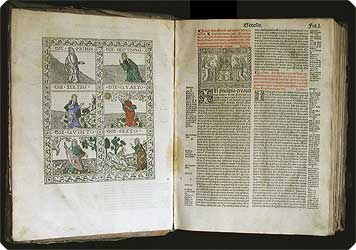
 Click any image where the hand appears on
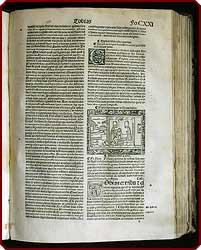
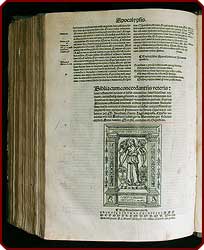
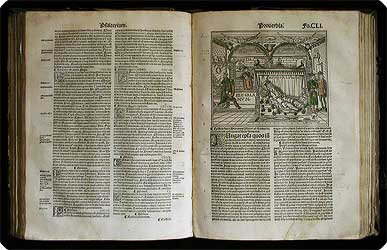
This Bible is illustrated with  two full-page and 130 in-text woodcuts (including some repeated images), a few of which have early hand-coloring, mostly but not entirely in green or
yellow. One full-page cut shows the six days of Creation — partially hand-colored in green, brown, red, blue, and yellow — while another depicts the manger scene. The text is followed by the Interpretationes nominum hebraicorum, a dictionary of Hebrew names often appended to manuscript and early printed Bibles.
two full-page and 130 in-text woodcuts (including some repeated images), a few of which have early hand-coloring, mostly but not entirely in green or
yellow. One full-page cut shows the six days of Creation — partially hand-colored in green, brown, red, blue, and yellow — while another depicts the manger scene. The text is followed by the Interpretationes nominum hebraicorum, a dictionary of Hebrew names often appended to manuscript and early printed Bibles.
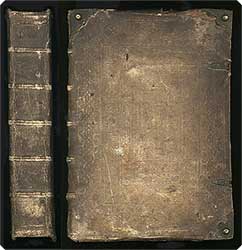
Binding: Contemporary blind-tooled, alum-tawed pigskin over beech boards, elaborately worked using embossing rolls with religious vignettes and busts. Covers with etched metal corner bosses and remnants of leather and metal clasps.
• Adams B988; c.f. Darlow & Moule 6101 & 6091.
Binding as above, spine with hand-inked title; overall dust-soiled and darkened
with several short tears to leather; leather no longer tight to the boards.
Straps, clasp locking-mechanisms, and lower front metal corner now lost. Title-page
and final two ff. of Interpretationes lacking; front pastedown separated
from board and back pastedown lacking. First and last few leaves with insect
damage to outer edges. First text page (contents) with old institutional rubber-stamp
and shadow of pencilled numeral. A few leaves separated; a number of leaves
with short tears from lower margins, a few extending into text, in many cases
with traces of old repairs. Two leaves with lower outer corners torn away,
one repaired some time ago. Pages age-toned, some waterstained. Scattered
contemporary inked marginalia; some light underlining and a few instances
of early inked doodling. Despite
its faults, and it is priced respecting them, this is rare and imposing.

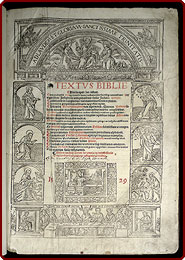
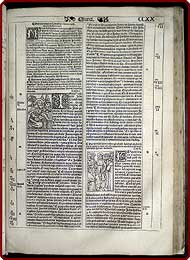
 An ILLUSTRATED RENAISSANCELarge Folio Bible Bible. Latin. Vulgate. 1529. Textus Biblie. [colophon: Impressum autem Lugduni {i.e.,Lyons}: per Joha[n]nem Crespin, M.ccccc.xxix {1529}]. Folio extra. [18], 268, [17] ff.
 Click the images for enlargement.
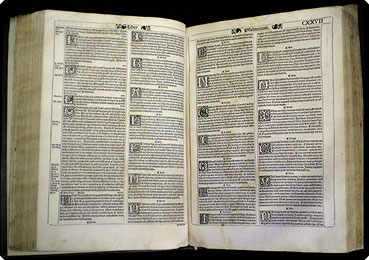
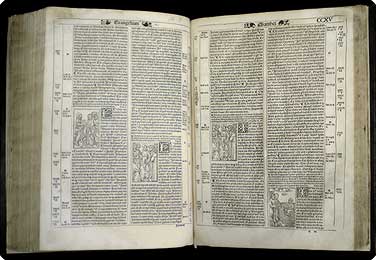
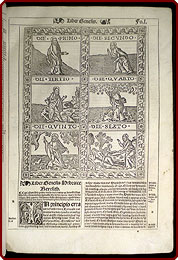
 more than 120 woodcuts. The woodcuts of the Old Testament are of good size, measuring approximately 3.8 x 6 cm (1.5" x 2.25") and with their four-element frames each one fills a text column left to right (5.5 x 8.5 cm; 2.25" x 3.25"). The cuts, “with the exception of the Creation, are close copies of those used in Jacques and Jean Mareschal's Lyons Bibles of 1523–1541" (Mortimer). They are also closely related to those used in Sacon's Bibles, which were by Hans Springinklee. The bottom border element on some has the initials “P B A” and the left and right elements of other frames read “Pour” “LEM.” The New Testament illustrations are smaller, 5.5 x 3.5 cm (2.25" x 1.375"), and each fills only half a column left to right.
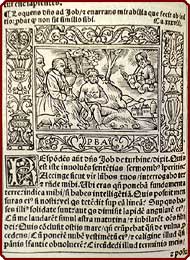
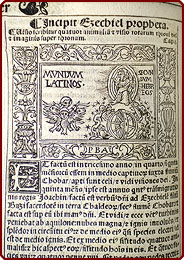
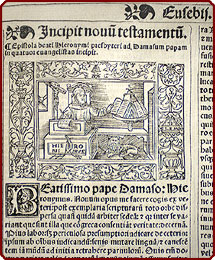
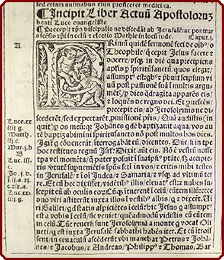
 Genesis opens with a gorgeous six-panel cut that is yet a bit larger, depicting God in His six days of Creation.
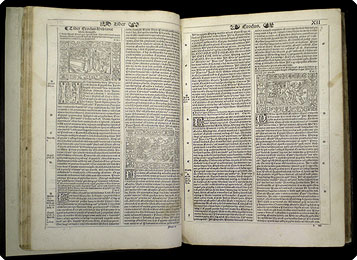
Evidence of readership: Scattered throughout are short marginal notes in a late 17th- or early 18th-century continental hand, in Latin, as well as underscoring and marks in the margins of important passages or words or thoughts.
This is the second Crespin edition, the first having appeared in 1527.
• Mortimer, French, 66; Fairfax-Murray, French, 36. Not in Darlow & Moule. Full calf old style: Round spine with gilt-accented raised bands and with title, place, and date gilt-stamped directly on spine; blind rules extending onto covers from each band to terminate in a trefoil, and covers framed in blind double fillets. Title-leaf crinkled; the occasional stain; moderate soil, light old staining, and/or wear variously to upper outer corners, lower gutter corners, and the odd foremargin, with a number of strengthenings to these instances. Marginalia slightly trimmed in 19th century. Library rubber-stamp on lower edges of closed volume; heavy library pencilling to a rear blank; no other such marks. Overall a good and satisfactory copy of a nicely illustrated Renaissance book. (24810)

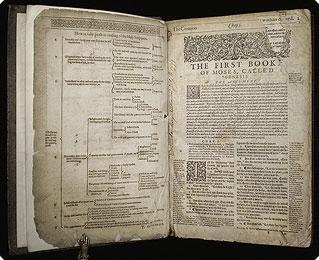
The LAST English “Breeches” Edition Bible. English. Geneva–Tomson–Junius. 1616. The Bible: that is, the Holy Scriptures contained in the Old and New Testament.... London: Robert Barker, 1616. Folio (31.1 cm, 12.25"). [1], 362 (i.e., 365), [7] ff. (t.-p., Apocrypha, & New Testament not present here; foliation extremely erratic); illus.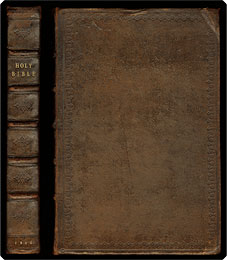
 Click the images for enlargements.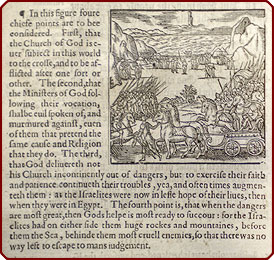
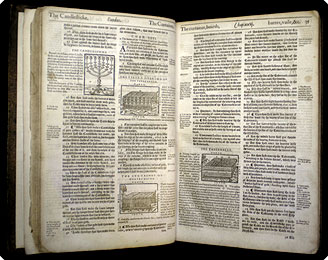
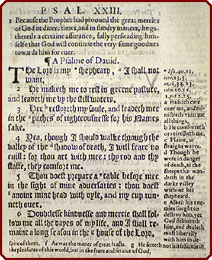
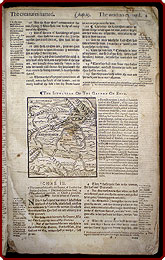
 black-letter folio edition, illustrated with a handful of in-text woodcuts (including the Ark and its paraphernalia, and charts of consanguinity). The copy consists essentially of the Old Testament and some additional matter; it lacks two of the four preliminary leaves (including the title-page, publication information being provided by the colophon) and it also lacks the Apocrypha and New Testament. It begins with “Of the incomparable treasure of the holy Scriptures”; the “Briefe Table of the interpretation of the proper names which are chiefly found in the Olde Testament” and the “Table of the principall things that are conteined in the Bible, after the order of the Alphabet” are both present.
• Darlow & Moule 270; ESTC S1792; Rumball-Petre, Rare Bibles, 130; STC (2nd ed.) 2244. Full later mottled calf, covers framed in double blind fillets and fleuron roll; spine with raised bands, blind-tooled compartment decorations, and gilt-stamped title and date; incomplete, with title-page, Apocrypha, and N.T. lacking. Binding rubbed/bumped at stress points, one compartment scuffed. Front free endpaper, first text page, and several others institutionally pressure-stamped; first page with rubber-stamped numeral in lower margin and early inked annotation regarding date of printing. Front free endpaper with affixed slips documenting gift donation in 1955, and with inked annotation regarding date; back pastedown showing traces of now-absent pocket. Tattering to first leaves not reaching text, and first one with recent repairs, second one with area of loss to upper outer portion affecting a border and ten lines of text, third one with central tear (touching woodcut map) repaired some time ago with tape, four leaves each with short tear from lower margin without loss, one leaf with lower outer corner torn away with partial loss of shouldernotes and image caption, final index leaf with hole affecting six lines. Expectable sorts of age-toning, dust-soiling, and light spotting/staining, only; lower outer corners of first quarter waterstained (often faintly). In sum a survivor; “breeches” in Genesis underlined in ink! (26072)
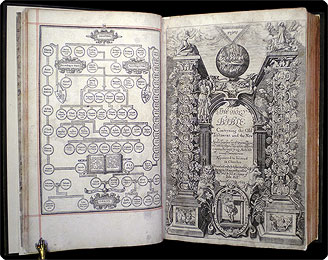
 Handsome KJV with Genealogies & Psalms Bible. English. Authorized (i.e., “King James Version”). 1632. The Holy Bible conteyning the Old Testament and the New. London: Robert Barker...by the assignes of John Bill, 1632. Folio (34 cm, 13.4"). [15], 507, [1] ff. (lacking 7 prelim. ff.).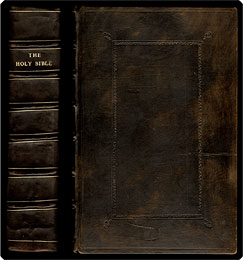
 Click the images for enlargements.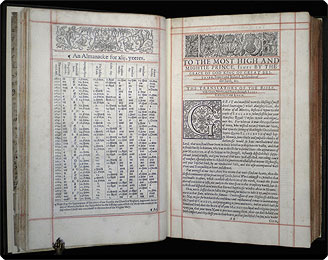
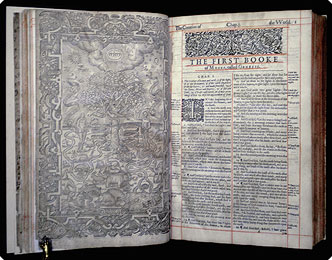
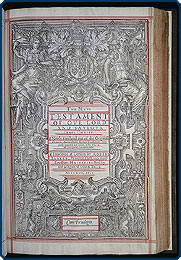
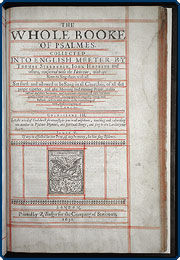
 The Psalter following the Bible includes music. The O.T. title-page is engraved and signed (very faintly in this example) by William (here “Guilielmus”) Hole, and is framed by an elaborate architectural border displaying the coats of arms of the 12 tribes of Israel and portraits of the 12 Apostles. The recto of the list of books is a full-page engraving of Adam and Eve in the Garden of Eden, surrounded by animals. The New Testament has a separate title-page, dated 1632, with an ornate wood-engraved border featuring Justice and Truth along with the British lion and unicorn and various architectural motifs.
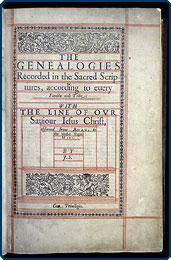
The volume opens with two fly-leaves bearing genealogical records in several different early inked hands, with dates ranging from 1743 through 1847. A copy of Speed's Genealogies precedes the Old Testament, while the “Description of Canaan” with map that should close the Genealogies has been bound in after the O.T. title-page.
• ESTC S122379; Darlow & Moule 359; STC (2nd ed.) 2298.5. Speed: ESTC S126191; STC (2nd ed.) 23039a.4. Psalms: ESTC S122383; STC (2nd ed.) 2633. Recent mottled calf, covers fillet-framed and panelled in blind with decorative inner blind roll and blind-tooled corner fleurons; spine with gilt-stamped title and gilt-ruled raised bands. Front cover with two slender scrapes; title-page with date altered in ink to 1633, as above. Front fly-leaves with margins repaired; “Description of Canaan” with inner margin reinforced. Bible, seven preliminary leaves lacking (calendar, dedication, preface, and list of books all present); Psalms, four final index leaves (only) lacking; foliation slightly erratic. Varying degrees of age-toning, occasional light waterstaining, some margins with faint smudging; in fact and in sum a nice volume to hold and work with. (26102)
Mill's Acclaimed Edition — Enhanced by Küster Bible. N.T. Greek. 1710. Mill. Novum testamentum graecum, cum lectionisbus variantibus mss. exemplarium, versionum, editionum, ss. patrum et scriptorum ecclesiasticorum; et in easdem notis. Accedunt loca scripturae parallela, aliaque exegetica. Praemittitur dissertatio de libris N.T. et canonis constitutione, et s. textus N. Foederis ad nostra usque tempora historia. Roterodami: Casparum Fritsch & Michaelem Böhm, 1710. Folio (36.5 cm, 14.4"). [22],168, [2], 632 pp.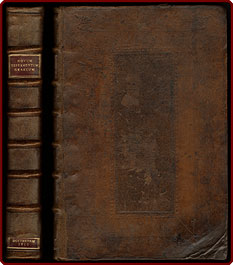
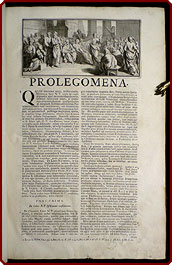
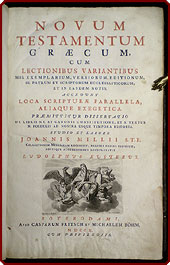 Click the images for enlargements. new collations of 12 additional manuscripts. The text is printed in double columns with notes in Latin and Greek; the title-page is in red and black, with a copper-engraved vignette done by Gilliam vander Gouwen after Bernard Picart. The volume also features a copper-engraved allegorical headpiece done by Picart after Adrian vander Werf, as well as five unattributed headpieces and assorted decorative capitals.
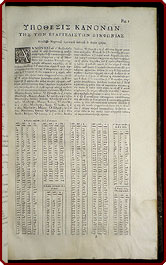
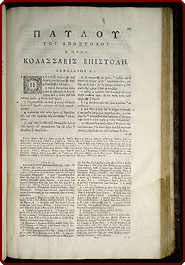
• This ed. not in Darlow & Moule, but mentioned in 4735. Contemporary speckled calf panelled in plain calf with blind tooling, rebacked with lighter speckled calf and spine with gilt-stamped leather title-label; original leather scuffed and abraded, corners rebuilt/refurbished (most notably the front lower outer one). Front pastedown with inked inscription as above, date partially obscured by institutional bookplate (no other markings). Waterstaining to lower portions of leaves, generally light to moderate with occasionally some other, associated soiling, and with cockling; paper not weakened or embrittled, however, and the volume now quite sound for scholarly use. (26241)
Syers’s
Bible — A Good ButDOOMED Production Bible. English. Douai–Rheims. 1811–13. The Holy Bible, translated from the Latin Vulgate... the Old Testament, first published by the English College at Doway, A.D. 1609, and the New Testament, first published by the English College at Rhemes, A.D. 1582; with annotations, references, and an historical and chronological index. Manchester: Oswald Syers, 1811–13. Folio (cm). [approx. 702] ff., lacking title–page, but having both cancel and cancelland of N.T. L2 present; (several signatures incorrectly signed); 19 plts. (1 excised & laid in).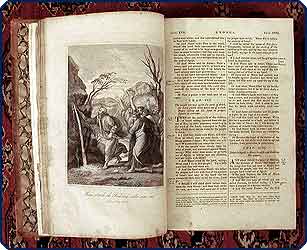
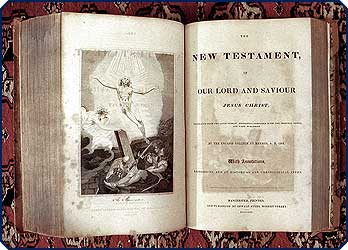 Click either image for an enlargement.
 The text generally follows the Challoner–Rheims revision, although the notes are collected from various sources. The volume is illustrated with two frontispieces and17 plates engraved by J. Bottomley, Symns and Mitchell, and others after paintings by Westall, Raphael, Reynolds, et al. Issued in parts in a small print run, this Bible is now uncommon.
• Darlow & Moule 1034. Contemporary treed calf, rebacked some time ago in plain calf with gilt-ruled bands and gilt-stamped title-label; sides rubbed and scraped, with spine scuffed, leather worn over extremities, front joint cracked from weight of oversized volume. Hinges (inside) reinforced with cloth tape. Lacking title-page. Plate from Genesis I:4 removed, and laid back in with margins cut away. First few leaves with edges ragged. Pages with offsetting around plates; occasional light spots of staining, mostly confined to outer margins.
First
U.S. Stereotype
Quarto
Bible —
MANYPlates
& Maps
Bible.
English. 1816. Authorized (i.e., “King James Version”).
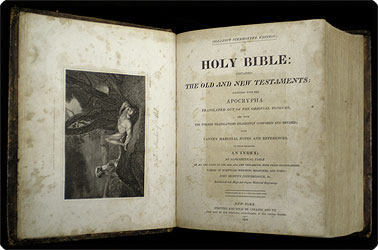
The Holy Bible: containing the Old and New Testaments: together with the
Apocrypha: translated out of the original tongues and with the former translations
diligently compared and revised; with Canne's marginal notes and references.
To which are added, an index; an alphabetical table of all the names in the
Old and New Testaments, with their significations; tables of scripture weights,
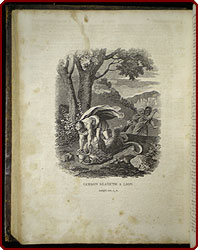
measures, and coins; John Brown's concordance, &c. Embellished with maps
and elegant historical engravings. New York: Collins & Co., 1816. 4to (28.5
cm, 11.25"). 683, [5], 160, [2], 687–932, 56 pp.; 20 plts., 4 maps, 1
fold. map.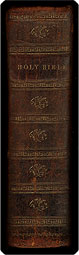
 Click the images for enlargements.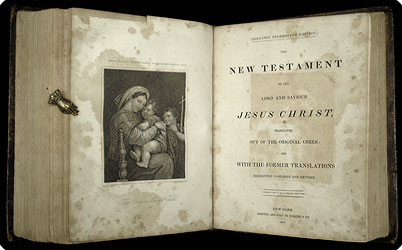
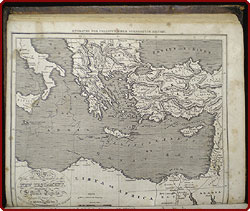
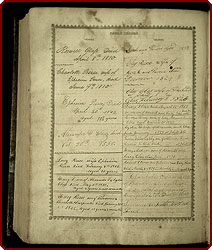
Provenance: Ownership note of “Ephraim Pierce” on front free endpaper, with the “Family Records” pages offering four pages (eight columns) on the Pierce family and its connections.
• Books Contained in the Library of the American Bible Society 15; Hills 296; O'Callaghan 128–29; Shaw & Shoemaker 36952; Wright, Early Bibles of America, 195–96. Contemporary mottled sheep, spine with gilt-stamped leather title-label, gilt-stamped Greek key bands, and gilt-stamped decorations consisting of a sickle, wheat, and an hourglass overlaid by an open book; binding rubbed overall, front cover with lower outer portion darkened, spine leather with minor cracking, spine with old inked shelving number in bottom compartment. Front pastedown with traces of now-absent bookplate, front free endpaper with early inked ownership inscription, title-page and two others institutionally pressure-stamped, preliminary advertisement with inked annotation along inner margin and rubber-stamped numeral in lower margin. Back fly-leaf with affixed contemporary religious clippings. Two plates torn, each with old hand-sewn repair in dark thread. Folding map torn along folds, one tear with small area of loss, edges tattered. Pages and plates predictably foxed, some browned; a few corners dog-eared. (26016)
 TEN Engraved Plates & a MapBible. English. Authorized. 1823. The Holy Bible: Containing the Old and New Testaments: Translated out of the original tongues.... Brattleborough, VT: Holbrook & Fessenden, 1823. 4to (27.5 cm, 10.9"). [6], 9–683, [5], 160, [2], 687–930, [2] pp.; 10 plts., 1 fold. map.

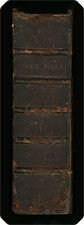
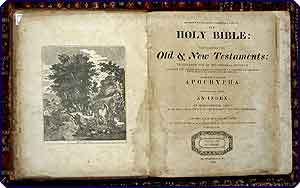
The family record leaves here were partially filled in with occasions in the lives of James M. Welling (b. 1807, d. 1882), his wife Susan Vail Welling (b. 1805, d. 1886), and their children; the final entry notes the death of Mark Hermon [sic] Wheeler in 1908.
Provenance: Front pastedown with small bookplate of prominent collector Michael Zinman.
• Hills 465 (describing 684 pp. andonly three plates); Shoemaker 11809 (for an edition of this year, but with only 684 pp.); O’Callaghan gives 1818 Holbrook stereotype edition only. Contemporary mottled sheep, spine with gilt-stamped title-label; binding rubbed and abraded, with leather cracking over spine and cracked over joints. Pages browned, with waterstaining to inner margins. One plate with hole to corner of image; oversized, folding map with small hole near edge.

Bible. German. 1829–34? Luther. Biblia, das ist: Die ganze Heilige Schrift des Alten und Neuen Testaments, nach der deutschen Uebersetzung D. Martin Luthers.... Philadelphia: Kimber & Sharpless, [ca. 1829–34?]. 4to (28.5 cm, 11.125"). Frontis., 975 pp.; 39 plts.; [2] ff. “Familien=Register” inserted between pp. 754 & [755]. 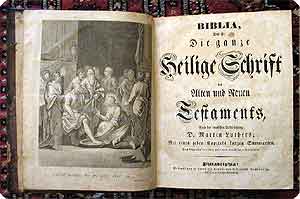
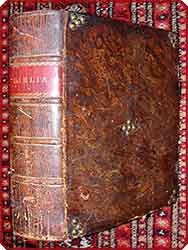 Binding: Contemporary treed calf with clusters of small bosses in center and at corners of covers; red leather label on spine, gilt-filletted and -rolled above and below and gilt-lettered; remnants of clasps on edges of covers. All edges saffron.
Provenance: Rubber-stamp of Lee D. Snyder on front pastedown, verso of title-leaf, and reverse of many plates.
• Cf. O’Callaghan 181; not in Darlow & Moule. Binding as above with some scratches; joints and edges rubbed. Small holes or chips out of a few pages with loss of individual letters, not affecting sense. Small hole in printed area of plate facing p. 119. Foxed with some soiling on the sectional title-page of the New Testament and a few darker spots elsewhere. A good, solid, satisfying copy.

PHINNEYTHUMB BIBLE Bible. English. Selections. 1829. History of the Bible. Cooperstown: H. & E. Phinney, 1829. 16mo (4.9 cm, 1.9"). 192 pp.; illus.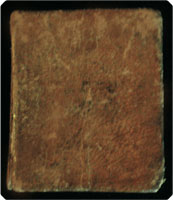
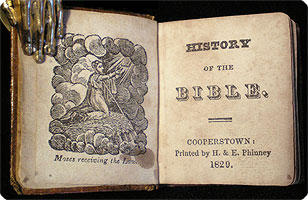
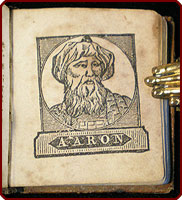
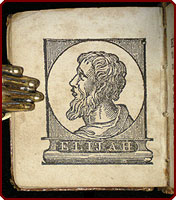 Click the interior images for enlargements.
 Adomeit notes that the “long run of Phinney Bibles . . . are distinctive as the majority of the cuts are portraits, which Stone suggests are portraits of neighboring farmers.” The present example is illustrated with 24 wood engravings.
Provenance: Early inscription “Abby A. Wades Book” on front free endpaper.
• Adomeit, Three Centuries of Thumb Bibles, A66; this ed. not in Rosenbach. Contemporary sheep, spine with gilt-stamped title, rubbed; spine leather cracked and front cover all but detached, but text block very sound and with all corners gently rounded in a style of the era. Endpaper with inscription above. Light to moderate foxing only. (25208)
PIRATED! Thumb Bible Bible. English. Selections and Paraphrases. History of the Bible. New-London: W. & J. Bolles, 1831. 32mo (5.3 cm, 2"). Frontis. (incl. in pagination), 192 pp.; illus.
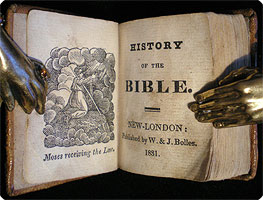
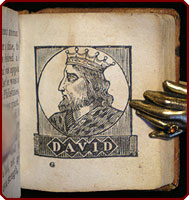
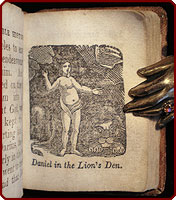 Click the interior images for enlargements.
 • Adomeit, Three Centuries of Thumb Bibles, A71; this ed. not in Rosenbach, Early American Children's Books. Contemporary sheep, spine with gilt-stamped title; slightly sprung, covers each with one small spot of worming, minor wear. Frontispiece recto with early pencilled inscription. Pages with some light spotting and occasional edge nicks. A nice example of this sort of production. (25201)
 Harper’s ILLUMINATEDFamily Records including Two for “Colored Servants”Bible. English. 1846. Authorized (i.e., "King James Version"). The illuminated Bible, containing the Old and New Testaments...With marginal readings, references, and chronological dates. Also, the Apocrypha....Embellished with sixteen hundred historical engravings by J.A. Adams, more than fourteen hundred of which are from original designs by J.G. Chapman. New York: Harper & Brothers, 1846. Folio (34.6 cm, 13.75"). Frontis., add. engr. t.-p., [4], 844, [2], 128, [6], frontis., add. engr. t.-p., [2], 256, 3, [1], 8, 14, 34 pp.; illus.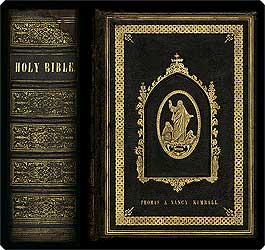
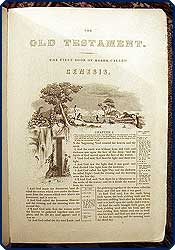
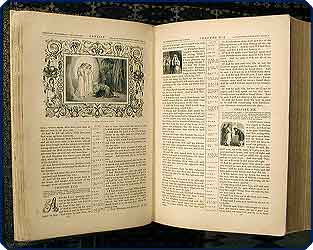 Single-click any image where the hand appears on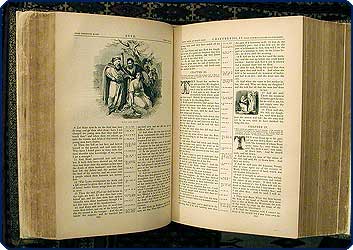
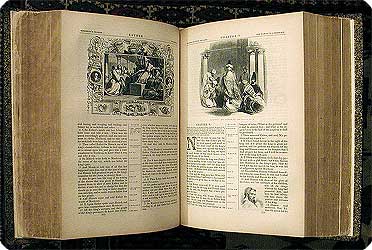
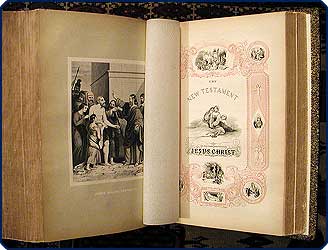
 At the bottom of the reverse of the “Death” leaf are two names inscribed in a different but also carefully ornate hand, within a circular title reading “Colored servants.”
• O’Callaghan 288–89; Hills 1161. Binding as above, carefully and reasonably rebacked, with portion of uppermost spine compartment left free of gilt; a few small scuffs, and some minor refurbishing over extremities. All edges gilt. First few leaves with outer edges ragged; pages very faintly age-toned, otherwise clean. A gorgeous copy, with the interesting manuscript additions described above.
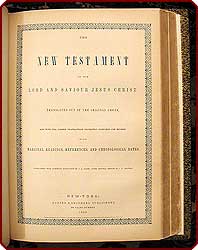
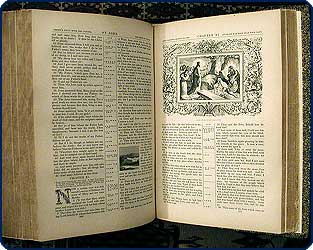
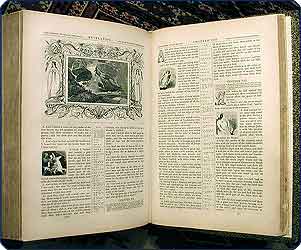
Large Paper & Luxurious!Bible. N.T. English. Authorized. 1864. The New Testament of our Lord and Saviour Jesus Christ. With engravings on wood from designs of Fra Angelico, Pietro Perugino, Francesco Francia.... London: Longman, Green, Longman, Roberts, & Green, 1864. 4to (29.5 cm, 11.75"). Frontis., [iii]–xvi, 540 pp.; illus.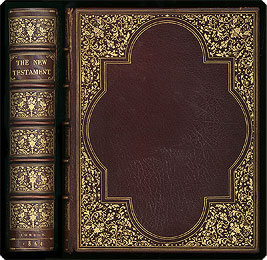
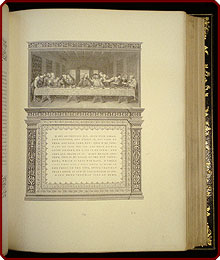 Click the images for enlargements.
 Binding: Signed reddish-brown morocco binding by Root & Son, with covers and spine gilt extra; extremely wide and handsome turn-ins elaborately gilt tooled — these last are illustrated in our last image here.
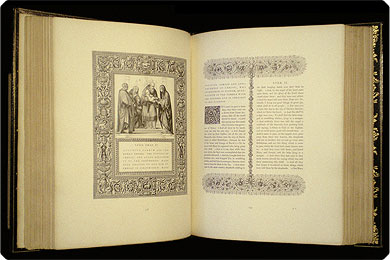
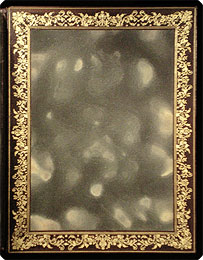
• Not in Darlow & Moule. Leather showing small rubbed spots over edges and extremities, with faint leather discoloration to part of front cover; front pastedown with traces of a now-absent bookplate. The weight of this substantial volume has partially cracked the front joint; however, with careful use (and storage on the volume’s back, not its lower edge), this damage should not quickly progress. A lavishly produced Victorian New Testament, in a still-impressive binding.
Ivy-Leaf Bible — Two-Color Frontispieces Bible. English. 1866. Authorized (i.e., “King James Version”). The Holy Bible, containing the Old and New Testaments, translated out of the original tongues, and with the former translations diligently compared and revised. Philadelphia: John E. Potter & Co., 1866. 4to (29.7 cm, 11.7"). 576, [4], 767, [1] pp.(lacking appended Psalms and concordance); 2 plts. (of 6).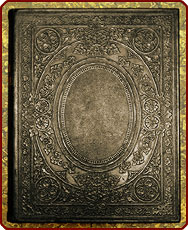
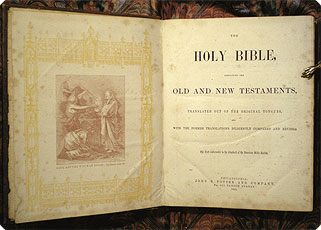
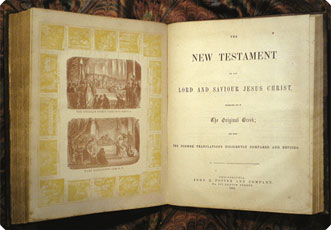 Click the interior images for enlargements.
 Provenance: The family register leaves record that one Peter Paul Shank, presumably the Bible's original owner, outlived three wives (born in 1833, he married in 1857, 1896, and 1903, and died in 1913 in Mineral Springs, NY). The birthdates of Shank and his wives are all listed, but no offspring are recorded.
Binding: Publisher's deluxe embossed brown roan in imitation of morocco, covers with central medallions surrounded by ivy motifs, spine with gilt-stamped title and blind-tooled knotwork and floral decorations.
• Hills 1796. Not in Wolf, From Gothic Windows to Peacocks. Binding as above, minor rubbing to joints, edges, and extremities. 64 pp. of appended material (index, concordance, metrical Psalms) lacking, with Biblical text and index complete; four plates (of six) lacking, with no indication of their ever having been present. Sewing loosening; first few leaves partially separated. Pages age-toned with some foxing. Front free endpaper torn from outer edge; one leaf with tear from outer margin, extending into text without loss. (24453)
Beautifully
IllustratedPulpit-Sized Bible — BIG!Bible. English. 1876. Authorized (i.e., “King James Version”). The self-interpreting Bible, containing the Old and New Testaments according to the Authorized Version.... New York: Johnson, Fry, & Co., 1876. Folio extra (42.5 cm, 16.75"). Engr. t.-p., xvii, [1 (blank)], 1030 (some pages out of order), 122 pp.; 73 plts. 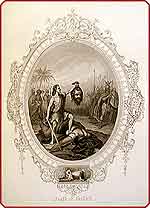
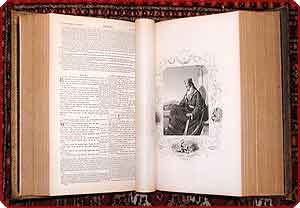
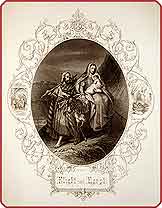
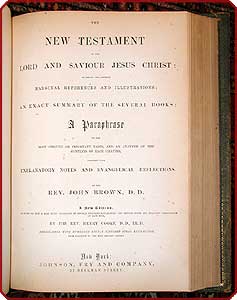
more than usually striking—that showing Christ being tempted by the Devil, with the Devil as an old man in black robes, being especially so.
Binding: Ornately gilt- and blind-tooled black morocco (with but remnants of gilt on covers and spine) including gilt inner dentelles. White silk endpapers. Purple silk placemarker. All edges gilt. 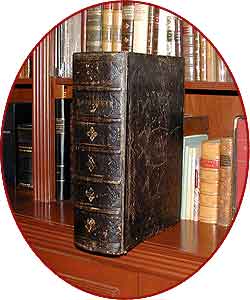
• Not in Hills. Binding as above, and at right; lightly rubbed and beautifully refurbished. Light foxing on engraved title-page and some plates; a few of the latter with traces of soiling; guard papers with occasional folding and a little tattering. Instances of light waterstaining, not affecting impression, on plates facing pp. 716 and 736; the plate facing p. 368 has remnants of adhesive. Pages lightly age-toned, with a few more instances of light waterstaining. Tears in the margins (only) of some leaves. Ownership inscription in ball point in a pretty hand on front pastedown, and notation in same hand on last page. Unusually
solid for a centennial-era Bible of this size—the weight of
such an imposing volume works against its retaining its covers as
here, over the years.

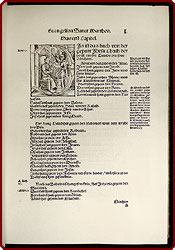
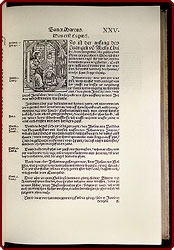
TheFamous September Testament — Well Evoked! Bible. N.T. German. (1522) 1883. Luther. Die Septemberbibel: Das Neue Testament deutsch von Martin Luther. Berlin: G. Grote, 1883. Folio (32.4 cm, 12.75"). [4], 9, [9] pp., CVII, [6], LXXVII, [26] ff.; illus.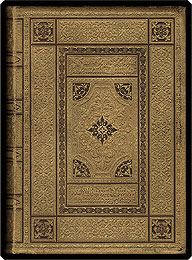
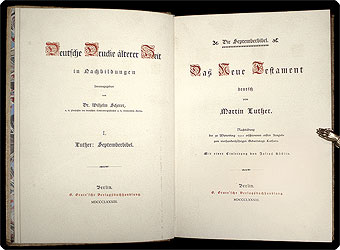 Click the images for enlargements. 21 full-page woodcuts by Lucas Cranach. Illustrating the Book of Revelation, the woodcuts appear here in their original state, before ordinary crowns took the place of the papal tiaras worn by the Antichrist and the Whore of Babylon.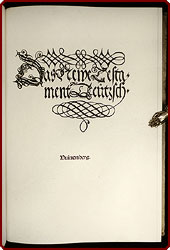
• Binding as above, with light rubbing; front pastedown with Leipzig bookseller's small ticket. Occasional faint smudges; pages mostly clean. A handsome thing. (26301)
Renaissance-InspiredDELUXE New Testament Bible. N.T. English. 1883. Authorized (i.e., “King James Version”). The New Testament of our Lord and Saviour Jesus Christ. With engravings on wood from designs of Fra Angelico, Pietro Perugino, Francesco Francia, Lorenzo di Credi, Fra Bartolommeo, Titian, Raphael, Gaudenzio Ferrari, Daniel di Volterra, and others. London: Longmans, Green, & Co., 1883. 4to (25.7 cm, 10.25"). xvi, 540 pp.; illus.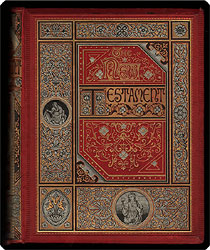
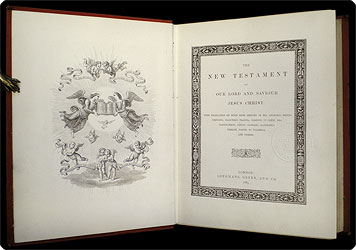
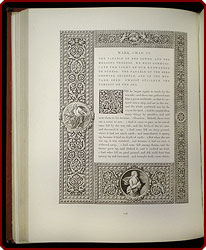 Click the images for enlargements.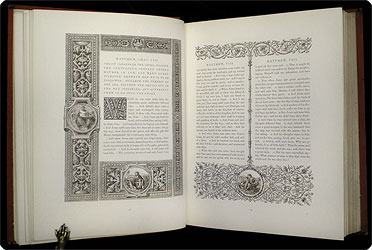
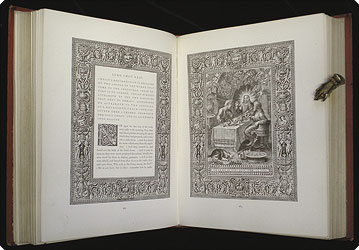
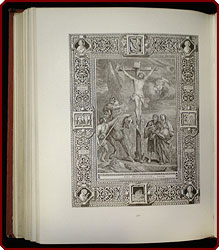
• Not in Darlow & Moule. Binding as above, corners and spine extremities mildly rubbed, a band at top of back cover a bit lightened in color. As with many examples of this publication, the volume's own considerable weight has partially cracked the front joint; however, with careful use (and storage on the volume's back, not its lower edge), this damage should not quickly progress. Title-page institutionally pressure-stamped (NOT rubber-stamped); no other markings. Clean and beautiful. (26123)

 For
other BIBLES, including
For
other BIBLES, including
 TO
Part III . . . TO
Part III . . . |