
 GREEK & LATIN
~ CLASSICS
GREEK & LATIN
~ CLASSICS
GREEK & LATIN
~ CLASSICS
GREEK & LATIN
~ CLASSICS
 The Sibylls & Zoroaster, Too!
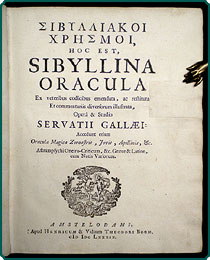
  Gallé, Servatius, editor. [two lines in Greek, romanized
as] Sibulliakoi chresmoi, [then in Latin], hoc est, Sibyllina oracula ex veteribus codicibus
emendata, ac restituta et commentariis diversorum illustrata, operâ & studio Servatii Gallaei:
accedunt etiam oracula magica Zoroastris, Jovis, Apollinis, &c. Astrampsychi Oneiro-criticum,
&c. graece & latine, cum notis variorum. Amstelodami: apud Henricum & viduam Theodori
Boom, 1689. Small 4to. [13 of 14] ff., 791, [1] pp., [13] ff., 127, [1 (blank)] pp.; without the
added engr. title-page.
Gallé, Servatius, editor. [two lines in Greek, romanized
as] Sibulliakoi chresmoi, [then in Latin], hoc est, Sibyllina oracula ex veteribus codicibus
emendata, ac restituta et commentariis diversorum illustrata, operâ & studio Servatii Gallaei:
accedunt etiam oracula magica Zoroastris, Jovis, Apollinis, &c. Astrampsychi Oneiro-criticum,
&c. graece & latine, cum notis variorum. Amstelodami: apud Henricum & viduam Theodori
Boom, 1689. Small 4to. [13 of 14] ff., 791, [1] pp., [13] ff., 127, [1 (blank)] pp.; without the
added engr. title-page.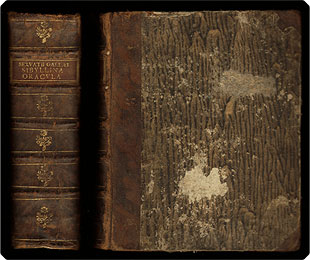
 Click the images for enlargements.
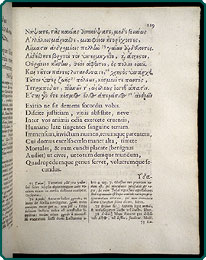
 Also contained here is the famous Oracula Magica Zoroastris cum Scolliis Plethonis et Pselli as edited by Johannis Opsopoeus.
• STCN 168904; Brunet, II, 1465; Caillet 10165; Hoffmann III, 396; Landwehr, Hooghe, 72; Schweiger, I, 287 . Contemporary half brown calf with mottled paper sides; spine with gilt-accented raised bands, red leather gilt label, and gilt devices in compartments; all edges interestingly marbled. Binding worn and top of spine pulled. Without the added engraved title-page, and a small, early paper repair on title-page; not a perfect copy, but certainly a decent one and priced accordingly. (26691)
 Prize Copy of
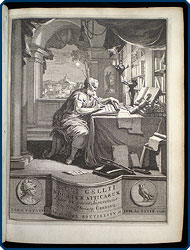
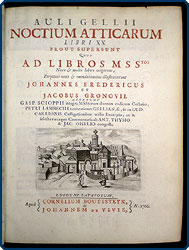
 the Attic Nights Gellius, Aulus. Auli Gellii Noctium atticarum libri XX prout supersunt quos ad libros msstos novo & multo labore exegerunt.... Lugduni Batavorum: Apud Cornelium Boutesteyn & Johannem du Vivié, 1706. 4to (26, 10.25" cm). Add. engr. t.-p., [34], 903, [65 (index; 1 final f. blank)] pp.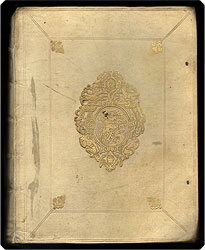
 Click the images for enlargements.
 The additional engraved title-page, done by P. Sluyter after a design by J. Groere, depicts the author at work on a moonlit night, and is decorated with medallions of Athena and her owl; the title-page is printed in red and black, with an engraved vignette of an Attic city.
Binding: Prize binding (without certificate) of contemporary vellum, covers framed and panelled in double blind fillets with gilt-stamped corner fleurons, gilt-stamped medallion on each cover showing a scimitar-wielding knight bearing two crossed keys on his shield, supported by monkeys and surmounted by lounging figures grasping snakes. Spine with gilt-ruled raised bands, gilt-stamped compartment decorations, and early inked title.
• Brunet, II, 1524; Graesse, II, 46; Schweiger, II, 379. Binding as above, small areas of discoloration, ties now lacking; front hinge (inside) very unobtrusively reinforced. Front pastedown with affixed slip of old cataloguing, partially obscuring an early inked annotation. Title-page with shadows of pencilled numeral and publication annotation. Some margins darkened or with mild spotting, pages otherwise clean, and all edges red. (25963)

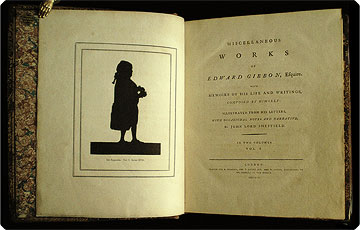
MuchMore than the Decline & Fall Gibbon, Edward. Miscellaneous works ... With memoirs of his life and writings, composed by himself: illustrated from his letters, with occasional notes and narrative, by John Lord Sheffield. London: A. Strahan and T. Cadell, Jr. & W. Davies, 1796. 4to (28.7 cm, 11.25"). 2 vols. I: Frontis., xxv, [1], 703, [1 (blank)] pp. II: viii, 726, [2 (errata & adv.)] pp.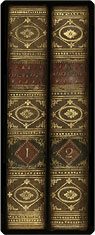
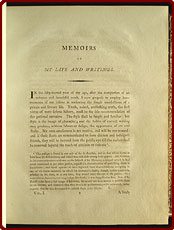
The work was additionally printed in Dublin and Basil in the same year. OCLC notes that a third volume was printed almost ten years later, by J. Murray; that supplementary volume is not present here.
Signed binding: Contemporary treed calf, covers framed in gilt rolls, beautifully rebacked with gilt-stamped spines preserving handsome original gilt-stamped, two-color leather title and volume labels, turn-ins with gilt rolls. Front pastedown of vol. I with binder's ticket: “Pigge Binders, Lynn.”
A charming silhouette of Gibbon serves as frontispiece to volume I.
• ESTC T79696; Allibone 663; Brunet, II, 1586; Norton, Gibbon, 131. Bindings as above with original leather showing some scuffs and abrasions; gilt on original spine labels a little (but a little only) dimmed. Hinges (inside) reinforced. Final page of each volume, back pastedown of vol. I, and title-page of vol. II institutionally rubber-stamped; no other such marks. Intermittent spots of light foxing. A lovely, wide-margined, archetypically “18th-century” quarto production for this quintessentially 18th-century writer. (23770)
 For more SETS, click here.
Buccolic Life & Death — HUNTINGGratius, Faliscus, & others. Poetae latini rei venaticae scriptores et bucolici antiqui. Lugduni Batavorum & Hagae Comitum: apud Jahannem Arnoldum Langerak, J. Gosse & J. Neaulme, Rutg. Christoph. Alberts, & J. Vander Kloot, 1728. 4to ( ). Frontis., [30] ff., 583, [1] pp., [8] ff., 335, [1] pp.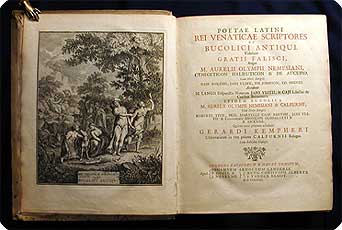 Click the image above for an enlargement.
Handsomely printed, the volume begins with a fine engraved frontispiece opposite the title in black and red. Engraved head- and tailpieces appear in expected places; each page is heavily laden with printed notes.
• Brunet 759; Schweiger, II, 328. Contemporary vellum over paste boards with blind-embossed center device on covers; that on front cover slightly loose due to a vandal’s attempt to excise it! Top of spine pulled (uncommon on a vellum-bound book); vellum soiled and binding a little sprung. Bookplate removed and glue residue visible on pastedown. The odd spot or small stain only; some light foxing and dust-soiling.


Classic Compendium of Classical ScholarshipHare, Julius Charles, ed. The philological museum. Cambridge: Pr. by J. Smith for Deightons, Rivingtons,
& Parker, 1832–33. 8vo (22.1 cm, 8.7"). 2 vols. I: iv, iv, 706 pp.; 1 fold. facs. II: iv, 706 pp.
Classical ScholarshipHare, Julius Charles, ed. The philological museum. Cambridge: Pr. by J. Smith for Deightons, Rivingtons,
& Parker, 1832–33. 8vo (22.1 cm, 8.7"). 2 vols. I: iv, iv, 706 pp.; 1 fold. facs. II: iv, 706 pp.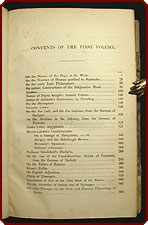
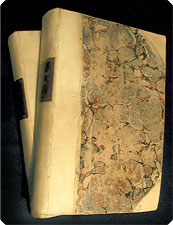 Click the interior image for an enlargement.
 • NSTC 2H412. Contemporary half vellum over marbled paper–covered sides, spines with gilt-stamped leather title-labels; sides and edges scuffed, vol. II with vellum starting to peel or lift up in several places; despite qualifications, neither unsound nor unattractive. Front pastedowns each with private collector’s 19th-century bookplate and with institutional stamp (no other markings); front pastedown of vol. I with bookseller’s ticket from B. Westermann & Co. of New York. Some faint foxing, more pronounced to endpapers; some corners dog-eared.
For more SETS, click here.
A “Works” & Bibliography with ProvenanceHoratius Flaccus, Quintus (Horace). ...Opera illustravit Christ. Giul. Mitscherlich. Lipsiae: Siegfried Lebrecht Crusii, 1800. 8vo (21.3 cm, 8.4"). 2
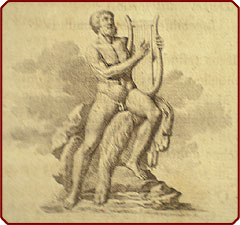
vols. I: [8], xxii, clxxxiv, 550 pp.; illus. II: vi, 712 pp.; illus.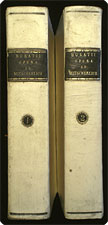
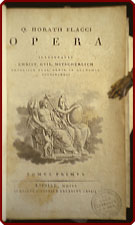
Provenance: Title-pages with personal stamp of Jean Antoine Letronne, member of the Académie des Inscriptions et Belles-Lettres.
• Brunet, III, 323; Dibdin, II, 118–19; Graesse, III, 356; Schweiger, II, 414. Contemporary vellum (just a little bit sprung), spines with gilt-stamped leather title and volume labels; bindings showing only very minor soiling, with some small, fine cracks in vellum on spine and back cover of vol. II. Front pastedowns each with private collector’s bookplate and institutional rubber-stamp; title-pages stamped as above. Pages age-toned and lightly spotted; one section of lower corners in vol. I bumped and crumpled, with one page corner broken off and several more threatening detachment. Two leaves with early inked marginal annotation and one with pencilled annotation. An attractive set.
 “If
in a
“If
in a Picture
(Piso) you should
see . . . ”
Horatius Flaccus, Quintus.
Horace:
Picture
(Piso) you should
see . . . ”
Horatius Flaccus, Quintus.
Horace: Of
the art of poetry: A poem. By the Earl of Roscommon. London:
Pr. & sold by H. Hills, 1709. 8vo. 16 pp.
Of
the art of poetry: A poem. By the Earl of Roscommon. London:
Pr. & sold by H. Hills, 1709. 8vo. 16 pp. 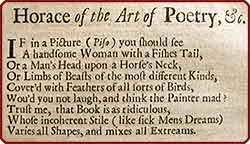
• ESTC T36655; Foxon D309. Mills College, Horace Checklist, 414. Removed from a nonce volume. Stamp in one margin of a 19th-century library. Very good copy.
 A
Philadelphia
A
Philadelphia “Prep”
Text — The
RARER of
Two
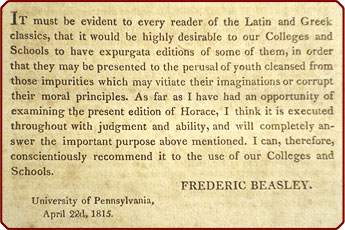
Horatius Flaccus, Quintus. Opera expurgata, notis anglicis illustrata: Quibus præfixum syntagma prosodiale. Cura et studio Thomæ Dugdale. Philadelphiae: Impensis Solomon W. Conrad, excud. Guilelmus Fry, 1815. 8vo. xvii, [1 (blank)], 359, [1 (blank)] pp.
“Prep”
Text — The
RARER of
Two
Horatius Flaccus, Quintus. Opera expurgata, notis anglicis illustrata: Quibus præfixum syntagma prosodiale. Cura et studio Thomæ Dugdale. Philadelphiae: Impensis Solomon W. Conrad, excud. Guilelmus Fry, 1815. 8vo. xvii, [1 (blank)], 359, [1 (blank)] pp.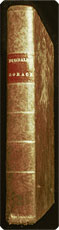
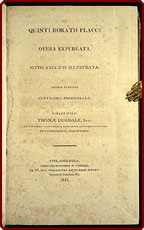
 Click the title-page image for an enlargement.
 This is the rarer of two Philadelphia editions of 1815: It is not listed in NUC Pre-1956 and Shaw and Shoemaker located only one copy (at The American Antiquarian Society); we do know of some other copies. The other edition has the imprint reading “Impensis E. Kimber.”
• Shaw & Shoemaker 34951. Original treed sheep, leather label; spine, with gilt-stamped red leather label, a little pulled at bottom. Significant degrees of browning and foxing, as expectable of the paper used. Front free endpaper missing; volume opens on title-page. An interesting volume in attractive condition. (7008)

One MORE
Horace . . .
Horatius Flaccus, Quintus. Les poësies
d’Horace, traduites en François, tome I. Paris: Chez Desaint & Saillant,
1750. 12mo. Vol. 1 (only) of 2. xxiv, 314 pp.
MORE
Horace . . .
Horatius Flaccus, Quintus. Les poësies
d’Horace, traduites en François, tome I. Paris: Chez Desaint & Saillant,
1750. 12mo. Vol. 1 (only) of 2. xxiv, 314 pp.

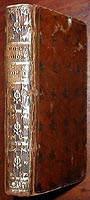 • "Je crois que la traduction d’un Poëte doit être poëtique. Cependant, comme elle est faite en prose, & que la prose ne peut avoir toutes les libertez de la poësie; j’ai conçu qu’il devoit y avoir un certain point mitoyen, au-delà & en-deça duquel la traduction fût ou trop foible, ou trop hardie."
So does Batteux, one of the most eminent translators of Horace into French, describe his rationale for setting the Latin verses of Horace in prose form. Following his preface are translations of the odes (Carmina, all four books), epodes, and secular songs (Carmen Saeculare) of Horace, vis à vis with Latin verse on versos and French prose translation on facing rectos. Many of the works begin with a brief description of the poem’s content, and Batteux is generous in providing footnotes to aid the reader not well versed in Classical mythology, history, or geography. The volume is dedicated to the Dauphin (probably Louis Dauphin, son of King Louis XV of France), apparently a fan of Horace, for whom it was created.
• Schweiger, Handbuch der classischen Bibliographie, II: 440. Full mottled calf with gilt double-rule frame on covers; gilt spine extra, with title and "Tome I" on gilt-stamped morocco label. Slightly sprung and binding rubbed/scuffed. All edges gilt and marbled endpapers, with blue ribbon bookmark attached to headband. Old inked ownership notes (tiny) on fly-leaf. Minimal foxing, and the volume solid. Vol. I of two only, but pleasing. It would appear that Horace's Sermones, Epistulae, and Ars Poetica were the contents of vol. II.
For
Books for the BUSTED
 TO Part IV TO Part IV |