
 GREEK & LATIN
~ CLASSICS
GREEK & LATIN
~ CLASSICS
GREEK & LATIN
~ CLASSICS
GREEK & LATIN
~ CLASSICS
 H.
Estienne's Final
H.
Estienne's Final FOLIO
Text
FOLIO
Text Greek, Latin, & Impressive
 Isocrates. [two
lines in Greek, then] Isocratis Orationes et epistolae cvm Latina interpretatione
Hier. VVolfij, ab ipso postremùm regognita. Henr. Steph. in Isocratem
Diatribæ VII: quarum van obseruationes Harpocrationis in eundem examinat.
Gorgiae et Aristidis quædam, eiusdem cum Isocraticis argumenti. Guil. Cantero
interprete. [Geneva]: Excudebat Henricus Stephanus, 1593. Folio. [fleuron]4*6**4a–z6aa–mm6nn4;
Aa–Ll6; A–C6D4; a
–d
4a.4b.6 (-b.6, blank); [14] ff., 427, [1 (blank)],
131, [1 (blank)], xxxiiii pp., [1 (blank)], [4] ff., 31, [1 (blank)] pp., [9]
ff. (without the final blank).
Isocrates. [two
lines in Greek, then] Isocratis Orationes et epistolae cvm Latina interpretatione
Hier. VVolfij, ab ipso postremùm regognita. Henr. Steph. in Isocratem
Diatribæ VII: quarum van obseruationes Harpocrationis in eundem examinat.
Gorgiae et Aristidis quædam, eiusdem cum Isocraticis argumenti. Guil. Cantero
interprete. [Geneva]: Excudebat Henricus Stephanus, 1593. Folio. [fleuron]4*6**4a–z6aa–mm6nn4;
Aa–Ll6; A–C6D4; a
–d
4a.4b.6 (-b.6, blank); [14] ff., 427, [1 (blank)],
131, [1 (blank)], xxxiiii pp., [1 (blank)], [4] ff., 31, [1 (blank)] pp., [9]
ff. (without the final blank).

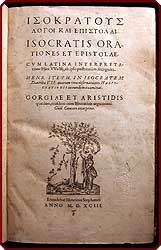

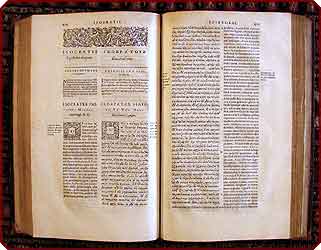
The texts of the orations and "letters" of the great Athenian orator (436–338 B.C.) are printed in double-column format, with the Greek presented in exquisite Greek type in the inner columns and the Latin translation in roman type in the outer ones. A version of the famous Estienne printer's device graces the title-page.
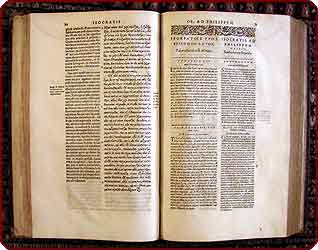
 Single-click either double-page image for an enlargement.
• Adams O219; Renouard (2nd ed.), Annales de l'imprimerie des Estienne, 155.1; Schreiber, Estienne, 225; Schweiger, Handbuch der classischen Bibliographie, I:181; Dibdin (4th ed.), An Introduction to . . . Greek and Latin Classics, II:126. 18th-century plain calf, recently rebacked; round spine, raised bands accented with gilt ruling. Gilt-tooled center devices in spine compartments. Two gilt-lettered spine labels. Title-page dust-soiled; a library's blind pressure-stamps; properly deaccessioned with no additional stamps.  A covetable exemplar.

Antiquities
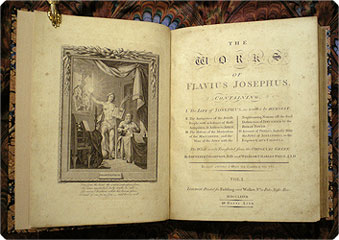
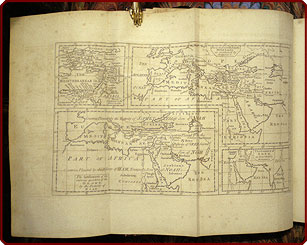
of the Jews ILLUSTRATEDJosephus, Flavius. The works of Flavius Josephus. Containing, I. The life of Josephus, as written by himself. II. The antiquities of the Jewish people; with a defense of those antiquities, in answer to Apion. III. The history of the martyrdom of the Maccabees; and the wars of the Jews with the neighbouring nations till the final destruction of Jerusalem by the Roman power. IV. Account of Philo's ambassy from the Jews of Alexandria, to the Emperor Caius Caligula. London: Pr. for Fielding & Walker by Henri Lion, 1777–78. 4to (27.2 cm, 10.75"). 2 vols. I: Frontis., 719, [1] pp. (lacking list of subscribers); 44 (1 fold.) plts., 7 maps (1 fold.). II: Frontis., [2], 644, [28 (index)] pp.; 16 (of 17) plts.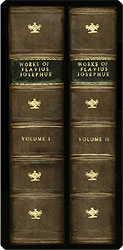
 Click the interior images for enlargements.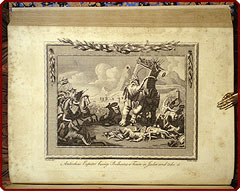
The two volumes are illustrated with a total of69 copper-engraved plates (out of 70 called for), including a number of maps, all engraved by several different hands after the work of various artists.
• CBEL, II, 1492; ESTC T112662; Lowndes 1236; Schweiger, I, 179. Period-style quarter mottled calf with marbled paper–covered sides, leather edges blind-tooled, spines with gilt-stamped leather title-labels and gilt-stamped compartment decorations. Front fly-leaf of vol. II with 19th-century inked gift inscription. Vol. I lacking list of subscribers; vol. II lacking one plate (“The Death of Caius Caesar”). Light to moderate spotting and staining throughout; some offsetting to and around plates. One leaf torn from outer edge, narrowly missing text. A sound, handsome set fine for working or playing with. (24538)

Antiquities
of the JewsILLUSTRATEDJosephus, Flavius. The works of Flavius Josephus. Containing, I. The life of Josephus, as written by himself. II. The antiquities of the Jewish people; with a defense of those antiquities, in answer to Apion. III. The history of the martyrdom of the Maccabees; and the wars of the Jews with the neighbouring nations till the final destruction of Jerusalem by the Roman power. IV. Account of Philo's ambassy from the Jews of Alexandria, to the Emperor Caius Caligula. London: Pr. for Fielding & Walker by Henri Lion, 1777–78. 4to (27.2 cm, 10.75"). 2 vols. I: Frontis., 719, [1] pp. (lacking list of subscribers); 44 (1 fold.) plts., 7 maps (1 fold.). II: Frontis., [2], 644, [28 (index)] pp.; 16 (of 17) plts.
Click the interior images for enlargements. The two volumes are illustrated with a total of69 copper-engraved plates (out of 70 called for), including a number of maps, all engraved by several different hands after the work of various artists.
• CBEL, II, 1492; ESTC T112662; Lowndes 1236; Schweiger, I, 179. Period-style quarter mottled calf with marbled paper–covered sides, leather edges blind-tooled, spines with gilt-stamped leather title-labels and gilt-stamped compartment decorations. Front fly-leaf of vol. II with 19th-century inked gift inscription. Vol. I lacking list of subscribers; vol. II lacking one plate (“The Death of Caius Caesar”). Light to moderate spotting and staining throughout; some offsetting to and around plates. One leaf torn from outer edge, narrowly missing text. A sound, handsome set fine for working or playing with. (24538)

 NO! Copies of the BOOK in the U.S. Justinianus. A leaf from the Digestum vetus. Venice: Andreas Torresanus, de Asula, 26 March 1491. Folio (42.5 cm; 16.625"). [1] f.
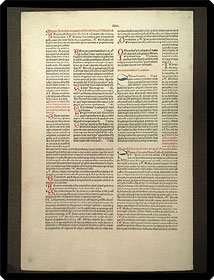 Click the image for an enlargement.
  In 1479 Torresano acquired the fonts of Nicholas Jenson and in 1505 he acquired Aldus Manutius as a son-in-law!
In the U.S., both Goff and the ISTC only locate only stray leaves of this text: two at Stanford and one at Illinois.
Provenance: Clearly once part of a offering of The Foliophiles Incorporated, and probably from its ad hoc album Pages from the past : a collection of original leaves from rare books and manuscripts [New York: T.F.I., c1926–27].
• ISTC ij00554000; Goff J554; H 9556*; GKW 7675; Pr 4725; BMC, V, 309. Mounted on a brown cardboard backing, with a description (but no bibliographical information) on the verso of the board. Leaf in very good, bright condition. (27100)
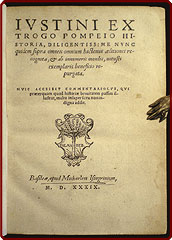
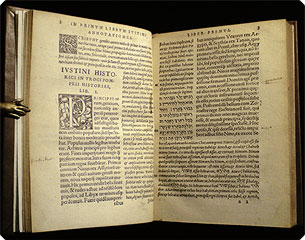
Grynaeus's Edition — Three Maps Justinus, Marcus Junianus; & Pompeius Trogus. Justini ex Trogo Pompeio historia diligentissime nunc quidem supra omnes omnium hactenus aeditiones recognita, et ab innumeris mendis - vetusti exemplaris beneficio purgata. Huic accessit commentariolus. Basilae: apud Michaelem Isingrinium, 1539. Small 4to. [16] ff., 319, [1 (blank)] pp.
 Click the interior images for enlargements.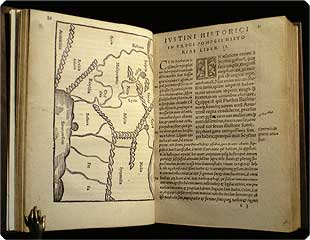
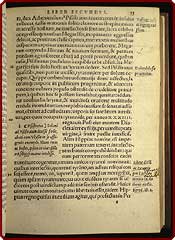
This copy has interesting, early, but now somewhat faded marginalia in a red or sepia ink. The marginalia is scattered and is at times heavy, other times light; in some sections, it is non-existent.
A rare edition: No copy traced via OCLC; VD16 locates only three copies in Europe.
• VD16 T2056. Full rich brown calf old style: Round spine with raised bands, accented in gilt rule; author and title lettered on cream-colored spine label; fillets in blind extending onto covers from each band to terminate in trefoils with blind double fillets beyond. Small rent in upper inner area of title-page with a very old and good repair on verso. Library name stamped on lower edge of closed book. (24808)

Binding Provenance Text Juvenalis, Decimus Junius; & Aulus Persius Flaccus. Iunii
Iuvenalis et Auli Persii Flacci Satyrae, ex doct: viror: emendatione. Amstelodami: Apud Iudocum Hondium, 1625. Narrow 32mo (11 cm; 4.25"). 116 pp.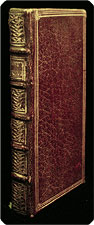
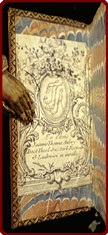
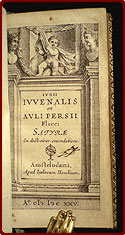 Click the title page image for an enlargement.
 Provenance: 19th-century engraved bookplate of Joannes Thomae Aubry, “Doct. Theol. Soc. Sorb., Rector S. Ludovici in insula.”
Binding: 18th-century crushed red morocco, gilt spine extra; triple fillet gilt border on covers; single gilt rule on board edges; gilt dentelles on turn-ins; French combed pattern endpapers. All edges gilt. Green silk placemarker.
• Not in Schweiger. Binding as above. A very good copy. (22246)

In Latin, Printed at The HagueJuvenalis, Decimus Junius, & Aulus Persius Flaccus. D. Iun. Iuvenalis et Auli Persii Flacci Satyrae. Hagae Comitum: Apud Arnoldum Leers, 1683. 12mo (14 cm, 5.5"). 189, [1 (blank)] pp.
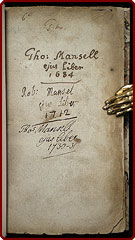
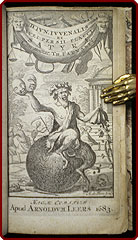
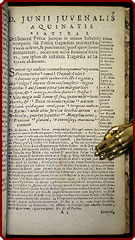 Click the images for enlargements. apparently the first printing at The Hague of any Latin Classic(s) in their original Latin.
Juvenal was a Roman poet of the early second century A.D. His Satires are a standard of the genre, eloquent, humorous, and rhetorically polished, but revealing a very bitter man. Persius (a.d. 34–62), was a gentler soul than Juvenal, and his poems are more Stoic sermons than satires, preaching a moral life during one of Rome's more corrupt periods and doing so, most remarkably, without a hint of self-righteousness. The two Satyrae are often published together, in contrast and comparison.
This is the first printing at the Hague of this edition with Farnaby's notes, originally printed at London in 1612 and then reprinted in Amsterdam in 1630. The emblematic engraved title-page here was done by A. de Blois; the separate title-page for Persius bears the printer's device.
Provenance: Front fly-leaf with three generations of early, dated, inked ownership inscriptions: Thomas Mansell, first Baron Mansel (1684); Robert Mansel (sic, 1712); and Thomas Mansell (1730–31).
• Brunet, III, 631; Graesse, III, 520; Morgan, Bibliography of Persius, 298; Schweiger, I, 511. Recent marbled paper–covered boards, spine with gilt-stamped leather title-label. Front fly-leaf darkened and engraved title a littlevery little tattered at edges, the first with inscriptions “stacked” as above and the second with old repair. Pages gently age-toned and generally clean, with all edges red. (25952)
 An Unusual Edition from
 the Widow VandenhoeckJuvenalis, Decimus Junius; & Aulus Persius Flaccus. D. Iunii Iuvenalis et Auli Persii Satyrae ad fidem optimorum librorum accurate recensitae. Gottingae: Viduae Abr. Vandenhoeck, 1769. 12mo (13.9 cm, 5.5"). [2], 178 pp.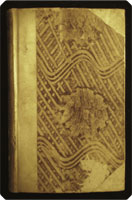
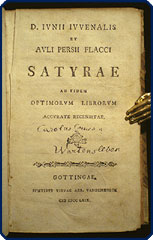
• Schweiger, II, 513; this ed. not in Brunet. Contemporary half vellum over paste paper covers, spine with early inked title; sides and edges lightly scuffed, spine with vellum darkened and chipped. Front pastedown with inked ownership inscription dated 1775, lined through; front free endpaper with 19th-century (?) inked inscription; title-page with early inked inscription reading “Carolus Comes a Wartensleben.” Back free endpaper excised. Title-page torn along inner margin and with short tear from outer edge, just touching one letter. One leaf with small ink blots and several leaves with small nicks to outer edges; scattered light foxing. A few small early inked annotations.
FromRomulus Augustulus to Louis PhilippeKoch, Christopher William. History of the revolutions in Europe.... Middletown [Ct.]: Edwin Hunt, 1833. 2 vols. in 1. 12mo (19.5 cm, 7.625"). I: 280 (i.e., 276) pp.; 4 plts. II: 393, [1 (blank)] pp., [1 (blank)] f.; 8 plts. 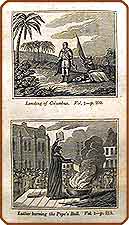
 24 wood-engraved illustrations on 12 plates, some of which are signed “JWB” and one of which is signed “B.”
• Contemporary publisher’s mottled sheep; spine gilt extra. Fine abrasions or chipping to leather, especially to head and foot of spine. Offsetting from turn-ins; lightly foxed throughout. A closed tear without loss in pp. 327–28. All edges marbled.

An
Elegant
& Scholarly
ProductionLa Baune, Jacques de. Panegyrici veteres. Parisiis: Simonem Benard, 1676. 4to (25 cm, 9.9"). ã4ē4ĩ4A–Z4Aa–Vv4Xx2a–u4 (-Xx2 [blank]); [12] ff., 350 (i.e., 346) pp., [80 (index)] ff. (frontis. lacking)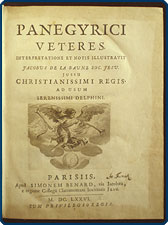
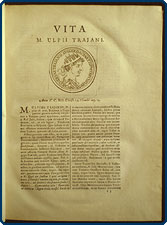

The engraved title-page vignette here incorporates the Dauphin’s coat of arms and the French royal banner, while the headpiece on the next page depicts two cherubim wrestling with dolphins.
Binding: Contemporary speckled calf, spine overlaid some time ago with red morocco (to achieve a uniform appearance with other books in a previous owner’s library); spine with gilt-stamped leather title label and a similar series/date label (“In usum Delphini”). Raised bands, spine compartments, and head and foot bear gilt-stamped decorations
• Brunet, IV, 342; Sandys, II, 292. Binding as above; boards very slightly warped, spine darkened and with small paper label, leather a bit rubbed at extremities and along spine. Front pastedown with private collector’s bookplate, old institutional rubber-stamp, and pencilled annotations; front free endpaper with inked ownership inscription dated 1892; title-page with small early ownership inscription. Frontispiece lacking. Some offsetting to margins of first and last few leaves. All edges speckled blue and red.


 “CORRECT”
Plutarch — Wrangham's
Edition
Langhorne, John & William. Plutarch's lives, translated from the original Greek; with notes critical and historical, and a life of Plutarch.... A new edition, in six volumes, with corrections and additions by the Rev. Francis Wrangham. London: Pr. by Thomas Davison, 1809 (vol. III pr. by Wood & Innes; vols. IV, V pr. by W. Flint). 8vo (21.8 cm, 8.6"). I: Frontis., [8], xcvi, 465, [1] pp. II: [4], 659, [1] pp. III: [4], 563, [1 (blank)] pp. IV: 648 pp. V: [4], 518 pp. VI: [4], 443, [1 (blank)], [4] pp.
“CORRECT”
Plutarch — Wrangham's
Edition
Langhorne, John & William. Plutarch's lives, translated from the original Greek; with notes critical and historical, and a life of Plutarch.... A new edition, in six volumes, with corrections and additions by the Rev. Francis Wrangham. London: Pr. by Thomas Davison, 1809 (vol. III pr. by Wood & Innes; vols. IV, V pr. by W. Flint). 8vo (21.8 cm, 8.6"). I: Frontis., [8], xcvi, 465, [1] pp. II: [4], 659, [1] pp. III: [4], 563, [1 (blank)] pp. IV: 648 pp. V: [4], 518 pp. VI: [4], 443, [1 (blank)], [4] pp. 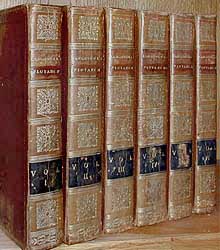
 correct than North's spirited translation from the French of Amyot, or the unequal production known as Dryden's version, and though written more than 120 years ago, it still holds the field" (this in 1892). First printed in 1770, the work was later edited by Francis Wrangham, a classical scholar and passionate collector of books; it appears here in the first printing of Wrangham's edition.
• On John and William Langhorne, see: Dictionary of National Biography, XXXII, 101–02. Contemporary calf, covers framed with gilt roll and blind-stamped feather-and-scroll roll, spines gilt extra with gilt-stamped titles and leather volume labels. Covers and edges showing moderate wear, some joints starting; spines with slight cracking, wear to title compartments and volume labels. With bookplates of two 20th-century collectors to front pastedowns, catalogue clipping affixed to front free endpaper of vol. I. Varying degrees of offsetting with some leaves lightly spotted. A dignified set.
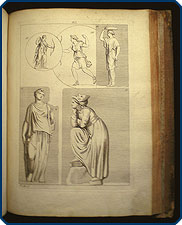
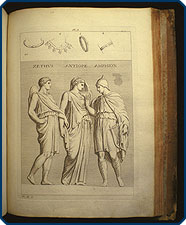
Ancient Dress. 51 Copper-Engraved Plates.Lens, André Corneille. Le costume ou essai sur les habillements et les usages de plusieurs peuples de l’antiquité, prouvé par les monuments. Liege: Aux dépens de l’auteur, chez J.F. Bassompierre, 1776. 4to (24.9 cm, 9.8"). xxxi, [1], 411, [1] pp.; 51 plts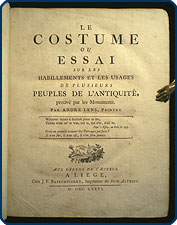
 Single-click any image where the hand appears on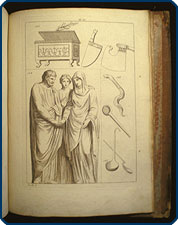
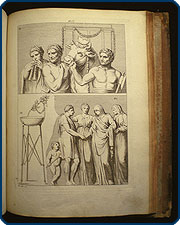
Roman Law, Emperor
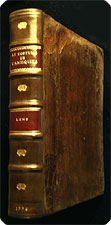
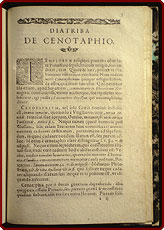
Theodosius, Desecration of Temples, & More Libanius, Antiochenus. Libanii antiocheni Pro templis gentilium non exscindendis, ad Theodosium m. imp. Oratio: ante M. CCC. fermè annos conscripta: nunc primùm edita à Iacobo Gothofredo ic. notisq[ue] illustrata. [with another, as below]. Genevae: [Petri Chouët?], 1634. 4to (22.5 cm; 8.75"). [12], 63, [9] p. [also bound in] Godefroy, Jacques. De cenotaphio: deq[ue]z, diversis, super eius religione, Ulpiani & Marciani sententiis, diatriba. Genevae: [s.n.], 1634. 4to. 15, [1] pp.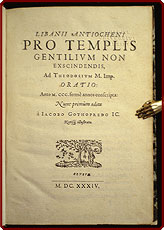
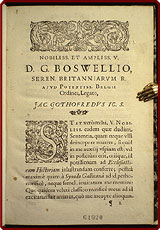
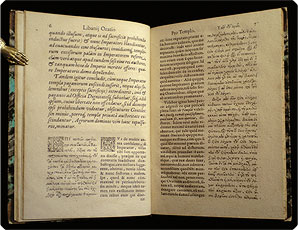
The present work is his famous “lamentation” on the desecration of pagan temples. Addressed to the Emperor Theodosius, the oration concerns the legality of the Emperor's order for the desecration; the text is in Greek and Latin in parallel columns.  The Greek font is notably light and elegant.
At the rear of this volume is Godefroy's opuscule on funeral rites and ceremonies. Several libraries report both works being bound together, as here, but not all.
• 19th-century quarter brown leather, spine sunned much lighter. Library-bound with call number inked on cover, bookplates on front pastedown, rubber-stamps on pastedowns. Title-page with old pressure-stamp; text itself without other markings save a six-digit number neatly stamped at base of next leaf. Actually, a clean, good copy. (22733)
Hippocratic AphorismsLoew von Erlsfeld, Johann Franz. Nova et vetus aphorismorum divi senis Hippocratis interpretatio iuxta mentem veterum et recentiorum in publica cathedra ingenuae juventuti medicae pragensi explanata .... Francofurti & Lipsiae: Johannis Ziegeri, 1711. 4to (21 cm, 8.25"). Frontis., [14], 1180 (i.e., 1172), [48 (index)] pp. (pagination skips 361–68, text uninterrupted).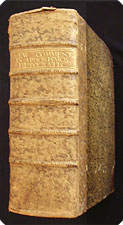
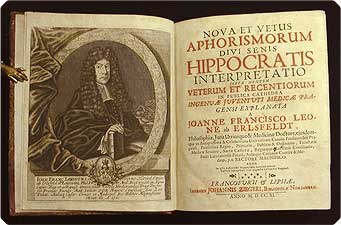 Click the interior image for an enlargement.
The title-page of this volume is printed in red and black; the engraved frontispiece portrait is signed “A.C.F.”
Scarce. Searches of OCLC, RLIN, and NUC Pre-1956 find only three U.S. and two overseas locations.
• Contemporary half mottled sheep with speckled paper–covered sides, spine with gilt-stamped leather title-label; sides and edges with a few small scuffs, leather chipped at head of spine and along parts of back joint. Front free endpaper with inked ownership inscription dated 1829 and with stamp (no other markings). Mild browning and spotting, with a few leaves more notably foxed; one leaf with ink stains. Pagination skips from 360 to 369, with text uninterrupted as shown by catchword and signature. A stout, rather handsome volume.
 Très French, Très Pretty — Illustrated & in a SIGNED BindingLongus. Daphnis et Chloé. Paris: L. Conquet, 1898. 8vo (17.4 cm, 6.8"). Frontis., [6], 219, [4] pp.; 4 plts.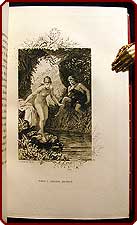
 Click the image to the right
Binding: Signed red morocco binding, done by Joly fils, with covers framed in gilt rolls, spine gilt extra, turn-ins with gilt-stamped flower and insect designs. The original paper spine label is bound in at the back of the volume.
• Binding as above. All edges gilt. Slight offsetting to endpapers from turn-ins, and very faint hints of offsetting opposite plates. A lovely copy, showing virtually no wear.

 TO Part V TO Part V |