 AMERICANA TO 1820
AMERICANA TO 1820
AMERICANA TO 1820
 One of Those
 Wonderfully AMBITIOUS!
 18th-Century “Sketches”
 Kames,
Henry Home, Lord. Sketches
of the history of man. Edinburgh: W. Creech, W. Strahan, & T. Cadell,
1774. 4to (27.5 cm, 10.9"). 2 vols. I: xii, 519, [1 (blank)] pp. II: [4], 507,
[1 (blank)] pp.
Kames,
Henry Home, Lord. Sketches
of the history of man. Edinburgh: W. Creech, W. Strahan, & T. Cadell,
1774. 4to (27.5 cm, 10.9"). 2 vols. I: xii, 519, [1 (blank)] pp. II: [4], 507,
[1 (blank)] pp. 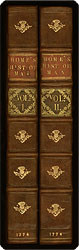
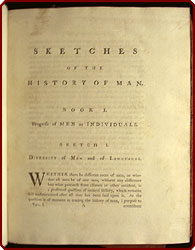
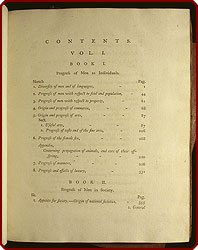
 Click the images for enlargements.
  the
“American Nations”), in which Lord Kames speculates
on the origin of races, provides an account of the progress of morality, and
offers arguments against the practicality of polygamy; the appendix focuses
more specifically on Scottish legal and economic issues near and dear to the
heart of the author, a prominent Scottish judge and gentleman farmer as well
as an influential figure of the Scottish Enlightenment. Other topics addressed:
Taxes, patriotism, Aristotelian logic, and women.
the
“American Nations”), in which Lord Kames speculates
on the origin of races, provides an account of the progress of morality, and
offers arguments against the practicality of polygamy; the appendix focuses
more specifically on Scottish legal and economic issues near and dear to the
heart of the author, a prominent Scottish judge and gentleman farmer as well
as an influential figure of the Scottish Enlightenment. Other topics addressed:
Taxes, patriotism, Aristotelian logic, and women.
Provenance: Front pastedown with bookplate “De la bibliotheque de F. Freudenreich.”
• ESTC T48434; Alston, III, 308; Goldsmiths’-Kress 11089; Sabin 32702. Contemporary speckled calf, neatly rebacked preserving original gilt-stamped leather title and volume labels, spines with gilt-stamped thistle decorations; edges and corners rubbed, sides showing small scrapes and discolorations. Residue on pastedowns from sometime removal of bookplates. Pages age-toned, with occasional small spots, and offsetting from binding to in margins of first and last few leaves. All edges speckled.
 For more SETS, click here.
 “Oriental” Romance for
 CT SubscribersLanghorne, John. Solyman and Almena: an Oriental tale. East Windsor, Conn.: Pr. by Luther Pratt, 1799. 12mo. 168 pp.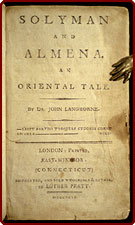
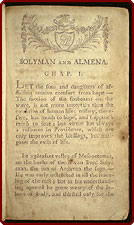
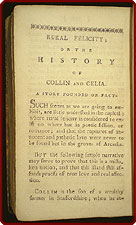
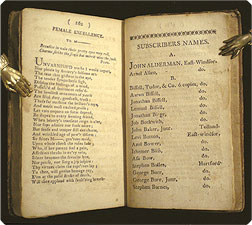 Click the images above for enlargements.
 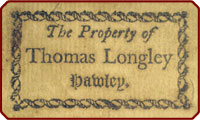 Provenance: Bookplate of Thomas Longley (Hawley).
We find seven copies reported in libraries, ALL between Worcester/Providence and Washington, D.C.
• Evans 35710; Trumbull, Connecticut, 2313; ESTC W3365. Old calf with remnants of black leather spine label; leather with one gouge to back cover and a bit abraded overall. Tear and chip to front free endpaper; title-page with tiny edge tears. Small wormhole at base of initial three leaves, not touching print. Some leaves extruded with shallow tattering. Bookplate as above on front free endpaper. Offsetting from leather of cover and a brown blot or stain at outer margin of title- and following page; same offsetting to last leaves; some general staining and an ink "x-mark" in margin of one other page. This seems to have been read with enthusiasm! (20994)

 Quaker
Meditations —
A Neat Compendium
Quaker
Meditations —
A Neat Compendium Two
Women in the Contents —
Womanly Provenance, Too
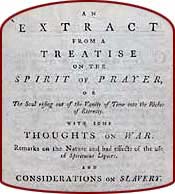
[Law, William].
An extract from a treatise on the spirit of prayer, or the soul rising out of
the vanity of time into the riches of eternity. With some thoughts on war. Remarks
on the nature and bad effects of the use of spirituous liquors. And considerations
on slavery. Philadelphia: Joseph Crukshank, 1780. 12mo (16.3 cm, 6.45"). 84
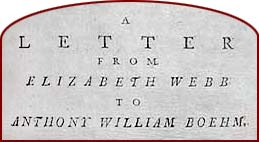
pp. [bound with] Webb,
Elizabeth. A letter...to Anthony William Boehm, with his answer.
Philadelphia: Joseph Crukshank, 1783. 44 pp. [with]
[Benezet, Anthony]. In the life
of the lady Elizabeth Hastings... [Philadelphia: Joseph Crukshank, 1784]. 8
pp.
Two
Women in the Contents —
Womanly Provenance, Too
[Law, William].
An extract from a treatise on the spirit of prayer, or the soul rising out of
the vanity of time into the riches of eternity. With some thoughts on war. Remarks
on the nature and bad effects of the use of spirituous liquors. And considerations
on slavery. Philadelphia: Joseph Crukshank, 1780. 12mo (16.3 cm, 6.45"). 84
pp. [bound with] Webb,
Elizabeth. A letter...to Anthony William Boehm, with his answer.
Philadelphia: Joseph Crukshank, 1783. 44 pp. [with]
[Benezet, Anthony]. In the life
of the lady Elizabeth Hastings... [Philadelphia: Joseph Crukshank, 1784]. 8
pp. 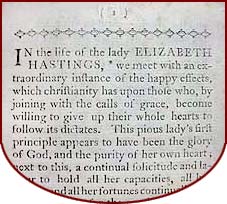
 Elizabeth Webb, "an acknowledged minister among the people called Quakers," first encountered Prince George of Denmark's chaplain Boehm while on a visit to Great Britain; the missive with which she opened her subsequent correspondence with him, here, greatly inspired him and a number of his friends.
Provenance: With inscription reading "Miss Hannah Amelia Moore / Book a Present from her worthy / Friend Ruth Patton / 1789."
 For more RELIGION, click here.
 Notebook of theFirst Lawyer in Boston — The 19th-Century Reissue Lechford, Thomas. Plain dealing or news from New England. Boston: J.K. Wiggin and Wm. Parsons Lunt, 1867. 4to (cm). xl, 160, [2], 203–11, [1 (blank)] pp. (text complete despite pagination).
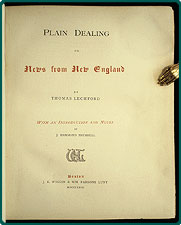
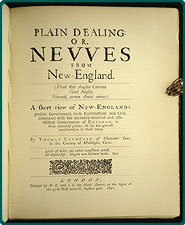
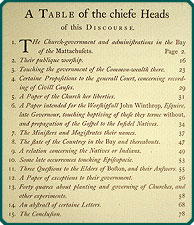 Click the interior images for enlargements.
 285 copies were printed; this is no. 180. The publication was dedicated to collector (“and careful reader”) George Brinley, Esq.
• Sabin 39642. Recent black moiré cloth, spine with gilt-stamped leather title-label. Several pages (including title-page) with faint shadows of institutional rubber-stamps, mostly effaced. Many signatures unopened; two index leaves with tears in upper margins from clumsy opening. Pagination shifts between text and index. (23906)

A
Southerner
Calls forABOLITION
in 1767
[Lee, Arthur]. [drop-title] Extract from an
address in the Virginia Gazette, of March 19, 1767. [Philadelphia?: Pr. by Joseph
Crukshank?, 1780?]. Small 12mo. 4 pp.
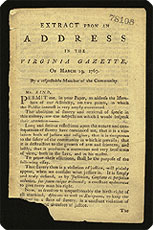 Click
the image for an enlargement.
Click
the image for an enlargement.
• Evans 16773; Hildeburn, The Issues of the Press in Pennsylvania, 1685–1784, 4006. Five-digit number stamped above the title; pp. 1 and 2 separated from 3 and 4, and gutter margin repaired, reattaching the halves. Semicircular tear in lower, inside area of all pages, costing a total of 9 or 10 words.

“A Short & Easy Method with theDeists”
Leslie, Charles. A short and easy method with the deists:
wherein the certainty of the Christian religion is demonstrated, by infallible proof from four rules, which are incompatible to any imposture that ever yet has been, or that can possibly be. In a letter to a friend. Windsor, VT: Pr. by T.M. Pomroy, 1812. 12mo. 168 pp.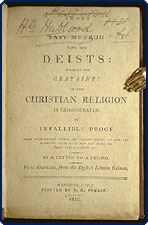
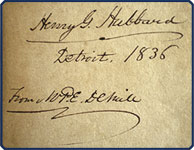 Click the title page image for an enlargement.
 Provenance: Property, in 1836, of Henry G. Hubbard of Detroit.
• Shaw & Shoemaker 25848. Contemporary sheep. Spine with compartments divided by gilt rules. Leather much rubbed with a little chipping. Browning from turn-ins onto endpapers and title-page. Top margins closely trimmed with loss of page numbers in some places. Inked ownership inscriptions on recto of front free endpaper and title-page. (5442)
A
Young Philadelphian’s
Christian EpicCharles
Brockden BrownLinn,
John Blair. Valerian, a narrative poem: Intended, in part, to describe
the early persecutions of Christians, and rapidly to illustrate the influence
of Christianity on the manners of nations...with a sketch of the life and character
of the author. Philadelphia: Thomas & George Palmer, 1805. 4to (24.5 cm, 9.6").
xxvi, [2], 97, [1 (blank)] pp.
Philadelphian’s
Christian EpicCharles
Brockden BrownLinn,
John Blair. Valerian, a narrative poem: Intended, in part, to describe
the early persecutions of Christians, and rapidly to illustrate the influence
of Christianity on the manners of nations...with a sketch of the life and character
of the author. Philadelphia: Thomas & George Palmer, 1805. 4to (24.5 cm, 9.6").
xxvi, [2], 97, [1 (blank)] pp.
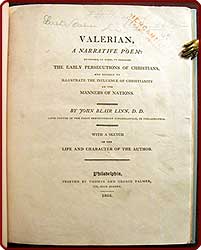 • First edition: Tale of a young Christian from Rome, written by the pastor of the First Presbyterian Church of Philadelphia (not to be confused with the John Blair Linn who served as Secretary of the Commonwealth of Pennsylvania). This piece was published one year after the Rev. Linn’s untimely death at the age of 27, and is preceded by an account of the author’s life written by his brother-in-law, Charles Brockden Brown.
• Shaw & Shoemaker 8790; Wegelin 1038; BAL 1509 (for Brown’s “Sketch”). On Linn, see: Dictionary of American Biography, XI, 281–82. Period-style quarter tan cloth and light blue paper-covered sides, spine with printed paper label. Lacking portrait of author. Title-page and a few others stamped by a now-defunct institution; title-page also with pencilled inscription dated 1830. Pages age-toned and slightly cockled; some staining, with some spots accounted for by laid-in floral matter; occasional stray pencil marks and short edge tears or chips, with repairs to margins and longer tears of first few leaves.

A
17th-Century English
Superhero
& ADVENTURERAMERICA
& PatagoniaLloyd, David, attrib. author. The wonderful, surprizing and uncommon voyages and adventures of Captain Jones, to Patagonia. London: Pr. for John Lever, 1766. Narrow 4to (21.1 cm; 8.5"). Engr. title-page, 74 pp., [1] f. (ads).
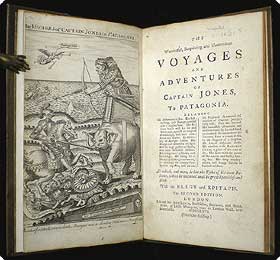 Click the images for enlargements.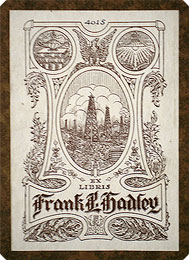
 Outrageous
in extremis, this has as its proximate target Captain John Smith, who is satirized
while references to Florida and America fly left and right, including, for example
on p. 5, a poem “engraven on a Pillar of Gold, in the famous City of Chiapa”
that purports to be in Maya! — this with, “by the assistance of
Mr. Gage,” a translation helpfully given below it.
Outrageous
in extremis, this has as its proximate target Captain John Smith, who is satirized
while references to Florida and America fly left and right, including, for example
on p. 5, a poem “engraven on a Pillar of Gold, in the famous City of Chiapa”
that purports to be in Maya! — this with, “by the assistance of
Mr. Gage,” a translation helpfully given below it.
The title-page better than a cataloguer summarizes this work: “Relating his adventures to sea. His first landing, and strange combat with a mighty bear. His furious battle with his six and thirty men, against an army of eleven kings, with their overthrow and deaths. His relieving of Kemper Castle. His strange and admirable sea fight with six huge galleys of Spain, and nine thousand soldiers. His being taken prisoner, and hard usage. His being set at liberty by the king's command, in exchange for twenty-four Spanish captains, and return for England. A comical description of Captain Jones's ruby nose. Part the second. His incredible adventures and atchievements [sic] by sea and land, particularly his miraculous deliverance from a wreck at sea, by the support of a dolphin. His several desperate duels. His combat with Bahader Cham, a giant of the race of Og. His loves with the queen of No-Land, and basely leaving her. His deep employments, and happy success in business of state. All which, and more, is but the tythe of his own relation, which he continued until he grew speechless and died. With his elegy and epitaph.”
Provenance: 20th-century bookplate of Frank L. Hadley
Searches of WorldCat and ESTC locate only four copies in U.S. institutions.
• Sabin 41685; ESTC T116640. 20th-century half tan calf with tan linen sides. Booksellers' catalogue entry pasted to the front free endpaper. Engraved title-page closely trimmed at left edge, costing a sliver of the image. (25940)
Documentingthe Sale of a SlaveLloyd, William L. A.L.S. to Garret D. Wall. [New Jersey or Pennsylvania], 22 May 1819. 12mo (6.125" x 8"), 1 p.
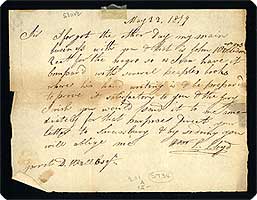
Click the image to the left Garret D. Wall was a lawyer in, and later a Senator from, New Jersey.
• Written in a clear hand. Fold along horizontal middle of document. Light stain and residue of mounting into an album. Lacks integral address leaf. Old price and dealer code (Sessler’s) in pencil in lower margin.

“The Candle that is Set up in Us Shines Bright Enoughfor All Our Purposes” Locke, John. An abridgment of Mr. Locke's essay concerning human understanding. Boston: Pr. by Manning & Loring for J. White, Thomas & Andrews, D. West, et al., 1794. 12mo (17.3 cm, 6.8"). 250 pp.
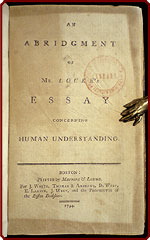
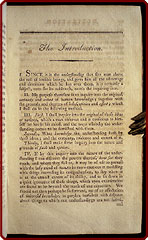 Click the interior images for enlargements.
 • ESTC W23203; Evans 27227; Printing & the Mind of Man 164. Contemporary treed sheep, spine with gilt-stamped leather title-label and gilt-stamped bands; chipped at spine extremities with leather darkened in bottom compartment, corners rubbed, and joints reinforced. Title-page institutionally rubber-stamped in the 19th century; offsetting from old binding to first and last few leaves. One pencilled annotation. (24873)
 United
Brethren in
United
Brethren in North
AmericaLoskiel,
Georg Henrich. Geschichte der Mission der evangelischen Brüder unter
den Indianern in Nordamerika. Barby: Zu finden in den Brüdergemein, &
Leipzig: Paul Gotthelf Kummer, 1789. 8vo (19.3 cm, 7.6"). [8] ff., 783, [1] pp.
North
AmericaLoskiel,
Georg Henrich. Geschichte der Mission der evangelischen Brüder unter
den Indianern in Nordamerika. Barby: Zu finden in den Brüdergemein, &
Leipzig: Paul Gotthelf Kummer, 1789. 8vo (19.3 cm, 7.6"). [8] ff., 783, [1] pp.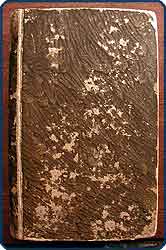
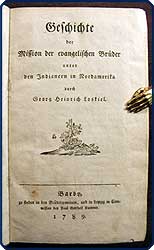
This first edition does not include the map found in the later English translation; the six lines of errata (rather than a full page) at the back mark the present copy as an example of the first issue.
• Howes, U.S.iana, L474; Pilling, Algonquian, 317; Sabin 42109; Vail 795. Early 19th-century German paper-covered boards, much worn and abraded, slightly cocked, spine with remnants of paper shelving label. Some corners dog-eared; scattered small spots of foxing, otherwise internally clean.
A
Boston Federalist Perspective
[Lowell, John].
Mr. Madison's war. A dispassionate inquiry into the reasons alleged by
Mr. Madison for declaring an offensive and ruinous war against Great-Britain.
Together with some suggestions as to a peaceable and constitutional mode of
averting that dreadful calamity. By a New-England farmer.... Third edition.
Boston: Russell & Cutler, 1812. 8vo (20.7 cm, 8.1"). x, 3–63, [1] pp.
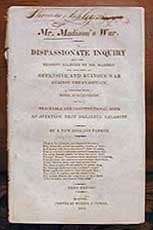
 TO
Part XIII . . . TO
Part XIII . . . |