 AMERICANA TO 1820
AMERICANA TO 1820
AMERICANA TO 1820
 “A Second Edition of My Mutilated Poems”
 Neal, John. The battle of Niagara: Second edition — enlarged: With other poems. Baltimore: N.G. Maxwell (pr. by B. Edes), 1819. 18mo (15.6 cm, 6.2"). Add. engr. t.-p., 272 pp.


• BAL 14856; Shaw & Shoemaker 48824; Wegelin 1066. On Neal, see: Dictionary of American Biography, XIII, 398–99. Period-style quarter tan cloth over light blue paper–covered boards, spine with printed paper label. Dedication page and a few others (not including title) stamped by a now-defunct institution. Waterstaining to upper margins and some inner page parts, with final leaves darkened and a few spotted with foxing. Some upper edges chipped; final leaf with inner margin repaired.


 Infighting! — New York State Senate — 1806 New York (state). Democratic-Republican Party. Broadside. Begins, “To the electors of the Western District. Fellow-citizens, In a few days you will again be called upon to exercise the distinguishing privilege of Freemen — that of electing your Representatives to the Legislature. In discharging this duty, the great body of the people only want correct information, and they will generally choose the most able and faithful men to legislate for them.” New York state: no publisher/printer, [1806?]. Folio (39 cm, 15.5"). [1] f. (verso blank).
 An interesting window into the factional struggles within the party and the growing dominance of the western district in state politics. Text printed in double columns.
Rare. We fail to trace any copies via OCLC.
• Not in Shaw & Shoemaker. As issued, with old folds. Short tear and spot in blank area of inner margin. A clean, very good copy. (24637)


New York Gubernatorial Election 1820 — The Issue of Patriotism “No Time Server,” & “Red-Jacket”. Broadside. Begins, “Of all the strange and unaccountable things which have appeared during the present electioneering campaign, the Federal Bucktail Address, which has lately been put into circulation is the most so.” New York state: no publisher/printer, 1820. Folio (34 cm, 12.75"). [1] f. (verso blank).
Several lines of text at the base of the document are headed “The Seminole Federalists,” an unflattering soubriquet given to the faction of Federalists who opposed the Clinton administration. This section is signed in type, “Red-Jacket.”
• Not in Shoemaker. As issued, with some later folds. Inch-long tear within first line of text, costing one word and portions of two or three letters, without affecting sense. Tear above center fold snaking five lines of text, touching letters from seven words without costing any text. Thumbnail-sized chip in center, affecting portions of three lines and costing several complete words but little sense. Lightly foxed. (24635)

Keepsake . . . The oath of a free-man. With a historical study by Lawrence C. Wroth and a note on the Stephen Daye Press by Melbert B. Cary, Jr. New York: Press of the Woolly Whale, 1939. 8vo. [20] pp.
This is Keepsake no. 60 of the American Institute of Graphic Arts, although this copy does not include the laid-in sheet noting that detail. Important study by the head of the John Carter Brown Library on the Oath.
• Publisher's cloth, front cover with printed paper label. Clean and fresh. (14191)
A Hard-Laboring Poet of Cumberland County Oliver, Isabella. Poems, on various subjects. Carlisle: A. Loudon, 1805. 12mo. 5, [1], [vi]–ix, [11]–220 pp.
 Click the image for an enlargement.
 First edition and an early Carlisle imprint; the first poetic publication in Cumberland County.
Provenance: “Presented to Alfred Creigh by His Mother, October 21st 1827,” on verso of front free endpaper: Alfred's modestly calligraphic ownership note inside front cover and his plain note at top of contents page; signature of Eleanor Jane Creigh at top of title-page.
• Sabin 57205; Shaw & Shoemaker 9346; Wegelin, American Poetry, 1072. Contemporary sheep, spine with gilt-stamped leather title-label; rubbed, front joint starting, spine and joints with small wormholes. Inscriptions as noted. Margins variously waterstained, never horribly; pages age-toned with occasional spotting. One leaf with tear from lower margin extending into text, partially repaired some time ago; one leaf with lower outer corner torn away, a few lost words replaced in manuscript. Occasional manuscript corrections. (23146)

FIRST PAINE COLLECTION Paine, Thomas. The works of Thomas Paine. London: D. Jordan, 1792. 8vo (21.6 cm, 8.5"). Frontis., [4], 67, [1], viii, 110, [2], 142, [2], 69, [3], 29, [3], 16, 9, [1] pp.


 Click the images for enlargements.
 Individual titles in this collection are often separated and sold as if complete in themselves, but the present volume reflects their original state and the publisher's intent.
• ESTC T5785; Goldsmiths'-Kress 15080; Sabin 58244; Stephans, Paine Collection of Richard Gimbel, 1. Recent quarter calf and marbled paper–covered sides, spine with gilt-stamped leather label and gilt-stamped compartment decorations between gilt-ruled raised bands. Title-page and a few others with oval,19th-century institutional rubber-stamp; lower (closed) page edges rubber-stamped sometime later. Variable, mild to moderate foxing and other spotting, especially “in from edges”; occasional pencilled bracketing or underlining. One leaf with short tear in outer margin, not touching text. (25027)
 For
a bit more THOMAS PAINE, click
here.
For
a bit more THOMAS PAINE, click
here. Or for HUMAN RIGHTS, click here.
Parry’s
First Voyage — Plates,
Maps,
StoriesParry, William Edward. Journal of a voyage for the discovery of a north-west passage from the Atlantic to the Pacific.... London: John Murray, 1821. 4to (27.3 cm, 10.75"). [4] ff., xxix, [3], 310, [2], clxxix, [3 (2 adv.)]pp.; 14 plts., 4 fold. maps, 2 maps.

 Click any image above for an enlargement.
lunar
observations, and a report on the state of health and disease
among the men.
The copper-engraved, oversized frontispiece
map shows Baffin's Bay, Barrow's Straits, Prince Regent's Inlet, and the North
Georgian Islands, as well as the bay named after Parry's two ships.
• Arctic Bibliography 13145; Hill (2nd ed.) 1311; Sabin 58860. Recent quarter calf over marbled paper–covered sides, spine with gilt-stamped leather title and author labels, and gilt-stamped anchor decorations in compartments. Title-page and a few others, plus reverse of 1 map, lightly stamped by a now-defunct institution. Pages gently age-toned, with occasional offsetting from engraving and the odd spot or smudge. One map with small portion of inner margin reinforced; final two leaves with inner margins reinforced; one plate with tears into image and mounted. Final advertisement leaf bound in before final text leaf. All edges marbled.
 The
PETITIONER
"Respectfully Sheweth
. . . "
The
PETITIONER
"Respectfully Sheweth
. . . "
 Patterson, Alexander. A
petition...to the legislature of Pennsylvania, during the session of 1803–4,
for compensation for the monies he expended and the services he rendered in
defence of the Pennsylvania title, against the Connecticut claimants; in which
is comprised, a faithful historical detail of important and interesting facts
and events that took place at Wyoming, and in the county of Luzerne, &c.
In consequence of the dispute which existed between the Pennsylvania land-holders,
and the Connecticut intruders, commencing with the year, 1763. Lancaster: Robert
Bailey, 1804. 8vo (23.9 cm, 9.4"). 34 pp.
Patterson, Alexander. A
petition...to the legislature of Pennsylvania, during the session of 1803–4,
for compensation for the monies he expended and the services he rendered in
defence of the Pennsylvania title, against the Connecticut claimants; in which
is comprised, a faithful historical detail of important and interesting facts
and events that took place at Wyoming, and in the county of Luzerne, &c.
In consequence of the dispute which existed between the Pennsylvania land-holders,
and the Connecticut intruders, commencing with the year, 1763. Lancaster: Robert
Bailey, 1804. 8vo (23.9 cm, 9.4"). 34 pp. 
Methodism's Start in America Peck, George. Early Methodism within the bounds of the old Genesee Conference from 1788 to 1828; or, The first forty years of Wesleyan evangelism in northern Pennsylvania, central and western New York, and Canada. Containing sketches of interesting localities, exciting scenes, and prominent actors. New York: Carlton & Porter, 1860. 8vo (19.3 cm, 7.6"). Frontis., 512 pp.; 1 plt. Click the image for an enlargement.
 The work is illustrated with a frontispiece portrait of the author done by A.H. Ritchie, one plate of Capt. Parish's residence at Ross Hill, Wyoming, and one in-text steel engraving.
• Sabin 59471. Publisher's brown textured cloth, spine with gilt-stamped title and sunned with adhesive shelving label at foot; binding rubbed overall with spots of light discoloration, cloth lost at spine extremities, and starting to split at back joint. Front pastedown with institutional bookplate, front free endpaper with inked ownership inscription. Foxing and staining intermittently throughout, notable but never of the worst kinds. (25820)
Jailhouse Law — Philadelphia 1801Pennsylvania.
Collection of the penal laws of the Commonwealth of Pennsylvania. Philadelphia: Pr. by Budd & Bartram, for the use of the Prison, 1801. 8vo (19.5 cm, 7.6").
72 pp.

 Click any image where the hand appears on

 Many institutions report microform holdings, but very few hold actual copies.
• Sabin 59986; Shaw & Shoemaker 1114. Contemporary-style quarter tan cloth over blue paper-covered sides, spine with printed paper label. Paper embrittled and somewhat fragile; pages age-toned and foxed.
Which OLD LAWS to Keep? Pennsylvania. Supreme Court. Report of the judges of the Supreme Court of Pennsylvania, of the English statutes which are in force in the Commonwealth of Pennsylvania; and of those of the said statutes which, in their opinion, ought to be incorporated into the statute law of the said commonwealth. Lancaster: Wm. Dickson, 1809. 8vo (23.1 cm, 9.1"). 28 pp.

 This copy is untrimmed, with the signatures unopened.
WorldCat and Shaw & Shoemaker locate a combined total of fewer than a dozen copies.
• Shaw & Shoemaker 18345. Sewn, as issued, but without the wrappers; edges tattered. Waterstaining, heavy on first and last few pages. Uncut. (25966)

We
Are in Production!
Pennsylvania
Society for the Encouragement of American Manufactures. A communication
from the Pennsylvania Society for the Encouragement of Manufactures and the
Useful Arts. Philadelphia: Pr. for the Society by Samuel Akerman, 1804. 8vo
(21.3 cm, 8.375"). 28 pp. 
Tench Coxe was the publishing President, Peter A. Browne, the Secretary.
• Shaw & Shoemaker 7024; Sabin 60367. Publisher's plain blue wrappers, soiled. Dog-earing, with a few chipped corners; some soiling and foxing.

Manuscript Notes: The State of Theology in Upland, 1871 Pepper, George Dana Boardman. Manuscript on paper, in English. “Outlines of Theology.” [Upland, PA]: 1871. 4to (20.7 cm, 8.1"). [10] pp., 276, [23 (blank)] ff. (pagination skips 38).

 Click the images for enlargements.


Uncommon Franklin Press Production Philadelphia Baptist Association. A Confession of faith, put forth by the elders and brethren of many congregations of Christians (baptized upon profession of their faith) in London and the country.Philadelphia: Printed by B. Franklin, 1743. Small 8vo (14.5 cm; 5.75") 112 pp., [1] f., 62 pp.

 Click the images for enlargements.
 This sixth edition of the Confession of Faith has yet another addition: “Of imposition of hands and Singing of Psalms in publick worship.”
Provenance: 1930s bookplate of John Clyde Oswald, author of (among other biblioworks) Benjamin Franklin, Printer (1917) and Printing in the Americas (1937).
• Evans 5124; Miller, Benjamin Franklin's Philadelphia Printing, 317; Sabin 61497; Hildeburn, Pennsylvania, 811; ESTC W037515. Griffith has its own Evans citation: Evans 5194. 19th-century half black roan in imitation of morocco, abraded along front joint (outside) and edges of the boards; signed with blind-embossed stamp, “Turner Hamilton, Binder, Philadelphia.” Bookplate as above. Three leaves torn with varying degrees of loss of text: pp. 21–24 (in fact all readable with confidence except for one word), 33–34 (text approximately half missing). Age-toning and spotting; abrasion to rear pastedown. Far from a “perfect copy” and priced as such, certainly a copy withvery pleasing provenance. (26032)
Post-XYZ AffairPickering, Timothy. Message from the President of the United States, accompanying a report of the Secretary of State, containing observations on some of the documents, communicated by the President, on the eighteenth instant. 21st January, 1799. Ordered to lie on the table. Philadelphia: John Ward Fenno, 1798 [i.e., 1799]. 8vo (20.2 cm, 8"). [2], 45, [1 (blank)] pp.

• Evans 36546; ESTC W26008. Period-style quarter calf over marbled paper–covered sides, spine with gilt-stamped title. First two leaves with a bit of light spotting in margins, otherwise clean.
For XYZ items, click here.
Bilingual
& AMERICAN Interest
Pindarus. [two lines in Greek, romanized as] Pindaroy Periodos [then, in Latin]: hoc est, Pindari lyricorum principis, plus quam sexcentis in locis emaculati, ut jam legi & intellegi possit ... illustrati versione nova fideli .Rationis metricae indicatione certa. Dispositione textus genuina. Commentario sufficiente. Cum fragmentis aliquot
diligenter collectis. Indice locuplete, victorum, tutorum, rerum & verborum. Discursu duplici; uno de dithyrambis; altero de insula Atlantica ultra Columnas Herculis quae America hodiè dicitur. Opera Erasmi Schmidii Delitiani. [Witebergae]: sumptibus Z. Schureri, 1616. 4to. 4 parts in 1 vol. [6], 23, [1], 331, [9], 395, [9], 267, [9], 264 pp., 1 fold. table.


 Click the images for enlargements.
 The main text is composed of “In Pindaricam exegesin prolegomena” (pt. 1: fol. 1–5 recto); “Prolegomina de Olympiis” (pt. 1: fol. 5 verso – 12, p. 13–45); “De eidei, strophe, antisrophei [sic], epodoi, kolois, pedibus, & carminibus lyricis” (pt. 1: p. 46–51); “Pindarou Olympionikai” (pt. 1: p. 53–331; caption title p. 53); “Pindari Pythionicae” (pt. 2: p. [1–8], 1–395; half title p. [1]); “Pindari Nemeonicae” (pt. 3: p. [1-8], 1–267; half title p. [1]); “Pindari Isthmionicae” (pt. 4: p. [1–8], 1-–53; half title p. [1]); “ Catalogus victorum, qvibus eide haec scripta sunt” (pt. 4: p. 155–56); “Leipsana seu residua fragmenta scriptorum Pindari, incuria superiorum seculorum amissorum, ex diversis autoribus collecta ab E[rasmo S[chmidtio]” (pt. 4: p. 157–68); “De dithyrambis. Qvaestio in promotione XXXII. Philosophiae candidatorum d. 23. Martii Anno 1607. à M. Joachimo Jaschio proposita” (pt. 4: p. 247–55); and two indices.
• Alden & Landis 616/94; Sabin 62917; Jantz, German Baroque, 193; Schweiger, I, 235; Dibdin, Greek & Latin Classics, II, 288. Contemporary vellum. Browned copy; ex-library with bookplate and attractive rubber -stamp in margin of one preliminary leaf; old notes in an elegant hand on front and rear free endpapers. In fact a very good copy. (21201)
BENEDICTINES Come
to the New WorldA
FINE Engraved Title-Page & 18 Splendid Plates[Plautius, Caspar]. Nova typis
transacta navigatio novi orbis Indiae occidentalis.... [Linz], 1621. Folio (32.6
cm, 12.875"). )(4 (-)(4, blank) A–M4 N4 (-N4,
blank); Engr. t.-p., [2] ff., 101, [1] pp.; 18 plts. 


 This
book bears an ornate, emblematic engraved title-page, with portraits of St.
Brendan and Boyl and more, and no fewer than 18 leaf-filling plates by Wolfgang
Kilian. These plates, which mixfancy and realism in entirely engaging ways, include
a portrait of Columbus, a scene of St. Brendan celebrating mass on the back of a whale, botanical images of the marvelous Peruvian potato, and numerous views of the missionaries’interaction with the natives, some friendly, and some not—the unfriendliest being notably violent and gory. Also, on p. 35–36 is given an example of purportednative
American music, with both words and notation. This copy is one (probably the first) of two states of this sole edition (with only three leaves in the preliminaries), without the additional foldout plate found in some copies.
This
book bears an ornate, emblematic engraved title-page, with portraits of St.
Brendan and Boyl and more, and no fewer than 18 leaf-filling plates by Wolfgang
Kilian. These plates, which mixfancy and realism in entirely engaging ways, include
a portrait of Columbus, a scene of St. Brendan celebrating mass on the back of a whale, botanical images of the marvelous Peruvian potato, and numerous views of the missionaries’interaction with the natives, some friendly, and some not—the unfriendliest being notably violent and gory. Also, on p. 35–36 is given an example of purportednative
American music, with both words and notation. This copy is one (probably the first) of two states of this sole edition (with only three leaves in the preliminaries), without the additional foldout plate found in some copies.


• Alden & Landis, European Americana, 621/100; Sabin 63367; Palau 224762. Binding as above and shown at left (distortion noted), chipped on corners and at head and foot of spine. Small wormholes visible on inside of covers, running into margins of pages and plates, and a few closed tears, neither affecting print or plates. Engraved title remounted. Small stains, light spots of waterstaining, and light soiling.
 A
very covetable illustrated Americanum of the early 17th century, in an enjoyable copy.
A
very covetable illustrated Americanum of the early 17th century, in an enjoyable copy.


Single-click
any image above, for an enlargement.
Get
Cured or
Get CleanYOU
Choose: “Druggs”
or Soap [A FAVORITE BOOK HERE]
Pomet, Pierre.
A compleat history of druggs, written in French by Monsieur Pomet ... To which
is added, what is further observable on the same subject, from Mess. Lemery
and Tournefort ... Illustrated with above four hundred copper cutts ... Done
into English from the originals. London: Pr. for R. & J. Bonwicke, and R.
Wilkin; John Walthoe & Tho. Ward,, 1725. 4to (22.5 cm; 9"). xii, 419, [1]
pp., [4] ff.; 86 plts.


 86 etched plates, mostly with four
specimens per plate; but there are also full-page images of a silk factory, a fishery, and of “negro's [sic] making Roucou.” Other plates are of unicorns, whales, rhinos, elephants.
86 etched plates, mostly with four
specimens per plate; but there are also full-page images of a silk factory, a fishery, and of “negro's [sic] making Roucou.” Other plates are of unicorns, whales, rhinos, elephants. 

 Americana content is noteworthy, with discussion of cacao, chocolate, “guinea pepper,” “long American pepper,” tobacco, and so on. Two surprising sections are devoted to glass manufacture and achieving color in glass, and soap making.
• Wellcome Catalogue, IV, 412; Graesse, Trésor de Livres rares, V, 398; Alden & Landis 725/158; not in Sabin; ESTC T111989; Pritzel 7258n; Junersforgg & Hasenkamp, Coffee, 1177– 1179. Recent full calf antique-style with gilt concentric panels on covers and gilt corner devices on same; round spine with raised bands, each accented by gilt rules. Some plates closely trimmed at foremargin. A very pleasing copy. (21774)
A
PRB&M “FEATURED BOOK” —
TheTwilight
of Colonial VenezuelaPons, François Raymond Joseph de. Voyage à la partie orientale de la Terre-Ferme, dans l'Amérique Méridionale, fait pendant les années 1801, 1802, 1803 et 1804: contenant la description de la capitainerie générale de Carácas.... Paris: Chez Colnet, F. Buisson, and others, 1806. 8vo (20 cm, 7.875"). 3 vols. I: [2] ff., 358 pp.; foldout map. II: [2] ff., 469, [1 (blank)] pp. III: [2] ff., 362 pp.; 3 foldout maps.  Single-click the image above, for an enlargement.
François Raymond Joseph de Pons (1751–1812) was archivist for the French Navy. This work also appeared in English, German, and Spanish editions; this is its first edition, and the sole French edition.
 Provenance: Engraved armorial bookplates of Thomas Munro on front pastedowns. Unattributed note in pencil in top margin of half-title of vol. I (repeated in substance in the other volumes): “This was Talleyrand’s copy.”
Overall quite handsome and intriguing.
For more SETS, click here.
EarlyAMERICAN
Law Book
“Practitioner
in the law.” The Young clerk’s magazine: or, English
law-repository: containing, a variety of the most useful precedents of articles
of agreement, bonds, bills, recognizances, releases, letters and warrants of
attorney, awards, bills of sale, gifts, grants, leases, assignments, mortgages,
surrenders, jointures, covenants, copartnerships, charterparties, letters of
licence, compositions, conveyances, partitions, wills, and all other instruments
that relate to publick business. With necessary directions for making distresses
for rent, &c. as the law between landlord and tenant now stands. To which
is added, the doctrine of fines and recoveries, and their forms. Together with
those of common writs, affidavits, memorials for registering deeds, &c.
in Middlesex; as also a choice collection of declarations in the King’s
bench and common pleas. Philadelphia: Reprinted [from the London edition] by
John Dunlap and Joseph Crukshank, 1774. 12mo. [2] ff., 303, [1 (blank)] pp.

The English and Dublin editions all give as the author on the title-page, “Practitioner in the law,” but the American editions omit it.

Uncommon in commerce.
• Evans 13786; Hildeburn 3140; ESTC W21104. Contemporary tan sheep, dry, joints cracked. Ex-library: call number on binding, bookplate on front pastedown, rubber- and pressure-stamps, pencilling on verso of title-page. Some spotting, not a great deal; a dried flower laid in. Now sporting a cranberry-colored paper jacket and housed in a red cloth clamshell case with cafe au lait-colored spine labels. (24514)
Woes!Prentis, Joseph. Autograph Letter Signed to Robert Saunders. Unnamed place in Virginia, 2 February 1820. Folio (32.8 cm, 13"). [2] ff. Click the image for an enlargement.
The writer seems to have been Joseph Prentis (1785–1851), son of a Williamsburg merchant of the same name; it is difficult to identify him with absolute certainty, but Saunders is elsewhere recorded as having assisted in the administration of the estate of Joseph Prentis the elder.
• Creased, with small spots of discoloration. Portion of upper and upper inner margins lost to hungry rodent, with loss of a number of words; one tear to the final leaf repaired some time ago with tape.

His “Christian History” (the Early Era) — Corrected & ExpandedPriestley, Joseph. A general history of the Christian church, to the fall of the Western Empire ...the second edition improved. Northumberland [PA]: Pr. for the author by Andrew Kennedy, 1803–04. 8vo (21.7 cm, 8.5"). 2 vols. I: xix, [1], 488 pp. II: 552 (i.e., 554), [2] pp.


The work was printed in Northumberland, Pennsylvania, where Priestley settled in 1782, when his liberal political opinions and defense of the French Revolution (in addition to his status as a nonconforming minister of questionable orthodoxy) obliged him to emigrate from England to the United States.
Provenance: Both title-pages inscribed by N. Irwin.
• Shaw & Shoemaker 4912 & 7121. Recent quarter calf over marbled paper–covered sides, spines with gilt-stamped leather title and volume labels. Title-pages with faint impression of a once-pencilled shelf number; some leaves lightly foxed.
For more SETS, click here.
His “Christian History” (the Later Era) — First EditionPriestley, Joseph. A general history of the Christian church, from the fall of the Western Empire to the present time.... Northumberland [PA]: Pr. for the author by Andrew Kennedy, 1802–03. 8vo (21.6 cm, 8.5"). 4 vols. I: xxxvi, 475, [1 (blank)] pp. II: vii, [1], 539, [1 (blank)] pp. III: [6], 488 pp. IV: x, [3], xii–xiii, [1], 480 pp.
 Click
the image to the left for an enlargement.
Click
the image to the left for an enlargement.
This work was printed in Northumberland, Pennsylvania, where Priestley settled in 1782, his liberal political opinions and defense of the French Revolution (in addition to his status as a nonconforming minister of questionable orthodoxy) having obliged him to emigrate from England to the United States.
Provenance: Each title-page inscribed by N. Irwin.
• Shaw & Shoemaker 2933 & 4913. Recent quarter calf over marbled paper–covered sides, paper darkened at edges and/or turn-ins on some volumes, most notably vol. IV; spines with gilt-stamped leather title and volume labels. Title-pages with faint impression of a once-pencilled shelf number; a few page edges slightly ragged; some instances of small spots of foxing, mostly in margins, and varying degrees of offsetting. Please note these are octavo values — they're substantial, but we think the photo may make them look a bit taller than they actually are.
For more SETS, click here.
Annals of New EnglandPrince, Thomas. A chronological history of New-England in the form of annals: Being a summary and exact account of the most material transactions and occurrences relating to this country, in the order of time wherein they happened, from the discovery by Capt. Gosnold in 1602, to the arrival of Governor Belcher, in 1730. With an introduction containing a brief epitome of the most remarkable transactions and events abroad, from the Creation.... Boston: Pr. by Kneeland & Green for S. Gerrish, 1736. 8vo (16.6 cm, 6.5"). [8], xi, [1], 20, 104, [2], 254 pp. (lacking title-page).
 Click either image above for an enlargement.

Dedicated to Jonathan Belcher, this first volume ends at the year 1630, with a note that the size of the undertaking had exceeded the expectations of both the author and the bookseller. The second volume did not appear until 1755, under the title Annals of New-England.
• Sabin 65585; Evans 4068; Howes P615; ESTC W30371. On Prince, see: Dictionary of American Biography. Contemporary sheep, spine with gilt-stamped leather title-label; leather rubbed and scraped, with spine label chipped. Front pastedown with institutional stamp; front free endpaper and fly-leaf with pencilled notations. Title-page lacking; first (dedication) leaf with signature “[W?] Nathans” and two early inked inscriptions on text pages reading “Nath[.] Mason his book.” Pages browned, most heavily the first 50 pages; some other staining; a few leaves with short edge tears, in two cases touching text without loss. Sound, and still interesting reading.
 The
FRENCH
Position: In
re:
The
FRENCH
Position: In
re: Privateers
& More
(Privateers). [Adet,
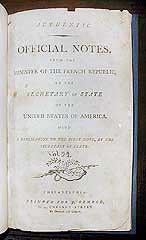
Pierre Auguste]. Authentic. Official notes, from the minister of the
French Republic, to the secretary of state of the United States of America.
With a replication to the first note, by the secretary of state. Philadelphia:
J. Ormrod, [ca. 1796]. 8vo signed in 4s (20 cm, 7.9"). 42 pp.
Privateers
& More
(Privateers). [Adet,
Pierre Auguste]. Authentic. Official notes, from the minister of the
French Republic, to the secretary of state of the United States of America.
With a replication to the first note, by the secretary of state. Philadelphia:
J. Ormrod, [ca. 1796]. 8vo signed in 4s (20 cm, 7.9"). 42 pp. • ESTC W21390; Evans 30442; not in Sabin. Recently rebound in quarter blue morocco over blue cloth, leather edges stamped with gilt rolls, spine gilt-stamped with title and publication information. Title-page with inner margin reinforced, chips to outer edges. Some leaves lightly spotted, title-page somewhat more darkly so.


 AMERICAN
Sericulture a
Possible Source ofRevenue?
Pullein, Samuel. The culture of silk:
or, an essay on its rational practice and improvement. In four parts... For
the use of the American colonies. London: Pr. for A. Millar, 1758. 8vo. Frontis.,
xv, [1 (blank)], 299, [1] pp., plt.
AMERICAN
Sericulture a
Possible Source ofRevenue?
Pullein, Samuel. The culture of silk:
or, an essay on its rational practice and improvement. In four parts... For
the use of the American colonies. London: Pr. for A. Millar, 1758. 8vo. Frontis.,
xv, [1 (blank)], 299, [1] pp., plt. 
In the period 1750 through 1820 there was considerable interest in the development of this potentially lucrative enterprise. The work in hand is divided into four parts: "I. On the raising and planting of mulberry trees. II. On hatching and rearing the silkworms. III. On obtaining their silk, and breed. IV. On reeling their silk-pods."
The two plates (one being the frontispiece) show various machinery and tools for, and stages of, the production of silk. The author, a "reverend," flourished 1734–60.
• Sabin 66625. Recent quarter calf, antique style. Round spine with raised bands accented with gilt ruling. Gilt center devices in spine compartments. Green morocco title-label. Marbled paper sides. Light foxing. A very good copy.
 TO Part
XVI
. . .
TO Part
XVI
. . . |