 AMERICANA TO 1820
AMERICANA TO 1820
AMERICANA TO 1820
 Whither,
the
Whither,
the AMERICAN
Economy?
AMERICAN
Economy?
 [Carey, Mathew]. Addresses of The Philadelphia Society for the Promotion of National Industry...Fourth edition. Philadelphia: Pub. by M. Carey & Son, pr. by G.L. Austin, Dec. 20, 1819. 8vo (19.2 cm, 7.625"). xi, [1 (blank) pp., pp. [9]–248.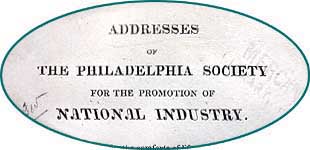
They address then-pressing topics: tariffs, protectionism, development of domestic industry, and European foreign policy.
• Shaw & Shoemaker 49095; Clarkin, Mathew Carey Bibliography, 1133. Recent quarter tan cloth with paper sides in the style of the era. Ex-library with stamp on title-page; paper brittle and age-toned. One page torn and repaired.

 HeLiked ItCarr, John. The stranger in Ireland: Or, a tour in the southern and western parts of that country, in the year 1805. Philadelphia: Samuel F. Bradford et al. (pr. by T. & G. Palmer), 1806. 8vo (21.5 cm, 8.5"). xi, [1], 168, *167/68, 169–339, [1 (blank)], 8 (adv.) pp.; 1 plt\.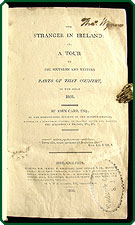
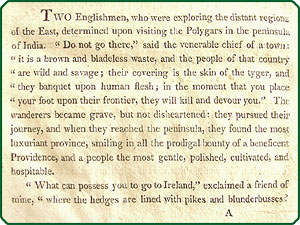
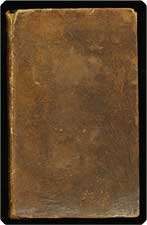
An Englishman through and through, Carr seems sincerely to have liked Ireland and the Irish he met. His book is full of extended and very readable detail — some original, much quoted — on (e.g.) language matters and Irish poetry, Irish agriculture and industry, Irish management of charities, Irish “sights” and ruins, Irish marriage cust marriage customs — and the implications of a potato-based diet.
Provenance: Contemporary inked inscription reading “Tho.s Wynne.”
• Shaw & Shoemaker 10096. On Carr, see: The Dictionary of National Biography. Contemporary mottled sheep, spine with gilt-stamped title-label; leather moderately rubbed, joints cracking and spine label dimmed. Title-page with owner's name as described above; title-page and one other stamped. Pages, except for central leaves, with waterstaining in lower margins; two pages with smeared spots of ink. (11960)

Second U.S. Edition: An Influential Classic Carter, Susannah. The frugal housewife: Or, complete woman cook. Philadelphia: James Carey, 1796. 12mo (17.2 cm, 6.75"). 132 pp.; 2 plts.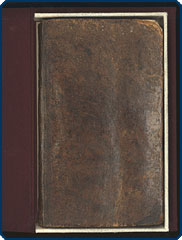
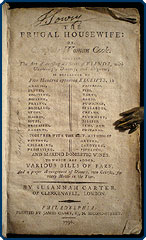
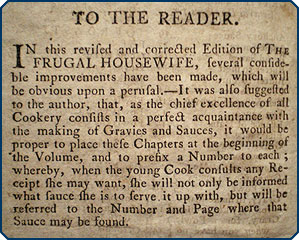
 Click the interior images for enlargements.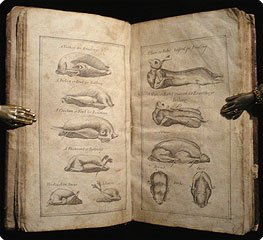
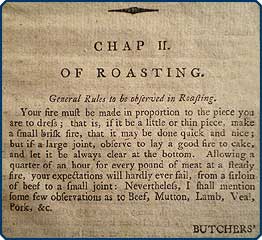
Provenance: Flourishing old signatures of “J. Lowry” to pastedown and title-page.
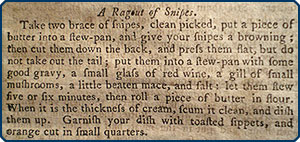 Click the interior images for enlargements.
 “On the Welch Tract on [the] Pee Dee River” 1743 Chanler, Isaac. Manuscript: “The Qualifications of a Gospel Minister for, and Duty in studying rightly to divide [sic] the Word of Truth; and the Duty of those who do partake of the Benefit of his Labours, towards him fully, plainly & impartialy [sic] represented in Two Sermons on 2 Tim: 2.15. Preached at the ordination of the Revd mr. Philip James at the Welch Tract on Pee Dee River in South Carolina April 4. 1743. With some Illustrations & Enlargements.” [South Carolina: 1743]. Folio (31.5 cm; 12.4"). [20] ff.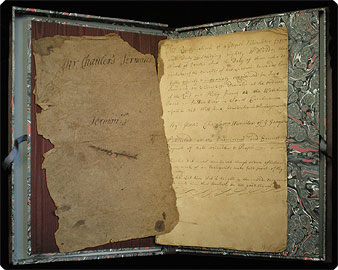
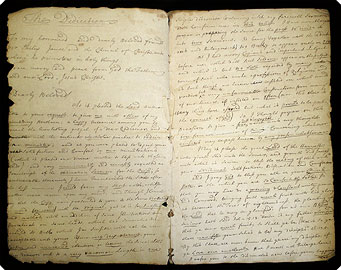
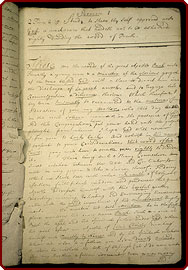
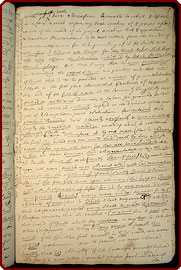 Click the images for enlargements.
 Although the title-page of this manuscript proclaims, “Published at the Unanimous and Earnest Request of Both Minister and People,” this work was never published in the sense of having been printed, or if it was printed, no copy survives, nor has any evidence of its publication.
 This manuscript is apparently the only surviving evidence, and very substantial it is, of an unpublished work by this pioneer minister.
The second sermon mentioned on the title-page was on Galatians 6:6 and is not present here; it may well have never been copied out and sewn to the end of this manuscript. In any case the second sermon is apparently long-lost.
Provenance: Ex-Crozer Theological Seminary.
• Written in a clear hand with numerous corrections. Unbound, on laid paper of the 1740s; now age-toned and a bit brittle, with some fold tears. Edges of paper chipped with some small pieces missing, occasionally costing a letter (only). Now safely housed in a Mylar sleeve within a marbled paper–covered chemise within a red cloth clamshell box. (26309)

American
Conscience — 1771
Chauncy, Charles. A compleat view of episcopacy, as exhibited from the fathers of the Christian church until the close of the second century.... Boston: Pr. by Daniel Kneeland, 1771. 8vo. x, 474 pp., [2] ff.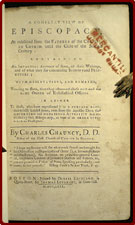
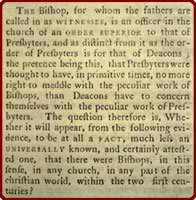
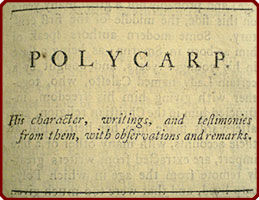
 Click any image where the hand appears on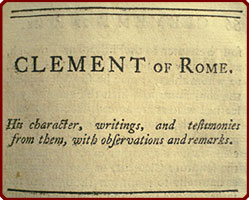
Paine
Was a DIRTY
Man!Cheetham, James. The life of Thomas Paine, author of Common sense, The crisis, Rights of man, &c. &c. &c. New York: Southwick & Pelsue, 1809. 8vo (22.2 cm, 8.75"). 347, [1] pp.
DIRTY
Man!Cheetham, James. The life of Thomas Paine, author of Common sense, The crisis, Rights of man, &c. &c. &c. New York: Southwick & Pelsue, 1809. 8vo (22.2 cm, 8.75"). 347, [1] pp.
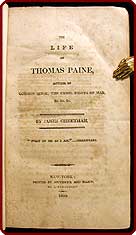 Click either image for an enlargement.
 Provenance: Pencilled note on endpaper, “From Ralph E. McCoy’s Library”; McCoy, emeritus Dean of Libraries at Southern Illinois University, Carbondale, published widely on the First Amendment freedoms.
• Howes C336; Sabin 12379; Shaw & Shoemaker 17193. Later quarter plain brown paper over contemporary tan paper–covered sides; edges and corners rubbed. Front free endpaper (modern) with pencilled note of McCoy’s ownership; front fly-leaf with pencilled gift inscription dated 1849. Offsetting and foxing throughout. A very sound copy.
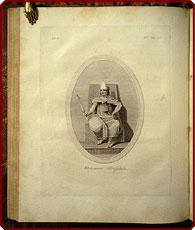
Illustrated IndigenousCustoms & Dress FIRST Edition in ENGLISH Clavigero, Francesco Saverio. The history of Mexico. Collected from Spanish and Mexican historians, from manuscripts, and ancient paintings of the Indians ... translated from the original Italian, by Charles Cullen. London: Pr. for G.G.J. and J. Robinson, 1787. 4to (28.5 cm, 11.2"). 2 vols. I: [2], xxxii, [4], 440, (441–44), 441–76 pp. (pagination skips v/vi, with text complete); 1 fold. map, 25 plts., 1 table. II: [4], 463, [1 (blank)] pp.; 1 fold. map, 1 plt.
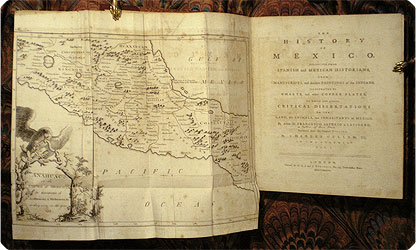 Click the interior images for enlargements.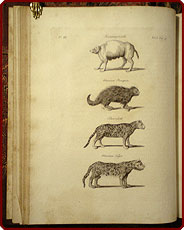
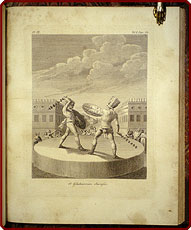
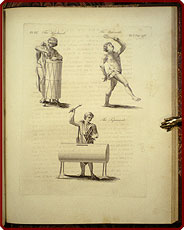
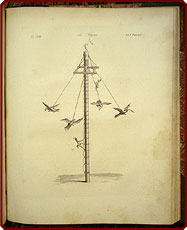
The two oversized, folding maps were engraved by T. Conder; a genealogical chart in vol. I shows the descent of the Mexican kings from the 13th century, while
 numerous engraved plates depict Mexican artifacts, costumes, activities, flora and fauna, architecture, etc.
 For more SETS, click here.
The Yucatan Franz Scholes & Robert Chamberlain Colección de documentos inéditos relativos al decumbrimiento, conquista y organización de las antigua posesiones españolas de ultramar. Segunda serie. Tomo num. 13, II Relaciones de Yucatán. Madrid: Impresores de la Real Casa, 1900. 8vo. xvi, 414 pp.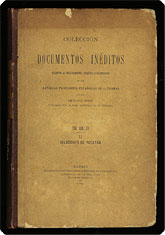
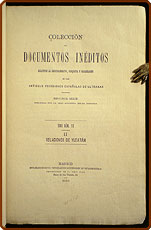
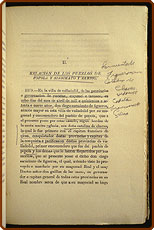 Click the interior images above for enlargements.
  extensively annotated in pencil by Robert Chamberlain and with occasional notes by Franz Scholes!
Provenance: First in the University of Miami Library, deacessioned; then in the library of Robert Chamberlain and later in that of Franz V. Scholes, both noted scholars of the Yucatán. Their signatures are on the front free endpaper and their notes are penciled in the margins of many pages.
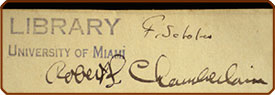
A
“Discourse” Still
Much Read — 18th-Century,
Newburyport
CopyColes, Elisha. A practical discourse of God’s sovereignty. With other material points derived thence.... Newburyport [MA]: Edmund M. Blunt, 1798. 8vo (20.5 cm, 8.2"). 372 pp.
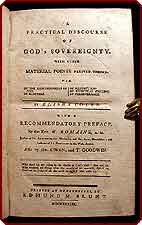
Single-click the image, for an enlargement. • ESTC W24802; Evans 33532. Contemporary mottled sheep, spine with gilt-stamped leather title-label; binding abraded with leather cracking over the spine, spine label lettering rubbed. Pages age-toned, with some spots of foxing.

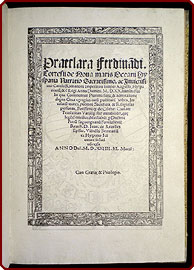
Cortés' Second Letter: The Conquest of Mexico Cortés, Hernando, & Peter Martyr. Praeclara Ferndinandi Cortesii De Nova Maris Oceani Hyspania Narratio. [colophon: Impressa in Nurimberga: per Fridericum Peypus], 1524. Folio (30.3 cm; 11.875" ). [4], 49, 12 leaves.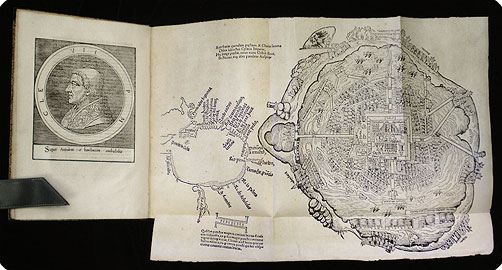 Click the images for enlargements. Cortés was the first conqueror since Julius Caesar to write a description of his conquests.
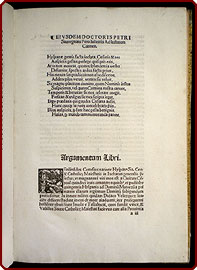
 It is here that Cortés provides a definitive name for the country, calling it “New Spain of the Ocean Sea.” This letter is also important for making reference to Cortés's “lost” first letter, supposedly composed at Vera Cruz on 10 July 1520. Whether that letter was actually lost or was suppressed by the Council of the Indies is unknown, though there is little doubt it once existed.
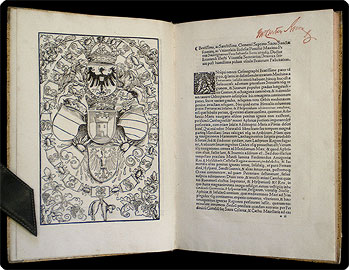
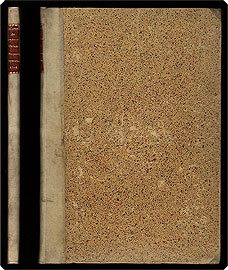 It is the text of this “second” letter, THE FIRST SURVIVING ONE, that was the first major announcement to the world of the discovery of major civilizations in the New World — and, as such, is a work of surpassing importance.
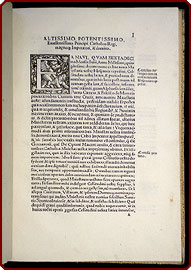
This copy bears the full-page woodcut portrait of Pope Clement VII on the verso of the fourth preliminary leaf, which is not found with all copies. Additionally, the title-page bears an interesting 14-piece composite woodcut border and the verso of that page has a stunning full-page woodcut of the coat of arms of Charles V, the Holy Roman emperor, to whom the letter is addressed. The coat of arms is surrounded by the collar of the Order of the Golden Fleece. The text is printed in roman with side- and shouldernotes; the lay-out is elegant and there is one large, handsome woodcut initial.
As usual, the letter is here bound with Peter Martyr's De Rebus, et insulis noviter repertis, which provides an account of the recently discovered islands of the West Indies and their inhabitants. It is often considered a substitute for the lost Cortés letter.
One of the most important early descriptions of Mexico and of the first encounter of the West with the Aztec civilization, this is a work of bedrock importance to the New World. No complete copy has appeared for sale since 1985.
• Alden & Landis, European Americana, 524/5; Sabin 16947; Harrisse, BAV, 125. Sanz 933–34; Medina, BHA, 70; Church 53; Burden 5; JCB, German Americana, 524/4; Streeter Sale 190. 18th-century half vellum and sprinkled paper over boards, gilt red leather label. Map supplied in expert facsimile; blank leaf H8 lacking. Bookplate of John Carter Brown (Library) on front pastedown, with deaccession stamp. Occasional very minor soiling in the text, else very good — a copy clean and even crisp. (26808)
Christianity Abroad, at Home, & among the (Jewish?) Native Americans Crawford, Charles. An essay on the propagation of the Gospel; in which there are numerous facts and arguments adduced to prove that many of the Indians in America are descended from the Ten Tribes ... the second edition. Philadelphia: James Humphreys, 1801. 12mo (18.3 cm, 7.2"). [1] f., 154 pp., [1] f. [with] Woodward, William Wallace. Increase of piety, or revival of religion in the United States of America; containing several interesting letters not before published. Together with three remarkable dreams, in succession, as related by a female in the Northern Liberties of Philadelphia to several Christian friends, and handed to the press by a respectable minister of the gospel. Philadelphia: W.W. Woodward, 1802. 12mo. [1] f., 114 pp.
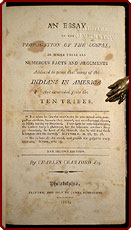
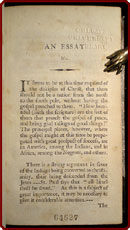 Click the interior images for enlargements.
 The second item here is the first edition of Woodward's collection of revival-themed letters to and from various clergymen, closing with an account of Mrs. Rebecca Ashburn's mysterious dreams. In these dreams a minister unknown to Mrs. Ashburn attempted to save her soul; she later identified her would-be converter as one Dr. William Rogers. This work is very uncommon in print form. OCLC and NUC Pre-1956 find only five U.S. institutional holdings of this Philadelphia printing, although it is widely held in microform.
• Essay: Sabin 17433; Shaw & Shoemaker 370; Rosenbach, American Jewish Bibliography, 123; Singerman, Judaica Americana, 0136. Increase: Shaw & Shoemaker 2587; Sabin 105172. Period-style half mottled calf and marbled paper–covered sides, spine preserving original gilt-stamped leather title-label. Title-page and first text page institutionally pressure-stamped. Pages lightly age-toned, somewhat more so in second work; one leaf with tear from outer margin extending into text. (25209)

Classic
Concordance
by“Alexander
the Corrector”Cruden,
Alexander. A complete concordance to the Holy Scriptures of the
Old and New Testaments: Or, a dictionary and alphabetical index to the Bible....
Philadelphia: Kimber, Conrad, & Co., 1806. 4to (30.3 cm, 11.9"). Frontis.,
[8], 1012 pp.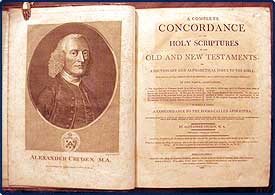
Cruden, bookseller to Queen Caroline, dedicated his initial publication of his concordance to her. Unfortunately, she died two weeks later, and profits from the sale of the volume did not meet the author’s expectations; Cruden’s disappointment (and bouts of eccentric behavior) regardless, the DNB stresses that “his biblical labours have justly made his name a household word among the English-speaking peoples.”
The
frontispiece portrait of the author was engraved by William Kneass.
• Shaw & Shoemaker 10233. On Cruden, see: The Dictionary of National Biography, V, 249–51. Contemporary sheep, spine with gilt-stamped leather title label; worn and abraded, leather cracking over spine. Front pastedown and free endpaper (partially separated) with stray pencil marks. Varying degrees of offsetting and spotting. One piece of dried plant material laid in. (5706)
For
more RELIGION, click here.

 TO
Part VII . . . TO
Part VII . . . |