
 MEXICO - UNA PIÑATA BIBLIOGRÁFICA
Una de nuestras especialidades mayores - If you collect in this area, let us know!
MEXICO - UNA PIÑATA BIBLIOGRÁFICA Advice to Guerrero on the Day He Deposed
 Pres. Gomez Pedraza
  Ibar, Francisco. Hoy se echan los cimientos al templo de la paz; o, Felicitacion al segundo presidente. [colophon: Mexico: Impr. á cargo de T. Urbide y Alcalde, 1829]. Folio. [2] ff.
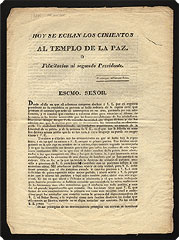
 Click the image for an enlargement.
 Rare: We locate only the copy at the Bancroft Library.
• Folded, as issued. A slim wormtrack in the foremargin, not touching any text; one pin-type wormhole in the text touching or costing one letter on each page. Clean, a nice copy. (25814)


 Juicy!
Iglesias
e Inzaurraga, J. M. Observaciones hechas en los informes de segunda y tercera
instancia, por el Licenciado J.M. Iglesias e Inzaurraga en el negocio seguido
por D. Bonifacio de Tosta, contra D. Jose Domingo Rascon sobre restitucion in
integrum. Mexico: Imp. de A. Boix, 1855. 8vo. 56 pp., [1] f.
Juicy!
Iglesias
e Inzaurraga, J. M. Observaciones hechas en los informes de segunda y tercera
instancia, por el Licenciado J.M. Iglesias e Inzaurraga en el negocio seguido
por D. Bonifacio de Tosta, contra D. Jose Domingo Rascon sobre restitucion in
integrum. Mexico: Imp. de A. Boix, 1855. 8vo. 56 pp., [1] f. 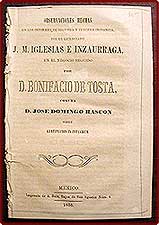
• Sutro 902. Removed from a nonce volume.

Another Pensador
Mejicano"Intruso, El." Respuesta de otro pensador mejicano sobre bagages y coches de providencia. [Mexico]: Alejandro Valdes, 1820. 4to. [2] ff.
Pensador
Mejicano"Intruso, El." Respuesta de otro pensador mejicano sobre bagages y coches de providencia. [Mexico]: Alejandro Valdes, 1820. 4to. [2] ff.
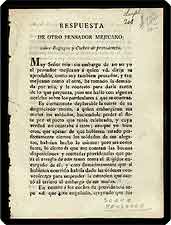
Searches of OCLC, RLIN and NUC Pre-1956 locate only four copies in the U.S.
• Medina, Mexico, 11808; Garritz, Impresos novohispanos, 3654; Steele 46; Sutro 134. Removed from a volume with ragged inner margin. Faint rubber-stamp in one margin.

 The
Surrender of
The
Surrender of Valladolid,
now, MORELIA
Iturbide,
Agustín de. [drop-title] Contestaciones
que precedieron a la capitulacion de la ciudad de Valladolid, entre los señores
coronels d. Agustin de Iturbide, y d. Luis Quintanar. [colophon: México:
en la oficina de Alejandro Valdes, 1821]. Small 4to (19.5 cm; 7.5"). 15, [1
(blank)] pp.
Valladolid,
now, MORELIA
Iturbide,
Agustín de. [drop-title] Contestaciones
que precedieron a la capitulacion de la ciudad de Valladolid, entre los señores
coronels d. Agustin de Iturbide, y d. Luis Quintanar. [colophon: México:
en la oficina de Alejandro Valdes, 1821]. Small 4to (19.5 cm; 7.5"). 15, [1
(blank)] pp.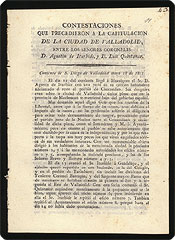 Click the image for an enlargement.
 Uncommon. We trace only three copies in the U.S.
• Garritz 4724; Sutro, Supplement, 145. Not in Medina, Mexico. Removed from a nonce volume. Very good condition. (24785)

Exam
Time in 1790
Querétaro
Iturriaga, Manuel. Questiones academicas, que ofrece
reverente el rector del Real Colegio de San Francisco Xavier de la ciudad de Queretaro al Exmo.
Señor Don Juan Vicente de Guemez Pacheo de Padilla Horcasitas y Aguayo.... Mexico: Por D.
Felipe de Zuñiga y Ontiveros, 1790. 8vo (20 cm; 8"). [1] f., 12 pp., 1 plt.
1790
Querétaro
Iturriaga, Manuel. Questiones academicas, que ofrece
reverente el rector del Real Colegio de San Francisco Xavier de la ciudad de Queretaro al Exmo.
Señor Don Juan Vicente de Guemez Pacheo de Padilla Horcasitas y Aguayo.... Mexico: Por D.
Felipe de Zuñiga y Ontiveros, 1790. 8vo (20 cm; 8"). [1] f., 12 pp., 1 plt.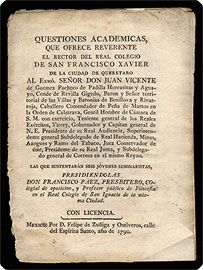
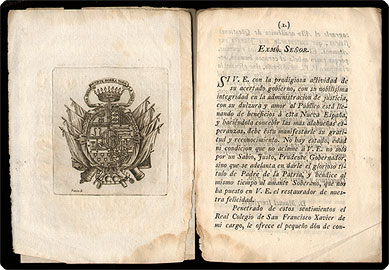 Click the images for enlargements.
 The plate is a very fine copper engraving of the viceroy's coat of arms and is signed in the plate “Garcia.” (There is also one handsome headpiece.)
• Not in Medina, Mexico; not in CCILA; not in Catálogo Colectivo del Patrimonio Bibliográfico Español; not in Catálogo Colectivo del Patrimonio Bibliográfico Mexicano. Never bound, never stitched; irregular at the lower area of the inner margin of all leaves with rodent-gnawing visible. Light waterstaining in lower inner corners as well. Some finger soiling; light chipping along top edges. Title-page lightly dust-soiled. (26879)
His
Surviving Oratory
&
The FIRST
BIBLIOGRAPHY
Printed
in the New World
Juan
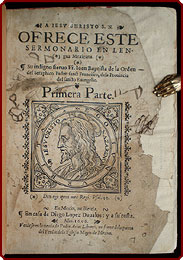
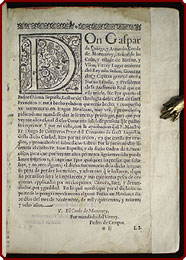
Bautista, fray. A Jesu Christo
S.N. ofrece este sermonario en lengua mexicana ... Primera parte. Mexico: En
casa de Diego Lopez Davalos, 1606. 4to (21.5 cm; 8.5"). [26] ff., pp. 1–559,
ff. 560–99, pp. 600–39, ff. 640–47, pp. 648–55, 664–709,
[1] p., [20 of 24] ff., lacks final 4 leaves.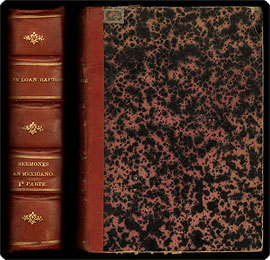
 Click the images for enlargements.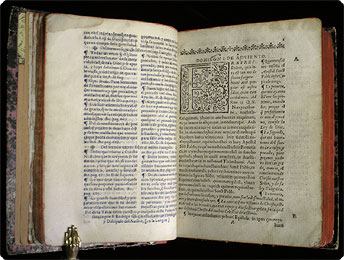
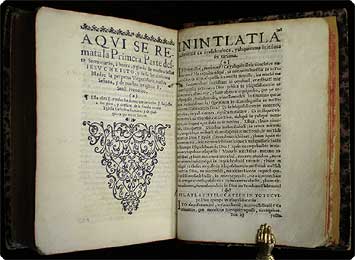
 A
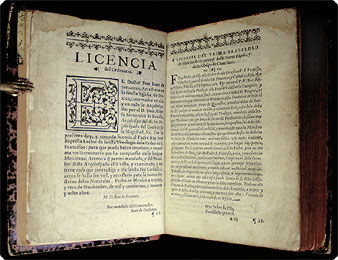
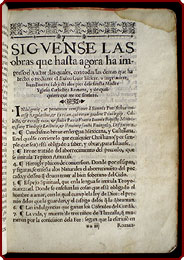
long unnoticed feature of this book is that it contains the first bibliography
published in the New World. On
signature **iiii recto and verso is a list of “las obras que hasta agora
ha impesso el Auctor” (“the works that until now the author has
had published”). The list is not in chronological order nor is it alphabetical
by title; nonetheless it is a bibliography and supplies us with information
now known only because of its inclusion here. Of the 17 items listed, several
have failed to survive in any known copy, including the second part of this
sermonario — though at the time of publication of this part one,
“de la segunda parte esta ya impresso gran pedaço” (“of
the second part a large portion is already printed”).
A
long unnoticed feature of this book is that it contains the first bibliography
published in the New World. On
signature **iiii recto and verso is a list of “las obras que hasta agora
ha impesso el Auctor” (“the works that until now the author has
had published”). The list is not in chronological order nor is it alphabetical
by title; nonetheless it is a bibliography and supplies us with information
now known only because of its inclusion here. Of the 17 items listed, several
have failed to survive in any known copy, including the second part of this
sermonario — though at the time of publication of this part one,
“de la segunda parte esta ya impresso gran pedaço” (“of
the second part a large portion is already printed”).
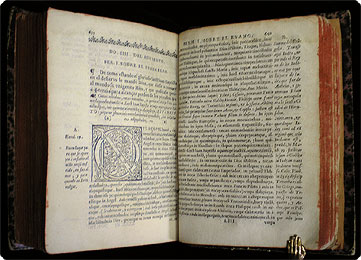
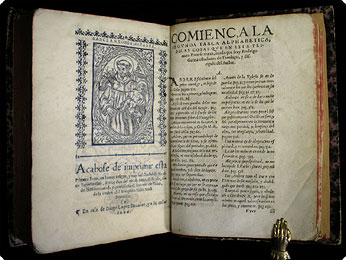
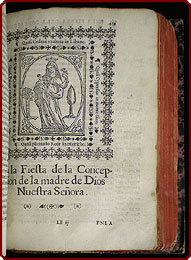
The volume is enhanced by  half-page woodcuts: here, Christ's
portrait profile on the title-page, St. Andrew with his Cross, St. Anne with
the Virgin as infant (appearing twice), and St. Anthony of Padua. The text
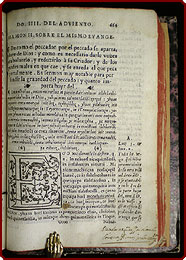
is in roman with side- and shouldernotes in italic type. Printer López
Dávalos employs an interesting set of very large (5 x 5 cm; 2" x 2")
foliated woodcut initials throughout the volume.
half-page woodcuts: here, Christ's
portrait profile on the title-page, St. Andrew with his Cross, St. Anne with
the Virgin as infant (appearing twice), and St. Anthony of Padua. The text
is in roman with side- and shouldernotes in italic type. Printer López
Dávalos employs an interesting set of very large (5 x 5 cm; 2" x 2")
foliated woodcut initials throughout the volume.
Provenance: 18th-century signature in a few margins of Carlos Perez; late 19th- or early 20th-century bookplate of Nicolás León; in the collection of the John Carter Brown Library (deaccessioned).
• Medina, Mexico, 227; García Icazbalceta, Lenguas, 13; H. de León-Portilla, Tepuztlahcuilolli, 342; Viñaza 114; Newberry Library, Ayer Indians, Nahuatl-21; Pilling, Proof-sheets, 235; Palau 23467; Putick & Simpson 154; Schwaller 11. For biographical information on Bautista, see: Archivo biográfico de España, Portugal, e Iberoamérica, fiche 104, frames 339–73. Late 19th-century quarter red Mexican sheep with purple and black mottled paper sides. Title- and following leaf with irregular foremargins, loss of blank areas of old repaired; waterstaining in margins of early leaves. Some worming in text costing letters here and there but not impeding sense for the reader. Last four leaves, one bearing an illustration of the Crucifixion, absent (i.e., from the section of Bible citations used in the sermons); last leaves present a bit chipped/gnawed at lower corners and one fore-edge. Old marca de fuego eradicated from top edge; all edges red and corners elegantly rounded. Some 18th-century marginalia in Spanish explicating words and phrases in the Nahuatl text. (26393)
 For
more of NATIVE AMERICAN interest,
For
more of NATIVE AMERICAN interest,
The
Road
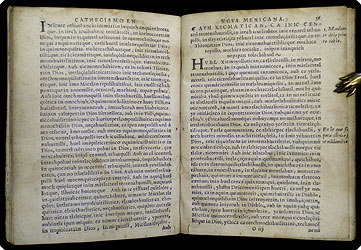
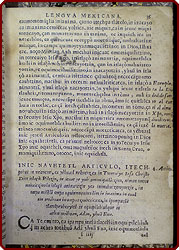
to Heaven in Nahuatl
León, Martín de. Camino del cielo en lengua mexicana, con todos los requisitos necessarios para conseguir este fin, co[n] todo lo que un Xp[r]iano deue creer, saber, y obrar, desde el punto que tiene uso de razon, hasta que muere. En Mexico: En la Emprenta de Diego Lopez Davalos, 1611. Small 4to (18.5 cm; 7.25"). Fols. 10–11, 13–69, 69[!]–73, [nothing missing] 76, 75, 77–108, 110–23.
Nahuatl
León, Martín de. Camino del cielo en lengua mexicana, con todos los requisitos necessarios para conseguir este fin, co[n] todo lo que un Xp[r]iano deue creer, saber, y obrar, desde el punto que tiene uso de razon, hasta que muere. En Mexico: En la Emprenta de Diego Lopez Davalos, 1611. Small 4to (18.5 cm; 7.25"). Fols. 10–11, 13–69, 69[!]–73, [nothing missing] 76, 75, 77–108, 110–23.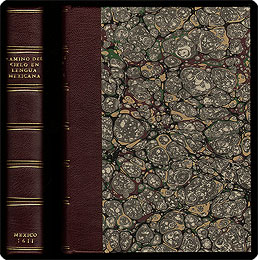
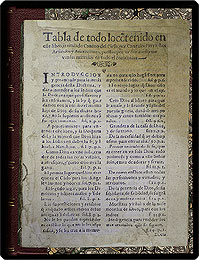
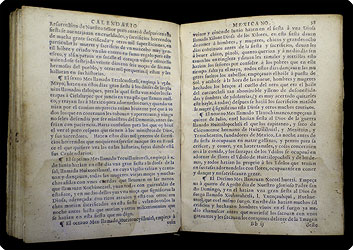 Click the images for enlargements.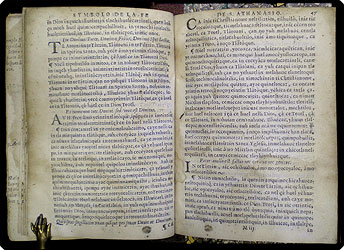
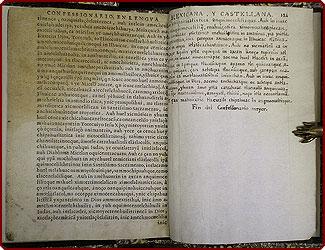 Priced much, much less than a good, complete copy; and a relic with much more than its lowered price to recommend it. (25860)
For Books for the BUSTED In
PRAISE of theVirgin
of Guadalupe
Lopez de Abiles, Joseph [a.k.a., José López de Aviles].
Veridicum ad modum anagramma, epigramma obsequiosum, unaque cum acrostichide virgilio
centunculus rigorosus in laudem purissimae immaculataeque conceptionis sanctissimae virginis
dei-genitricis Mariae.... Mexici: ex typographia vidue Bernardi Calderon, 1669. Folio (30 cm;
11.75"). [17of 19] ff., lacking half-title and plate.
In
PRAISE of theVirgin
of Guadalupe
Lopez de Abiles, Joseph [a.k.a., José López de Aviles].
Veridicum ad modum anagramma, epigramma obsequiosum, unaque cum acrostichide virgilio
centunculus rigorosus in laudem purissimae immaculataeque conceptionis sanctissimae virginis
dei-genitricis Mariae.... Mexici: ex typographia vidue Bernardi Calderon, 1669. Folio (30 cm;
11.75"). [17of 19] ff., lacking half-title and plate.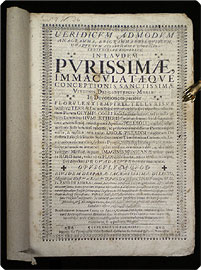
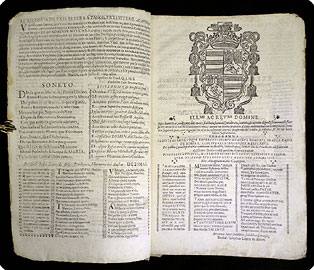 Click the images for enlargements.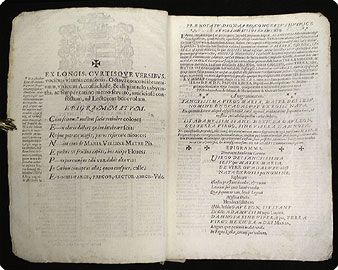
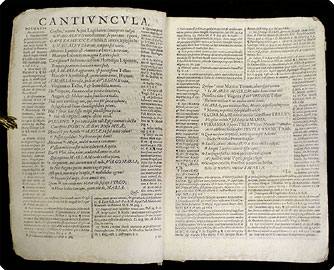
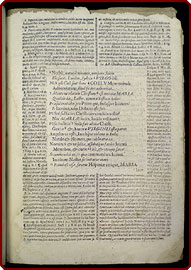
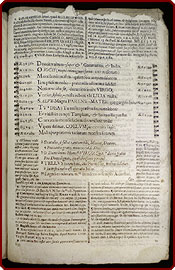
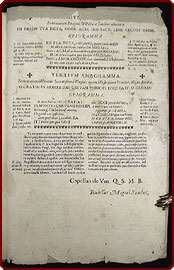
 This
ambitiously designed production is from the press of one of Mexico's famous
17th-century woman printers, the Widow Calderón.
This
ambitiously designed production is from the press of one of Mexico's famous
17th-century woman printers, the Widow Calderón.
The work ends with a short essay addressed to López de Abiles by Lic. Miguel Sánchez and with anagrams by him as well. Sánchez was the author of Imagen de la Virgen Maria madre de dios de Guadalupe, milagrosamente aparecida en la ciudad de Mexico that had appeared in 1648. As a researcher with considerable knowledge of the Virgin of Guadalupe, he praises López de Abiles in no uncertain terms.
For some unfathomable reason Medina lists this under the extensive half-title — Poeticum viridarium in honorem, laudationem, et obsequium purae admodum ... Mariae: eiusdem dominae miraculosae Mexiceae imaginis de Guadalupe.... — and the cataloguer at the University of Arizona has blindly followed Medina down that road so that the WorldCat record is not findable via the real title.
Rarity: WorldCat locates only one copy worldwide but we know of two others. No additional copies were located via COPAC, Catálogo Colectivo del Patrimonio Bibliográfico, Metabase, or the OPACs of the Spanish National Library, the Mexican National Library, and the British Library.
• Medina, Mexico, 1016; Andrade 582; Grajales & Burrus, Bibliografia guadalupana, 82. In later wrappers, a little tattered at the spine. Lacks the half-title and the plate. Top margins of last 10 leaves rodent-gnawed with loss of paper but not of text, although a few letters are touched and the headline words “Segundum Anagramma” lost to that animal. Some light staining, front and rear. In all, a good if damaged copy of an important rarity. (26413)
For a whole short shelf devoted
Cortés Malinche & Montezuma López de Gómara, Francisco. Historia, di Don Ferdinando Cortes, marchese della Valle, capitano varlorosissimo. In Venetia: per Giouanni Bonadio, 1564. 8vo. [8], 354 of 356 ff. (lacking fol. 1 and final blank).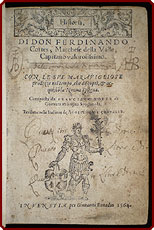
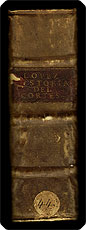
The Historia general de las Indias (first published in 1552) is divided into two parts which stand on their own although clearly written as two parts of a whole. Part I is a history of events concerning the discovery and conquests of the New World exclusive of those involving Cortés. Part II is entirely dedicated to the telling of Cortés's role in the conquest of Mexico and subsequent discoveries.
Click the images for enlargements. In this Italian translation from the pen of Agostino di Cravaliz, López's “all-Cortés” volume stands as part III of the three-volume Historia, delle nuove Indie Occidentali, with parts I and II being translations of Cieza de Leon's Historia, over Cronica del gran regno del Peru and the previously mentioned part I of Gómara's Historia general de las Indias.
The text here is printed in italic type except the capitals, which are roman. The title-page is printed in roman and italic and has the woodcut printer's device.
• Alden & Landis 564/25; Sabin 27741; Medina, BHA, 159n; Wagner, Spanish Southwest, 2v. 18th-century vellum over paste boards, soiled and a bit rubbed; red leather spine label, with a chip, and an old circular paper shelf-label. Title-page dust-soiled, mounted; small, narrow, oblong portion of blank area of title-page excised and filled in at an early time. Lacks folio 1 and final blank. Top margins closely trimmed, sometimes costing the running heads and folio numbers. (25767)
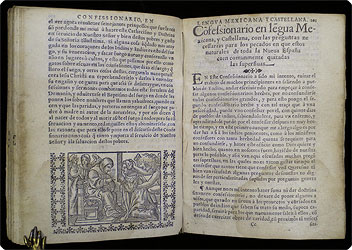
Dictionary & Catechism in OTOMÍ López Yepes, Joaquín. Catecismo y declaracion de la doctrina cristiana en lengua otomí, con un vocabulario del mismo idioma. Megico [i.e., Mexico]: Impreso en la oficina del ciudadano Alejandro Valdes, 1826. 8vo. 254 pp., [1] f.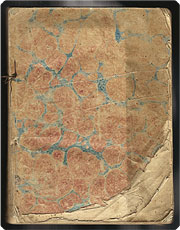
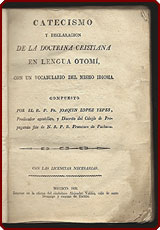
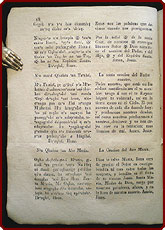
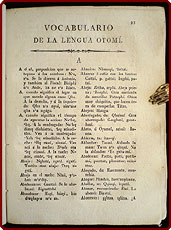 Click the interior images above for enlargements. More than 150 pages of this work comprise an Otomí/Spanish vocabulary. Included at the end are instructions for teaching the catechism to Indians.
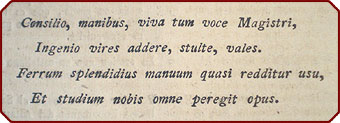
• Viñaza 420; García Icazbalceta, Apuntes, 40; Sabin 106013; Palau 142256; Pilling, Proof-sheets, 2316. Not in Newberry Library, Ayer Collection. Stitched in original wrapper; wrappers tattered, torn with some loss, and partly darkened; same for the front free endpaper and fly-leaf. Some dog-earing, and some leaves (including title) with some marginal soiling, but really, a worthwhile copy. (25558)
For
DICTIONARIES/GRAMMARS, ETC.,

Mariology for the New World Luzuriaga, Juan de. Paranympho celeste[.] Historia de la mystica zarza, milagrosa imagen, y prodigioso santuario de Aranzazu de religiosos observantes de n. seraphico padre San Francisco en la provincia de Guypuzcoa. Mexico: Por los herederos de la viuda de Bernardo Calderon, 1686. Folio (27 cm; 10.75"). 3 pts. in 1 vol. [17 of 18] ff., 114, 96, 112 pp., [8] ff., lacking the plate (as usual), and a leaf in the preliminaries.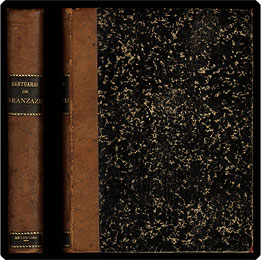
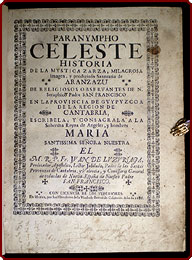 Click the images for enlargements.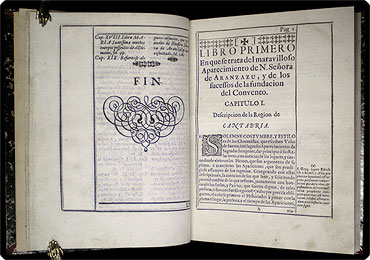
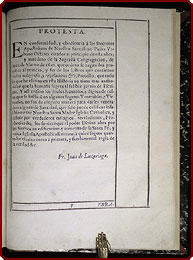 It is extremely noteworthy that this thick and significant history of this Cantabrian apparition was written and published in Mexico and not in Spain. After years of service in Cantabria, his native region, in 1680 the author was transferred to New Spain to serve as the Comisario General of the Franciscan Order in New Spain and the Philippines, and it was in Mexico City that he composed his massive and important work. He then also had it printed there, in spite of the fact that he retained contacts in Spain where it presumably would have had a greater natural audience, and in spite of the fact that it was, for its day, a very large project for a Mexican press to be offered. Or for one to take on! Additionally, it is printed on exceptionally thick paper.
Provenance: Bookplates of Luis and Clotilde Montt (Chilean collectors) and of the John Carter Brown Library (deaccessioned).
• Medina, Mexico, 1376; Palau 144367; Beristain, II, 198; Leclerc 1190. On Luzuriaga, see: Archivo biográfico de España, Portugal, e Iberoamérica, fiche 534, frames 77–81. 19th-century quarter brown sheep with black leather spine labels lettered in gilt; black and white marbled paper sides. Without the plate and one leaf in the preliminaries; last three leaves of the index damaged with loss in the foremargins, costing a few words and letters; title-page soiled and with several old tears very well-repaired of old; stains occasionally, never bad ones. Withal a rather good copy of a very uncommon work of New World Mariology. (26392)

 TO Part VI
. . .
TO Part VI
. . . |