 MEXICO - UNA PIÑATA BIBLIOGRÁFICA
Una de nuestras especialidades mayores - If you collect in this area, let us know!
MEXICO - UNA PIÑATA BIBLIOGRÁFICA Noble
Orders — American
Ones Included Here
Noble
Orders — American
Ones Included Here Maigne, W. Dictionnaire encyclopédique des ordres de chevalerie civils et militaires créés chez les différents peuples depuis les temps les plus reculés jusqu'a nos jours. Paris: Adolphe Delahays, 1861. 12mo (17.2 cm, 6.8"). xvi, 240 pp., fold. table/plt.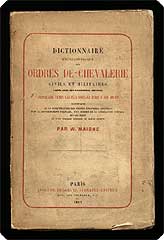
• Vicaire, Manuel de l'amateur de livres du XIXème, I, 772. Uncut, mostly unopened copy. Publisher's wrappers, printed in black and red; front one off, with expectable chipping and with soiling. Some pages lightly spotted; mostly, clean. Now housed in a simple acid-free phase-box. (14356)


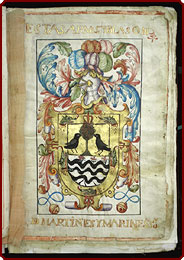
Mexican Hidalgo — Meaty Matter — Vivid Full-Page Paintings MEXICAN Binding Available for Analysis Martínez, Marín, Montemayor, & Almonazi families. Manuscript carta confirmatoria de hidalguía. On paper and vellum. Madrid, Seville, Puebla, Mexico: ca. 1583–1706. Folio. Ca. 170 folios.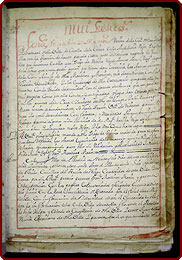
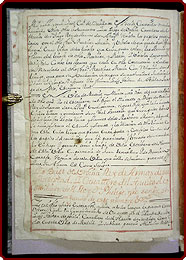
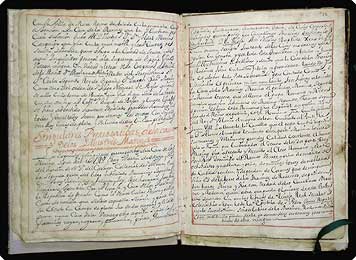
 Click the images for enlargements.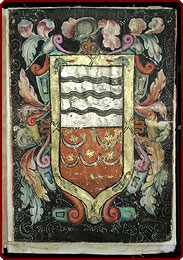
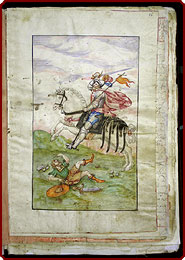
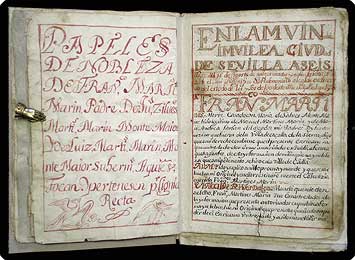
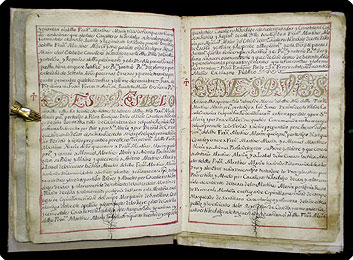
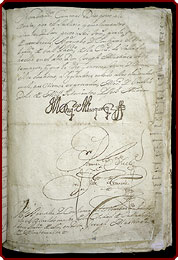
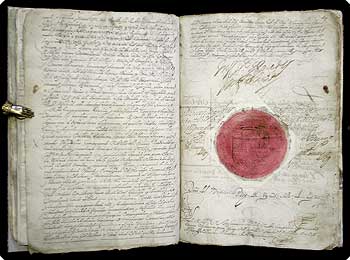
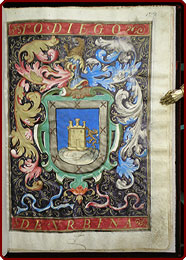
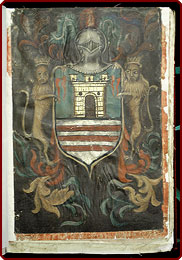
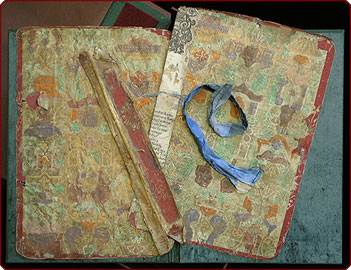 signed by Viceroy Albuquerque in his own large, distinctive hand, and a third document confirming an appointment of the Alferez Silvestre Martínez de Montemayor is signed by the Marques de la Laguna (i.e., the viceroy in 1685).
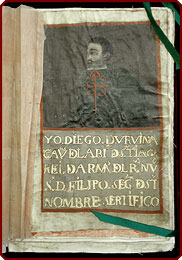
The Six Illustrations: Four full-page, full-color, illuminated coats of arms on vellum of the Marín, Martínez, Almonazir, and Montemayor families; a full-page full-color miniature of a Martínez on horseback slaying a Moor (a strangely garbed Moor, but by his curved sword a Moor nonetheless), and a half-page portrait of Diego de Urbina, the king of arms under Felipe II, with his name and title illumined below. Salmon silk guards are present for several of these.
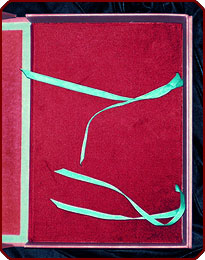
• New binding in traditional style as above, with green ribbon ties, in a clamshell box; elements of original binding preserved in box compartment. Some text leaves torn with loss of text at outer margin, leaves repaired; one vellum leaf with top half excised and a neighboring paper one with its bottom half taken. Otherwise, only some few tears, none serious.  A production and survival both treasurable and studyable. (25787)

Michoacán MeasuredMartínez de Lejarza, Juan José. Análisis estadístico de la provincia de Michuacan, en 1822. Mexico: Imprenta nacional del supremo gobierno de los Estados-Unidos, 1824. Small 4to (20 cm; 8"). [2] ff., ix, [1 (blank)], 281, [1 (blank)] pp., 9 fold. tables.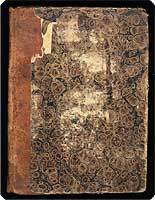
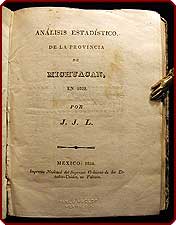 Click the image to the left
 Such statistical publications as this were essential for the government of the newly independent nation, especially for planning purposes and for use when negotiating with bankers for the loans so essential to the nascent nation.
Interestingly, the population statistics ignore distinctions such as “indio,” “mestizo,” etc.  The brief paragraphs about the towns and hamlets are filled with facts such as that the nuns of one particular town still wear hats of the Quiroga style.
An observation having nothing to do with the text: The paper on which this work is printed is very thin laid paper with no apparent watermark. The quality is not “European” and this cataloguer (DMS), with nearly 40 years experience with Mexican books, wonders if the paper is from one of Mexico's first paper mills?
• Palau 155712; not in Sutro. Later 19th-century quarter sheep with stone pattern marbled paper sides. Binding worn, text skewed in binding. Private ownership pressure stamp on title-page.

 Lord
Save Us — An AttractiveSMALL
Broadside(Medical
Prayer). Broadside.
Begins: "Deprecacion contra la peste. Al divino rostro." [Mexico City, ca. 1830–50].
12mo (165 x 112 mm; 6.5" x 4.5). [1] f.
Lord
Save Us — An AttractiveSMALL
Broadside(Medical
Prayer). Broadside.
Begins: "Deprecacion contra la peste. Al divino rostro." [Mexico City, ca. 1830–50].
12mo (165 x 112 mm; 6.5" x 4.5). [1] f.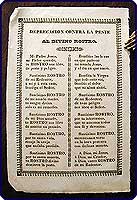
 worried
devout.
worried
devout.
• Slightly irregular margins, as issued. Handsome.
 WONDERFUL
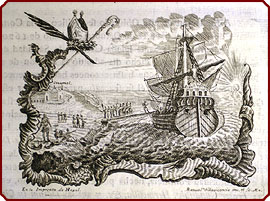
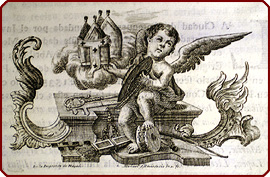
Culs-de-Lampe by
Villavicencio
& NavarroMexico
(ecclesiastical province). 1st & 2nd Concilia (1555, 1565).
Concilios provinciales primero, y segundo, celebrados en la muy noble,
y muy leal Ciudad de México, presidiendo el Illmo. y Rmo. Señor
D. Fr. Alonso de Montúfar, en los años de 1555, y 1565. En México:
En la Imprenta de el Superior Gobierno, de el Br. D. Joseph Antonio de Hogal,
1769. Folio (27 cm; 10.5"). [10], 34, [2], 35–38, 41–184, [2], 185–396,
[12] pp.
WONDERFUL
Culs-de-Lampe by
Villavicencio
& NavarroMexico
(ecclesiastical province). 1st & 2nd Concilia (1555, 1565).
Concilios provinciales primero, y segundo, celebrados en la muy noble,
y muy leal Ciudad de México, presidiendo el Illmo. y Rmo. Señor
D. Fr. Alonso de Montúfar, en los años de 1555, y 1565. En México:
En la Imprenta de el Superior Gobierno, de el Br. D. Joseph Antonio de Hogal,
1769. Folio (27 cm; 10.5"). [10], 34, [2], 35–38, 41–184, [2], 185–396,
[12] pp.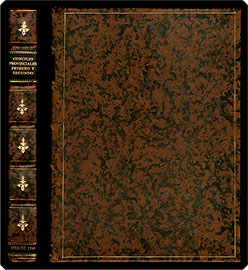
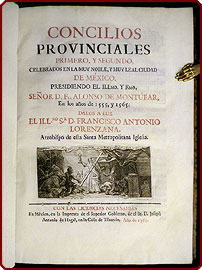
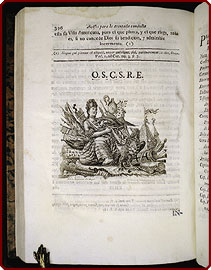
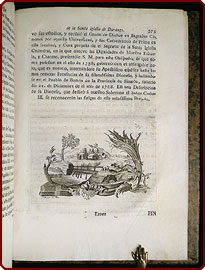 Click the images for enlargements. This text is from the press of José Hogal,
who is often called the Baskerville of Mexico.
Click the images for enlargements. This text is from the press of José Hogal,
who is often called the Baskerville of Mexico.
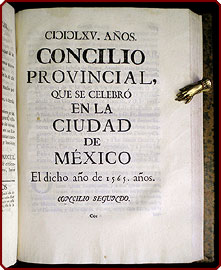
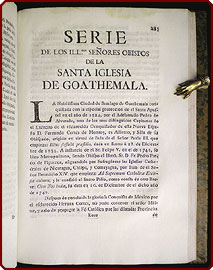
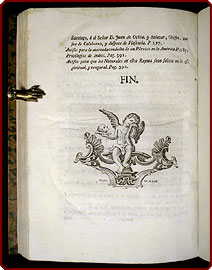
The force behind this edition was archbishop Francisco Antonio Lorenzana (1722–1804), a patron of Hogal's press and of the arts, who soon after assuming the archbishopric of Mexico in 1766 saw the need for a concilium. In preparation for it he paid Hogal to publish or republish, as was the case, the acts of the first three provincial councils of Mexico, held respectively in 1555, 1565, and 1585; these appeared in 1769 and 1770. In 1771 he himself held the fourth Mexican provincial synod; ironically, those acts were not published until 1898.
• Medina, Mexico, 5299; Palau 142387; Sabin 42063.
Recent Spanish sheep mottled in the Valenciana style. Occasional light waterstain
in some upper margins, never in text. Paper crisp and printing very sharp.
 A
very good copy. (26797)
A
very good copy. (26797)
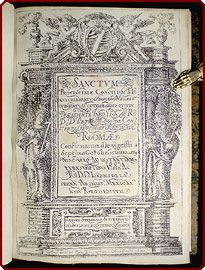
Attempting aCOMPULSORY Social Code for New Spain A Juan Ruíz Imprint Mexico (ecclesiastical province). 3rd Concilium. Sanctum provinciale concilium mexici celebratum anno dñi milless.mo quingetess.mo octuagessimo quinto. [Mexici]: Apud Ioannaem Ruiz, 1622. Folio. [5 (of 6)], 102, [1], 38, [1] ff. (lacks title-leaf, supplied in facsimile).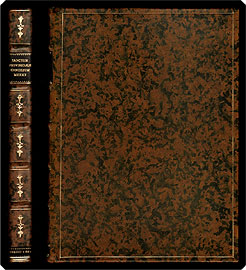
 Click the images for enlargements.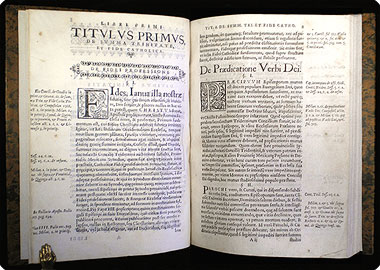
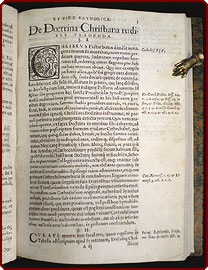
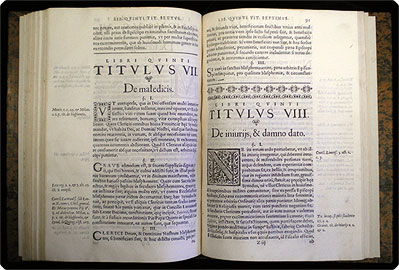
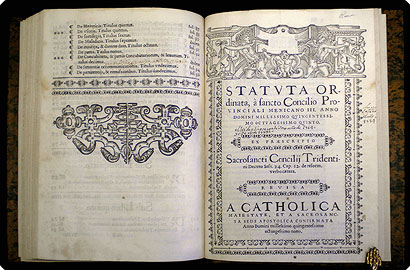
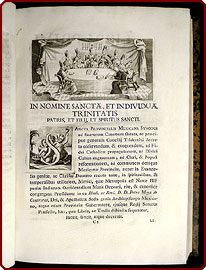
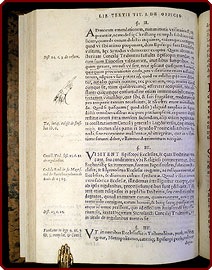 The printer of this work, Juan Ruíz, was an important figure in colonial Mexican book arts and his books are among the most elegant produced during the 17th century in the New World. Here he provides handsome typography, accented with wonderful and large woodcut initials, some historiated, and a woodcut title-page border element originally cut for the incunable-era printer Antonio Espinosa, bearing his initials!
Evidence of readership: In addition to the expected marking in margins indicating important statement in the text (which is extensive in this copy), folios 17r, 17v, and 18r of the second foliation have interesting marginalia.
 &
ANOTHER
from
&
ANOTHER
from the
Hogal Press
Mexico
(ecclesiastical province). 3rd Concilium.
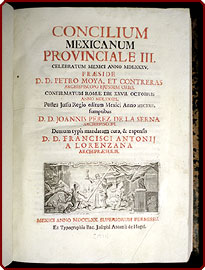
Concilium Mexicanum Provinciale III celebratum Mexici anno MDLXXXV. Praeside
D.D. Petro Moya, et Contreras archiepiscopo ejusdem urbis. Confirmatum Romae
die XXVII. Octobris anno MDLXXXIX. Mexici: Ex typ. Bac. Josephi Antonii de Hogal,
[1770]. Folio (27 cm; 10.5"). [6] ff., 328 pp., [3] ff., 141, [1] pp., [2] ff.
the
Hogal Press
Mexico
(ecclesiastical province). 3rd Concilium.
Concilium Mexicanum Provinciale III celebratum Mexici anno MDLXXXV. Praeside
D.D. Petro Moya, et Contreras archiepiscopo ejusdem urbis. Confirmatum Romae
die XXVII. Octobris anno MDLXXXIX. Mexici: Ex typ. Bac. Josephi Antonii de Hogal,
[1770]. Folio (27 cm; 10.5"). [6] ff., 328 pp., [3] ff., 141, [1] pp., [2] ff.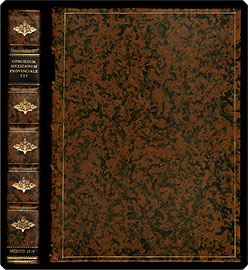
 Click the images for enlargements.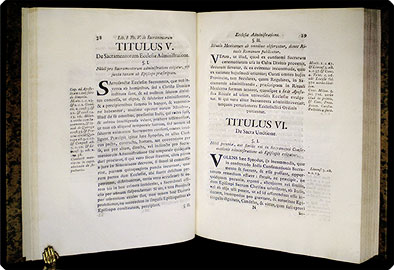
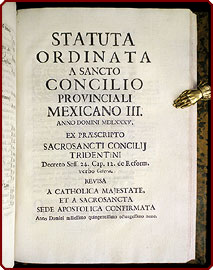
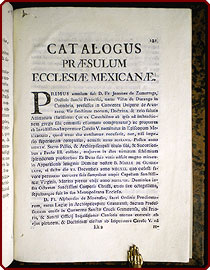
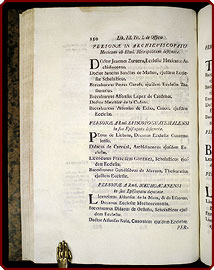
The Third Mexican Concilium, which was celebrated in Mexico city in 1585, had been called by Archbishop Moya de Contreras with the object of producing a comprehensive and compulsory social code for New Spain. The code was shaped, but only those rules directly affecting the conduct of priests (regular and secular) and nuns (cloistered and not) were promulgated.
The force behind this edition was archbishop Francisco Antonio Lorenzana (1722–1804), a patron of Hogal's press and of the arts, who soon after assuming the archbishopric of Mexico in 1766 saw the need for a concilium. In preparation for it, he paid Hogal to publish or republish, as was the case, the acts of the first three provincial councils of Mexico, held respectively in 1555, 1565, and 1585; these appeared in 1769 and 1770. In 1771 he himself held the fourth Mexican provincial synod; ironically, those acts were not published until 1898.
• Medina, Mexico, 5361; Palau 142389; Sabin 42064 .
Recent Spanish sheep mottled in the Valenciana style. Minor worming at some
inner margins, never in text. Paper crisp and printing very sharp. A very good copy. (26794)

Treasury Form specifying“Arbitrary” Penalties for Failure to Comply Mexico (viceroyalty). Royal Treasury. Broadside, begins: Real Caxa de Durango. Guia Numo. Pasa el conductor ... [Mexico City: no printer/publisher, ca. 1762–75]. Folio. [1] p.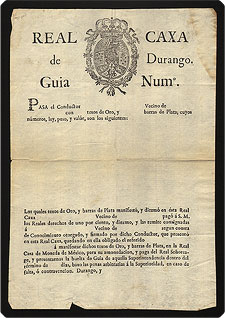 Click the image for an enlargement.
 Printed in roman type with one decorative initial and a handsome woodcut of the royal coat of arms (as modified by Charles III) in the center at the top of the leaf.
No copy located via WorldCat, CCILA, or METABASE.
• Not in Medina, Mexico; nor González de Cossío, Cien; nor González de Cossío, 510. Old folds, small rent in lower blank margin. Waterstain in upper right corner and a big of soil along one fold. (25800)
The Inquisition & Father Hidalgo's“Manifiesto” Mexico. Inquisition. Broadside, begins: “Sabed: que ha
llegado á nuestras manos un proclama del rebelde Cura de Dolores que se titula: 'Manifiesto, que el Señor Don Miguel Hidalgo y Costilla::::,, [sic] haze al Pueblo.'” Mexico: no publisher/printer, 26 January 1811. Folio (43.4 cm; 17.125"). [1] p.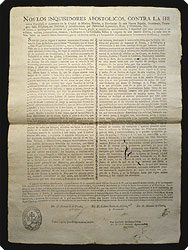 Click the image for an enlargement.
 Printed in double-column format and with the woodcut seal of the Inquisition in the lower right corner of the lower edge.
Uncommon: Garritz located only the copy in the Biblioteca Nacional and OCLC locates only five U.S. institutions holding copies.
• Not in Medina, Mexico. Garritz 1137. Old folds; five small meandering wormholes touching or costing a very few letters, but not impeding reading sense. (24917)
Ending an Amnesty for Rebels Mexico. Inquisition. Broadside, begins: Nos los inquisidores apostolicos, contra la herética pravedad y apostasía en la ciudad de México, estados y provincias de esta Nueva España, Guatemala, Nicaragua, Islas Filipinas, sus distritos y jurisdicciones ... Sabed, que el ... Inquisidor General ha mandado publicar ... un edicto del tenor siguiente ... Bien sabeis como por nuestros edictos de dos de enero y diez de febrero, y con mas amplitud por el de cinco de abril del año proximo pasado, hemos llamado ... á todos los que se sintieren gravados con el horrendo crímen de la heregía ... ofreciéndoles la reconciliacion y absolucion de todos ellos ... Dado en la Inquisicion de México á ocho de junio de mil ochocientos diez y seis.... Mexico: 8 June 1816. Folio extra (60 cm; 23.5"). [1] p.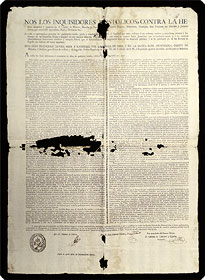
Click the image for an enlargement. Signed by each Mexican Inquisitor with his paraph and with the woodcut seal of the Inquisition in the lower left corner
Very uncommon: We trace only one copy in the U.S. — at the University of California at Berkeley.
• Not in Medina, Mexico. Several holes of various sizes, including one very large one in the middle of the first column, with loss of paper costing words and whole sentences. Otherwise, light staining and some instances of soiling most notably around the holes, only. Priced accordingly. (17028)
Procesion
del Palacio a la Iglesia
— Ocupacion
del Trono Chico
Mexico.
Comisión encargada de formar el Proyecto del Ceremonial
que para la inauguración. Proyecto del ceremonial que para
la inauguración, consagración y coronación de Su Magestad
el emperador Agustín Primero. Mexico: Impr. de D. Jose Maria Ramos Palomera,
1822. Small 4to (22 cm., 8.75"). 14, [2 (blank)] pp.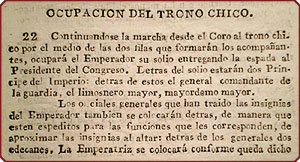
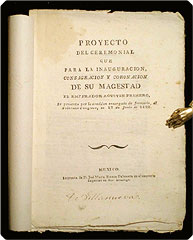
Rare: Via OCLC and NUC Pre-1956 we locate only three copies in the U.S.
• Sutro 358. Folded as issued, but lacking sewing. Small waterstain in upper inner corner of all leaves. Old note, “De Villanueva” on title-page. (25446)
SILVER MINING in 18th-CenturyMexico & Peru Mexico (viceroyalty). Laws, statutes, etc. Reales ordenanzas para la direccion, regimen y gobierno del importante cuerpo de la mineria de Nueva-España, y de su real tribunal general. De orden de su magestad. Lima: 1786. 4to. [1] f., LXXIX, [1 (blank)], VII, [1 (blank)], 269, [1 (blank)] pp.
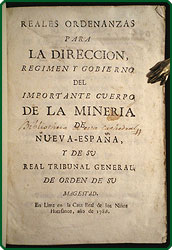
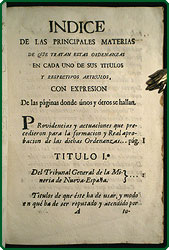
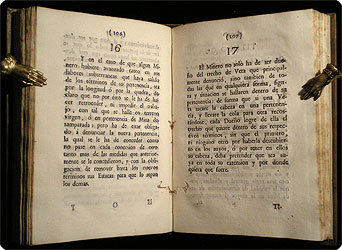 Click the interior images for enlargements.
 Sabin calls this work a “rare and valuable compendium of the old mining laws and mineral customs.” Galvez was a special commissioner charged with making reforms in the governing of Mexico; his work greatly influenced the 1786 replacement of the Mexican provinces with 12 intendencias. The 18th century saw a rebirth of the Mexican and the Peruvian silver industry as new technologies and techniques were introduced. Concomitant with the increased production was increased wealth for the mine owners and the crown.
• Palau 251938a; Medina, Lima, 1636; Sabin 56260. Recent calf bordered in gilt tooling, spine with gilt bands and floral devices in compartments, gilt-stamped leather title label; a few very small scuffs to covers. All edges sprinkled blue and red. Title-page recto and verso with inked ownership inscriptions in an early hand. Final leaf with repairs to outer edge; penultimate two leaves with lower corners torn away, outer edge of one with small chewed portion. Occasional spots of foxing. Two worm pinholes to title-page; more extensive worming to inner margins of central 20 leaves, on some pages touching text without affecting comprehensibility. Handsome. (3039)
RULES
for Administrators
Overseeing Sales
Taxes &
Pulque
Mexico (Viceroyalty).
Dirección General de Aduanas. Reglas que deben observar
los administradores de los Reales Ramos de Alcabalas y Pulques.... [Mexico:
1781]. Folio. 4 pp.
Sales
Taxes &
Pulque
Mexico (Viceroyalty).
Dirección General de Aduanas. Reglas que deben observar
los administradores de los Reales Ramos de Alcabalas y Pulques.... [Mexico:
1781]. Folio. 4 pp.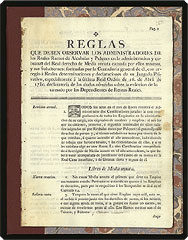 Click the image for an enlargement.
 • Not in Medina, Mexico; not in González de Cossío, Cien or 510; not in Harper, Americana Iberica. Removed from a bound volume and left margin slightly irregular. Now in a quarter cloth (faux leather) folder with marbled paper sides. (4773)
Opening the Port ofMatamoros Mexico. Laws, statues, etc. 16 July 1836. Broadside. Begins, “Durante la guerra con los sublevados de Tejas, se permitará la introducción de viveres del extrangero por el puerto de Matamoros.” México: no publisher/printer, 1836. Folio (30.5 cm; 12"). [1] p.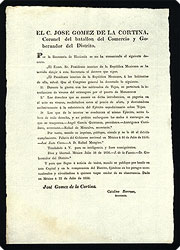
This is a states' edition, promulgated by José Gómez de la Cortina, Governor of the Federal District.
• Streeter, Texas, 880. Very good condition. Lacking the integral blank leaf. (24618)
On LOCAL ReinvestmentMexico (Viceroyalty). Laws, statutes, etc. Broadside. Begins: "Don Manuel Antonio Florez Maldonado Martinez de Angulo y Bodquin...El Exmô. Senor Don Antonio Porlier Secretario de Estado y del Despacho...se sirvió comunicarme en 14 de Septiembre del ano anterior de 1788 la Real resolucion del tenor siguiente...." [Mexico: , 1789]. Double folio. [1] f. . 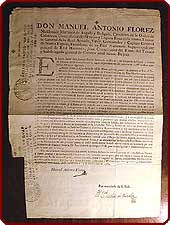
• Not in Medina, Mexico; nor González de Cossío, Cien or 510; nor Harper, Americana Iberica. A folded, very good copy. (10667)
 New“Stamping”
StyleMexico.
Laws, statutes, etc. Ley del timbre de los Estados-Unidos Mexicanos expedida
en 1.o de diciembre de 1874. Mexico: Impr. en la calle del Hospicio
de San Nicolás, 1874. 8vo. 35 pp.
New“Stamping”
StyleMexico.
Laws, statutes, etc. Ley del timbre de los Estados-Unidos Mexicanos expedida
en 1.o de diciembre de 1874. Mexico: Impr. en la calle del Hospicio
de San Nicolás, 1874. 8vo. 35 pp.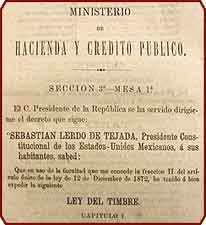
• Not in Sutro. Sewn; original plain wrappers, lacking the front one. Library pencilling in preparation for cataloging, but no stamps.
Tax
Matters 1756Mexico (Viceroyalty). Laws, statutes, etc.
3 November 1756. Mexico diez y nueve de julio de mil setecientos cincuenta
y seis. Con fecha de veinte y dos de marzo del presente ano expedi un Decreto
del thenor siguiente. = Siendo el animo del Rey facilitar el possible alivio a
sus vasallos... Mexico 1756. Folio, [4] ff.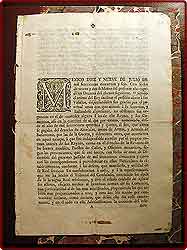
• Removed from a bound volume and with a few fold tears; irregular in inner margin. A few stray stains. now housed in a quarter cloth (faux leather) folder with marbled paper sides.
Constituciones with an Important & Useful OVERVIEW of 110Mexican Intellectual History Mexico (Viceroyalty). University. Constituciones de la real y pontificia universidad de Mexico. Mexico: Felipe de Zúñiga y Ontiveros, 1775. Folio. [16] ff., 238 pp., [11] ff.. 
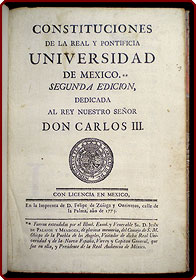
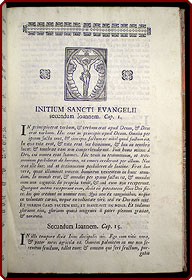
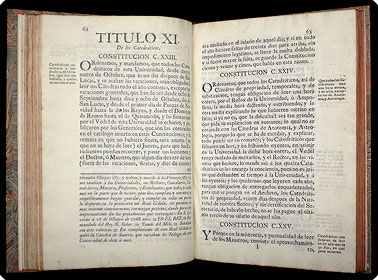 Click the images for enlargements.
 Although the university was founded in 1551 and began offering classes in 1553, its rules and practices were not published until 1668: Various manuscript compilations of the rules had been gathered during the first hundred years of the institution, but it fell to Bishop Palafox to undertake the definitive compilation and to initiate the publication of the results, which did not see light of day until after his death. It is his omnium gatherum that the body of this volume offers.
• Medina, Mexico, 5836; Palau 6067; not in Harper, Americana Iberica; not in Maggs, Bibl. Amer. 20th-century quarter calf with marbled paper sides and endpapers. All edges carmine. Paper clean and crisp. A lovely copy.
 For
more CHILDREN / EDUCATION, click
here. For
more CONSTITUTIONS, click here. MEXICO
is one of our great specialties.
For
more CHILDREN / EDUCATION, click
here. For
more CONSTITUTIONS, click here. MEXICO
is one of our great specialties.
Daily Business Life — International! New Orleans 1831 Moctezuma, A.M. Autograph Letter Signed, to Francisco Pizarro Martínez. In Spanish, on paper. New Orleans: 22 October 1831. Small 4to (25 cm x 10"). [1] p. with integral address leaf; and [2] p. translation into English, ca. 1837.
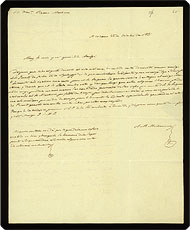 Click the image for enlargement.
 • Very good condition. Written in a small but clear hand. (24650)

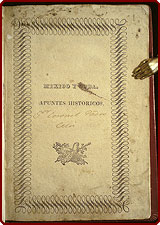
Apologia Pro Vita Sua Montenegro Colón, Feliciano. Conducta militar y política
de Feliciano Montenegro durante su dependencia del gobierno español. Demostración de sus servicios á la causa Americana bajo la protección de la República Megicana. Caracas: Fermin Romero, 1831. Small 4to. 96 pp.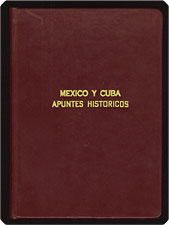
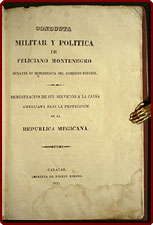 Click the interior images for enlargements.
 Front wrapper reads: “Mexico y Cuba; apuntes históricos.”
Apparently scarce: OCLC has a record for this but with no library holdings given. Searches of the University of Texas and University of California OPACs failed to find this publication.
• 20th-century Mexican red calf binding. Title in gilt on front cover. Original wrappers bound in. Front free endpaper torn out exposing inner hinge; waterstaining particularly visible to first leaves, faint to later ones. (21513)
The FIRST ENTIRELY ENGRAVED Bookthe AMERICAS Montes de Oca, José. Vida de San Felipe de Jesus protomartir de Japon y patron de su patria Mexico. Mexico: Montes de Oca ... Calle del. Baustisterio de S. Catalina m.e n.o 3, 1801. 4to (23 cm; 9"). [1] f., 28 [of 30] plts.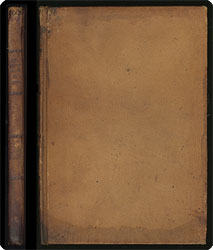
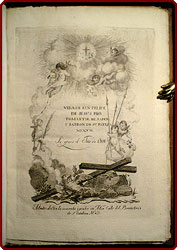
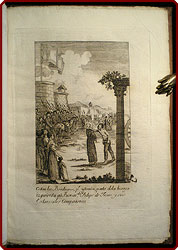 Click the interior images for enlargements.
  self-published this, the first entirely engraved book printed in the Americas. In a series of 30 plates with captions he told the biography of St. Philip of Jesus (1572–97), the protomartyr of Japan.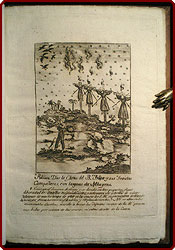
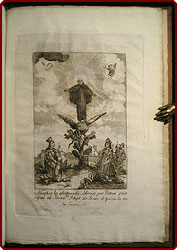
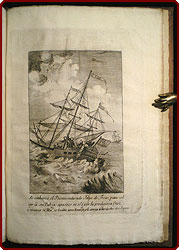
Montes de Oca's plates are particularly detailed and moving when they show the saint in Japan being abused and tortured, but all are strong and striking.
Uncut.
• Palau 363045. Late 19th-century plain sheep binding. Uncut; lacking two plates and two with minor worming as noted above; all plates well impressed, as would be expected of a work that the artist himself saw through the press! A very good copy of a scarce and important work. (25095)
 Estate Law
Montiel, Isidro A. Informe en los estrados de la e. primera sala del Tribunal Superior del Estado. Toluca: Tip. del Instituto Literario á cargo de Manuel Jimenez, 1856. 12mo. 35 pp.
Estate Law
Montiel, Isidro A. Informe en los estrados de la e. primera sala del Tribunal Superior del Estado. Toluca: Tip. del Instituto Literario á cargo de Manuel Jimenez, 1856. 12mo. 35 pp.
• Montiel seeks to have set aside the civil decision of 26 November 1856 against Silvestre López Tello and his sister Guadalupe, in the matter of the estate of Teodoro López Tello.
• Sutro 908. Removed from a nonce volume.
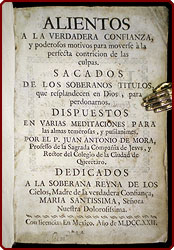
Interesting Mariology — A Fine Image of Her Mora, Juan Antonio de. Alientos a la verdadera confianza, y poderosos motivos para moverse â la perfecta contricion de las culpas. Sacados de los soberanos titulos, que resplandecen en dios para perdonarnos. Dispuestos en varias meditaciones para las almas temerosas y pusilanimes. Mexico: No publisher/printer, 1722. Small 8vo (14.5 cm; 5.75"). [12] ff., 238 pp., plt.
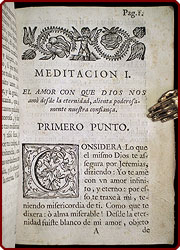 Click the images for enlargements.
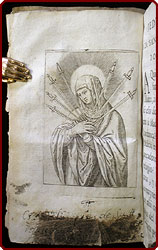
 An excellent, unsigned, copper engraving of Our Lady of Sorrows opposite the first page of the dedication represents each of the Seven Sorrows as a long sword piercing Her heart; “Meditacion I” with an absolutely charming headpiece.
No U.S. library reports ownership of this edition.
• Medina, Mexico, 2685; DeBacker-Somervogel, V, 1275. Contemporary vellum over paste boards, lacking the ties; vellum stained and worn through at board edges; text block loose in binding. Finger soiling in foremargins, old ink stains and some areas of light waterstaining here and there, some light foxing, instances of light dust-soiling. Ownership inscriptions in lower margins of two leaves inked over. Minor worming at inner margins at rear of book, touching some letters. (26870)
BUILDER of the FIRSTNew World Utopian Community Moreno, Juan Joseph. Fragmentos de la vida, y virtudes del v. illmo. y rmo. Sr. Dr. D. Vasco de Quiroga primer obispo de la santa iglesia cathedral de Michoacan, y fundador del real, y primitivo Colegio de s. Nicolàs obispo de Valladolid ... Con notas criticas, en que se aclaran muchos puntos historicos, y antiguedades americanas especialmente michoacanenses. Mexico: en la imprenta del Real, y mas antiguo Colegio de S. Ildefonso, 1766. Small 4to (20.5 cm; 8"). [13] ff., 202 pp., [2] ff., 29, [1 (errata)] pp., port.
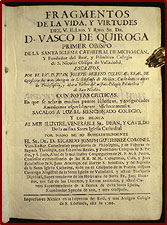
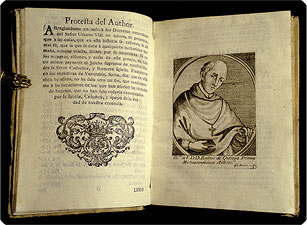
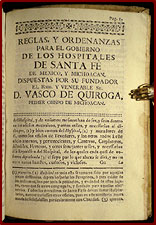 Click the interior images for enlargements.
 Not the least of his accomplishments was the creation of two pueblo-hospitals for native Americans, and appended and integral to this biography are his “Reglas, y ordenanzas para el gobierno de los Hospitales de Santa Fé de México, y Michoacàn,” which occupy the final 29 pages.
Historians still consider this to be the definitive biography of Quiroga. The engraved portrait of him, handsome and from the burin of José Morales, adds a face to the words of the biographer and to the account of the deeds of the biographee.
• Medina, Mexico, 5099; Wellcome, Medical Americana, M.134; Palau 181902; Beristain, III, 2059. Contemporary limp vellum lacking ties. A very good copy. (23061)

 TO Part VII
. . .
TO Part VII
. . . |