
 EUROPEAN LAW
 [EMBRACING LAW OF “CONTINENTAL HERITAGE”]
 EUROPEAN LAW
 Bilingual
 Laws
of Toro
Laws
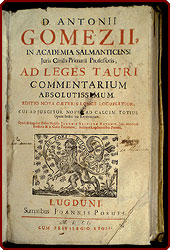
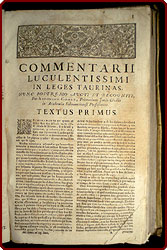
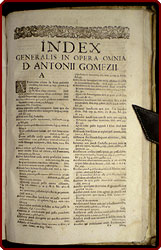
of Toro Gómez, Antonio. Ad leges tauri commenatrium absolutissimum. Editio nova cæteris longe locupletior.... Lugduni: Joannis Posuel, 1701. Folio (34 cm, 13.5"). ã2A–C4 D–Z6 Aa–Zz6 Aaa–Ccc6 Ddd4; [2] ff., 504 pp., [40 (index)] ff.
 Click the images for enlargements.
 The text is mostly in Latin, with portions in Spanish; the printer has made use of nicely cut head- and tailpieces as well as a striking woodcut printer’s vignette (“De forti dulcedo”) on the red and black title-page.
 RLIN and OCLC show only two U.S. holdings of this edition.
Provenance: Front free endpaper with bookplate of Michael J. O’Farrell, the first Bishop of the Diocese of Trenton; also with bookplate noting O’Farrell’s gift of the book to an institution.
• Palau 103253. Contemporary limp vellum, cockled and lightly soiled, with ties now lacking; spine with faded inked title. Title-page dusty, thin, and holed, with lower outside corner torn away, touching one letter and a red rule; date altered to 1601 by erasure of the first “C” in the roman-numeralled date! Leaves browned, foxed; instances of early inked marginalia and blots. Uncommon, as well as interesting for its contemporary use and its later provenance. (12184)

 CONTRA-BANDO González de Salcedo, Pedro. Tratado juridico politico del contra-bando.... Madrid: Juan Muñoz, 1729. Folio (30 cm, 12.75"). [6] ff., 400 pp.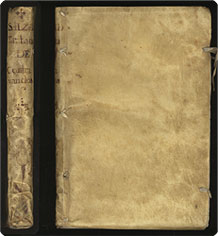
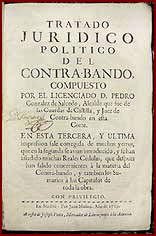
 In all, an important and bedrock work for the study of Spanish commercial policy. First published in 1654: We offer here the third edition, corrected.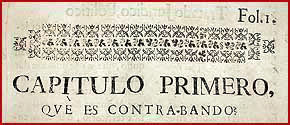
 Sin & Redemption Grotius, Hugo. Defensio fidei Catholicae de satisfactione Christi adversus Faustum Socinum senensem. Lugduni Batavorum: Excudit Ioannes Patius, 1617. 4to (22.5 cm; 8.875" ). [4] ff., 183, [1 (blank)] pp.
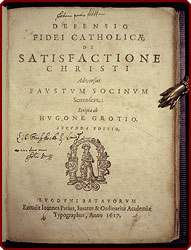
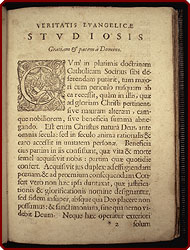 Click the images for enlargements.
 Both the first and this second edition are little held in the U.S.: We trace three copies of the first and three of the second, one of which has been deaccessioned.
Provenance: Three 18th-century ownership inscriptions on title-page: Jehoua Portis, Lib. Richbach, and Joh[ann]is Buys. 19th-century pressure-stamps of a Pennsylvania theological library, deaccessioned.
• Full modern calf old style: Spine with raised bands, accented with gilt beading and blind rules, rules extending onto boards to Vs and ending with trefoils; blind double fillets beyond. Gilt center device in each spine compartment and a green title label lettered in gilt. Waterstaining in inner margins, extending into text on pp. 136–61; otherwise, expectable age-toning only. All edges red. (25847)

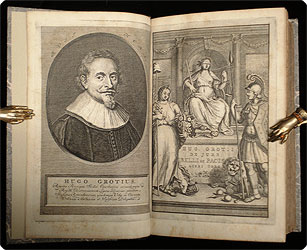
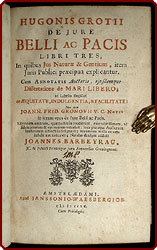
Grotius on THE LAW of War & of the Sea, & on Natural Law Grotius, Hugo. Hugonis Grotii De jure belli ac pacis libri tres, in quibus jus naturae & gentium, item juris publici praecipua explicantur. Cum annotatis auctoris, ejusdemque dissertatione de Mari libero, ac Libello singulari de aequitate, indulgentia, & facilitate, nec non Joann. Frid. Gronovii v.c. notis in totum opus De jure belli ac pacis. Amstelaedami: Apud Janssonio-Waesbergios, 1720. 8vo (20 cm; 8"). Frontis., engr. title-page, [13] ff., xxxv, [1] pp., [2] ff., 483, [1] pp., [1] f., [483!]–936 pp.; 43, [1] pp., [42] ff.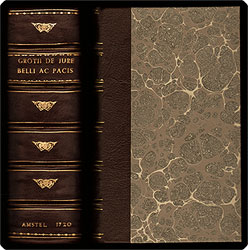
 Click the images for enlargements.
 Grotius saw his book published for the first time in 1625 at Paris: It studies the legality of war and immediately established itself as a foundational work on the topic. Modern scholars regard it as foundational in international law.
This edition contains added scholarship from Joannes Fredericus Gronovius (1611–71) and Jean Barbeyrac (1674–1744). In addition to De jure belli ac pacis the reader will find two other important Grotius tracts at the rear of the volume: Mare liberum and Libellus singularis de aequitate, indulgentia et facilitate, meaning the volume treats not just of law of war, but natural law, international law, maritime law, and law of the sea.
There are two issues of this edition, the other having “Ex Officina Wetsteniana” on the title-page in place of “Apud Janssonio-Waesbergio.” In both editions the title-page is printed in black and red, and of course, they have the same pagination. The work has side- and shouldernotes, an engraved portrait of Grotius, and an added engraved title-page.
• Meulen & Diermanse (1950 ed), Grotius, 602. Modern quarter claret-colored morocco with gilt-accented raised bands; gilt center device in each spine compartment. Marbled paper sides. Library pressure-stamps on title-page, no other markings; light age-toning and occasional spotting or foxing. A very nice copy with all edges decorated — more than “speckled,” not quite “marbled,” definitely attractive. (26526)
 The
“Laws of the Sea”
at a Time When
England Was!
The
“Laws of the Sea”
at a Time When
England Was! the
Law on the Seas
Jacobsen, Friedrich Johann. Laws of the sea, with reference to maritime commerce during peace and war. Baltimore: Edward J. Coale, (J. Robinson, printer), 1818. 8vo (22 cm; 8.75"). xxxv, [1], 636 pp.
the
Law on the Seas
Jacobsen, Friedrich Johann. Laws of the sea, with reference to maritime commerce during peace and war. Baltimore: Edward J. Coale, (J. Robinson, printer), 1818. 8vo (22 cm; 8.75"). xxxv, [1], 636 pp.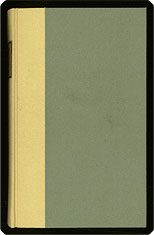
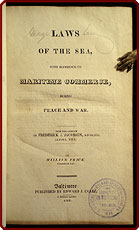
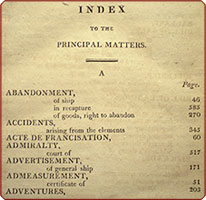
Published at a critical period in America's commercial history, this work presents the then prevailing international law on such matters as shipwreck, salvage, abandonment, blockages, embargoes, delivery, demurrage, and neutrality, to mention just a few topics.

NO! Copies of the BOOK in the U.S. Justinianus. A leaf from the Digestum vetus. Venice: Andreas Torresanus, de Asula, 26 March 1491. Folio (42.5 cm; 16.625"). [1] f.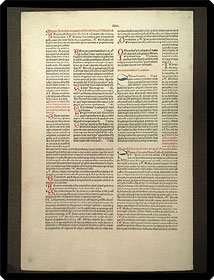 Click the image for an enlargement.
  In 1479 Torresano acquired the fonts of Nicholas Jenson and in 1505 he acquired Aldus Manutius as a son-in-law!
In the U.S., both Goff and the ISTC only locate only stray leaves of this text: two at Stanford and one at Illinois.
Provenance: Clearly once part of a offering of The Foliophiles Incorporated, and probably from its ad hoc album Pages from the past : a collection of original leaves from rare books and manuscripts [New York: T.F.I., c1926–27].
• ISTC ij00554000; Goff J554; H 9556*; GKW 7675; Pr 4725; BMC, V, 309. Mounted on a brown cardboard backing, with a description (but no bibliographical information) on the verso of the board. Leaf in very good, bright condition. (27100)
 He
Had One of Those
He
Had One of Those Breathtakingly
Simple Insights
. . .
Lancellotti, Giovanni Paolo. Institvtiones ivris canonici, qvibvs ivs pontificivm singulari methodo libris quattuor comprehenditur.... Lugduni: Apud haeredes Gulielmi Rouillii, 1614. 16mo (12.1 cm, 4.75"). A–Z8Aa–Nn8; 500 pp., [38] ff. [bound with] Naogeorg, Thomas. Rvbricæ, sive svmmæ capitvlorvm ivris canonici Thomæ Noageorgi [sic] Straubingensis opera in lucem editæ.... Lugduni: Apud haeredes Gulielmi Rouillii, 1614. 16mo. A–S8; 286 pp., [1 (blank)] f.
Breathtakingly
Simple Insights
. . .
Lancellotti, Giovanni Paolo. Institvtiones ivris canonici, qvibvs ivs pontificivm singulari methodo libris quattuor comprehenditur.... Lugduni: Apud haeredes Gulielmi Rouillii, 1614. 16mo (12.1 cm, 4.75"). A–Z8Aa–Nn8; 500 pp., [38] ff. [bound with] Naogeorg, Thomas. Rvbricæ, sive svmmæ capitvlorvm ivris canonici Thomæ Noageorgi [sic] Straubingensis opera in lucem editæ.... Lugduni: Apud haeredes Gulielmi Rouillii, 1614. 16mo. A–S8; 286 pp., [1 (blank)] f. 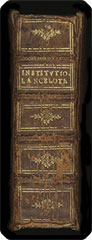
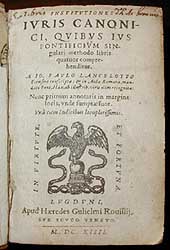
Bound with Lancellotti's work is a summary of titles of chapters of canon law compiled by Thomas Naogeorg (1508–63). Naogeorg's wanderings took him from being a Dominican to being a Lutheran to being a Calvinist. Along the way, during his Lutheran phase, he studied canon law for a year (1551) at Basel, during which time he compiled and published this work, likely as a student's guide. He is better known for his plays, in which he sharply attacks the Papacy.
The two works here were first published by the firm of Guillaume Rouillé, in 1587 and 1588 respectively, and may have been intended to be bound together, as witnessed by the Library of Congress copy. The title-page transcriptions of the earlier editions (except for the date and "hæredes"), and their signatures, pagination, and arrangement, match those of these present 1614 editions. There are italic shouldernotes, and woodcut headpieces and initials.
• On Lancellotti, see: New Catholic Encyclopedia, VIII, 356. 17th-century calf; covers gilt-ruled; gilt spine. Abraded, corners bumped with leather lost, joints opening—yet this is a perfectly sound volume. All edges speckled brown. Bouquiniste's paper label on front pastedown and front free endpaper lacking. Two words inked long ago in two margins, and one page with old pencilled underlining.
 For
more CATHOLICA, click here.
For
more CATHOLICA, click here.

Roman
Law, Emperor
Theodosius, Desecration
of Temples,
&
More
Libanius, Antiochenus. Libanii antiocheni Pro templis gentilium non exscindendis, ad Theodosium m. imp. Oratio: ante M. CCC. fermè annos conscripta: nunc primùm edita à Iacobo Gothofredo ic. notisq[ue] illustrata. [with another, as below]. Genevae: [Petri Chouët?], 1634. 4to (22.5 cm; 8.75"). [12], 63, [9] p. [also bound in] Godefroy, Jacques. De cenotaphio: deq[ue]z, diversis, super eius religione, Ulpiani & Marciani sententiis, diatriba. Genevae: [s.n.], 1634. 4to. 15, [1] pp.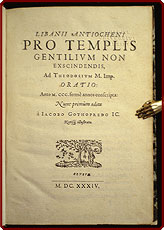
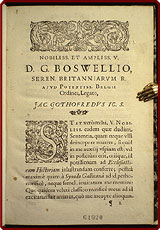
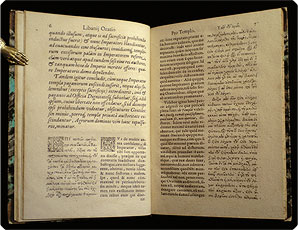
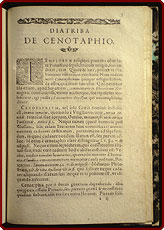
The present work is his famous “lamentation” on the desecration of pagan temples. Addressed to the Emperor Theodosius, the oration concerns the legality of the Emperor's order for the desecration; the text is in Greek and Latin in parallel columns.  The Greek font is notably light and elegant.
At the rear of this volume is Godefroy's opuscule on funeral rites and ceremonies. Several libraries report both works being bound together, as here, but not all.
• 19th-century quarter brown leather, spine sunned much lighter. Library-bound with call number inked on cover, bookplates on front pastedown, rubber-stamps on pastedowns. Title-page with old pressure-stamp; text itself without other markings save a six-digit number neatly stamped at base of next leaf. Actually, a clean, good copy. (22733)
Polygamy
isENJOINED
upon Christians?
Lyserus, Johann Peter Theodore. Polygamia triumphatrix, id est discursus politicus de polygamia. Londini Scanorum: Sumtibus authoris, 1682. 4to (21 cm, 8.25"). [10], 565, [33] pp.
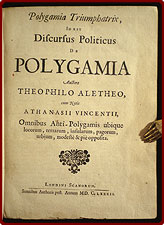
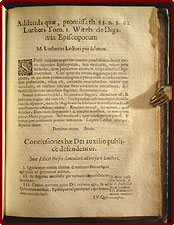
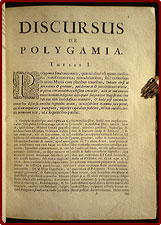 Click the images for enlargements.
 According to the online cataloguing of this book at Brigham Young University, “Early editions [were] burnt by [the] hangman in Denmark (1676); in Sweden (1679) . . . the possession of a copy meant a 1000 ducat fine. This edition was added to the Index of forbidden books in 1687.” It is often held today in medical libraries.
• Graesse, I, 68. 17th-century speckled calf, spine gilt extra with gilt-stamped leather title-label; leather chipped at top of spine with front joint open (though holding), abraded/pitted, and rubbed through to paste boards at corners. Front pastedown with Parisian bookseller's ticket; front free endpaper with pencilled annotation; back pastedown with rubber-stamped date in 1908. Slip of old printed cataloguing laid in. (23549)
First English-Language Edition — Pr. byBradford, 1795Martens, [Georg Friedrich von]. Summary of the law of nations, founded on the treaties and customs of the modern nations of Europe...translated from the French by William Cobbett. Philadelphia: Thomas Bradford, 1795. 8vo. XIX, [1], 379, [1 (blank)] pp.
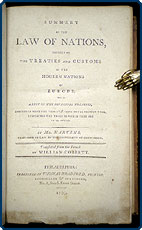
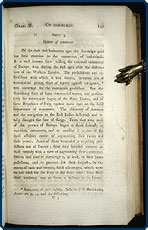
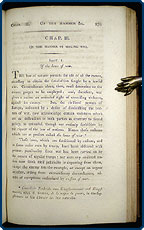 Click the images for enlargements.
 Provenance: 19th-century ownership signatures on front pastedown or front fly-leaf of John T. Wait (Dec. 14, 1839), Luther Spalding (undated), and W.H. Richards.
• Evans 29025; ESTC W29507; Sabin 44848. On Cobbett, see: The Dictionary of National Biography, XI, 142–45. Contemporary sheep, framed in blind with a roll of a rope design, spine with gilt-stamped title-label; leather worn at edges and front cover expertly reattached, spine worn with chipping. Ownership inscriptions as above. Minor spotting and offsetting.
Ending an Amnesty for Rebels Mexico. Inquisition. Broadside, begins: Nos los inquisidores apostolicos, contra la herética pravedad y apostasía en la ciudad de México, estados y provincias de esta Nueva España, Guatemala, Nicaragua, Islas Filipinas, sus distritos y jurisdicciones ... Sabed, que el ... Inquisidor General ha mandado publicar ... un edicto del tenor siguiente ... Bien sabeis como por nuestros edictos de dos de enero y diez de febrero, y con mas amplitud por el de cinco de abril del año proximo pasado, hemos llamado ... á todos los que se sintieren gravados con el horrendo crímen de la heregía ... ofreciéndoles la reconciliacion y absolucion de todos ellos ... Dado en la Inquisicion de México á ocho de junio de mil ochocientos diez y seis.... Mexico: 8 June 1816. Folio extra (60 cm; 23.5"). [1] p.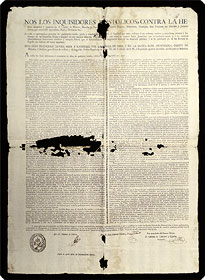
Click the image for an enlargement. Signed by each Mexican Inquisitor with his paraph and with the woodcut seal of the Inquisition in the lower left corner
Very uncommon: We trace only one copy in the U.S. — at the University of California at Berkeley.
• Not in Medina, Mexico. Several holes of various sizes, including one very large one in the middle of the first column, with loss of paper costing words and whole sentences. Otherwise, light staining and some instances of soiling most notably around the holes, only. Priced accordingly. (17028)

Enlightenment CatholicismMuratori, Lodovico Antonio. Della pubblica felicita oggetto de' buoni principi.... Lucca, 1749. 8vo (18.8 cm, 7.375"). [6] ff., 236 pp.
 Click the interior image for an enlargement.
 • Goldsmith’s Kress 8390. On Muratori, see: New Catholic Encyclopedia, X, 81. Contemporary vellum over paste boards with remnants of gilt label on spine; soiled, stained, and chipped with loss of top layer of vellum on rear cover and part of spine. Interior with light foxing, water- and other staining. Far from splendid, far from dead. (11592)

Maimonides
Meets
Muvhar inOdessa
Muvhar, Shelomoh ben Shemuel. Sefer Hozek yad. Ve-hu piske rabenu Mosheh b.R. Maimon zal be-Yado ha-hazakah meyusad be-derekh shir. Odessa: Bi-defus Moharama Belinson, 1865. 8vo (26 cm; 10.5"). 228 pp.

Also present in the volume is a section of didactic poetry, rhymed rules for pious people.
Moses Eliezer Beilinson was an important figure in Eastern European Jewish letters during the 19th century, who opened his printing press in Odessa sometime in the 1860s.
We gratefully acknowledge the immense help in cataloguing this work that Arthur Kiron (Schottenstein-Jesselson Curator of Judaica Collections University of Pennsylvania Library) has provided us. Any errors are all ours.
• Original printed wrappers, a bit dusty and dog-eared; front one beginning to separate from bottom. Occasional bug-spotting or waterdrop stain. (24651)
Marriage Law from aNoted
Mysogynist . . . Nevizzano, Giovanni. Sylvae nuptialis libri sex: In quibus ex dictis moder. materia matrimonii, dotium, filiationis, adulterii, originis, successionis & monitorialium plenissimè discutitur: vnà cum remediis ad sedandum factiones Guelphorum & Giebelinorum. Item modus iudicandi & exequendi iussa principum. Ad haec, de authoritatibus
doctorum, priuilegiisque miserabilium personarum. Quae omnia ex quaestione, an nubendum sit, vel non, desumpta sunt. [Geneva?]: Ioannes Lertotius, 1592. 8vo. [32], 601, [5], pp.


Click the interior image for enlargement. • Not in Adams. Contemporary vellum with yapp edges and remnants of ties, spine with inked title: spots of staining, light soiling, and (on spine) traces of a paper label. Lightly age-toned with occasional light soiling. Early inked notations on front pastedown and title-page. Inked call number on title-page. (11869)
Sicilian LawNovarius, Joannes Maria [Novario, Giovanni Maria]. Praxis novissima et amplissimus, absolutissimusque tractatus de electione, et variatione fori, sive dilucida commentaria .... Venetiis: Bertanorum, 1656. Folio (32.5 cm, 12.7"). †6A–Y6; [6] ff., 240, [24 (index)] pp. [with, as issued, the same author’s] Decisiones et resolutiones in materia electionis, & variationis fori diversorum totius orbis supremorum tribunalium, de quibus in opere passim fait facta mentio, a variis antiquis, recentioribusque authoribus .... Venetis: Bertanorum, 1656. Folio. *4a–c6d8; [4] ff., 51, [1 (blank)] pp. 

 Single-click any image where the hand appears on
Uncommon. Searches of OCLC, RLIN, and NUC Pre-1956 locate only three holdings, all in the U.S.
• Recent marbled paper–covered boards, spine with printed paper label. Title information inked in an early hand on lower page edges; title-page with early inked ownership inscriptions. A few leaves browned; one leaf with short tear from outer margin, repaired some time ago and not touching text.

A Good, Old-Fashioned, INDEX to Complicated Law Stuff Perez y Lopez, Antonio Xavier. Teatro de la legislacion universal de España é Indias. Madrid: Various publishers, 1791–98. Small 4to. 28 volumes.

 Click the images for enlargements.
• Palau 221275; Sabin 60899. Modern quarter brown calf over marbled paper boards, with red and green spine labels. A clean, very nice set, with only a bit of minor dampstaining and the odd spot or paper flaw in all the many volumes. All edges red. (25829)
“You
will Stop Disinheriting
the Indians!”
Philip IV, King of Spain. Manuscript Signed (“Yo El Rey”). In Spanish, on paper. Madrid: 20 June 1628. Folio (30.3 cm; 11.875"). [1] p. 
The king orders the bishops of the New World to see that the practice is ended.
This copy sent to the bishop of Guadalajara, Mexico.
• Light waterstaining; one short fold tear and a small hole piercing the top line of text without loss of sense. Written in a small and legible hand. (25890)
The Land & Indian Problems Pimentel, Francisco. Memoria sobre las causas que han originado la situacion actual de la raza indígena de México, y medios de remediarla. Mexico: Impr. de Andrade y Escalante, 1864. 8vo. 241, [1] pp., [1] f. [with the same author's] La economía política aplicada a la propiedad territorial en México. México: Imprenta de Ignacio Cumplido, 1866. 8vo. 265, [1 (blank)] pp., [1] f.

 Click the interior images for enlargements.
The Pope Appointsa New Grand Inquisitor for Spain Pope Paul V (1552–1621; pontificate 1605–21). Letter to King Philip III of Spain, in Latin, on vellum. Rome: 4 January 1619. Narrow strip (10 x 40.5 cm; 4" x 16"). [1] leaf. Click the image for enlargement.
 This contemporary file copy was retained in Rome and signed “S. Card. S. Susannae” (i.e., Cardinal Scipione Cobelluzzi, who was also at this time the Librarian of the Vatican Library).
• Written in a very handsome italic on very good quality vellum. Light discoloration along lower edge, below the writing. (26978)
 Dominican Missions in
 California Quiñones, Baltasar de. Autograph Letter Signed in Spanish to Fray Ignacio Gentil. Rome: 7 April 1789. Tall 8vo (26.5 cm; 10.5"). [2] pp., with integral address leaf.
 Click the images for enlargements.
 The main question at hand is the appointing of a new attorney/solicitor (i.e., procurador) for the California missions. He says, “quiero que ahora y siempre que ocurra [la necesidad de un nuevo procurador], se haga el nombramiento por la Provincia misma despues de haber oido al Presidente de las Misiones, el cual es mi voluntad que en cuanto sea posible camine con acuerdo de la mayor parte a lo menos de los demas misioneros, antes de hacer su propuesta a la Prov[inci]a.”
He also makes appointments to the positions of “Depositarios del Deposito” and the names of the four appointees are given.
• Written in a clear large hand and with the paper and wax closure in evidence. (25329)
 TO Part
IV TO Part
IV |