 WOMEN
WOMEN  The California Poets
  California Writers Club. Poems. 1933. Berkeley: Pr. by The Professional Press, 1933. 8vo. 67, [1] pp.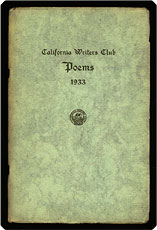
Provenance: Bookplate inside front wrapper of Lorraine & Horace Haynes.
• Publisher's light-blue wrappers. Bookplate as above. Near fine. (23669)

 A Nun's Copy
 Then Another Nun's Capuchin Nuns. Regla de la gloriosa santa Clara,con las constituciones de las monjas Capuchinas del santissimo crucifixo de Roma, reconocidas, y reformadas por el Padre General de los Capuchinos y con las adiciones a los estatutos de dicha regla ... Mexico: Reimpressa en la Imprenta del Lic. Don Joseph de Jauregui, n.d. [ca. 1760–75]. 16mo (15 cm; 6'). [4] ff., 234 pp.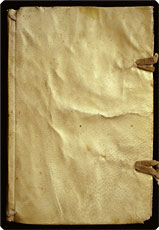
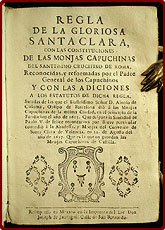
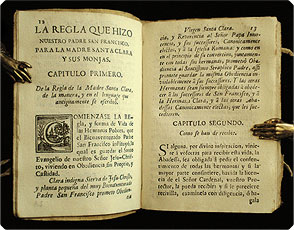
 Click the interior images for enlargements.
  As part of the last, they pray for intervention in medical and mental matters for those suffering from maladies.
Provenance: On front free endpaper in 18th-century hands: “del uso de Sor Maria Coleta,” lined through; below which, “del uso de Sor M[ari]a Juan Nep[umacen]a.
The printer has supplied two charming initials, an “I” and a “C.”
• Medina, Mexico, 9208. Publisher's limp vellum with remnants of ties. Occasional light foxing. Ownership signatures as noted. (23966)

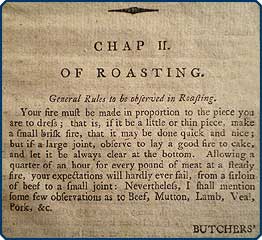
Second U.S. Edition: An Influential Classic Carter, Susannah. The frugal housewife: Or, completewoman cook. Philadelphia: James Carey, 1796. 12mo (17.2 cm, 6.75"). 132 pp.; 2 plts.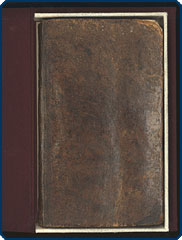
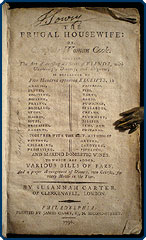
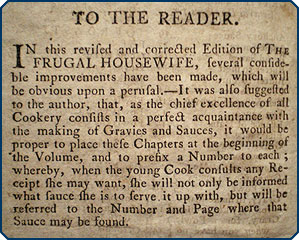 Click the interior images for enlargements.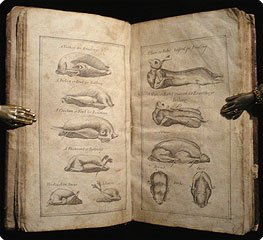
Provenance: Flourishing old signatures of “J. Lowry” to pastedown and title-page.
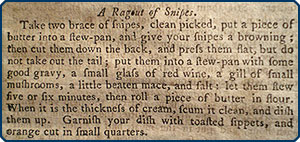 Click the interior images for enlargements.
 Extraordinary
 CONFESSORS
for Nuns
Catholic
Church. Pope, 1740–58 (Benedictus XIV).
[drop-title] Constitutio sanctissimi in Christo patris et domini nostri Benedicti
divina providentia Papæ XIV. Super designationes confessariorum extraordinariorum
pro monialibus. Constitucion del santissimo en Christo padre y señor
nuestro señor Benedicto por la divina providencia Papa XIV, sobre señalamiento
de confessores extraordinarios para las monjas. Madrid: En la imprenta de Phelipe
Millan, [1748]. Folio (28.3 cm, 11.375"). 46 pp.
CONFESSORS
for Nuns
Catholic
Church. Pope, 1740–58 (Benedictus XIV).
[drop-title] Constitutio sanctissimi in Christo patris et domini nostri Benedicti
divina providentia Papæ XIV. Super designationes confessariorum extraordinariorum
pro monialibus. Constitucion del santissimo en Christo padre y señor
nuestro señor Benedicto por la divina providencia Papa XIV, sobre señalamiento
de confessores extraordinarios para las monjas. Madrid: En la imprenta de Phelipe
Millan, [1748]. Folio (28.3 cm, 11.375"). 46 pp. 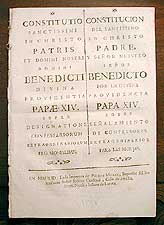 nuns
are not making full confessions because of the intimate nature of some transgressions
and the fact that each convent is assigned only one permanent confessor. He
now allows extraordinary confessors who will visit once or twice a year.
nuns
are not making full confessions because of the intimate nature of some transgressions
and the fact that each convent is assigned only one permanent confessor. He
now allows extraordinary confessors who will visit once or twice a year.
This is printed in Latin with a Spanish translation in the facing column, sidenotes, and a woodcut initial. A search of NUC Pre-1956, RLIN, and OCLC revealed only two copies of the constitution in addition to the one given in Palau.
• Palau 27260. On Benedict XIV, see New Catholic Encyclopedia, II, 278. Removed from a nonce volume. Paper generally clean and crisp with a few small spots of foxing and waterstaining. Paper closely trimmed by binder, shaving some sidenotes.

Bound
with All
for Love
Centlivre, Susannah. The
busy body. A comedy. Taken from the manager's book at the Theatre Royal Covent-Garden.
London: Pr. by R. Butters, [ca. 1770]. 12mo. 48 pp. Bound with John Dryden's
"All for love. Or the world well lost. A tragedy, in five acts" ("Taken from
the manager's book, at the Theatre-Royal, Drury-Lane." London: Pr. for R. Butters,
[ca. 1770]. 12mo. 51 pp. Removed from a nonce volume; sewing loosening. Title-page
soiled and nearly separated from spine. Library stamps. Only a few very small
spots. Outer margins of a several pages uneven. Without the frontispieces. (352)
All
for Love
Centlivre, Susannah. The
busy body. A comedy. Taken from the manager's book at the Theatre Royal Covent-Garden.
London: Pr. by R. Butters, [ca. 1770]. 12mo. 48 pp. Bound with John Dryden's
"All for love. Or the world well lost. A tragedy, in five acts" ("Taken from
the manager's book, at the Theatre-Royal, Drury-Lane." London: Pr. for R. Butters,
[ca. 1770]. 12mo. 51 pp. Removed from a nonce volume; sewing loosening. Title-page
soiled and nearly separated from spine. Library stamps. Only a few very small
spots. Outer margins of a several pages uneven. Without the frontispieces. (352) For
more (similarly inexpensive)
For
more (similarly inexpensive)
 Presentation Copy Signed by ABOLITIONIST
 Maria Weston Chapman Chapman,
Maria Weston, ed.
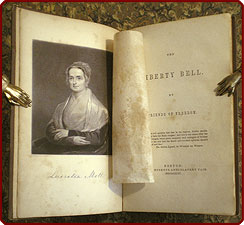
The Liberty bell. By friends of freedom. Boston: Massachusetts Anti-Slavery
Fair, 1844. 12mo (19.5 cm, 7.75"). Frontis. (incl. in pagination), viii, 232
pp.
Maria Weston Chapman Chapman,
Maria Weston, ed.
The Liberty bell. By friends of freedom. Boston: Massachusetts Anti-Slavery
Fair, 1844. 12mo (19.5 cm, 7.75"). Frontis. (incl. in pagination), viii, 232
pp.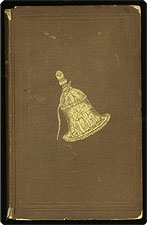
 Click any image where the hand appears on
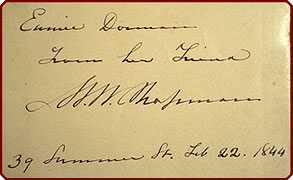
 Chapman, along with several of her sisters, founded the Boston Female Anti-Slavery Society and was one of the staunchest supporters of the abolitionist cause, braving mob scenes and social condemnation to attend anti-slavery meetings, circulate petitions, organize the Anti-Slavery Fair, and publish the present annual. Not many solid, presentable copies of the Liberty Bell make their way to the market, and this one is especially notable for its having been inscribed by Chapman herself.
Provenance: Front free endpaper with presentation inscription reading “Eunice Dorman [?] from her friend M.W. Chapman,” dated February, 1844 (“39 Summer St.”).
• On Chapman, see: McHenry, Famous American Women, 68–69, and DAB, IV, 19. Publisher’s brown cloth, front cover with gilt-stamped bell vignette, spine with gilt-stamped title and blind-stamped decorative bands; cloth worn along board edges and corners and chipped away at spine extremities, exposing underlying boards or support. Front cover and outer edge with a few small dents, back cover with line of light, unobtrusive staining. Pages lightly foxed, otherwise clean, with some corners dog-eared.
 A desirable copy. (21279)
Legal Age for Marrying Charles IV, King of Spain. Begins: Don Carlos ... Con fecha de diez de Abril de este año he tenido a bien expedir mi Real Decreto del tenor siguiente.” [Madrid: No publisher/printer, 1803]. Folio. [4] pp. (last blank).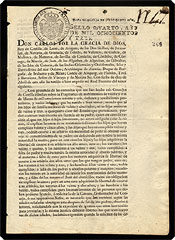
Signed by the crown with a wooden stamp, “Yo el Rey.”
This copy sent to Santiago, Chile, and docketed there.
• Removed from a nonce volume. Clean and untattered. (25817)

 A
Manuscript
Playlet — The Lovers
(China? Not Hardly!).
Anonymous. Manuscript, "The Lovers, A Tragedy in Five Acts. Founded
on an incident in Eastern History." On paper, in English. [Philadelphia?,
ca. 1830]. Folio (32 cm, 12.5"), 14 ff. (12.5 written on).
A
Manuscript
Playlet — The Lovers
(China? Not Hardly!).
Anonymous. Manuscript, "The Lovers, A Tragedy in Five Acts. Founded
on an incident in Eastern History." On paper, in English. [Philadelphia?,
ca. 1830]. Folio (32 cm, 12.5"), 14 ff. (12.5 written on). 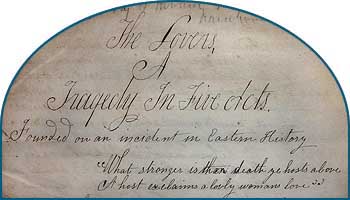
The play's length is that of a "filler" piece in a jam-packed 19th-century
theatrical night of three or four plays (or parts thereof) and other "entertainments"—or,
the length of a school or home production.  The
style is distinctly amateur/naive. E.g., the euphonious
exotic names are far from consistently Chinese and one character is "carried
[from his 'chinese cottage'] to the ganges"; the author confuses exit
and exeunt ("Exeunt Priest")—we wonder if this blithe vagueness
as to geography and world cultures, and the seeming lack of even basic
classical education, suggest a lively-minded and enthusiastically play-going
but unrigorously schooled
The
style is distinctly amateur/naive. E.g., the euphonious
exotic names are far from consistently Chinese and one character is "carried
[from his 'chinese cottage'] to the ganges"; the author confuses exit
and exeunt ("Exeunt Priest")—we wonder if this blithe vagueness
as to geography and world cultures, and the seeming lack of even basic
classical education, suggest a lively-minded and enthusiastically play-going
but unrigorously schooled  female
writer?
female
writer?
Provenance: Gift inscription: "Horace W. Smith, Esq. to W.W., 1863." A pencil note says "By J. Howard Payne in his handwriting, W.W."—but the handwriting does not match that of Payne's MSS. at Yale and Brown Universities.
• First leaf dust-soiled and now separated. Edges of some leaves chipped costing a few letters and, very rarely, an entire word; lost letters and words are easily supplied by context. Comfortable, for working with.
Restoration Binding — Painted Fore-Edge Church of England. Book of Common Prayer. The book of common prayer and administration of the sacraments, and other rites and ceremonies of the church, according to the use of the Church of England. Together with the Psalter or Psalms of David, pointed as they are to be sung or said in churches. London: John Bill, Thomas Newcomb, & Henry Hills, 1680. 12mo (14.7 cm, 5.75"). [432] pp. (lacking A1, blank or licence). [with] Bible. English. Authorized (i.e., “King James Version”). 1679. The Holy Bible, containing the Old Testament and the New ... appointed to be read in churches. London: John Bill, Thomas Newcomb, & Henry Hills, 1679. 12mo. [870] pp. [and with] Bible. O.T. Psalms. English. Sternhold & Hopkins. 1679. The whole book of Psalms, collected into English metre, by Thomas Sternbold, John Hopkins, and others. London: Pr. for the Company of Stationers, 1679. 12mo. [72] pp. 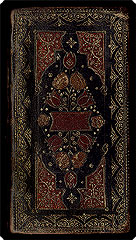
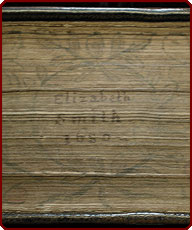
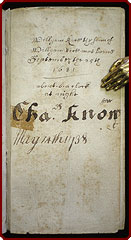
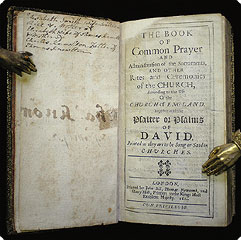 Click the images for enlargements.
 Provenance: Fore-edge painted with “Elizabeth Smith, 1680”; front fly-leaf with inscription recording the birth of William Rice in 1681 and with inscription of Charles Knowlton, dated 1738; fly-leaf verso with early inked genealogy describing the Smith-Rice-Knowlton descent.
Binding: Elaborate Restoration binding: black morocco framed in gilt semi-circle and strawberry rolls surrounding a broken panel design of red-inlaid scalloped corners decorated with floral-dotted volutes, containing a bouquet of tulips and other flowers with red and citron morocco inlays; the upper- and lowermost tulips each with a smaller gilt-stamped flower and leaf tool inside, spaces filled with small flowers and dots. Spine gilt extra using cover rolls and additional floral decorations, with two decorated compartments of red morocco; board edges and turn-ins with gilt rolls. The tools used do not appear to be an exact match to any binder represented in Bennett, Nixon, or Maggs: Bookbinding in the British Isles, although the tulip with superimposed small flower is reminiscent of the binder Nixon identifies as the Small Carnation Binder. All edges gilt. Fore-edge painted with name as above, surrounded by hand-painted floral decorations.
• BCP: Wing (rev. ed.) B3659B. Not in ESTC; not in Griffiths (see 1680/5 for a very close example). Bible: ESTC R215858; Wing (rev. ed.) B2308A; Herbert 758. Psalms: Not in ESTC, not in Wing. Binding as above, front joint cracked (sewing holding) with corners/edges rubbed; spine leather with small cracks and head chipped, small area darkened. BCP lacking A1, either a blank or a licence and much more likely an initial blank; title-page repaired at one corner. Elsewhere, one leaf with tear from outer margin, extending across one column without loss; page edges with occasional small smudges from fore-edge decorations; some faint spotting and foxing. Now housed in a café au lait morocco slipcase mistakenly giving 1630 as year of publication, based on misleading print impression on title-page. A good and interesting book apart from its extraordinary binding, charming fore-edge treatment, and multi-generational provenance. (25925)
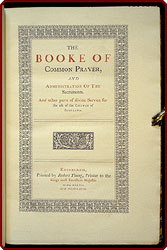
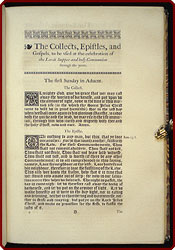
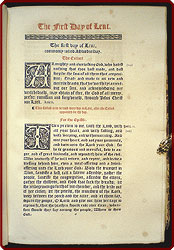
Pickering & Whittingham'sSEVEN BCPs Church of England. Book of Common Prayer. [Seven editions of the Book of Common Prayer, 1549–1844 ]. London: William Pickering (pr. by Whittingham), 1844. Folio (35.8 cm, 14"). 7 vols. I: [264] ff. II: [314] ff. III: [134] ff. IV: [130] ff. V: [142] ff. VI: [140] ff. VII: [154] ff.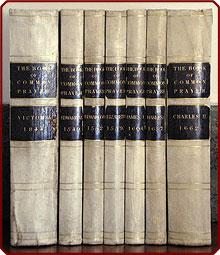
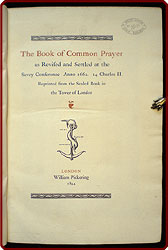
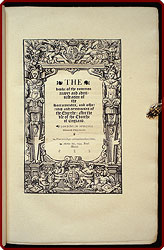 Click the images for enlargements.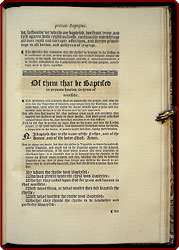
 Mary
Byfield. The original title-pages are reproduced in facsimile.
Mary
Byfield. The original title-pages are reproduced in facsimile.
Provenance: Elegant old lozenge-shaped ink-stamp on title-pages: “John Brymer Heir-Loom.”
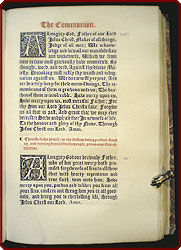
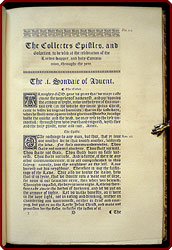
What to Wear, the Duty of Schoole-Masters, Divorce Sentences, & More Church of England. Constitutions and canons. 1603. English. Constitutions and canons ecclesiasticall treated upon by the Bishop of London, president of the convocation for the province of Canterbury, and the rest of the bishops and clergy of the said province: And agreed upon with
the Kings Majesties licence in their synod begun at London, anno Dom. 1603, and in the year of the reign of our soveraigne Lord James, by the grace of God, King of England, France, and Ireland the first, and of Scotland the 37. And now published for the due observation of them, by His Majesties authority under the Great Seal of England. London: Pr. by John Norton, for Joyce Norton, and Richard Whitaker, 1633. Small 4to. [60] ff.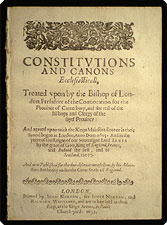
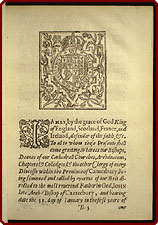
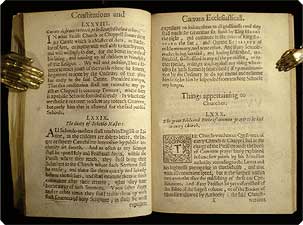 Click the images for enlargements.
 The Constitutions and Canons Ecclesiastical was an assemblage of rulings given equal force with the canon law, although the rulings themselves were not based on canon law.
• STC (rev. ed.) 10076; ESTC S101555. Removed from a nonce volume. A very nice, clean copy with an array of marginal markings — Xs, asterisks, “vid.,” and the odd hand-with-pointing-finger. (21226)

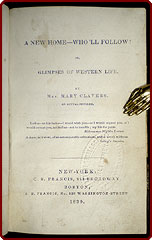
Life on the American Frontier Clavers, Mary [pseud. of Caroline M. Kirkland]. A new home — who'll follow? Or, glimpses of western life. New York: C.S. Francis; Boston: J.H. Francis, 1839. 12mo (17.5 cm, 6.9"). 317, [1 (blank)] pp. (lacking 2 final adv. pp.).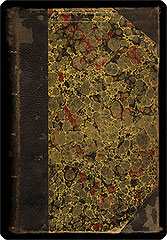
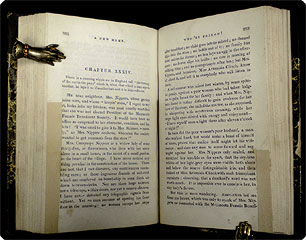 Click the images for enlargements.
 This copy includes the half-title, but has been well read and shows the signs thereof!
• BAL 11139; Howes K184; Sabin 37991; Wright, I, 1583. Contemporary half sheep and marbled paper–covered sides, spine with gilt-stamped title and author; leather worn/rubbed, especially at head of spine, but text firm in its binding. Front pastedown with Philadelphia bookbinder's ticket of B. Kohler (printed on blue paper). Ex–social club library: 19th-century inked call numerals on endpaper and half-title overlaid with paper labels, title-page pressure-stamped, no other markings. Pages age-toned, with intermittent stains and short edge tears; many leaves with edge repairs done some time ago, often with loss of a few letters, generally not affecting sense. Two final pages of advertisements lacking; one leaf with upper outer portion torn away, costing parts of 12 lines; two leaves with lower portions torn away, with loss of about 14 lines to each. Last leaves with waterstaining to outer portions.  Clearly, as noted above, the club library that owned this had avid clientele for it; and that they were as determined to “keep it going” as the repairs show, even after it had been damaged, is interesting! (26386)
 TO Part
IV .
. . TO Part
IV .
. . |