
 THE
INQUISITION
THE
INQUISITION
THE
INQUISITION
THE
INQUISITION
 Famous, Devoutly Catholic; BUT He still Ran afoul
 the INQUISITION
 (A
Surprise?). Valtanás, Domingo de (a.k.a. Baltanas,
Baltanas Mexia, Baltanas Messia ). Exposicion de los evangelios con
sermones desde primero domingo de adviento hasta el domingo. xxv. despues de la
Trinidad ... co[n] anotaciones morales dignas de saber. Sevilla: en casa de Martin
de Montesdoca, 1558. 4to (21cm; 8.25"). [3], 186, [8], lxxv folios (lacking Initial
blank and fol.lxx).
(A
Surprise?). Valtanás, Domingo de (a.k.a. Baltanas,
Baltanas Mexia, Baltanas Messia ). Exposicion de los evangelios con
sermones desde primero domingo de adviento hasta el domingo. xxv. despues de la
Trinidad ... co[n] anotaciones morales dignas de saber. Sevilla: en casa de Martin
de Montesdoca, 1558. 4to (21cm; 8.25"). [3], 186, [8], lxxv folios (lacking Initial
blank and fol.lxx).


 Click the images for enlargements.

The Exposicion de los evangelios con sermones begins with a visually complex title-page printed in black and red and featuring a large woodcut of the Crucifixion, which in this copy has the wounds of Christ additionally touched in a penman's red; and it then proceeds to present 57 sermons, each centered on a moral state or quality (laziness, adversity, sin, patience, charity, love), a doctrinal topic (the trinity, confession, the Passion of Christ, prayer, false prophets, forgiveness of sins), or some aspect of the Gospels. Each sermon is printed in roman type with sidenotes in gothic and begins with two readings, one from one of the four Gospels and the other from another part of the Bible. The work continues with the “Segunda parte de la exposicion de los eva[n]gelios de sanctos en particular, y del comun, con sermones sacados de diversos autores catholicos,” which has its own sectional title-page, signatures, and foliation. It has a four-element woodcut border and
 a small woodcut of the Annunciation.
All of Valtanás’s writings are scarce. The Catálogo Colectivo del Patrimonio Bibliográfico locates only 9 titles (one catalogued under Baltanas) as held by Spanish libraries and one of those titles is not for a true work but rather for the just mentioned “Segunda parte.” The OPAC of the Spanish National Library shows one additional title not found via the CCPB.  This title is not traced via WorldCat, COPAC, Catálogo Colectivo del Patrimonio Bibliográfico, or the OPAC of the Spanish National Library.
• Palau 349174 (giving incorrect date of publication, as per Nicolás Antonio, and saying it is printed in gothic type when it is in roman). Not in Adams; not in Index Aurel., although one book is listed there under “Baltanas.” Late 17th- or early 18th-century dark Spanish sheep, gilt spine extra and with a red leather gilt label. Light to occasionally moderate waterstaining, mostly in margins, variously occurring throughout the volume; lacking an initial blank leaf and one text leaf (i.e., lxx) in the “Segunda parte.”  A darned good copy of a very rare book. (26174)

 Dutch Opinions on theSpanish Inquisition Avontroot, Johannes Bartholomeus. Den grouwel der verwoestinghe, oft grondich bericht ende ontdeckinghe, van de gronden der Spaensche inquisitie. In s'Graven-haghe: Aert Meuris, 1621. 4to (19.7 cm, 7.75"). [28], 212 pp.
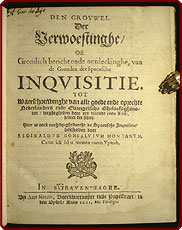
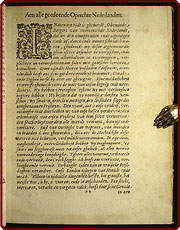
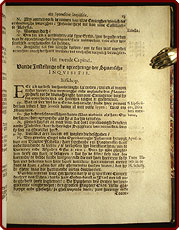 Avontroot was executed by the Inquisition at Toledo in 1632.
This copy lacks the work by González de Montes, a.k.a. Reginaldus Gonsalvius Montanus, which should follow p. 212. It is largely printed in black letter.
Uncommon. OCLC finds only two holdings in the U.S., one being this copy, now properly deaccessioned, and the other at the John Carter Brown Library. NUC Pre-1956 does not identify any additional copies.
• Vekené, Bib. der Inquisition, 139-140; Boehmer, Bibliotheca Wiffeniana, 290 (identifying the volume as the second Dutch translation of the Montanus work not present here). 19th-century half calf with marbled paper-covered sides; joints and corners rubbed. Front pastedown with institutional bookplate, title-page with early inked ownership inscription in upper margin. Pages age-toned with some mild waterstaining; one leaf with lower outer corner torn away, not affecting text. (19569)

 HE Certainly Didn't“Expect The Spanish Inquisition” Madrid shaver's singular adventures and wonderful escape from the Spanish Inquisition. A true story. Glasgow: Pr. for the booksellers, n.d. [ca. 1840?]. 12mo. 24 pp.
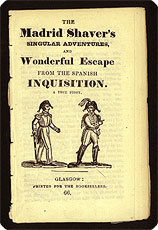 Click the image for an enlargement.
 • NSTC 2M9198. Uncut, unopened. Folded as issued. Two long tears into text on two different leaves, repaired with archival tissue. Good+ copy. (17506)


The Grand Inquisitor ofMANTUA Medicis, Girolamo de. Summae theologiae S. Thomae Aquinatis doctoris angelici, explicatio formalis, qua redactis ad formam syllogisticam argumentis & rationibus, textuq[ue] diligenter enucleato, mens sancti doctoris apertissime traditur & explanatur auctore R.P.F. Hieronymo de Medices. Coloniae: Sumptibus Conradi Butgenii, 1622. 8vo. [16] ff.,
1352 pp. 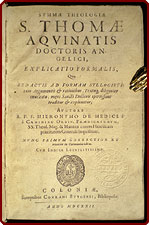
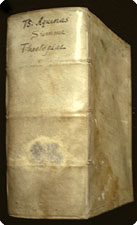 Click the interior image for an enlargement.
 According to the colophon: “Finit explicatio formalis totius primae partis Summae theologiae Sancti Thomae Aquinatis . . . Die 21. Decembris anni 1611 . . . Mantuae in aedibus Sanctissimae Inquisitionis.” The earliest edition in any U.S. library is the Venice, 1614 edition. This 1622 printing is reported as owned by only one U.S. institution, this copy having been deaccessioned by the other library of record.
• VD17 12:643261D. Contemporary vellum over light boards, small area of discoloration on spine; lacks the silk ties, bookplate removed, old library pressure-stamp on title (properly deaccessioned), NO rubber stamps. All edges stained blue. A very nice copy. (20728)
Ending an Amnesty for Rebels Mexico. Inquisition. Broadside, begins: Nos los inquisidores apostolicos, contra la herética pravedad y apostasía en la ciudad de México, estados y provincias de esta Nueva España, Guatemala, Nicaragua, Islas Filipinas, sus distritos y jurisdicciones ... Sabed, que el ... Inquisidor General ha mandado publicar ... un edicto del tenor siguiente ... Bien sabeis como por nuestros edictos de dos de enero y diez de febrero, y con mas amplitud por el de cinco de abril del año proximo pasado, hemos llamado ... á todos los que se sintieren gravados con el horrendo crímen de la heregía ... ofreciéndoles la reconciliacion y absolucion de todos ellos ... Dado en la Inquisicion de México á ocho de junio de mil ochocientos diez y seis.... Mexico: 8 June 1816. Folio extra (60 cm; 23.5"). [1] p.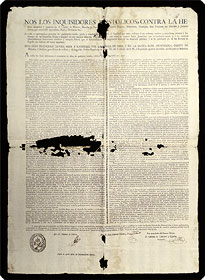
Click the image for an enlargement. Signed by each Mexican Inquisitor with his paraph and with the woodcut seal of the Inquisition in the lower left corner
Very uncommon: We trace only one copy in the U.S. — at the University of California at Berkeley.
• Not in Medina, Mexico. Several holes of various sizes, including one very large one in the middle of the first column, with loss of paper costing words and whole sentences. Otherwise, light staining and some instances of soiling most notably around the holes, only. Priced accordingly. (17028)
A Renaissance/Reformation Man — WhoDIED at the HandsPaleario, Aonio. ... Opera. Ad illam editionem quam ipse auctor recensuerat & auxerat excusa, nunc novis accessionibus locupletata ... Amstelaedami: Apud Henricum Wetstenium, 1696. 8vo (16.5 cm; 6.5"). *8 **4 A-Z8 Aa–Ss8 Tt4 (Tt4 blank); [12] ff., 650, [7] ff.

Paleario was at once a creation of the Renaissance and of the Reformation: He carried on a wide correspondence with the intellectuals of his time, he studied the writings of Luther and Erasmus, and he sought to reconcile the old with the new. This edition of his works is chiefly composed of his letters, but also includes “De Immortalitate Animorum libri III,” and “Poematia.”
• On Paleario, see: Contemporaries of Erasmus, III, 45–46. Contemporary vellum over boards; bit of abrasion and black speckling in lower area of spine. 18th-century armorial bookplate on front pastedown. Occasional light spotting in text. Notes in pencil on rear endpapers. Rear free endpaper torn with loss of paper in the lower outer area.

The
Famous Wager
inEnglish
Pascal,
Blaise. Thoughts on religion, and other subjects ... translated
from the French. London: Pr. by W.B. for A. & J Churchil, R. Sare, &
J. Tonson, 1704. 8vo (19.4 cm, 7.6"). [2], lviii, [12], 352, 361–76, 369–92
pp. (text complete despite pagination).

 Click the interior images for enlargements.
 Kennett, an antiquary and translator of a number of French works, served
as the first chaplain to the British merchants at Leghorn — where his
ministry incurred the
wrath of the Inquisition. An interesting international
addition to this book's trouble with religious authority, for the Pensees
were placed on the Index shortly after their original publication.
the
wrath of the Inquisition. An interesting international
addition to this book's trouble with religious authority, for the Pensees
were placed on the Index shortly after their original publication.
Binding: Contemporary speckled calf and mottled calf framed and panelled in gilt rules with gilt-stamped corner fleurons; recently rebacked with speckled calf, spine with gilt-stamped leather title-label and gilt-stamped decorations within gilt-dotted raised bands.
• ESTC T144329; Lowndes 1795. On Kennett, see: Oxford Dictionary of National Biography online. Binding as above, corners and edges with minor rubbing; lower (closed) edges institutionally rubber-stamped. Front fly-leaf with early inked ownership inscription. Pages age-toned and in some instances browned; old, usually (but not quite always) faint waterstaining to a number of leaves; corner creases from old dog-earring and one old inkblot, one leaf with closed tear from outer margin touching a few letters without loss. Pagination erratic, but catchwords correct and text continuous. A solid, usable copy in an attractively refreshed binding. (25099)
The Pope Appointsa New Grand Inquisitor for Spain Pope Paul V (1552–1621; pontificate 1605–21). Letter to King Philip III of Spain, in Latin, on vellum. Rome: 4 January 1619. Narrow strip (10 x 40.5 cm; 4" x 16"). [1] leaf. Click the image for enlargement.
 This contemporary file copy was retained in Rome and signed “S. Card. S. Susannae” (i.e., Cardinal Scipione Cobelluzzi, who was also at this time the Librarian of the Vatican Library).
• Written in a very handsome italic on very good quality vellum. Light discoloration along lower edge, below the writing. (26978)
Let's NOT Bring Back the Inquisition S., Y. O. Anecdota importante relativa a la Inquisicion de España, y varias reflexiones sobre el mismo asunto. Mejico: Impr. de D.M. Ontiveros, 1820. Small 4to. 35, [1 (blank)] pp.

Uncommon: OCLC locates only the copies at the Bancroft and Chilean National libraries; although, clearly, there is or was one in the Sutro Library.
• Sutro 175. Removed from a nonce volume. A good clean copy. (21742)

Watch Your Mouth!Spain.
Sovereigns, 1621–1665 (Philip IV).
Prematica en que su magestad manda se executen las penas en ella contenidas, contra
los que juraren, declarando, que solo queden permitidos los juramentos que se
hazen judicialmente, ò para valor de algun contrato; y que en los Consejos
de Inquisicion,
Ordenes, y otras comunidades de estatuto, a la pregunta de las costumbres se añada
la denotadeste vicio. Madrid: Pedro Tazo, 1639. Folio (28.2 cm, 11.1"). A6;
6 ff.  Click the image for an enlargement.
 • Not in Palau. Removed from a nonce volume. Title-page with shadow of pencilled numeral and faintly inked earlier numeral in upper margin. Pages creased but clean.

 For
GENERAL CATHOLICA,
For
GENERAL CATHOLICA,


PLACE AN ORDER | E-MAIL US | GO (BACK) TO TOPIC/INTEREST TABLE | PRB&M HOME
All material © 2010
The Philadelphia Rare Books & Manuscripts
Company