 GERMAN-LANGUAGE BOOKS
GERMAN-LANGUAGE BOOKS
GERMAN-LANGUAGE BOOKS
 A
POLYGLOT
Mass Lectionary
— Latin,
Greek,
Hebrew,
A
POLYGLOT
Mass Lectionary
— Latin,
Greek,
Hebrew, GERMAN
 Bible.
N.T. Polyglot. Hutter. Selections. 1601.
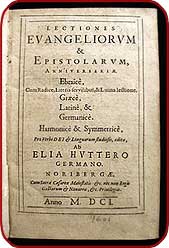
Lectiones evangeliorum & epistolarum, anniversariae. Ebraicé, cum radice, literis servilibus, & Latina lectione. Græcé, Latiné, & Germanicé. Harmonicé & symmetricé...editæ ab Elia Huttero.... Noribergae: 1601. 8vo. (19 cm, 7.5"). A–Z8
Aa–Zz8 Aaa–Ccc8; 781, [1 (blank)] pp., [1 (blank)] f.; plts.
Bible.
N.T. Polyglot. Hutter. Selections. 1601.
Lectiones evangeliorum & epistolarum, anniversariae. Ebraicé, cum radice, literis servilibus, & Latina lectione. Græcé, Latiné, & Germanicé. Harmonicé & symmetricé...editæ ab Elia Huttero.... Noribergae: 1601. 8vo. (19 cm, 7.5"). A–Z8
Aa–Zz8 Aaa–Ccc8; 781, [1 (blank)] pp., [1 (blank)] f.; plts. 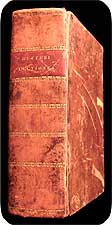
a
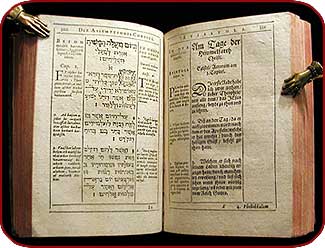
Hebrew translation of the liturgical epistles and gospels
for use at Mass, accompanied by a transcription of the Hebrew into Latin letters, as well as the Greek, Latin, and German versions. The Hebrew text incorporates some small handsome woodcut initials, and the printer has also employed some interesting woodcut headpieces.
Elias Hutter (1553–1609) was an orientalist and professor of Hebrew at Leipzig. The text here is drawn from his famous and sought after polyglot New Testament in 12 languages (Nuremberg, 1599), and so shares in the censure Hutter received for there translating and inserting "in some versions missing passages which he found in others" (Darlow and Moule)—but, he was open about that. The present work was apparently for devout students of Hebrew, both to further their knowledge of that language and to give them comparative
texts for study and meditation on the week’s lessons.  Polyglot lectionaries are not common, and this is the only polyglot lectionary of the epistles and gospels listed by NUC Pre-1956 before the 19th century.
• Not in Darlow & Moule, but see 1430, 1431, 1432, 1433, and 1434 for Hutter’s polyglot New Testament in 12 languages, and his St. Matthew’s Gospel, St. Mark’s Gospel, polyglot Psalter, and polyglot New Testament in four languages. Sheep, spine simply gilt with a red leather title label; leather rubbed and abraded, front joint opening. Pages with some instances of light waterstaining or browning. All edges red.

 A
Lectern Bible
A
Lectern Bible USED
in a Lutheran Church?
Bible. German.
1710. Luther. Biblia, das ist: Die gantze heilige Schrift des Alten und
Neuen Testaments. Wie solche von Herrn Doctor Martin Luther Seel. im Jahr Christi
1522. in unsere Teutsche Mutter-Sprach zu übersetzen angefangen.... Nürnberg:
In Verlegung Johann Andreä Endters Seel, Sohn, und Erben, 1710. Folio (39
cm, 15.38"). Frontis., [32] ff., 1181, [1] pp., [11 (-1)] ff.; 1 plt., illus.
USED
in a Lutheran Church?
Bible. German.
1710. Luther. Biblia, das ist: Die gantze heilige Schrift des Alten und
Neuen Testaments. Wie solche von Herrn Doctor Martin Luther Seel. im Jahr Christi
1522. in unsere Teutsche Mutter-Sprach zu übersetzen angefangen.... Nürnberg:
In Verlegung Johann Andreä Endters Seel, Sohn, und Erben, 1710. Folio (39
cm, 15.38"). Frontis., [32] ff., 1181, [1] pp., [11 (-1)] ff.; 1 plt., illus.
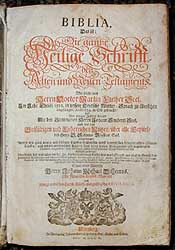
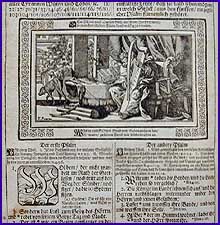
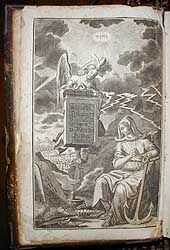
In this printing, a fine engraved title-page shows an angel delivering Luther's translation of the Old Testament to a Church still in bondage to the requirements of the old Law. A similar sectional title-page, depicting God the Father, Jesus Christ, and allegorical figures of the sacraments of Baptism and Communion, comes before the New Testament. Six special pairs of leaves, bound in at various places, each offer a first page containing an engraving of biblical figures and three following pages containing their biographies. A woodcut vignette of the unusual triple arms of the city of Nürnberg appears on the title-page; a number of chapters are adorned, at head, with one-third page woodcut illustrations set in neat borders; and the books typically open with typographically appealing two-column "headers." The text is in a handsome and relatively legible fraktur. The size, decoration, and overall composition of the volume, along with its faults (especially the manner in which which pages are worn), suggest a history as a lectern Bible in a Lutheran Church.
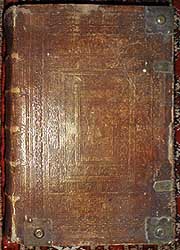
 Binding: This copy is bound in ornately
blind-tooled and -stamped alum-tawed sheep over wooden boards, the front cover
with three of its original etched corner bosses and with its two etched clasp-catches.
(Bosses of back cover no longer present, remnants of clasps.) A martial portrait
is centered on each cover; unfortunately these are now so worn that they are
no longer identifiable. Perhaps they belong to the electors of Saxony who
safeguarded the Lutheran faith in its infancy.
Binding: This copy is bound in ornately
blind-tooled and -stamped alum-tawed sheep over wooden boards, the front cover
with three of its original etched corner bosses and with its two etched clasp-catches.
(Bosses of back cover no longer present, remnants of clasps.) A martial portrait
is centered on each cover; unfortunately these are now so worn that they are
no longer identifiable. Perhaps they belong to the electors of Saxony who
safeguarded the Lutheran faith in its infancy.
• Binding as above. Covers abraded and worn, some scraping to back upper board, leather peeling back from fore-edge of front cover and opening at ends of joints, most notably at bottom of front one. Front free endpaper with inked inscription, in German, dated Philadelphia, 1852. Frontispiece with a fore-edge chip (not into image) and tears in from bottom margin and at gutter, with small loss to plate area at bottom inner corner. A number of pages with tears extending into text, a few places with chips to bottom outer corners with loss of words but not of sense. Scattered foxing, with occasional darker small stains. Last leaf (of Confession, NOT Bible) lacking. Despite faults, a grand volume both usable and inspiring.
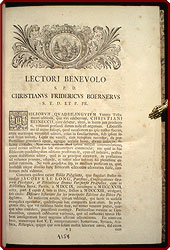
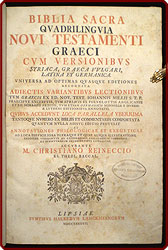
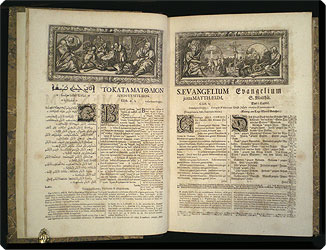
 The Leipzig Polyglot Bible. Polyglot. 1747. Reineccius. Biblia Sacra quadrilinguia Veteris [ac Novi] Testamenti Hebraici ... accurante M. Christiano Reineccio. Lipsiae: Sumtibus Haeredum Lanckisianorum, 1747–51. Folio (37.4 cm, 14.75"). 3 vols. I: [20], 1604 pp. II: [36], 607, [1] pp. III: Add. engr. t.-p., [22], 968 pp.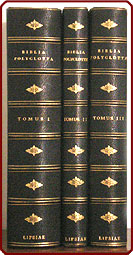
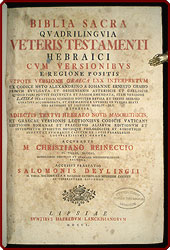
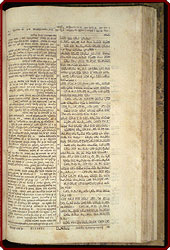
 Click the interior images for enlargements.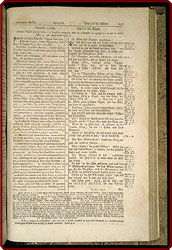
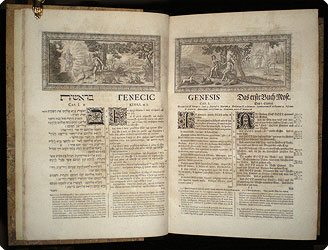
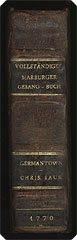
 Saur's Lutheran Hymnal Bible. O.T. Psalms. Paraphrases, German. Vollständiges Marburger Gesang-Buch zur Uebung der Gottseligkeit, in 649 christlichen und trostreichen Psalmen und Gesängen Hrn. D. Martin Luthers. Germantown [PA]: Christoph Saur, 1770. (16.8 cm, 6.7"). Frontis., [12], 490, [15], 13, 83 (i.e., 84; 85/86 lacking) pp.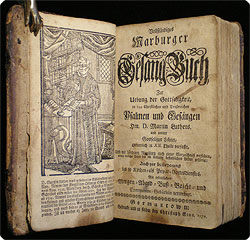
 Click the interior image for an enlargement.
 The volume opens with a woodcut portrait of Martin Luther which according to Hamilton (cited in Reilly [see below]) “might have been made by Justu Fox who was working in Philadelphia at this time.”
• Evans 11714; Hildeburn, Pennsylvania, 2561; ESTC W21005; Warrington, History and Practice of Psalmody in the United States, p. 39; Reilly, Dictionary of American Printers' Ornaments & Illustrations, 1577. Contemporary sheep, rebacked some time ago, spine with gilt-stamped leather title-, place, “Chris. Saur,” and date labels; rubbed in the ordinary degree and with remnants of clasps. Back free endpaper lacking; pastedowns and blanks with old inked and pencilled signatures and writing practice(?) — which we do not make out much of, beyond “Johann(es).” Three leaves each with closed tear from outer margin extending into text; three index leaves with tattered outer edges, one with loss of lower outer portion; small section of pages with odd little dent to outer edge; last leaf present (and that leaf only) with a couple of pin-type wormholes; final leaf lacking. Pages age-toned, with moderate spotting and staining. Priced according to its described “issues,” not according to its considerable charm on shelf and in hand. (25105)

ProtestantFrench–GERMAN
DIGLOT
Bible.
N.T. French
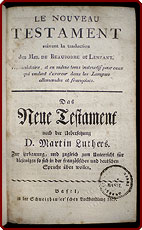
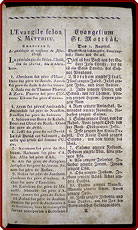
& German. 1819. Beausobre–Lenfant & Luther. Le Nouveau
Testament suivant la traduction des Mrs. [sic] de Beausobre et Lenfant
... das Neue Testament nach der Uebersetzung D. Martin Luthers. Basel: In der
Schweighauser'schen Buchhandlung, 1819. 8vo (18.5 cm, 7.3"). [8], 1101 (i.e.,
961), [1 (blank)] pp. (536–37 used twice in pagination, 959–1098
skipped).
 OCLC
locates only one U.S. institutional holding of this edition, which has since
been deaccessioned.
OCLC
locates only one U.S. institutional holding of this edition, which has since
been deaccessioned.
• Darlow & Moule 4318. Recent speckled paper–covered boards, spine with gilt-stamped leather title-label, all edges stained blue. Front fly-leaf with early inked inscriptions, one dated 1851. Title-page with early institutional rubber-stamp, last page with pressure-stamp, second page of contents with inked annotation along inner margin and rubber-stamped numeral in lower margin. Pp. 959–1098 skipped in pagination; text complete. Foxed, but not badly; clean. (25856)

 Early American Mennonite Hymnal Bible. O.T. Psalms. German. 1820. Die kleine geistliche Harfe der kinder Zions, oder auserlesene geistreiche Gesänge. Germantaun: Gedruckt bey Michael Billmeyer, 1820. 12mo (17.3 cm, 6.8"). Frontis., [4], 39, [1], 412, [20], 20 pp. (21/22 lacking).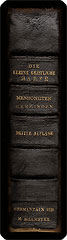
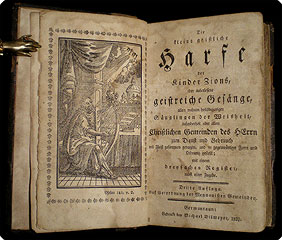 Click the images for enlargements. It's an engaging fact that psalms are given in multiple versions; there are four of the 23d.
Arndt and Eck cite Bender, who says “This first American Mennonite Hymnbook is not to be confused with one of similar title printed by Saur at Germantown in 1753, called erroneously by Seidensticker and Flory a Mennonite hymnbook.” Each portion of this item has a separate title-page, with the second section's title-page reading Sammlung altre und neuer Geistreichen Gesänge. The woodcut frontispiece depicts David playing his harp.
• Arndt & Eck 2419; Shoemaker 2239. Contemporary calf rebacked some time ago, spine with gilt-stamped leather title and publication labels; rubbed, original clasps now lacking. Front fly-leaves with early inked and pencilled inscriptions. Final leaf (pp. 21/22 of the 22-page appendix of brief hymn texts, not of the main portion of the work) lacking. Edge nicks, chips, and tears, some extending into text; three leaves torn in half from outer margin, without loss of text; two leaves (one index) with lower outer corner torn away, with loss of a few words; last two leaves with outer edges ragged. Some upper corners bumped. Pages browned, with waterstaining to lower inner portions of about a third of the volume. (25569)
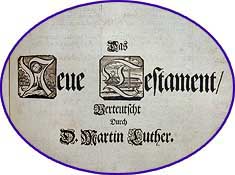
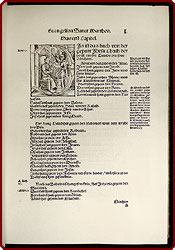
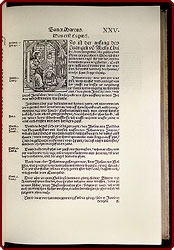
TheFamous September Testament — Well Evoked! Bible. N.T. German. (1522) 1883. Luther. Die Septemberbibel: Das Neue Testament deutsch von Martin Luther. Berlin: G. Grote, 1883. Folio (32.4 cm, 12.75"). [4], 9, [9] pp., CVII, [6], LXXVII, [26] ff.; illus.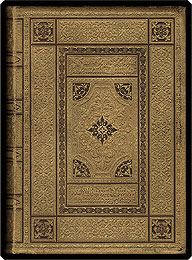
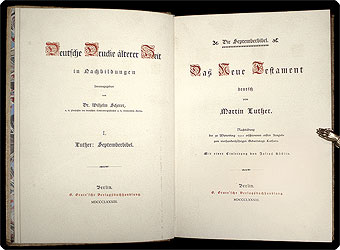 Click the images for enlargements.
  21 full-page woodcuts by Lucas Cranach. Illustrating the Book of Revelation, the woodcuts appear here in their original state, before ordinary crowns took the place of the papal tiaras worn by the Antichrist and the Whore of Babylon.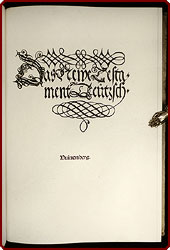
• Binding as above, with light rubbing; front pastedown with Leipzig bookseller's small ticket. Occasional faint smudges; pages mostly clean. A handsome thing. (26301)
 TO Part
III . . . TO Part
III . . . |