 GERMAN-LANGUAGE BOOKS
GERMAN-LANGUAGE BOOKS
GERMAN-LANGUAGE BOOKS
 Wonderful
 “Peasant”(!)
Binding
“Peasant”(!)
Binding
 (AH!
OVER-THE-TOP)! Martin,
von Cochem. Der grosse Baumgarten. Sulzbach: Im verlage der J. E. Seidelschen
Kunst- und Buchhandlung, 1807. 8vo (18.5 cm; 7.375"). Frontis., [9] ff., 688 pp.,
[6] ff., 16 plts.
(AH!
OVER-THE-TOP)! Martin,
von Cochem. Der grosse Baumgarten. Sulzbach: Im verlage der J. E. Seidelschen
Kunst- und Buchhandlung, 1807. 8vo (18.5 cm; 7.375"). Frontis., [9] ff., 688 pp.,
[6] ff., 16 plts.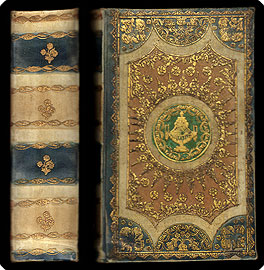
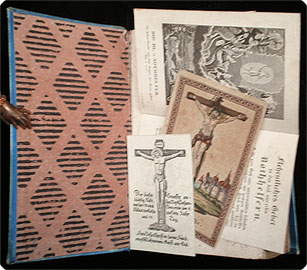
 Click the images for enlargements.
  16
woodcut plates.
16
woodcut plates. 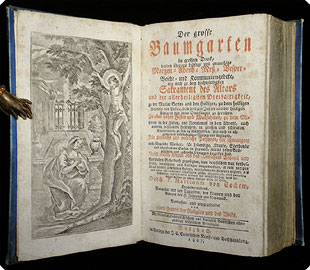
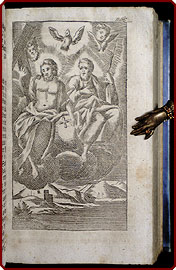
The vellum binding is elaborately tooled in gilt and in-painted in blue, green, and salmon. All edges are gilt and gauffered.
• Binding as above with light rubbing. A very handsome, interestingly late example of this uncommon binding style. (26690)
 This entry is repeated in the

Not THAT AgricolaAgricola, Johann. Siebenhundert und funfftzig deutscher sprüchwörter ernewert und begessert durch Johan. Agricola. Mit vielen schönen lustigen und nützlichen historien und exempeln erkleret und ausgelegt. Wittenberg: Gedruckt bey J. Krafft, 1592. Small 8vo. )(8 *8 A–Z8 Aa–Xx8 (-Xx8, a blank) [14], 350 ff.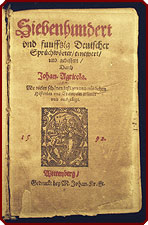
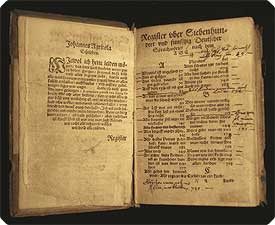
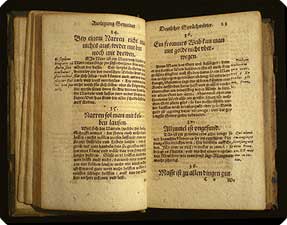 Click the interior images for enlargements.
 All 16th-century editions are scarce. Via NUC, OCLC and RLIN we locate only this copy of this edition (now deaccessioned) and that at Princeton.
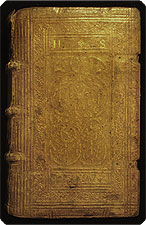
Binding: Contemporary alum-tawed sheep over wooden boards with partially bevelled edges. Elaborately blind-embossed with a roll and a center panel ornament. Front cover with initials “H. S.” and date “1597” in gilt. Rear cover with gilt putti in the areas where initials and the date appear on the front.
Evidence of readership: Marginalia in the prefatory index; very scattered early underscoring.
• VD16 A969; Goedeke, II, 8. Binding as above, lacking clasps and with old paper spine label; ex-library with bookplate and call number in old, faded, white numbering on spine. Title-page browned and tipped in; loss of paper to fore- and bottom margins of same. Some age-toning to paper and several leaves with natural paper flaws, repaired with archival tissue; three other leaves also with natural paper flaws repaired at time of binding or shortly after printing. Approximately 12 leaves with inkstains, sometimes obscuring text. One leaf (178) with a hole costing a significant loss of text. A marginally acceptable copy as regards text, in a good binding.


Reformation Concern about Monasticism Ain Schoner Dialogus wie ain Bawr mit aim Frawe[n] brüder Münch redt[,] das er die Kutten von jm würfft, vnd dem Münch arbayt zügeben, lustbarlich vnd lieblich zu lesen. [Augsburg: Philipp Ulhart d.Ä.], 1525. Small 4to (19 cm; 7.5"). 6 pp.
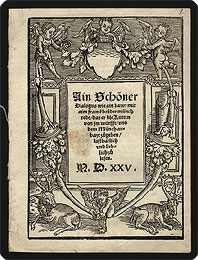 Click the image for an enlargement.
 This edition has a handsome, single-unit woodcut title-border incorporating pillars, stags, vines, and cherubs. The text is in fraktur, of course.
Rare: WorldCat locates only one copy of any edition in the U.S. (at Emory — this edition), while VD16 locates three German copies each for the Augsburg and Würzburg editions and only a microform of the Strassburg printing.
• Kuczynsk 579; VD16 S3433. Removed from a nonce volume. One small area of discoloration on title-page. Very good condition. (25922)

 Anti-Anabaptist Althamer, Andreas, attrib. author. Ein kurtze Vntterricht, den Pfarherrn und Predigern: Inn meiner gnedigen Herrn der Marggraffen zu Branndenburg. [et]c. Fürstenthumben un[d] Landen, hieniden in Francken, und auff dem Gebirg verordent, wes sie das Volck wider etliche verfürische Lere, der Widertauffer, an den Feyertägen auff der Canntzel, zum getreülichsten und besten, auss götlicher Schrifft vermanen, und unterrichten sollen. [Nuremberg: Jobst Gutknecht, 1528]. Small 4to (20 cm; 8.75"). [14] ff.
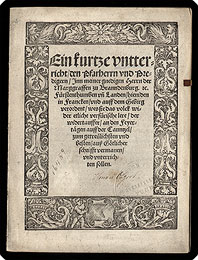 Click the image for an enlargement.
 During the Bern Disputation (1528) Althamer stood and defended the Lutheran doctrine of the Lord's Supper.
This is printed in gothic type and offers a title-page graced by a four-element woodcut border composed of floral, avian, and animal motifs, with putti not forgotten.
Provenance: Ownership signature on title-page of Howard Osgood, noted late 19th- and early 20th-century collector and scholar; old circular pressure-stamp on same page of a seminary (properly released).
WorldCat finds two copies in North America, one of which has been deaccessioned, and COPAC finds two copies in Great Britain, both at the British Library.
• Hillerbrand, Anabaptism,3577; VD16 ZV2334 or ZV2333 or B6972 (all listed without attrib. author). Removed from a nonce volume, provenance indications as above. Light dust-soiling to exterior paper; minor library pencillings and one old inked numeral; limited brown stain in blank area of last leaf, offsetting to previous page opposite. A few instances of marginal notation or textual correction in old ink and an old hand. (25960)

European
Conquest &
Settlement of Ceylon
Malabar
& “The East”Baldaeus, Philippus. Wahrhaftige ausführliche beschreibung der berühmten ostindischen kusten Malabar und Coromandel, als auch der insel Zeylon... Amsterdam: Brey Johannes Janssonius & Joannes von Someren, 1672. Folio (31.5 cm, 12.5"). *4 A–Z4 Aa–Zz4 Aaa–Zzz4 Aaaa–Fff4 Gggg6 2*4 **4 ***4; [3] ff., 610 pp., [13] ff., 16 fold. maps/plans, 18 fold. plts., and in-text illus.
Ceylon
Malabar
& “The East”Baldaeus, Philippus. Wahrhaftige ausführliche beschreibung der berühmten ostindischen kusten Malabar und Coromandel, als auch der insel Zeylon... Amsterdam: Brey Johannes Janssonius & Joannes von Someren, 1672. Folio (31.5 cm, 12.5"). *4 A–Z4 Aa–Zz4 Aaa–Zzz4 Aaaa–Fff4 Gggg6 2*4 **4 ***4; [3] ff., 610 pp., [13] ff., 16 fold. maps/plans, 18 fold. plts., and in-text illus.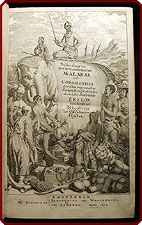
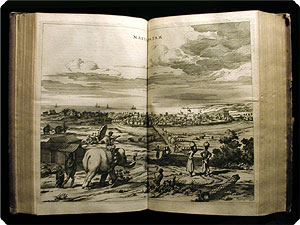
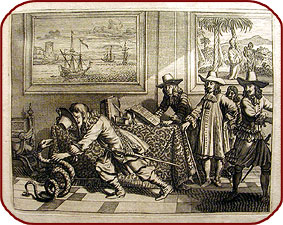
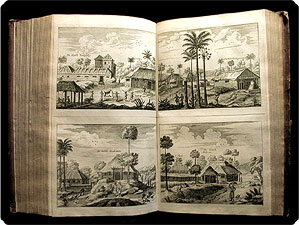
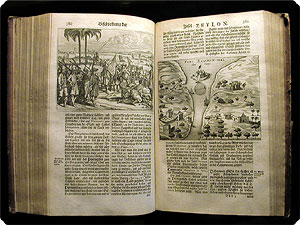
 Click any image for an enlargement.
 The work is highly illustrated and the engravings, being16 folding maps/plans, and 18 folding plates, are of battles, plans of fortresses, maps of areas, statutes, etc. Three double-page engraved tables are of scripts. The in-text illustrations, which are just as detailed and impactful, are numerous.
An important book on the rising Dutch presence in the East Indies and concomitant diminution of the Portuguese hegemony. This is the first edition in German; a Dutch-language edition also appeared in 1672.
• Landwehr, VOC, 557. 18th-century calf, gilt spine extra. Binding shows wear, with abrasions and leather lost; joints starting. Once in a library and bearing the odd pencilling, but no stamps. Clean copy.
 A PRB&M “FEATURED BOOK”
—
A PRB&M “FEATURED BOOK”
—

 A
Thrilling Adventure by
CAR —
The
A
Thrilling Adventure by
CAR —
The First
International Motor Rally
Barzini, Luigi. Peking–Paris im Automobil: Eine
Wettfahrt durcht Asien und Europa in sechzig Tagen ... mit einer Einleitung von fürst Scipione
Borghese. Leipzig: F.A. Brockhaus, 1908. 8vo (23.5 cm, 9.25"). [6], 558 pp.; 32 plts., 1 fold.
map.
First
International Motor Rally
Barzini, Luigi. Peking–Paris im Automobil: Eine
Wettfahrt durcht Asien und Europa in sechzig Tagen ... mit einer Einleitung von fürst Scipione
Borghese. Leipzig: F.A. Brockhaus, 1908. 8vo (23.5 cm, 9.25"). [6], 558 pp.; 32 plts., 1 fold.
map.
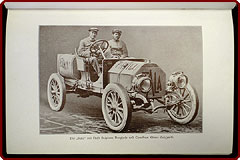
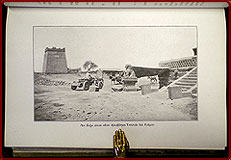
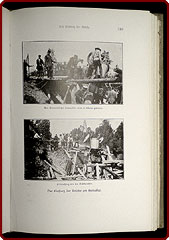 Click the images for enlargements.
 Binding: Publisher's textured tan cloth, covers and spine with stamped in brown with small pictorial vignettes evoking “the road”; title and author stamped in gilt. All edges subtly blue-sprinkled.
• Spine very slightly darkened and virtually no wear otherwise. One signature loosening; one page with a scrape (with a bit of loss to type), this and a few others with the ink's having offset or adhered pages together (usually separable); and all otherwise clean and crisp. A handsome copy. (26680)
LONDON
for theGerman
Traveller — Armchair
or Actual!
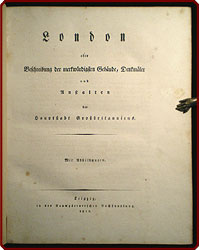
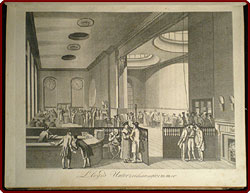
Bergk, Johann Adam. London oder Beschreibung der merkwürdigsten Gebäude, Denkmäler und Anstalten der Hauptstadt Grossbritanniens. Leipzig: in der Baumgärtner Buchhandlung, 1812. 4to (29.5 cm; 11.625"). iv, 44 pp., 20 plts.
 Click the interior images for enlargements.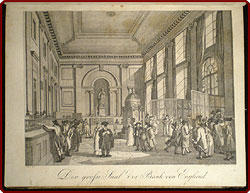
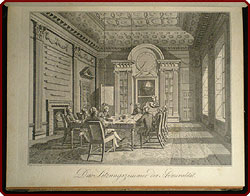
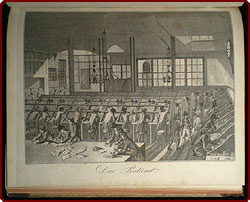
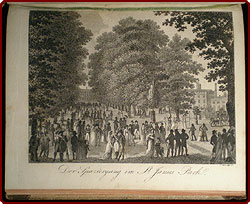
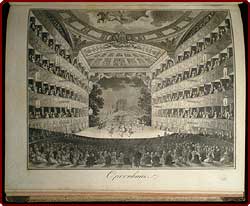
• Contemporary German half-calf with tan paper over the boards, the paper sprinkled with black. Leather of corners worn and almost gone; leather of spine also worn with spine label missing; a perfectly solid copy however. Internally some age-toning only. All edges red. A very good copy. (25049)
Blogg/Bloch onHebrew Blogg, Salomon Ephraim. Aedificium Salomonis, enthaltend: Eine vollständige Geschichte der hebräischen Sprache, des Thalmuds und vieler merkwürdiger Begebenheiten des Alterthums, die bis dahin gänzlich unbekannt geblieben ... Hannover: Ernst August Telgener, 1832. 4to. xv, [1], 143, [1] pp.
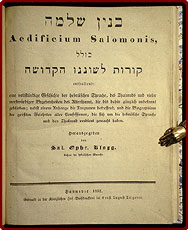
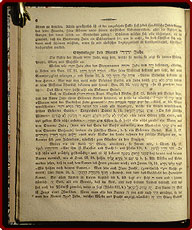 Click the interior images for enlargements.
 • Zedner, Catalogue of the Hebrew Printed Books in the Library of the British Museum, 153. Recent marbled paper–covered boards, spine with gilt-stamped leather title-label. Light age-toning and a bit of faint foxing. (23145)
HAMBURG
— Its History as Trade
CenterBüsch, Johann Georg. Versuch einer Geschichte der Hamburgischen Handlung, nebst zwei kleineren Schriften eines verwandten Inhalts. Hamburg: Benjamin Gottlob Hoffmann, 1797. 8vo (17.7 cm, 7"). x, [2], 288, 60 pp.
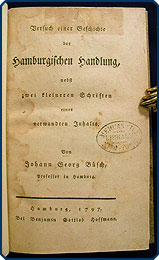 Click
the interior image for an enlargement.
Click
the interior image for an enlargement.
Uncommon: Fewer than nine copies located in U.S. libraries.
• Goldsmiths’-Kress 16971. Period-style speckled paper, spine with printed paper title and publication labels. Title-page and one other rubber-stamped by a now-defunct institution (being a “mercantile” library, intereting provenance for this work; title-page with short tear from upper margin (touching one word of title) repaired some time ago. Pages age-toned; first few leaves with inner margins waterstained.
First
German-Language Edition Social
& Economic Causes
Buxton, Thomas Fowell. Der afrikanische Sklavenhandel und
seine Abhülse ... mit einer Vorrede: Die Nigerexpedition und ihre Bestimmung. Leipzig: F.A.
Brockhaus, 1841. 8vo (21.6 cm, 8.5"). lxx, 453, [3] pp.; 1 fold. map.
Social
& Economic Causes
Buxton, Thomas Fowell. Der afrikanische Sklavenhandel und
seine Abhülse ... mit einer Vorrede: Die Nigerexpedition und ihre Bestimmung. Leipzig: F.A.
Brockhaus, 1841. 8vo (21.6 cm, 8.5"). lxx, 453, [3] pp.; 1 fold. map.
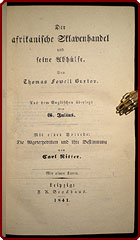
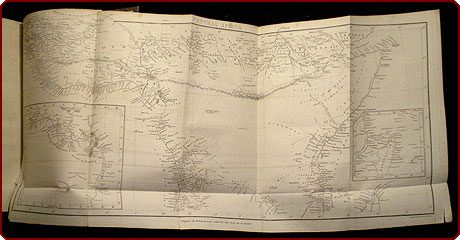
The volume is illustrated with an oversized, folding engraved map captioned in English.
Uncommon: OCLC and NUC Pre-1956 find only nine U.S. holdings (one deaccessioned).
• Goldsmiths'-Kress 32415.2; Sabin 9688. On Buxton, see: Oxford Dictionary of National Biography online and Allibone, 317. Boards covered with German-style black-flecked brown paper, spine with printed paper label. Pages slightly age-toned, with a very few scattered instances of light spotting; map with faint offsetting and short tear along lower inner margin, not touching image. An attractive copy. (25325)
GermanRENAISSANCE
Caesar — Lushly
IllustratedCaesar, Julius. Julius der erst römisch Keiser von seinem Leben und Krieg, erstmals uss dem Latein in Tütsch gebracht vnd mit andrer Ordnung der Capittel und uil zusetz nüw getruckt. [Strassburg: Durch Joannem Grüninger, vff sant Adolffs des heiligen Bischoffss, 1508]. Folio (31 cm; 11.5"). A6 Aa8 B6 C4 D–N6 O4 P–Z6 Zz6; [148] ff., illus.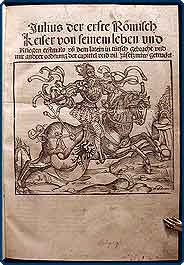
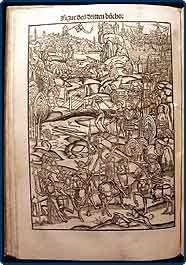
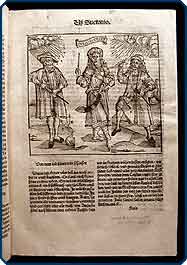 All images of this book enlarge, via single-click.
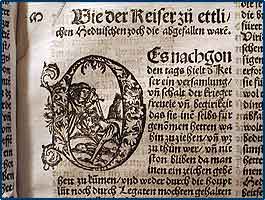
This handsome and SCARCE book is famous for its woodcut illustrations: It has one quarter-page, four half-page, one three-quarter page, and eleven full-page woodcuts. These include battle scenes, the assassination, camp life, etc., all of the figures being dressed anachronistically in Renaissance garb.
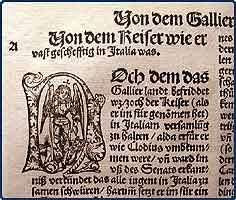 The text is printed in large gothic in double-column format.
 Of the first edition we find only two copies in the U.S. (Harvard and Stanford), and of the second we trace three (Brown, Duke, and Trinity College), all being incomplete except the Brown copy.
• Index Aurel. 128.654; Schmidt, Repertoire bibliographique Strasbourgeois, no. 91, p. 40–41; Schweiger, II, 51; not in Adams (who only lists much later editions in German). Recased in an 18th-century vellum-over-boards binding. Sophisticated copy in all likelihood, with several leaves apparently supplied from a different copy, those leaves being either slightly smaller than the others or more heavily sized. Occasional light waterstains in from a very few margins; two leaves with old scribbling in ink in margins; minor worming in lower margin of last six leaves.  A very nice copy of a very scarce book that is clearly difficult to find complete, incomplete, or sophisticated.
Stolen
Letters!
Damage
Control! —
The Reformation
Capito, Wolfgang [a.k.a., Wolfgang Köpfel]. Der
nüwen zeytu[n]g vnd heymlichen wunderbarlichen offenbarung so D. Hans Fabri jungst vfftriben
vnd Wolffgang Capitons brieff gefälschet hat bericht vnd erklerung. Strassburg: No
publisher/printer, 1526. Small 4to. [32] ff.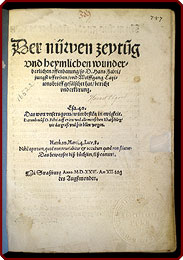
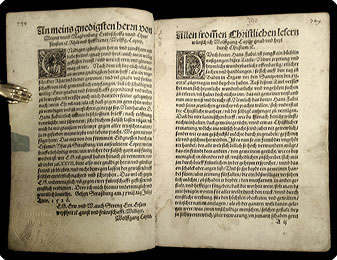
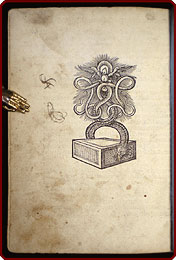 Click the images for enlargements.
 In his capacity as a leader of the early Reformation he was present at several important “conferences” (the second Zürich and that at Marburg). He coauthored, with Martin Bucer, the Confessio Tetrapolitana.
Capito's archenemy was a Dominican named Hans Faber (a.k.a. Johannes Faber), the vicar general of the bishop of Constance, who at every turn sought to undermine Capito and his relations with authorities and other Reformers, Zwingli in particular. Der nüwen zeytu[n]g is Capito's rebuttal of Faber's Newe Zeittung vnd heimliche wunderbarliche Offenbarung etlicher sache[n] vnd handlungen so sich vff dem tag der zw Baden, in which Faber published distorted versions of letters his agents had stolen that were addressed to Zwingli by Capito and relate to the disputation at Baden in 1526, which Zwingli had decided not to attend.
Schrodt and Vogelstein summarize: “Capito's defense in this tract suggests that he was not altogether comfortable with the language he had used, intended as it was for the eyes of a friend and spiritual comrade in arms. By presenting his original text passage by passage together with Faber's published German version of the same, Capito shows that it given the most offensive turn through the opponent's manner of translation.”
This proffers a large, interesting woodcut device on the verso of its last leaf and two small but nice woodcut initials in text.
Provenance: Ownership signature on title-page of Howard Osgood, noted late 19th- and early 20th-century collector and scholar; old circular pressure-stamp on same page of a seminary (properly released).
WorldCat finds no copies in North America and COPAC finds none in Great Britain.
• Panzer, II, 3051; Kuczynski 381; Index Aurel.; 131.648; VD16 C828; Schrodt & Vogelstein 28–29. In later plain wrappers; title-page torn with small loss of blank foremargin, repaired. Two different sequences of manuscript pagination, one in red, indicating the opusculum was bound at least twice in different sammelbands. Provenance indications as above, and a five-digit number in ink in the inner corner of the title-page; dust-soiling and old staining. (25953)
Use of Augsburg — Handsomely Printed & RARE Catholic Church. Augsburg (diocese). Rituale augustanum ad normam ritualis romani à glor. mem. Benedicto XIV. anno 1752. Augustae Vindelicorum: Josephi Antonii Labhart, 1764. 4to (22 cm, 8.65"). Engr. t.-p., [18], 544, 544a–d, 545–58, [40 (index)] pp.
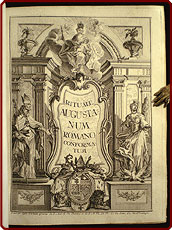
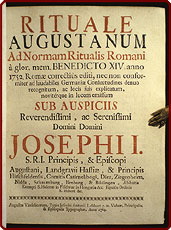
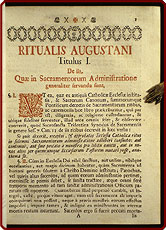 Click the interior images for enlargements. Includes some of the music of the mass.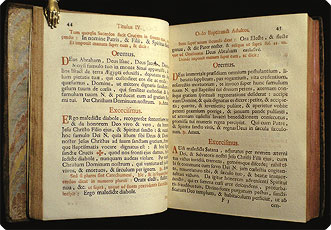
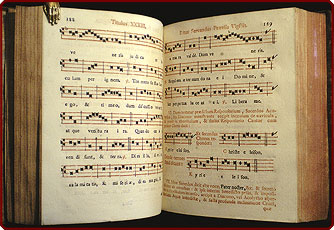
A very handsome production.
• Contemporary speckled calf, rebacked with speckled calf; gilt-stamped leather spine-label. Verso of front free endpaper with inked ownership inscription dated 1816. Title-page partially separated from bottom up, and with shadow of old pencilled numeral. A good clean copy. (18542)
 Home
Use in
Home
Use in Schleswig-Holstein
[Cramer, Johann Andreas], ed. Allgemeines Gesangbuch, auf königlichen allergnädigsten Befehl zum öffentlichen und haüslichen Gebrauche in den Gemeinen des Herzogthums Schleswig.... Altona: Eckhardt, 1781. 8vo (17.3 cm, 6.875"). [10] ff., 1008 pp., [14] ff. [bound with] [Evangelisch-Lutherische Landeskirche Schleswig-Holsteins]. Liturgy and ritual. Biblisches und Geistreiches Gebet-Buch.... Altona: Burmester, [after 1766]. 8vo. 96 pp. [bound with] [Evangelisch-Lutherische Landeskirche Schleswig-Holsteins]. Liturgy and ritual. Die Collecten, Episteln und Evangelia auf alle Sonn- und Fest-Tage durchs ganze Jahr. Nebst beygefügter Historie vom Leiden und Sterben Jesu Christi.... Altona: Burmester, [1781]. 96 pp.
Schleswig-Holstein
[Cramer, Johann Andreas], ed. Allgemeines Gesangbuch, auf königlichen allergnädigsten Befehl zum öffentlichen und haüslichen Gebrauche in den Gemeinen des Herzogthums Schleswig.... Altona: Eckhardt, 1781. 8vo (17.3 cm, 6.875"). [10] ff., 1008 pp., [14] ff. [bound with] [Evangelisch-Lutherische Landeskirche Schleswig-Holsteins]. Liturgy and ritual. Biblisches und Geistreiches Gebet-Buch.... Altona: Burmester, [after 1766]. 8vo. 96 pp. [bound with] [Evangelisch-Lutherische Landeskirche Schleswig-Holsteins]. Liturgy and ritual. Die Collecten, Episteln und Evangelia auf alle Sonn- und Fest-Tage durchs ganze Jahr. Nebst beygefügter Historie vom Leiden und Sterben Jesu Christi.... Altona: Burmester, [1781]. 96 pp.
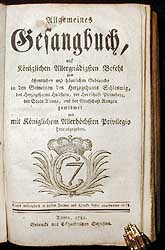 • Lay hymnal and prayer book intended for private and household devotions as well as for use in church. It was published for the use of members of the state Lutheran church in Schleswig-Holstein, a group of German-speaking dominions of the Danish Crown. The first work is a hymnal without music. Bound in with it are a prayer book, including extracts from the Lutheran liturgy, and the propers (collects, epistles, and gospels) accompanied by a meditation on the passion and death of Jesus. Lutheran hymnals appear commonly to have been bound with prayer books and propers.
 Edited by Johann Andreas Cramer (1723–88), a poet, hymnographer, and theologian at the Christian Albrecht's University of Kiel, the hymnal's text is printed in fraktur, with a title-page vignette showing the royal cipher of Christian VII of Denmark and with a few woodcut tailpieces, one handsomely showing the royal arms of Denmark, including Schleswig and Holstein.
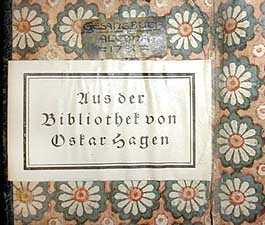 Provenance:
Bookplate: "Aus der Bibliothek von Oskar Hagen;" Ink inscription opposite
the title-page, noting the volume's donation in honor of Thura Niemann, d.
1870.
Provenance:
Bookplate: "Aus der Bibliothek von Oskar Hagen;" Ink inscription opposite
the title-page, noting the volume's donation in honor of Thura Niemann, d.
1870.
• Contemporary black sheep; covers modestly decorated in blind with a ruled border, tiny roundels at corners, and strokes resembling stitching at spine. Worn with a little leather lost at spine and corners; front joint opening. All edges gilt and gauffered; wallpaper style endpapers. A shaken volume: Some quires coming loose and some page corners bumped with loss of gilding. Pages shaved, just touching running heads in some places; all pages lightly age-toned but otherwise clean, save small light stain to title-page and darker one to p. 319 of first work. Pressed leaf laid in.
Including
a Full-Text Printing
ofThe
Augsburg ConfessionCyprian, Ernst Salomon. Historia der Augspurgischen confession, auf gnädigsten Befehl des Durchlauchtigsten Fürsten und Herrn, herrn Friedrichs des Andern, hertzogens zu Sachsen-Gotha aus dem original-acten beschrieben. Gotha: J.A. Reyher, 1730. 4to. 24, 227, 224 p.
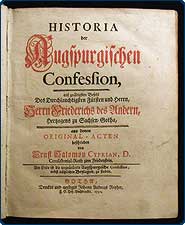
 Click
the title-page image for an enlargement.
Click
the title-page image for an enlargement. The main title-page is printed in black and red, the text in black letter (i.e., gothic, fraktur) and the footnotes in roman.
• Contemporary vellum over paste boards; later paper spine label with hand lettering; small area of lower spine with black spots. Vellum loosening at the turn-ins. Board edges soiled. Few stray stains in some margins. Private bookplate.
Searching
for theCourse
of the NigerDenham, Dixon;
Hugh Clapperton; Walter Oudney. Beschreibung der Reisen und entdeckungen
im Nördlichen und Mittlern Africa in den Jahren 1822 bis 1824. Weimar:
Im Verlage des Landes-Industrie-Comptoirs, 1827. 8vo (20.5 cm.; 8.25"). [2]
ff., viii, 720 pp., 2 fold. plts., 2 fold. maps.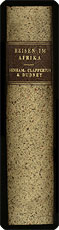
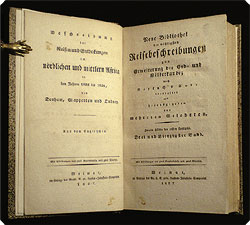
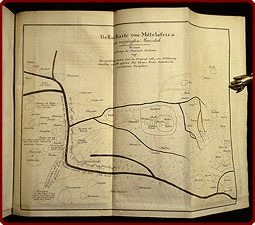 Click the interior images for enlargements.
 Of this account of the expedition, Howgego (II, 167) writes that it “provided a wealth of new material on the African interior but so belittled Clapperton's contribution that it almost reads as thought Denham was travelling alone.” Clapperton had left Denham in England to write the account while he returned to Africa to again explore the Niger, thus enabling Denham to do his dirty, self-aggrandizing deed.
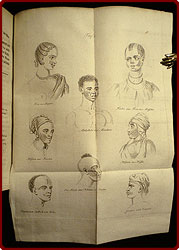
In this German edition the two folding plates are of various tribesmen (and -women). One map is quite large.
• Howgego, Encyclopedia of Exploration, II, 132–34, 166–67; Henze, I, 571; II, 49; III, 675; Embacher 95; Kainbacher, I, 39. Modern boards covered in the19th-century German style with brown paper speckled in black, with a brown leather spine label lettered in gilt. Two leaves closely trimmed in foremargins, with no loss of text. A very good copy. (23123)
Elegant Production — GORGEOUS Copy Ebhardt, Franz. Der gute Ton in allen Lebenslagen. Leipzig & Berlin: Julius Klinkhardt, [1889]. 8vo. viii, 774, [2 (adv.)] pp.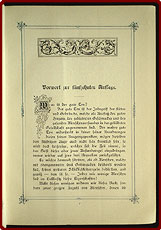
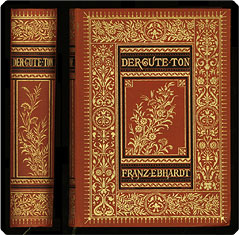 Click the interior image for an enlargement.
 Binding: Publisher's crimson cloth, front cover and spine gilt- and black-stamped, back cover black-stamped. All edges gilt. Actually, breathtaking.
• Binding as above, clean and bright with only very faint traces of wear to corners and joints. Pages clean; some lower outer corners slightly crumpled. It is hard to imagine a better copy. (23709)

Eck
on the Blood Libel
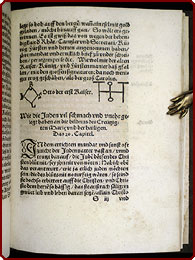
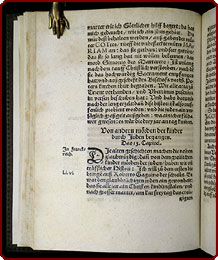
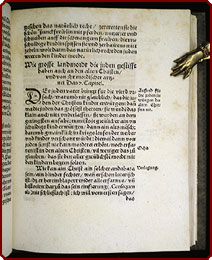
Eck, Johann. Ains Juden büechlins verlegung darin ain
Christ, gantzer Christenhait zu schmach, will es geschehe den Juden unrecht in bezichtigung der
Christen Kinder Mordt. Gedruckt zü Ingoldstat: durch Alexander Weissenhorn, 1541. 4to (19.5
cm; 7.75"). [96] ff.
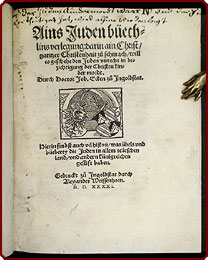
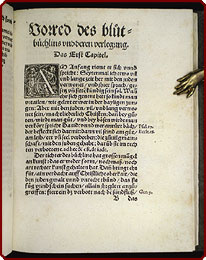 Click the images for enlargements.
 The text is printed in gothic with side- and shouldernotes, and the title-page has a woodcut of the arms of the Bishop of Trent.
WorldCat
locates only three copies in the U.S. and COPAC only three in the U.K.
An Arch-Opponent of LUTHER'S Eck, Johann. Der viert tail Christenlicher Predigen von den siben H. Sacramente[n] nach aussweysung Christlicher Kirchen vn grund Byblischer gschrifft den alten frummen Christen zu gut, durch Johann von Eck. [colophon: Augspurg: getruckt durch Alexander weyssenhorn, in verlegung D. Iohan Ecken zu Ingelstat], 1534. Folio (31.5 cm; 12.25"). [6], 158, [1] ff. (lacks final blank).
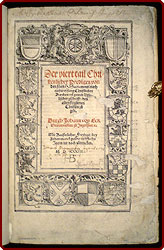
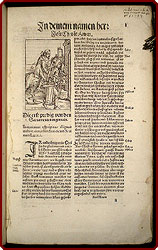
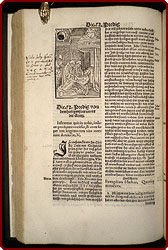 Click the images for enlargements.
 Present here are 76 sermons, being vol. 4 of Eck's Christliche Auslegung der Evangelien. The volumes were all issued separately over the course of several years, by different publishers, and all are treated as stand-alone productions by VD16 and all bibliographies as well as library catalogues.
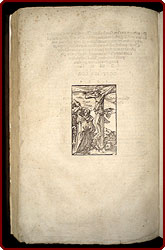
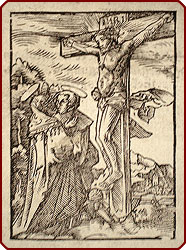
Provenance: Ownership signature of Joannes Bintengerber (1579); unidentified 16th- or early 17th-century ownership mark in ink on top edge of volume (resembling a brand mark); Howard Osgood (late 19th-, early 20th-century collector and Baptist minister and teacher); later in collection of Colgate Rochester Crozer Divinity School (deaccessioned, with their old circular pressure-stamp partially discernable on title-page).
Evidence of readership: Scattered marginalia (e.g. 68r, 96v, 97r, 120r, 137r, 140v, 155v), usually short but not always.
Rare: Via OCLC and NUC Pre-1956 we trace only 4 copies in U.S. libraries.
• VD16 E288. Full modern calf old style: Round spine with raised bands, accented with gilt rules; red leather title label; rules in blind extending onto covers from each band to terminate in trefoils with blind double fillets beyond. Title-leaf with repairs to foremargin and to small losses in five places at or within the borders; same instances affect four places in the text on the verso. Foremargins of some other early and late leaves a little tattered and irregular, with some repair; endpapers soiled and one other leaf soiled in outer margin; leaf A6 repaired in inner margin. Pin-hole type worming, not serious, in the text at times; waterstain in inner margin of some leaves; outer corners, especially upper ones, bumped/creased in first part. Ownership inscriptions and marginalia as noted. Despite flaws that must be recounted, a sound and handsome book. (25415)
Will Eck & Zwingli Square Off? Eck, Johannes. Ein Sentbrieue an ein frum Eidgnoszschafft betreffendt die ketzerische disputation Frantz Kolben des aussgeloffen m[ue]nchs vnnd B. Hallers des verlognen predicanten zü Bern. Ein annderer brieue an Vlrich Zwingli. Der drit brieue an Cunrat Rotenacker zu Vlm. [Ingolstadt: Georg and Peter Apian, 1528]. Small 4to (20 cm; 7.75"). [4] ff.
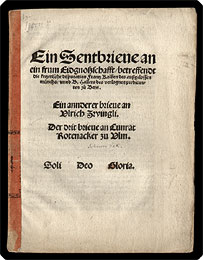 Click the image for an enlargement.
 Schrodt and Vogelstein offer a different summary: “The letters refer to an invitation sent to Eck by Zwingli, Haller and Kolbe, all of them evangelical preachers, to participate in a religious disputation scheduled to take place in Bern. The first letter, addressed to the confederation, explains courteously enough that he, Eck, does not intend to follow the call of the three proven heretics individually, a call not issued by the civic authorities. Not that he is afraid of their arguments; but he insists on an authoritative invitation and presence.
The other letters are framed in very aggressive and personally offensive language but carry the same message. Eck challenges the evangelical disputants to appear with him before any of the Catholic potentates, spiritual or secular, or any of the great (Catholic) universities, and he would shatter their heretical arguments.”
This pamphlet is type-signed, “Johan. Eck. inquisitor.”
WorldCat locatesonly one copy in North America and one in Great Britain; COPAC locates an additional one in Britain.
• VD16 E422; Kuczynski 650; Hohenemser 3352; Pegg, Swiss Libraries, 1496; Schrodt & Vogelstein 64. Removed from a nonce volume. Spine with a reinforcing strip of 19th-century German scrap paper. Title lightly dust-soiled and evidence of old erased pencilling. A clean, good copy. (25964)
Verses
for Morning
& EveningGerman
Americans
(Eckartshausen, Karl von). Witschel,
Johann Heinrich W. Gott ist die reinste Liebe, oder
Morgen- und Abend-Opfer, in Gebeten, Betrachtungen und Gesängen. Ein Gemeinschaftliches
Gebet-Buch, Bestehend in Auszügen aus Witschels und Eckartshausen Gebätbüchern.
Reading: Carl M'Williams & Co. (pr. by Carl
A. Brudman), 1822. 12mo (17.8 cm, 7"). 300
pp. 
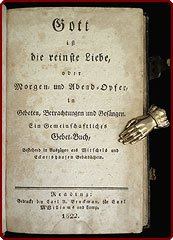 Click
the images for enlargements.
Click
the images for enlargements.
• Shoemaker 8591; First Century of German Language Printing in the U.S., 2565. Contemporary sheep framed in blind, spine with blind-ruled raised bands, abraded but solid. One clasp lacking, one present and working. Moderate foxing; one sectional title with pencilled annotations. Clearly a volume that saw both use and reasonable care. Plain, and pleasing.
Two Works of theCatholic Reformation Eisengrein, Martin. Sechsz Christlicher Leichpredigen. Wie man die Verstorbne glaubigen klagen, Auch Christlich vnd ehrlich zu der Erden bestatten solle. Vnd Ob den Verstorbnen mit Betten, Vigilien, Seelmessen, vnnd andern Caeremonien, ... geholfen seye. Es wirdt auch ... Vom Fegfevr ... ein Bericht gegeben [with another, as below]. [colophon: Gedruckt zu Ingolstat: Durch Alexander und Samuel Weissenhorn gebruder], 1564. [with the same author's] Ein Christliche predig Was vom Heilthumb, so im Papstum[m], in so grossen ehren, zühalten sey. Vnd Ob ain frommer Christ mit güttem gewissen, züdisem oder jänem Heiligen walfarten gehen künde. Zü Jngolstatt in der Pfarrkirchen bey S. Mauritz gepredigt, Durch Martinum Eisengrein, der heiligen Schrifft Licentiatum vnd Probst zü Moßpurg. Gedruckt zu Ingolstatt: Durch Alexander und Samuel Weissenhorn, 1564. 4to (20.5 cm; 8.25"). XL ff. 4to (20.5 cm; 8.25"). [8], XC ff.
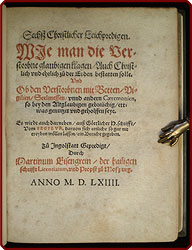
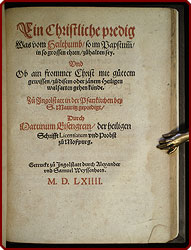 Click the images for enlargements.
 The present two works of preachings are scarce in the U.S., with only two institutions reporting ownership of Sechsz Christlicher Leichpredigen (one copy now deaccessioned) and only one reporting ownership of Ein Christliche predig (that copy also deaccessioned). The Sechsz Christlicher Leichpredigen ends with a two and a half pagepoem by the Dutch humanist and poet Hannard Gamerius, Eisengrein’s colleague at Ingolstadt, where Gamerius taught Greek.
Each work has its title-page printed in red and black; the printing throughout is neat and typical.
• Sechsz: VD16 E817; Index Aurel. 159.363. Ein: VD16 E789; Index Aurel. 159.362. Full dark modern calf old style, with simple blind double fillets bordering covers and a chain rule as vertical accent towards spine; spine without labels and with gilt-touched raised bands accented by blind rules extending onto covers to terminate in trefoils. Text unmarked; light overall age-toning. (26143)
For German-American Children — Learn YourFRAKTUR Letters! Erstes Lesebuch für Kinder. Neu-York: Amerikanischen Tractat-Gesellschaft, [ca. 1850]. 16mo. Frontis. (incl. in pagination), 160 pp.; illus.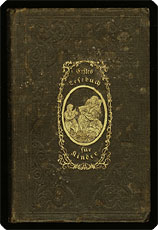
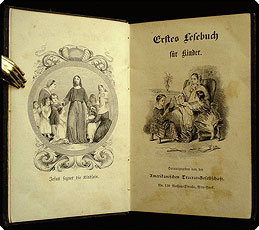
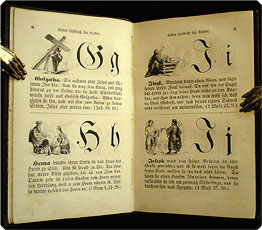 Click the interior images for enlargements.
 The title-page wood engraving is signed “Whitney” — possibly Elias James Whitney.
• Publisher's brown cloth, front cover with gilt-stamped pictorial vignette in blind-stamped frame; cloth with spots of discoloration, corners and spine extremities a little rubbed. Light to moderate foxing/spotting. Charming.
(23911)
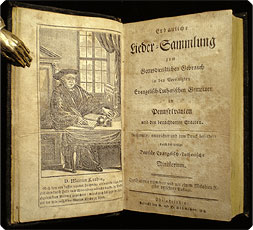
German-AmericanHymnalEvangelical Lutheran Ministerium of Pennsylvania and the Adjacent States. Erbauliche Lieder-Sammlung zum Gottesdienstlichen Gebrauch in den vereinigten Evangelisch-Lutherischen Gemeinen in Pennsylvanien und den benachbarten Staaten. Philadelphia: gedruckt bey G. und D. Billmeyer, 1814. 12mo (17.2 cm, 7"). Frontis., [11] ff., 626 pp., [5] ff. [bound with] Helmuth, Justus Henry Christian. Kurze Andachten einer Gottsuchenden Seele, auf alle Tage der Woche und andere Umstände eingerichtet. Philadelphia: G. & D. Billmeyer, 1814. 12mo (17.2 cm, 7"). 26 pp.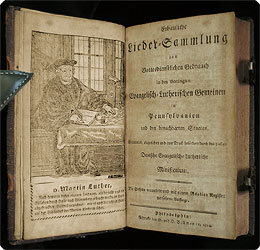
 which differs from that below (look at the windows), is printed in two columns in fraktur type; it contains the texts of the hymns only, no music. The work was first published in 1786, with a number of subsequent editions. Helmuth's Kurze Andachten, a short collection of morning, evening, and other occasional prayers, was issued with this edition of the hymnal and is usually, as here, bound in at the end.
Click the images for enlargements.
which differs from that below (look at the windows), is printed in two columns in fraktur type; it contains the texts of the hymns only, no music. The work was first published in 1786, with a number of subsequent editions. Helmuth's Kurze Andachten, a short collection of morning, evening, and other occasional prayers, was issued with this edition of the hymnal and is usually, as here, bound in at the end.
Click the images for enlargements. • Hymnal: Shaw & Shoemaker 31426; Arndt, The First Century of German Language Printing in the United States of America, 2032. Kurze Andachten: Shaw & Shoemaker 31686; Arndt, The First Century of German Language Printing in the United States of America, 2034. Contemporary sheep over wooden boards withworking brass clasps, abraded; spine with raised bands and later spine labels. Leather of top spine compartment damaged with loss of leather; front joint abraded and starting. Spots of browning throughout as usual in German imprints of this period, not worse and indeed better than is often the case. (26967)
Billmeyer-PrintedGerman Lutheran Hymnal Evangelical Lutheran Ministerium of Pennsylvania and the Adjacent States. Erbauliche Lieder-Sammlung zum Gottesdienstlichen Gebrauch in den vereinigten Evangelisch-Lutherischen Gemeinen in Pennsylvanien und den benachbarten Staaten. Philadelphia: G. & D. Billmeyer, 1818. 12mo (14.7 cm, 5.75"). Frontis., [22], 463, [9 (index)] pp. [with] Helmuth, Justus Henry Christian. Kurze Andachten einer Gottsuchenden Seele, auf alle Tage der Woche und andere Umstände eingerichtet. Philadelphia: G. & D. Billmeyer, 1818. 12mo. 26 pp.
• Hymnal: Shaw & Shoemaker 43969 ( = 43951); Arndt, The First Century of German Language Printing in the United States of America, 2286. Kurze Andachten: Shaw & Shoemaker 44299; Arndt 2288. Contemporary black roan in imitation of straight-grain morocco, spine with gilt-stamped leather title-label; binding with minor scuffing, spine with faintly visible scuff from now-absent shelving label. Front pastedown institutionally rubber-stamped; back pastedown with Pennsylvania bookseller's small ticket. Expectable spots of browning throughout as usual in German imprints of this period. A few page corners dog-eared. (24426)
For GERMAN AMERICANA,

 TO Part
II . . . TO Part
II . . . |