 CHILDREN
• EDUCATIONCHILDREN
• EDUCATION
CHILDREN
• EDUCATIONCHILDREN
• EDUCATION Saving the Souls of the Rich via
 CHARITY
  Nelson, Robert. An address to persons of quality and estate ... To which is added, an appendix of some original and valuable papers. [with another related title, as below]. London: A. & G. Way, prs., 1715. 8vo (21.9 cm, 8.6"). Frontis., xxxi, [1], 267, [1], 55, [7] pp. [with] A poem in memory of Robert Nelson Esquire. London: Pr. by Geo. James for Richard Smith, at Bishop Beveridge’s-Head, 1715. 8vo. 21, [3] pp.

 seminaries
and schools, relieving prisoners, and establishing houses
for the improvement of ladies (both proper and fallen). The appendix provides
texts of various proposals as well as statistics on numbers of residents in
hospitals and schools.
seminaries
and schools, relieving prisoners, and establishing houses
for the improvement of ladies (both proper and fallen). The appendix provides
texts of various proposals as well as statistics on numbers of residents in
hospitals and schools.
 Click
the images for enlargements.
Click
the images for enlargements.
The frontispiece portrait of Nelson was engraved by George Vertue after a painting by Sir Godfrey Kneller. The volume also includes all publisher's advertisements as well as the rather uncommon Poem in Memory of Robert Nelson Esquire.
 This
was produced to be a handsome work, printed in large type on good paper with
wide margins — the better to appeal to a “quality” audience?
This
was produced to be a handsome work, printed in large type on good paper with
wide margins — the better to appeal to a “quality” audience?
• ESTC T85360; Goldsmiths’-Kress 5249. Poem: ESTC T25431; Foxon P538. Contemporary speckled calf, framed and panelled in blind with blind-tooled corner fleurons; rebacked with speckled calf, spine with gilt-stamped leather title-label, raised bands, and blind-tooled foliate compartment decorations. Original leather abraded, front cover with small chip to outer edge and area of faint discoloration from a now-absent label; title-page institutionally rubber-stamped (no other markings). Some signatures browned and foxed, most pages clean. (25999)
Stories
Pictures
Interesting
Ads! The new fishing smack;
or, perserverence and determination. With coloured frontispiece. London: Frederick
Warne & Co.; New York: Scribner, Welford, and Armstrong, [ca. 1870]. 24mo. [2
(1 blank)], frontis., engraved t.-p., [1], 5-92, [4] pp.; illus. 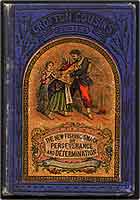
• Publisher's blue cloth, stamped in black and gold; with a full-color illustration on-lay on front cover. Spine rubbed and with a tiny bit of cloth loss at both ends. Rubber stamp of St. John's Episcopal Church, Glenwood, Iowa and pencilled inscription on front pastedown. Small chip out of one corner of pp. 7-8. Frontispiece loose. In mylar covering. Binding sound, overall good +. (4670)

 Multiply
 IN YOUR HEAD by 27 . . . Orton, Hoy D. Orton's lightning calculator, and accountant's assistant. The shortest, simplest, and most rapid method of computing numbers, adapted to every kind of business, and within the comprehension of every one having the slightest knowledge of figures. Shelby, Ohio: H.D. Orton, ©1866. 12mo. vi, [9]–194 pp.

 “Energy is the price of success.” “Address all orders for this book to H.D. Orton, Shelby, O. Single copies by mail, One Dollar. For sale by all Booksellers.”
• Publisher's brown cloth shelf-back with printed paper on the boards; small rent in cloth. Very nice copy. (26558)

 Christmas
Nights' Entertainments!
(um, “Shop Early”?)
Palafox, Juan de. Christmas nights' entertainments; or, the pastor's visit to the science of salvation. New York: P.J. Kennedy, 1893. 12mo. Frontis., 194 pp., [4] ff. (ads.).
Christmas
Nights' Entertainments!
(um, “Shop Early”?)
Palafox, Juan de. Christmas nights' entertainments; or, the pastor's visit to the science of salvation. New York: P.J. Kennedy, 1893. 12mo. Frontis., 194 pp., [4] ff. (ads.).
 Click either image for an enlargement.
 Binding: Publisher's brick red cloth, elaborately stamped in black and bold on front cover (“Catholic Presentation Library”) and spine; stamped in blind on rear cover.
Prize book / Provenance: In manuscript on a slip of paper attached to the front free endpaper, “Premium / awarded to / Master Frank Von Au / for / Regular Attendance. / June 30, 1898.”
• Bound as above, cloth of front joint starting to open; bright and fresh. Presentation slip as above, and presentee's name also rubber-stamped on front fly-leaf. Light foxing to guard tissue between frontispiece and title-page; offsetting to these, therefrom. A clean, nice copy. (25786)

 Design Manual, Used by aFemale Philadelphia Art Student? Peale, Rembrandt. Graphics, the art of accurate delineation; a system of school exercise, for the education of the eye and the training of the hand, as auxiliary to writing, geography, and drawing. Philadelphia: E.C. & J. Biddle, 1853. 8vo (18.7 cm, 7.4"). [6 (adv.)], xvii, [1], 22, [2], 27–132 pp.; 41 plts.

 Click the images for enlargements. 41 plates depicting various aspects of line production and calligraphy.


• Contemporary quarter black sheep with black ribbed cloth–covered sides, spine with gilt-stamped title; spine much rubbed, corners and edges far less so. Front pastedown with inscription as above. Pages and plates clean. (27050)
 Rauschenbusch
Family
Provenance
Peirce, James. An essay in favour of the ancient practice of
giving the Eucharist to children. London: J. Noon & J. Gray, 1728. 8vo. viii, 183, [1] pp.
Rauschenbusch
Family
Provenance
Peirce, James. An essay in favour of the ancient practice of
giving the Eucharist to children. London: J. Noon & J. Gray, 1728. 8vo. viii, 183, [1] pp.
 Click the interior image for an enlargement.
 Provenance: Ownership signature on the front fly-leaf of August Rauschenbusch, father of Walter Rauschenbusch, a key figure in the Social Gospel movement in the U.S. Before it was given to the Rochester Theological Seminary (whence it was deaccessioned), this would have been one of the books in the Rauschenbusch home library for Walter's perusal.
• ESTC T110135. Contemporary calf, framed and panelled in blind with blind-tooled corner fleurons in the Cambridge style; spine with a bit of leather lost at bottom and old paper author/title labels. Ex-library, with title-page pressure-stamped (but not rubber-stamped); shadow of old pencilled call number on back of title-page and five-digit inked number to first leaf of preface. Joints (outside) expertly repaired. Some light foxing and an old blot to one leaf; otherwise, a nice clean old book. (24168)
“A
Grind on a [YALE]
Tutor”
(One Wise-Guy
Mexican
ELI)
Peña, Auxcencio Maria. Long Tom's pilgrimage. [New Haven, CT: 1829]. Folio (28.6 cm, 11.25"). [1] f.
Wise-Guy
Mexican
ELI)
Peña, Auxcencio Maria. Long Tom's pilgrimage. [New Haven, CT: 1829]. Folio (28.6 cm, 11.25"). [1] f.

Click the image for an enlargement. An issue of the New Haven Journal Courier from December of 1890 recounts the following story of the broadside's origin and subsequent fate: “The late Charles Harvey Townshend, Esq., of New Haven about the year 1880 met Mr. Robert Livingston of New York while crossing the Atlantic. One day while Mr. Livingston was telling him of his experiences while a Yale student, he asked him, if he ever had the chance, to look in the front middle room, fourth story, north entry of old South Middle College, between the ceiling over the wood closet door. He said that in 1829 he placed there a bundle of printed sheets of 'doggerel verse,' a grind on a tutor of those days. These verses were recited by the composer, Peña, a Mexican (who was afterwards expelled) in the college chapel, on a Wednesday afternoon. Most of the class was expelled afterwards, for various reasons, and Mr. Livingston, who was one of them, said that his father always told him that he did perfectly right in not telling who wrote the verses (our emphasis). A fir [sic] broke out in Old South Middle in December 1890, and Mr. Townshend, with the permission of the then occupants of the room, searched the ceiling of the front middle room in accordance with Mr. Livingstons [sic] directions. He found there the bundle of verse, just as Mr. Livingston described.”
Uncommon: OCLC and NUC Pre-1956 report five U.S. locations, with Yale (predictably) holding several copies.
• American Imprints 39988. As issued (not showing signs of having been bound); creased once horizontally, upper edge darkened, four or five tiny spots of foxing in the lower left portion. A very nice copy of this scarce ephemeral piece. (24643)
Manuscript Notes: The State of Theology in Upland, 1871 Pepper, George Dana Boardman. Manuscript on paper, in English. “Outlines of Theology.” [Upland, PA]: 1871. 4to (20.7 cm, 8.1"). [10] pp., 276, [23 (blank)] ff. (pagination skips 38).

 Click the images for enlargements.


Chapbook
Prayer Book — GRACES
A
prayer book for families and private persons, upon various subjects
and occasions; in which all the prayers are so arranged, that when any one is
too long to be used without inconvenience, it may be shortened by leaving out
some of the paragraphs: and this may be done without injury to the connection.
To which are added, graces for young persons. Glasgow: Pr. for the booksellers,
[1850?]. 12mo. 24 pp. 
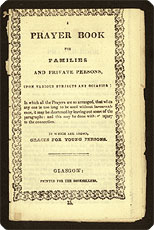
• NSTC 2P24752. Removed from a nonce volume. Title-page cropped close to the border along the top edge and the spine; second leaf with outer edge chipped. (16771)
Illustrated
Primer — “do
not lash the cat” — Philadelphia,
ca. 1860
Pretty
stories in easy words. Philadelphia: Davis, Porter & Co.,
[ca. 1860]. 16mo (13.3 cm, 5.25"). [2], 13–18 pp.; illus.

 Click the images for enlargements.
 Uncommon: OCLC and NUC Pre-1956 locate only four holdings, all in the U.S.
• Publisher's printed paper wrappers, front wrapper with early inked inscription in upper portion; paper just starting at foot of spine. Age-toned, otherwise clean and fresh. (25501)
From aSuccessful & Insightful Indian Civil ServantPrinsep, Henry Thoby. The India question in 1853. London: William H. Allen & Co., 1853. 8vo (19.6 cm, 7.75"). [2], 111, [1 (blank)] pp.
 • Parliament reviewed the management of the East India Company every 20 years beginning in 1773. At the time of the 1853 review the number of directors of the East India company was reduced, one of those retained being Henry Prinsep (1793–1878), an able and successful Indian civil servant and member of the Council of India. He here gives his insights on a wide range
of issues, from education and the press to finance, the administration of justice, and how best to govern the country.
• Parliament reviewed the management of the East India Company every 20 years beginning in 1773. At the time of the 1853 review the number of directors of the East India company was reduced, one of those retained being Henry Prinsep (1793–1878), an able and successful Indian civil servant and member of the Council of India. He here gives his insights on a wide range
of issues, from education and the press to finance, the administration of justice, and how best to govern the country.
• NSTC 2P27024. On Prinsep, see: DNB. Removed from a nonce volume. Lightly age-toned. Traces of soiling and small inked numeral on title-page. A few instances of pencilled sidelining.
Dutch PrizePropertius, Sextus. Sex. Aurelii Propertii elegiarum libri IV. Trajecti ad Rhenum: Barth. Wild, 1780. 4to (26.3 cm, 10.4"). [10], xiv, [2], 990 (i.e., 996; pagination repeats 627–32), [2] pp. 


Binding/Provenance: Prize binding of contemporary vellum, covers framed and panelled in gilt rolls with gilt-stamped corner fleurons and gilt central vignette with the crest of the city of Amsterdam, spine with gilt-ruled raised bands and gilt-stamped decorations in compartments. The partially printed, partially inscribed, bound-in prize certificate reads “Ingenuo magnaeque spei adolescenti, Henrico Gerteler propter insignes in artibus humanioribus progessus, in classe tertia . . . Quod testor R. v. Ommeren [/] Gymnasii publici Amstelaedamensis Rector,” dated 1791.
• Brunet, IV, 905; Dibdin, I, 385–86; Graesse, V, 460; Sandys, II, 455; Schweiger, II, 831. Binding as above, vellum slightly darkened, lacking ties; spine with gilt dimmed and traces of a now-absent label and inked call number at foot of spine. Lower edges with institutional rubber-stamp; title-page with shadow of a pencilled numeral. Front free endpaper with paper adhesions from a now-absent bookplate; back pastedown with rubber-stamp and small adhesion. Pages clean save for offsetting to upper margins of a few, from a laid-in slip.
A Medieval BoyhoodPyle, Howard. Otto of the silver hand. New York: Looking Glass Library, n.d.. 8vo. [2 (1 blank)], frontis., [2], vii–xiii, [1 (blank)], 175, [3 (blank)] pp.; 25 plts. 

• Publisher's green paper boards. Light wear to edges, small paper loss to head of spine and back cover. Light wear to edges; bits of paper loss to spine, and dime-sized loss at back cover. Pages clean and crisp, binding tight. (5867)

The Choir Master’s Nephew’s Widow Gets
the (that’s, HER!) ChildrenRamírez Carrillo, Alonso. Two documents. In Spanish, on paper. Peñafiel, Spain, 2 May 1592. Folio. [14] pp., [50] pp.
Gets
the (that’s, HER!) ChildrenRamírez Carrillo, Alonso. Two documents. In Spanish, on paper. Peñafiel, Spain, 2 May 1592. Folio. [14] pp., [50] pp.

Click the image to the left • Written in a clear notarial hand, but with bleed-through in the inventory, making reading slightly challenging — not, impossible. Very good condition.
“Patty
Horner obey'd, &
pleas'd
LENT HER AID . . .”
The
renowned history of little Jack Horner. Illustrated with
sixteen elegant copper-plates. [London: William Darton, 1826]. Square 16mo (12.5
cm; 5"). 16 ff.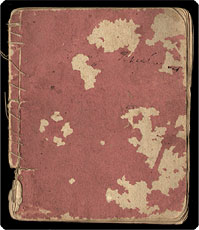
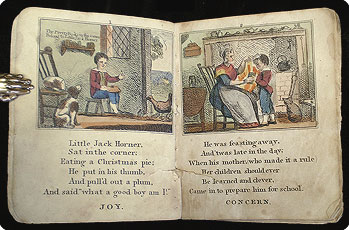
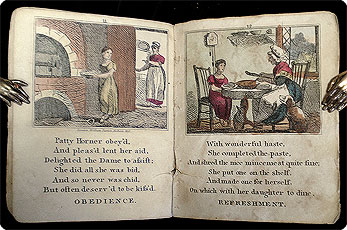 Click the images for enlargements.
 In this edition all leaves are engraved on one side of leaf only, the engraved pages facing each other: each top half is filled with a hand-colored copper engraving with engraved text below. “The first stanza of this is the traditional nursery rhyme Little Jack Horner. The rest of the text varies considerably from the ballad usually appended to this nursery rhyme. Each stanza is labelled at foot with the activity or quality it represents: Joy, Concern, Prudence, Distress, Benevolence, Hope, Compassion, Gratitude, Reward, Industry, Obedience, Refreshment, Surprise, Encouragement, Affection, Liberality” (UCLA cataloguer).
Provenance: Signature of Henry Wheelwright inside front cover (and on it, though rubbed much away); ownership note of “Mary E. Basto 4 (or possibly 9) Yrs” to front free endpaper, with pencilled reiteration of that and the date 1844.
• Cf. Osborne catalogue, I, 98; Cf. Opie N790. Contemporary
or near contemporary reddish wrappers with later oversewing. Lower inner margins
of all leaves torn, sometimes into text. Portion of folio 3 missing, costing
three words (knowable from the rhyme scheme) and touching two others with
resultant loss of four letters.  For a children's book whose edition was clearly read
to death, this is far better than a good copy. (26014)
For a children's book whose edition was clearly read
to death, this is far better than a good copy. (26014)
Armstrong–Christy Production Riley, James Whitcomb. Out to Old Aunt May's. Indianapolis: The Bobbs-Merrill Co., (copyright 1904). Frontis., [50] pp; 20 plts. • First legitimate published edition of the extended version of this poem (a briefer version appeared in the periodical Afterwhiles in 1888, and an earlier book-form printing was for copyright purposes only according to BAL). This is the first printing, matching the points described by BAL, in binding state A.
This nostalgic evocation of the exploits of two young boys at their aunt's countryside house is illustrated with 20 full-page plates and numerous smaller “studies from nature” by Howard Chandler Christy. Margaret Armstrong designed the binding, including the floral framing decorations and the endpapers are signed with her “MA.”
• BAL 16667; Gullans, A checklist of trade bindings by M. Armstrong. Publisher's green cloth, front cover with gilt-stamped title and white-stamped decorative frame around an affixed half-tone portrait, spine decoratively stamped in gilt and white; corners and spine extremities very slightly rubbed, back cover with small adhesion, binding otherwise clean and beautiful. Sewing loosening a bit; this is heavy paper. (24864)
Scots Antiquarianism — ILLUSTRATED Ritson, Joseph, ed. The Caledonian muse: A chronological
selection of Scotish poetry from the earliest times. London: Robert Triphook, 1821. 8vo. Frontis., iv, 232 pp.

 Click the images for enlargements. nursery
rhymes, Robin Hoodiana, English songs and ballads, and
English and Scottish poems. Shortly before the present work was supposed to
be published in 1785, a fire destroyed part of the printer's warehouse and the
manuscript of Ritson's introductory essay; the surviving sheets, printed in
octavo with horizontal chain lines, make their first appearance here with a
new introduction. The poems are illustrated with vignettes engraved by Heath
after Stothard's designs, and with small woodcuts by Bewick. The frontispiece
is an engraved silhouette portrait of Ritson.
Click the images for enlargements. nursery
rhymes, Robin Hoodiana, English songs and ballads, and
English and Scottish poems. Shortly before the present work was supposed to
be published in 1785, a fire destroyed part of the printer's warehouse and the
manuscript of Ritson's introductory essay; the surviving sheets, printed in
octavo with horizontal chain lines, make their first appearance here with a
new introduction. The poems are illustrated with vignettes engraved by Heath
after Stothard's designs, and with small woodcuts by Bewick. The frontispiece
is an engraved silhouette portrait of Ritson.
• NSTC 2R11677; Lowndes 2099; Hugo, The Bewick Collector, 434. Contemporary half dark green morocco with red marbled paper sides, spine with gilt-stamped title; some rubbing and with a bit of green discoloration to paper of front cover. Minor offsetting to frontispiece and title-page; mild to moderate foxing in first third of volume and to last few pages. (21934)
“Dr Franklin” — Illustrated Robinson, David F. Stories about Dr. Franklin, designed for the instruction and amusement of children. Hartford: D.F. Robinson & Co. (pr. by P. Canfield), 1829. 16mo (13.1 cm, 5.25"). 69, [3] pp.; illus.
 Click the image at right for an enlargement.
 • Shoemaker 40547. Not in Rosenbach, Early American Children's Books. Publisher's printed yellow paper wrappers, front wrapper lacking, back wrapper stained with edges nicked, spine overstitched at a later date. Moderate spotting and staining to pages; corners bumped. Slightly tattered: first few leaves with short tear from outer margin, not touching text; title-page and subsequent two leaves with short tear from inner margin, extending into text without loss. (24545)
 Inspiration,
“Biblology,”
Attributes,
Angels
Robinson, Ezekiel
Gilman. Manuscript on paper, in English. “Christian theology
by E.G. Robinson, D.D. Vol. I & Vol. II.” Rochester, NY: 1868–69.
8vo (20.3 cm, 8"). 2 vols. I: [4], 316 pp. II: [4], 315, [1] pp.
Inspiration,
“Biblology,”
Attributes,
Angels
Robinson, Ezekiel
Gilman. Manuscript on paper, in English. “Christian theology
by E.G. Robinson, D.D. Vol. I & Vol. II.” Rochester, NY: 1868–69.
8vo (20.3 cm, 8"). 2 vols. I: [4], 316 pp. II: [4], 315, [1] pp.


 Click the images for enlargements.
 The final section of the first volume and first section of the second volume here are on angels; the second has also an interesting section on the "Salvation of Infants." The preface to the printed text notes that “however [readers] may value this book, the printed page can only imperfectly indicate the power of the living teacher,” and it is fair to feel closer to that teacher via these volumes.
• Original half sheep and textured paper–covered sides, spines with gilt-ruled compartments; bindings rubbed overall, front cover of vol. I detached, spines sunned and with remnants of paper shelving labels. All edges marbled. Front free endpapers with early inked ownership inscription. Pages clean. (26318)
The Boy’s Book ofGoldRoquette, José. Livro d'ouro dos meninos para servir d’introducção ao thesouro da adolescencia e da juventude. Pariz: [Typ. A. Parent] Va. J.-P. Aillaud, Guillard & Ca., [1867]. 18mo (15.3 cm, 6"). 288 pp.; 4 plts. 
 four chromolithographed plates showing (1) the Livro d’ouro being read by a father to his family, (2) Abraham’s sacrifice, (3) Moses being found among the bulrushes, and (4) “The Turtledove” with Inez and her parents on the walls of their castle.
José-Ignacio Roquette (1801–70), a Franciscan friar and professor at the patriarchal seminary in Lisbon, also wrote a History of the Discovery of America and works on natural history and philology. First published in 1844, this is the fifth edition of this rare work: We were unable to trace any copies via NUC Pre-1956, OCLC, or RLIN.
Single-click the chromo, for an enlargement. • Contemporary mottled calf, spine handsomely gilt with floral devices and with a gilt-lettered red leather label; scratched and abraded with some loss on edges and corners. Marbled endpapers, a little rubbed. Light foxing and some spots of light soiling; a few tears in margins of pages and plates. A book apparently used by members of its intended audience, though not put through truly gruesome maltreatment.
21
Engravings The rose-bud;
or poetic garland of unfading flowers. Embellished with
numerous engravings. New Haven: S. Babcock, n.d. [1841]. 16mo (14.8 cm, 5.9").
24 pp.; illus. 
• Sewn; in original printed wrappers. Front cover illustrated with scenes of children playing. Publisher's advertisement on back cover. Foxed. Numerous chips and short tears, limited to margins; one long tear (1.5") to pp.15 and 16, intruding upon text and engraving. One corner of back cover chipped. A child has colored most of the engravings. A somewhat worn copy. (4845)
Father ofPediatric Medicine Rosén von Rosenstein, Nils. Des Herrn Nils Rosén von Rosenstein ... Anweisung zur Kenntniss und Cur der Kinderkrankheiten. Göttingen und Gotha : Bey Johann Christian Dieterich, 1768. 8vo (17.7 cm; 7"). [8] ff., 541 (i.e., 539 ), [1] pp., [7] ff.
 Click the interior image for an enlargement.
 Garrison and Morton say of the first edition in English: “Sir Frederick Still considered this work 'the most progressive which had yet been written;' it gave an impetus to research which influenced the future course of paediatrics.”
Translator Murray (1740–91) was a Swedish student of Linnaeus and later a professor of botany and medicine at Göttingen.
Provenance: Bookplate of Adamus Elias Schmidt, dated 1784. Early 19th-century signature of a Philadelphia doctor (erased) at top of title-page.
• G&M 6323. Contemporary half calf, well worn: leather dry and gone to red with joint leather lost, cords holding, paper of covers worn through to boards in some places. Text with age-toning. Not a pretty copy but complete, and solid for now. Housed in a red cloth clamshell case. (22256)
 TO Part
VI . . . TO Part
VI . . . |