 AMERICANA
AFTER 1820
AMERICANA
AFTER 1820
AMERICANA
AFTER 1820
AMERICANA
AFTER 1820
 Life on the
 American Frontier
  Clavers, Mary [pseud. of Caroline M. Kirkland]. A new home — who'll follow? Or, glimpses of western life. New York: C.S. Francis; Boston: J.H. Francis, 1839. 12mo (17.5 cm, 6.9"). 317, [1 (blank)] pp. (lacking 2 final adv. pp.).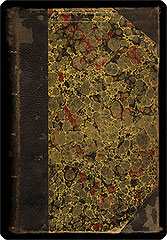
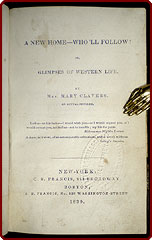
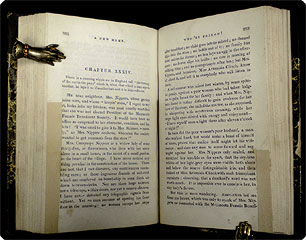
 Click the images for enlargements.
  This copy includes the half-title, but has been well read and shows the signs thereof!
• BAL 11139; Howes K184; Sabin 37991; Wright, I, 1583. Contemporary half sheep and marbled paper–covered sides, spine with gilt-stamped title and author; leather worn/rubbed, especially at head of spine, but text firm in its binding. Front pastedown with Philadelphia bookbinder's ticket of B. Kohler (printed on blue paper). Ex–social club library: 19th-century inked call numerals on endpaper and half-title overlaid with paper labels, title-page pressure-stamped, no other markings. Pages age-toned, with intermittent stains and short edge tears; many leaves with edge repairs done some time ago, often with loss of a few letters, generally not affecting sense. Two final pages of advertisements lacking; one leaf with upper outer portion torn away, costing parts of 12 lines; two leaves with lower portions torn away, with loss of about 14 lines to each. Last leaves with waterstaining to outer portions.  Clearly, as noted above, the club library that owned this had avid clientele for it; and that they were as determined to “keep it going” as the repairs show, even after it had been damaged, is interesting! (26386)

 "THE
PATRIOTIC
DEAD" [Collins, William T., & Hanson
E. Weaver]. Broadside.
Begins: "Headquarters Grand Army of the Republic, Adjutant General's Office, 411
F Street" Washington, 1870. 12mo (20.3 cm, 8"). [1] f.
"THE
PATRIOTIC
DEAD" [Collins, William T., & Hanson
E. Weaver]. Broadside.
Begins: "Headquarters Grand Army of the Republic, Adjutant General's Office, 411
F Street" Washington, 1870. 12mo (20.3 cm, 8"). [1] f. 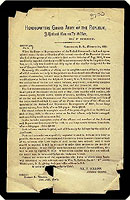
Single-click the image, for an enlargement.• One leaf, printed on one side and creased from folding into six parts. Top left and bottom right corners torn. Tear to lower margin resulting in the loss of one or two words of text. (6336)
For
an unillustrated, PDF-format list of (additional)

 GUIDE for Early Travellers to the
 American “WEST” Colton, Joseph H.; & John Calvin Smith. The western tourist and emigrant's guide; with a compendious gazetteer of the states of Ohio, Michigan, Indiana, Illinois, and Missouri, and the territories of Wisconsin and Iowa: being an accurate and concise description of each state, territory, and county, and an alphabetical arrangement of every city, town, post village or hamlet, the county in which situated, their distance from the capital of the state and from Washington city: also, describing all the principal stage routs [sic], canals, rail roads, and the distances between the towns: accompanied with a correct map, showing the lines of the United States' surveys, by J. Calvin Smith. New York: J.H. Colton, 1839. 12mo (15.5 cm; 6.125"). 180 pp.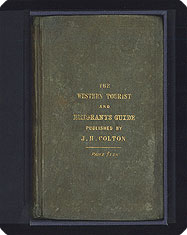
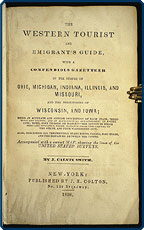
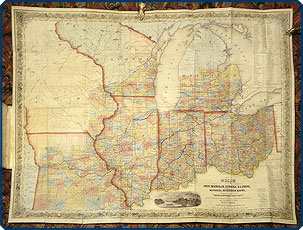 Click the images for enlargements.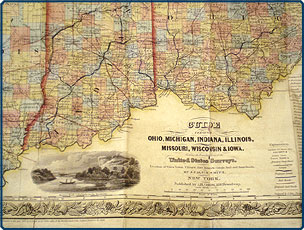
 If you were heading “West” in 1839 or the early 1840s, you probably had a copy of this to help you travel safely and expeditiously.
• Sabin 82931; Howes S-615; Checklist of printed maps of the Middle West to 1900 1-0816; Karpinski, Bibliography of the printed maps of Michigan, 146. Publisher's green ribbed cloth covers stamped in blind with a plaque and lettered in gold. Old water crinkling to text block and some associated soiling. Map backed with Tengoju Japanese paper and the case binding with minor repairs using Japanese paper toned with acrylic. A delicate book and a very delicate map, now not delicate at all and housed in a blue cloth clamshell case with leather spine label. A good ++ copy of an important and scarce work. (24796)

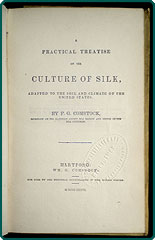
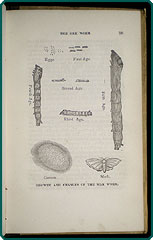
 An ExpertPromotes AMERICAN Sericulture — His Son Promotes His Business Comstock, Franklin G. A practical treatise on the culture of silk, adapted to the soil and climate of the United States. Hartford: Wm. G. Comstock, 1836. 12mo (19.1 cm, 7.5"). 108 pp.; illus.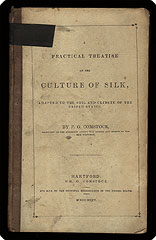
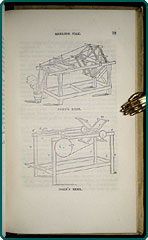 Click the images for enlargements.
 The advertisement on the back cover of this volume notes that William G. Comstock (the author's son and publisher) offered for sale 100,000 white Italian mulberry trees; 10,000 Chinese mulberry plants; and 2,000,000 “silk worms eggs,” among other items of sericulture.
• American Imprints 36859. Publisher's quarter brown cloth and printed paper–covered sides, moderately rubbed and soiled; spine sunned and a strip of black cloth tape across its head. Ex–social club library: 19th-century bookplate, call number on pastedown, front free endpaper with inked number covered over by black tape, pressure-stamp on title-page. No other markings. Pages clean. (26271)
WAR
Threatens
U.S.Constitutional
Rights — 1863
(Constitutional
Matters). Agnew, Daniel. Our national Constitution:
Its adaptation to a state of war or insurrection. Philadelphia: Pr. by C. Sherman,
Son & Co., 1863. 8vo. 39 pp. 
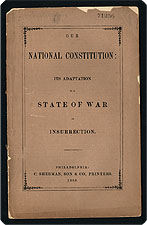
• Original printed wrappers; five-digit number stamped on front wrapper; some chipping; loss of paper from spine. (78)
A Journalist Reports from Virginia Cook, Joel. The siege of Richmond: A narrative of the military operations of Major-General George B. McClellan during the months of May and June, 1862. Philadelphia: George W. Childs, 1862. 12mo (19 cm, 7.5"). 358 pp.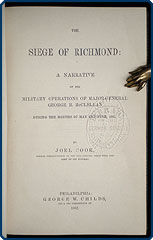
 Click the images for enlargements.
 • Sabin 16279. Publisher's textured teal cloth, spine with gilt-stamped title; sides and edges clean and showing virtually no wear, spine with head pulled, title dimmed, and small rubbed spots. Ex–social club library: number on endpaper in a good 19th-century hand, rubber- and pressure-stamp on title-page, several other pages faintly stamped. Front free endpaper lacking. A nice, clean, sound copy with its paper holding up beautifully. (26266)

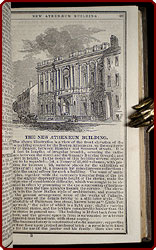
1850 inProsperous, Bustling Boston Coolidge & Wiley. The Boston almanac for the year 1850. Boston: B.B. Mussey & Co., & Thomas Groom (pr. by Coolidge & Wiley), [1849]. 12mo (13.9 cm, 6.45"). 211, [5] pp.; 1 map, illus.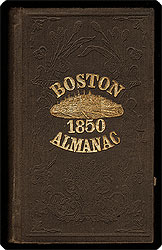
 Click the images for enlargements.
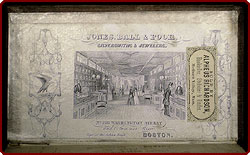
 Boston-area businesses with full-page advertisements in this publication include a silversmith/jeweler, an apothecary, an upholsterer, a pianoforte manufacturer, and an ink maker; also provided are both an extensive business directory and an index of the smaller in-text advertisements promoting local merchants.
Binding: Signed binding of brown straight-grained cloth, front cover gilt-stamped with vignette of the city and blind-stamped with two female figures representing Agriculture (holding a scythe) and Law and Order (holding scales), back cover similarly blind-stamped with central stamp of Benjamin Bradley & Co. bookbinders.
• Drake, Almanacs, 4446; Spawn & Kinsella, American
Signed Bindings, 56. Not in Phillips, List of Maps of America.
Binding as above, spine showing minimal wear; clean and beautiful.
Front pastedown with ticket of a Massachusetts bookseller. Endpapers with
offsetting; map age-toned with offsetting, outer edges slightly ragged; one
index page with chip to outer margin, with loss of a few letters. Pages lightly
age-toned. An excellent copy. (26684)
An
American Indian'sEuropean
Travel
Copway, George
(a.k.a. Kah-ge-ga-gah-bowh). Running sketches of men and places, in
England, France, Germany, Belgium, and Scotland. New York : J.C. Riker, 1851.
12mo (19 cm; 7.5"). Frontis., 346, [2 (ads)] pp., 4 plts.
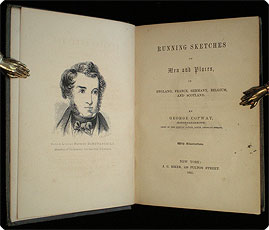
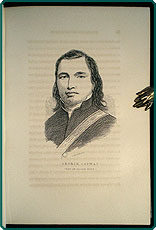 Click the interior images for enlargements.
 He was a talented speaker and a well-published writer. His autobiography, The life, history, and travels of Kah-ge-ga-gah-bowh (Philadelphia, 1847), went through several editions.
The present work is one of the first published European travel accounts from the pen of a Native American. He describes what he saw and whom he met (Disraeli, Baron de Rothschild, Lord John Russell, and others), as well as how he was received by the Europeans. The main purpose of the trip was to represent Christian American Indians at the 1850 General Peace Conference at Frankfurt am Main, where in full native attire he delivered a protracted and passionate antiwar speech.
An uncommon work.
Provenance: Bookplate of St. Catherine's Hall Library of the Sisters of the Blessed Sacrament, the American order founded by “Mother” Katharine Drexel. Daughter of one of her time's richest families, Drexel used much of her fortune in efforts on behalf of American Indians.
• Sabin 16721. Not in Pilling, Proof-sheets; not in Field. On Copway, see: Dictionary of Canadian Biography (online). Publisher's charcoal grey cloth elegantly stamped in blind on covers; gilt center device on each cover and gilt tooling and stamping on spine. Bookplate as above on front pastedown; neat white number on spine; no other markings. A very good copy. (25245)
PrudentNew England-Style DOMESTICITY Cornelius, Mrs. Mary Hooker. The young
housekeeper's friend; or, a guide to domestic economy and comfort. Boston: Charles Tappan;
New York: Saxton & Huntington, 1846. 12mo (18.2 cm, 7.2"). 190 pp.
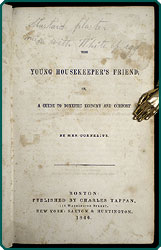
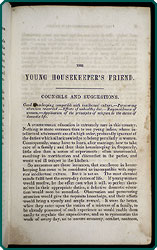 Click the images for enlargements.
 The endpapers bear several additional recipes pencilled in an early hand, including a “Cure for Felon.”
• American Imprints 46-1830; Bitting 100; Brown, Culinary Americana, 1491 (1860 ed.); Cagle & Stafford 187; Lowenstein 399. Publisher's quarter brown cloth and printed light green paper–covered sides; edges rubbed, sides lightly stained. Endpapers as above; title-page with early pencilled annotation in upper portion; foxing and staining, but no tears or tattering. In fact a good copy, the more interesting as showing it was used. (26685)
FIRST Edition In English Cortés, Hernán. The despatches of Hernando Cortés,the conqueror of Mexico, addressed to the emperor Charles V, written during the conquest, and containing a narrative of its events. New York: Wiley & Putnam, 1843. 12mo. xii, 431 pp.; ill.
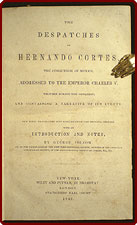
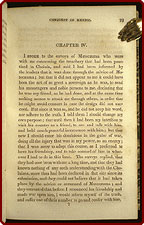
• Sabin 16964. Publisher's quarter cloth over marbled paper boards, lightly abraded; light foxing to interior. Private bookplate. Good+ copy. (20502)
San Francisco Cookery in a High-Flying Era Craig, John C., ed. The recipe book of
Lillie Hitchcock Coit. Introduction by Carol Hart Field. Berkeley, CA: The Friends of the Bancroft Library, University of California, Berkeley, 1998. 8vo. [2 (blank)], frontis., 5–65, [5 (3 blank)] pp.
High-Flying Era Craig, John C., ed. The recipe book of
Lillie Hitchcock Coit. Introduction by Carol Hart Field. Berkeley, CA: The Friends of the Bancroft Library, University of California, Berkeley, 1998. 8vo. [2 (blank)], frontis., 5–65, [5 (3 blank)] pp. 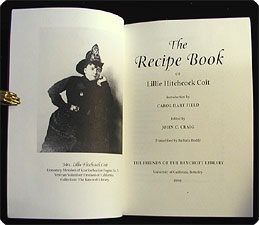
The recipes collected by Mrs. Coit reflect the “cosmopolitan character of San Francisco” during the 1870's and 1880's and show “the influence of the French, Spanish, Mexican, and English traditions in the cookery of the period.”
Illustrated with a frontispiece portrait and one additional illustration.
• Paperback. Fine. (5461)
By Fr. “Double Leaf/Fixed Star”Cuoq, Jean-André. Études philologiques sur quelques langues
sauvages de l’Amérique. Par N.O. Montréal: Dawson Brothers, 1866. 8vo (24.5 cm, 9.6"). 160 pp.
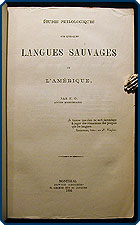
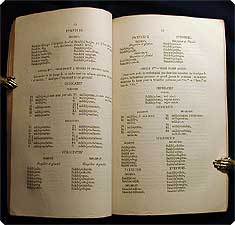 Click the middle or right image for an enlargement.
 Father Cuoq (1821–98) was an extremely accomplished linguist as evidenced by his becoming fluent in both Algonquin and Iroquois; Field (Indian Bibliography, p. 93) writes glowingly of his mastery of these languages. His life as a missionary of the Order of Sulpitians, notably among the Nipissing at Lake of Two Mountains, certainly aided in his scholarly achievement.
• Pilling, Algonquian, 100-101; Pilling, Proof-sheets, 952; Field 391; Newberry Library, Indian Linguistics in the Edward E. Ayer Collection, Algonkin-14; Sabin 17980. Not in Banks; not in Evans, Masinanhikan. Original printed green wrappers, spine reinforced some time ago, edges chipped. Half-title with pencilled annotations. First text page rubber-stamped by a now-defunct institution; pages otherwise clean.
 For
more of AMERICANThe
19th-Century
U.S. Constitutional
History
Curtis,
George Ticknor. History of the origin,
formation, and adoption of the Constitution of the United States; with notices
of its principal framers. New York: Harper & Brothers, 1854–58. 8vo
(24.1 cm, 9.5"). 2 vols. I: xxxvi, 518 pp. II: xvi, 653, [1] pp.
For
more of AMERICANThe
19th-Century
U.S. Constitutional
History
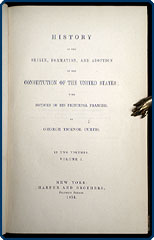
Curtis,
George Ticknor. History of the origin,
formation, and adoption of the Constitution of the United States; with notices
of its principal framers. New York: Harper & Brothers, 1854–58. 8vo
(24.1 cm, 9.5"). 2 vols. I: xxxvi, 518 pp. II: xvi, 653, [1] pp.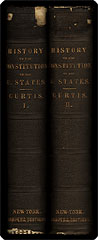

 Click
the images for enlargement.
Click
the images for enlargement.
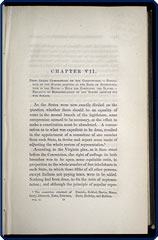
The uncommon errata slip accounting for the absent “note on the authorship of the Ordinance of 1787") is laid into vol. I.
• Sabin 18038; Allibone 462. Publisher's dark brown corded cloth of Krupp's style Lea8, front covers with gilt-stamped eagle, flag, and motto vignette (of which a detail-photo is given above), back covers with same vignette in blind, spines with gilt-stamped title; corners/edges rubbed, spine extremities chipped, gilt slightly oxidized, and vol. I with joints starting yet covers firm. Ex–social club library: call numbers inked to endpapers (in some cases then obscured with old paper), rubber-stamp on front free endpapers and title-page of vol. II (not that of vol. I), several other pages rubber-stamped (most, faintly). Pages slightly age-toned. (26521)
 For
CONSTITUTIONS & CONSTITUTIONAL
For
CONSTITUTIONS & CONSTITUTIONAL
 TO
Part VII . . . TO
Part VII . . . |