 ABOLITION
SLAVERY RECONSTRUCTION AFRICAN AMERICANA
 generally,
“BLACK STUDIES”
ABOLITION generally,
“BLACK STUDIES”
generally,
“BLACK STUDIES”
ABOLITION generally,
“BLACK STUDIES”
 The Very Rare Richmond Printing
 First Edition of the First Register — Anti-Slavery Content
  (Anti-Slavery
Statement published in 18th-Century VIRGINIA). Asplund, John.
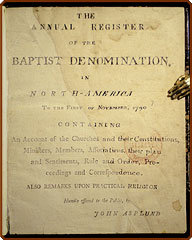
The annual register of the Baptist denomination, in North-America; to the first
of November, 1790. Containing an account of the churches and their constitutions,
ministers, members, associations, their plan and sentiments, rule and order, proceedings
and correspondence. Also remarks upon practical religion. [Richmond: Printed by
Dixon, Nicolson, and Davis, April, 1792]. 4to (18.5 cm; 7.5"). iv, 5-60 pp.
(Anti-Slavery
Statement published in 18th-Century VIRGINIA). Asplund, John.
The annual register of the Baptist denomination, in North-America; to the first
of November, 1790. Containing an account of the churches and their constitutions,
ministers, members, associations, their plan and sentiments, rule and order, proceedings
and correspondence. Also remarks upon practical religion. [Richmond: Printed by
Dixon, Nicolson, and Davis, April, 1792]. 4to (18.5 cm; 7.5"). iv, 5-60 pp.
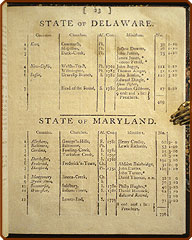
 Click the interior images for enlargements.
 The wonderful cataloguers at the American Antiquarian Society write of this edition: “Apparently printed in sections, presumably by John Dixon, Thomas Nicolson and Augustine Davis, rival Richmond printers. The first 16 p. were probably printed in 1791; p. 17-60 in or before April, 1792. Evans, however, postulates that the first 16 p. were printed by Thomas Dobson of Philadelphia in September, 1792, and that Asplund replaced the original gatherings A and B of this edition with Dobson’s corrected sheets. Cf. the prefaces to the 1794 and 1796 editions, with title: The universal register of the Baptist denomination . . .”
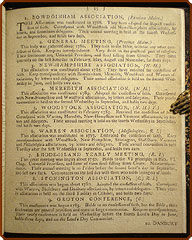
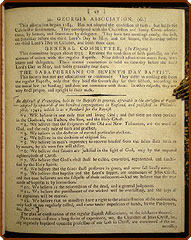
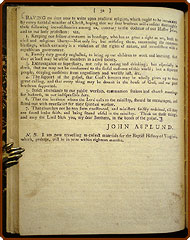
 This
was a standard Baptist stance, if not one universally held; it is striking here
as appearing on p. 52, in the part of the pamphlet that Evans and the AAS agree
was Richmond-printed. At the end of that section,
Asplund notes that
This
was a standard Baptist stance, if not one universally held; it is striking here
as appearing on p. 52, in the part of the pamphlet that Evans and the AAS agree
was Richmond-printed. At the end of that section,
Asplund notes that he
is writing from the American “field” —
“N.B. I am now travelling to collect materials for the Baptist History
of Virginia, which, perhaps, will be in print within eighteen months.”
he
is writing from the American “field” —
“N.B. I am now travelling to collect materials for the Baptist History
of Virginia, which, perhaps, will be in print within eighteen months.”
Rare. We trace fewer than half a dozen copies in U.S. libraries.
• Evans 26580; Sabin 2222; ESTC W37301. 19th-century half morocco with marbled paper covered boards; binding with label of “John C. Moore, Rochester, NY.” Ex-library with area of discoloration on front board where call number label was removed; bookplate on front pastedown; rubber-stamp on title-page, and small stamp and pencilling on rear of same. Approximately 60% of title-leaf replaced in pen and ink facsimile. Some foxing and age-toning. Not an ideal copy, but given the rarity, a darned good one. (24456)


 Back to Africa? American Society for Colonizing the Free People of Colour of the United States. [drop-title] Memorial of the President and Board of Managers of the American Society for Colonizing the Free People of Colour of the United States. January 14, 1817. Read and ordered to lie on the table. [Washington: William A. Davis, 1817]. 8vo. 5 pp.
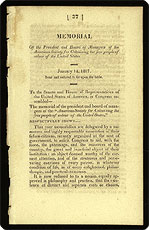
Click
the image to the left • Shaw & Shoemaker 42652. Removed from a nonce volume; inner edge slightly irregular. Leaves once separated, now re-attached at inner edge with transparent tape. Clean, with only a little darkening along inner margins. (18246)


An
Address to the
“Livery”(Abolition).
To the livery of London. [London, 1791?]. 8vo (18.5 cm, 7.25").
24 pp. (lacking pp. 9–16).
the
“Livery”(Abolition).
To the livery of London. [London, 1791?]. 8vo (18.5 cm, 7.25").
24 pp. (lacking pp. 9–16).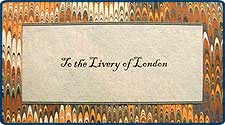
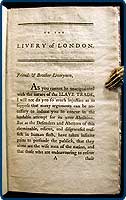
• Not in ESTC. Marbled paper–covered boards, old style, front cover with printed paper label. Lacking pp. 9–16. Pages cockled and slightly browned; edges untrimmed.

Dobson Printing of Asplund's Annual Register Asplund, John. The annual register of the Baptist denomination, in North-America; to the first of November, 1790. Containing an account of the churches and their constitutions, ministers, members, associations, their plan and sentiments, rule and order, proceedings and correspondence. Also remarks upon practical religion. [Philadelphia: Pr. by Thomas Dobson, 1792]. Small 4to. iv, 5-57, [1], 69-70 pp.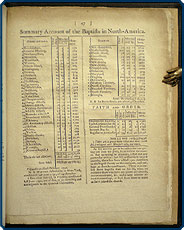
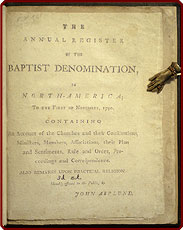 Click the images for enlargements.
 As is the case with the 70 p. issue, the first 16 p. are the same sheets as appear in the original [Richmond, April 1792] edition (Evans 26580), and were probably printed in 1791. Evans, however, postulates that the first 16 p. were printed by Dobson in September 1792. He accounts for their presence in copies of the [Richmond] edition of 60 p. by suggesting that Asplund substituted the corrected Philadelphia sheets for the unsatisfactory sheets of the earlier edition. Cf. the prefaces to the 1794 and 1796 editions, with title: The universal register of the Baptist denomination.”
In addition to its exhaustive account of who's who and what's where, this lists both principles of belief and “Rules of Decorum”; the latter, e.g., forbid laughing and whispering when another member of the association is speaking in assembly. Between the “Rules of Decorum” and the Index, Asplund remarks on the un-Christian “inconsistency” of “Keeping our fellow-creatures in bondage, who have as good a right was we, both to civil and religions liberty — Not only so; but misusing them, concerning common blessings, which certainly is a violation of the rights of nature and inconsistent with a republican government.”
• Evans 26582; ESTC W37302. Uncut copy. In 20th-century black buckram binding. Ex-library with bookplate but no other markings. (24467)

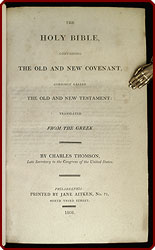
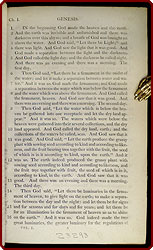
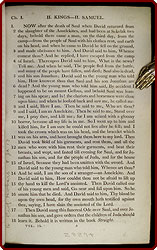
AT LEAST THREE “FIRSTS” — First English SeptuagintBible. English. 1808. Thomson. The Holy Bible, containing the Old and New Covenant, commonly called the Old and New Testament: Translated from the Greek. By Charles Thomson.... Philadelphia: Pr. by Jane Aitken, 1808. 8vo. 4 vols. I: [252] ff. II: [245] ff. III: [222] ff. IV: [240] ff.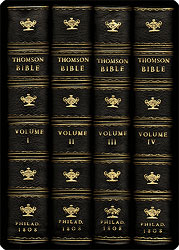
 Click the images for enlargements.
  It was also the first translation of the Greek New Testament into English by a native of Ireland, and of course it is the work of a key figure of the American Revolution.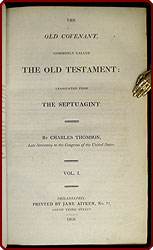
 abolitionist
and ardent supporter of the Revolutionary cause, he was characterized by a fellow
Revolutionary (John Adams) as “the Sam Adams of Philadelphia, the life
of the cause of liberty,” and by a conservative (Joseph Galloway) as “one
of the most violent of the Sons of Liberty in America.” It was he who
informed George Washington of his election to the presidency.
abolitionist
and ardent supporter of the Revolutionary cause, he was characterized by a fellow
Revolutionary (John Adams) as “the Sam Adams of Philadelphia, the life
of the cause of liberty,” and by a conservative (Joseph Galloway) as “one
of the most violent of the Sons of Liberty in America.” It was he who
informed George Washington of his election to the presidency.
On 4 July 1776 only two signatures were affixed to the unanimously adopted Declaration of Independence — those of John Hancock, president of the Congress, and Charles Thomson, secretary, in order to authenticate the document that had been voted on and approved. Yet by a curious twist of fate (read rather, surely, of a political enemy's knife), when the calligraphic copy that is so well known to every school child was ready shortly after 19 July, authenticator Thomson was not invited to sign it!
When he had retired from public life in 1789, Thomson was to turn his interest in the Bible and Greek to the 20-year task of producing this monumentally important work.
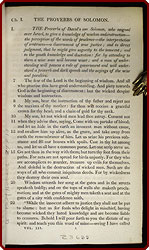
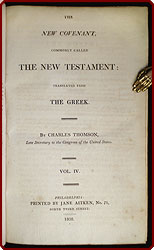
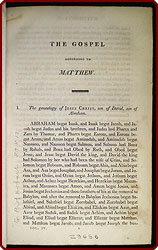
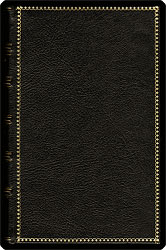
Its printer was the daughter of Robert Aitken, who had printed the first Bible in English in America. A major edition of the English Bible, this is essential for any Bible collection, not just for collections of American Bibles — though as an American Bible and simple Americanum it has a revered place.• Rumball-Petre, Rare Bibles, 184; Hills 153; Herbert 1514; O'Callaghan 91–92; Shaw & Shoemaker 14486. On Thomson, see: Dictionary of American Biography, XVIII, 481–82. Modern full black morocco, signed “GB” (Grace Bindings). Gilt spines. Black endpapers. The effect, richly elegant. Faintly visible pressure-stamps of a library (properly deaccessioned), each volume with neatly pencilled collection note and small old inked 5-digit number to first text leaf; in fact a remarkably clean, ever–well cared for, and handsome set. (26019)
U.S. Cavalry, including the“Buffalo Soldiers” Brackett, Albert G. History of the United States cavalry; from the formation of the federal government to the 1st of June, 1863; to which is added a list of all the cavalry regiments, with the names of their commanders, which have been in the United States service since the breaking out of the rebellion. New York: Harper & Brothers, 1865. 12mo. 337, [1 (blank)], 2 (ads) pp.; illus.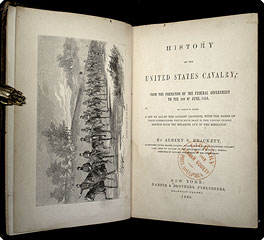 Click the image for an enlargement.
 • Sabin 7195. Publisher's brown cloth, with crossed sabers on the front cover; cloth discolored, and breaking across back joint. Ex–social club library: call number in a neat 19th-century hand on endpaper and fly-leaf, rubber-stamp on title- and a few other pages. No other markings. Endpapers with old waterstaining, this continuing faintly on first few leaves in some inner margins; a few early margins with short tears. Withal, a good copy. (26282)
 Letters to aSister
in Stockholm — A Swedish FeministAmericaBremer, Fredrika. The homes of the New World; impressions of America. New York: Harper & Brothers, 1853. 12mo (20.2 cm, 7.9"). 2 vols. I: xii, 651, [1 (blank)] pp. II: 654,2 (adv.) pp.
Letters to aSister
in Stockholm — A Swedish FeministAmericaBremer, Fredrika. The homes of the New World; impressions of America. New York: Harper & Brothers, 1853. 12mo (20.2 cm, 7.9"). 2 vols. I: xii, 651, [1 (blank)] pp. II: 654,2 (adv.) pp.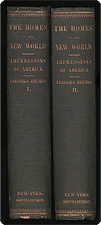
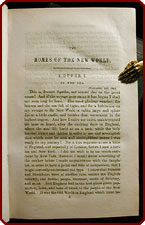 Click the image to the left
 The first London edition appeared in three volumes, but the present edition in two, as stated on the title-page.
• Howes B-745. Publisher’s charcoal blind-stamped cloth, spines with gilt-stamped title; cloth showing mild wear overall, with spine gilt attractively oxidized. Front free endpapers with pencilled owner’s inscription dated 1869. Pages slightly age-toned, with scattered small spots of staining. Quite a nice set.

Explaining Haiti to the U.S. in 1837 Brown, Jonathan. The history and present condition of St. Domingo. Philadelphia: William Marshall and Co., 1837. 12mo (18.5 cm; 7.25"). 2 vols. I: iv, 307 pp. II: 289 pp.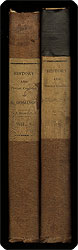
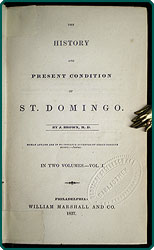 Click the image for an enlargement.
 Binding: Publisher's brown ribbon-embossed cloth with original paper spine labels.
• Sabin 8530; Palau 36231; Library Company, Afro-Americana (rev. ed.), 1701. On binding: Krupp, Bookcloth in England and America, 1823--50, Fs 1. Publisher's cloth, light spotting on covers with spine label of one volume chipped and the other faded; discoloration to head of spine head, vol. I, and strips of black cloth tape at head of spine and onto boards of vol. II. Ex–social club library: each volume with a 19th-century bookplate, call number on endpaper, pressure-stamp on title-page, no other markings. Title-page and front free endpaper of vol. I neatly joined/reinforced with old paper tape; a firm, decent set. (26410)

He Tried. Burrows, Julius C. Civil rights. Speech of Hon. Julius C. Burrows, of Michigan, in the House of Representatives, February 5, 1875. Washington: Government Printing Office, 1875. 12mo. 10 pp.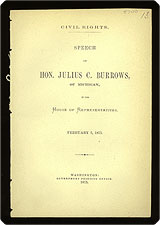
• Very good. Removed from a nonce volume. (936)
First
German-Language EditionSocial
& Economic Causes
Buxton, Thomas Fowell. Der afrikanische Sklavenhandel und
seine Abhülse ... mit einer Vorrede: Die Nigerexpedition und ihre Bestimmung. Leipzig: F.A.
Brockhaus, 1841. 8vo (21.6 cm, 8.5"). lxx, 453, [3] pp.; 1 fold. map.
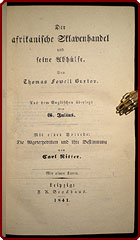
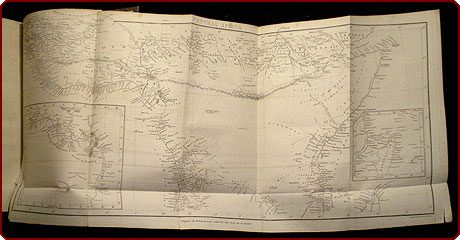
The volume is illustrated with an oversized, folding engraved map captioned in English.
Uncommon: OCLC and NUC Pre-1956 find only nine U.S. holdings (one deaccessioned).
• Goldsmiths'-Kress 32415.2; Sabin 9688. On Buxton, see: Oxford Dictionary of National Biography online and Allibone, 317. Boards covered with German-style black-flecked brown paper, spine with printed paper label. Pages slightly age-toned, with a very few scattered instances of light spotting; map with faint offsetting and short tear along lower inner margin, not touching image. An attractive copy. (25325)
Presentation Copy Signed by ABOLITIONISTMaria Weston Chapman Chapman, Maria Weston, ed. The Liberty bell. By friends of freedom. Boston: Massachusetts Anti-Slavery Fair, 1844. 12mo (19.5 cm, 7.75"). Frontis. (incl. in pagination), viii, 232 pp.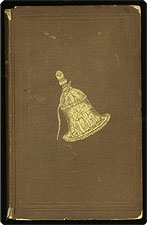
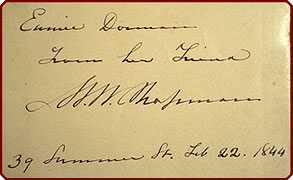
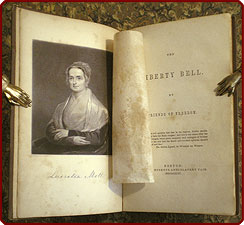 Click any image where the hand appears on
 Chapman, along with several of her sisters, founded the Boston Female Anti-Slavery Society and was one of the staunchest supporters of the abolitionist cause, braving mob scenes and social condemnation to attend anti-slavery meetings, circulate petitions, organize the Anti-Slavery Fair, and publish the present annual. Not many solid, presentable copies of the Liberty Bell make their way to the market, and this one is especially notable for its having been inscribed by Chapman herself.
Provenance: Front free endpaper with presentation inscription reading “Eunice Dorman [?] from her friend M.W. Chapman,” dated February, 1844 (“39 Summer St.”).
• On Chapman, see: McHenry, Famous American Women, 68–69, and DAB, IV, 19. Publisher’s brown cloth, front cover with gilt-stamped bell vignette, spine with gilt-stamped title and blind-stamped decorative bands; cloth worn along board edges and corners and chipped away at spine extremities, exposing underlying boards or support. Front cover and outer edge with a few small dents, back cover with line of light, unobtrusive staining. Pages lightly foxed, otherwise clean, with some corners dog-eared.
A desirable copy. (21279)
“Official
Edition” of
a Human
Rights MilestoneColombia. Constitution. 1853. Constitucion política de la Nueva Granada. Año de 1853. [Bogotá]: no publisher/printer, 1853. Small 8vo (20 cm, 7.9"). 12 pp.
 abolition of slavery,
establishment of freedom of the press, and creation of separation of church
and state.
Click
the images for enlargements.
abolition of slavery,
establishment of freedom of the press, and creation of separation of church
and state.
Click
the images for enlargements.
There were two editions in 1853, the other being 24 pages in length.
• Palau 59737. Original printed yellow wrappers, creased and a little dusty. Very good condition.
Davis Himself
on the Civil War
— Many
Plates &
Maps
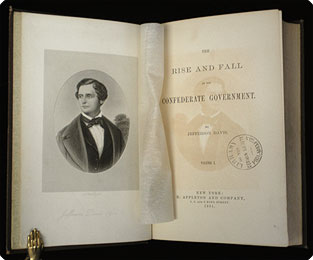
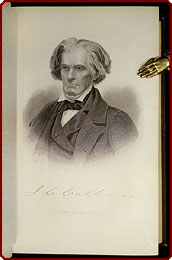
Davis,
Jefferson. The rise and fall of the Confederate government.
New York: D. Appleton & Co., 1881. 8vo (23.8 cm, 9.4"). 2 vols. I: xxi,
[3], 707, [5 (adv.)] pp.; 9 plts., 1 map. II: xvii, [3], 808, [4 (adv.)] pp.;
10 plts., 13 fold. maps.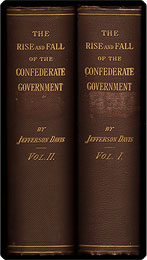
 Click
the images for enlargements.
Click
the images for enlargements.
• Howes D120. Publisher's pebbled brown cloth, covers framed in blind with central gilt-stamped horse and rider medallion on front, spines with gilt-stamped title; edges/extremities lightly rubbed and spines each with a patch lightened (moreso to vol. I). Ex–social club library: call number on endpapers, title-pages rubber-stamped. Minor offsetting from some plates, pages otherwise clean. (26900)
“Apology”
NOT Accepted!
[Dexter, Franklin]. A letter to the Hon. Samuel
A. Eliot, representative in Congress from the city of Boston, in reply to his
apology for voting for the fugitive slave bill. Boston: Wm. Crosby & H.P.
Nichols, 1851. 8vo. 57 pp.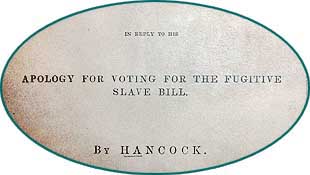
 First
edition.
First
edition.
• Sabin 19890; Dumond 63. Sewn, in original printed wrappers, slightly chipped. Five-digit number stamped on front wrapper, and a neat paper label at upper left corner. A very nice copy.
First & Most FamousAnti-TOM Novel Eastman, Mary Henderson. Aunt Phillis's cabin; or, Southern life as it is. Philadelphia: Lippincott, Grambo & Co., 1852. 12mo (17.9 cm, 7"). Frontis., add. engr. t.-p., [2], [11]–280 pp.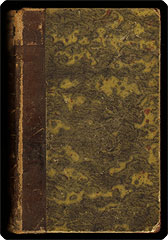
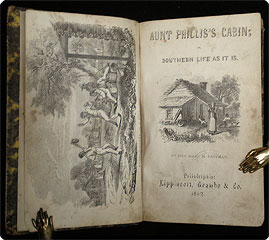 Click the images for enlargements.
 • Library Company, Afro-Americana, 3386; Sabin 21683; Wright, II, 831. Contemporary quarter sheep and marbled paper-covered sides, spine with gilt-stamped title; binding rubbed and worn overall, head of spine chipped and abraded. Hinges (inside) starting, reinforced some time ago with paper. Ex-social club library: Front free endpaper with early inked numeral, title-page pressure-stamped, added engraved title-page and three other pages lightly rubber-stamped. Pages age-toned, with spots of staining throughout; a few light/faded pencilled annotations to the preface and no other markings. (26385)
GOOD
“Traditional”
AMERICAN
History
Elliott, Charles W. The New England history, from the discovery of the continent by the Northmen, A.D. 986, to the period when the colonies declared their independence, A.D. 1776. New York: Charles Scribner, 1857. 8vo. 2 vols. I: Frontis., 479, [1] pp. II: Frontis., 492 pp.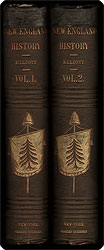
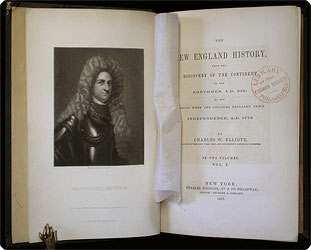 Click the images for enlargements.
 • Sabin 22260. Publisher's brown cloth, covers framed in blind, spines with gilt-stamped title and banner motif; lightly worn and moreso at corners, spines each with relatively unobtrusive strip of cloth tape at head. Ex–social club library: 19th-century bookplates, front free endpapers excised, rubber-stamp on title-pages and a few others, no other markings. (26890)
The Party of Lincoln
Ferry, Orris S.
Speech of Orris S. Ferry, of Connecticut. Delivered in the House of Representatives,
February 10, 1860. [Washington?: 1860]. 8vo. 7, [1] pp. Uncut and unopenned.
(1068)
• Folded, never bound.
New York's Gubernatorial Election 1820 — The Issue of Slavery “Forty Thousands”. Broadside. Begins, “To the 40 gentlemen who have addressed the independent federal electors of the state of New-York.” New York state: no publisher/printer, [1820]. Folio (34 cm, 12.75"). [1] f. (verso blank).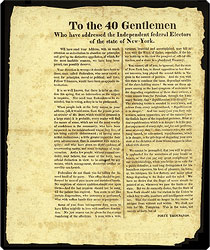
Nearly half of the text deals with the slavery issue. Ends as follows, “We shall not vote for Mr. Tompkins. This is the voice, not merely of forty, but of FORTY THOUSANDS.” A window into a turbulent period in New York politics
Rare. Not located via OCLC.
• Not in Shoemaker. As issued, with some later folds; edges a little irregular. Lightly foxed. (24634)
Civil War Narrative Geer, John James. Beyond the lines: Or a Yankee prisoner loose in Dixie. Philadelphia: J.W. Daughaday, 1863. 12mo (17.7 cm, 7"). Frontis., 285, [3 (2 adv.)] pp.; 5 plts.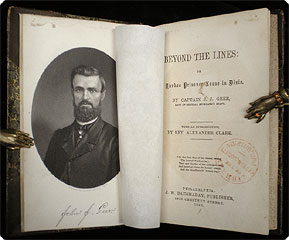
 Click the images for enlargements.
 • Library Company, Afro-Americana, 4057; Sabin 26835. Contemporary half brown sheep and yellow marbled paper–covered sides, spine with gilt-stamped title and band decorations; rubbed and spine head with strip of dark cloth tape extending onto sides. Ex–social club library with its bookplate; call number on endpaper, title-page and several others rubber-stamped. Scattered spots of light staining. In fact a nice-looking and sound copy. (26397)
New York Banking — In Essence *&* at Point of Crisis Gibbons, James Sloan. The banks of New-York, their dealers, the Clearing House, and the panic of 1857. New York: D. Appleton & Co., 1858. 12mo (20.2 cm, 8"). Frontis., x, [2], [9]–399, [1], 4 (adv.) pp.; 29 plts., 1 fold. chart.
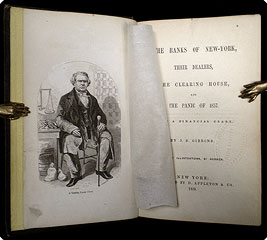
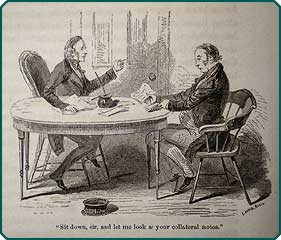 Click the images for enlargements. 30
wood-engraved plates by Henry Herrick: expressive depictions
of bank employees, customers, and their interactions. Gibbons, a financier by
trade anda
Quaker abolitionist, provides an excellent “picture
of the banks of New York as they are” (p. v) — often by way of “you
are there” conversations, including, on p. 95, a vigorous, decision-making
interchange as to backinga
house “too important . . . to be allowed to go down.”
Click the images for enlargements. 30
wood-engraved plates by Henry Herrick: expressive depictions
of bank employees, customers, and their interactions. Gibbons, a financier by
trade anda
Quaker abolitionist, provides an excellent “picture
of the banks of New York as they are” (p. v) — often by way of “you
are there” conversations, including, on p. 95, a vigorous, decision-making
interchange as to backinga
house “too important . . . to be allowed to go down.”
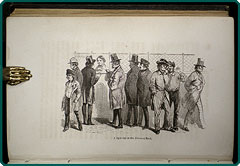
• Sabin 27289; not in Goldsmiths'-Kress. Publisher's blind-stamped textured cloth, spine with gilt-stamped title and pictorial vignette; binding cocked, extremities rubbed, spine sunned. Ex–social club library: call numbers on endpaper, front free endpaper excised, pressure-stamp on title-page, two other pages rubber-stamped, no other markings. Some plates with small areas of staining to margins. (26638)
 What You Saw Depended
onWhere You Stood
Giddings, [Joshua
R.]. [drop-title] Privilege of the representative -- Privilege
of the people. Speech of Mr. Giddings, of Ohio, on the trial of Preston
S. Brooks,
for an assault on Senator Sumner. Before the House of Representatives,
July 11, 1856. [Washington, D.C.: Buell & Blanchard, 1856]. 8vo. 8
pp.
What You Saw Depended
onWhere You Stood
Giddings, [Joshua
R.]. [drop-title] Privilege of the representative -- Privilege
of the people. Speech of Mr. Giddings, of Ohio, on the trial of Preston
S. Brooks,
for an assault on Senator Sumner. Before the House of Representatives,
July 11, 1856. [Washington, D.C.: Buell & Blanchard, 1856]. 8vo. 8
pp.

 • Giddings sees the attack on Sen. Sumner as an attack on free speech and the
free debate of the Senate. He points out the differences in interpretation of
events expressed by Senators from the slave-holding states and the free states.
• Giddings sees the attack on Sen. Sumner as an attack on free speech and the
free debate of the Senate. He points out the differences in interpretation of
events expressed by Senators from the slave-holding states and the free states.
• Removed from a nonce volume; respined with archival tissue. (576)
AnAbolition Sermon (1836)Green, Beriah. Things for Northern men to do: a discourse delivered Lord's Day evening, July 17, 1836, in the Presbyterian Church, Whitesboro’, N.Y. New York: Pub. by request, 1836. 8vo (21.5 cm, 8.4"). 22, [2 (blank)] pp.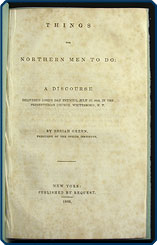
The author, a pastor and educator, was one of the most determined abolition activists in the United States; the DAB notes that while his dedication to the cause led to the closing of many doors in his career, his sermons on the subject “attracted wide attention,” contributing greatly to the catalyzing of American Christian opposition to slavery.
• On Green, see: Dictionary of American Biography, VII, 539–40. Sabin 28512. Recent wrappers. Foxing throughout.
A
Radical
Republican's
CONTROVERSIAL
Civil War
Critique
,
count. Diary, from March 4, 1861, to November 12, 1862 [and]
from November 18,1862, to October 18, 1863. Boston: Lee & Shepard; & New York: Carleton, 1862–64.
8vo (19.5 cm, 7.7"). 2 vols. I: [4], 315, [1 (blank)] pp. II: [4], [7]–348
pp.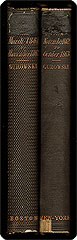
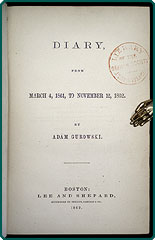
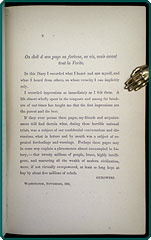 Click the images for enlargements.
 • Sabin 29319; Howes G465. Publishers' brown cloth very close in color but Boston's textured while New York's is smooth; covers framed in blind, spines with gilt-stamped author, title, and variant place information in parallel places and in typestyles not exactly matching but very close; corners rubbed, spine extremities chipped, spine heads with small strip of brown cloth tape, vol. I with binding very slightly cocked and cloth starting to split at front joint. Ex–social club library: call number on endpapers, rubber-stamp on title-pages and two others, no other markings. Front free endpaper of vol. I lacking. Pages slightly age-toned, otherwise clean and paper good. (26252)
Anti–Slave
Trade[Harrison,
George]. An address to the right reverend the prelates of England and Wales,
on the subject of the slave trade. London: J. Parsons, 1792. 8vo (19 cm, 7.5").
15, [1 (blank)] pp.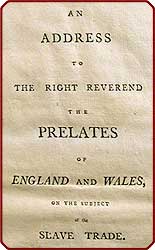
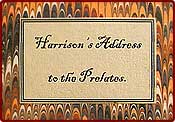
• ESTC N46161. Marbled paper–covered boards, old-style, front cover with printed paper label. Pages skillfully reinforced at inner margins; clean throughout.
Popular Philosophical Dialogues Helps, Arthur, Sir. Friends in council: A series of
readings and discourse thereon. Boston & Cambridge: James Munroe & Co. (pr. by Allen &
Farnham), 1853. 8vo (18.5 cm, 7.25"2 vols. I: [2 (adv.)], viii, [2], 291, [1] pp. II: vi, [2], 271, [1]
pp.
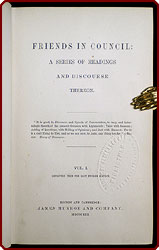 Click the images for enlargements.
 Present here is an early U.S. edition of the first series; two series were published, the first in 1847–49 and the second in 1859. Much of the second volume of this series is dedicated to the question of slavery.
• Allibone 818. On Helps, see: Dictionary of National Biography online. Publisher's blind-stamped brown cloth, spines with gilt-stamped title; moderate rubbing most noticeable at vol. I spine head, and vol. II with strip of dark cloth tape at head of spine extending onto sides. Ex–social club library: front pastedowns with 19th-century bookplate and call-number sticker, front free endpapers lacking, title-pages pressure-stamped, no other markings. Pages age-toned, with intermittent spots of staining and light pencilled bracketing. (26412)
The
Case that Split the Nation
—Howard, Benjamin C. Report of the decision of the Supreme
Court of the United States, and the opinions of the judges thereof, in the case of Dred Scott versus
John F.A. Sandford. December term, 1856. Washington: Cornelius Wendell, 1857. 8vo (22.8 cm, 9").
239, [1] pp.
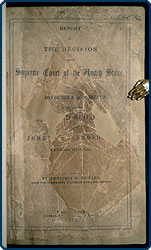
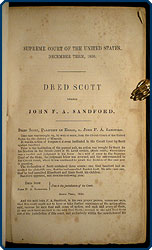 Click the interior images for enlargements.
 A New York printing was issued simultaneously.
• Howes S218; Library Company, Afro-Americana, 4994; Sabin 33240. Recent very handsome black moiré cloth, spine with printed paper label. Original printed paper front wrapper bound in. Wrapper, title-page, and last text page tattered (wrapper significantly, pages less so) and now mounted; wrapper with inked ownership inscription dated 1896. Pages age-toned, with intermittent foxing. (25316)
A
Popular-at-Home History
of VirginiaHowison, Robert Reid. A history of Virginia, from its discovery and settlement by Europeans to the present time. Philadelphia: Carey & Hart. Richmond: Drinker & Morris; New York & London: Wiley & Putnam, 1846 & 1848. 8vo (23.3 cm, 9.2"). 2 vols. I: 496 pp. II: 528 pp.
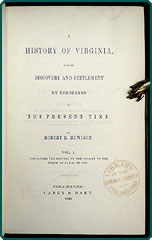
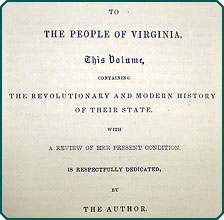 Click the images for enlargement. slavery
— which the author defends as a legal institution, but attacks as a detriment
to the state's overall prosperity.
Click the images for enlargement. slavery
— which the author defends as a legal institution, but attacks as a detriment
to the state's overall prosperity.
• Sabin 33370; Howes H739. Publisher's cloth, vol. I (now) olive and vol. II brown, covers blind-stamped, spines with gilt-stamped title and gilt-stamped seal of Virginia (“Sic semper tyrannis”); corners and spine extremities rubbed, sides with areas of light discoloration, endpapers darkened. Ex–social club library: 19th-century bookplate on front pastedowns, call number inked on front free endpaper of vol. I and front fly-leaf of vol. II, vol. II lacking front free endpaper. No other markings. Upper margins of vol. I with small areas of light waterstaining, extending to touch top lines of text at back of volume only; vol. II with similar light waterstaining never touching text. Vol. II with occasional lightly pencilled marginalia and marks of emphasis, many pertaining to the perceived value of the footnotes and references. (26452)
Printed
to Commemorate theFirst
AnniversaryKing,
Martin Luther, Jr. Letter from Birmingham jail. Stamford: The Overbrook
Press, [1968]. Small quarto. [8 (4 blank)], 17, [3 (2 blank)] pp.
• Stiff printed wrappers, center bit of top edge a trifle bumped. Near fine. (23499)
A Novel of the “Peculiar Institution” Kirke, Edmund [pseud. of James R. Gilmore]. Among the pines: Or, South in secession-time. New York: J.R. Gilmore & Charles T. Evans, 1862. 8vo. 310 pp.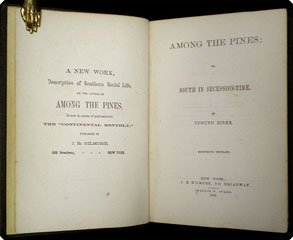
 Click the images for enlargements.
 • Wright, II, 1003. Publisher's dark green textured cloth, spine with gilt-stamped title; corners and spine extremities rubbed, spine slightly sunned, sides with spots of lighter discoloration. Front free endpaper with pencilled and inked inscription (partly) dated 1862. Light to moderate foxing throughout. (25992)
Quaker
Meditations —
A Neat CompendiumTwo
Women in the Contents —
Womanly Provenance, Too
[Law, William].
An extract from a treatise on the spirit of prayer, or the soul rising out of
the vanity of time into the riches of eternity. With some thoughts on war. Remarks
on the nature and bad effects of the use of spirituous liquors. And considerations
on slavery. Philadelphia: Joseph Crukshank, 1780. 12mo (16.3 cm, 6.45"). 84
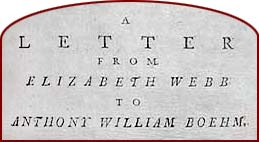
pp. [bound with] Webb,
Elizabeth. A letter...to Anthony William Boehm, with his answer.
Philadelphia: Joseph Crukshank, 1783. 44 pp. [with]
[Benezet, Anthony]. In the
life of the lady Elizabeth Hastings... [Philadelphia: Joseph Crukshank, 1784].
8 pp. 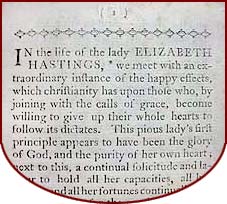
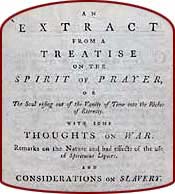 Considerations
on Slavery are designated simply as those of a "number
of different authors"; the Remarks on . . . Liquors, which aims to
promote health and happiness rather than directly religious concerns, is attributed
by ESTC to Anthony Benezet, as is the volume's last piece, the title of which
is taken from its opening lines. Lady Elizabeth Hastings was the original for
Aspasia in Steele's "Tatler" and a major donor to Oxford University Queen's
College.
Considerations
on Slavery are designated simply as those of a "number
of different authors"; the Remarks on . . . Liquors, which aims to
promote health and happiness rather than directly religious concerns, is attributed
by ESTC to Anthony Benezet, as is the volume's last piece, the title of which
is taken from its opening lines. Lady Elizabeth Hastings was the original for
Aspasia in Steele's "Tatler" and a major donor to Oxford University Queen's
College.
 Elizabeth
Webb, "an acknowledged minister among the people called Quakers," first encountered
Prince George of Denmark's chaplain Boehm while on a visit to Great Britain;
the missive with which she opened her subsequent correspondence with him, here,
greatly inspired him and a number of his friends.
Elizabeth
Webb, "an acknowledged minister among the people called Quakers," first encountered
Prince George of Denmark's chaplain Boehm while on a visit to Great Britain;
the missive with which she opened her subsequent correspondence with him, here,
greatly inspired him and a number of his friends.
Provenance: With inscription reading "Miss
Hannah Amelia Moore / Book a Present from her worthy / Friend Ruth Patton / 1789."
The
Spirit of Prayer
Law, William. An extract from a treatise...called, the spirit of prayer; or, the soul rising out of the vanity of time, into the riches of eternity. With some thoughts on the nature of war, and its repugnancy to the Christian life, &c. &c. Philadelphia: Henry Miller, 1766. 8vo [signed in 4s] (17.3 cm, 6.8"). 48 pp.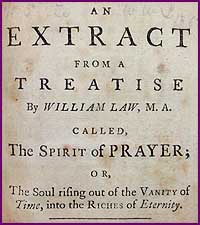
The present copy does not include the thirty pages, mentioned in the subtitle, on the nature of war; the Extract and Some Thoughts were issued as the first and second titles in a collection of religious tracts printed by Henry Miller, and also issued separately (Evans 10352 and 10505). Sabin calls for 48 pages, as found in this copy.
• Evans 10352; Sabin 39325. On Law, see: Dictionary of National Biography, XXXII, 236–40. Later neat plain cloth binding, spine with gilt-stamped morocco title label; clean. Half-title lacking. Some foxing, mostly marginal. Pencilled notes to top of title-page and final page; early inked ownership inscription to title-page verso, including Philadelphia street address.

A
Southerner
Calls forABOLITION
in 1767
[Lee, Arthur]. [drop-title] Extract from an
address in the Virginia Gazette, of March 19, 1767. [Philadelphia?: Pr. by Joseph
Crukshank?, 1780?]. Small 12mo. 4 pp.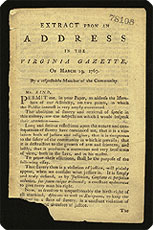 Click
the image for an enlargement.
Click
the image for an enlargement.
• Evans 16773; Hildeburn, The Issues of the Press in Pennsylvania, 1685–1784, 4006. Five-digit number stamped above the title; pp. 1 and 2 separated from 3 and 4, and gutter margin repaired, reattaching the halves. Semicircular tear in lower, inside area of all pages, costing a total of 9 or 10 words.
Progressive Charity Lesley, Susan I. [cover title] Suggestions to ward visitors. A paper read by Susan I. Lesley, before the visitors of the Seventh Ward. October 27th, 1879. Philadelphia: McCalla & Stavely, printers, 1879. 8vo. 24 pp.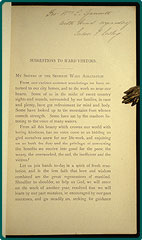
Click
the image to the left Provenance: Inscribed by the author to William C. Gannett, at top margin of p. [1]. Gannett spent three years in the 1860s working among freedmen in the South; he was afterwards to become a Unitarian minister and pastor of the church where Susan B. Anthony worshipped.
• Original dark blue wrappers. A couple of tiny tears at top edge of front cover. Very good. (20940)
Free Speech for theSenate Chamber?
Lincoln, Levi.
Speech of Mr. Lincoln, of Massachusetts. Delivered in the House of Representatives
of the United States, Feb. 7, 1837, on the resolution to censure the Hon.
John Q. Adams, for inquiring of the Speaker, whether a paper, purporting to
come from slaves, came within the resolution laying on the table all petitions
relating to slavery. Washington: Gales & Seaton, printers, 1837. 8vo.
9, [1 (blank)] pp. 
• Stitched, never bound. Small piece torn from upper outer area of title-page just touching two letters of the title. Five-digit number stamped on title-page. (934)
Documentingthe Sale of a SlaveLloyd, William L. A.L.S. to Garret D. Wall. [New Jersey or Pennsylvania], 22 May 1819. 12mo (6.125" x 8"), 1 p.
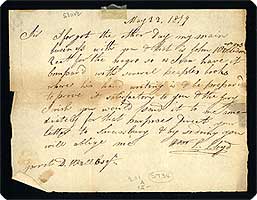
Click the image to the left Garret D. Wall was a lawyer in, and later a Senator from, New Jersey.
• Written in a clear hand. Fold along horizontal middle of document. Light stain and residue of mounting into an album. Lacks integral address leaf. Old price and dealer code (Sessler’s) in pencil in lower margin.
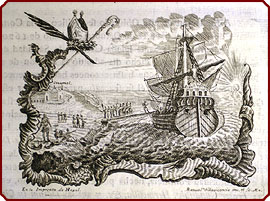
WONDERFUL
Culs-de-Lampe by
Villavicencio
& NavarroMexico
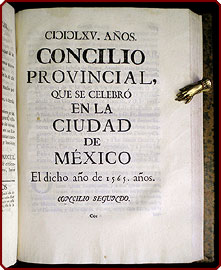
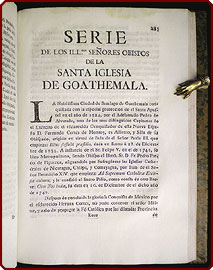
(ecclesiastical province). 1st & 2nd Concilia (1555, 1565).
Concilios provinciales primero, y segundo, celebrados en la muy noble,
y muy leal Ciudad de México, presidiendo el Illmo. y Rmo. Señor
D. Fr. Alonso de Montúfar, en los años de 1555, y 1565. En México:
En la Imprenta de el Superior Gobierno, de el Br. D. Joseph Antonio de Hogal,
1769. Folio (27 cm; 10.5"). [10], 34, [2], 35–38, 41–184, [2], 185–396,
[12] pp.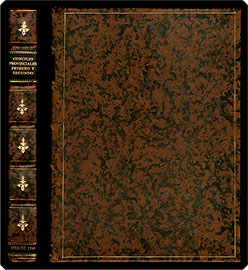
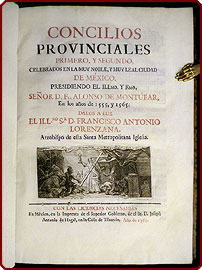
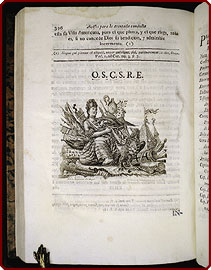
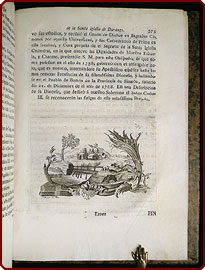 Click the images for enlargements. This text is from the press of José Hogal,
who is often called the Baskerville of Mexico.
Click the images for enlargements. This text is from the press of José Hogal,
who is often called the Baskerville of Mexico.
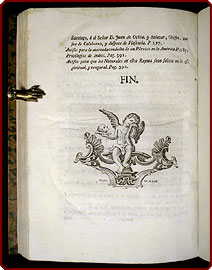 slaves
and free blacks, and most curiously prohibiting Indians
from owning collections of sermon and Bibles.
slaves
and free blacks, and most curiously prohibiting Indians
from owning collections of sermon and Bibles.
The force behind this edition was archbishop Francisco Antonio Lorenzana (1722–1804), a patron of Hogal's press and of the arts, who soon after assuming the archbishopric of Mexico in 1766 saw the need for a concilium. In preparation for it he paid Hogal to publish or republish, as was the case, the acts of the first three provincial councils of Mexico, held respectively in 1555, 1565, and 1585; these appeared in 1769 and 1770. In 1771 he himself held the fourth Mexican provincial synod; ironically, those acts were not published until 1898.
• Medina, Mexico, 5299; Palau 142387; Sabin 42063.
Recent Spanish sheep mottled in the Valenciana style. Occasional light waterstain
in some upper margins, never in text. Paper crisp and printing very sharp.
 A
very good copy. (26797)
A
very good copy. (26797)
A Hard-Laboring Poet ofCumberland County Oliver, Isabella. Poems, on various subjects. Carlisle: A. Loudon, 1805. 12mo. 5, [1], [vi]–ix, [11]–220 pp.
abolitionist
exhortation and tributes to George Washington and Alexander
Hamilton. The lengthy list of subscribers shows names from many Pennsylvania
counties as well as from Philadelphia, New York, Princeton, and Fredericktown,
MD.
Click
the image for an enlargement.
First edition and an early Carlisle imprint; the first poetic publication in Cumberland County.
Provenance: “Presented to Alfred Creigh by His Mother, October 21st 1827,” on verso of front free endpaper: Alfred's modestly calligraphic ownership note inside front cover and his plain note at top of contents page; signature of Eleanor Jane Creigh at top of title-page.
• Sabin 57205; Shaw & Shoemaker 9346; Wegelin, American Poetry, 1072. Contemporary sheep, spine with gilt-stamped leather title-label; rubbed, front joint starting, spine and joints with small wormholes. Inscriptions as noted. Margins variously waterstained, never horribly; pages age-toned with occasional spotting. One leaf with tear from lower margin extending into text, partially repaired some time ago; one leaf with lower outer corner torn away, a few lost words replaced in manuscript. Occasional manuscript corrections. (23146)
TheGlorious Revolution's Centennial Revolution Society (London). An abstract of the history and proceedings of the Revolution Society, in London. To which is annexed a copy of the Bill of Rights. [London]: Pr. by Order of the Committee, 1789. 8vo. 40, 7, [1 (blank)] pp., [1] f., pp. 41–78, [1 (blank)] f., pp. 79–87, 90–92, pp. 79–86, 93–96 (page numbers 88, 89 not used).

 Click the interior images for enlargements. Abolition
of the slave trade, repeal of religious tests, freedom
of the press, expansion of the franchise, and revision of the code of criminal
laws. Others were more general (“welfare of all mankind” or “religious
liberty”) or pithy (“when kings lose their utility may the people
find their dignity”). Still others praised the navy or the militia, “King
and Royal Family,” or called for the principles of the Glorious Revolution,
the Magna Charta, and the Bill of Rights to “be deeply engraven for ever
on every British breast.”
Click the interior images for enlargements. Abolition
of the slave trade, repeal of religious tests, freedom
of the press, expansion of the franchise, and revision of the code of criminal
laws. Others were more general (“welfare of all mankind” or “religious
liberty”) or pithy (“when kings lose their utility may the people
find their dignity”). Still others praised the navy or the militia, “King
and Royal Family,” or called for the principles of the Glorious Revolution,
the Magna Charta, and the Bill of Rights to “be deeply engraven for ever
on every British breast.”
Uncommon: No U.S. copy of this issue located via OCLC and ESTC locates only the Harvard copy. There were other, less complete editions of 40 pp., 58 pp., and 78 pp.
• ESTC N15187. Recent full calf, period style; spine with raised bands accented in gilt, oxblood leather gilt-lettered title, publication date and place in gilt at base; covers framed and paneled in gilt rules with gilt-stamped corner fleurons. Shallow chip to top outer corners of final two leaves. One word on p. 32 is blotted out in ink by an early owner with the correction supplied above it. Penned signature (partly cropped) at top edge of p. 79. Pp. 79–92 duplicated, nothing missing. (23766)
Educational & Career Rights forBlacks in the Spanish EmpireSpain. Sovereigns, etc., 1808–33 (Ferdinand VII). Broadside. Begins: “Don Francisco Xavier Venegas...`Exmô, Señor = La Regencia del Reyno se ha servido dirigirme el Decreto que sigue...Deseando las Córtes generales y extraordinarias facilitar á los súbditos Españoles,
que por qualquiera línea traigan su orígen del Africa, el estudio de las ciencias, y el acceso á la carrera eclesiástica....’” Mexico, 25 September 1812. Folio extra (48 cm; 17.25"). [1] p.

Click the image to the left While Ferdinand VII remained the prisoner of Napoleon, the Regency promulgated several important human rights acts, and this was one of the most important. The Regency ratified and published it 29 January and on 31 January it was ordered distributed throughout the empire.
• Not in Medina, Mexico; not in Garritz, Impresos novohispanos; not in Sutro. One horizontal fold, top margin a little crumpled and irregular; left margin with a V-shaped bit of blank margin missing at fold, otherwise only a little irregular. Revenue stamps on the verso. Viceroy Venegas’s paraph (“rúbrica”) below his printed name. A very good copy.
Back
to Africa (Yet
again) . . .
United States. Congress. [drop-title] Report on colonizing the free people of colour of the United States. February 11, 1817. Read, and committed to a committee of the whole House on Monday next. [Washington: William A. Davis, 1817]. 8vo. 5 pp. Click the image for an enlargement.
 • Shaw & Shoemaker 42738; Library Company, Afro-Americana, 10602. Removed from a nonce volume. Lightly pencilled librarian's notation on p. [1]. Leaves separated. (18440)
Abolishing “Traffick” — Proposing “Colinization” United States. Congress. [drop-title] Joint resolution for abolishing the traffick in slaves, and colinization [sic] of the free people of colour of the United States. February 11, 1817. Read, and committed to a committee of the whole House on Monday next. [Washington: William A. Davis, 1817]. 8vo. 2 pp.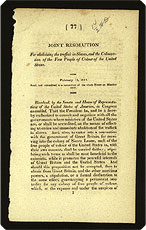
• Shaw & Shoemaker 42596; Library Company, Afro-Americana, 10583. Removed from a nonce volume. Lightly pencilled librarian's notation on p. [1]. Very mild foxing. (18436)
Search
& SeizureVan Buren, Martin (President, 1837–1841). [drop-title] Search or seizure of American vessels on coast of Africa, &c. Message from the President of the United States, transmitting a report from the Secretary of State, in relation to seizures or search of American vessels, &c. March 3, 1841. Read, and laid upon the table. [Washington, 1841]. 8vo. 766 pp. Click
the image
for an enlargement.
Click
the image
for an enlargement. • Disbound; three holes in inner margin, not touching text. Ink notation and numeral on first page. Some dog-earing and tattering in corners and outer margins. Pencillings in several margins. Occasional mild spotting. Now housed in a simple archival phase box. (13455)
For more POST-1820 AMERICANA, click here. For MARITIME matters, click here. For more AFRICANA, click here.
Against! “Secret Confederations” Warfield, Charles. The kingdom and glory of the branch, and testament of the west. Baltimore: William Wooddy [sic], 1833. 8vo (21.9 cm, 8.6"). 261, [3 (blank)], 263–341, [1 (blank)] pp. (lacking port.).

 Click the interior images for enlargements.
 Scarce. Only 11 institutions, all in the U.S., report holdings via OCLC.
• Sabin 37866; American Imprints 22538. Period-style quarter tan cloth with light blue paper–covered sides, spine with printed paper label. Frontispiece portrait lacking. Light to moderate foxing. (23903)
No, No, No. Woodward, George W. Negro suffrage -- The Reconstruction laws. Speech... delivered in the House of Representatives, March 21, 1868. Washington, [D.C.]: F. & J. RIves, & George A. Bailey, 1868. 8vo. 14 pp.
• Folded, never bound. Uncut, mostly unopened. (456)
COLLECTING
Jenkins Company, booksellers, Austin.
The South, Civil War, blacks, and slavery. Austin: The Jenkins Company, 1985.
Folio.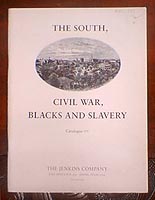
• Original illustrated wrappers. Ink and pencil markings on front cover. Address label on rear.

 For
HUMAN RIGHTS —
For
HUMAN RIGHTS —
 Click here
for related
Click here
for related  material
. . .
material
. . .