 TOBACCOTOBACCO
 Design,
Beauty, Gout,
TOBACCO,
“Chickens”
Design,
Beauty, Gout,
TOBACCO,
“Chickens” Browne, Isaac Hawkins. Poems upon various subjects, Latin and English. London: J. Nourse, 1768. 8vo (24 cm, 9.4"). [10], 160 pp. (frontis. lacking).
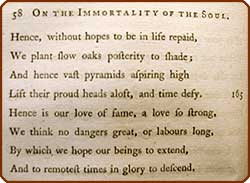
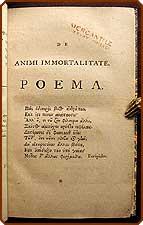
• ESTC T116967. Recent marbled paper–covered boards, spine with printed paper label. Frontispiece lacking; title-page and a few others stamped by a now-defunct institution. Inner margins of the first two leaves and outer margin of the final leaf repaired.

“Who’s
Who”Great Britain. Parliament. A true and exact list of the lords spiritual and temporal, also of the knights[,] commissioners of shires, citizens and burgesses, chosen to serve in the Parliament of Great Britain. [London], 1741. 8vo (19.7 cm, 7.75"). 16 pp.
 tobacco
and wine). The current U.K. Parliament website sums up the terms thusly: “The
Lords Spiritual are made up of the Archbishops of Canterbury and of York, the
Bishops of London, Durham and Winchester as well as specific bishops of the
Church of England. The Lords Temporal are made up of Hereditary Peers elected
under Standing Orders, Life Peers, Law Lords, the earl Marshal and the Lord
Great Chamberlain.”
tobacco
and wine). The current U.K. Parliament website sums up the terms thusly: “The
Lords Spiritual are made up of the Archbishops of Canterbury and of York, the
Bishops of London, Durham and Winchester as well as specific bishops of the
Church of England. The Lords Temporal are made up of Hereditary Peers elected
under Standing Orders, Life Peers, Law Lords, the earl Marshal and the Lord
Great Chamberlain.”
 Click
the image to the right
Click
the image to the right  Uncommon:
ESTC locates only four copies, none of which are in the U.S.
Uncommon:
ESTC locates only four copies, none of which are in the U.S.
• ESTC T26238; Goldsmiths’-Kress 7877.5. Recent marbled paper–covered boards, spine with gilt-stamped leather title-label. Pages age-toned, with some dustsoiling.


 Abolition
of a
Abolition
of a Tobacco
Monopoly
Spain. Laws, statutes, etc. 17 March 1814. Begins: "...Sabed: Que las Cortes han decretado lo siguiente: ...1.o Queda abolido el estanco del tabaco en todas las provincias de la monarquía española en ambos mundos...." [in text at end: Madrid, 17 March 1814 with final subscription in italic type of 20 March 1814]. Folio. [2] ff. (final page blank).
Tobacco
Monopoly
Spain. Laws, statutes, etc. 17 March 1814. Begins: "...Sabed: Que las Cortes han decretado lo siguiente: ...1.o Queda abolido el estanco del tabaco en todas las provincias de la monarquía española en ambos mundos...." [in text at end: Madrid, 17 March 1814 with final subscription in italic type of 20 March 1814]. Folio. [2] ff. (final page blank).
 • The first printing of the 31-clause decree abolishing the Crown's tobacco monopoly, creating free trade in the commodity "in both [the Old and New] worlds," scrapping the old tax structure and instituting a new one, and addressing what is to be done with the government employees in the Tobacco Branch.
• Not in Palau (?); not in Maggs, Bibl. Amer.; not in Harper, Catalogue XVI. Excised from a volume and leaves no longer integral, but now rehinged. Light stain in inner margin. Rubber-stamped numbers in upper margins. Manuscript notes indicating that this copy was sent to authorities in Chile. Now housed in a quarter cloth (faux leather) folder with marbled paper sides.  A nice copy of an important economic document.


 “Apikuni's” Letter, Signed
 Life among the Blackfeet Indians Schultz, James Willard (a.k.a., Apikuni). Typed Letter Signed to Dr. George Bird Grinnell. In English, on paper. “Bozeman, Montana: 1929. Folio (28 cm, 11"). [1] f. (verso blank).
The letter begins: Dear Pinutoyi Istsimokan: Your letter of January 24, about Joe Butch (Henkel). Yes, he is an old timer, but terribly unreliable.” (Unreliable though Henkel may have been, he, too, had a mountain named for him.)
Schultz goes on to tell Grinnell that he is currently writing a story “whenever
a lessening of neuritis pain permits.” There are two paragraphs about
Eli Guardipee, a Métis, who has been with him for a month helping him
with the Blackfeet language. He writes, “I gave him a very pleasant
time of it, good room and meals, plenty of good beer, and sent him to a motion
picture show nearly every evening. . . . He knows the Blackfeet language better
than any mixed blood or white man I ever knew, and loves to dig into the real
meaning of its words and expressions.” Other topics include his study
of Nahwatosis
(or Blackfeet tobacco) and his desire to be called before
a Congressional Committee investigating the Indian Bureau.
Nahwatosis
(or Blackfeet tobacco) and his desire to be called before
a Congressional Committee investigating the Indian Bureau.
Grinnell was an anthropologist, naturalist, and significant writer/editor as to the American West; he actually discovered the Montana glacier that bears his name.
• As it was sent, with some later folds; slight chipping at edges. (24631)



PLACE AN ORDER | E-MAIL US | GO (BACK) TO TOPIC/INTEREST TABLE | PRB&M HOME
All material © 2010
The Philadelphia Rare Books & Manuscripts
Company