 PROVENANCE!
 . . . the history of ownership of an object . . .
PROVENANCE!  “Patty
Horner obey'd, &
pleas'd
LENT HER AID . . .”
“Patty
Horner obey'd, &
pleas'd
LENT HER AID . . .”
 The renowned history of little Jack Horner. Illustrated with sixteen elegant copper-plates. [London: William Darton, 1826]. Square 16mo (12.5 cm; 5"). 16 ff.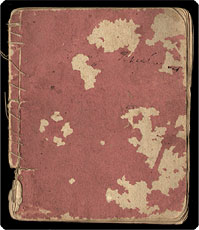
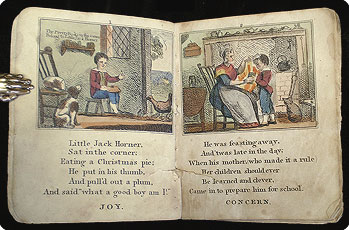
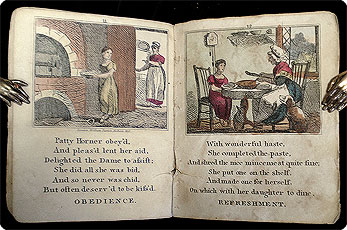
 Click the images for enlargements.
 In this edition all leaves are engraved on one side of leaf only, the engraved pages facing each other: each top half is filled with a hand-colored copper engraving with engraved text below. “The first stanza of this is the traditional nursery rhyme Little Jack Horner. The rest of the text varies considerably from the ballad usually appended to this nursery rhyme. Each stanza is labelled at foot with the activity or quality it represents: Joy, Concern, Prudence, Distress, Benevolence, Hope, Compassion, Gratitude, Reward, Industry, Obedience, Refreshment, Surprise, Encouragement, Affection, Liberality” (UCLA cataloguer).
Provenance: Signature of Henry Wheelwright inside front cover (and on it, though rubbed much away); ownership note of “Mary E. Basto 4 (or possibly 9) Yrs” to front free endpaper, with pencilled reiteration of that and the date 1844.
• Cf. Osborne catalogue, I, 98; Cf. Opie N790. Contemporary or near contemporary reddish wrappers with later oversewing. Lower inner margins of all leaves torn, sometimes into text. Portion of folio 3 missing, costing three words (knowable from the rhyme scheme) and touching two others with resultant loss of four letters.  For a children's book whose edition was clearly read to death, this is far better than a good copy. (26014)

Legends of the American Landscape — Plates & Painterly Prose Richards, Thomas Addison. American scenery, illustrated. New York: Leavitt & Allen Bros., [1854]. 4to (22 cm, 8.7"). Frontis., 310 pp.; 30 plts. (lacking add. t.-p.).
 Click the images for enlargements.
 The work was also published in the same year under the title The Romance of American Landscape, and bears that running title here. This copy has an intriguing early pencilled inscription: “The 1st book my Father gave me came out of his book store - C.L.”
Binding: Publisher's brown sheep in imitation of morocco, covers with embossed grapevine and latticework border stamped in black and with decorative gilt-stamped title (“LANDSCAPE ANNUAL”); spine with same gilt-stamped title and gilt- and black-stamped decorations. All edges gilt.
• Sabin 70958; Wright, II, 2030. Not in BAL. Binding as above, light wear to edges and extremities. Hinges (inside) starting. Front fly-leaf with inscription as above; additional engraved title-page with vignette of Mt. Vernon, lacking. Intermittent light to moderate foxing, mostly to margins of plates.  Lovely book, lovely copy. (26679)
 Catholic Catechism in Aztec — First Edition — Excellent Provenance Ripalda, Gerónimo. Catecismo mexicano. Mexico: Impr. de la Bibliotheca Mexicana, 1758. 16mo. [17] ff., 170 pp., [1] f.


 Click the images for enlargements.
 Beristain describes Paredes as being “outstanding in the Mexican language.” His volume was intended for use by missionaries, by parish priests, and by Indians: Indeed, there is a prologue intended to persuade Indians in particular to read and learn this catechism.


Provenance: Henry Ward Poole ownership signature in minute pencil on rear free endpaper, dated Mexico 1879; old paper auction label at top of spine with lot number; private ownership stamp and bookplate of John Carter Brown; later in the John Carter Brown Library, Providence; deaccessioned.
• Garcia Icazbalceta, Lenguas, 56; Viñaza 341; H. de León-Portilla, Tepuztlahcuilolli, 2286; Palau 269110; Medina, Mexico, 4500; DeBacker-Sommervogel, VI, 210–211; Sabin 71488; Leclerc 2334; Pilling, Proof-sheets, 2891. 19th-century Mexican acid-stained calf, gilt roll of a rope design on boards; gilt spine extra; spine label defective and missing much leather. Title-pages closely cropped at foremargin not costing any letters; small piece torn from the frontispiece. Light to moderate waterstaining and light wear. A rather decent copy of a decidedly important work. (26388)
 Father ofPediatric Medicine Rosén von Rosenstein, Nils. Des Herrn Nils Rosén von Rosenstein ... Anweisung zur Kenntniss und Cur der Kinderkrankheiten. Göttingen und Gotha : Bey Johann Christian Dieterich, 1768. 8vo (17.7 cm; 7"). [8] ff., 541 (i.e., 539 ), [1] pp., [7] ff.
 Click the interior image for an enlargement.
 Garrison and Morton say of the first edition in English: “Sir Frederick Still considered this work 'the most progressive which had yet been written;' it gave an impetus to research which influenced the future course of paediatrics.”
Translator Murray (1740–91) was a Swedish student of Linnaeus and later a professor of botany and medicine at Göttingen.
Provenance: Bookplate of Adamus Elias Schmidt, dated 1784. Early 19th-century signature of a Philadelphia doctor (erased) at top of title-page.
• G&M 6323. Contemporary half calf, well worn: leather dry and gone to red with joint leather lost, cords holding, paper of covers worn through to boards in some places. Text with age-toning. Not a pretty copy but complete, and solid for now. Housed in a red cloth clamshell case. (22256)
 Early Evangelical DevotionsRowe, Elizabeth Singer. Devout exercises of the heart, in meditation and soliloquy, prayer and praise. Hartford: Pr. by J. Babcock, 1800. 12mo (14 cm, 5.5"). 180 pp.
 • Elizabeth Rowe (1674–1737), essayist and poet, requested that hymnographer Isaac Watts edit and publish this collection of prayers and meditations after her death. The first edition appeared in 1738, the first American edition in Boston, 1742, and this work became something of a standard of early Evangelical piety.
Provenance: On a rear blank, “Amos Clarke his book”; another signature with a plea to borrowers below that. Opposite, “Southington September 7th 179[?]” and the note, “Read your Book Every opportunity.”
• ESTC W37924; Evans 38424. On Rowe, see: Dictionary of National Biography. Quarter sheep over paste boards, covers much abraded and chipped; spine leather torn at base and lacking at head. Dog-ears, shallow chipping, and brownstaining—with loss of individual words in a few places. Early inked notations on endpapers.

 Against Magic & Sorcery Saint André, François de. Lettres de Mr. de St. André conseiller-medecin ordinaire du Roy; a quelques-uns de sees amis, au sujet de la magie, des malefices et des sorciers. Où il rend raison des effets les plus surprenans qu'on attribue ordinairement aux démons; & fait voir que ces intelligences n'y ont souvent aucune part; & que tout ce qu'on leur impute, qui ne se trouve ni dans l'ancien, ni dans le Nouveau-Testament, ni autorisé par l'eglise, est naturel ou supposé. Paris: Robert-Marc Despilly, 1725. 16mo (16.2 cm, 6.5"). [3], 446 pp.

 Click the interior images for enlargements.
 Provenance: Ink signatures of “Mesange de St. Andre,” dated 1784, appear on front free endpaper and at top margin of title-page; gift inscription on front fly-leaf reads “Henri de Mesange St. Andre offr. au regt. de Barrois.” Later from the library of Helen de Guerry Simpson.
• Pichon 2075; Coumont, Demonology and Witchcraft, S3.1. Contemporary mottled calf, spine gilt extra and with gilt-stamped label; spine chipped at head and foot, joints open. Marbled endpapers. Ribbon placemarker. Edges stained red. Faint waterstain at lower margin of some leaves. Chip at lower outer corner of pp. 145/146. Slight loss of paper at lower edge of pp. 289/290. Ownership markings include a bookplate on the front pastedown and early ink inscriptions on the front free endpaper, front fly-leaf, and in the blank area of the top margin of the title-page. (24562)
 La Famiglia
 CONTI Salici, Giovanni Andrea. Historia della famiglia Conti di Padova, di Vicenza, et delle discendenti da essa, con l'albero. Vicenza: Appresso Gioan Pietro Gioannini, 1605. Small 4to. [3 (of 4)] ff., 210 pp., [1 (blank)] f.

 Click the images for enlargements.
 Uncommon: We locate only three copies in U.S. libraries.
Provenance: Bookplates of Lord Farnham and the famous Bibliotheca Lindesiana.
• 20th-century faux leather. Two blank portions of title-page excised (old ownership stamps/signatures?); repaired sometime back and next two leaves also with old repairs at gutter. Lacks one preliminary leaf; usually-slim strip of water- or damp-damage affecting top margins in various degrees; all edges red. (13489)

The PRESS of the Aldine Forger Sallustius Crispus, C. [i.e., Sallust]. Salvstius. [Lugduni {i.e., Lyons}: The Aldine Forger, 1504]. Small 8vo. [116] ff.


 Click the images for enlargements.
 Rare: COPAC locates only the copy at the University of Manchester library, but we trace other U.K. copies in the British Library and Cambridge University library. In the U.S. and Canada the only copies we find are at the UCLA and the Pierpont Morgan libraries.
Provenance: Ownership signatures on the front free endpaper: “J. Turner, 1790" and “John S. Conner / North Bend Ohio / Oct. 18th 1877.”
• Renouard 48:10 and 308:22; Baudrier, VII, 20; Adams S137; Shaw 44; Aldine Press. Catalogue of the Aldine Collection, UCLA, 1115. Full dark walnut modern calf old style: Spine with raised bands accented with gilt and blind rules, the blind ones extending onto covers to terminate in trefoils; burgundy leather author label and gilt date; gilt tools to spine compartments. Blind double fillets framing covers. Heavy browning to the first two and a half signatures and again in the last gathering; minor worm damage to blank area of title-leaf; additional dampstaining, mainly though not exclusively to margins, more often than “occasionally” and yet not quite “throughout.” Withal, a reputable copy of a notable forgery. (25748)
Hawkey's Sallust Sallustius Crispus, Gaius. C. Crispi Sallustii opera. Dublinii: E Typographia Academiae, 1747. 8vo in 4s (18.6 cm, 7.4"). [2], 168 (i.e., 198) pp.

 Click the images for enlargements.
 OCLC and ESTC locate only six U.S. institutional holdings.
Binding: Contemporary treed calf with covers framed in gilt single fillet, spine gilt extra with gilt-stamped leather title-label. The sunburst tool with floral center used on the spine resembles that used by the Hallhead and McKenzie binderies on Dublin College books, lacking the border. Marbled endpapers; green silk placemarker present.
Provenance: Title-page with early inked inscription of “M. M'Causland” (possibly Marcus McCausland [1787–1862]).
• ESTC T132869; Schweiger, II, 822; McDonnell & Healy, Gold-Tooled Bindings Commissioned by Trinity College Dublin, 27–30 & 295–99; Lowndes 1607; Graesse, VI, 241; Dibdin, II, 109; Brunet, V, 87. Binding as above, board edges lightly rubbed, leather lost at head of spine, small abrasion to front cover, some spine gilt chipped; still, quite nice. Inscription as above; pages otherwise clean and unmarked. Pp. 197/98 incorrectly paginated as 167/68. (25949)
Illustrated Early Frisian History — 16 Engraved Portraits Schotanus, Christianus. De geschiedenissen kerckelyck ende wereldtlyck van Friesland Oost ende West; beginnende van d'eerste Geheuchenis ende vol-trocken tot op het Iaar na Christi Geboorte MDLXXXIII [i.e., 1583 but in error for MDLXXXIV]. Franeker: Ian Boudewyns Wellens, 1658. Folio (32 cm, 12.5"). [34], 929 (i.e., 931), [25 (index)], 148 pp.; 17 plts.


 Click the interior images for enlargements.
 A collection of relevant letters and documents in Latin and Dutch (“Tablinum dat is: Brieven ende documenten, dienende tot de Friesche historie”) is appended at the back. The volume is attractively printed in double columns (primarily black-letter), with an engraved title-page, 16 engraved portraits of Classical, medieval, and Renaissance figures, and a striking, full-page engraved coat of arms as well as decorative capitals and head- and tailpieces.
Moderately uncommon in libraries, with OCLC and NUC Pre-1956 locating only ten U.S. holdings (one of which has been deaccessioned), this is quite uncommon on the market.
Provenance: Bookplate of “I.M.” (Isaac Meulman) on front pastedown, with his device and motto, “Grijpt als 't rijpt.” Meulman, a 19th-century merchant collector in Amsterdam, gathered an extraordinary library of Dutch history and theology, much of which was purchased at his sale by the Evangelisch Luthersch Seminarium of his home city.
• Pirenne, Bibliographie de l'histoire de Belgique, 1232. 19th-century quarter vellum and speckled paper–covered sides, spine with very neatly inked title, author, and date information; joints starting from head, sides rubbed/scuffed with corners bumped, spine with inked call number and light discolored patch from now-absent label at foot. Half-title with small inked numeral in lower margin; lower edges of closed book institutionally rubber-stamped. One leaf with short tear from outer margin, touching shouldernote without loss of text; four leaves with lower outer corners torn away, not affecting text. Some instances of light offsetting; scattered faint spotting confined almost entirely to upper and outer margins. Front pastedown with bookplate as above, speckled with old staining.  A strong copy with a pleasing provenance. (24980)
The Reformation Through the Reformers' Letters Schweblin, Heinrich (comp. & ed.). Centuria epistolarum theologicarum ad Johannem Schwebelium. Ante annos LXXV. ecclesiarum illustrissimi ducatus Bipontini praesidem. [Bipontinum]: Typographia Bipontia per Casparum Wittelium, 1597. Small 8vo ( ). [8] ff., 359, [1 (blank)] pp., [31] ff. (without the final blank).

 Click the interior images for enlargements.
 The correspondence was printed in roman type with some italic, in this Zweibrücken imprint. Heinrich's life of his father, which occupies the first 16 leaves following the main text, is entirely in italic type.
Provenance: Ownership inscription on title-page of “D. Fr. Gothold Dürr 1773.”
Rare outside of Germany: We locate only one copy in a U.S. library.
• VD16 S4757. Full dark walnut modern calf old style: Spine with raised bands accented with gilt beading and blind rules, the latter extending onto covers to terminate in trefoils; title in gilt in one spine compartment and date in gilt at base of spine. Blind double fillets framing covers and with blind-tooled devices in the corners of the covers; a center panel on each cover with a cross-hatched diamond pattern in blind. 18th- century ownership note and a few other marks to title-page, with extended old note on front free endpaper opposite. Uniform age-toning, and all edges red. (25822)
Eyewitness Report of theArmenian Genocide, Inscribed by the Author Shahbaz, Yonan H. The rage of Islam: An account of the massacre of Christians by the Turks in Persia ... fourth edition. Philadelphia: The Judson Press, [1929]. 8vo (20 cm, 7.9"). Frontis., xiv, [4], 210 pp.; 1 fold. map., 16 plts.

 The 16 plates of illustration are interesting, sometimes moving.
Click the images for enlargements.
The 16 plates of illustration are interesting, sometimes moving.
Click the images for enlargements. Presentation copy: Front free endpaper inscribed “Compliments of the Author. To Dr. Franklin Feb. 19th 1930.”
• Starr, Baptist Bibliography, S2241. Publisher's maroon cloth, front cover and spine with gilt-stamped title; insignificant wear to corners and spine extremities, foot of spine with small area of faint discoloration. Title-page institutionally pressure-stamped, dedication page with inked notation along inner margin and rubber-stamped numeral in lower margin. Back pastedown with traces of now-absent bookplate. Sewing starting to loosen. Pages and plates clean. (26041)
TWO Important Works of Local HistoryThe Editor’s OWN CopiesSigüenza y Góngora, Carlos de; José María Zelaa é Hidalgo (rev. & ed.). Glorias de Queretaro, en la fundacion y admirables progresos de la muy i. y ven. congregacion eclesiástica de presbiteros seculares de Maria Santisima de Guadalupe de Mexico, con que se ilustra y en el suntuoso templo que dedicó a su obsequio el Br. D. Juan Caballero y Ocio... que en otro tiempo escribio el Dr. D. Cárlos de Sigüenza y Góngora. Mexico: En la oficina de M.J. de Zúñiga y Ontiveros, 1803. Small 4to (19.8 cm; 7.875"). [8] ff., 235, [1] pp., [2] ff., 2 fold. plans. [bound with] Zelaa e Hidalgo, José María. Adiciones al libro de las Glorias de Querétaro, que se imprimió en México el año de mil ochocientos tres. Mexico: Imprenta de Arizpe, 1810. Small 4to (19.8 cm; 7.875"). [6] ff., 94 pp., [2] ff.

 Click any image above for an enlargement.
The pairing of Zelaa’s two efforts in one volume is both uncommon and intellectually reinforcing. But here, it is more than that: It is a personal memento of a life’s work as well, forthis copy bears the bookplate of the editor himself.
 Provenance: Bookplate of José María Zelaa é Hidalgo. 20th-century rubber-stamp with initials only of a private Mexican collector.
• Sigüenza: Medina, Mexico, 9637; Palau 312964. Zelaa: Medina, Mexico, 10540; Garritz 940; not in Palau. Publisher's sheep, gilt spine; small amount of leather missing from base of spine. Collector’s stamp partly offset to title-page; otherwise, the occasional stray stain only. “Association copies” don’t get much more “associated” than this.

 A
Catholic School
Prize Copy:
“High Sanctity
Attained in an Indian Wigwam”
Smet, Pierre-Jean de. New Indian sketches. New York:
D. & J. Sadlier & Co., [ca. 1870]. 12mo (16.4 cm, 6.45"). Frontis., [2], [2]–3, [7]–175, [1] pp.
A
Catholic School
Prize Copy:
“High Sanctity
Attained in an Indian Wigwam”
Smet, Pierre-Jean de. New Indian sketches. New York:
D. & J. Sadlier & Co., [ca. 1870]. 12mo (16.4 cm, 6.45"). Frontis., [2], [2]–3, [7]–175, [1] pp.

 Click the images for enlargements.
 Provenance: Front pastedown with presentation bookplate of a Catholic Sunday School in Virginia, dated 1880; front free endpaper with recipient's ownership inscription.
• Sabin 82267; Pilling, Proof-sheets, 3631; Wagner-Camp 395; Howes D285. Publisher's green cloth blind-stamped in diapered pattern containing crosses (not in Krupp), spine with elaborate gilt-stamped title and decorations; binding cocked and rubbed, sides with spots of discoloration. Front pastedown and free endpaper as above. Back hinge (inside) reinforced with cloth tape. Pages age-toned, with scattered spotting. (26581)
For
German-AMERICANS
Wanting
to Learn
English
Sower (a.k.a. Saur), Christopher, comp. Eine nuetzliche Anweisung oder Beyhuelffe vor Deutsche um Englisch zu lernen.... Nebst einer Grammatic.... Vierte und vermehrte Auflage. Germantaun: Gedruckt und zu bekommen bey Peter Leibert, 1792. 8vo (16.8 cm, 6.6"). [4], 282 (i.e., 284) pp.
Learn
English
Sower (a.k.a. Saur), Christopher, comp. Eine nuetzliche Anweisung oder Beyhuelffe vor Deutsche um Englisch zu lernen.... Nebst einer Grammatic.... Vierte und vermehrte Auflage. Germantaun: Gedruckt und zu bekommen bey Peter Leibert, 1792. 8vo (16.8 cm, 6.6"). [4], 282 (i.e., 284) pp. 


 Click the images for enlargements. In addition to the lessons it includes short German–English and English–German lexicons. First published in 1751, it is printed here in both fraktur and roman type, with a woodcut headpiece of the all-seeing eye above the preface. This is the fourth of four 18th-century editions.
Provenance: Front fly-leaf with early inked inscription “Sebastian Keller jnr.” Sebastian Keller the second was the son of Catharine Hummer of White Oak, Pennsylvania; Hummer was the first woman to preach among the German Baptist Brethren of Pennsylvania, and famed for her visions of dead people being baptized in Heaven.
• ESTC W21002; Evans 24771; Arndt & Eck, German Language Printing in the U.S., 853. Contemporary mottled sheep, covers framed in blind double fillets; binding scuffed and rubbed, spine and front cover with insect damage. Pages browned and intermittently stained as usual with German American imprints; edges of front free endpaper, first few leaves, and back free endpaper tattered. Front fly-leaf with inscription as above. (26180)

Spenser inPickering's Aldine Edition Spenser, Edmund. The poetical works of Edmund Spenser. London: William Pickering, 1839. 8vo (16.5 cm, 6.5"). 5 vols. I: Frontis., viii, lxxvi, 282 pp. II: vi, 295, [1] pp. III: iv, 296 pp. IV: vi, 305, [1] pp. V: vi, 317, [1] pp.


Binding: Brown embossed morocco ca. 1850–60, spines with gilt-stamped title and blind-tooled decorations; all edges gilt and gauffered; binding signed by Field.
Provenance: Armorial bookplates of Robert H. Menzies, early inked ownership inscriptions of Caroline Syers.
• NSTC 2M31627; Lowndes 2477. On Pickering, see: Oxford Dictionary of National Biography online. Bindings as above, extremities showing only minimal wear. Bookplates on front pastedowns and ownership inscriptions on front fly-leaves, as above. A very handsome production, a very nice set. (24404)
 For more SETS, click here.
Shaker Bible — “Testimonies” as Part Two Stewart, Philemon. A holy, sacred, and divine roll and book; from the Lord God of Heaven, to the inhabitants of Earth: revealed in the United Society at New Lebanon, County of Columbia, State of New-York, United States of America. Canterbury, N.H.: United Society, 1843. 8vo. vii, 222, [3] pp., [2] ff., 223–403, [3] pp.

 Click the interior images for enlargements.
 The second part (pp. 267–403), which contains its own title-page, is a collection of testimonies by “inspired writers,” or Shakers professing their faith in the book's divine source.
“Read and understand all ye in mortal clay,” exhorts the title-page — “Received by the church of this communion, and published in union with the same.”
Provenance: In the library of Colgate Rochester Divinity School; inscription on front free endpaper “To be returned to Amelia G. Mace, Office.”
• Sabin 32664, 79708; and 90701.5 for revised collation. Contemporary sheep, recently rebacked in plain calf with gilt-ruled bands and gilt-stamped green leather title-label. Ex-library copy, with rubber-stamp on all paper edges and p. [1]; rubber-stamped five-digit number at base of p. [iii]; inscription on front free endpaper in blue ink (see above); and faint traces of a librarian's penciling at inner margin of p. [iii] and verso of title-page. Small bookseller's ticket at lower outer corner of rear pastedown. Some foxing, especially to endpapers; offsetting from leather affecting title-page and following page, at edges; very good condition. (24495)
Fred's Book — Scarce! Sunbeam, Susie [pseud. of Mrs. Henry S. Mackarness]. The picture alphabet, with stories. Boston: Locke & Bubier, [1856]. 32mo. [2 (blank)], 96, 96, [4 (blank)] pp.; illus.
 Click the images for enlargements.
 Binding: Publisher's terra cotta colored cloth, stamped in black on front cover, spine stamped with gilt lettering and decorations. Center of front cover bears a full-color paper on-lay picturing a dancing boy (possibly, Irish?) playing an accordion.
Provenance: In ink, on fly-leaf, “Fred from Aunty Bertha.” In pencil, “Frederic Wade Hitching, father of Elizabeth.”
Scarce, OCLC listing only one copy with this imprint.
• Binding slightly cocked/loose, stained, lightly rubbed over joints, and with cloth tearing a bit at head and foot of spine; paper cover onlay with one corner chipped. Lacks front free endpaper. Presentation inscription and note as above. Good+. (7481)

 TO
Part IX TO
Part IX |