 PRESSES / TYPOGRAPHY
PRESSES / TYPOGRAPHY
PRESSES / TYPOGRAPHY
 English Incunable
Leaf — Crucifixion
Woodcut
English Incunable
Leaf — Crucifixion
Woodcut
 (A
WYNKYN DE WORDE LEAF). Jacobus
de Voragine. Golden legend [single leaf]. [Westmynster:
Wynkyn de Worde, 1498]. Small folio (27.5 cm; 10.5"). [1] f. .
(A
WYNKYN DE WORDE LEAF). Jacobus
de Voragine. Golden legend [single leaf]. [Westmynster:
Wynkyn de Worde, 1498]. Small folio (27.5 cm; 10.5"). [1] f. .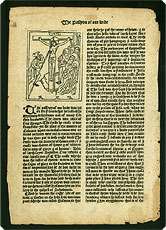
 Click the images for enlargements.
 The text is printed in double-column format in English gothic type. The printer, Wynkyn de Worde (a.k.a., Jan van Wynkyn) was England's first typographer and worked with William Caxton, England's first printer. In 1495, he took over Caxton's print shop, but only after a difficult three-year litigation following Caxton's death in 1491.
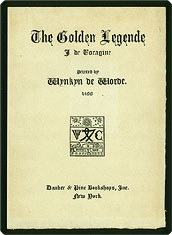
Provenance: Sold by Dauber & Pine (NY), the firm having dismembered an incomplete copy of the work and offered the individual leaves each with a letter-press leaf serving as ad hoc title-page.
English incunable leaves with woodcuts are increasingly difficult to obtain. That this Golden Legend leaf bears the image at the heart of its matter makes it a particularly desirable one.
• STC (rev. ed.) 24876; ESTC S103597; Duff 411; Copinger 6475; Goff J-151. Irregular in the margins and the recto of the leaf with old ink crossing out. The page with the woodcut in very good condition. (24601)

Two
Church Fathers —
Two
Scholar Printers An
Apparatus by Erasmus
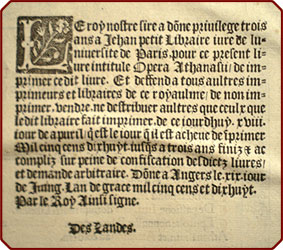
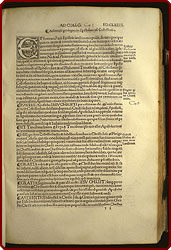
Athanasius, Saint, Patriarch of Alexandria.
Athanasii Episcopi Alexandrini sanctissima, eloquentissma que opera ...
que omnia olimia[m] latina facta Christophoro Porsena, Ambrosio Monacho, Angelo
Politiano, interpretibus, una cum doctissima Erasmi Roterodani ad pium lectorem
paraclesi. [bound with anoth er work as below]. Parisiis: Joanne Paruo [i.e.,
Jean Petit] , [1519]. Folio extra. [6], 255, [66] ff. [bound with] Basil,
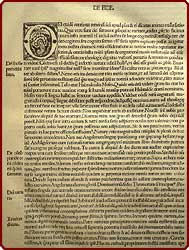
Saint, Bishop of Caesarea. Basilii Magni Caesariensium in Cappadocia
Antistitis sanctissimi opera plane diuina, variis e locis sedulo collecta: & accuratio[n]e
ac impe[n]sis Iodici Badii Asce´sii recognita & coimpressa, quorum index proxima
pandetur charta. [Paris: Venundantur eidem Ascensio [i.e., Badius Ascensius, 1520].
Folio extra. [10], 178 ff.
An
Apparatus by Erasmus
Athanasius, Saint, Patriarch of Alexandria.
Athanasii Episcopi Alexandrini sanctissima, eloquentissma que opera ...
que omnia olimia[m] latina facta Christophoro Porsena, Ambrosio Monacho, Angelo
Politiano, interpretibus, una cum doctissima Erasmi Roterodani ad pium lectorem
paraclesi. [bound with anoth er work as below]. Parisiis: Joanne Paruo [i.e.,
Jean Petit] , [1519]. Folio extra. [6], 255, [66] ff. [bound with] Basil,
Saint, Bishop of Caesarea. Basilii Magni Caesariensium in Cappadocia
Antistitis sanctissimi opera plane diuina, variis e locis sedulo collecta: & accuratio[n]e
ac impe[n]sis Iodici Badii Asce´sii recognita & coimpressa, quorum index proxima
pandetur charta. [Paris: Venundantur eidem Ascensio [i.e., Badius Ascensius, 1520].
Folio extra. [10], 178 ff. 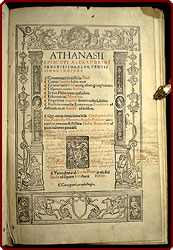
 Click any image where the hand appears on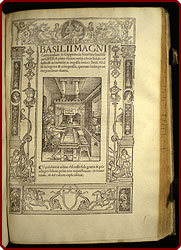
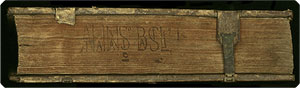
 A
PRB&M “FEATURED BOOK” —
A
PRB&M “FEATURED BOOK” —
 A Book, then a Movie — A Woman Writer'sROMANTIC Fairy Tale Abbott, Eleanor Hallowell. Molly make-believe. New York: Press of the Woolly Whale, 1931. 8vo. [8], 154, [4] pp.
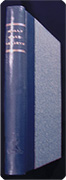
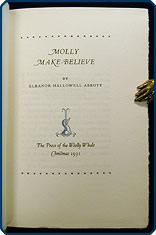
• Publisher's half blue morocco over lighter blue cloth-covered boards, top edge gilt. A fine copy. (24546)

Ethics
of Patriotism —
Illusions of War
— Woolly
WhaleAngell, Norman. Patriotism versus welfare: An extract from the "Unseen assassins" New York: Press of the Woolly Whale, 1932. 8vo. [4], vii, [3], 32, [2] pp.
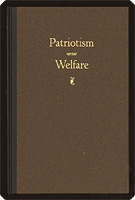
• Publisher's quarter cloth with paper-covered boards, front cover and spine with gilt-stamped title. Very fine. (20579)


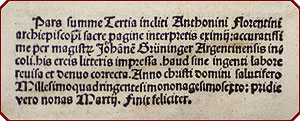
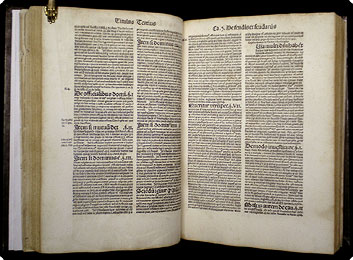
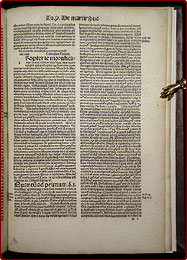
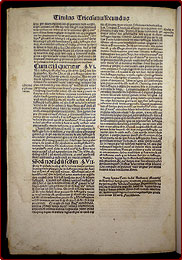
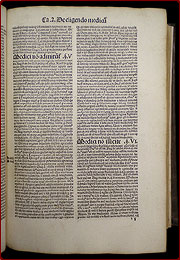
His Fellow Novice Was Fra Angelico . . . Incunable from the Press of Grüninger Antoninus, Saint, Abp. of Florence. Tertia pars totius su[m]me maioris beati Antonini [i.e., Summa theologica, pars tertia]. [Argentinae: Johann Grüninger, 1496]. Folio ( 31 cm; 12/25"). [311 of 312] ff., lacks final blank.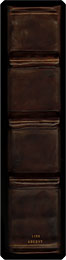
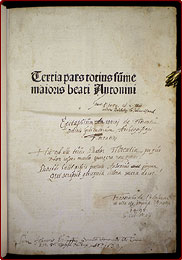
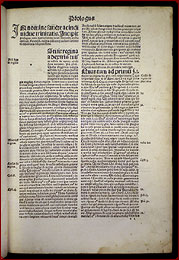
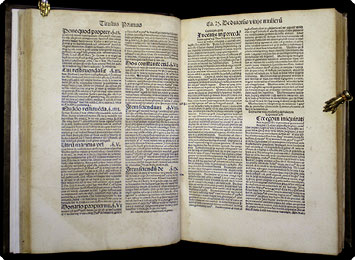 Click the interior images for enlargements.
 Summa Theologica Moralis is the saint's principal work and was written shortly before his death. Scholars say it marks a new and considerable development in moral theology, as well as containing a fund of matter for the student of the history of the 15th century.
Provenance: 1630 ownership inscription; later in the library of a divinity school, deaccessioned.
Jane Austen's Works — A Handsome,
Limited Edition Illustrated by the Brock Brothers Austen, Jane. The novels and letters of Jane Austen. New York & Philadelphia: Frank S. Holby, 1906. 8vo. 12 (of 12) vols. I: Frontis., [6], vii–lix, [6], 255 pp.; 5 plts. II: Frontis., [8], 302 pp.; 6 plts. III: Frontis., [4], v–vii, 3–283 pp.; 5 plts. IV: Frontis., [8], [3]–299 pp.; 5 plts. V: Frontis., [4], v–vii, [5], 338 pp.; 5 plts. VI: Frontis., [8], 347 pp.; 5 plts. VII: Frontis., [6], vii–viii, [4]–339 pp.; 5 plts. VIII: Frontis., [8], 359 pp.; 5 plts. IX: Frontis., [4], v–viii, [4]–338 pp.; 5 plts. X: Frontis., [4], vii–viii, [4]–362 pp.; 5 plts. XI: [10], 3–392 pp.; 3 plts. XII: Frontis., [8], 3–393 pp.; 3 plts. (1 fold.).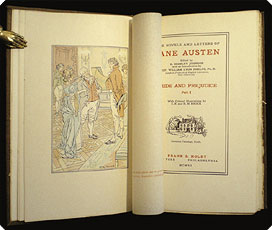
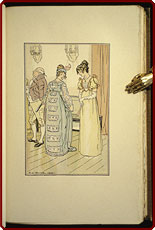
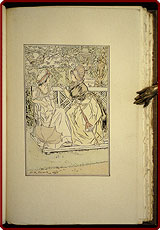 Click any interior image for enlargement.
 PRB&M offers a small prize to anyone who can, without looking anything up,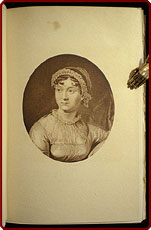
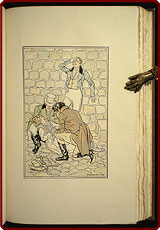
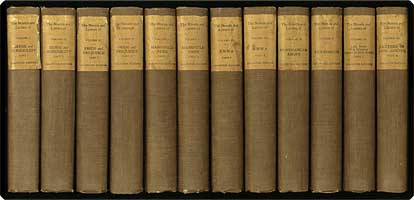 69 plates, including a wonderful series of color drawings to accompany the text, done by the brothers Charles Edmond and Henry Matthew Brock, this isadditionally embellished with portraits of the author, pictures of her residences in Bath and Winchester, a view of her burial place inside Winchester Cathedral, a facsimile autograph letter, and a facsimile title-page of the first edition of Sense and Sensibility. Each plate is accompanied by a protective tissue guard, printed with a descriptive caption in red ink. Title-pages are printed in red and black, and each has its own unique engraved vignette.
  The delights in this production abound. On the whole, very satisfying!
• Publisher's brown cloth, spines with brown paper label; several labels with ssmall brown spots, cracks, and edge chips, not too conspicuous and not affecting printing. Two leaves (pp. 343–346 of vol. X) detached from binding; long tear down center of pp. 283/284 (vol. IV), without loss of text; except for two leaves with some offsetting from laid-in scrap of paper, interiors clean. Outer and lower edges deckle, with a few signatures opened unevenly and some unopened. A very good set. (24537)
 For more SETS, click here.
Amores — A Partial ElzevirBaudius, Dominicus. Amores, edente Petro Scriverio, inscripti Th. Graswinckelio. Lugduni-Batavorum: Francisci Hegerus & Hackius, 1638. 12mo. [6] ff., 518 pp., [1] f.; illus. 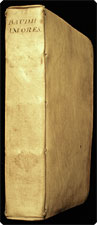
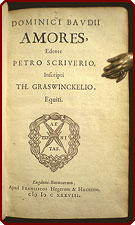
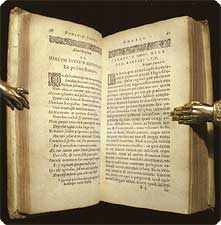
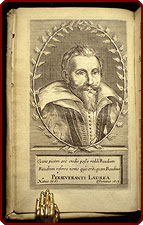 Click the interior images for enlargements.
 This work is the first listed in all bibliographies under Louis Elzevir’s press at Amsterdam. In fact both the Elzevir edition of 1638 and this have the same colophon: “Lugduni-Batavorum: Typis Georgii Abrahami vander Marse, MDCXXXVIII.” And both collate the same, the only difference being the printer’s device and imprint information on the title-page.
Uncommon: Searches of OCLC, RLIN, & NUC locate fewer than ten copies in U.S. libraries.
Provenance: The Rev. Edward A. Dalrymple (Baltimore collector, mid–19th century); his collection given to the Maryland Diocesan Library; that library sold in 2006.
• Rahir 1876; Willems 961 note. Contemporary vellum over light boards; spine delicately and lightly tooled in gilt. Ex–Maryland Episcopal Diocesan Library with stamp on front pastedown. One natural paper flaw; occasional early underlining.
Bede's
Commentary onOLD
Testament Books
Bede,
the Venerable, Saint. Bedae presbyteri Anglosaxonis,
theologi suo aevo celeberrimi, Opus planè nouum. Cui insunt In Samuelem
prophetam, id es Regnorum primum, libri IIII ... En nouam operum Bedae portiunculam
tibi candide lector damus, iamprimu[m] ex vetustissimo corruptissimoq[ue] codice,
qui unicus nobis fuit, typis nostris ea qua potuimus diligentia transformata[m],
quam si probare te senserimus, eiusdem longe maiora, quae penes nos sunt manu
scripta, propediem exhibituri sumus, illis interim felix fruere. Basileae: [colophon:
Per Andr. Cratandrum et Ioan. Bebelium], 1533. Folio (29.5
cm; 11.75"). [4], 195, [1] ff.
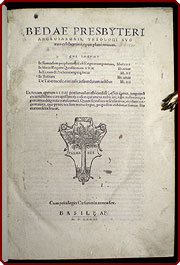
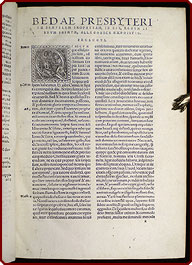
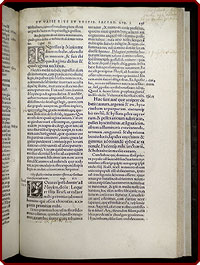 Click the images for enlargements.
 Johannes Bebelius’ printer’s device appears on the title-page and on the verso of the final leaf, while the errata are printed on the verso of leaf 195, just above the colophon.
Evidence of readership: Faded sepia marginalia and/or underlining on folios 154, 155, 156.
WorldCat locates only six copies in U.S. libraries, one of which has been deaccessioned.
• VD16 B3048. Full dark modern calf old style, green leather spine label; spine with raised bands accented with blind rules extending onto covers to terminate in trefoils, and simple blind double fillets to covers; title-page reinforced at inner margin, lightly soiled. Pinhole worming, on most pages in lower margin; occasionally in text touching a letter but not costing text. “Elenchus” leaves with light waterstain to upper outer quadrant; same in inner upper and upper margins of commentary most notable from folios 100 to end, where at times it is brown and into the text of the inner columns. (26539)
 Printed
in Baskerville Type
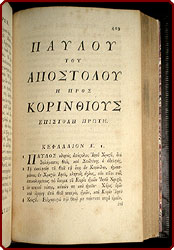
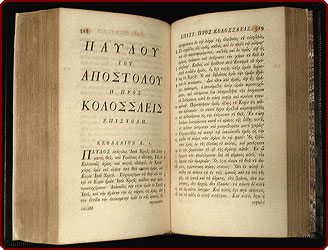
Bible.
N.T. Greek. 1763. [two lines in Greek, then]
Novum Testamentum juxta exemplar millianum. Oxonii: Typis Joannis Baskerville;
e typographeo Clarendoniano, sumptibus academiae, 1763. 8vo. [1] f., 676 pp.,
without the half-title.
Printed
in Baskerville Type
Bible.
N.T. Greek. 1763. [two lines in Greek, then]
Novum Testamentum juxta exemplar millianum. Oxonii: Typis Joannis Baskerville;
e typographeo Clarendoniano, sumptibus academiae, 1763. 8vo. [1] f., 676 pp.,
without the half-title.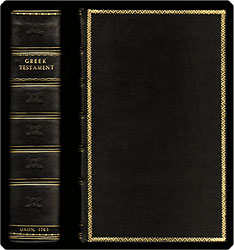
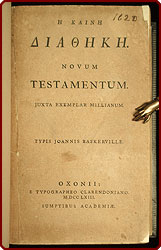
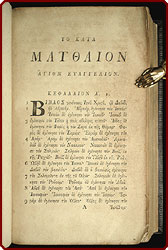 Click the images for enlargements.
  An
important example of 18th-century fine printing of the Bible. The
text uses the Mill edition of the Greek N.T.
An
important example of 18th-century fine printing of the Bible. The
text uses the Mill edition of the Greek N.T.
 Edited & Printed by a
 Would-Be Academic Bible. O.T. Hebrew. 1662. Sacra Biblia Hebraea, ex optimis editionibus diligenter expressa, & formâ, literis versuumque distinctione commendata. Lugduni Batavorum: Nisselianis, 1662. 8vo (19.1 cm, 7.5"). [431] ff. (lacking 1 internal f. [blank]).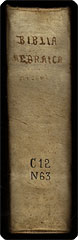
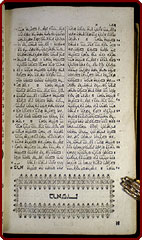
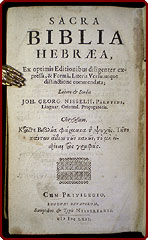
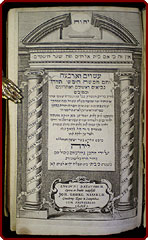 Click the images for enlargements.
 Darlow and Moule note that the text here is based on Stephanus's Bible, with reference to the editions of Bomberg and Mannasseh ben Israel; after Nisselius's death, the work was completed by Allart Uchtmann, who wrote the preface. The Hebrew text is vocalized and, for the most part, set fairly plainly in double columns, but it is occasionally decorated with typographical ornaments. This copy includes the additional engraved title-page, which is handsome.
• Darlow & Moule 5133; Fuks & Fuks-Mansfeld, Hebrew Typography in the Northern Netherlands, 1585-1815, 48 (on Nisselius and this work, see also pp. 45–46). Contemporary vellum, soiled; spine with early inked title and old shelving number. Front free endpaper with early inked annotations; first three leaves institutionally pressure-stamped; title-pages reinforced along inner margin; one internal blank leaf lacking. Pages with light age-toning and offsetting; roughly half of volume with light staining in upper margins. All edges red. (26193)
Saur Psalms, 1764 Bible. O.T. Psalms. German. Luther. 1764. Das kleine Davidische Psalterspiel der Kinder Zions. Germantown: Gedruckt bey Christoph Saur, 1764. 12mo. [3] ff., 570 pp., [12] ff.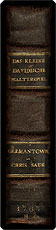
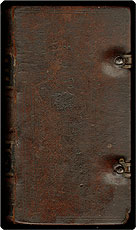
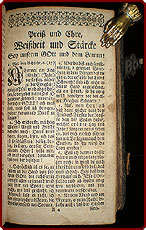 Click the images for enlargements.
 Provenance: Old inked inscription of John Ebersole, dated 1793, on front free endpaper; later pencilled signatures of Anna Ebersole and another person to pastedown.
• Evans 9602; Hildeburn, Pennsylvania, 2045; Arndt & Eck, First Century of German Language Printing in the U.S., 296; ESTC W20981. Contemporary calf with one clasp working and a remnant of the other; moderate rubbing to covers, leather on spine showing flex marks from the tight-back binding. Later spine labels. Faint library pressure-stamp on title-page; signatures as above. Age-toning and some staining; in fact the paper in cleaner condition than is often seen. (25959)
For the“United States of Columbia” Bible. English. 1800. Authorized (i.e., “King James Version”). The Holy Bible, containing the Old and New Testaments: Translated out of the original tongues, and with the former translations diligently compared and revised, by the special command of King James I, of England. Worcester, MA: Isaiah Thomas, 1800. 12mo (17.6 cm, 6.9"). [788 (of 792)] pp. (X1 and X12 lacking).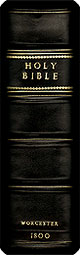
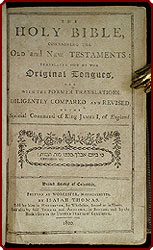
 Click the images for enlargements.
 In an attempt to promote the idea of changing the country's name from the United States of America to the United States of Columbia, Thomas used the latter nomenclature on all issues of his proudly local, non-imported production.
ESTC and OCLC locate only eight institutional holdings, all in the U.S.
• ESTC W4503; Evans 36955; Hills 72; O'Callaghan 55 (for 1799 ed.). Period-style calf, framed and panelled in blind rolls, spine with gilt-stamped title and publication information and gilt-ruled raised bands, turn-ins blind-tooled. Two pages of Jeremiah (not consecutive) lacking. Pages age-toned with moderate staining; first and last few leaves with edge nicks, chips, and short tears; a few leaves creased; one leaf with lower margin chipped, resulting in loss of about four words. Some corners bumped or dog-eared. (26121)
AT
LEAST THREE
“FIRSTS” — First
English SeptuagintBible.
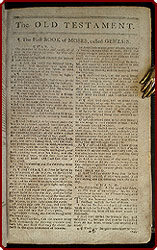
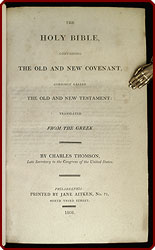
English. 1808. Thomson.
The Holy Bible, containing the Old and New Covenant, commonly called the Old
and New Testament: Translated from the Greek. By Charles Thomson.... Philadelphia:
Pr. by Jane Aitken, 1808. 8vo. 4 vols. I: [252] ff. II: [245] ff. III: [222]
ff. IV: [240] ff.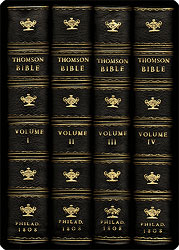
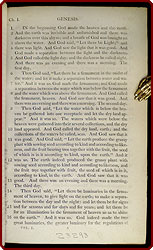
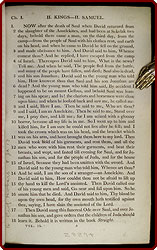
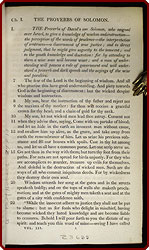
 Click the images for enlargements.
  It was
also the first translation of the Greek New Testament into English by a native
of Ireland, and of course it is the work of a key figure of the American Revolution.
It was
also the first translation of the Greek New Testament into English by a native
of Ireland, and of course it is the work of a key figure of the American Revolution.
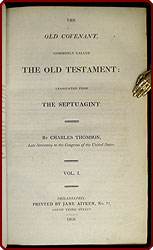
On 4 July 1776 only two signatures were affixed to the unanimously adopted Declaration of Independence — those of John Hancock, president of the Congress, and Charles Thomson, secretary, in order to authenticate the document that had been voted on and approved. Yet by a curious twist of fate (read rather, surely, of a political enemy's knife), when the calligraphic copy that is so well known to every school child was ready shortly after 19 July, authenticator Thomson was not invited to sign it!
When he had retired from public life in 1789, Thomson was to turn his interest in the Bible and Greek to the 20-year task of producing this monumentally important work.
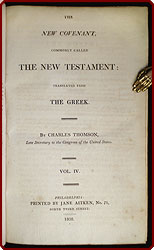
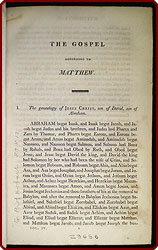
Its printer was the daughter of Robert Aitken, who had printed the first Bible in English in America. A major edition of the English Bible, this is essential for any Bible collection, not just for collections of American Bibles — though as an American Bible and simple Americanum it has a revered place.• Rumball-Petre, Rare Bibles, 184; Hills 153; Herbert 1514; O'Callaghan 91–92; Shaw & Shoemaker 14486. On Thomson, see: Dictionary of American Biography, XVIII, 481–82. Modern full black morocco, signed “GB” (Grace Bindings). Gilt spines. Black endpapers. The effect, richly elegant. Faintly visible pressure-stamps of a library (properly deaccessioned), each volume with neatly pencilled collection note and small old inked 5-digit number to first text leaf; in fact a remarkably clean, ever–well cared for, and handsome set. (26019)
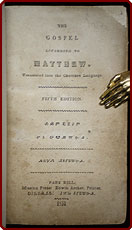
A Composite New Testament inCHEROKEE Bible. N.T. Cherokee. Worcester & Boudinot. [Composite New Testament, as below]. Park Hill: Mission Press, 1842–59. 12mo (13 cm; 5"). Various paginations.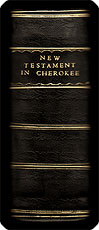
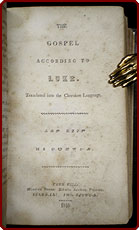
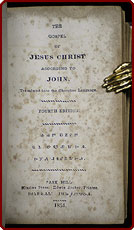 Click the images for enlargements.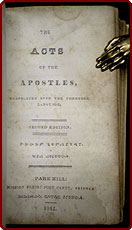
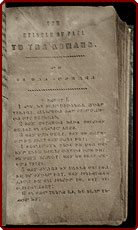
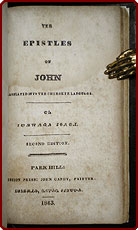
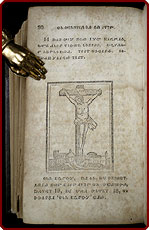 Creating composite New Testaments composed of mixed editions of the separately published Gospels and other books of the New Testament in Cherokee was a common practice at the Park Hill Mission Press in the middle of the 19th century. The main translators were Samuel A. Worcester, a medical missionary, and Elias Boudinot, a Cherokee who had been educated at the Foreign Mission School in Cornwall, Connecticut. His name at birth was Galagina, but at the school he adopted the name of its chief benefactor. Evan Jones was a Welsh-born missionary who spent 50 years among the Cherokee; John B. Jones was his son and was educated at the University of Rochester and then worked with his father as a missionary among the Cherokee until his death in 1876. The Rev. Stephen Foreman was a Cherokee Presbyterian minister and politician, born in Georgia in 1807, the son of John Anthony Foreman, of Scotch descent, and his Cherokee wife Wattie. He attended Union Theological Seminary in Virginia and Princeton Theological Seminary in New Jersey.
The first complete New Testament came from the press of the American Bible Society with a publication date of 1860, but it seems not to have really been published until 1862.
Present are 13 separately published works containing 23 books of the N.T. in Cherokee using Sequoyah's syllabary (generally called the “Cherokee alphabet”) and printed at the famous Park Hill mission press. Absent from the present offering are Titus, Philemon, Hebrews, and Jude only. The first three of these were printed as a unit, while Jude was a stand-alone.
There is one illustration, a crucifixion, in John.
This is the most complete composite N.T. in Cherokee that we have ever had in our more than a quarter century dealing in American Indian language materials and Bibles.
• Matthew: Pilling, Proof-sheets, 4224; Newberry Library, Ayer Indians, Cherokee-7; not in Darlow & Moule. Mark: Not in Pilling, Proof-sheets (no edition listed); not in Newberry Library, Ayer Indians, (1850 edition listed); not in Darlow & Moule (1858 edition listed). Luke: Not in Pilling, Proof-sheets (no edition listed); not in Newberry Library, Ayer Indians, Cherokee-9; not in Darlow & Moule 2439. John: Pilling, Proof-sheets, 4228; Newberry Library, Ayer Indians, Cherokee-10; not in Darlow & Moule (1838 edition listed). Acts: Pilling, Proof-sheets, 4230; Newberry Library, Ayer Indians, Cherokee-7; not in Darlow & Moule. Romans: Not in Pilling, Proof-sheets; not in Newberry Library, Ayer Indians; not in Darlow & Moule 2446(?). Corinthians: Not in Pilling, Proof-sheets; not in Newberry Library, Ayer Indians; Darlow & Moule 2445. Philippians: Not in Pilling, Proof-sheets; not in Newberry Library, Ayer Indians; Darlow & Moule 2447 (?). Epistles of Paul: Pilling, Proof-sheets, 1214; Newberry Library, Ayer Indians, Cherokee-15; not in Darlow & Moule. Also see North & Nida, Book of a Thousand Tongues (1972), 215 for the publication of the various books of the Bible. Modern black morocco, covers diced and blind-tooled, spine with gilt ruling/beading and a neat gilt spine-label. Most of the Bible parts are browned and more than a few have waterstains. Despite these not uncommon faults we are proud to offer this volume, for we know just how scarce an item it is. (25891)


Blake,
Rosenwald,
& Keynes
— Trianon PressA
Presentation Copy from
the Owner of the Original
Blake, William. The book of Ahania. [colophon: Boissia, Clairvaux: Published by the Trianon Press for the William Blake Trust, London; distributed by B. Quaritch, London, 1973]. 4to (28.8 cm; 11.5"). [11] ff., 7 of which are plates (6 color).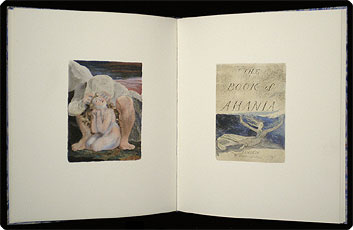 Click the image for an enlargement.
 “Commentary and bibliographical history” (p. [3–7]) signed in type by Geoffrey Keynes.
• Bentley, Blake Books, A15. Publisher's quarter black morocco with marbled paper sides. In the publisher's marbled paper slipcase. Very good condition. (25900)
Trianon Innocence
“Pre-”
(their) ExperienceBlake, William. The songs of innocence, [a facsimile of the illuminated book]. [colophon: Boissia, Clairvaux: Published by the Trianon Press for the William Blake Trust, 1954]. 8vo (22cm.; 8.625"). [60] ff. (54 facsims. of the original; 1 f. a facsim. of provenance information, 5 ff. of text.
Innocence
“Pre-”
(their) ExperienceBlake, William. The songs of innocence, [a facsimile of the illuminated book]. [colophon: Boissia, Clairvaux: Published by the Trianon Press for the William Blake Trust, 1954]. 8vo (22cm.; 8.625"). [60] ff. (54 facsims. of the original; 1 f. a facsim. of provenance information, 5 ff. of text.
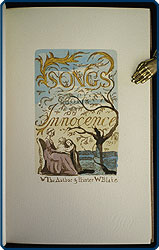
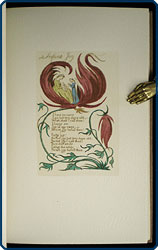 Click the images for enlargements.
 The edition was limited to 1626 copies, this being no. 840 of 1600 regular copies. The Trianon Innocence AND Experience (our emphasis) did not appear until the year after this did.
Provenance: Presentation copy from Lessing Rosenwald to his daughter Joan and her husband Isadore Scott: “For Scotty and Joannie / With love / Dad / 2/15/55" in Lessing's characteristic green ink.
• Bentley & Nurmi 156; Bentley, Blake Books, 165. Publisher's quarter tan calf, abraded; usual discoloration at hinges (inside) from the binding glue. Top edge gilt. In the publisher's leather trimmed slipcase, leather here also abraded (leather too soft!!). A clean, attractive copy with a provenance up there amongst the best imaginable. (25939)
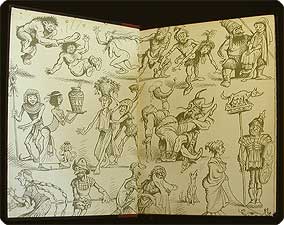
Soldier Humor Illustrated Cary, Melbert B., Jr. ( ed. & pub.). Mademoiselle from Armentières, volume two. New York: Press of the Woolly Whale, 1935. 8vo. xlv, [9], 111, [1] pp.; illus.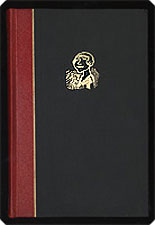
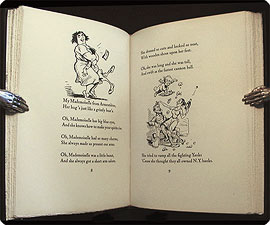
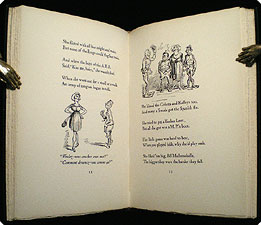 Click the interior images for enlargements.
 • Publisher's quarter crimson morocco and gilt black cloth, top edge gilt; fine save for one corner bump (sans glassine wrapper). Pictorial endsheets and illustrations, tipped-in facsimile. (18011)
Las Siete Partidas
— In aFolio
Set & Handsome
Castile (Kingdom). Sovereign (1252-84 — Alfonso X). Las siete partidas del rey d. Alfonso el Sabio, glossadas por el Sr. D. Gregorio Lopez ... En esta impression se representa a la letra el texto de las Partidas, que de orden del Consejo real se corrigió. y publicó el Dr. Bernì en el ano 1758. Se reimprime la glossa del Sr. Gregorio Lopez, por el tenor de la edicion de Salamanca del ano 1555. Se han examinado las citas, cotejado, y puntualizado. Se han corregido las materialas erratas de imprenta. Y colocado en las margenes de los textos las Leyes recopiladas, y Autos accordados. En obedecimiento del Decreto del Consejo real de 4. de noviembre de 1759 por el Dr. Don Joseph Berní y Català. Valencia: Imp. de Benito Monfort, 1767. Folio (14.25", 36 cm). 8 parts in 4 vols. I: [12] ff., 356 pp; II: [5] ff., 280 pp.; III: [9] ff., 436 pp.; IV: [4[ ff., 175, [1 (blank)] ff., 2 plts.; V: [6] ff., 270 pp.; VI: [5] ff., 285, [1] pp.; VII: [6] ff., 251, [1 (blank)] pp.; Index vol.: 164, xvi, 548 pp. 
The first edition appeared in Seville in 1491. In the 1555 Gregorio López issued his influential edition with commentary, which became the standard edition, reprinted several times in subsequent centuries. According to Palau, López "revisó y corregió escrupulosamente los manuscritos y textos anteriores, en los que el descuido de copistas e impresores había llegado a introducir variantes de importancia y a falsear el espiritú del legislador. De modo que esta edición [i.e., la primera] fue declarada como texto único auténtico y legal en la práctica del foro."
In the years following issuance of the 1555 edition, corruptions began to
enter the text yet again, and in 1759 a further revision was ordered to bring
the text back to its original wording and sense. This is only the second edition
of that revision.  The
printer here was Monfort, one of Spain's best 18th-century practioners of
the black art. The main title-page is printed in black
and red, the text in clear and precise roman with some italic in double-column
format; López's notes are laid in below the text. A fine engraved headpiece
adorns the "Prólogo" in vol. I and a handsome woodcut headpiece of
a ship under full sail on the open sea introduces each partida. Additionally
there is a modest use of historiated initials.
The
printer here was Monfort, one of Spain's best 18th-century practioners of
the black art. The main title-page is printed in black
and red, the text in clear and precise roman with some italic in double-column
format; López's notes are laid in below the text. A fine engraved headpiece
adorns the "Prólogo" in vol. I and a handsome woodcut headpiece of
a ship under full sail on the open sea introduces each partida. Additionally
there is a modest use of historiated initials.
• Palau 7007 (Siete partidas) & 7008 (index). Contemporary
mottled calf, round spines, raised bands, gilt spines extra. Minor abrasions
on some covers. All edges carmine. Silk place markers. A very few instances
of worming, holes filled by means of the 18th-century version of leafcasting
(i.e., a paper slurry "painted" onto the paper to fill the opening): a few
letters lost in some words, but sense not obscured. A very handsome set of a very important book.
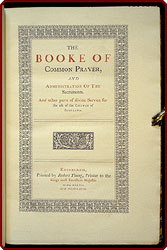
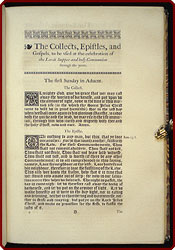
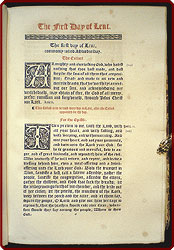
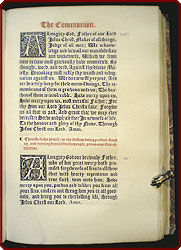
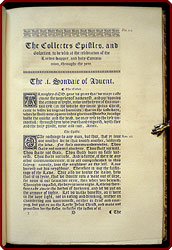
Pickering & Whittingham'sSEVEN BCPs Church of England. Book of Common Prayer. [Seven editions of the Book of Common Prayer, 1549–1844 ]. London: William Pickering (pr. by Whittingham), 1844. Folio (35.8 cm, 14"). 7 vols. I: [264] ff. II: [314] ff. III: [134] ff. IV: [130] ff. V: [142] ff. VI: [140] ff. VII: [154] ff.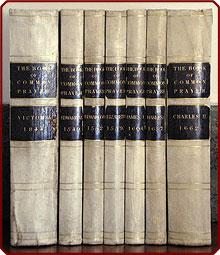
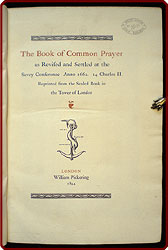
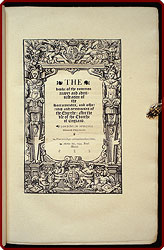 Click the images for enlargements.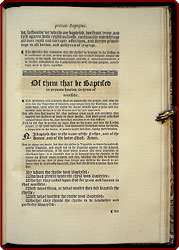
Provenance: Elegant old lozenge-shaped ink-stamp on title-pages: “John Brymer Heir-Loom.”
 For more SETS, click here.
Bodoni Printing: Texts of the Hebrew Old Testament De Rossi, Giovanni Bernardo. Variae lectiones Veteris Testamenti, ex immensa mss. editorumq. codicum congerie haustae et ad Samar. textum, ad vetustiss. versiones, ad accuratiores sacrae criticae fontes ac leges examinatae [and] Scholia critica in v.t. libros seu supplementa ad varias sacri textus lectiones. Parmae: Ex Regio typographeo, 1784–88. Folio (I & II: 29.8 cm, 11.75"; III: 28.8 cm, 11.25"). 5 vols. in 3. I: [8], clx, 116, xiv, [2], 264 pp. II: viii, [2], 268, xxxii, [2], 242 (pp. 241/42 misbound), [16] pp. III: xvi, 144 pp.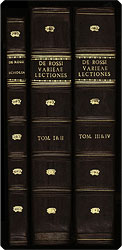
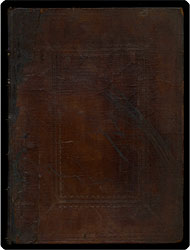
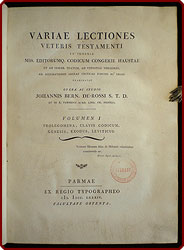
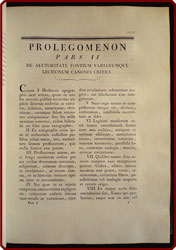 Click the interior images for enlargements.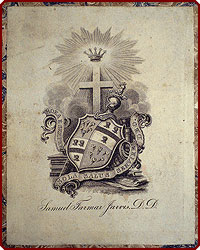
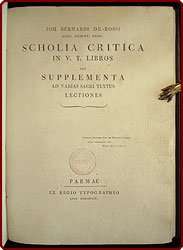
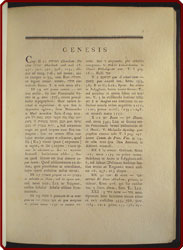
• Brooks, Compendiosa Bibliografia di Edizioni Bodoniane, 279; Steinschneider, Catalogus hebraeorum in Bibliotheca Bodleiana, 2152. Binding on vols. I–IV: Contemporary calf, covers framed and panelled in blind rolls with original leather cracked, chipping, and darkened (III–IV especially severely); rebacked, spines with gilt-stamped title, gilt-dotted raised bands, and gilt-stamped compartment decorations. Hinges (inside) reinforced. Binding on the Scholia: Recent, full period-style calf framed and panelled in blind rolls; spine with gilt-stamped title, gilt-dotted raised bands, and gilt-stamped compartment decorations. All title-pages with very old institutional rubber-stamps; early portions of vol. I with lightly pencilled annotations and bracketing, and vol. II with small pencilled marks of emphasis. Old soft corner creases or mild cockling variously throughout to vols. I–IV and, where these things (or a natural paper flaw) are most notable, a grey soil has entered at the loose or open places to mark the margins at their edges. Otherwise, scattered light foxing, golden, not brown; and the occasional old spill (e.g., I Samuel) or smudge only. Not “fresh” — but substantial, impressive, and with its lovely typography still lovely. (25513)
BIBLIO–BEDTIME READING
(Fortsas Hoax). Klinefelter, Walter. The Fortsas bibliohoax...With a reprint of the Fortsas catalogue and bibliographical notes and comment by Weber de Vore. New York: Press of the Woolly Whale, 1942. 12mo. [3] ff., 71, [1] pp., [1] f. 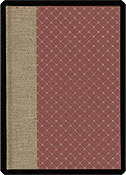
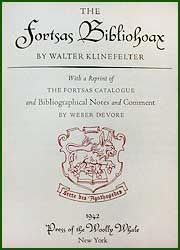
The Fortsas hoax is legendary for having fooled many renowned collectors and dealers near the mid-point of the 19th century (1840, to be precise) into travelling to the small town of Biche, Belgium for an auction of unique books that were bibliographically unknown!
• Publisher's quarter cloth and decorated boards; top edge gilt, fore-edges untrimmed. Map endpapers. A copy not quite perfectly fresh but very nice. (26977)


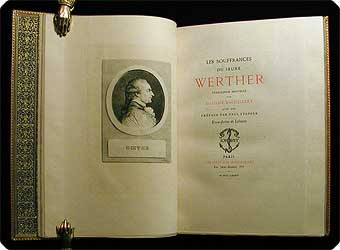
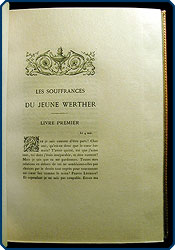
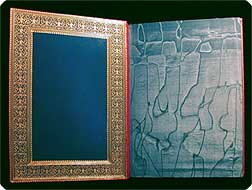
Beautifully
Bound & Illustrated FRENCH Edition“Tr.
by Mme. Bachellery”
Goethe, Johann Wolfgang von. Les souffrances du jeune Werther. Tr. by Mme. Bachellery. Paris: Librairie des Bibliophiles, 1886. 8vo.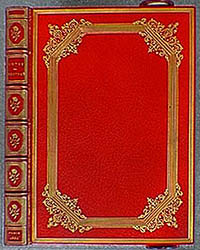
 Click any image where the hand appears on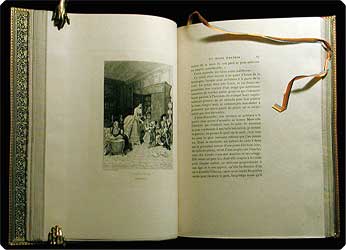
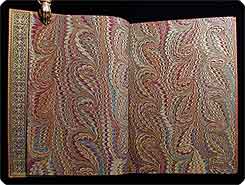 A
PRB&M “FEATURED BOOK” —
A
PRB&M “FEATURED BOOK” —
Ars
TypographicaGoudy, Frederick W., ed. Ars Typographica. New York: Press of the Woolly Whale, Autumn, 1934. Folio. [1] f., 50 pp., [1] f.
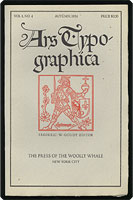 • The final number (volume I, #4) of Goudy's distinguished periodical, published 16 years after the first number, and the intervention of McMurtrie's periodical of the same title. A total of 514 copies were printed.
• Cary 216. Printed wrappers. Collotype plates and illustrations. A fine copy. (17734)
One of the Special CopiesGoudy, Frederic W. The story of the Village Type by its designer.... New York: Press of the Woolly Whale, 1933. 8vo (23.4 cm, 9.25"). [6], 13, [15] pp.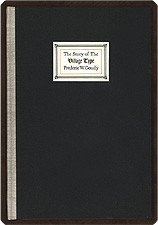
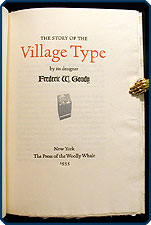
• Publisher’s quarter tan cloth over black paper–covered
sides, front cover with black- and red-printed paper label, in original glassine
dustwrapper; clean and unworn. An
elegant book.
 H.
Estienne's FinalFOLIO
TextGreek,
Latin,
& Impressive
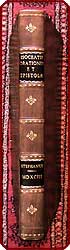
Isocrates. [two
lines in Greek, then] Isocratis Orationes et epistolae cvm Latina interpretatione
Hier. VVolfij, ab ipso postremùm regognita. Henr. Steph. in Isocratem
Diatribæ VII: quarum van obseruationes Harpocrationis in eundem examinat.
Gorgiae et Aristidis quædam, eiusdem cum Isocraticis argumenti. Guil. Cantero
interprete. [Geneva]: Excudebat Henricus Stephanus, 1593. Folio. [fleuron]4*6**4a–z6aa–mm6nn4;
Aa–Ll6; A–C6D4; a
–d
4a.4b.6 (-b.6, blank); [14] ff., 427, [1 (blank)],
131, [1 (blank)], xxxiiii pp., [1 (blank)], [4] ff., 31, [1 (blank)] pp., [9]
ff. (without the final blank).
H.
Estienne's FinalFOLIO
TextGreek,
Latin,
& Impressive
Isocrates. [two
lines in Greek, then] Isocratis Orationes et epistolae cvm Latina interpretatione
Hier. VVolfij, ab ipso postremùm regognita. Henr. Steph. in Isocratem
Diatribæ VII: quarum van obseruationes Harpocrationis in eundem examinat.
Gorgiae et Aristidis quædam, eiusdem cum Isocraticis argumenti. Guil. Cantero
interprete. [Geneva]: Excudebat Henricus Stephanus, 1593. Folio. [fleuron]4*6**4a–z6aa–mm6nn4;
Aa–Ll6; A–C6D4; a
–d
4a.4b.6 (-b.6, blank); [14] ff., 427, [1 (blank)],
131, [1 (blank)], xxxiiii pp., [1 (blank)], [4] ff., 31, [1 (blank)] pp., [9]
ff. (without the final blank).
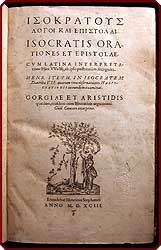

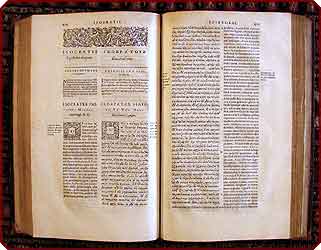
The texts of the orations and "letters" of the great Athenian orator (436–338 B.C.) are printed in double-column format, with the Greek presented in exquisite Greek type in the inner columns and the Latin translation in roman type in the outer ones. A version of the famous Estienne printer's device graces the title-page.
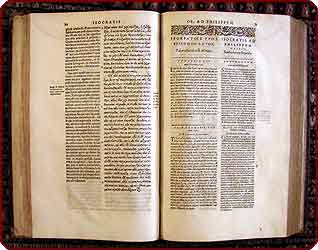 Single-click either double-page image for an enlargement.
• Adams O219; Renouard (2nd ed.), Annales de l'imprimerie des Estienne, 155.1; Schreiber, Estienne, 225; Schweiger, Handbuch der classischen Bibliographie, I:181; Dibdin (4th ed.), An Introduction to . . . Greek and Latin Classics, II:126. 18th-century plain calf, recently rebacked; round spine, raised bands accented with gilt ruling. Gilt-tooled center devices in spine compartments. Two gilt-lettered spine labels. Title-page dust-soiled; a library's blind pressure-stamps; properly deaccessioned with no additional stamps. A covetable exemplar.
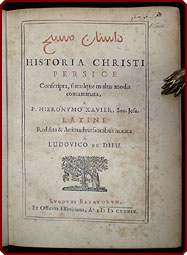
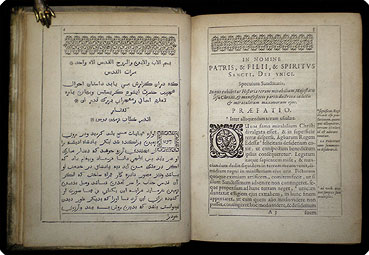
TWO Notable Orientalists — Elzevir Edition Javier, Jerónimo. [two words in Persian, then] Historia Christi Persice conscripta, simulque multis modis contaminata. Lugduni Batavorum: Ex Officina Elseviriana, 1639. 4to (20.6 cm, 8.1"). [24], 636, [4 (index)] pp. [with, as issued, the same author's] [three words in Persian, then] Historia S. Petri Persice conscripta, simulque multis modis contaminata. Latine reddita, & brevibus animadversionibus notata ... Lugduni Batavorum: Ex Officina Elseviriana, 1639. [8], 144 pp. 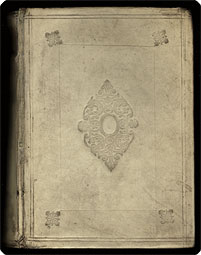
 Click the images for enlargements.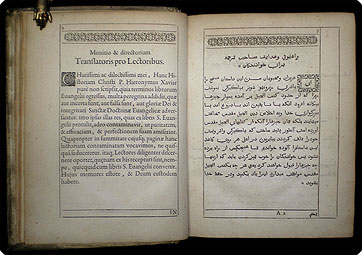
• Willems 490; Copinger 5255; Palau 376807–8; DeBacker-Sommervogel, VIII, 1339. Contemporary vellum, covers framed in blind with blind-tooled central medallion, spine with early hand-inked title; vellum lightly soiled overall, upper outer front corner bumped, splits in spine vellum repaired with Japanese paper and minor (expert) repair to joints. Upper outer corner of title-page with early inked ownership inscription in both Persian and English, possibly by orientalist Henry Pitts Forster (1766–1815); title-page with shadows of other annotations. Pages age-toned, with upper portions darkened; scattered light spotting towards back of volume. Eleven leaves with small spots of worming, affecting a few letters without loss of sense; light to moderate waterstaining to portions of leaves towards back of volume. Last leaf with small tear without loss. One page with pencilled annotations. (25957)
The
LIST Jonah &
the Woolly whale were breakfasting. . . . New York: Press of the Woolly Whale, [ca. 1934]. 12mo. 12 pp. 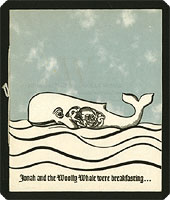
• Sewn plain wrappers with pictorial cutout overlay. Fine. (24123)

NO! Copies of the BOOK in the U.S. Justinianus. A leaf from the Digestum vetus. Venice: Andreas Torresanus, de Asula, 26 March 1491. Folio (42.5 cm; 16.625"). [1] f.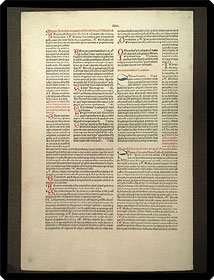 Click the image for an enlargement. In 1479 Torresano acquired the fonts of Nicholas Jenson and in 1505 he acquired Aldus Manutius as a son-in-law!
In the U.S., both Goff and the ISTC only locate only stray leaves of this text: two at Stanford and one at Illinois.
Provenance: Clearly once part of a offering of The Foliophiles Incorporated, and probably from its ad hoc album Pages from the past : a collection of original leaves from rare books and manuscripts [New York: T.F.I., c1926–27].
• ISTC ij00554000; Goff J554; H 9556*; GKW 7675; Pr 4725; BMC, V, 309. Mounted on a brown cardboard backing, with a description (but no bibliographical information) on the verso of the board. Leaf in very good, bright condition. (27100)

Commemorating
theFirst
Anniversary of His DeathKing,
Martin Luther, Jr. Letter from Birmingham jail. Stamford:
The Overbrook Press, [1968]. Small quarto. [8 (4 blank)], 17, [3 (2 blank)] pp.
• Stiff printed wrappers, center bit of top edge a trifle bumped. Near fine. (23499)
One
ofOnly
20 Sets — Splendidly
Bound
La Fontaine, Jean
Louis. Oeuvres complettes de J. La Fontaine.... A Paris: de l'imprimerie de Crapelet, Chez Lefèvre, libraire, 1814. 8vo. 6 vols.
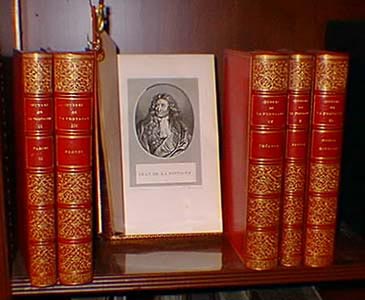
 This
set carries the bookplate of French collector Louis Mercier.
This
set carries the bookplate of French collector Louis Mercier.
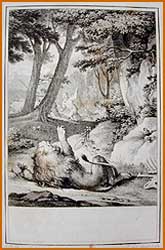
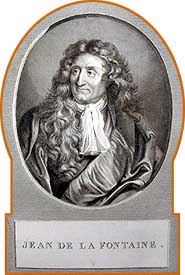
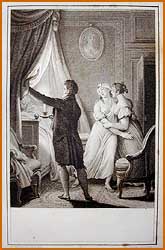
 LUSCIOUS.
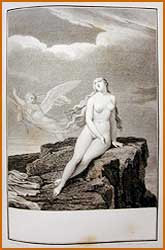
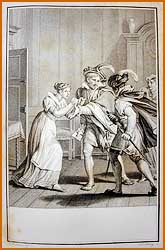
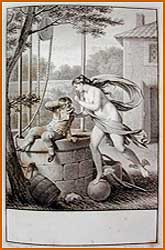
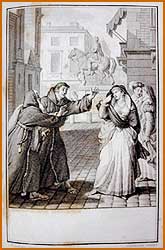
 A fine set of a scarce and beautiful edition.
For more SETS, click here.A
PRB&M “FEATURED BOOK” —
A fine set of a scarce and beautiful edition.
For more SETS, click here.A
PRB&M “FEATURED BOOK” —
Amour . . .Lassalle, Ferdinand. Une page d'amour de Ferdinand Lassalle. Recit - Correspondance - Confessions. Stamford, CT: Overbrook Press, 1959. 8vo. [8], 86, [2] pp.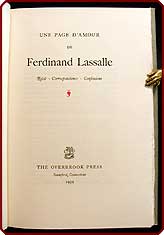
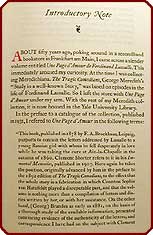 Click the image to the right
• Publisher's cloth, clean and unworn, in original glassine dustwrapper. (14192)
Still Thoughtful — Still Thought-ProvokingLippman, Walter. The scholar in a troubled world. An address delivered as the Phi Beta Kappa oration at the commencement exercises of Columbia University May 31, 1932. New York: Press of the Wooly Whale, 1932. 8vo. [40] pp. 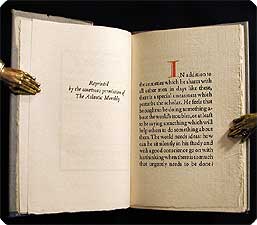 Click
the image for an enlargement.
Click
the image for an enlargement.
• Metallic marbled paper-covered boards, front cover with printed paper label; clean and pleasant, in original glassine dustwrapper a little chipped at edges. (22940)
“The Most Perfect Specimen” — Yep, Strawberry-Hill!Lucanus, M Annaeus. Pharsalia cum notis Hugonis Grotii, et Richardi Bentleii. Strawberry-Hill [Twickenham]: [Strawberry Hill Press], 1760. 4to. [2] ff., 525, [1 (blank) pp., without the “Ad Lectorem” leaf.
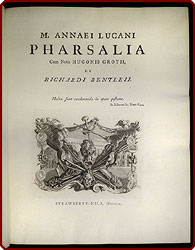
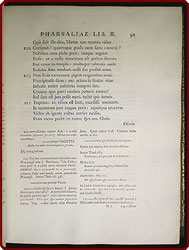
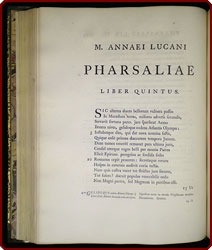 Click the images for enlargements. This edition consisted of only 500 copies.
Horace Walpole (1717–97), the 4th earl of Orford, is best remembered as the author of the Gothic novel The Castle of Otranto. Among bibliophiles he is also remembered for his private press, variously known as the Officina Arbutana or the Strawberry Hill Press. Walpole's almost fantastic wealth allowed him the connoisseur's luxury of this noble enterprise, which he operated in the arena of the rebirth of fine printing in Great Britain that was being carried on by the Foulis brothers, Baskerville, and others.
Binding: Contemporary sprinkled calf with a single gilt rule framing covers, rebacked and original spine reapplied; spine with raised bands, each compartment elegantly filled with tooling and each band itself gilt-accented; complementary gilt-tooled bands at top and bottom of spine; the epitome of “gilt extra” without being gaudy. Red leather spine label lettered and ruled in gilt (“LUCAN STRAWBERRY HILL”); gilt roll on board edges and on turn-ins; marbled endpapers.
Provenance: Bookplates of Charles James Packe (British, late-19th century) and H.M. Brower (American, early- to mid-20th century).
• Hazen (1973 ed.), Bibliography of the Strawberry Hill Press, 7; Dibdin (4th ed.), Introduction to . . . Greek and Latin Classics, II, 187; ESTC T11286; Schweiger, II,565. Bound as above, corners rubbed and expertly, even beautifully, rebacked; lacks the “Ad Lectorem” leaf (only). Good paper, wide margins, only the occasional instance of offsetting or soil. A very good copy. (25974)
CHESS — One of150 CopiesMansfield, Comins. Adventures in composition[:] The art of the two-move chess problem. Stamford: Printed at the Overbrook Press, 1944. Small quarto. [8 (2 blank)], iii–xi, [2 (blank)], 212, [8 (5 blank)] pp.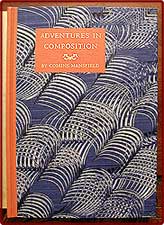
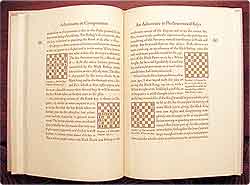
• Cahoon, 42. Quarter gilt cloth and pastepaper over boards, gilt label. Fine in tissue dust jacket, jacket with a chip and some spots of discoloration. (24502)
CHESS — One of250 CopiesMansfield, Comins. Adventures in composition[:] The art of the two-move chess problem. Stamford: Printed at the Overbrook Press, 1944. Small quarto. [8 (2 blank)], iii–xi, [2 (blank)], 212, [8 (5 blank)] pp.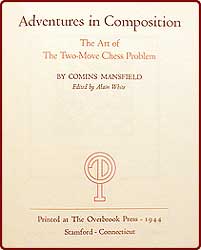
• Cahoon, 42. Quarter gilt cloth and boards, gilt label. Fine in tissue dust jacket. (24501)
Cockney “Mar” Mar. [New York: Press of the Woolly Whale, ca. 1934?]. 8vo. [8] pp.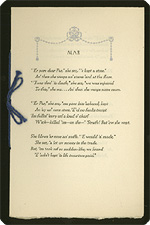
• Sewn octavo French fold. Fine and unopened. (24124)
Sole Aldine Edition Mela, Pomponius. Pomponivs Mela. Ivlivs Solinvs. Itinerarivm Antonini Avg. Vibivs Seqvester. P. Victor de regionibus urbis Romae. Dionysius Afer de situ orbis Prisciano interprete. [colophon: Venetiis: In aedibvs Aldi, et Andreae soceri mense, M.D. XVIII {1518}]. 8vo (16.5 cm; 6.5"). 233, [1] ff., without the final two leaves (one blank, one with Aldine device).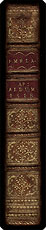
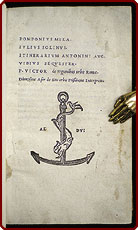
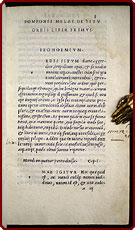
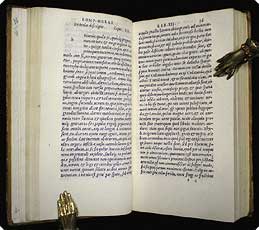 Click the images for enlargements.
 The sole Aldine edition of these works, it is also the editio princeps of Publius Victor, the second edition of Antoninus Augustus' Itinerarium, and the third edition of Dionysius in Latin.
As is to be expected, the text is in italic with spaces and guide letters provided for (unaccomplished) initials.
The register (leaf G2 recto) lists a gathering *4 that is not found here or in any known copy, so the reference would seem to be incorrect.
Binding: 18th-century English sprinkled tan calf, gilt spine extra and board edges gilt-tooled.
• Renouard, Alde, 83; Adams M1053; Schweiger, II, 607 (“seltene Ausg.”). Bound as above, small darkened spot near top of spine; joints starting to open but covers still nicely attached; without the final two leaves (one blank, one with Aldine device). Bookplate. Title-page holed at gutter, not nearing device; light waterstaining and a bit of dust-soiling to first and last leaves. Interior otherwise clean, even bright. (25876)
A
Prüss Incunable Leaf
Melber, Johannes.
Vocabularius praedicantium, sive Variloquus. Strassburg: [Johann Prüss],
1 June 1486. 4to (20.5 x 14. 5 cm; 8" x 5.5"). 1 leaf. 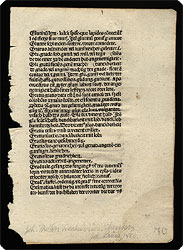
• ISTC im00464000; Goff M464; H 11040*; Pr 516; BMC, I, 119. Inner margin irregular and light semi-circular waterstain in lower outside corner away from text. Leaf identified in pencil in lower margin of the recto side. (26686)
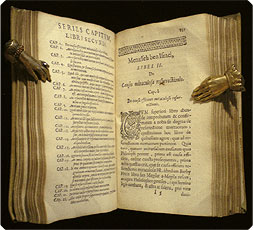
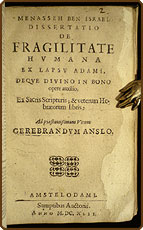
Private Press, The Index ExpurgatoriusMenasseh ben Israel.
De resurrectione mortuorum libri III. Quibus animae immortalitas
& corporis resurrectio contra Zaducaeos comprobatur: caussae item miraculosae
resurrectionis exponuntur: deque judicio extremo, & mundi instauratione agitur:
ex sacris literis, & veteribus Rabbinis. Amstelodami: Typis & sumptibus auctoris,
1636. 8vo. [24], 133, [11], 137–241, [11], 245–346, [6] pp. [bound
with his] ... Dissertatio de fragilitate humana ex lapsu Adami deque divino
in bono opere auxilio, exrsacris scripturis, et veterum Hebraeorum libris ...
Amstelodami: Sumptibus auctoris, 1642. 8vo. 16, 141, [1] pp. 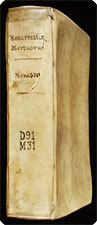
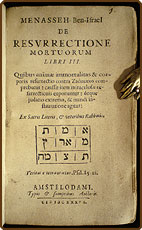
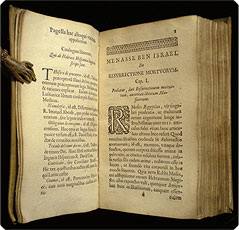 Click the interior images for enlargements. Both
are from the author's own press, one of the first Hebrew-language presses in
the Netherlands.
Click the interior images for enlargements. Both
are from the author's own press, one of the first Hebrew-language presses in
the Netherlands.
WONDERFUL
Culs-de-Lampe by
Villavicencio
& NavarroMexico
(ecclesiastical province). 1st & 2nd Concilia (1555, 1565).
Concilios provinciales primero, y segundo, celebrados en la muy noble,
y muy leal Ciudad de México, presidiendo el Illmo. y Rmo. Señor
D. Fr. Alonso de Montúfar, en los años de 1555, y 1565. En México:
En la Imprenta de el Superior Gobierno, de el Br. D. Joseph Antonio de Hogal,
1769. Folio (27 cm; 10.5"). [10], 34, [2], 35–38, 41–184, [2], 185–396,
[12] pp.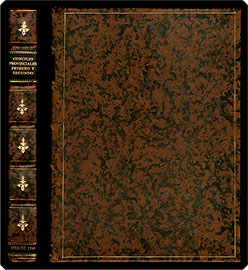
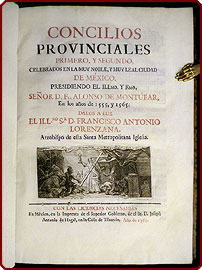
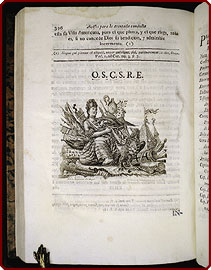
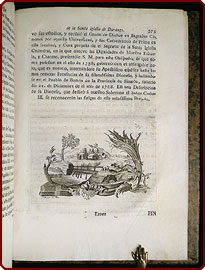 Click the images for enlargements. This text is from the press of José Hogal,
who is often called the Baskerville of Mexico.
Click the images for enlargements. This text is from the press of José Hogal,
who is often called the Baskerville of Mexico.
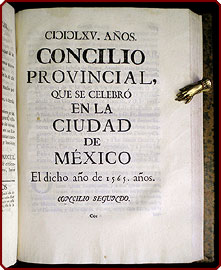
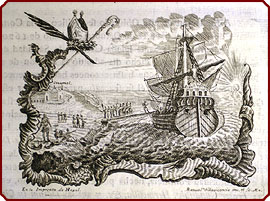
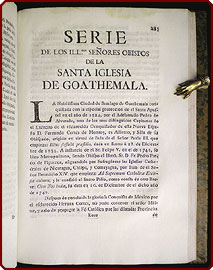
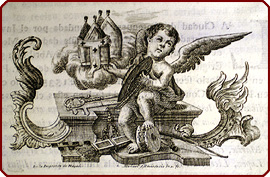
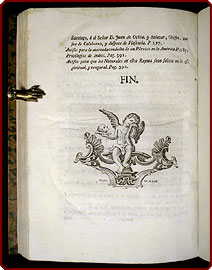
The force behind this edition was archbishop Francisco Antonio Lorenzana (1722–1804), a patron of Hogal's press and of the arts, who soon after assuming the archbishopric of Mexico in 1766 saw the need for a concilium. In preparation for it he paid Hogal to publish or republish, as was the case, the acts of the first three provincial councils of Mexico, held respectively in 1555, 1565, and 1585; these appeared in 1769 and 1770. In 1771 he himself held the fourth Mexican provincial synod; ironically, those acts were not published until 1898.
• Medina, Mexico, 5299; Palau 142387; Sabin 42063.
Recent Spanish sheep mottled in the Valenciana style. Occasional light waterstain
in some upper margins, never in text. Paper crisp and printing very sharp.
A
very good copy. (26797)
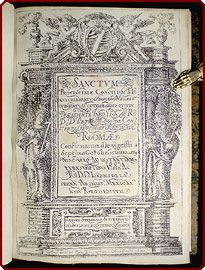
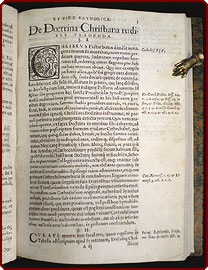
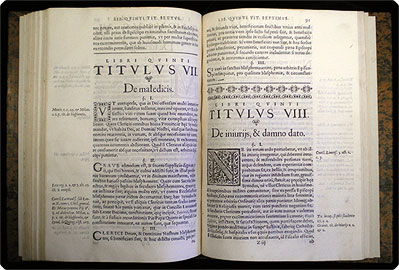
Attempting aCOMPULSORY Social Code for New SpainA Juan Ruíz Imprint Mexico (ecclesiastical province). 3rd Concilium. Sanctum provinciale concilium mexici celebratum anno dñi milless.mo quingetess.mo octuagessimo quinto. [Mexici]: Apud Ioannaem Ruiz, 1622. Folio. [5 (of 6)], 102, [1], 38, [1] ff. (lacks title-leaf, supplied in facsimile).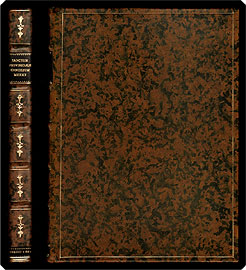
 Click the images for enlargements.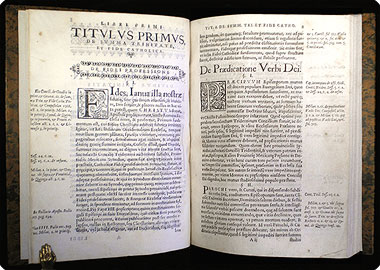
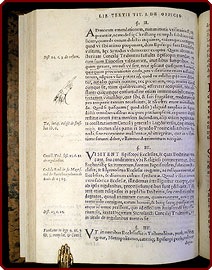 The printer of this work, Juan Ruíz, was an important figure in colonial Mexican book arts and his books are among the most elegant produced during the 17th century in the New World. Here he provides handsome typography, accented with wonderful and large woodcut initials, some historiated, and a woodcut title-page border element originally cut for the incunable-era printer Antonio Espinosa, bearing his initials!
Evidence of readership: In addition to the expected marking in margins indicating important statement in the text (which is extensive in this copy), folios 17r, 17v, and 18r of the second foliation have interesting marginalia.
&
ANOTHER
fromthe
Hogal Press
Mexico
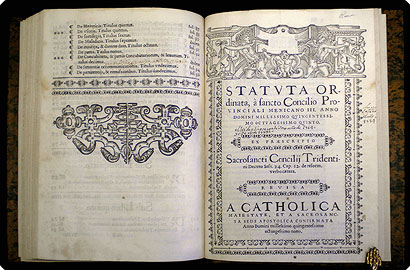
(ecclesiastical province). 3rd Concilium.
Concilium Mexicanum Provinciale III celebratum Mexici anno MDLXXXV. Praeside
D.D. Petro Moya, et Contreras archiepiscopo ejusdem urbis. Confirmatum Romae
die XXVII. Octobris anno MDLXXXIX. Mexici: Ex typ. Bac. Josephi Antonii de Hogal,
[1770]. Folio (27 cm; 10.5"). [6] ff., 328 pp., [3] ff., 141, [1] pp., [2] ff.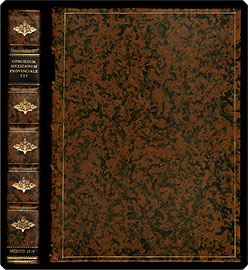
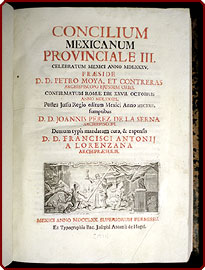
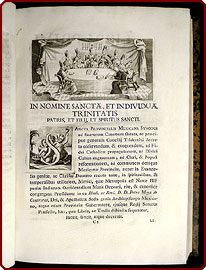
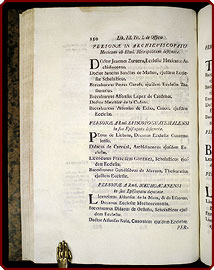 Click the images for enlargements.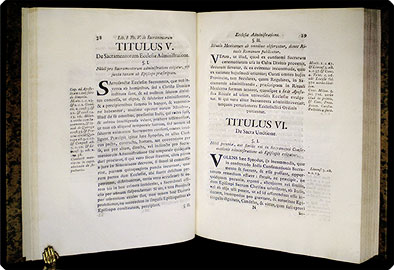
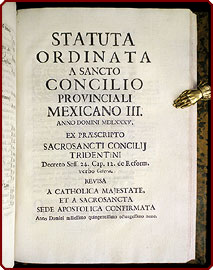
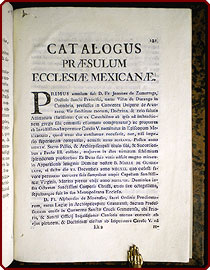
The Third Mexican Concilium, which was celebrated in Mexico city in 1585, had been called by Archbishop Moya de Contreras with the object of producing a comprehensive and compulsory social code for New Spain. The code was shaped, but only those rules directly affecting the conduct of priests (regular and secular) and nuns (cloistered and not) were promulgated.
The force behind this edition was archbishop Francisco Antonio Lorenzana (1722–1804), a patron of Hogal's press and of the arts, who soon after assuming the archbishopric of Mexico in 1766 saw the need for a concilium. In preparation for it, he paid Hogal to publish or republish, as was the case, the acts of the first three provincial councils of Mexico, held respectively in 1555, 1565, and 1585; these appeared in 1769 and 1770. In 1771 he himself held the fourth Mexican provincial synod; ironically, those acts were not published until 1898.
• Medina, Mexico, 5361; Palau 142389; Sabin 42064 .
Recent Spanish sheep mottled in the Valenciana style. Minor worming at some
inner margins, never in text. Paper crisp and printing very sharp. A very good copy. (26794)
The FIRST ENTIRELY ENGRAVED Bookthe AMERICAS Montes de Oca, José. Vida de San Felipe de Jesus protomartir de Japon y patron de su patria Mexico. Mexico: Montes de Oca ... Calle del. Baustisterio de S. Catalina m.e n.o 3, 1801. 4to (23 cm; 9"). [1] f., 28 [of 30] plts.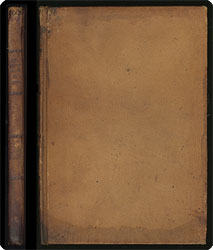
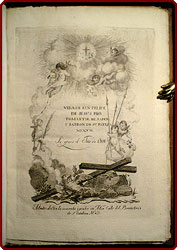
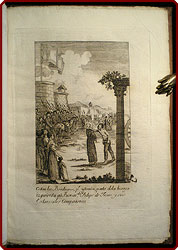 Click the interior images for enlargements. self-published this, the first entirely engraved book printed in the Americas. In a series of 30 plates with captions he told the biography of St. Philip of Jesus (1572–97), the protomartyr of Japan.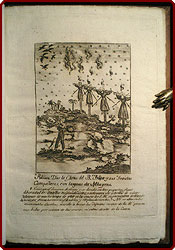
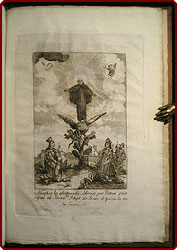
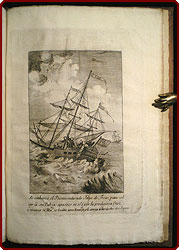
Montes de Oca's plates are particularly detailed and moving when they show the saint in Japan being abused and tortured, but all are strong and striking.
Uncut.
• Palau 363045. Late 19th-century plain sheep binding. Uncut; lacking two plates and two with minor worming as noted above; all plates well impressed, as would be expected of a work that the artist himself saw through the press! A very good copy of a scarce and important work. (25095)
BUILDER of the FIRSTNew World Utopian Community Moreno, Juan Joseph. Fragmentos de la vida, y virtudes del v. illmo. y rmo. Sr. Dr. D. Vasco de Quiroga primer obispo de la santa iglesia cathedral de Michoacan, y fundador del real, y primitivo Colegio de s. Nicolàs obispo de Valladolid ... Con notas criticas, en que se aclaran muchos puntos historicos, y antiguedades americanas especialmente michoacanenses. Mexico: en la imprenta del Real, y mas antiguo Colegio de S. Ildefonso, 1766. Small 4to (20.5 cm; 8"). [13] ff., 202 pp., [2] ff., 29, [1 (errata)] pp., port.
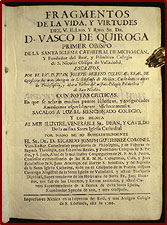
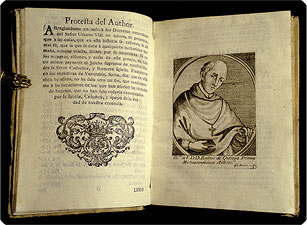
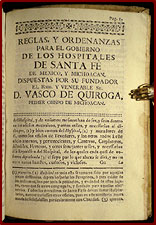 Click the interior images for enlargements.
 Not
the least of his accomplishments was the creation of two pueblo-hospitals
for native Americans, and appended and integral to this biography are his
“Reglas, y ordenanzas para el gobierno de los Hospitales de Santa Fé
de México, y Michoacàn,” which occupy the final 29 pages.
Historians still consider this to be the definitive biography of Quiroga.
The engraved portrait of him, handsome and from the burin of José Morales,
adds a face to the words of the biographer and to the account of the deeds
of the biographee. This
is from ”la imprenta del Real” and it is well done.
• Medina, Mexico, 5099; Wellcome, Medical Americana, M.134; Palau 181902; Beristain, III, 2059. Contemporary limp vellum lacking ties. A very good copy. (23061)

Keepsake . . . The oath of a free-man. With a historical study by Lawrence C. Wroth and a note on the Stephen Daye Press by Melbert B. Cary, Jr. New York: Press of the Woolly Whale, 1939. 8vo. [20] pp.
This is Keepsake no. 60 of the American Institute of Graphic Arts, although this copy does not include the laid-in sheet noting that detail. Important study by the head of the John Carter Brown Library on the Oath.
• Publisher's cloth, front cover with printed paper label. Clean and fresh. (14191)
Lenten Liturgy fromthe Phoenix Press Orthodox Eastern Church. Liturgy & ritual. [In Greek: Triodion katanyktikon, periechon apasan ten anekousan auto akolouthian tes Hagias kai Megales Tessarakostes ... ]. Benetia: Ek tou Hellenikou Typographeiou o Phoinix, 1876. 4to (32 cm, 12.5"). [4], 455, [1 (blank)] pp.

 Click the interior images for enlargements.


• Contemporary blind-stamped black cloth, covers with central gilt-stamped cross and Virgin-with-Infant vignettes, spine with gilt-stamped title; edges, extremities, and back cover rubbed; cloth wrinkled at spine and split at front joint with small bubbles on covers. Front covers lacking clasp hardware (straps present on back cover), spine with inked shelving number; hinges (inside) tender. Front pastedown with New York bookseller's small ticket. Half-title, title-page, and several others institutionally pressure-stamped. Some mild foxing, most pages clean. All edges speckled red. (25894)
MAGNIFIQUE Racine, Jean. Oeuvres de Jean Racine. Paris: Pierre Didot l'aîné, 1801. Folio extra (50 cm, 19.75"). 3 vols. I: Frontis., [8], 466, [2] pp.; 23 plts. II: [4], 500, [2] pp.; 25 plts. III: [4], 416 pp.; 8 plts.

 Click any image for enlargement. three elephant folio, illustrated volumes that include his verse, letters, and plays. This deluxe edition was limited to 250 sets on paper (plus one additional copy printed on vellum). Produced by the renowned Didot press and part of the prestigious collection known as the Éditions du Louvre, this work is a monument of typography; Brunet extols it as “un des livres les plus magnifiques que la typographie d'aucun pays eut encore produits,” while Graesse confines himself to a mere “magnifique.”


Signed Binding: Contemporary red straight-grain morocco, covers framed in substantial gilt and blind-tooled rolls with gilt-stamped corner fleurons, surrounding central gilt-stamped medallions of the French imperial eagle. Spines gilt extra in arabesque and foliate motifs with additional blind-tooling; board edges gilt-stamped and turn-ins with wide gilt rolls. All edges gilt. Bindings signed by Charles Hering — one of the most prominent English binders of the early 19th century.
 This classic French author is here presented with classic French illustration of the era in a limited edition from a classic French printer/publisher in a classic French binding — at least, it's a “five-fer”! (24990)
A “Graphic Arts” SouvenirRollins, Carl Purington. This house of havoc. New York: Pr. by the Press of the Woolly Whale for the American Institute of Graphic Arts, 1941. 8vo. 16 pp.
• Sewn in publisher’s printed paper wrappers; clean and all but unworn, with the lower outer corners just slightly bumped.
Vita's Tribute to Virginia — Hogarth Press Sackville-West, Vita. Seducers in Ecuador. London: Leonard & Virginia Woolf at the Hogarth Press., 1924. 8vo (17.2 cm, 6.75"). 73, [1] pp.
 Click the images for enlargements.
 • NCBEL, IV, 336. Publisher's red and black marbled cloth, spine with printed paper label, dust jacket lacking; minor rubbing, unobtrusive spots of discoloration, spine label darkened. Front free endpaper with pencilled sketch, back pastedown with bookseller's small ticket and front one with a collector's(?) pencilled note on the book and its rarity. Pages clean and crisp; top edges red. (27044)
The PRESS of theAldine Forger Sallustius Crispus, C. [i.e., Sallust]. Salvstius. [Lugduni {i.e., Lyons}: The Aldine Forger, 1504]. Small 8vo. [116] ff.


 Click the images for enlargements.
 Rare: COPAC locates only the copy at the University of Manchester library, but we trace other U.K. copies in the British Library and Cambridge University library. In the U.S. and Canada the only copies we find are at the UCLA and the Pierpont Morgan libraries.
Provenance: Ownership signatures on the front free endpaper: “J. Turner, 1790" and “John S. Conner / North Bend Ohio / Oct. 18th 1877.”
• Renouard 48:10 and 308:22; Baudrier, VII, 20; Adams S137; Shaw 44; Aldine Press. Catalogue of the Aldine Collection, UCLA, 1115. Full dark walnut modern calf old style: Spine with raised bands accented with gilt and blind rules, the blind ones extending onto covers to terminate in trefoils; burgundy leather author label and gilt date; gilt tools to spine compartments. Blind double fillets framing covers. Heavy browning to the first two and a half signatures and again in the last gathering; minor worm damage to blank area of title-leaf; additional dampstaining, mainly though not exclusively to margins, more often than “occasionally” and yet not quite “throughout.” Withal, a reputable copy of a notable forgery. (25748)
A
Leaf from
theNuremberg
Chronicle —8
Portraits
Schedel, Hartmann.
Liber chronicarum. Nürnberg: AntonKoberger,
for Sebald Schreyer and Sebastian Kammermeister, 1493. Folio (42 x 29.5
cm; 16.5" x 11.5"; h x w). 1 leaf. Click
the image for an enlargement.
Click
the image for an enlargement.
• ISTC is00307000; Goff S307; HC 14508*; Klebs 889.1; Polain(B)
3469; IGI 8828; Oates 1026, 1027, 1028, 1029; Pr 2084; BMC, II, 437.
Old stitching holes in inner margin; one short tear in lower margin;
spotting or old staining (generally light) in margins; no wormholes. Very nice. (26692)
How to BEHAVE
inNapoleon’s
Court[Ségur, Louis Philippe, comte de]. Étiquette du palais impérial. Année 1806. Paris: De l’imprimerie
impériale, 1806. 4to (25.7 cm, 9.9"). [1] f., 159, [1 (blank)] pp.


The work is generally attributed to the Comte de Ségur, a diplomat and historian who served under Rochambeau in the American War of Independence; he also published works on classical and Jewish history.
• Old-style blue morocco, covers framed in double gilt fillets, spine with gilt-ruled raised bands and gilt-stamped devices in compartments, leather turndowns tooled in blind. Tear in upper margin of one leaf repaired very unobtrusively; several leaves with closed tears or holes also professionally patched, just touching a few letters; one leaf with clear tape covering tear. Pages washed, resized, and very clean, with only a few faint spots; edges slightly brittle, with occasional very short tears.
From aFINE Woman Printer Segura, José de. Manual de administrar los santos sacramentos de la eucharistia, y extremauncion, y oficiar los entierros, segun el uso, y observacion del Sagrario de la Santa Iglesia Metropolitana desta ciudad. Mexico: Por Doña Maria de Benavides, Viuda de Juan de Ribera, 1697. Small 8vo. [4] ff., 130 pp., [2] ff.

 Click the images for enlargements.
 Quite rare: Via OCLC we locate only three copies in the U.S.
• Medina, Mexico, 1680. Contemporary stiff vellum; binding stained and lacking ties, and a little bowed. Text starting to loosen. Waterstaining to early and late sections, paper yet strong. Withal, a good+ copy of a scarce and important early Mexican medical-related item. (14649)
With theRUBENS-Designed “Bathing” Plate Seneca, Lucius Annaeus. Opera quae exstant omnia: a Justo Lipsio emendata et scholiis illustrata. Antuerpiae: Ex Officina Plantiniana Balthasaris Moreti, 1652. Folio extra (41 cm; 16.25") Engr. frontis., engr. t.-p., [6] ff., xxxvi, 911, [1 (blank)] pp.

 Click the images for enlargements.


• Corpus Rubenianum Ludwig Burchard, part XXI (Book Illustrations and Title-pages [by Peter Paul Rubens]), vol. I, pp. 154–65; vol. II, p. 443; Brunet,V,276-77; Schweiger, II, 912. Late 17th-century plain calf; rebacked with modest blind tooling, and red spine-label. Late 20th-century private bookplate on front pastedown; early 20th-century private pressure-stamps in margins of first two leaves. With minor worming in upper inner margins of some leaves and some spots/soiling generally light and marginal, this is a nice copy. (26571)
Quaker Life inDutchess County, NY — 1779Society
of Friends. To the yearly meeting. Extracts taken from the minnets of our quarterly meeting held at the Oblong by adjournments from ye 1st of the 5 month to 3ed of the same inclusive. 1779. New York: Pr. by Melbert B. Cary,
Jr. at the Sign of the Woolly Whale, 1936. 8vo (20.2 cm, 7.9"). [12] pp. 
Long, breathless, run-on sentences make the expected Quaker standards of behavior, in this place and time, quite clear.
• Sewn in publisher’s color-flecked paper wrappers. A crisp, clean copy.

Spenser
inPickering's
Aldine Edition
Spenser,
Edmund. The poetical works of Edmund Spenser. London: William
Pickering, 1839. 8vo (16.5 cm, 6.5"). 5 vols. I: Frontis., viii, lxxvi, 282
pp. II: vi, 295, [1] pp. III: iv, 296 pp. IV: vi, 305, [1] pp. V: vi, 317, [1]
pp.


Binding: Brown embossed morocco ca. 1850–60, spines with gilt-stamped title and blind-tooled decorations; all edges gilt and gauffered; binding signed by Field.
Provenance: Armorial bookplates of Robert H. Menzies, early inked ownership inscriptions of Caroline Syers.
• NSTC 2M31627; Lowndes 2477. On Pickering, see: Oxford Dictionary
of National Biography online. Bindings as above, extremities showing
only minimal wear. Bookplates on front pastedowns and ownership inscriptions
on front fly-leaves, as above. A
very handsome production, a very nice set. (24404)
For more SETS, click here.
Unattributed
& UNCUT Spring song. New York: Press of the Woolly Whale, [ca. 1934?]. 8vo. 8 pp.
• Sewn octavo French fold. Fine and unopened. (18014)
Tiny Tasso — Levitan/Littell Provenance Tasso, Torquato. La Gerusalemme liberata. Londra: Presso C. Corrall a spese di G. Pickering, 1822. 48mo (8.6 cm, 3.4"). I: Frontis., add. engr. t.-p., [4], 199, [1] pp. II: [201]–405, [3] pp.

 Click the interior images for enlargements.
 Provenance: Front pastedown with the “Ex Mini-Libris Levitan” bookplate of Rabbi Kalman L. Levitan, the first president of the Miniature Book Society and one of the most prominent miniature book collectors in the United States. Also with the red morocco bookplate of Neva and Guy Littell, the latter president of the R.R. Donnelley & Sons binding company.
Binding: Late 19th- or early 20th-century Jansenist style red morocco; spines with gilt-stamped title, board edges with gilt fillets, turn-ins with wide gilt inner dentelles; crimson silk pastedowns and free endpapers. Top edges gilt. Binding signed by Zaehnsdorf.
• NSTC 2T2346; Welsh, Bibliography of Miniature Books, 6608. Binding as above, corners slightly rubbed, spines darkened; top boards expertly reattached. Front pastedowns each with the two private collectors' bookplates as above, front free endpaper and front fly-leaf of vol. II with Littell ownership inscriptions. Some signatures in vol. II unopened. Pages clean save for a very few scattered faint spots. A lovely little set. (25177)
Colophon
Leaf fromPadua,
1473
Thomas,
Aquinas, Saint. Summa theologicae. Pars prima. Padua:
Albertus de Stendal, 1473. Folio (28 x 19.5 cm; 11" x 7.75"). 1 leaf.

 Click the images for enlargements.
 The text is St. Thomas' highly influential theological treatise: It is printed in a small gothic with roman influence, in double-column format, 48 lines per column, with hand rubrication and one initial (“A”) accomplished by hand in blue. The type bears all the appearance of a trial font and clearly was one that did not gain favor, thereby making it yet more interesting.
• ISTC it00197000; Goff; T-197; Hain; 1440*; BMC, VII, 911
(IB. 29893); Pr *6781; Oates 2550. Overall dust-soiling; old creasing,
one tear into text without loss, and some small, pin type worming. One margin
reinforced and two other small areas with modern paper reinforcement. A very nice early incunable leaf, and a handsome
representative of an early Italian incunable. (26688)
Private & Limited Printing Thompson, Lawrence. Emerson and Frost, critics of their times. Philadelphia: The Philobiblon Club, 1940. Small 8vo. 44 pp. Click the image for enlargement.
 • Publisher's cloth-backed orange-marbled paper covered boards; with the original slipcase. (16882)

Sumptuously
Bound by DAVID
forCortland
Bishop
Uzanne,
Octave. Son altesse la
femme. Paris: A. Quantin, 1885. Small folio (27.5 cm; 11" ). [2] ff.,
[i]–xii, 312 pp., 2 l. illus. (part col.).


 Click the images for enlargements.


The work was limited to 100 copies, all printed on Japan vellum. It has an
engraved vignette on the black and red printed title, small illustrations
or vignettes on 50 text pages, 11 vignette borders or headpieces (three of
them in color, 10 of them in anextra
state), and 10 tipped-in color plates. The illustrations are
by Henri Gervex, J.A. Gonzalès, L. Kratké, Albert Lynch, Adrien
Moreau, and Félicien Rops.
Binding:
Full red crushed morocco with five raised bands. Covers with a triple-rule
gilt border; spine gilt extra with gilt beading on bands. Triple gilt fillet
on board edges. Wide turn-ins richly tooled in gilt and with cream and blue
leather inlays that are also gilt-tooled. Blue silk pastedowns and free endpapers.
Marbled paper fly-leaves. All edges gilt. Binding
signed “David.”
Provenance: Red leather bookplate of Cortland Field Bishop, the famed collector of the early 20th century and, at one time, owner of the TWO most important auction galleries in NY/USA.
Original
full-color wrappers bound in.
• Vicaire, VII, 924. Uncut copy. Bound as above with original
wrappers bound in. Light refurbishment of front joint (outside). A
fabulous copy. (26675)
With a Photo ofthe Printers in Their Garret Village Press. The Village Press a retrospective exhibition 1903–1933. New York: The American Institute of Graphic Arts, 1933. 8vo. 32 pp.; illus.
 Click the images for enlargements.
 • Sewn in publisher's printed paper wrappers; wrappers slightly age-toned, otherwise a clean, handsome copy. (14424)
A Fundamental WorkHandsomely Printed Villaseñor y Sánchez, José Antonio de. Theatro americano, descripcion general de los reynos y provincias de la Nueva España y sus jurisdicciones. México: En la Imprenta de la Viuda de D. Joseph Bernardo de Hogal, Impresora del Real y Apostólico Tribunal de la Santa Cruzada en todo este Reyno, 1746–48. 2 vols. in 1 (29.5 cm; 11.5"). I: [9] ff., 232 pp., [2] ff., pp. 233–382, [5] ff., lacks engr. title. II: [6] ff., 428 pp., [5] ff., lacks engr. title.

 Click the images for enlargements.

The volumes are from the famous press of the widow of José Bernardo de Hogal, the Baskerville of Mexico, and they retain all of the fine characteristics that are associated with the Hogal name, including handsome black and red title-pages, great typography (here in double-column format), and use of good quality paper.
The author was general accountant of the Treasury's office of mercury accounting (the element was important in silver refining) and one of the most illustrious Cosmographers of New Spain. He wrote this treatise at the insistence of the viceroy, who was greatly pleased by it.
• Sabin 99686; Medina, Mexico, 3802; Tovar de Teresa, Bibliografía novohispana de arte, II, 86/87. Recent full dark brown calf, round spines, raised bands accented with gilt rules; green and red leather spine labels; gilt center devices. Covers with elaborate gilt roll at edges, concentric center compartments and gilt corner devices. Lacking the engraved title, only. Present are intermittent touches of limited worming and, in vol. II, the occasional old stain to a top margin's edge. This is a clean and indeedBEAUTIFUL SET. (26378)
French Symbolism in Ornate Dress Villiers de L'Isle-Adam, Auguste, comte de. Histoires souveraines. Bruxelles: Edmond Deman, 1899. 8vo (26.4 cm, 10.4"). 367, [5] pp.; illus.


 Click the images for enlargements.
 Binding: Contemporary quarter garnet red morocco with fawn brocade–covered sides, spine gilt extra with title and arabesque motifs. Original green wrappers bound in.
• Caillet, Manuel bibliographique des sciences psychiques ou occultes, 11198. Binding as above, spine faintly sunned and with one small spot darkened; joints a bit rubbed and cloth corners/edges somewhat moreso, with instances of spotting/discoloration to cloth that should be mentioned but are not obtrusive. Front pastedown with attractive 20th-century bookplate. Some signatures unopened. A lovely book in quite a nice copy. (26821)
Vossius’sLatin
Etymological Dictionary
— First EditionVossius, Gerardus Joannes. Etymologicon linguae latinae. Praefigitur ejusdem de litterarum permutatione tractatus. Amstelodami: Apud Ludovicum & Danielem Elzevirios, 1662. Folio (35.4 cm, 14"). *4 A–F4 G6 2A–2G4 H–Z4 Aa–Za4 Aaa–Zzz4 Aaaa–Gggg4; [34] ff., 606 pp., [1 (blank)] f. 


 This first edition has a title-page in black and red with the printer’s device of the Amsterdam Elzevirs, “Ne Extra Oleas”—showing Minerva with owl and shield next to an olive tree—and it is printed in two columns in roman, italic, Greek, and Hebrew, ornamented with woodcut initials.
• Willems, Les Elzevier, 1295. On the Vossius, father and son, see: Sandys, History of Classical Scholarship, 307–309 and 322–23. Contemporary English calf ruled in blind, bumped and abraded with a little loss on corners and edges; joints fully open at base and some chipping at head and foot of spine. Paper, ink-lettered spine label; inked call number and date on title-page. Pastedowns entirely gone and remnants of a manuscript used as binder’s waste visible at gutters, inside covers; due to the pastedowns’ removal, much of the binder’s construction can readily be examined here. A little light waterstaining and browning to first and last leaves (only). All edges red.
Allay that Pheasant, Splat that Pyke, Border that Pasty! Wayland, Harold & Virginia, eds. Of carving, cards &
cookery or the mode of carving at the table as represented in a pack of playing cards originally
designed & sold by Joseph & James Moxon, London 1676–7. Arcadia, CA: Pr. for V. & H.
Wayland by Carol Allen Cockel at the Raccoon Press, 1962. 4to (21 cm, 8.25"). [6], 122, [2]
pp.; illus.


 Click the images for enlargements. 53 (one-sided) facsimiles of the Moxons' original
instructional playing cards plus their wrapper.
Click the images for enlargements. 53 (one-sided) facsimiles of the Moxons' original
instructional playing cards plus their wrapper.


• Publisher's vellum over boards, spine with raised bands and faux hand-inked title, in original red cloth slipcase. A beautiful, clean, unworn copy in a perfect slipcase. (26750)
Strawberry
HillPress
Book
Whitworth, Charles Whitworth, Baron. An account of
Russia as it was in the year 1710. [Twickenham]: Printed at Strawberry-Hill, 1758. Small 8vo
(18 cm; 7.25"). xxiv, 158, [2] pp.
 Limited
to 700 copies.
Click
the images for enlargements.
Limited
to 700 copies.
Click
the images for enlargements.
Whitworth was perhaps the most effective English ambassador to Russia in the first half of the 18th century. His Account was originally written for the foreign office and remained in manuscript till Walpole printed it. The DNB (on-line) writes of it, “Succinct and perceptive, it was a survey of Petrine Russia which held its readership through to the century's end and beyond.”
Horace Walpole (1717–97), the 4th earl of Orford, is best remembered as the author of the Gothic novel The Castle of Otranto. Among bibliophiles he is also remembered for his private press, variously known as the Officina Arbutana or the Strawberry Hill Press. Walpole's almost fantastic wealth allowed him the connoisseur's luxury of maintaining this noble enterprise, which he operated in the arena of the rebirth of fine printing in Great Britain that was being carried on by the Foulis brothers, Baskerville, and others.
Provenance: 20th-century bookplate of William & Helena Hand.
• Hazen (1973 ed.), Bibliography of the Strawberry Hill Press, 5; ESTC T138827; Rothschild 2560; Cox, I, 195. Contemporary sprinkled calf, gilt spine extra, gilt dull; joints and hinges with good repairs. Two old booksellers' descriptions taped to front pastedown. Off-setting from the turn-ins on the front and rear free endpapers and fly-leaves, title-page, and errata leaf; else, quite clean. A handsome book. (26862)

Printed
for the FoundationWilson,
Woodrow. Cabinet government in the United States...with an introductory
note by Thomas K. Finletter. Stamford: The Overbrook Press, 1947. [6 (3 blank)],
v–xii, [2 (blank)], 31, [1] pp.  • One of one thousand copies, printed in Caslon Old Face on rag paper,
for the Wilson Foundation, by The
Overbrook Press..
• One of one thousand copies, printed in Caslon Old Face on rag paper,
for the Wilson Foundation, by The
Overbrook Press..
• Cahoon, 56. Boards, printed label. Fine, without printed dust jacket, as issued.

PLACE AN ORDER | E-MAIL US | GO (BACK) TO TOPIC/INTEREST TABLE | PRB&M HOME
All
material © 2010
The Philadelphia Rare Books & Manuscripts Company