 THE PHILIPPINES
THE PHILIPPINES
THE PHILIPPINES
 Extended MANUSCRIPT in an
 UNCOMMON PHILIPPINE LANGUAGE
  Antonio Lobato de Santo Tomás. Manuscript in Ibanag on paper: “Quinque sermones in quinque precipuis festivitatibus B. Maria Virginis. Quibus accedunt sermo in feria quarta cinerumz et sermo in dominica 2o post octavam trinitatis. Per R. P. fray Antoniium Lobatao de Sto. Thomas. Tuguegarao, The Philippines: 1776–80. Small 4to. 196 pp.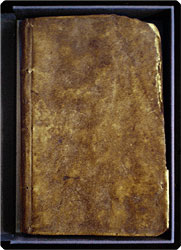
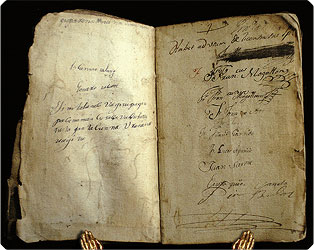
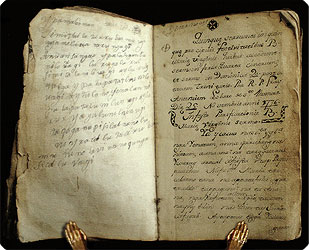
 Click the interior images for enlargements.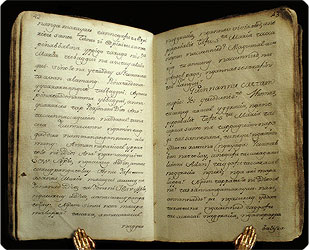
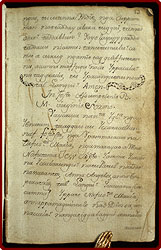
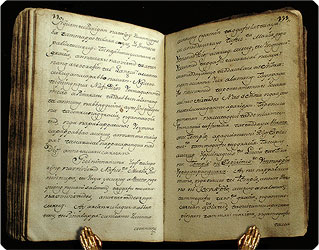
 a large body of work set down in the Ibanag language, from the 18th century and as written/spoken by one of the seminal scholars of the language, should be obvious for anyone researching the language as understood by missionaries, as used by missionaries, as influenced by Spanish, and as held out by Spaniards of authority as the model of Ibanag speech to be emulated. Beyond this, of course, is the interest of the sermons themselves, letting us see what the Ibanaq speakers were hearing from their missionaries — or, at least, this missionary — in this place, in this period.
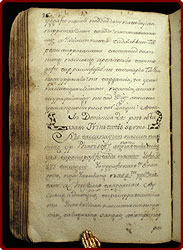
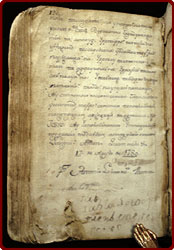
Provenance: A signature “Fr. Antonio Lobato de Sto. Thomas” appears at the bottom of the last page and is almost certainly that of the the friar himself, which would mean that this is his autograph manuscript of the sermons.
• Contemporary very stiff vellum. Binding gnawed by a rodent with loss. Written on a good quality European paper, with some soiling and an occasional stain. No faults are serious and overall this is a remarkably good survival for an 18th-century Philippines manuscript. Now housed in a blue cloth clamshell box. (23668)

 Psalms
in Sangir
/ Sangihe
/ Sangirese:
Siau
Bible. O.T. Psalms. Sangir. Kelling et al. 1901. Buke u Masmur ko susi. London: British & Foreign Bible Society, 1901. 8vo (19.2 cm; 7.5"). 222 pp.
Psalms
in Sangir
/ Sangihe
/ Sangirese:
Siau
Bible. O.T. Psalms. Sangir. Kelling et al. 1901. Buke u Masmur ko susi. London: British & Foreign Bible Society, 1901. 8vo (19.2 cm; 7.5"). 222 pp.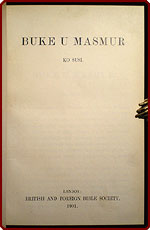
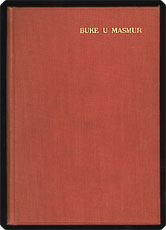
Sangir is an Austronesian language spoken inthe Philippines and Indonesia, especially in the Silawesi and Siau regions.
Click the interior image for an enlargement. Uncommon: We locate only one copy in U.S. libraries.
• Darlow & Moule 7983. Publisher's red cloth. Very good copy. (25001)

First Pentateuch in thisIsland Language Bible. O.T. Pentateuch. Pangasinan. 1912. Benitez. Saray simaran onaan á lebro'y Santa Biblia ya Genesis, Exodo, Levitico, Numero tan Deuteronomio. Manila: Sociedad Bíblica Británica y Extrangera, 1912. 12mo (18 cm; 7.25"). 541, [1 (blank) pp.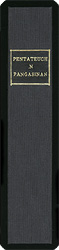
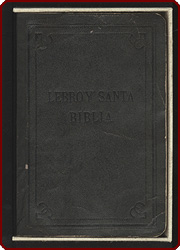
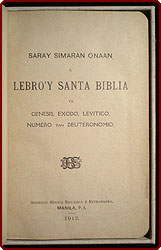
The first translation of any book of the Bible into Pangasinan did not come about until 1887, followed by the first Testament in 1908 and the first complete Bible in 1915.  This is the first printing of the Pentateuch. It was translated by Eduardo Benitez assisted by Teodoro Basconcillo and A. Rayner, all of the American Methodist Episcopal Mission. It has chapter headings and some footnotes.
Rare. Searches of NUC Pre-1956, COPAC, and OCLC locate no copies in U.S. libraries and only the B.F.B.S. copy at Cambridge.
• North & Nida, Book of a Thousand Tongues (1972), 346. Publisher's flexible black fabric over light boards, stamped in blind on front cover; expertly rebacked and remnants of original spine reapplied. Small “nick” to fore-edge of first two leaves, without loss; paper a little age-toned, with interior otherwise quite clean. Housed in a dark blue cloth clamshell case. (25180)
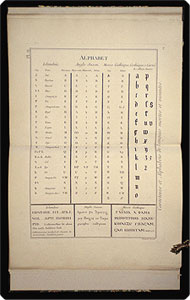
 ABCs around the WORLD — Illustrated Diderot, Denis. Caractères et alphabets de langues mortes et vivantes (Extracted from the Encyclopédie, ou dictionnaire raisonné des sciences, des arts et des métiers). [Paris: ca. 1750–72]. Folio (30.5 cm, 12"). 24 double-p. plts. (of 25).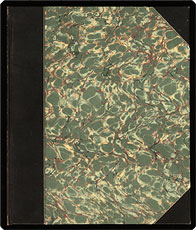
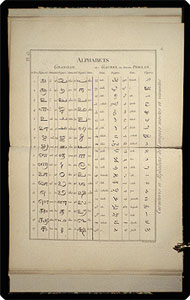
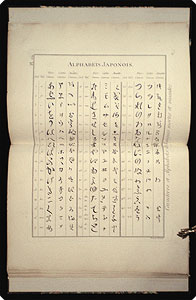 Click the images for enlargements.
  24 double-spread engraved plates of alphabets for various languages. They were engraved for the article on alphabets in the Diderot Encyclopédie, a massive 20-year project aiming to encompass every branch of human knowledge that was a landmark of Enlightenment-era philosophy, attacking superstition while promoting science, rationality, and scholarship. Many of the volumes were supplemented with illustrations, such as the plates present here, designed to facilitate comparing and contrasting the alphabets and basic writing conventions of “dead and living” languages.
Languages charted in these tables include “Tartares Mouantcheoux,” Tamoul, Telongou, Persian (ancient and modern), Armenian, Russian (ancient and modern), Coptic, Hebrew, etc., with the engraving done by master artisan Robert Bénard (fl. 1750–85).
• Half green calf with green marbled paper–covered sides, spine with gilt-stamped title; slight wear to corners and spine extremities. Lacking one plate (#25). (24823)


PLACE AN ORDER | E-MAIL US | GO (BACK) TO TOPIC/INTEREST TABLE | PRB&M HOME
All material © 2010
The Philadelphia Rare Books & Manuscripts
Company