 NAPOLEON
NAPOLEON
NAPOLEON
 Was It or Wasn't It
 “It”
“It”  (A
RELIC)? Rosenbach Company (booksellers,
Philadelphia).
Description of the Vignali Collection of relics of Napoleon. Philadelphia: The
Rosenbach Company, 1924. Sq. 8vo. [5] ff., 3 plts.
(A
RELIC)? Rosenbach Company (booksellers,
Philadelphia).
Description of the Vignali Collection of relics of Napoleon. Philadelphia: The
Rosenbach Company, 1924. Sq. 8vo. [5] ff., 3 plts.
 Rare.
Rare.
• Stapled in wrappers as issued. Four small spots on front wrapper. (20870)

 The
Machinations
of
The
Machinations
of NAPOLEON
Against the SpanishCevallos, Pedro. Exposicion de los hechos y maquinaciones que han preparado la usurpacion de la corona de España, y los medios que el Emperor de los Franceses ha puesto en obra para realizarla. Mallorca: En la imprenta de Melchor Guasp, 1808. 4to (19.5 cm, 7.625"). 60 pp. [bound with] Cevallos, Pedro de. Política peculiar de Buonaparte en quanto a la religion católica.... Palma[, Mallorca]: En la imprenta de Brusi, 1812. 4to. 48 pp.
NAPOLEON
Against the SpanishCevallos, Pedro. Exposicion de los hechos y maquinaciones que han preparado la usurpacion de la corona de España, y los medios que el Emperor de los Franceses ha puesto en obra para realizarla. Mallorca: En la imprenta de Melchor Guasp, 1808. 4to (19.5 cm, 7.625"). 60 pp. [bound with] Cevallos, Pedro de. Política peculiar de Buonaparte en quanto a la religion católica.... Palma[, Mallorca]: En la imprenta de Brusi, 1812. 4to. 48 pp. 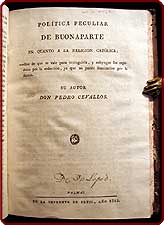
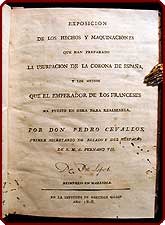 Mallorcan imprints of the Napoleonic wars by Pedro Cevallos (1764–1840). The Exposicion details the perfidy of Napoleon in Spain, in particular his luring of Ferdinand VII away from Madrid and the placing of Joseph Bonaparte on the throne. This piece proved an effective piece of anti-French propaganda, was widely published, and was translated into Portuguese, English, German, and French. In the Politica peculiar Cevallos reveals Napoleon’s attitude toward the Church, and his desire, if he could not absolutely destroy Catholicism, at least to bring it under thorough state subjection. Both of these editions were issued in Mallorca and they are rare: We were able to trace only one copy of each in the U.S. via NUC Pre-1956, OCLC, and RLIN.
• Exposicion: Palau 54257. Política peculiar: this edition not in Palau. Contemporary acid-stained calf simply gilt with brown leather label on each spine; scattered wormholes and some loss of leather over corners and at base of spine. Endpapers stencilled red and green. Some interior worming, most noticeable in endpapers and first title-page, resulting in loss of parts of letters without loss of sense. Scattered light foxing and a few leaves shallowly dog-eared. Inked ownership inscription on title-pages. All edges speckled red.

 Memoirs of
 the Minister of Police Fouché, Joseph. The memoirs of Joseph Fouché, Duke of Otranto, minister of the general police of France. London: Charles Knight (William Clowes, pr.), 1825. 8vo. Frontis. port., viii, 357, [3], 329, [1] pp.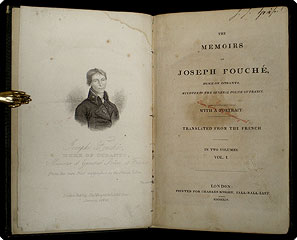
 Click the image for an enlargement.
 • NSTC 2F12262, 2J13268, & 2B13609. Green cloth over boards, gilt rules and lettering to spine; cloth worn away at spine extremities and corners and splitting over front joint; preliminary pages (including frontispiece) and pp. 1–2 separated from binding. Private ownership signature at top edge of title-pages; a (different) private owner's pressure- and rubber-stamps; institutional bookplate. Off-setting to six pages from old newspaper articles or leaves laid in; old newspaper article (a review of a much later biography of Fouché) still inserted; Inner margin of pp. 327–8 repaired, not affecting text. Spotting and staining of various sorts and a few dog-ears; not a swell copy but a perfectly serviceable one. (14222)

 How theBrits Defeated Boney — Sole Edition, 19 PlatesO’Neill, Thomas. A treatise on the eighteen manoeuvres.... Likewise, observations on the interior regulation of companies.... London: Pr. by R. Edwards, 1805. 8vo (24.4 cm, 9.625"). 128 pp.; 19 plates.

 Click the images for enlargements.


• NSTC O363. Recent quarter red morocco over marbled paper with gilt-lettered spine. Upper outer corner of pp. 9–10 lost, repaired with paper resulting in no loss of text. Shallow chipping and tattering (with one tissue repair on title-page), not touching text or figures. Some brownstaining in margins. Rubber-stamps of a now-defunct library, including one on title-page. All edges gilt. (10986)

How to Behave in Napoleon’s
Court[Ségur,
Louis Philippe, comte de].
Étiquette du palais impérial. Année 1806. Paris: De l’imprimerie
impériale, 1806. 4to (25.7 cm, 9.9"). [1] f., 159, [1 (blank)] pp.
Napoleon’s
Court[Ségur,
Louis Philippe, comte de].
Étiquette du palais impérial. Année 1806. Paris: De l’imprimerie
impériale, 1806. 4to (25.7 cm, 9.9"). [1] f., 159, [1 (blank)] pp.


The work is generally attributed to the Comte de Ségur, a diplomat and historian who served under Rochambeau in the American War of Independence; he also published works on classical and Jewish history.
• Old-style blue morocco, covers framed in double gilt fillets, spine with gilt-ruled raised bands and gilt-stamped devices in compartments, leather turndowns tooled in blind. Tear in upper margin of one leaf repaired very unobtrusively; several leaves with closed tears or holes also professionally patched, just touching a few letters; one leaf with clear tape covering tear. Pages washed, resized, and very clean, with only a few faint spots; edges slightly brittle, with occasional very short tears.
 “Blue Lights” & “Bob Short” — Early American PoetryScott, Jonathan M. Blue lights, or the convention. A poem in four cantos. New York: Charles N. Baldwin, 1817. 12mo (13.5 cm, 5.25"). [2], 150, [2 (blank)] pp. [bound with] Scott, Walter. Vision of Don Roderick. Boston: T.B. Wait & Co., 1811. 12mo. 74, [2 (blank)] pp. [and] Longstreet, Augustus Baldwin. Patriotic effusions; by Bob Short. New York: L. & F. Lockwood (J. & J. Harper, prs.), 1819. 12mo. 46, [2] pp. [and] Scott, Walter. Field of Waterloo. New York: Van Winkle & Wiley, 1815. 12mo. 48 pp. [and] Pitt, William. Letters written by the late Earl of Chatham to his nephew Thomas Pitt, Esq. Boston: C. Williams (T.B. Wait & Co., prs.), 1811. 12mo. 64 pp. (pp. 49–56 bound in at end).


 Click some of the images for enlargements.

• Blue Lights: Wegelin 1132; Shaw & Shoemaker 42070. Vision: Shaw & Shoemaker 23893. Patriotic Effusions: Wegelin 1045; Shaw & Shoemaker 48509. Waterloo: Shaw & Shoemaker 35871. Letters: Shaw & Shoemaker 23699. Contemporary sheep, covers framed in single gilt roll, spine with gilt-stamped leather title-label and gilt-stamped decorative bands; binding a little rubbed at joints and extremities. Front pastedown with early inked ownership inscription; free endpapers excised. Trimmed closely, in occasional instances just touching outermost letters. Some age-toning and spotting; one leaf with ink stain not obscuring text, two leaves with tears from outer margins extending into text. Intermittent pencilled underlining and small marks. Pp. 49–56 of Letters bound in at end.
“A Glorious Period of the Past” Sor, Charlotte de. Napoleon and his times. Philadelphia: E.L. Carey & A. Hart, 1838. 12mo (19.2 cm, 7.5"). 2 vols. I: viii, [13]–253, [1 (blank)] pp. II: viii, [13]–230 pp.
 Click
the images for enlargements.
Click
the images for enlargements.
Binding: Publisher's
ribbon-embossed green geometric-patterned cloth of Krupp's style Gt2; original
printed paper labels.Do
please click to enhance the image of this handsome American binding cloth—
it's hard to show, but worth trying to see!
• American Imprints 49627. On the binding, see: Krupp,
Bookcloth in England & America, 1823–1850, Gt2. Bindings
as above, cocked; edges, extremities, labels rubbed, chipped, spotted —
far from fresh, but also far from devastated. Ex–social club library:
bookplate on each front pastedown, call numbers in a 19th-century hand (lined
through) on pastedown and front free endpaper, title-pages and a few others
rubber-stamped. No other institutional markings. Front hinge (inside) of vol.
I starting, text block pulling away from spine, first few leaves starting
to separate. Front fly-leaf with pencilled numeral and pencilled
doodle/sketch of a chubby child; occasional faint pencilled
annotations. A few scattered spots of staining, pages mostly clean. (26294)
TYRANNY
. . . by Taxation . . .[Walsh,
Robert]. A letter on the genius and dispositions of the French government,
including a view of the taxation of the French Empire. Addressed to a friend,
by an American recently returned from Europe. Philadelphia:
Hopkins & Early; also by P.H. Kicklin & Co. [and in Baltimore
and elsewhere by other publishers], 1810. 8vo (23.2 cm; 9.125"). iv, 253, [1 (blank)]
pp. 

• Sabin 101158; Shaw & Shoemaker 21936. 19th-century quarter
green morocco with marbled paper sides; round spine with raised bands, gilt
center ornaments in three compartments, title in gilt in one compartment.Ex–Library
Company of Philadelphia, properly deaccessioned. Joints rubbed,
top of spine pulled; foxing and staining. Uncut.


PLACE AN ORDER | E-MAIL US | GO (BACK) TO TOPIC/INTEREST TABLE | PRB&M HOME
All material © 2010
The Philadelphia Rare Books & Manuscripts
Company