 MINING
MINING
MINING
 A Celebrated Study of Nicaragua's Natural History
  Belt, Thomas. The naturalist in Nicaragua: A narrative of a residence at the gold mines of Chontales; journeys in the savannahs and forests. With observations on animals and plants in reference to the theory of evolution of living forms. London: John Murray, 1874. 8vo (19.4 cm, 7.6"). Frontis., xvi, 401, [1] pp.; 3 plts., 1 fold. col. map.
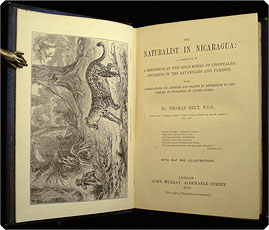
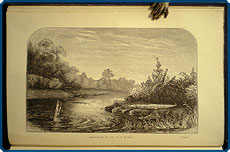
 Click the interior images for enlargements.
  the
workings of the mines, as well as instances of support
for Darwin's theory of evolution. The volume is illustrated with a number of
in-text wood engravings in addition to four plates (including the frontispiece)
and an oversized, colored map.
the
workings of the mines, as well as instances of support
for Darwin's theory of evolution. The volume is illustrated with a number of
in-text wood engravings in addition to four plates (including the frontispiece)
and an oversized, colored map.
• NSTC 00522718; Palau 26647; Jackson, Guide to the Literature of Botany, 368. Publisher's blue cloth, covers framed in black-stamped designs, front cover with central gilt-stamped alligator vignette; binding slightly shaken, spine sunned, corners and spine extremities rubbed, sewing just starting to loosen. Two leaves with outer margins lightly waterstained; map edges lightly foxed. A nice clean copy. (24406)

 Coal
Mining (or Lack Thereof)
in Scotland(Biggar vs. Buccleugh). Information for William Biggar of Wolmet, against her Grace the Dutchess of Buccleugh. [Edinburgh, 1705–10?]. Folio (31.5 cm, 12.35"). [4] pp.
Coal
Mining (or Lack Thereof)
in Scotland(Biggar vs. Buccleugh). Information for William Biggar of Wolmet, against her Grace the Dutchess of Buccleugh. [Edinburgh, 1705–10?]. Folio (31.5 cm, 12.35"). [4] pp.
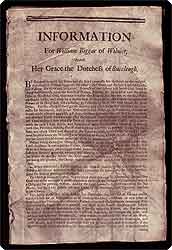
 ESTC records only one, imperfect holding of this item.
• ESTC T37215. Tipped onto a leaf of 19th-century paper, now in a Mylar folder. Dust-soiling, creasing; repairs to tears in both leaves done some time ago, with some unrepaired closed tears resulting in loss of a few letters here and there.


 Illustrated Explorations of theCountryside Dibdin, Charles. Observations on a tour through almost the whole of England, and a considerable part of Scotland, in a series of letters, addressed to a large number of intelligent and respectable friends. London: G. Goulding & John Walker (pr. by T. Woodfall), [1801–02]. 4to (28.9 cm, 11.4"). 2 vols. I: 404 pp.; 27 plts. II: [2], 406, [2] pp.; 33 plts., 1 fold. map, 1 fold. chart.
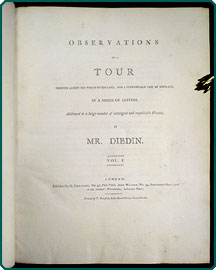
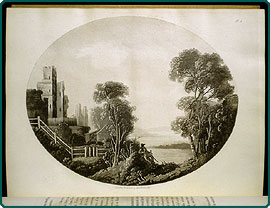
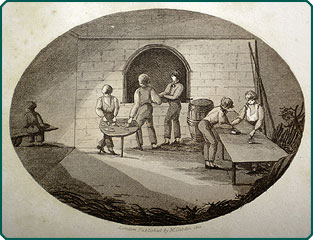 Click the images for enlargements.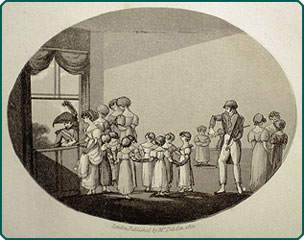
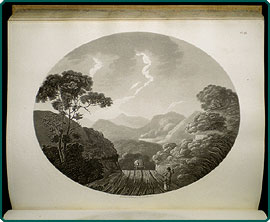
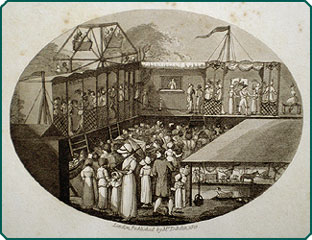 illustrated with 60 copper-engraved and aquatint plates, one folding map, and one folding chart. The copper engravings are done in two different styles; one set consists of large renditions of scenery, the other of smaller depictions of people and everyday life — the former done from Dibdin's own paintings, and the latter from drawings by his daughter Anne.
• Anderson, Book of British Topography, 373; Lowndes 638; NSTC D1044. Not in Abbey, Life in England; not in Ray, The Illustrator & the Book in England. On Dibdin, see: Oxford Dictionary of National Biography online. Recent quarter caramel morocco and ochre cloth. Light to moderate foxing; mild offsetting around plates; four pages with patch of offsetting from now-absent laid-in item. Plates depicting people all with small area of waterstaining to upper inner portions, just touching corner of platemark without affecting images; scenic plates unaffected. All edges marbled.  A solid, handsome, satisfying set. (26939)

The Amalgamation Process ExplainedRoyal
OrderGarcés y Eguía, José. Nueva teórica y práctica del beneficio de los metales de oro y plata por fundicion y amalgamacion, que de orden del rey nuestro señor Don Carlos Quarto ... ha escrito y da al publico José Garcés y Eguia. Mexico: Mariano de Zuñiga y Ontiveros, 1802. Small 4to. [5] ff., 12, 168 pp.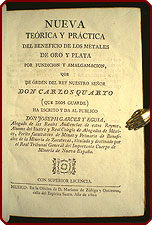

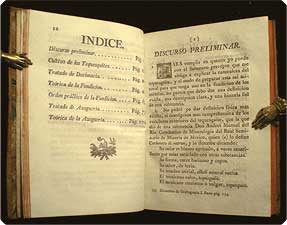 Single-click any image where the hand appears on
 A work also of considerable
scarcity in the marketplace.
A work also of considerable
scarcity in the marketplace.
• Medina, Mexico, 9502; Palau 97721; Sabin 16551. Publisher's treed sheep binding, gilt spine extra, spine label mostly perished. All edges carmine. A very good copy.

The
Mining Revival &
The Father of Mexican
Independence
Hidalgo,
Miguel de, Father of Mexican Independence. Document
Signed (Br. Hidalgo), on paper, in Spanish. No place [mining region of Real de
Bolaños or Aguas Calientes], no date [1780]. Folio, 1 p., bound in a dossier
of documents relating to the execution of the provisions of the will of Augustina
Velázquez. [with] A number of other collateral documents relating
to the Condes de Vivanco. On paper, in Spanish. Mexico City, Real de Bolaños,
Aguas Clientes, Valladolid (now Morelia), and elsewhere in Mexico. Folio (31 cm,
12.25") and smaller.
Mexican
Independence
Hidalgo,
Miguel de, Father of Mexican Independence. Document
Signed (Br. Hidalgo), on paper, in Spanish. No place [mining region of Real de
Bolaños or Aguas Calientes], no date [1780]. Folio, 1 p., bound in a dossier
of documents relating to the execution of the provisions of the will of Augustina
Velázquez. [with] A number of other collateral documents relating
to the Condes de Vivanco. On paper, in Spanish. Mexico City, Real de Bolaños,
Aguas Clientes, Valladolid (now Morelia), and elsewhere in Mexico. Folio (31 cm,
12.25") and smaller.  Approximately
350 ff.
Approximately
350 ff.
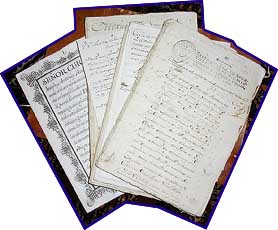
 This
is a fine, extremely early example of Father Hidalgo's signature.
This
is a fine, extremely early example of Father Hidalgo's signature.
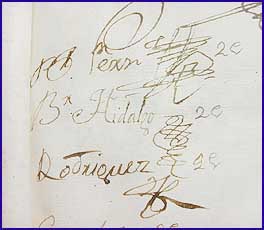 The woman who provided the money for the above mentioned masses was the wife
of Antonio de Vivano (also spelled Bibano) Gutiérrez and mother of
Antonio Guadalupe de Vivano, the first two Condes de Vivanco. Cambridge scholar
David Brading credits Antonio de Vivanco with restoring the mining region
of Bolaños to prosperity in the early 1770s, following the region's
sharp decline in silver ore production during the first two-thirds of the
18th century — whereby he became very wealthy.
The woman who provided the money for the above mentioned masses was the wife
of Antonio de Vivano (also spelled Bibano) Gutiérrez and mother of
Antonio Guadalupe de Vivano, the first two Condes de Vivanco. Cambridge scholar
David Brading credits Antonio de Vivanco with restoring the mining region
of Bolaños to prosperity in the early 1770s, following the region's
sharp decline in silver ore production during the first two-thirds of the
18th century — whereby he became very wealthy.
In addition to payment for masses for her soul, Doña Augustina's will provides for large sums of money to be spent on construction work on the chapel of Our Lady of Guadalupe in the bishopric of Guadalajara. The paperwork, including receipts, associated with the distribution of her largesse is weighty and detailed.
Among
the collateral documents in this offering are copies of the last wills and
testaments of Antonio de Vivanco Gutiérrez (1796), Augustina Velázquez
(1780), and Antonio Guadalupe de Vivanco (1800); the inventory of the younger
Vivanco's massive estate (1801); and a marvelouscalligraphic
manuscript in which the bishop of Guadalajara grants
a special privilege to Vivanco the elder. All are notarially certified copies
of the originals.
• All documents in very good condition, sewn, in contemporary vellum bindings.
Treasury Form specifying“Arbitrary” Penalties for Failure to Comply Mexico (viceroyalty). Royal Treasury. Broadside, begins: Real Caxa de Durango. Guia Numo. Pasa el conductor ... [Mexico City: no printer/publisher, ca. 1762–75]. Folio. [1] p.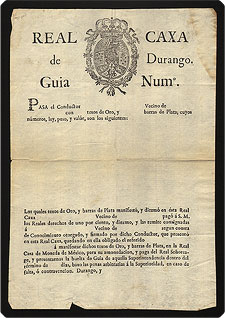 Click the image for an enlargement.
 Printed in roman type with one decorative initial and a handsome woodcut of the royal coat of arms (as modified by Charles III) in the center at the top of the leaf.
No copy located via WorldCat, CCILA, or METABASE.
• Not in Medina, Mexico; nor González de Cossío, Cien; nor González de Cossío, 510. Old folds, small rent in lower blank margin. Waterstain in upper right corner and a big of soil along one fold. (25800)
SILVER MINING in 18th-Century Mexico & Peru Mexico (viceroyalty). Laws, statutes, etc. Reales ordenanzas para la direccion, regimen y gobierno del importante cuerpo de la mineria de Nueva-España, y de su real tribunal general. De orden de su magestad. Lima: 1786. 4to. [1] f., LXXIX, [1 (blank)], VII, [1 (blank)], 269, [1 (blank)] pp.
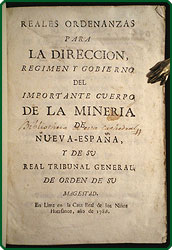
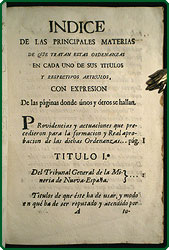
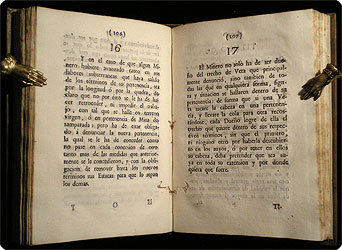 Click the interior images for enlargements.
 Sabin calls this work a “rare and valuable compendium of the old mining laws and mineral customs.” Galvez was a special commissioner charged with making reforms in the governing of Mexico; his work greatly influenced the 1786 replacement of the Mexican provinces with 12 intendencias. The 18th century saw a rebirth of the Mexican and the Peruvian silver industry as new technologies and techniques were introduced. Concomitant with the increased production was increased wealth for the mine owners and the crown.
• Palau 251938a; Medina, Lima, 1636; Sabin 56260. Recent calf bordered in gilt tooling, spine with gilt bands and floral devices in compartments, gilt-stamped leather title label; a few very small scuffs to covers. All edges sprinkled blue and red. Title-page recto and verso with inked ownership inscriptions in an early hand. Final leaf with repairs to outer edge; penultimate two leaves with lower corners torn away, outer edge of one with small chewed portion. Occasional spots of foxing. Two worm pinholes to title-page; more extensive worming to inner margins of central 20 leaves, on some pages touching text without affecting comprehensibility. Handsome. (3039)
MEXICANSILVER
MINING
Spain.
Laws, statutes, etc. Reales ordenanzas para la direccion, régimen
y gobierno del importante cuerpo de la minería de Nueva-España,
y de su real tribunal general. De orden de su magestad. Madrid, 1783. Folio
(34.3 cm, 13.5"). [1] f., XLVI, 214 pp. 
 here
printed for the first time. Sabin
calls it a "rare and valuable compendium of the old mining laws and mineral
customs."
here
printed for the first time. Sabin
calls it a "rare and valuable compendium of the old mining laws and mineral
customs."
Galvez was a special commissioner charged with making reforms in the governing of Mexico; his work greatly influenced the 1786 replacement of the Mexican provinces with 12 intendencias. The 18th century saw a rebirth of the Mexican and the Peruvian silver industry as new technologies and techniques were introduced. Concomitant with the increased production was increased wealth for the mine owners and the crown.

 A
tall copy, regular copies being only 31 cm tall.
A
tall copy, regular copies being only 31 cm tall.
A Tour ofRUSSIA Conducted by a SPECIALIST Tooke, William. View of the Russian empire, during the reign of Catharine the second, and to the close of the eighteenth century ... the second edition. London: Pr. by A. Strahan & G. Woodfall for T.N. Longman & O. Rees, 1800. 8vo (21.7 cm, 8.5"). 3 vols. I: xxxvi, 630 pp.; 1 fold. map. II: [2], 574 pp. III: [2], 628 pp. (pagination skips 561–64).

 Click the images for enlargements.
 The state of the Russian military forces is here described at length. The
commerce section includes chapters on viniculture, sericulture, and apiculture,
as well as mining
and salt harvesting; at the back of the third volume are extensive
tables of Russian imports and exports, merchant ships arrived and sailed,
duties and taxes, and names of the most active St. Petersburg merchants. Coins
and measures are also examined.
Binding: Contemporary treed calf, flat spines with gilt tooling of several sorts creating compartments, each with a large device; gilt-stamped green leather title and volume labels.
• ESTC T109837; Allibone 2434. On Tooke, see: Dictionary of
National Biography online. Bound as above, two volumes with front
covers off and all other joints weak; covers showing some gouges and spines
some chips, the set apparently having been exposed not only to normal wear/rubbing
but sometime long past to something (heat? “repairs”?) that darkened
and roughened them irregularly. Ex–social club library: front pastedowns
each with 19th-century bookplate and inked numerals, title-pages pressure-stamped.
Intermittent light foxing and light to moderate offsetting throughout; vol.
III with waterstaining in upper margins. Map lightly foxed but otherwise in
excellent condition. A set of booksstill
striking, and priced to permit the next owner to contemplate
repairs. (26366)
Click
here for
related  material
. . .
material
. . .

PLACE AN ORDER | E-MAIL US | GO (BACK) TO TOPIC/INTEREST TABLE | PRB&M HOME
All material © 2010
The Philadelphia Rare Books & Manuscripts
Company