
 JESUITANA
JESUITANA
JESUITANA
 “Sicut Serpentes”
  (“A”
is for “ANTI”?).
Pascal, Blaise.
The mystery of Jesuitism, discovered in certain letters, written upon occasion
of the present differences at Sorbonne between the Jansenists and the Molinists,
displaying the pernicious maximes of the late casuists. London: Richard Royston,
1679. 8vo (18.7 cm, 7.4"). [14], 152, 161–342 pp.; 1 fold. plt. (text complete;
lacking frontis. and prelim. ff.). [with, as issued] Additionals
to the Mystery of Jesuitism. Englished by the same hand. London: Richard Royston,
1679. [2] ff., 126 pp. (lacking final 8 adv. pp.).
(“A”
is for “ANTI”?).
Pascal, Blaise.
The mystery of Jesuitism, discovered in certain letters, written upon occasion
of the present differences at Sorbonne between the Jansenists and the Molinists,
displaying the pernicious maximes of the late casuists. London: Richard Royston,
1679. 8vo (18.7 cm, 7.4"). [14], 152, 161–342 pp.; 1 fold. plt. (text complete;
lacking frontis. and prelim. ff.). [with, as issued] Additionals
to the Mystery of Jesuitism. Englished by the same hand. London: Richard Royston,
1679. [2] ff., 126 pp. (lacking final 8 adv. pp.).

 Click the interior image for an enlargement.
 The work was first printed in English in 1657, as Les provinciales: Or the Mysterie of Jesvitisme.  The present edition is illustrated with an oversized, folding plate depicting prominent Jesuits. The second section (the “Additionals”) has a separate title-page.
Our caption is the first title's epigraph.
• ESTC R5437; Wing (rev. ed.) P641 & 642; Lowndes 1208; PMM 140 (on the first edition). Period-style mottled calf, covers framed and panelled in gilt rules with gilt-stamped corner fleurons, spine gilt extra with gilt-stamped leather title-label. Frontispiece (Moses delivering the law), a few preliminary leaves, and final advertising leaves lacking; text complete despite skip in pagination and fold-out plate present. Title-page with early inked numerals and institutional rubber-stamp. Light waterstaining to outer and lower page portions; otherwise, the odd spot only. (24874)
 This entry is repeated in the

 The
The FIRST
Latin Gradus
Aler, Paul. Gradus ad Parnassum, sive Novus synonymorum epithetorum, et phrasium poeticarum thesaurus ... Lipsiae: Apud Michaelem Blochbergerum, 1738. 8vo (17.7 cm, 7"). [8], 48, 768 (i.e., 760) pp.
FIRST
Latin Gradus
Aler, Paul. Gradus ad Parnassum, sive Novus synonymorum epithetorum, et phrasium poeticarum thesaurus ... Lipsiae: Apud Michaelem Blochbergerum, 1738. 8vo (17.7 cm, 7"). [8], 48, 768 (i.e., 760) pp.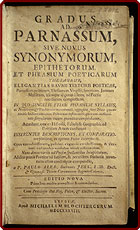
• DeBacker-Sommervogel, II, 1092–95 (for other eds.). Contemporary vellum, spine with inked title; lightly soiled, front cover with partially effaced early inked ownership inscription and back cover with faded early inked inscription. Front pastedown institutionally rubber-stamped, front free endpaper lacking, title-page with early inked ownership inscription partially effaced (resulting in small holes). Pages age-toned, with occasional foxing. (24349)
A Jesuit Pioneer in India & Japan Bouhours, Dominique. La vie de Saint François Xavier, de la Compagnie de Jésus, apostre des Indes et du Japon. Nouvelle édition. Paris: Chez Guillot, 1787. 12mo (16 cm, 6.5"). 2 (of 2) vols. I: 24, 442, [2] pp. (lacks frontis.) II: [4], 418, [1] pp.
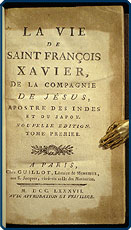
Click the interior image for an enlargement. The New Advent Catholic Encyclopedia notes that Dominique Bouhours (1632–1702) was best known to English readers as the author of this much-reprinted work and an earlier life of Ignatius of Loyola; for a long time these were “the most widely circulated biographies” of the two saints. Bouhours also achieved prominence for his anti-Jansenist writings.
The pair of volumes were nicely printed, with some nicely engraved head- and tailpieces. The text offers sidenotes.
Rare. A search of OCLC records only two copies, of which this is one, now deaccessioned.
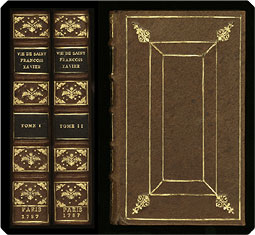
• De Backer-Sommervogel, I, 1904–1905; Cordier, Bibliotheca Japonica, 146. Recent full calf, covers framed and panelled with single gilt fillets and with gilt-stamped corner fleurons; spines gilt extra, with gilt-ruled raised bands, gilt-stamped leather title and volume labels, gilt publication date at foot, and elaborately gilt-tooled floral decorations in compartments; marbled endpapers. Tear in outer margin of pp. 269/270, just barely touching sidenotes; very occasional foxing; offsetting from leather of previous binding affecting first and last leaves at margins, including title-pages. Ex-library, with faint penciled notations on verso of title-page and at base of following page in each volume. Vol. I lacks the frontispiece portrait. Faults noted, still a good copy and in an attractive binding. (24526)
For more SETS, click here.

Canisius' Catechism of the Youngest Children Canisius, Petrus, Saint. Institutiones christianae pietatis. Seu parvus catechismus catholicorum. Coloniae : Apud Maternum Cholinum, 1571. 12mo (13.5 cm; 5.25"). [16] ff., 51, [1] pp., [36] ff.
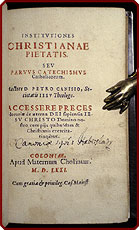
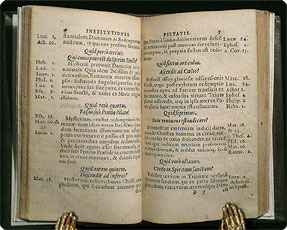
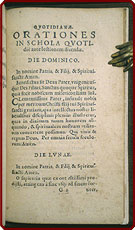 Click the interior images for enlargements.
 Offered here is an early printing of the version for the youngest students. The title-page and calendar are printed in red and black, and a few headlines in the early section are also in red.
Uncommon. OCLC locates only this now deaccessioned copy in the U.S., and one copy in Europe. Index Aureliensis fails to list this edition at all.
• Not in Index Aurel.; not in Adams. Recent ebony-brown calf old style: Round spine with raised bands, accented in gilt and with blind-tooled devices in compartments; single blind rules extending onto covers from each band to terminate in trefoils, and covers framed in blind double fillets. Author's name and date of printing in gilt on spine. Early underscoring and some minimal marginalia in red ink in a 16th-century hand; ownership note of same era on title-page. Some age-spotting and other light discoloration, not serious.  For an early children's book, a very, very nice copy. (24855)
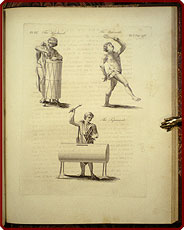
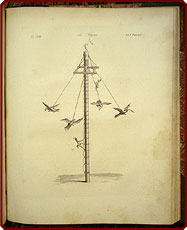
Illustrated IndigenousCustoms & Dress FIRST Edition in ENGLISH Clavigero, Francesco Saverio. The history of Mexico. Collected from Spanish and Mexican historians, from manuscripts, and ancient paintings of the Indians ... translated from the original Italian, by Charles Cullen. London: Pr. for G.G.J. and J. Robinson, 1787. 4to (28.5 cm, 11.2"). 2 vols. I: [2], xxxii, [4], 440, (441–44), 441–76 pp. (pagination skips v/vi, with text complete); 1 fold. map, 25 plts., 1 table. II: [4], 463, [1 (blank)] pp.; 1 fold. map, 1 plt.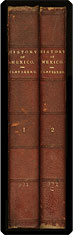
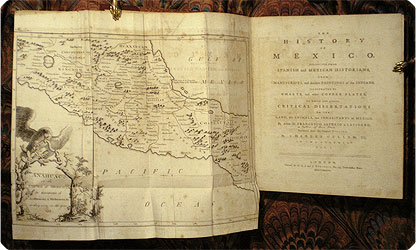 Click the interior images for enlargements.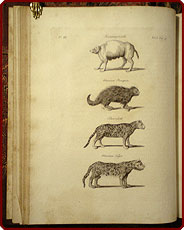
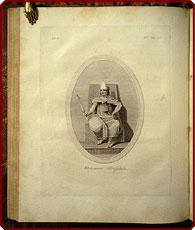
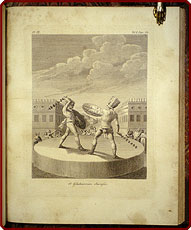
Thetwo oversized, folding maps were engraved by T. Conder; a genealogical chart in vol. I shows the descent of the Mexican kings from the 13th century, while numerous engraved plates depict Mexican artifacts, costumes, activities, flora and fauna, architecture, etc.
 For more SETS, click here.

 TO Part II
 |