 HORSES
HORSES
HORSES
 “What Is Dis, A Chin-Chin to a Show Down?”
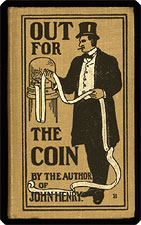
  McHugh, Hugh. Out for the coin. New York: G.W. Dillingham Co., 1903. 8vo. 107, [1], xx (adv.) pp.; 6 plts.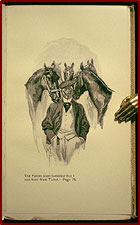
 Click the interior image for an enlargement.
 Binding: Publisher's tan cloth, front cover pictorially stamped in black and white; designed by Thomas Watson Ball and with his “B” cipher. The cover depicts a richly dressed man at a tickertape machine. Top edge gilt.
• Bound as above; black stamping showing light wear: a solid, clean copy. (22208)

 Remembrances of
 Idyllic Youth Sassoon, Siegfried. Memoirs of a fox-hunting man. New York: Printed for the Members of The Limited Editions Club, 1981. Tall 8vo. Frontis., [8], 9–284 pp.; 8 plts.

Paul Hogarth illustrated the book with black-and-white vignettes which open and close each chapter, and eight full-page color wash drawings. John Lewis designed the book choosing a monotype Walbaum font. The binding is quarter red calf over light-brown buckram sides, gilt-lettered on the spine, and gilt-stamped on the front cover with a design of various fox-hunting implements; tucked away at the lower edge of the back cover is a gilt design of a sly-looking fox in full trot.
This edition is limited to 1600 copies and is signed by the artist on the colophon.
• Limited Editions Club, Bibliography of the Fine Books Published by The Limited Editions Club, 1929–1985, 506. Binding as above, in original glassine wrapper and slipcase; wrapper with tears at bottom edge. Slipcase with slight bumping at inner front edge. A fine copy, in a near fine slipcase. (22104)

 “Horse-Hoing” — 6
 NIFTY Fold-Out PlatesTull, Jethro. The horse-hoing husbandry: Or, an essay on the principles of tillage and vegetation.... London: Pr. for the author, and sold by G. Strahan, T. Woodward, A. Miller, J. Stagg, and J. Brindley, 1733. Folio (30.2 cm, 11.875"). [4], x, 200 pp.; pp. [201–202]. 6 fold-out plts. [bound with] Tull, Jethro. A supplement to the essay on horse-hoing husbandry.... London: Pr. for and sold by the author, and may be had at Mr. Mills's, London, at John Aitkins's, Esq, in Edinburgh, and at the Bear in Hungerford, Berks., 1736. Folio. pp. [203–205], 206–69; [1] pp.

 Single-click any image, for an enlargement.

 six beautifully engraved, pleasantly intelligible plates (“W. Thorpe, sculp.) illustrate some of Tull’s inventions, including improved plows and drills for planting seeds.

• Goldsmiths’-Kress 7065; ESTC T81915 and N24607. Contemporary calf with remnants of gilt; dry, flaking, and partially gone to red, with some chips to edges, corners, and spine tips; old repairs to joints. Remnants of bookplate on front pastedown. Old water/mildew damage to lower margins, occasionally making its way a bit into text; several leaves repaired, long since. Plates generally quite clean and always pleasing, with faintest waterstaining to lower portion of plate 6 (only). All edges speckled red.

 Popular
Fiction by
a Victorian “Sporting”
Novelist
—
Popular
Fiction by
a Victorian “Sporting”
Novelist
— Reading
for Country-House
Mornings
Whyte-Melville, G[eorge] J[ohn]. Holmby House: A tale of Old Northamptonshire. London: John W. Parker and Son, 1860. 8vo. 2 vols. I: Frontis., [3] ff., 325 pp. II: [2] ff., 344 pp., 3, [1] pp. (ads).
Reading
for Country-House
Mornings
Whyte-Melville, G[eorge] J[ohn]. Holmby House: A tale of Old Northamptonshire. London: John W. Parker and Son, 1860. 8vo. 2 vols. I: Frontis., [3] ff., 325 pp. II: [2] ff., 344 pp., 3, [1] pp. (ads). 
• Publisher's cloth. Signatures split from bindings at several places — one more reading and this will very likely achieve "binding now a portfolio" status, though it will be readable and shelvable even then.


PLACE AN ORDER | E-MAIL US | GO (BACK) TO TOPIC/INTEREST TABLE | PRB&M HOME
All material © 2010
The Philadelphia Rare Books & Manuscripts
Company