 CHIVALRY
/ HERALDRY
CHIVALRY
/ HERALDRY
CHIVALRY
/ HERALDRY
CHIVALRY
/ HERALDRY
 He Survived “La Noche Triste” & Much, Much More
 THE
CONQUEROR'S REWARD
THE
CONQUEROR'S REWARD
 (A
CONQUISTADOR'S GRANT OF ARMS). Felipe
II, King of Spain.
Illuminated Document Signed (on his behalf by his sister/regent, “La Princesa”).
In Spanish, on vellum. Valladolid, 17 March 1559. Folio (58 x 54.5
cm; 23" x 21.5"; h x w), 1 leaf.
(A
CONQUISTADOR'S GRANT OF ARMS). Felipe
II, King of Spain.
Illuminated Document Signed (on his behalf by his sister/regent, “La Princesa”).
In Spanish, on vellum. Valladolid, 17 March 1559. Folio (58 x 54.5
cm; 23" x 21.5"; h x w), 1 leaf.  |
|
|
|
|
|
|
|
|
|
|
|
|
|
|
|
 |
| ||||||||||||||
 |
 |
 |
 |
 |
 |
 |
|
||||||||
 |
| ||||||||||||||
 |
| ||||||||||||||
 |
 |
| |||||||||||||
 |
 |
| |||||||||||||
 |
 |
| |||||||||||||
 |
 |
| |||||||||||||
 |
| ||||||||||||||
 |
 |
 |
 |
| |||||||||||
 |
 |
 |
 |
| |||||||||||
 |
| ||||||||||||||
 |
 |
| |||||||||||||
 |
 |
| |||||||||||||
 |
| ||||||||||||||
 |
 |
| |||||||||||||
 |
 |
| |||||||||||||
 |
| ||||||||||||||
 |
| ||||||||||||||
 |
| ||||||||||||||
 Move your mouse over the document above, and click,
to select and view details.
 Villanueva was among the small but grand “army” that marched into Tenochtitlán in the Spring of 1520 and in July of the same year were to flee the western world's largest city fighting for their lives, on the “Noche Triste.” He survived the hell and slaughter of the causeways and later returned with the greatly augmented force that destroyed the Aztec capital and its empire. Still later he was with Cortés in the exploration and conquest of Pánuco and following that with Nuño de Guzmán in the exploration and conquest of Zacatecas and Jalisco. He and his brother Fernando (also a member of the Saucedo contingent) jointly received an encomienda (Quechula) and settled in Puebla de los Angeles where Pedro served as a regidor on the town council in the 1540s and 1550s.

 The text of the grant of arms is elegantly
indited in a standard court semi-round gothic in sepia ink and is enclosed
on the left, right, and top sides by an illuminated and historiated sash-like
border. In the upper left and right corners are miniatures of Justice
and Knowledge in sylvan settings. Running between those two along the
top of the document is a decorative panel incorporating flowers, fruits, mythic
animals, and cherubs. Below this, the king's name is accomplished in
large letters of gold on a field of red accented with gold, and the “D”
of his honorific “Don” is given special treatment. This
is elaborated in an ornate, almost baroque style that comes close to obfuscating
the fact of its being a majuscule “d”: Wrought in gold,
the letter at first appears to be merely a “frame” for the royal
coat of arms that fills its center. The king's arms are accomplished
in gold, white, black, red, and blue; the whole being laid on a blue field
with white accents.
The text of the grant of arms is elegantly
indited in a standard court semi-round gothic in sepia ink and is enclosed
on the left, right, and top sides by an illuminated and historiated sash-like
border. In the upper left and right corners are miniatures of Justice
and Knowledge in sylvan settings. Running between those two along the
top of the document is a decorative panel incorporating flowers, fruits, mythic
animals, and cherubs. Below this, the king's name is accomplished in
large letters of gold on a field of red accented with gold, and the “D”
of his honorific “Don” is given special treatment. This
is elaborated in an ornate, almost baroque style that comes close to obfuscating
the fact of its being a majuscule “d”: Wrought in gold,
the letter at first appears to be merely a “frame” for the royal
coat of arms that fills its center. The king's arms are accomplished
in gold, white, black, red, and blue; the whole being laid on a blue field
with white accents.

The panels running down the left and right
sides of the document are accomplished in red, gold, green, pink, white, red,
blue, and brown, many in several shades. The decoration includes birds
of several varieties including a fine owl, animals including a watchful rabbit,
strawberries and other fruits, and flowers, ribbons, grotesques, and butterflies.

The document is signed in the king's name by Juana (Joanna Habsburg) de Austria, “princesa de Portugal.” Married to Prince Juan of Portugal, young Juana (b. 1537) was the regent of the Spanish crown from 1554 until her brother Philip's return to Spain in September of 1559. She had just lost her husband to death and borne his posthumous son, both in January, 1554, when she left Portugal and her child in the Spring of that year to assume the regency throne in Valladolid.

 In
format and content this document differs dramatically from the cartas executorias
de hidalguía that most collectors are familiar with. Here we have a
In
format and content this document differs dramatically from the cartas executorias
de hidalguía that most collectors are familiar with. Here we have a  single large sheet
of vellum handsomely engrossed, artfully illuminated, and exquisitely decorated
with a composite border containing miniatures. This is not a bound volume
of copies of documents created for storage in the family archive.
single large sheet
of vellum handsomely engrossed, artfully illuminated, and exquisitely decorated
with a composite border containing miniatures. This is not a bound volume
of copies of documents created for storage in the family archive.  This
was created for display in a prominent place of honor; and it is a magnificent
display item. This is not a grant of nobility nor
a confirmation of it based on something that some vague ancestor did; rather
it is a grant of a coat of arms to a man who himself performed significant
military and other service for the Crown and whom the Crown wishes to honor
both publicly and privately. Only a few hundred of Cortés's men
survived the Noche Triste, the reentry into and destruction of Mexico
City, and the subsequent conquests in Panuco and elsewhere. The number
of grants such as this to actual members of Cortés's original “army”
were few.
This
was created for display in a prominent place of honor; and it is a magnificent
display item. This is not a grant of nobility nor
a confirmation of it based on something that some vague ancestor did; rather
it is a grant of a coat of arms to a man who himself performed significant
military and other service for the Crown and whom the Crown wishes to honor
both publicly and privately. Only a few hundred of Cortés's men
survived the Noche Triste, the reentry into and destruction of Mexico
City, and the subsequent conquests in Panuco and elsewhere. The number
of grants such as this to actual members of Cortés's original “army”
were few.
 And surviving grants to those actual participants in the Conquest are extremely
rare, even more so in commerce.
And surviving grants to those actual participants in the Conquest are extremely
rare, even more so in commerce.  This
is the only royal grant of a coat of arms to an actual member of Cortés's
“army” that we have seen that has ever appeared in the marketplace.
Via published auction records and our extensive archive of dealer catalogues,
we trace no instance before this one of the offering for sale of a grant of
arms to a Conqueror of Mexico. Yes, there are examples in various libraries
and museums in Mexico and Spain, and probably in the U.S., but such examples
seem to have entered their institutional resting places via donation from
descendants of Conquerors, not via purchase.
This
is the only royal grant of a coat of arms to an actual member of Cortés's
“army” that we have seen that has ever appeared in the marketplace.
Via published auction records and our extensive archive of dealer catalogues,
we trace no instance before this one of the offering for sale of a grant of
arms to a Conqueror of Mexico. Yes, there are examples in various libraries
and museums in Mexico and Spain, and probably in the U.S., but such examples
seem to have entered their institutional resting places via donation from
descendants of Conquerors, not via purchase.

Provenance: It
is awesome to realize that this is no mere retained secretarial copy of Felipe's
grant of arms to Pedro de Villanueva. This gorgeous document not only
records the king's rewards to one of Cortés's men, but was that Conqueror's
personal property. It is the copy of the decree sent to him expressly,
by the Crown!

• On Villanueva, see: Icaza, Diccionario autobiográfico
de conquistadores y pobladores de la Nueva España, I, 88–89;
Thomas, Who's Who of the Conquistadors, 146; Himmerich y Valencia,
The Encomenderos of New Spain, 1521–1555, 262; Díaz
del Castillo, Verdadera historia de la conquista de la Nueva España,
chap. LIII. On Juana de Austria, see: the work of Dr. Kelli Ringhofer.
Overall in very good condition. Some fold tears, some minor rubbing
of small areas of images, stains as visible in our illustrations. The
wax seal and its silk cords no longer present.  Text
clear, not faded, and colors strong.
Text
clear, not faded, and colors strong.
 To review the pictures of this document more systematically than


 Early
Illustrated Effort
at a DICTIONARY
for the Masses
Early
Illustrated Effort
at a DICTIONARY
for the Masses
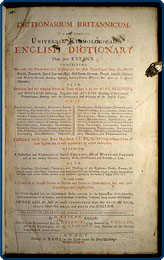
 Bailey, Nathan; Philip Miller; Thomas Lediard; George Gordon. Dictionarium Britannicum: Or a more compleat universal etymological English dictionary than any extant ... illustrated with near five hundred cuts, for giving a clear idea of those figures, not so well apprehended by verbal description ... the second edition with numerous additions and improvements. London: T. Cox, 1736. Folio (35.5 cm, 13.9"). [460] ff.; 1 plt., illus.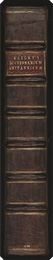
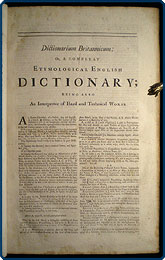
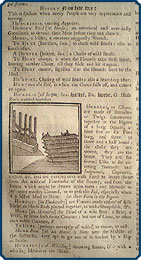
 Click the interior images for enlargements.
 The title-page is printed in red and black; a full-page plate shows an orrery
(for which word there is an unusually long entry) from multiple perspectives,
while many of the in-text woodcuts are  depictions
of heraldic terms, or mathematical and scientific concepts.
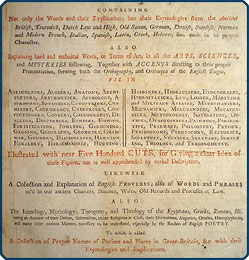
Etymological information is provided in “Antient British, Teutonick,
Dutch Low and High, Old Saxon, German, Danish, Swedish, Norman and Modern
French, Italian, Spanish, Latin, Greek, Hebrew, &c. each in its proper
Character” (from the title-page). Our
photographic detail, third image from left, above, highlights the (endearing!)
ambition and achievement of this large volume.
depictions
of heraldic terms, or mathematical and scientific concepts.
Etymological information is provided in “Antient British, Teutonick,
Dutch Low and High, Old Saxon, German, Danish, Swedish, Norman and Modern
French, Italian, Spanish, Latin, Greek, Hebrew, &c. each in its proper
Character” (from the title-page). Our
photographic detail, third image from left, above, highlights the (endearing!)
ambition and achievement of this large volume.
• ESTC T87976; O'Neill B-5; Vancil 12. On Bailey, see: Oxford
Dictionary of National Biography online. Contemporary mottled calf,
covers framed in gilt double fillets, rebacked, spine with gilt-stamped leather
title-label and gilt-ruled raised bands; sides acid-pitted and scraped. 19th-century
endpapers. Title-page with old-fashioned, round institutional pressure-stamp;
light soil and old inkblots (also light!) in upper portion. Pages a little
browned right at edges; light or faint waterstaining visible in first third
of volume, usually to lower margin only; one leaf with tear from outer margin
just touching text, without loss; one lower outer corner torn away, with loss
of one letter from catchword.  A
sound, pleasant copy of this handsome and interesting production.
(25002)
A
sound, pleasant copy of this handsome and interesting production.
(25002)
Nouveau Dictionnaire — CHIVALRY Gourdon de Genouillac, Henri. Nouveau dictionnaire des ordres de chevalerie crées chez les différents peuples despuis les premiers siècles jusqu'a nos jours.... Paris: E. Dentu, 1891. 8vo. 347 pp. 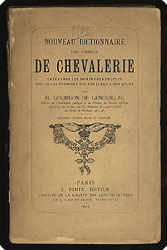
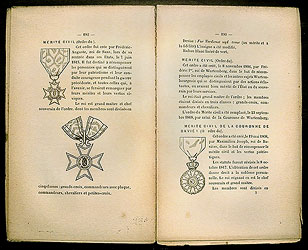 Click the interior image for an enlargement.
  UNCUT and mostly unopened exemplar.
• Original printed wrappers; dusty, with chipping, and front one now separated. Paper lost at top of spine along front joint. The whole, fragile and wanting to separate between signatures. (Our interior image tends a bit to pink tone that is not actually present, FYI.) Now housed in a simple acid-free phase box.
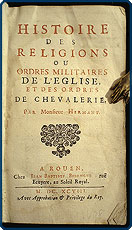
 Knights of the Round Table & OthersHermant, Jean. Histoire des religions ou ordres militaires de l'eglise, et des ordres de chevalerie. Rouen: Chez Jean Baptiste Besongne, 1698. 8vo (16.9 cm, 6.6"). [24], 422, [10] pp.; illus.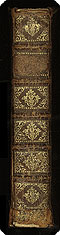
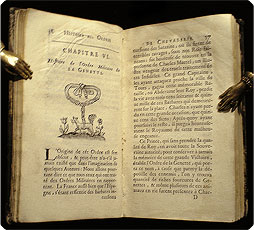
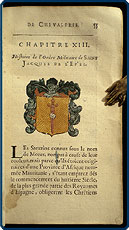 Click the interior images for enlargements.
 • Contemporary speckled calf, spine gilt extra; binding sprung, leather starting to peel back from rubbed corners and edges, back cover cracked with crack extending into foot of spine and spine lacking title-label, leather chipped at spine extremities. Front free endpaper lacking; title-page verso with early inked presentation inscription in French. Many leaves with light to moderate waterstaining in margins, extending into text in some cases. Not at all so sad a case as detailing of faults suggests; price reduced, for the faults, nonetheless. (24390)
Noble Orders — American
Ones Included HereMaigne, W. Dictionnaire encyclopédique des ordres de chevalerie civils et militaires créés chez les différents peuples depuis les temps les plus reculés jusqu'a nos jours. Paris: Adolphe Delahays, 1861. 12mo (17.2 cm, 6.8"). xvi, 240 pp., fold. table/plt.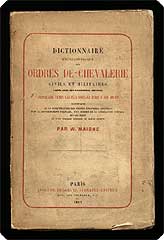
• Vicaire, Manuel de l'amateur de livres du XIXème, I, 772. Uncut, mostly unopened copy. Publisher's wrappers, printed in black and red; front one off, with expectable chipping and with soiling. Some pages lightly spotted; mostly, clean. Now housed in a simple acid-free phase-box. (14356)

 Ancient DaysFORWARD Moulin, Gabriel, du. Histoire generale de Normandie. Contenant les choses memorables aduenuës depuis les premieres courses des Normands payens, tant en France qu'aux autres pays, de ceus qui s'emperent du pays de Neustrie sous Charles le Simple. Avec l'histoire de leurs ducs, leur genealogie, & leurs conquestes, tant en France, Italie, Angleterre, qu'en Orient, iusques a la reünion de la Normandie à la couronne de France. A Rouen: Iean Osmont, 1631. Folio. [6] ff., 56 pp., [1] f., 564, 52 pp., [22] ff.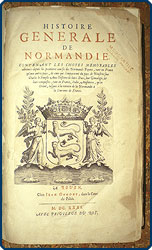
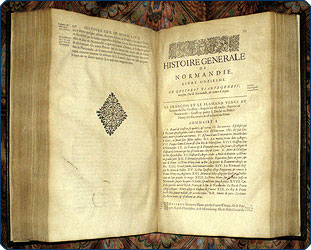
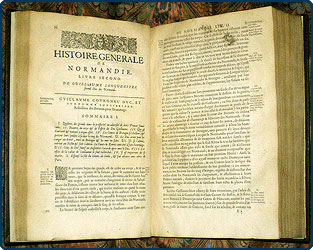 Click the interior images for enlargements.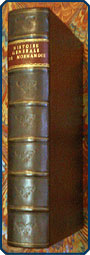
An early owner has mounted on the title-page an armorial plate bearing an image of the two leopards of Normandy on a shield superimposed by a crown, the whole flanked by attendants holding long branches (palms? laurels?) in one hand and the shield in the other.
Handsomely decorated with engraved initials and tailpieces.
• Brunet 24296. Recent deep walnut full calf old style, by Grace Bindings (signed in blind at inner area of rear cover, lower turn-in); round spine with raised bands accented in gilt and with blind-tooled devices in compartments, oxblood leather gilt-lettered title-label, blind fillets extending onto covers from each band to terminate in trefoils and covers framed in double blind fillets. Ex–Mercantile Library of Philadelphia with stamps, mostly faint, including to title-page; title-page re-margined along top and inner edge with an interior hole filled also (no words affected). Title-page with early inked ownership initials; a few other instances of early inked notations within text. Some leaves chipped, others mildly to moderately waterstained; we have chosen to show pages bearing more waterstains rather than fewer.  Armorial device mounted to title-page, as noted; we cannot be sure what this covers, but it is elegant! (21215)
 “Rank Confusion” — That’s a Joke![Nares, Edward]. Heraldic anomalies; or, rank confusion in our orders of precedence, With disquisitions, moral, philosophical, and historical, on all the existing orders of society. By It Matters Not Who. London: G. and W.B. Whittaker (pr. by R. Gilbert), 1823. 8vo (19.7 cm, 7.75"). 2 vols. I: xxii, [2], 334, [2 (1 blank)] pp. II: [4], 372 pp.
 Single-click the image where the hand appears on
 Though Nares is quite capable of picking nits with a level of scrupulousness to match that of the most pedantic of scholars, he is also prone to flights of fancy such as pondering—after noting that a married woman’s moveable goods are unquestionably the property of her husband— “whether the female tongue is to be reckoned among the moveables . . . I believe it is pretty generally held to continue ‘in potestate Mulieris,’ even after marriage, and I know nothing to prevent it” (p. 148). This is followed up with references to Ovid, the Wife of Bath, and the much-storied Flitch of Bacon!
• Contemporary half calf with marbled paper sides, spines with gilt-stamped helm decorations and gilt-stamped leather title and volume labels (the volume labels recently supplied, in sympathetic style). Board edges showing light to moderate wear, with leather cracking at joints and crackled over the spines generally. Top edges gilt. Front pastedowns with bookplates now partially torn away; title-page of vol. II with an early inked ownership inscription in the upper margin. Delightful reading, as well as an overall attractive set.
 For more SETS, click here.

 Virtuous EMBLEMS — Engraved Title-Page
 after RUBENS Pietrasanta, Silvestro. Symbola heroica. Amstelaedami: Janssonio Waesbergios & Henr. Wetstenium, 1682. 4to (21.3 cm, 8.4"). lxxx, 480, [32] pp.; illus. (lacking 1 portrait).


 Click the images for enlargements. 264 in-text copper engravings. One emblem features a telescope aimed at the sun, with the heading “Non ideo maculor”; Pietrasanta's anti-Galilean explanation is that any flaws to be perceived in the character of a virtuous prince are as imaginary as the illusory sunspots created by optical vibrations.


 Society History
Society
of the Cincinnati. Pennsylvania. Proceedings of
the General Society of the Cincinnati, with the original institution of the
Order.... Philadelphia: Pr. by John Ormrod, 1801. 8vo. 82 pp.
Society History
Society
of the Cincinnati. Pennsylvania. Proceedings of
the General Society of the Cincinnati, with the original institution of the
Order.... Philadelphia: Pr. by John Ormrod, 1801. 8vo. 82 pp.
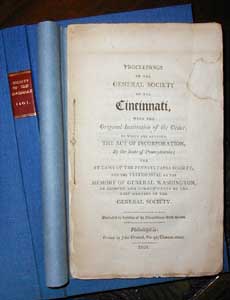
This publication demonstrates that change among many others, as it traces the Society via its own documents from its founding at the "Cantonment of the American Army, on Hudson's River, 10th May, 1783," through the incorporation of the Pennsylvania branch, to the death of Gen. Washington. Included here are the by-laws of the Pennsylvania chapter.
• Shaw & Shoemaker 1339. Sewn, as issued. Front wrapper missing, rear wrapper present. A few spots of waterstaining. Uncut copy. New protective paper corset provided and the whole housed in a cloth clam shell case with a leather spine label lettered in gilt. A very good copy.
 And
463
Years of
And
463
Years of SWEDISH
Chivalry!
Tibell, G. W. af. Seraphimer ordens historia. Stockholm: Tryckt i Kongl. Ordens Tryckeriet, 1826. Tall 4to.
SWEDISH
Chivalry!
Tibell, G. W. af. Seraphimer ordens historia. Stockholm: Tryckt i Kongl. Ordens Tryckeriet, 1826. Tall 4to.
 • Covering the period from 1285 to 1748, this does not illustrate
medals of office but extensively lists members. Rare, with NUC Pre-1956
showing copies at the Library of Congress and Yale only, and OCLC not adding
any others!
• Covering the period from 1285 to 1748, this does not illustrate
medals of office but extensively lists members. Rare, with NUC Pre-1956
showing copies at the Library of Congress and Yale only, and OCLC not adding
any others!
• Original stiff green wrappers with paper spine label. A very nice copy.

PLACE AN ORDER | E-MAIL US | GO (BACK) TO TOPIC/INTEREST TABLE | PRB&M HOME
All material © 2010
The Philadelphia Rare Books & Manuscripts
Company