 BROADSIDESBROADSIDESHow
Many? HODS
were in a
BROADSIDESBROADSIDESHow
Many? HODS
were in a “Dale”
of Coal?
“Dale”
of Coal? (A
Scots Broadside). [Anderson, Andrew]. Broadside.
Begins: “At Edinburgh, 170....”[Edinburgh, ca. 1700]. Folio (31.4
cm, 12.4"). [1] p.
(A
Scots Broadside). [Anderson, Andrew]. Broadside.
Begins: “At Edinburgh, 170....”[Edinburgh, ca. 1700]. Folio (31.4
cm, 12.4"). [1] p.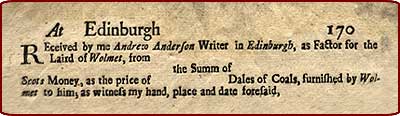
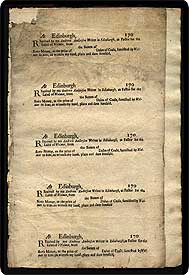
 Only
one holding of this item, in Scotland, is reported by ESTC.
Only
one holding of this item, in Scotland, is reported by ESTC.
• ESTC R172299; Wing (rev.) A3084B. Small portion of upper inner margin torn away. Tipped onto a leaf of 19th-century paper; now in a Mylar folder.


 “Cancion
Patriotica de Caracas”
— Rare
“Cancion
Patriotica de Caracas”
— Rare BELLO
Poetry BroadsideBello, Andrés. Broadside, begins: “Cancion Patriotica de Caracas.” [Caracas: Gallagher y Lamb, 1810]. Folio (31 cm; 12.25"). 1 p.
BELLO
Poetry BroadsideBello, Andrés. Broadside, begins: “Cancion Patriotica de Caracas.” [Caracas: Gallagher y Lamb, 1810]. Folio (31 cm; 12.25"). 1 p.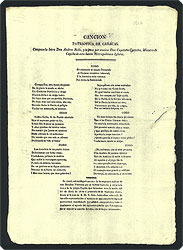
 Click the image for an enlargement.
 the
premiere of this one, as unknown as that one is famous, is stirring to visualize.
Beginning, “Caraqueños, otra época empieza: / De la gloria la senda se
abrio,” it was sung for the first time by Cayetano Carreño himself and six other
voices, the night of 23 April 1810, with the accompaniment of the military orchestra
of the “Batallon Veterano.” The performance took place below the balcony on
which were assembled the members of the Supreme Junta.
the
premiere of this one, as unknown as that one is famous, is stirring to visualize.
Beginning, “Caraqueños, otra época empieza: / De la gloria la senda se
abrio,” it was sung for the first time by Cayetano Carreño himself and six other
voices, the night of 23 April 1810, with the accompaniment of the military orchestra
of the “Batallon Veterano.” The performance took place below the balcony on
which were assembled the members of the Supreme Junta.
That Bello wrote this patriotic song is known, and even the first few lines
were recorded for history, but beyond that the
text is not recorded and is not found in his Obras
completas or, apparently anywhere else.
In addition to the historic collaboration of Bello and Carreño, this fabulous document has the distinction of having been printed by Venezuela’s first press, that of Gallagher and Lamb, which only arrived in Caracas in October of 1808, and was almost certainly printed on 24 April, the day after the hymn was first sung!
Very
Rare.
This broadside was unknown to both Medina and Pedro Grases. Searches of NUC,
OCLC, and RLIN fail to find any copy at all, as is the case when searching
the OPACs of the national libraries of Venezuela, Colombia, Spain, France,
and England.
• Not in Medina, Caracas; not in Grases, Historia de la imprenta en Venezuela; not in Villasana. As issued. Worming in foremargin, repaired. A very good copy.
 “Northern Liberties” Broadside. Partially printed, completed in manuscript, beginning: To --------- Esq. Attorney of the Court of Common Pleas, at Philadelphia in the County of Philadelphia in the state of Pennsylvania to any other Attorney of the said Court, or of any other Court elsewhere. Philadelphia: before 1790. Folio. 1 page (13.125" x 8").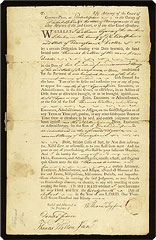
Tyson and Walton signed the document on 24 August 1791.
 An excellent display piece.
• Old folds with a few short tears. Residue of mounting tape at two points on the left margin. (14729)
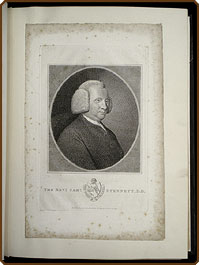
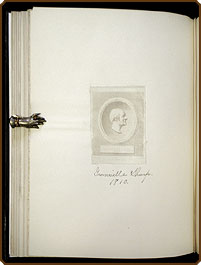
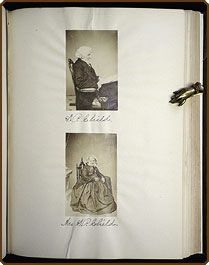
 A Volume EXTRA ILLUSTRATED & Then Some! Brown University. Celebration of the one hundreth anniversary of the founding of Brown University, September 6th, 1864. Providence: Sidney S. Rider & Bro., 1865. 4to (26.5 cm; 10.25"). [4] ff., 178 pp., [1] f.
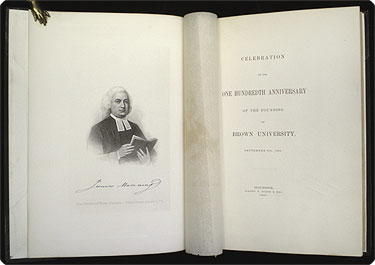
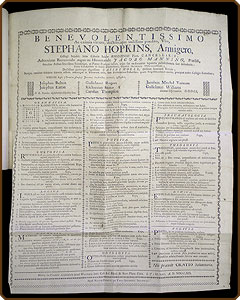
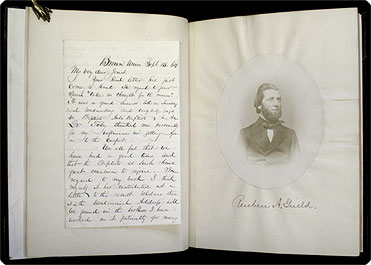 Click the images for enlargements. the broadside publication of the theses
for the first commencement of the College of Rhode Island
(the first name of Brown University), 19 autograph letters signed, 14 engravings
(views, portraits), 15 photographs (including cartes de visite), eight
clipped signatures, and 5 other items including a partially printed document
from 1738.
Click the images for enlargements. the broadside publication of the theses
for the first commencement of the College of Rhode Island
(the first name of Brown University), 19 autograph letters signed, 14 engravings
(views, portraits), 15 photographs (including cartes de visite), eight
clipped signatures, and 5 other items including a partially printed document
from 1738.
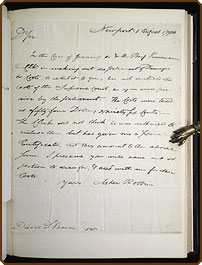
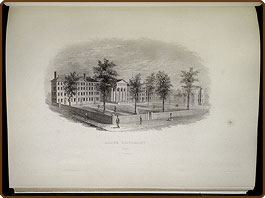
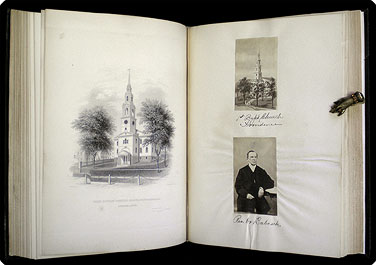
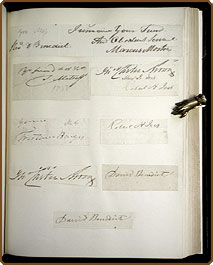
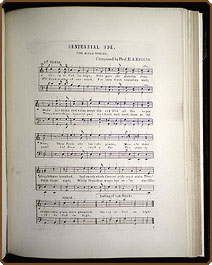
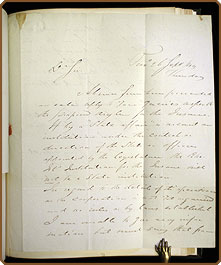
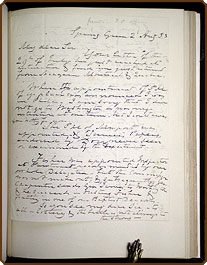 A full list of contents is available by clicking here.
 "THE PATRIOTIC DEAD" [Collins, William T., & Hanson E. Weaver]. Broadside.
Begins: "Headquarters Grand Army of the Republic, Adjutant General's Office, 411 F Street" Washington, 1870. 12mo (20.3 cm, 8"). [1] f.
"THE PATRIOTIC DEAD" [Collins, William T., & Hanson E. Weaver]. Broadside.
Begins: "Headquarters Grand Army of the Republic, Adjutant General's Office, 411 F Street" Washington, 1870. 12mo (20.3 cm, 8"). [1] f. 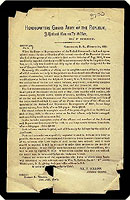
Single-click the image, for an enlargement.• One leaf, printed on one side and creased from folding into six parts. Top left and bottom right corners torn. Tear to lower margin resulting in the loss of one or two words of text. (6336)
WHO
Gets the BEER
& Why?(Dunsinnan
vs. Ramsay). Broadside.
Begins: “Information for William Nairn of Dunsinnan, commissar clerk of
Edinburgh, against Mr. David Ramsay writer to the signet....”[Edinburgh,
ca. 1710]. Folio (31.2 cm, 12.35"). [2] pp.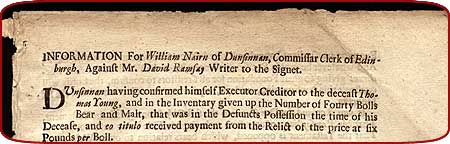 This
is a scarce document, with no copies listed by ESTC, RLIN, OCLC, or NUC Pre-1956.
This
is a scarce document, with no copies listed by ESTC, RLIN, OCLC, or NUC Pre-1956.
• In good clean condition, tipped onto a leaf of 19th-century paper; now in a Mylar folder.
EarlyEl Salvador Imprint Nullifying an Appointment El Salvador. Asamblea legislativa. Broadside, begins: “Ministerio general del Gobierno del Estado del Salvador ... La Asamblea legislativa ... decreta. Se declara insubsistente el nombramiento de magistratado par que fue electo el Lic. Atanacio Urritia. San Salvador: No publisher/printer, 1833. Small 8vo. [1] p.
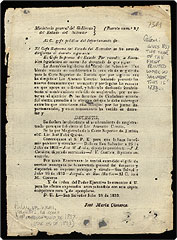
Printing seems to have arrived in El Salvador in 1825, placing this in the first decade of that art there.
Apparently rare: We trace no copy via NUC Pre-1956, WorldCat, CCILA, or METABASE.
• Removed from a nonce volume. A few small holds from insect damage, a few of the few repaired with archival tissue. Old bibliographical notations in pencil in margins. Light waterstaining in upper outer corner. (25791)

For
Distribution in Scotland?
— Scarce BROADSIDE(England
— Party Politics).
Broadside. Begins: “Queries. Whether any Parliament ever did better than
this has done...” [Edinburgh?]: J.M., 1710. Folio (30.8 cm, 12.1"). [2]
pp.
Scotland?
— Scarce BROADSIDE(England
— Party Politics).
Broadside. Begins: “Queries. Whether any Parliament ever did better than
this has done...” [Edinburgh?]: J.M., 1710. Folio (30.8 cm, 12.1"). [2]
pp.
 Searches
of ESTC, OCLC, RLIN, and NUC
Pre-1956 locate only two copies—one in Scotland,
one in England.
Searches
of ESTC, OCLC, RLIN, and NUC
Pre-1956 locate only two copies—one in Scotland,
one in England.
• ESTC T168050. Now in a Mylar folder; edges slightly ragged, repair at lower inner margin just touching letters on one side, small holes in lower center with loss of a few letters. Some letters in header cut off at top due to printer’s error. Tipped onto a blank leaf bearing a watermark of 1826.

(English
Political Broadside). Bluster, Humphrey [pseud.].
Humphrey Bluster’s letter to his father, respecting the Hull election. Hull:
Pr. for the author by W. Ross, [ca. 1818]. Folio (32.5 cm, 12.75"). [1] f.
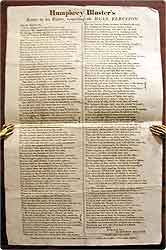
There were American versions of “Humphrey Bluster” letters; in
1818 two such items respecting the Boston election were printed. At this writing
RLIN, OCLC, and NUC Pre-1956list
no holdings of the present, Anglo Bluster.
• Not in NSTC. On Graham, see: The Dictionary of National Biography, XXII, 328–32. Creased, with corners bent, otherwise good. A few early, lightly inked marginalia.
Napoleon,
AgainFernández,
Manuel. Broadside. Begins: "Ciudadanos.
Es llegado ya el momento en que el heroico pueblo Español...." [Cardona,
1823]. Folio. [1] f.
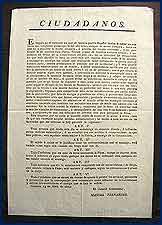
The five articles go so far as to proclaim that sharing of bad news is treason and
punishable as such.
• One fold.
 New York's Gubernatorial Election 1820 — The Issue of Slavery “Forty Thousands”. Broadside. Begins, “To the 40 gentlemen who have addressed the independent federal electors of the state of New-York.” New York state: no publisher/printer, [1820]. Folio (34 cm, 12.75"). [1] f. (verso blank).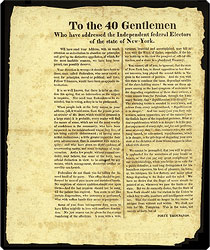
Nearly half of the text deals with the slavery issue. Ends as follows, “We shall not vote for Mr. Tompkins. This is the voice, not merely of forty, but of FORTY THOUSANDS.” A window into a turbulent period in New York politics
Rare. Not located via OCLC.
• Not in Shoemaker. As issued, with some later folds; edges a little irregular. Lightly foxed. (24634)


 TO Part
II TO Part
II |