
BINDINGS • BINDINGS • BINDINGS
 Marmontel's Political-Philosophical Novel with
 Gravelot's Illustrations
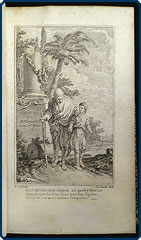
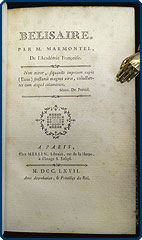
  Marmontel, Jean François. Bélisaire. Paris: Chez Merlin, 1767. 8vo (19.9 cm, 7.8"). [4], x, 340, [6] pp.; 4 plts.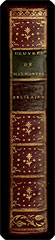
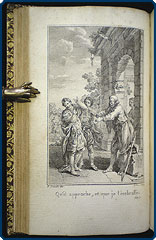
 Click the images for enlargements.
 Merlin also printed a duodecimo edition in 1767; in the present edition, “Fragmens de philosophie morale” is found on pp. 273–340, followed by the Addition and Approbation.
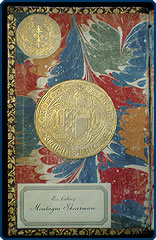
Provenance: Front pastedown with gilt-stamped armorial bookplate of notable 19th-century book collector Edward Hailstone, gilt-stamped “I.T.” bookplate with motto “Inter folia fructus,” and bookplate of Sir Montague Shearman.
Binding: Contemporary crimson morocco, covers framed in gilt triple fillets; spine gilt extra with gilt-stamped leather labels, board edges and turn-ins with gilt rolls. This volume (complete in itself) seems at one time to have been part of a set of Marmontel's works, and bears an (unnumbered) spine label reading “Oeuvres de Marmontel.”
• Brunet, III, 1440; Cohen de Ricci, Guide de l’amateur de livres à gravures du XVIIIe siècle, 688; Graesse 406; Tchermezine 455. Binding as above, with edges, extremities, and joints showing minor rubbing. Front pastedown with bookplates as above; front free endpaper with affixed slip of early cataloguing; rear pastedown with small chip out of paper. Light spots of foxing, slightly heavier around plates. All edges gilt. (25776)

 Wonderful
 “Peasant”(!)
Binding
Martin, von Cochem. Der grosse Baumgarten.
Sulzbach: Im verlage der J. E. Seidelschen Kunst- und Buchhandlung, 1807. 8vo (18.5 cm;
7.375"). Frontis., [9] ff., 688 pp., [6] ff., 16 plts.
“Peasant”(!)
Binding
Martin, von Cochem. Der grosse Baumgarten.
Sulzbach: Im verlage der J. E. Seidelschen Kunst- und Buchhandlung, 1807. 8vo (18.5 cm;
7.375"). Frontis., [9] ff., 688 pp., [6] ff., 16 plts.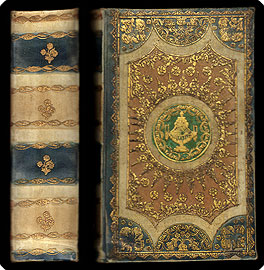
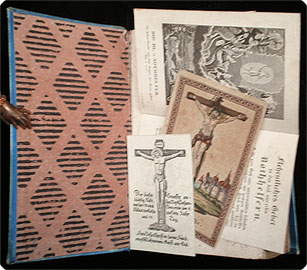 Click the images for enlargements.
  16
woodcut plates.
16
woodcut plates. 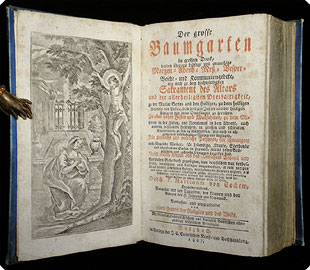
The vellum binding is elaborately tooled in gilt and in-painted in blue, green, and salmon. All edges are gilt and gauffered.
• Binding as above with light rubbing. A very handsome, interestingly late example of this uncommon binding style. (26690)

A First
Edition of the First
“Volume”Martin,
William, ed. Peter
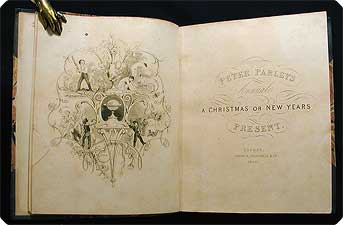
Parley’s annual: a Christmas and New Year's present for young people. London: Simpkin, Marshall, & Co.,
1840 [i.e., 1839]. 12mo (15 cm, 5.9"). Engr. t.-p., vi, 378 pp.; 4 plts.,
illus.
First
“Volume”Martin,
William, ed. Peter
Parley’s annual: a Christmas and New Year's present for young people. London: Simpkin, Marshall, & Co.,
1840 [i.e., 1839]. 12mo (15 cm, 5.9"). Engr. t.-p., vi, 378 pp.; 4 plts.,
illus.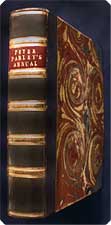
 Click
the interior images for enlargements.
the history and rules of
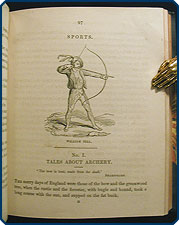
chess, are illustrated with a number of in-text steel engravings
and four engraved plates, one of which depicts a ship at sea in stormy weather.
Click
the interior images for enlargements.
the history and rules of
chess, are illustrated with a number of in-text steel engravings
and four engraved plates, one of which depicts a ship at sea in stormy weather.
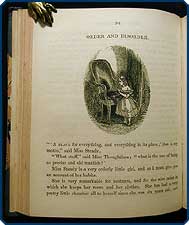
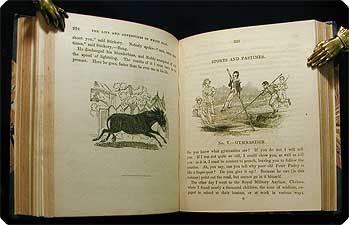
• Faxon 108. Binding as above, paper scuffed and joints a touch
rubbed. Front free endpaper with owner’s name; front pastedown and fly-leaf
with pencilled notations. Frontispiece with small chip to outer margin, repaired.
Some instances of offsetting surrounding plates and illustrations, pages otherwise
clean. An attractive, engaging
little book.
 A
PRB&M “FEATURED BOOK” —
A
PRB&M “FEATURED BOOK” —
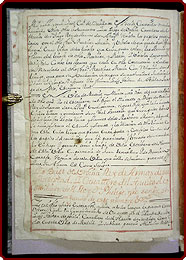
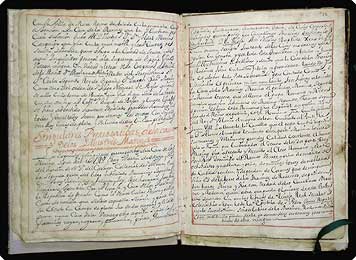
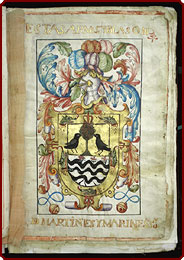
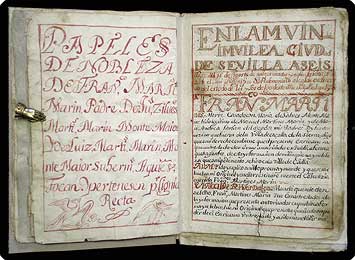
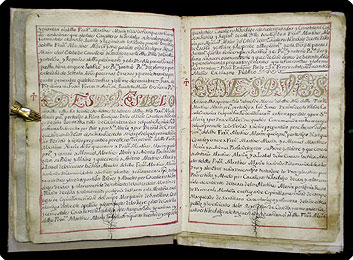
Mexican Hidalgo — Meaty Matter — Vivid Full-Page PaintingsMEXICAN Binding Available for Analysis Martínez, Marín, Montemayor, & Almonazi families. Manuscript carta confirmatoria de hidalguía. On paper and vellum. Madrid, Seville, Puebla, Mexico: ca. 1583–1706. Folio. Ca. 170 folios.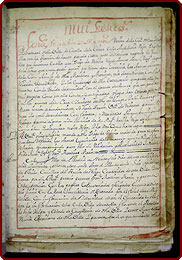
 Click the images for enlargements.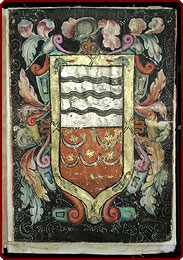
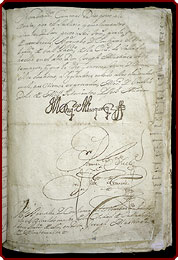
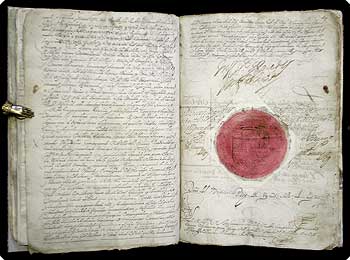
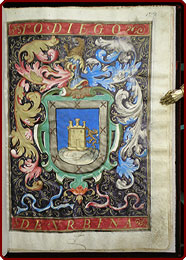
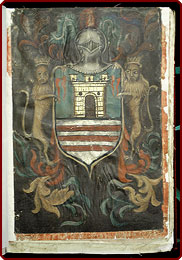
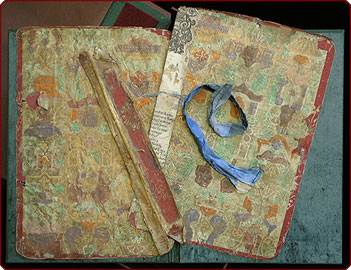 signed by Viceroy Albuquerque in his own large, distinctive hand, and a third document confirming an appointment of the Alferez Silvestre Martínez de Montemayor is signed by the Marques de la Laguna (i.e., the viceroy in 1685).
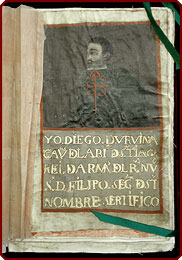
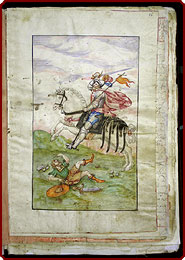
The Six Illustrations: Four full-page, full-color, illuminated coats of arms on vellum of the Marín, Martínez, Almonazir, and Montemayor families; a full-page full-color miniature of a Martínez on horseback slaying a Moor (a strangely garbed Moor, but by his curved sword a Moor nonetheless), and a half-page portrait of Diego de Urbina, the king of arms under Felipe II, with his name and title illumined below. Salmon silk guards are present for several of these.
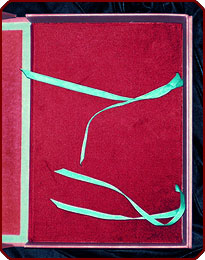
• New binding in traditional style as above, with green ribbon ties, in a clamshell box; elements of original binding preserved in box compartment. Some text leaves torn with loss of text at outer margin, leaves repaired; one vellum leaf with top half excised and a neighboring paper one with its bottom half taken. Otherwise, only some few tears, none serious. A production and survival both treasurable and studyable. (25787)

A
Universalist Women's
Literary
Annual:
1843
Mayo, Sarah Carter Edgarton, ed. The rose of Sharon:
A religious souvenir, for MDCCCXLIII. Boston: A. Tompkins & B.B. Mussey, 1843 [i.e., 1842].
8vo (17.8 cm, 7"). add. engr. t.-p., 312 pp.; 3 plts. (lacking frontis.).
Women's
Literary
Annual:
1843
Mayo, Sarah Carter Edgarton, ed. The rose of Sharon:
A religious souvenir, for MDCCCXLIII. Boston: A. Tompkins & B.B. Mussey, 1843 [i.e., 1842].
8vo (17.8 cm, 7"). add. engr. t.-p., 312 pp.; 3 plts. (lacking frontis.).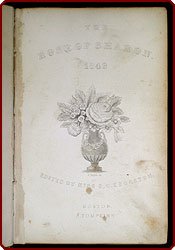
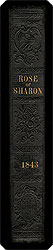 Click the images for enlargements.
 The volume is illustrated with an added engraved title-page and three steel-engraved plates, done by O. Pelton after designs by T.B. Read and Beaume, and by Charles Phillips after Sir Joshua Reynolds.
Signed binding: Hunter green embossed morocco, covers with cherub vignette in foliate frame; the embossed panel was designed by Francis N. Mitchell and engraved by Alex C. Morin, and the binding was done by Benjamin Bradley, with all three names stamped in panel. All edges gilt.
• Faxon 713. On binding, see: Wolf, From Gothic Windows to
Peacocks, 178; Spawn & Kinsella, American Signed Bindings,
53. Binding as above, extremities with very minor rubbing; frontispiece
lacking. Offsetting from plates, two pages with offsetting from now-absent
laid-in item, scattered light spotting elsewhere. A gorgeous example of the binding, with interesting
reading inside. (26737)

A Universalist Women's Literary Annual: 1844 Mayo, Sarah Carter Edgarton, ed. The rose of Sharon: A religious souvenir, for MDCCCXLIV. Boston: A. Tompkins & B.B. Mussey, 1844 [i.e., 1843]. 8vo (17.8 cm, 7"). Add. engr. t.-p., 304 pp.; 4 plts.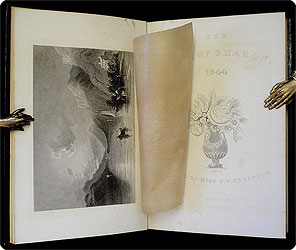
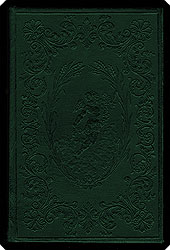 Click the images for enlargements.
 The volume is illustrated with four steel-engraved plates and an additional engraved title-page by various hands.
Signed binding: Hunter green embossed morocco, covers with cherub vignette in foliate frame; the embossed panel was designed by Francis N. Mitchell and engraved by Alex C. Morin, and the binding was done by Benjamin Bradley, with all three names stamped in panel. All edges gilt.
• Faxon 714. On binding, see: Wolf, From Gothic Windows to Peacocks, 178; Spawn & Kinsella, American Signed Bindings, 53. Binding as above, showing virtually no wear. A few light spots, pages mostly clean. Dried flower laid in. It is hard to imagine a better copy of this lovely annual. (26743)
Sole Aldine Edition Mela, Pomponius. Pomponivs Mela. Ivlivs Solinvs. Itinerarivm Antonini Avg. Vibivs Seqvester. P. Victor de regionibus urbis Romae. Dionysius Afer de situ orbis Prisciano interprete. [colophon: Venetiis: In aedibvs Aldi, et Andreae soceri mense, M.D. XVIII {1518}]. 8vo (16.5 cm; 6.5"). 233, [1] ff., without the final two leaves (one blank, one with Aldine device).
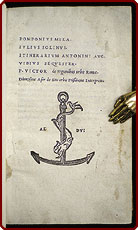
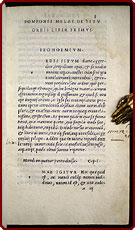
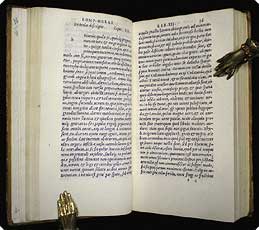 Click the images for enlargements.
 The sole Aldine edition of these works, it is also the editio princeps of Publius Victor, the second edition of Antoninus Augustus' Itinerarium, and the third edition of Dionysius in Latin.
As is to be expected, the text is in italic with spaces and guide letters provided for (unaccomplished) initials.
The register (leaf G2 recto) lists a gathering *4 that is not found here or in any known copy, so the reference would seem to be incorrect.
Binding: 18th-century English sprinkled tan calf, gilt spine extra and board edges gilt-tooled.
• Renouard, Alde, 83; Adams M1053; Schweiger, II, 607 (“seltene Ausg.”). Bound as above, small darkened spot near top of spine; joints starting to open but covers still nicely attached; without the final two leaves (one blank, one with Aldine device). Bookplate. Title-page holed at gutter, not nearing device; light waterstaining and a bit of dust-soiling to first and last leaves. Interior otherwise clean, even bright. (25876)

 Cortlandt
Bishop Copy
Mérimée, Prosper. Colomba. Paris: L. Conquet, 1904. Small folio.
Cortlandt
Bishop Copy
Mérimée, Prosper. Colomba. Paris: L. Conquet, 1904. Small folio.
Binding: Bound by M. Lortic in red morocco, gilt extra with accents of black; original wrappers bound in. Wide turn-ins with gilt dentelles; marbled endpapers. All edges gilt.
• Rubbing to joints at top and bottom.
Conspiracy!Montjoie, Christophe Félix Louis Ventre de la Touloubre, called Galart de. Histoire de la conjuration de Louis-Philippe-Joseph d’Orléans.... Paris, 1796. 3 vols. 8vo (25 cm, 8"). I: Frontis., [4], xvi, 304 pp. II: [2], 392 pp. III: [4], 304, 8 (index), 4 (contents) pp.
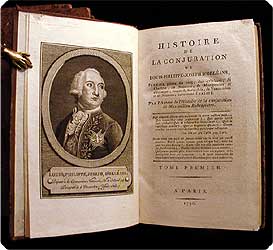
Binding: Contemporary treed calf; spines with gilt-stamped decorative bands and compartment devices, and with gilt-stamped leather title and volume labels. Edges gilt-rolled. All page edges stained yellow.
• Bindings a little rubbed over joints and extremities, with a few instances of pinhole-type worming to back cover of vol. I; upper and outer edges dust-soiled. Some instances of light foxing. An attractive set.
 For more SETS, click here.
Lalla Rookh, the Irish Melodies, & More Moore, Thomas. The poetical works of Thomas Moore including his melodies, ballads, etc. Paris: A. & W. Galignani, 1827. 8vo (23.3 cm, 9.1"). Frontis., [4], vi, [2], xxii, 383, [1] pp.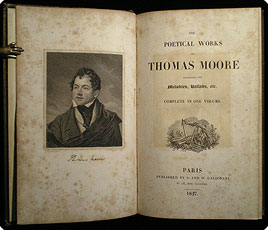
 Click the interior image for an enlargement.
 Binding: Contemporary straight-grain black morocco, covers framed and panelled in gilt and blind, spine with gilt-stamped title and gilt-framed compartments, spine compartments blind-tooled in foliate designs, turn-ins with gilt double fillets. All edges gilt.
• NCBEL, III, 264. Bound as above, edges and extremities with minor rubbing, bottom spine compartment with small crack, leather (only) starting at front joint (joint itself strong). Front pastedown with early inked ownership inscription. Moderate foxing, more pronounced to first and last few leaves; two pages with offsetting from dried plant matter laid in.  A lovely volume. (24906)
 Illustrated — Inspiring — Sumptuous Orsini, Mathieu, abbé, & J. Sadlier. Life of the blessed virgin Mary, mother of God; with the history of the devotion to her. Completed by the traditions of the East, the writings of the fathers, and the private history of the Jews. Translated from the French of the Abbé Orsini, by Mrs. J. Sadlier. New York, Boston, & Montreal: D. & J. Sadlier & Co., 1861. 4to. [4], xxviii, 225, [3], 311, [12], 8–192, 133 pp.; 22 plts.
 Click the images for enlargements.
 Illustrated with 22 engraved plates (each with protective tissue guard), an added engraved title-page (in color), and in-text engravings used as chapter tail-pieces. Text printed within an engraved decorative border, repeated throughout.
• Publisher's full red morocco, elaborately stamped in gilt. Spine with raised bands, gilt center devices and lettering in spine compartments. Front cover bears a gilt image of the Blessed Virgin framed in an oval, with “Mary A. Dunigan” stamped in gilt beneath it; back cover bears a gilt-stamped crucifix within an oval. All edges gilt. Rubbing at edges and joints. Front joint starting and weak. Scratch-marks. Some spotting to plates and tissue guards. Very light waterstaining in margins of later pages. Chip at top margin of two leaves, only. Very good condition, without ownership markings. (14268)
Multiply IN YOUR HEAD by 27 . . . Orton, Hoy D. Orton's lightning calculator, and accountant's assistant. The shortest, simplest, and most rapid method of computing numbers, adapted to every kind of business, and within the comprehension of every one having the slightest knowledge of figures. Shelby, Ohio: H.D. Orton, ©1866. 12mo. vi, [9]–194 pp.
 “Energy
is the price of success.” “Address all
orders for this book to H.D. Orton, Shelby, O. Single copies by mail, One Dollar.
For sale by all Booksellers.”
“Energy
is the price of success.” “Address all
orders for this book to H.D. Orton, Shelby, O. Single copies by mail, One Dollar.
For sale by all Booksellers.”
• Publisher's brown cloth shelf-back with printed paper on the boards; small rent in cloth. Very nice copy. (26558)
 There are so many kinds of bindings
Palafox on Kingship — A Handsome VolumePalafox y Mendoza, Juan de. Historia real sagrada, luz de principes, y subditos. Brusselas: Francesco Foppens, 1655. 4to (23 cm, 9.1"). *4**4a–f4A–Z4Aa– Zz4Aaa–Mmm4; [32] ff., 435, [29 (index)] pp. (add. engr. t.-p. lacking).

 Click the interior images for enlargement.
• Sabin 58295; Medina, BHA, 1245; Peeters-Fontainas 1029; Palau 209622. Contemporary mottled sheep, spine gilt extra, with gilt-stamped leather title-label; corners, spine, and spine extremities a touch rubbed, otherwise pleasingly fresh. Front free endpaper with early inked inscription, front fly-leaf with early inked “Acto de contricion” affixed. Lacking additional engraved title-page. Final third of text block starting to pull away from spine, sewing still holding. Pages age-toned, with some instances of spotting and offsetting. All edges mottled to match binding.
The
Famous Wager
in English
Pascal,
Blaise. Thoughts on religion, and other subjects ... translated from the French. London: Pr. by W.B. for A. & J Churchil, R. Sare, & J. Tonson, 1704. 8vo (19.4 cm, 7.6"). [2], lviii, [12], 352, 361–76, 369–92 pp. (text complete despite pagination).
English
Pascal,
Blaise. Thoughts on religion, and other subjects ... translated from the French. London: Pr. by W.B. for A. & J Churchil, R. Sare, & J. Tonson, 1704. 8vo (19.4 cm, 7.6"). [2], lviii, [12], 352, 361–76, 369–92 pp. (text complete despite pagination).

 Click the interior images for enlargements.
 Kennett, an antiquary and translator of a number of French works, served as the first chaplain to the British merchants at Leghorn — where his ministry incurred the wrath of the Inquisition. An interesting international addition to this book's trouble with religious authority, for the Pensees were placed on the Index shortly after their original publication.
Binding: Contemporary speckled calf and mottled calf framed and panelled in gilt rules with gilt-stamped corner fleurons; recently rebacked with speckled calf, spine with gilt-stamped leather title-label and gilt-stamped decorations within gilt-dotted raised bands.
• ESTC T144329; Lowndes 1795. On Kennett, see: Oxford Dictionary of National Biography online. Binding as above, corners and edges with minor rubbing; lower (closed) edges institutionally rubber-stamped. Front fly-leaf with early inked ownership inscription. Pages age-toned and in some instances browned; old, usually (but not quite always) faint waterstaining to a number of leaves; corner creases from old dog-earring and one old inkblot, one leaf with closed tear from outer margin touching a few letters without loss. Pagination erratic, but catchwords correct and text continuous. A solid, usable copy in an attractively refreshed binding. (25099)
SignedLeather Gift-Book Binding Percival, Emily, ed. The amaranth, or token of remembrance. A Christmas and New Year's gift for 1854. Boston: Phillips, Sampson & Co., 1854. 8vo. [2], 288 pp.; 6 plts.
Binding: Publisher's bright red sheep in imitation of morocco, covers and spine gilt extra with arabesque and foliate designs. All edges gilt. Ticket inside back cover claims this as the work of “B. Bradley & Co. Boston.”
• Faxon 24. Leather worn over edges and joints, with joints starting; top inch of spine along back joint with sliver of leather missing. First and last few leaves foxed, with some additional foxing in proximity to plates, and pages gently age-toned. (12953)
For more AMERICAN GIFT BOOKS, click here.
Covers
withEmbossed
Paper Onlays
Percival, Emily,
ed. The garland. Or, token of friendship. A Christmas and New Year's gift. New York: George A. Leavitt,
1869. 12mo. Frontis., 288 pp.; 4 plts.
 Click the interior image for an enlargement.
 Binding: Publisher's red cloth, covers embossed and gilt-stamped, each cover with chromolithographed paper illustration affixed; spine gilt extra. All edges gilt.
• Faxon 259. Binding slightly dimmed overall, scuffed at edges and joints. Front free endpaper with owner's inscription dated 1869. A few spots of foxing, mostly in proximity to plates. (12931)
For AMERICAN GIFT BOOKS, click here.
 The
OnlyGIFT
of Its Kind
Percival, Walter, ed. Friendship's gift: A souvenir for
MDCCCXLVIII. Boston: John P. Hill, [1847]. 12mo (19.3 cm, 7.6"). Frontis., add. engr. t.-p.,
vi, [2], [13]–312 pp.; 8 plts.
The
OnlyGIFT
of Its Kind
Percival, Walter, ed. Friendship's gift: A souvenir for
MDCCCXLVIII. Boston: John P. Hill, [1847]. 12mo (19.3 cm, 7.6"). Frontis., add. engr. t.-p.,
vi, [2], [13]–312 pp.; 8 plts.
 Click the images for enlargements.
 Signed binding: Black sheep in imitation of morocco, covers framed in heavy gilt borders surrounding gilt-stamped arabesque designs, spine gilt extra; front free endpaper with bookbinder Bradley's small pressure-stamp. All edges gilt.
• Faxon 224. Not in Hamilton, Early American Book Illustrators.
On binder's stamp, see: Spawn & Kinsella, American Signed Bindings,
55f. Binding as above, minor wear to corners, spine with tiny scuff
towards foot; binding clean and bright. Pages with varied degrees of foxing/staining
and age-toning. Very spiffy. (26673)

Prize
Binding, withthe
CertificatePomey, François. Pantheum mythicum, seu Fabulosa deorum historia hoc epitomes eruditionis volumine brevitur dilucidéque comprehensa. Amstaelodami: Ex officina Schoudeniana ; Trajecti ad Rhenum: Apud J.J. a Poolsum, 1777. Small 8vo (15.5 cm; 6"). [8] ff., 298, [7] ff., 27 plts. (4 fold.).

 27 plates, four of which are folding. The text is edited by Samuel Pitiscus (1637–1727).

Provenance: With the printed and folding ex-proemium of J.J.S. van Goltstein van Hoekenburg, Jan. 1819.
• DeBacker-Sommervogel, VI, 976. Binding as above. All edges marbled. A very good copy; text block very slightly skewed in binding.
Gorgeous
St. James Hymnal
— Chapel
Binding &
Fore-Edge
Painting
Pordage, Edward, ed. A collection of anthems, as the
same are now performed in his Majesty's Chapels Royal, &c. London: Pr. by J. Bettenham for B.
Barker, 1749. 8vo (18.7 cm, 7.4"). [2], 214, [6 (index)] pp.

 Click the images for enlargements.
 Binding: Contemporary red goat, framed in gilt floral tooling with crowned fleurons, covers stamped with center medallions of crowned monograms surmounted by herald angels. Supra-Libros —“Chapel Royal St James's.” Board edges gilt-tooled. All edges gilt, with fore-edge painting as below.

• ESTC T123146. Binding as above, strongly rebacked with
red morocco, spine with gilt-stamped leather title-label and compartments
with gilt-stamped floral decorations; older portions with rubbing and a few
small scuffs. Minor rubbing to page edge gilt and to fore-edge; pages gently
age-toned with the odd faint spot.  An altogether lavish little production.
(26522)
An altogether lavish little production.
(26522)

 THACKERAY
Admired These “Most Charmingly
HumorousTHIS
Set Bound
Prior, Matthew. The
poetical works...: Now first collected, with explanatory notes, and memoirs
of the author, in two volumes. London: Pr. for W. Strahan, T. Payne, J. Rivington,
et al., 1779. 8vo (19.4 cm, 7.6"). I: xvi, xxviii, 420 pp.; 1 plt. II:
[2] ff., xvi, 287, [1 (errata)] pp.
THACKERAY
Admired These “Most Charmingly
HumorousTHIS
Set Bound
Prior, Matthew. The
poetical works...: Now first collected, with explanatory notes, and memoirs
of the author, in two volumes. London: Pr. for W. Strahan, T. Payne, J. Rivington,
et al., 1779. 8vo (19.4 cm, 7.6"). I: xvi, xxviii, 420 pp.; 1 plt. II:
[2] ff., xvi, 287, [1 (errata)] pp.
The "Story of the Country-Mouse and the City-Mouse," Prior's satiric and politically motivated response to Dryden's "Hind and Panther," is not included, but the long pieces "Solomon on the Vanity of the World" and "Alma" are present. The "Life of Mat. Prior" in the first volume commences beneath a small engraved portrait.
Binding: Later sprinkled calf, covers gilt-ruled with gilt inner dentelles, spines gilt extra with gilt-stamped leather title and volume labels. All edges saffron.
Provenance: Both volumes with armorial bookplates of Sir Robert D'Arcy Hildyard.
• On Prior, see: Dictionary of National Biography, 397–401. Leather cracking over joints with hinges tender; spine tips a little dry and pulled; upper and outer edges of all covers somewhat darkened; light wear to extremities. Light foxing to some pages. In fact a very handsome pair.
Dutch PrizePropertius, Sextus. Sex. Aurelii Propertii elegiarum libri IV. Trajecti ad Rhenum: Barth. Wild, 1780. 4to (26.3 cm, 10.4"). [10], xiv, [2], 990 (i.e., 996; pagination repeats 627–32), [2] pp. 


Binding/Provenance: Prize binding of contemporary vellum, covers framed and panelled in gilt rolls with gilt-stamped corner fleurons and gilt central vignette with the crest of the city of Amsterdam, spine with gilt-ruled raised bands and gilt-stamped decorations in compartments. The partially printed, partially inscribed, bound-in prize certificate reads “Ingenuo magnaeque spei adolescenti, Henrico Gerteler propter insignes in artibus humanioribus progessus, in classe tertia . . . Quod testor R. v. Ommeren [/] Gymnasii publici Amstelaedamensis Rector,” dated 1791.
• Brunet, IV, 905; Dibdin, I, 385–86; Graesse, V, 460; Sandys, II, 455; Schweiger, II, 831. Binding as above, vellum slightly darkened, lacking ties; spine with gilt dimmed and traces of a now-absent label and inked call number at foot of spine. Lower edges with institutional rubber-stamp; title-page with shadow of a pencilled numeral. Front free endpaper with paper adhesions from a now-absent bookplate; back pastedown with rubber-stamp and small adhesion. Pages clean save for offsetting to upper margins of a few, from a laid-in slip.
MAGNIFIQUE!
Racine,
Jean. Oeuvres de
Jean Racine. Paris: Pierre Didot l'aîné, 1801. Folio extra (50
cm, 19.75"). 3 vols. I: Frontis., [8], 466, [2] pp.; 23 plts. II: [4], 500,
[2] pp.; 25 plts. III: [4], 416 pp.; 8 plts.

 Click any image for enlargement. three elephant folio, illustrated volumes that include his verse, letters, and plays. This deluxe edition was limited to 250 sets on paper (plus one additional copy printed on vellum). Produced by the renowned Didot press and part of the prestigious collection known as the Éditions du Louvre, this work is a monument of typography; Brunet extols it as “un des livres les plus magnifiques que la typographie d'aucun pays eut encore produits,” while Graesse confines himself to a mere “magnifique.”


Signed Binding: Contemporary red straight-grain morocco, covers framed in substantial gilt and blind-tooled rolls with gilt-stamped corner fleurons, surrounding central gilt-stamped medallions of the French imperial eagle. Spines gilt extra in arabesque and foliate motifs with additional blind-tooling; board edges gilt-stamped and turn-ins with wide gilt rolls. All edges gilt. Bindings signed by Charles Hering — one of the most prominent English binders of the early 19th century.
 This classic French author is here presented with classic French illustration of the era in a limited edition from a classic French printer/publisher in a classic French binding — at least, it's a “five-fer”! (24990)
The FIRST English-LanguageHistory of Java Raffles, Thomas Stamford, Sir. The history of Java ... second edition. London: John Murray, 1830. 8vo (21.6 cm, 8.5"). 2 vols. I: xlviii, 536 pp.; 1 fold. table. II: iv, 332, clxxix, [1] pp.

 Click the images for enlargements.
 The editor's advertisement, type-signed by Sophia Raffles (Sir Thomas's second wife), notes that the plates from the first edition and some additional plates were published in “a separate quarto volume, detached entirely from the present work” (p. xi). This did not actually appear until 1844 and so is not present here.
• Brunet, IV, 1088; Graesse, VI, 17; Lowndes 2037. On Raffles, see: Oxford Dictionary of National Biography online. Contemporary calf, covers framed in blind triple fillets with gilt-stamped corner fleurons, spines with gilt-stamped leather title and volume labels and with gilt-stamped and blind-tooled compartment decorations; board edges with blind roll. Binding rubbed at joints/edges and with small scuffs, portions of boards variously stained/sunned; still quite attractive. Ex–social club library: 19th-century bookplate and inked call number on each front pastedown, title-pages pressure- and lightly rubber-stamped; no other markings. Fore-edge of vol. I shows signs of old water exposure, without actual waterstaining to pages themselves save in a few cases where upper or outer margins are touched; pages clean. A pleasant old pair of books. (26379)
Legends of the American Landscape — Plates & Painterly Prose Richards, Thomas Addison. American scenery, illustrated. New York: Leavitt & Allen Bros., [1854]. 4to (22 cm, 8.7"). Frontis., 310 pp.; 30 plts. (lacking add. t.-p.).
 Click the images for enlargements.
 The work was also published in the same year under the title The Romance of American Landscape, and bears that running title here. This copy has an intriguing early pencilled inscription: “The 1st book my Father gave me came out of his book store - C.L.”
Binding: Publisher's brown sheep in imitation of morocco, covers with embossed grapevine and latticework border stamped in black and with decorative gilt-stamped title (“LANDSCAPE ANNUAL”); spine with same gilt-stamped title and gilt- and black-stamped decorations. All edges gilt.
• Sabin 70958; Wright, II, 2030. Not in BAL. Binding as above, light wear to edges and extremities. Hinges (inside) starting. Front fly-leaf with inscription as above; additional engraved title-page with vignette of Mt. Vernon, lacking. Intermittent light to moderate foxing, mostly to margins of plates. Lovely book, lovely copy. (26679)
POETRY
in aFrankly
Magnificent Embossed
BindingSigned
by Gaskill
Rogers, Samuel;
Thomas Campbell; James Montgomery; et al. The poetical works of Rogers,
Campbell, J. Montgomery, Lamb, and Kirke White. Philadelphia: Grigg & Elliot,
1841. 8vo (22.4 cm, 8.8"). Frontis., vii, [1], 98, [2], [v]–viii, 66,
[2], [v]–viii, 195, [1], v, [1], 29, [1], xxiii, [1], 56 pp.
 Click
the images for enlargements.
Click
the images for enlargements.
Binding: Signed binding by Gaskill: Oxblood calf ornately embossed with a central medallion of Aurora in her chariot, surrounded by foliate designs, within a framing roll of drawer-handles and tulips; spine with gilt-stamped authors' names and embossed foliate designs; board edges and turn-ins with gilt rolls. All edges gilt.
• American Imprints 41-4210; Wolf, From Gothic Windows
to Peacocks, 190. Binding as above, corners and spine extremities
showing faint traces of wear. Moderate foxing throughout. A
beautiful example of Philadelphia Victorian high book culture and of a classic
Gaskill binding in particular. (25994)
Rousseau the PoetElegantly Published Rousseau,
Jean-Baptiste. Oeuvres poétiques
... avec un commentaire par M. Amar. Paris: Chez Lefèvre, 1824. 8vo (23.1 cm, 9.1"). 2 vols. in 1. Frontis., xxxv, [1], 419, [5], 363, [1 (blank)] pp. 

• Brunet, IV, 1421. Contemporary black half morocco over blue pebbled cloth, spine beautifully gilt extra, leather edges ruled in gilt; volume clean and virtually unworn. Front pastedown with private collector’s bookplate and with institutional rubber-stamp (no other markings); some soiling and offsetting to front pastedown and free endpaper. Many leaves lightly to moderately foxed, a few more heavily — the paper here was not as good as it might have been. One leaf with short tear from upper margin, touching page number but not text. An attractive production.
 TO Part
VIII . . . TO Part
VIII . . . |