 ASTRONOMY \ ASTROLOGY
ASTRONOMY \ ASTROLOGY
ASTRONOMY \ ASTROLOGY
 Early
Illustrated Effort
at a DICTIONARY
Early
Illustrated Effort
at a DICTIONARY for
the Masses
for
the Masses
 (Any
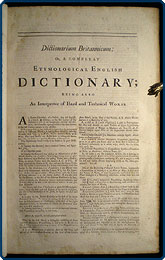
Polymath's Delight)! Bailey, Nathan; Philip Miller; Thomas
Lediard; George Gordon. Dictionarium Britannicum: Or a more compleat
universal etymological English dictionary than any extant ... illustrated with
near five hundred cuts, for giving a clear idea of those figures, not so well
apprehended by verbal description ... the second edition with numerous additions
and improvements. London: T. Cox, 1736. Folio (35.5 cm, 13.9"). [460] ff.; 1 plt.,
illus.
(Any
Polymath's Delight)! Bailey, Nathan; Philip Miller; Thomas
Lediard; George Gordon. Dictionarium Britannicum: Or a more compleat
universal etymological English dictionary than any extant ... illustrated with
near five hundred cuts, for giving a clear idea of those figures, not so well
apprehended by verbal description ... the second edition with numerous additions
and improvements. London: T. Cox, 1736. Folio (35.5 cm, 13.9"). [460] ff.; 1 plt.,
illus.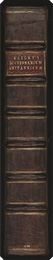
 Click the interior images for enlargements.
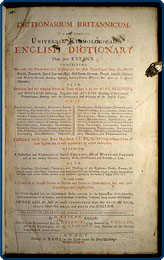
 The title-page is printed in red and black; a full-page plate shows an orrery
(for which word there is an unusually long entry) from multiple perspectives,
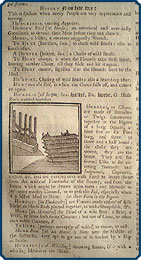
while many of the in-text woodcuts are depictions of heraldic terms, or mathematical
and scientific concepts. Etymological information is provided in “Antient
British, Teutonick, Dutch Low and High, Old Saxon, German, Danish, Swedish,
Norman and Modern French, Italian, Spanish, Latin, Greek, Hebrew, &c.
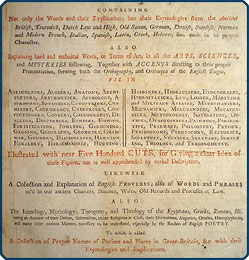
each in its proper Character” (from the title-page).  Our
photographic detail, third image from left, above, highlights the (endearing!)
ambition and achievement of this large volume; ASTRONOMY (and ASTROLOGY)
may both be seen to figure.
Our
photographic detail, third image from left, above, highlights the (endearing!)
ambition and achievement of this large volume; ASTRONOMY (and ASTROLOGY)
may both be seen to figure.
• ESTC T87976; O'Neill B-5; Vancil 12. On Bailey, see: Oxford Dictionary of National Biography online. Contemporary mottled calf, covers framed in gilt double fillets, rebacked, spine with gilt-stamped leather title-label and gilt-ruled raised bands; sides acid-pitted and scraped. 19th-century endpapers. Title-page with old-fashioned, round institutional pressure-stamp; light soil and old inkblots (also light!) in upper portion. Pages a little browned right at edges; light or faint waterstaining visible in first third of volume, usually to lower margin only; one leaf with tear from outer margin just touching text, without loss; one lower outer corner torn away, with loss of one letter from catchword.  A sound, pleasant copy of this handsome and interesting production. (25002)

 Defining
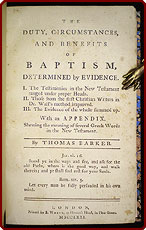
 “Child” for Baptismal Purposes — RAREBarker, Thomas. The duty, circumstances, and benefits of baptism, determined by evidence ... with an appendix, shewing the meaning of several Greek words in the New Testament. London: B. White, 1771. 8vo (20.5 cm, 8"). x, 208, [6 (index & errata)] pp.
 Click the interior images for enlargements.
  The
author was a dedicated observer of meteors and comets and published
several well-received works on those subjects in addition to his religious
and philosophical treatises.
The
author was a dedicated observer of meteors and comets and published
several well-received works on those subjects in addition to his religious
and philosophical treatises.
Rare: OCLC and ESTC locate only one U.S. holding, since deaccessioned; there are only two holdings found in the U.K.
• ESTC T68482. Recent marbled paper–covered boards, spine with gilt-stamped leather title-label; yellow wrapper with early hand-inked title bound in. Title-page institutionally pressure-stamped and a five-digit number inked twice to the first page of the preface; no other markings. First and last few leaves with minor foxing; other scattered spots mostly confined to margins. Occasional pencillled annotations. (25768)
 A
Capuchin
on the Trinity, with
Some
POETRY
as Well
Feliciano de Sevilla. El sol increado dios trino y uno, y
la grande excelencia de su culto y devocion. Reimpreso en Mexico: por D. Felipe de Zúñiga y
Ontiveros, 1790. 4to (20.5 cm; 8.25"). [10] ff., 464 pp.
A
Capuchin
on the Trinity, with
Some
POETRY
as Well
Feliciano de Sevilla. El sol increado dios trino y uno, y
la grande excelencia de su culto y devocion. Reimpreso en Mexico: por D. Felipe de Zúñiga y
Ontiveros, 1790. 4to (20.5 cm; 8.25"). [10] ff., 464 pp.
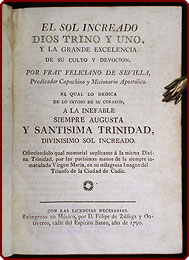
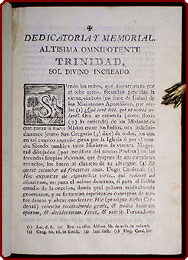 Click the images for enlargements.
 The volume ends with a “Corona Florida a la Santisima Trinidad,”
being a small literary collection of coplas, canciones, and
a romance“en
Metafora del Sol, que discurre por los doce signos del Zodiaco.”
Binding: Publisher's mottled sheep, gilt spine extra. Marbled endpapers; all edges red.
• Medina, Mexico, 8016. Binding lightly worn. A few gatherings starting to extrude. A very good, clean copy. (26851)
 The
Northern Lights . . .Green, Samuel Abbott. Remarks on the early
appearance of the northern lights in New England. Cambridge, MA: John Wilson &
Son, 1885. 8vo. 7, [1 (blank)] pp.
The
Northern Lights . . .Green, Samuel Abbott. Remarks on the early
appearance of the northern lights in New England. Cambridge, MA: John Wilson &
Son, 1885. 8vo. 7, [1 (blank)] pp. 

• Good. Sewn; in original printed wrappers. Wrappers lightly soiled and chipped in the margins; front wrapper partially detached. Pages a little brittle with small tears and chipping in the margins. (1279)
 “Remarkable
Book” ofMaps
of Eclipses in Europe in
the Early
19th CenturyA
Copy in a Remarkable Binding
Hallaschka, Cassian
[Franz Ignaz Cassian]. Elementa eclipsium quas patitur tellus, luna
eam inter et solem versante, ab A.1816 usque ad A.1860, ex tabulis astronomicis
recentissime conditis et calculo parallactico deducta, typo ecliptico et tabulis
projectionis geographicis collustrata. Pragae: Typis Theophili Haase, 1816.
4to (23.5 cm; 9.25"). Engr. title, xi, [1],107, [1] pp., 19 [of 20] fold. leaves
of plates mounted on leaves.
“Remarkable
Book” ofMaps
of Eclipses in Europe in
the Early
19th CenturyA
Copy in a Remarkable Binding
Hallaschka, Cassian
[Franz Ignaz Cassian]. Elementa eclipsium quas patitur tellus, luna
eam inter et solem versante, ab A.1816 usque ad A.1860, ex tabulis astronomicis
recentissime conditis et calculo parallactico deducta, typo ecliptico et tabulis
projectionis geographicis collustrata. Pragae: Typis Theophili Haase, 1816.
4to (23.5 cm; 9.25"). Engr. title, xi, [1],107, [1] pp., 19 [of 20] fold. leaves
of plates mounted on leaves.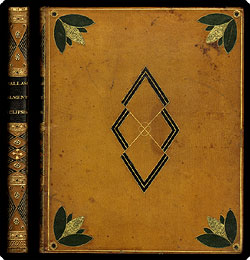
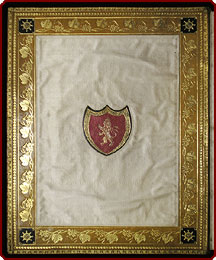
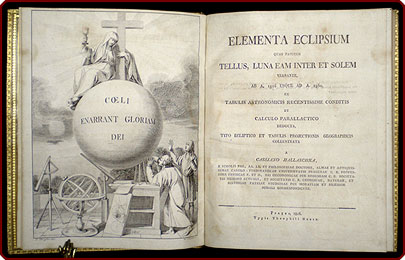 Click the images for enlargements.
 Cassian (1780–1847) published this “. . . remarkable book . . . in Prague in 1816. It contain[s] the maps for eclipses between 1816 and 1860. . . . The geometric constructions used by Hallaska anticipated the standard theory of eclipses developed later by Friedrich Wilhelm Bessel” (S. Débarat, “Historical Eclipses in Europe,” in Astron. Abs. Skalnate Pleso 28 (1999), 167–68).
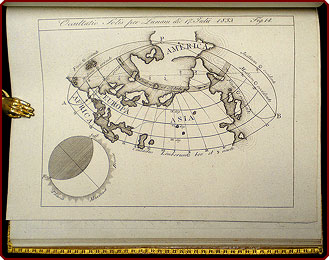
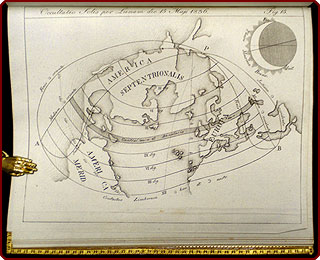
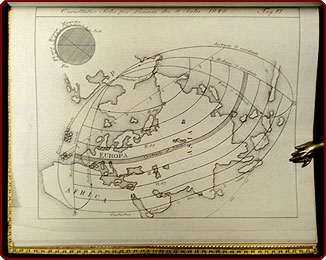
Provenance: Inlaid to front pastedown is a red and green leather bookplate featuring a crowned lion en passant with a doubled tail (particularly associated with Bohemia).
• Binding as above, discoloration in spots and patches to covers. Without the first plate, all others present and crisp. A most remarkable copy of a very scarce book. (26668)
Colonial-era
AMERICAN
Almanac
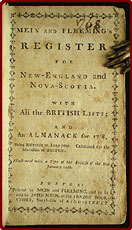
Mein and Fleeming's register for New-England and Nova Scotia. With all the British lists; and an almanack for 1768, being bissextile or leap year. Calculated for the meridian of Boston. Illustrated with a type of the eclipse of the sun of January 19th. Boston: Printed by Mein and Fleeming, and to be sold by John Mein at the London Book-Store, north-side of King-Street, [1767]. 12mo. 92, [4] pp.; illus.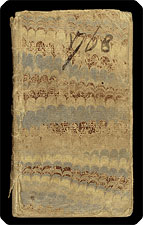
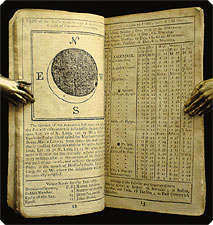 Click the interior images for enlargements.
  The last leaf, filled on both sides, lists a “Grand Assortment” of books available from
• Evans 10687; Drake 3164; ESTC w22665. Sewn in original marbled wrappers. Usual foxing and light age-toning of almanacs of this era and region. Some dog-earing and “thumbing”; small piece of wrapper missing from lower spine. Else very good. (18214)
 For
more ALMANACS, click here.
For
more ALMANACS, click here.

 Parry’s First Voyage — Plates, Maps, StoriesParry, William Edward. Journal of a voyage for the discovery of a north-west passage from the Atlantic to the Pacific.... London: John Murray, 1821. 4to (27.3 cm, 10.75"). [4] ff., xxix, [3], 310, [2], clxxix, [3 (2 adv.)]pp.; 14 plts., 4 fold. maps, 2 maps.

 Click any image above for an enlargement.
lunar
observations, and a report on the state of health and disease
among the men.
 The copper-engraved, oversized frontispiece
map shows Baffin's Bay, Barrow's Straits, Prince Regent's Inlet, and the North
Georgian Islands, as well as the bay named after Parry's two ships.
The copper-engraved, oversized frontispiece
map shows Baffin's Bay, Barrow's Straits, Prince Regent's Inlet, and the North
Georgian Islands, as well as the bay named after Parry's two ships.
• Arctic Bibliography 13145; Hill (2nd ed.) 1311; Sabin 58860. Recent quarter calf over marbled paper–covered sides, spine with gilt-stamped leather title and author labels, and gilt-stamped anchor decorations in compartments. Title-page and a few others, plus reverse of 1 map, lightly stamped by a now-defunct institution. Pages gently age-toned, with occasional offsetting from engraving and the odd spot or smudge. One map with small portion of inner margin reinforced; final two leaves with inner margins reinforced; one plate with tears into image and mounted. Final advertisement leaf bound in before final text leaf. All edges marbled.
 If
YouLook
Like a Swine
. . . Porta, Giambattista della. Della fisionomia dell'huomo.... Venetia: Presso Christoforo Tomasino, 1644. 4to (23 cm, 9"). a6 A–Z8 Aa–Nn8; [6] ff., 570 (i.e., 572) pp., [2] ff.; illus.
If
YouLook
Like a Swine
. . . Porta, Giambattista della. Della fisionomia dell'huomo.... Venetia: Presso Christoforo Tomasino, 1644. 4to (23 cm, 9"). a6 A–Z8 Aa–Nn8; [6] ff., 570 (i.e., 572) pp., [2] ff.; illus. 

"Porta's system . . . leads him constantly to conclusions of analogies between plants, animals and men. Similar humours are found in various apparently unrelated organisms. Plants and animals that correspond in shape are interrelated. A leaf formed like a stag horn shares the character of the deer. The horse is a noble animal, therefore it is a sign of nobility to walk erect with the head held high. Men who resemble a donkey are like that animal: timid, stupid, nervous. He who looks like an ostrich is akin to it in character: he is timid, elegant, vicious, stolid. A man who reminds us of a swine is a swine, eating greedily and having all the other characteristics, such as rudeness, irascibility, lack of discipline, sordidness, lack of intelligence [and] modesty. In a similar way, men who look like ravens are impudent; those who resemble oxen are stubborn, lazy, irascible; men who have lips shaped like those of a lion are hearty, magnanimous, courageous; others who make us think of a ram are timid, malicious and humble. When practising medicine, Porta had many occasions to observe his patients, and to study their character and complexion; the results of this studious inquiry are laid down in his book." (Seligmann)
 This
work was written in Latin and first published in 1586 under the title De
humana physiognomia. It saw 19 editions before 1701, and has been translated
into Italian (1598; translation by Salvatore Scarano), German (1651), French
(1655), and English (1817). This
tenth Italian edition is replete with a large number of intriguing (and humorous)
woodcuts. The first is a portrait
of Porta, and, while some of the rest show anatomical figures, the vast majority
contrast the shapes of faces and bodies of animals and men. The title-page
vignette is of Aesculapius, the Greco-Roman god of healing.
This
work was written in Latin and first published in 1586 under the title De
humana physiognomia. It saw 19 editions before 1701, and has been translated
into Italian (1598; translation by Salvatore Scarano), German (1651), French
(1655), and English (1817). This
tenth Italian edition is replete with a large number of intriguing (and humorous)
woodcuts. The first is a portrait
of Porta, and, while some of the rest show anatomical figures, the vast majority
contrast the shapes of faces and bodies of animals and men. The title-page
vignette is of Aesculapius, the Greco-Roman god of healing.
Appended to Della fisionomia humana are the Fisionomia naturale
of Giovanni Ingegneri († 1600), the Physionomia of Polemon (ca.
a.d. 88 –
a.d. 145) in an Italian translation, Porta’s
Della celeste fisionomia (a repudiation of astrology), and
two short related treatises by Livius Agrippa and Luigi Settala (1552–1633).
Della celeste fisionomia has a number of interesting woodcuts showing
pagan gods and constellations.
• Seligmann, The History of Magic, 319. On physiognomy,
see: Thorndike, History of Magic and Experimental Science, VII, 448
& following. On Porta, see: Webster’s New Biographical Dictionary
811. Vellum over paste boards, soiled and cockled with a little chipping and
front joint opening. Ex-library: paper labels on spine and rubber-stamps,
including one on title-page. Pages cockled with traces of soiling on top edges;
a few edges bumped.  Plates
in very clear, strong impressions.
Plates
in very clear, strong impressions.
“Take 500 Protestations . . . ” Spofford, Thomas. Astronomical diary, or almanack, for the year ... 1819. ... Calculated for the meridian of Andover ... but will serve without any error of consequence for any of the New-England states. Boston: Hews & Goss, [1818]. 12mo. [18] ff. how
to compose a “modern” love letter plus a (truly) humorous description
of marriage. Two states of gathering C noted. In
the second, a
note has been added at foot of p. [34], correcting information given in the
calendar pages about a solar eclipse on April 24th. This
is a copy in the state without the correction.
how
to compose a “modern” love letter plus a (truly) humorous description
of marriage. Two states of gathering C noted. In
the second, a
note has been added at foot of p. [34], correcting information given in the
calendar pages about a solar eclipse on April 24th. This
is a copy in the state without the correction.
• Drake 3819; Shaw & Shoemaker 43108. Uncut copy; old stitching. A very good copy. (9622)
“ The GREAT BAUBLE of the Christian Priest, Exploded — ‘Busted’! ”Woolley, Milton. The career of Jesus Christ: Being a supplement to the author’s Science of the Bible. Streator, IL: Free Press Publishing House, 1877. 8vo (20.7 cm, 8.2"). Frontis. (incl. in pagination), 52, [2] pp.; [60 (20 blank)] ff. astrological/astronomical
analysis in which Jesus personifies “the annual Sun” and the events of the Gospels overall serve as a representation of the phenomena of the seasons. Wooley uses these “discoveries” to claim that Christianity as a religion is “a fraud of the blackest dye” (p. 51), adding that the working classes (former slaves explicitly included) are duped and oppressed by the capitalists (Northern and Southern) who encourage them to besot themselves with religion, whiskey, and tobacco rather than work towards real, liberating knowledge.
Click the image to the left
astrological/astronomical
analysis in which Jesus personifies “the annual Sun” and the events of the Gospels overall serve as a representation of the phenomena of the seasons. Wooley uses these “discoveries” to claim that Christianity as a religion is “a fraud of the blackest dye” (p. 51), adding that the working classes (former slaves explicitly included) are duped and oppressed by the capitalists (Northern and Southern) who encourage them to besot themselves with religion, whiskey, and tobacco rather than work towards real, liberating knowledge.
Click the image to the left  The printed Career is followed in this little volume by an extended manuscript section containing neatly written excerpts from Wooley’s Science of the Bible or an Analysis of the Hebrew Mythology.
• Contemporary half calf over textured cloth, spine with gilt-stamped leather title-label and gilt-ruled raised bands; front cover detached, leather scuffed. All page edges marbled. Upper portion of front free endpaper torn away; two front fly-leaves partially excised. Back free endpaper with pencilled owner’s name. Printed portion very slightly age-toned, with faint creasing to first section.

 Click here
for a database including
Click here
for a database including  keyword,
e.g. = ASTRO . . .probablyexcepting,
keyword,
e.g. = ASTRO . . .probablyexcepting,


PLACE AN ORDER | E-MAIL US | GO (BACK) TO TOPIC/INTEREST TABLE | PRB&M HOME
All material © 2010
The Philadelphia Rare Books & Manuscripts
Company