 NATIVE
AMERICANA
NATIVE
AMERICANA
NATIVE
AMERICANA
NATIVE
AMERICANA
 Ojibway
— OTTAWA
Ojibway
— OTTAWA Catholic
Church. Catechism.
Ojibway. A short compendium of the Catechism for the Indians, with the
approbation of the Rt. Rev. Frederic Baraga, Bishop of Saut Sainte Marie, 1864.
Rev. N. L. Sifferath, Missionary of the Ottawa and Otchipwe Indians. Buffalo,
N.Y.: C. Wieckmann, (Aurora Printing House.), 1869. 12mo (18.3 cm, 7.2"). 62,
2 pp.
Catholic
Church. Catechism.
Ojibway. A short compendium of the Catechism for the Indians, with the
approbation of the Rt. Rev. Frederic Baraga, Bishop of Saut Sainte Marie, 1864.
Rev. N. L. Sifferath, Missionary of the Ottawa and Otchipwe Indians. Buffalo,
N.Y.: C. Wieckmann, (Aurora Printing House.), 1869. 12mo (18.3 cm, 7.2"). 62,
2 pp.

 Click either image above for an enlargement.

• Sabin 80996; Pilling, Algonquian, 462; Pilling, Proof-sheets, 3601a. Not in Banks; not in Evans. Original buckram, showing minor water damage; upper page margins waterstained, obviously to very lightly. Title-page with library stamps and some rough old pen-markings; first two leaves a bit torn at binding.


 Illustrated Indigenous
 Customs & Dress
 FIRST Edition in ENGLISH Clavigero, Francesco Saverio. The history of Mexico. Collected from Spanish and Mexican historians, from manuscripts, and ancient paintings of the Indians ... translated from the original Italian, by Charles Cullen. London: Pr. for G.G.J. and J. Robinson, 1787. 4to (28.5 cm, 11.2"). 2 vols. I: [2], xxxii, [4], 440, (441–44), 441–76 pp. (pagination skips v/vi, with text complete); 1 fold. map, 25 plts., 1 table. II: [4], 463, [1 (blank)] pp.; 1 fold. map, 1 plt.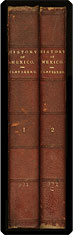
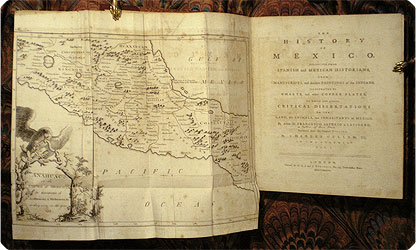 Click the interior images for enlargements.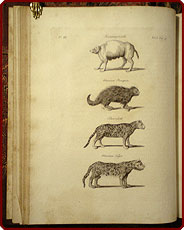
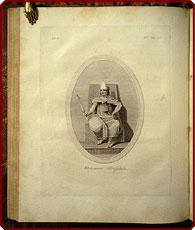
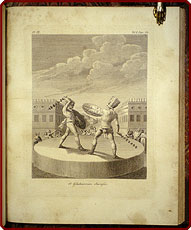
The two oversized, folding maps were engraved by T. Conder; a genealogical chart in vol. I shows the descent of the Mexican kings from the 13th century, while
 numerous engraved plates depict Mexican artifacts, costumes, activities, flora and fauna, architecture, etc.
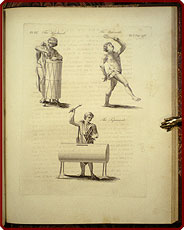
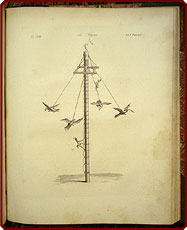
 For more SETS, click here.
The Yucatan Franz Scholes & Robert Chamberlain Colección de documentos inéditos relativos al decumbrimiento, conquista y organización de las antigua posesiones españolas de ultramar. Segunda serie. Tomo num. 13, II Relaciones de Yucatán. Madrid: Impresores de la Real Casa, 1900. 8vo. xvi, 414 pp.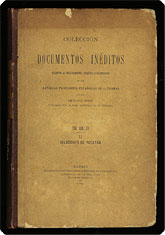
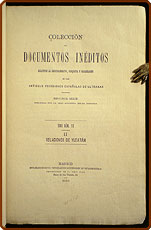
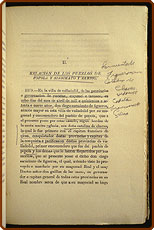 Click the interior images above for enlargements.
  extensively annotated in pencil by Robert Chamberlain and with occasional notes by Franz Scholes!
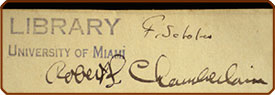
Provenance: First in the University of Miami Library, deacessioned; then in the library of Robert Chamberlain and later in that of Franz V. Scholes, both noted scholars of the Yucatán. Their signatures are on the front free endpaper and their notes are penciled in the margins of many pages.
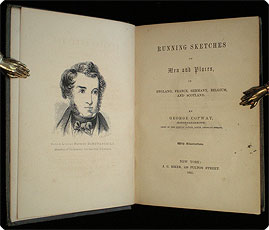
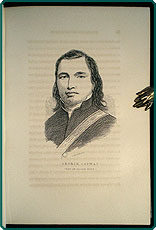
 An American Indian'sEuropean Travel Copway, George (a.k.a. Kah-ge-ga-gah-bowh). Running sketches of men and places, in England, France, Germany, Belgium, and Scotland. New York : J.C. Riker, 1851. 12mo (19 cm; 7.5"). Frontis., 346, [2 (ads)] pp., 4 plts.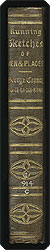
 Click the interior images for enlargements.
 He was a talented speaker and a well-published writer. His autobiography, The life, history, and travels of Kah-ge-ga-gah-bowh (Philadelphia, 1847), went through several editions.
 The present work is one of the first published European travel accounts from the pen of a Native American. He describes what he saw and whom he met (Disraeli, Baron de Rothschild, Lord John Russell, and others), as well as how he was received by the Europeans. The main purpose of the trip was to represent Christian American Indians at the 1850 General Peace Conference at Frankfurt am Main, where in full native attire he delivered a protracted and passionate antiwar speech.
An uncommon work.
Provenance: Bookplate of St. Catherine's Hall Library of the Sisters of the Blessed Sacrament, the American order founded by “Mother” Katharine Drexel. Daughter of one of her time's richest families, Drexel used much of her fortune in efforts on behalf of American Indians.
• Sabin 16721. Not in Pilling, Proof-sheets; not in Field. On Copway, see: Dictionary of Canadian Biography (online). Publisher's charcoal grey cloth elegantly stamped in blind on covers; gilt center device on each cover and gilt tooling and stamping on spine. Bookplate as above on front pastedown; neat white number on spine; no other markings. A very good copy. (25245)
Cortés' Second Letter: The Conquest of Mexico Cortés, Hernando, & Peter Martyr. Praeclara Ferndinandi Cortesii De Nova Maris Oceani Hyspania Narratio. [colophon: Impressa in Nurimberga: per Fridericum Peypus], 1524. Folio (30.3 cm; 11.875" ). [4], 49, 12 leaves.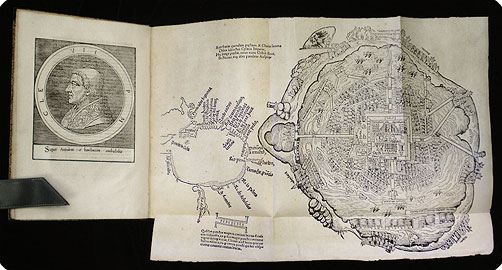 Click the images for enlargements. Cortés was the first conqueror since Julius Caesar to write a description of his conquests.
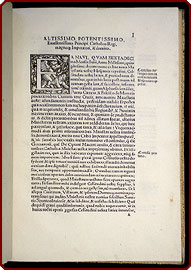
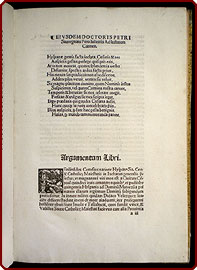
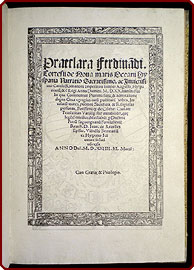 It is here that Cortés provides a definitive name for the country, calling it “New Spain of the Ocean Sea.” This letter is also important for making reference to Cortés's “lost” first letter, supposedly composed at Vera Cruz on 10 July 1520. Whether that letter was actually lost or was suppressed by the Council of the Indies is unknown, though there is little doubt it once existed.
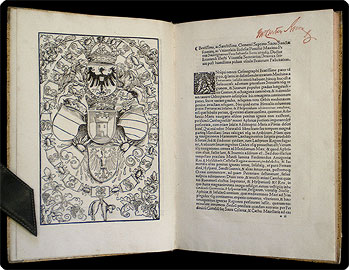
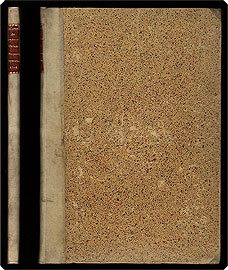 It is the text of this “second” letter, THE FIRST SURVIVING ONE, that was the first major announcement to the world of the discovery of major civilizations in the New World — and, as such, is a work of surpassing importance.
This copy bears the full-page woodcut portrait of Pope Clement VII on the verso of the fourth preliminary leaf, which is not found with all copies. Additionally, the title-page bears an interesting 14-piece composite woodcut border and the verso of that page has a stunning full-page woodcut of the coat of arms of Charles V, the Holy Roman emperor, to whom the letter is addressed. The coat of arms is surrounded by the collar of the Order of the Golden Fleece. The text is printed in roman with side- and shouldernotes; the lay-out is elegant and there is one large, handsome woodcut initial.
As usual, the letter is here bound with Peter Martyr's De Rebus, et insulis noviter repertis, which provides an account of the recently discovered islands of the West Indies and their inhabitants. It is often considered a substitute for the lost Cortés letter.
One of the most important early descriptions of Mexico and of the first encounter of the West with the Aztec civilization, this is a work of bedrock importance to the New World.  No complete copy has appeared for sale since 1985.
• Alden & Landis, European Americana, 524/5; Sabin 16947; Harrisse, BAV, 125. Sanz 933–34; Medina, BHA, 70; Church 53; Burden 5; JCB, German Americana, 524/4; Streeter Sale 190. 18th-century half vellum and sprinkled paper over boards, gilt red leather label. Map supplied in expert facsimile; blank leaf H8 lacking. Bookplate of John Carter Brown (Library) on front pastedown, with deaccession stamp. Occasional very minor soiling in the text, else very good — a copy clean and even crisp. (26808)
 Cortes's Stirring Lettersin French Cortés, Hernán. Correspondance de Fernand Cortès avec l'empereur Charles Quint sur la conquête du Mexique. Francfort: J.J. Kesler, 1779. 8vo. xvi, 471 pp.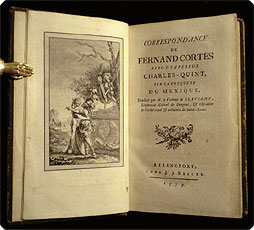
 Click the interior image for an enlargement.
 • Sabin 16953. Contemporary treed calf, front joint (outside) starting at top to open. A good+ copy — in fact, a rather nice one. (20510)
FIRST Edition In English Cortés, Hernán. The despatches of Hernando Cortés,the conqueror of Mexico, addressed to the emperor Charles V, written during the conquest, and containing a narrative of its events. New York: Wiley & Putnam, 1843. 12mo. xii, 431 pp.; ill.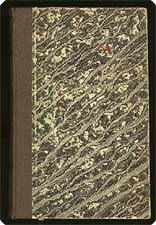
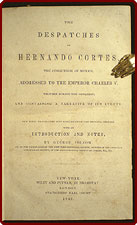
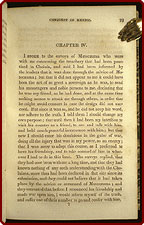
• Sabin 16964. Publisher's quarter cloth over marbled paper boards, lightly abraded; light foxing to interior. Private bookplate. Good+ copy. (20502)
Christianity Abroad, at Home, & among the (Jewish?) Native Americans Crawford, Charles. An essay on the propagation of the Gospel; in which there are numerous facts and arguments adduced to prove that many of the Indians in America are descended from the Ten Tribes ... the second edition. Philadelphia: James Humphreys, 1801. 12mo (18.3 cm, 7.2"). [1] f., 154 pp., [1] f. [with] Woodward, William Wallace. Increase of piety, or revival of religion in the United States of America; containing several interesting letters not before published. Together with three remarkable dreams, in succession, as related by a female in the Northern Liberties of Philadelphia to several Christian friends, and handed to the press by a respectable minister of the gospel. Philadelphia: W.W. Woodward, 1802. 12mo. [1] f., 114 pp.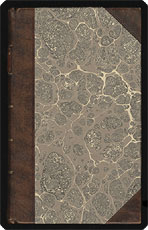
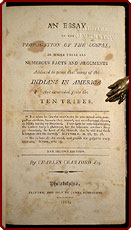
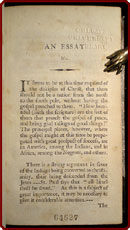 Click the interior images for enlargements.
 The second item here is the first edition of Woodward's collection of revival-themed letters to and from various clergymen, closing with an account of Mrs. Rebecca Ashburn's mysterious dreams. In these dreams a minister unknown to Mrs. Ashburn attempted to save her soul; she later identified her would-be converter as one Dr. William Rogers. This work is very uncommon in print form. OCLC and NUC Pre-1956 find only five U.S. institutional holdings of this Philadelphia printing, although it is widely held in microform.
• Essay: Sabin 17433; Shaw & Shoemaker 370; Rosenbach, American Jewish Bibliography, 123; Singerman, Judaica Americana, 0136. Increase: Shaw & Shoemaker 2587; Sabin 105172. Period-style half mottled calf and marbled paper–covered sides, spine preserving original gilt-stamped leather title-label. Title-page and first text page institutionally pressure-stamped. Pages lightly age-toned, somewhat more so in second work; one leaf with tear from outer margin extending into text. (25209)

Full Set of Her Works, IncludingVillancicos in Nahuatl & an African Language Cruz, Juana Inés de la, Sister. Poemas de la unica poetisa americana, musa dezima, Soror Juana Ines de la Cruz ... Tercera edicion, corregida, y añadida por su authora. [with others, as below]. Barcelona: por Joeph Llopis, 1691. 4to (21 cm; 8.25"). [8] ff., 426 pp., [5] ff. [with the same author's] Segundo tomo de las obras de Soror Juana Ines de la Cruz. Madrid: Impr. de Angel Pasqual Rubio, 1725. 4to (20 cm; 8"). [4] ff., 438 pp., [3] ff. [with the same author's] Fama, y obras posthumas del fenix de Mexico, dezima musa, poetisa americana. Madrid: Impr. de Angel Pasqual Rubio, 1725. 4to (20 cm; 8"). [10] ff., 352 pp., [2] ff.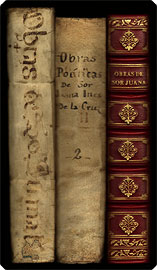
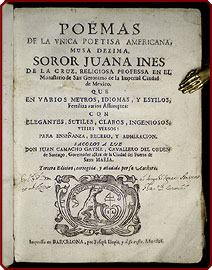
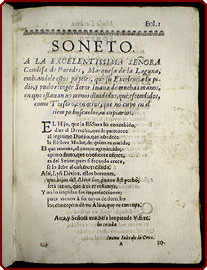
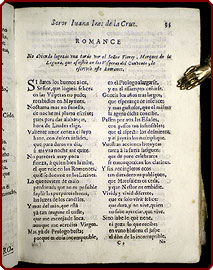 Click the images for enlargements.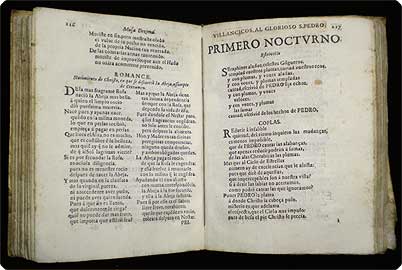
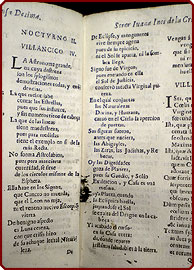 For a sense of her range of subjects, click to enlarge our images. She invented a decasyllabic meter and cultivated dramatic poetry: Among her works are sonnets, redondillas, décimas, villancicos, and plays, as well as prose works, including the famous Carta athenagorica in which she criticizes the great Luso-Brazilian preacher and defender of the Brazilian Indians, Antônio Vieira. The contents here are mostly Spanish-language, but some portions are in Latin — and a few, as is seldom recognized, are in the black language of “Guinea” (e.g., Villancico VIII of the “Villancicos que se cantaron en la Sta. Iglesia Metropolitana de Mexico en honor de Maria Santissima Madre de Dios . . . y se imprimieron año de 1679") or in Nahuatl (e.g., Villancico V of the “Villancicos que se cantaron en la Santa Iglesia Metropolitana de Mexico, en honor de Maria Santissima Madre de Dios . . . año de 1687, en que se imprimieron”).
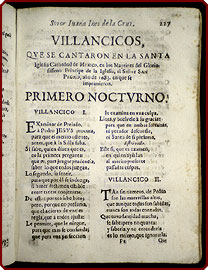
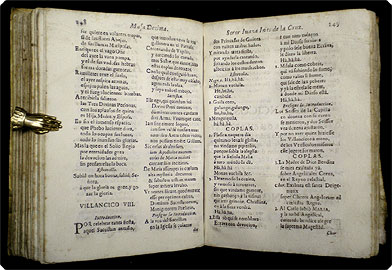
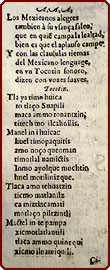
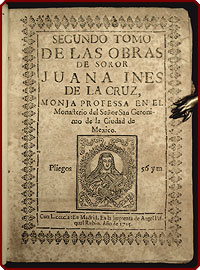
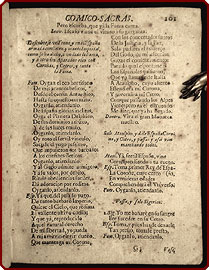
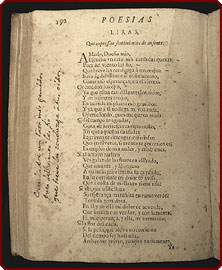
 In the offering here, vol. I was printed during the great poet's lifetime, and is one of the last to hold that distinction.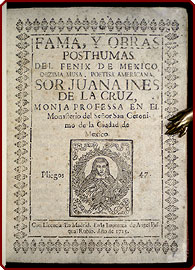
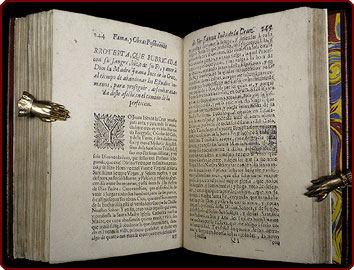
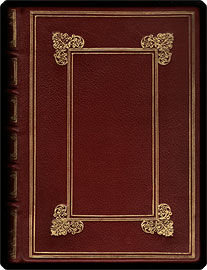 With slight faults only, this is a handsome set of this major writer's works. (26753)
By
Fr. “Double
Leaf/Fixed
Star”Cuoq, Jean-André. Études philologiques sur quelques langues
sauvages de l’Amérique. Par N.O. Montréal: Dawson Brothers, 1866. 8vo (24.5 cm, 9.6"). 160 pp.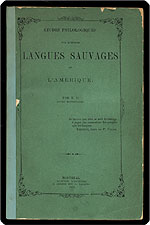
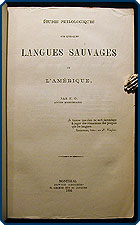
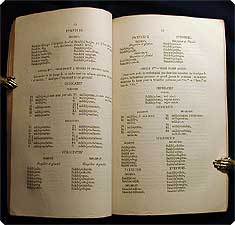 Click the middle or right image for an enlargement.
 Father Cuoq (1821–98) was an extremely accomplished linguist as evidenced by his becoming fluent in both Algonquin and Iroquois; Field (Indian Bibliography, p. 93) writes glowingly of his mastery of these languages. His life as a missionary of the Order of Sulpitians, notably among the Nipissing at Lake of Two Mountains, certainly aided in his scholarly achievement.
• Pilling, Algonquian, 100-101; Pilling, Proof-sheets, 952; Field 391; Newberry Library, Indian Linguistics in the Edward E. Ayer Collection, Algonkin-14; Sabin 17980. Not in Banks; not in Evans, Masinanhikan. Original printed green wrappers, spine reinforced some time ago, edges chipped. Half-title with pencilled annotations. First text page rubber-stamped by a now-defunct institution; pages otherwise clean.

 TO Part
IV
TO Part
IV |